
Quick Answer
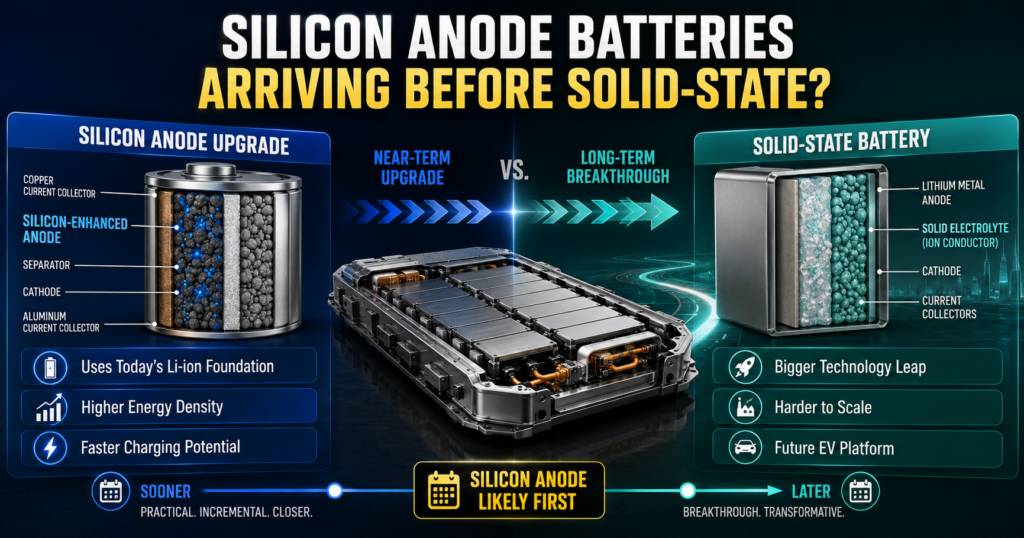
A silicon anode battery may reach mainstream EVs before solid-state batteries because it improves today’s lithium-ion platform instead of replacing the entire battery architecture. Instead of replacing the liquid electrolyte with a solid material, a silicon anode battery mainly changes the anode side of the cell, usually by adding silicon to graphite or carbon-based materials.
That matters because automakers and battery suppliers can potentially use parts of existing lithium-ion manufacturing infrastructure while improving energy density, charging performance, and cold-weather capability. Solid-state batteries still promise bigger long-term gains, but they face harder manufacturing, interface, pressure-control, cost, and scale-up challenges. In simple terms, silicon anode batteries may be the next practical step. Solid-state batteries may still be the bigger long-term leap.
Introduction: The Battery Breakthrough That May Arrive First
For years, solid-state batteries have been described as the future of electric vehicles. They sound almost perfect on paper: higher energy density, better safety, faster charging, and possibly longer range. Toyota, BMW, Mercedes-Benz, QuantumScape, Factorial, and other companies are all working on solid-state technology, and recent road-testing announcements show that the technology is moving beyond the lab. Mercedes-Benz, for example, began road tests of an EQS equipped with a lithium-metal solid-state battery in 2025, while BMW has been testing all-solid-state battery cells in a BMW i7 test vehicle.
But there is another battery technology that may reach real EV buyers sooner: silicon anode batteries. Silicon anode batteries do not sound as futuristic as solid-state batteries. They usually do not require a completely new battery architecture. They do not always replace the electrolyte. They do not necessarily turn an EV into a 700-mile miracle machine overnight.
And that is exactly why they matter. A silicon anode battery is closer to the lithium-ion batteries already being manufactured today. Instead of replacing the entire cell design, it improves one of the most important parts of the battery: the anode, where lithium is stored during charging. Most current lithium-ion EV batteries use graphite-based anodes. Silicon can store far more lithium than graphite in theory, which is why battery companies are trying to blend it into anodes or use silicon-dominant materials. The challenge is that silicon expands dramatically during charging, so the breakthrough is not simply “add silicon and get more range.” The real breakthrough is making silicon work reliably inside an automotive cell.
That is why this topic is so important in 2026. The EV industry does not only need spectacular lab breakthroughs. It needs technologies that can be manufactured, validated, warranted, and scaled. Silicon anode batteries may fit that path better than solid-state batteries in the near term.
Why a Silicon Anode Battery Could Arrive Before Solid-State
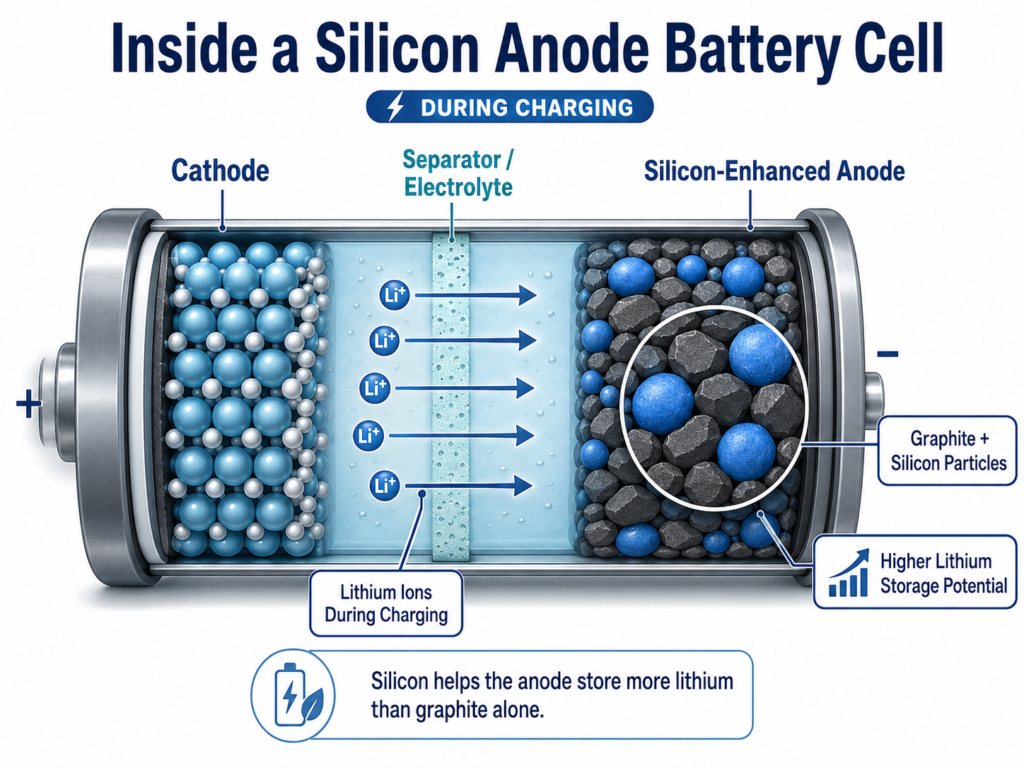
A lithium-ion battery has two main electrodes: the cathode and the anode. During discharge, lithium ions move from the anode to the cathode through the electrolyte. During charging, they move back into the anode.
In most EV batteries today, the anode is mostly graphite. Graphite has been successful because it is stable, relatively affordable, and well understood. It can survive many charge-discharge cycles when properly managed. But graphite is also approaching its practical energy-storage limit.
Silicon is attractive because it can host much more lithium than graphite. That gives battery engineers a tempting opportunity: increase the amount of energy stored in the same cell volume, or reduce battery size while keeping similar range.
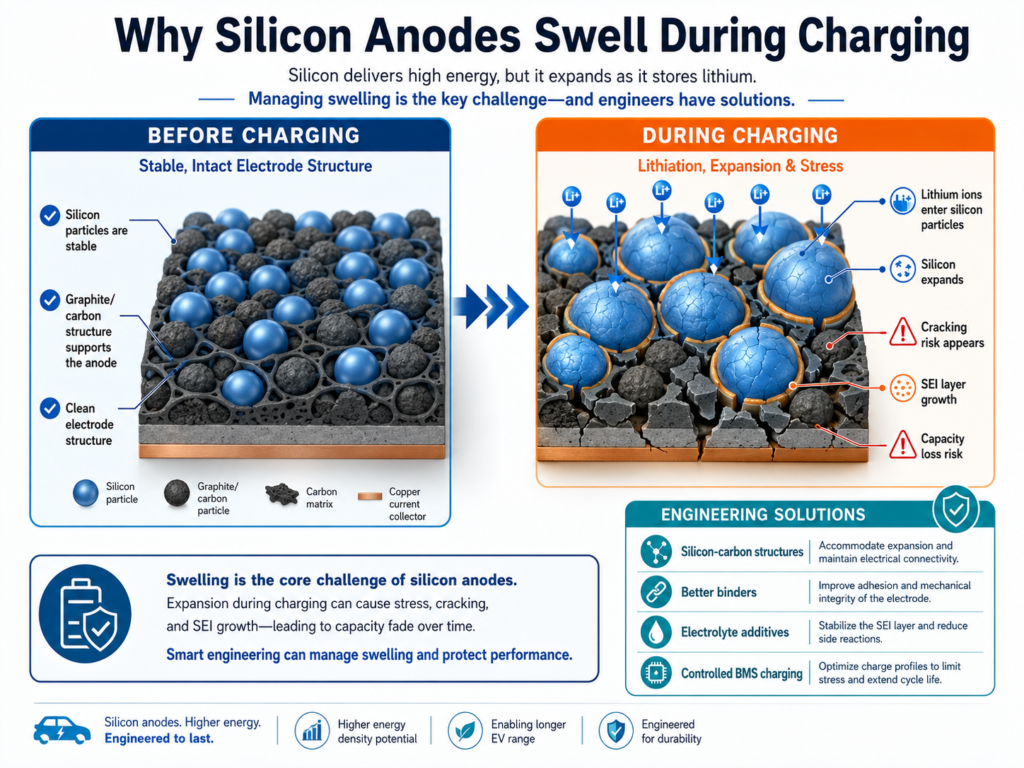
However, silicon comes with a serious problem. It expands and contracts as lithium enters and leaves the material. This repeated swelling can crack particles, damage the electrode structure, create fresh surface area for side reactions, and consume lithium through repeated solid-electrolyte interphase formation. Research literature continues to identify silicon volume expansion and electrode degradation as central barriers to long-life silicon anodes.
That is why most near-term silicon anode batteries are not pure silicon batteries. They are often silicon-graphite, silicon-carbon, silicon oxide, or silicon-dominant designs. The exact chemistry varies by company, but the goal is similar: capture some of silicon’s energy-density benefit while controlling swelling, cycle life, first-cycle lithium loss, and manufacturability.
For a deeper beginner-friendly explanation of the basic concept, see our earlier article: Silicon-Anode Batteries: 2026 EV Range Upgrade?.
Why Silicon Anodes Could Beat Solid-State Batteries to Market
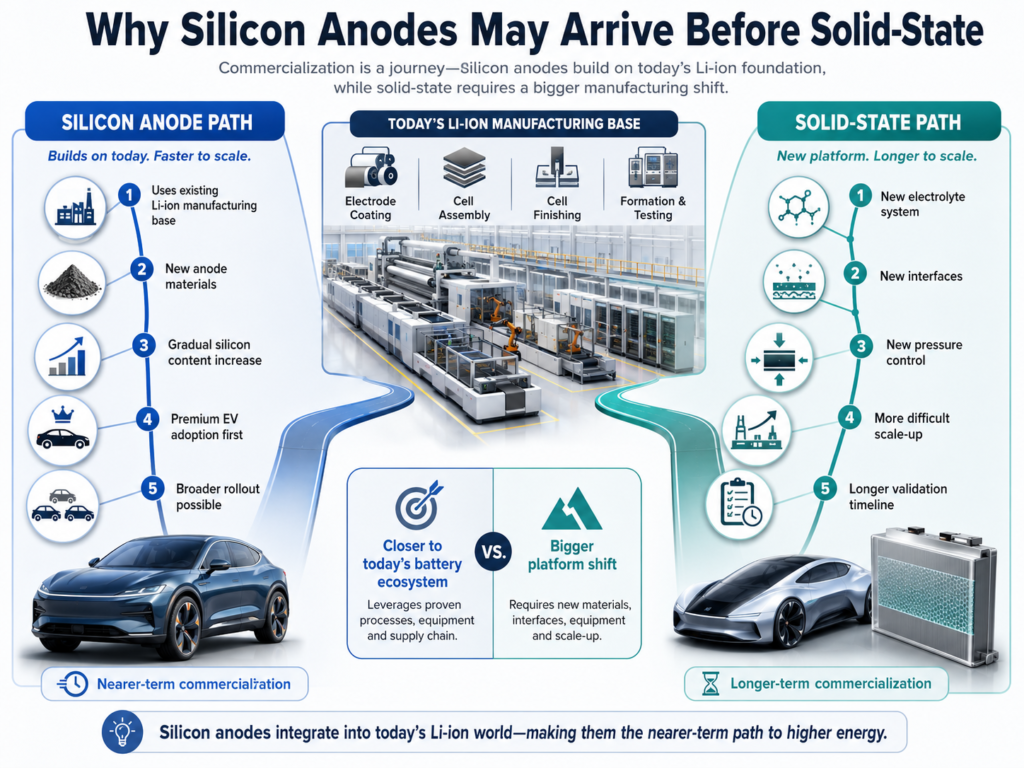
The biggest reason silicon anodes may arrive first is simple: they do not require the EV industry to throw away everything it already built. Today’s battery industry has spent enormous capital on lithium-ion manufacturing plants, supply chains, electrode coating lines, formation equipment, electrolyte filling systems, quality-control processes, pack designs, and BMS software. Solid-state batteries may eventually require different materials, different interfaces, different pressure-control strategies, different manufacturing steps, and different validation methods.
Silicon anodes are not easy, but they fit more naturally into the current lithium-ion world. That does not mean every existing factory can simply switch overnight. High-silicon anodes still require new material handling, electrode formulation, binder systems, electrolyte additives, formation recipes, swelling control, and cell validation. But compared with full solid-state battery commercialization, silicon anode adoption looks more like a difficult upgrade than a complete industrial reset.
This is the practical reason automakers are paying attention. A recent InsideEVs report described General Motors as viewing silicon anodes as a nearer-term battery improvement than solid-state technology, partly because silicon anodes can improve lithium-ion batteries without waiting for a full solid-state manufacturing revolution. GM has also shown interest in silicon anode technology through its battery supply-chain activity, including earlier references to OneD Battery Sciences and silicon anode technology in GM investor materials.
The same pattern appears across the industry. Sila has opened an automotive-scale silicon anode plant in Moses Lake, Washington, and has announced Mercedes-Benz as a customer for its Titan Silicon material (Sila). Group14 says it is scaling silicon battery materials production, including EV-scale production capacity in South Korea. These are not just lab papers. They are supply-chain moves.
That is the key difference. Solid-state batteries are entering road tests and customer sample programs, but silicon anode materials are already moving into manufacturing scale-up discussions that fit more closely with today’s battery ecosystem.
Silicon Anode vs Solid-State: Not the Same Kind of Breakthrough
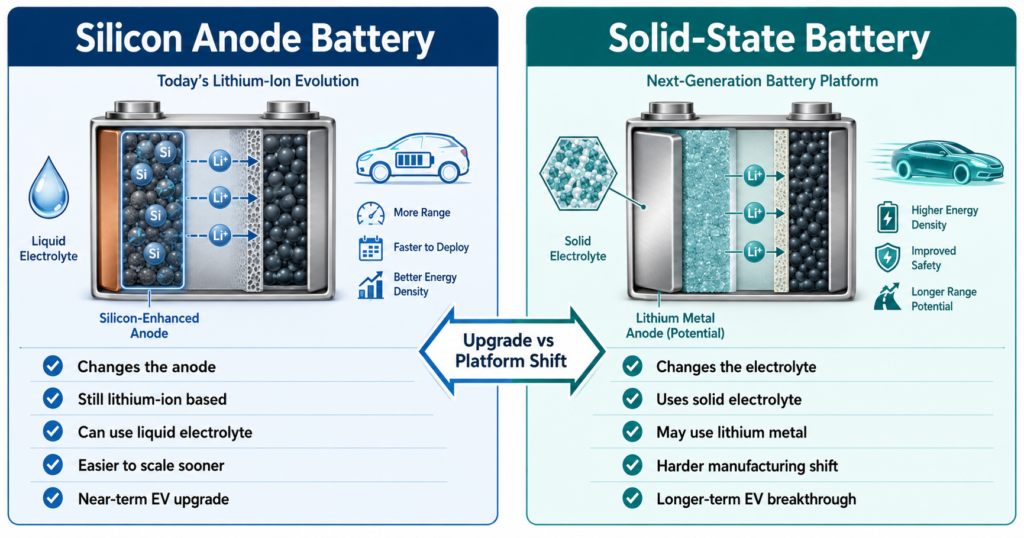
A common misunderstanding is that silicon anode batteries and solid-state batteries are competing versions of the same idea. They are not. A silicon anode battery changes the anode material. A solid-state battery changes the electrolyte system, usually replacing the liquid electrolyte with a solid electrolyte. Many solid-state battery designs also aim to use lithium metal anodes, which could offer very high energy density if the interface and dendrite challenges are solved.
So the comparison is not “silicon or solid-state forever.” It is more like this: Silicon anode batteries improve today’s lithium-ion platform. Solid-state batteries try to create a next-generation platform. That is why their commercialization paths are different. Silicon anodes can be introduced gradually. An automaker might begin with a modest silicon content, then increase the silicon loading as suppliers improve swelling control, cycle life, and cost. This allows the technology to enter premium models first, then spread as confidence improves.
Solid-state batteries are harder to introduce gradually because the electrolyte, interface behavior, manufacturing process, and mechanical requirements change more deeply. Solid electrolytes do not flow into microscopic gaps the way liquid electrolytes do. Maintaining intimate contact between layers becomes a major engineering issue, especially when electrodes expand, contract, heat up, cool down, and vibrate inside a vehicle.
That is why solid-state road tests are exciting but should not be confused with mass-market readiness. Toyota and Idemitsu have described plans to begin producing solid-state batteries for BEVs around 2027–2028 and then build toward mass production. Idemitsu also announced a solid electrolyte facility tied to Toyota’s all-solid-state BEV plans. Those are meaningful steps, but they still point to a staged rollout rather than immediate mass adoption.
For readers who want a deeper background on the solid-state side, see our related guide: Solid-State Batteries: Hype vs Reality in 2026.
Why Automakers Care About Silicon Anodes
The EV market is entering a more practical phase. Early adopters may have accepted high prices, slower charging, and limited model choices. Mainstream buyers are less forgiving. They want more range, faster charging, better cold-weather performance, lower cost, and longer battery life.
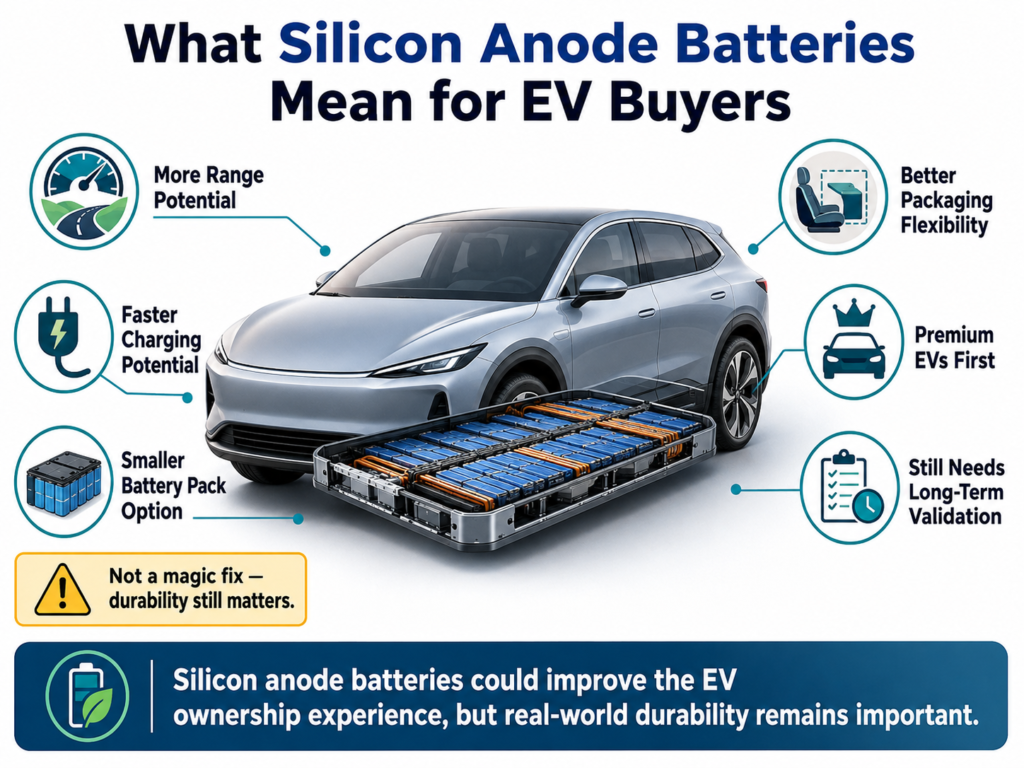
Silicon anodes can help with several of those goals, although not all at once and not without tradeoffs. The most obvious benefit is energy density. If a cell stores more energy in the anode, the vehicle may be able to drive farther without making the pack larger. That is valuable because battery packs are heavy and expensive. A higher-energy cell can also allow an automaker to use a smaller pack for the same range, which may reduce vehicle weight and improve efficiency.
The second benefit is charging performance. In theory, a better-designed silicon-containing anode can improve lithium storage behavior and support higher charge rates. But this is not automatic. Fast charging still depends on temperature, electrode design, electrolyte chemistry, lithium plating risk, internal resistance, cooling, pack voltage, and BMS limits. A silicon anode does not magically make every EV charge in five minutes.
The third benefit is packaging. If energy density improves, designers may gain flexibility. A future EV could keep the same range with fewer cells, create more cabin space, reduce pack height, or offset the weight of larger trucks and SUVs.
The fourth benefit is cold-weather performance, although this needs careful wording. Silicon anodes may help certain charging and energy-density targets, but cold weather is still one of the most difficult environments for lithium-ion batteries. Lithium-ion movement slows down when the cell is cold, internal resistance rises, and lithium plating risk increases during aggressive charging. That is why preconditioning and BMS control remain essential. For more detail, see our article on EV battery preconditioning and winter fast charging. In short, silicon anodes are not a magic fix. They are a high-value engineering lever.
The Manufacturing Advantage: Evolution Beats Revolution
The EV battery industry is not just a chemistry contest. It is a manufacturing contest. A battery chemistry that works in a lab is interesting. A battery chemistry that can be made by the millions, with high yield, predictable aging, safe behavior, affordable materials, and reliable warranty performance, is far more valuable.
This is where silicon anodes have an advantage over solid-state batteries. A conventional lithium-ion gigafactory already has a production flow built around mixing, coating, drying, calendering, slitting, cell assembly, electrolyte filling, formation, aging, and grading. Our article on EV battery gigafactories explains why each of these steps matters for cell quality and cost.
Silicon anode materials can potentially enter parts of this flow. They may require new recipes, new quality checks, different formation steps, and stronger swelling-management strategies, but they do not necessarily require an entirely new battery factory concept.
Solid-state batteries are more disruptive. Depending on the design, manufacturers may need new solid electrolyte processing, dry-room changes, high-pressure stacking, different interface-control methods, and new validation systems. The cell may also behave differently during formation, cycling, storage, abuse testing, and crash events.
This does not make solid-state batteries bad. It makes them harder to scale. Battery history shows that technologies often win not because they are the most impressive in theory, but because they can be manufactured consistently. LFP is a good example. It does not offer the highest energy density, yet it has become extremely important because it is durable, cost-effective, and scalable. Silicon anodes may follow a similar practical logic: not perfect, but manufacturable enough to matter.
The Biggest Technical Problem: Silicon Swelling
If silicon is so promising, why has it not already replaced graphite everywhere? The answer is swelling. When silicon stores lithium, its volume can change dramatically. This repeated expansion and contraction can damage the electrode over time. In a phone battery, some swelling might be managed within a smaller format and shorter expected product life. In an EV, the battery must survive years of vibration, temperature swings, fast charging, high power demand, and warranty expectations.
Automotive batteries are unforgiving. Swelling can affect the cell in several ways. It can increase mechanical stress inside the electrode. It can break electrical pathways. It can expose fresh silicon surfaces that react with electrolyte. It can consume active lithium. It can change stack pressure in pouch or prismatic cells. It can also complicate pack design because cells need enough mechanical support without being over-compressed.
This is why silicon anode development is as much a mechanical engineering problem as a chemistry problem. Companies are not just asking, “How much lithium can silicon store?” They are asking, “Can this electrode survive thousands of cycles inside a real vehicle?”
That is also why silicon content will likely rise gradually. The first mainstream EV silicon anode designs may use silicon-enhanced graphite rather than pure silicon. Higher silicon loading may come later as materials improve.
For a related discussion of cell swelling and pack-level mechanical management, see Why EV Batteries Swell in 2026.
Fast Charging: Where Silicon Could Help, But BMS Still Rules
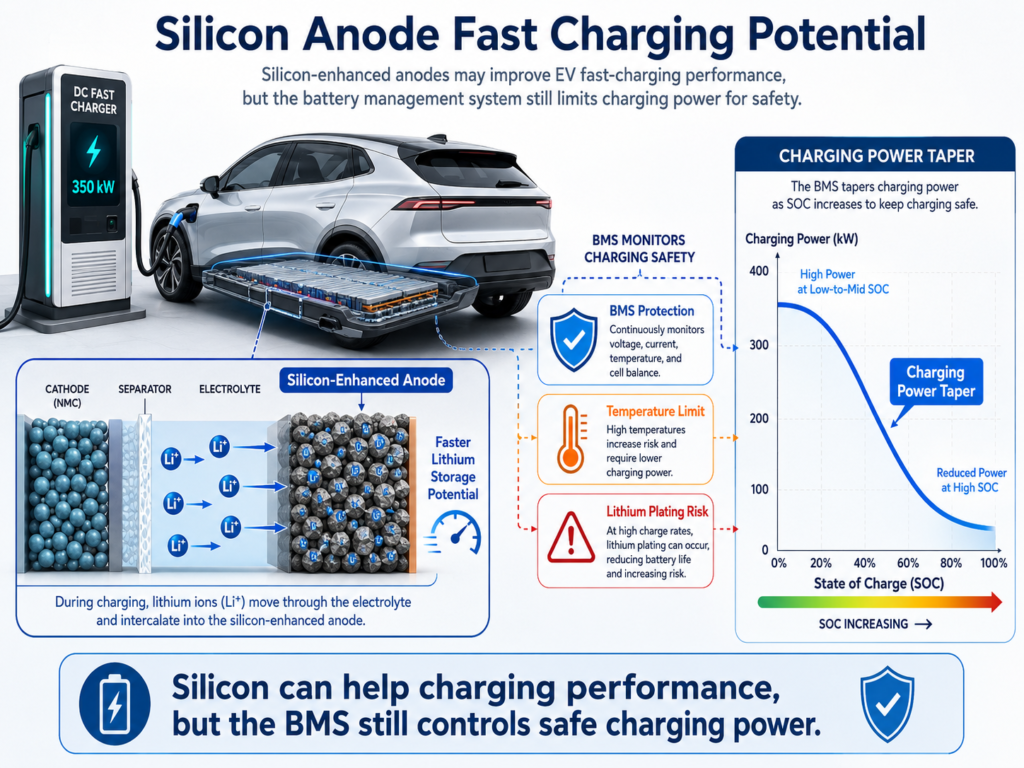
One reason silicon anode batteries attract attention is fast charging. If a future EV can add range more quickly without accelerating degradation, that would remove one of the biggest barriers for mainstream buyers. Silicon may help because it changes how the anode stores lithium. But fast charging is not limited by one material property. During DC fast charging, lithium ions must move through the electrolyte, cross interfaces, enter the anode structure, and do so without causing excessive heat or lithium plating.
Lithium plating is especially important. It occurs when lithium deposits as metallic lithium on the anode surface instead of properly entering the anode material. This risk increases when the battery is cold, the current is high, or the state of charge is already high. That is why many EVs charge quickly at low-to-mid state of charge, then taper charging power as the pack fills. For a deeper explanation, see Lithium Plating Explained: Why Fast Charging Can Damage EV Batteries.
Even with silicon anodes, the BMS will still decide how much power the pack can safely accept. The BMS looks at cell temperature, voltage, current, SOC, cell imbalance, estimated battery health, and safety margins. A silicon anode may give the BMS a better cell to work with, but it does not remove the need for careful control.
This is one reason EV buyers should be cautious about simple claims like “silicon batteries will charge in 10 minutes.” Some may. Many will not. The real question is whether they can charge faster, more often, and with less long-term degradation under real driving conditions.
Why Solid-State Is Still Important
It would be a mistake to say silicon anodes make solid-state batteries irrelevant. Solid-state batteries still have enormous potential. If manufacturers can solve interface stability, cycle life, lithium-metal control, production yield, and cost, solid-state batteries could eventually deliver higher energy density and improved safety compared with many conventional lithium-ion designs.
The recent road-testing activity is meaningful. Mercedes-Benz reported an EQS solid-state test vehicle with a claimed 25% longer range potential in its road-test program. BMW has also moved large-format all-solid-state cells into an i7 test vehicle. QuantumScape announced shipment of B1 samples for customer testing in 2025, showing progress toward automotive qualification. These are real milestones.
But solid-state batteries are still moving through the difficult phase between impressive prototype and mass-market product. That gap matters. A prototype can prove that the chemistry works. A production EV battery must prove that it can be manufactured consistently, integrated into a pack, managed by software, cooled or heated properly, crash-tested, serviced, shipped, stored, and warranted. That is why silicon anodes may arrive first. Not because they are more exciting, but because they are closer to the manufacturing reality of today’s EV industry.
What This Means for EV Buyers
For EV buyers, silicon anode batteries may not appear as a dramatic revolution. They may show up quietly. A future EV might advertise longer range from a similar battery size. Another model might keep the same range but reduce weight. A premium SUV might charge faster from 10% to 60%. A performance EV might maintain power better in demanding conditions. A cold-weather EV might recover some charging speed when paired with better preconditioning.
The word “silicon” may not even appear prominently in the marketing. Automakers often focus on range, charging time, battery warranty, and vehicle performance rather than electrode chemistry. Buyers should pay attention to practical results instead of chemistry labels. The best questions are:
- How fast does the EV charge in real conditions?
- How does it perform in winter?
- What is the warranty threshold?
- How does the battery age over time?
- Does the vehicle have strong thermal management and preconditioning?
- Is the battery chemistry proven at automotive scale?
A silicon anode battery can be excellent if it is well engineered. It can also disappoint if the design pushes energy density too aggressively and sacrifices cycle life. As always, the full system matters more than one material.
What to Watch Next
The next stage of silicon anode development will not be defined by one headline. It will be defined by production capacity, automaker supply agreements, cell validation data, and real EV launches. Watch for three things. First, look for automotive-scale material plants moving from announcements to real supply. Sila’s Moses Lake facility and Group14’s production expansion are important because EV battery technology only matters at scale if the material supply exists.
Second, watch which vehicle segments adopt silicon first. Premium EVs, performance vehicles, luxury SUVs, and high-end trucks are likely candidates because they can absorb higher early costs and benefit from range or charging improvements.
Third, watch warranty language. If automakers are confident in silicon-rich cells, they will need to back them with battery warranties comparable to today’s EVs. A high-energy battery that cannot meet durability expectations will not succeed in mainstream vehicles.
The most realistic path is gradual. Silicon content rises. Cell designs improve. BMS algorithms adapt. Thermal systems become more precise. Pack structures become better at handling swelling and pressure. Over time, buyers get better range and charging without needing to understand every material change behind the scenes.
Conclusion: Silicon Anodes May Be the Bridge to the Next EV Era
Solid-state batteries still deserve attention. They may become one of the most important battery technologies of the 2030s. But for the next wave of practical EV improvements, silicon anode batteries may arrive first.
The reason is not hype. It is manufacturing logic. Silicon anodes improve one of the most important parts of today’s lithium-ion battery while keeping more of the existing battery ecosystem intact. They can potentially increase energy density, improve charging performance, support better packaging, and help automakers build longer-range EVs without waiting for a complete solid-state transition.
The tradeoff is that silicon is difficult to manage. Swelling, cycle life, first-cycle lithium loss, electrode cracking, and pack pressure must be controlled carefully. The winners will not be the companies that simply add the most silicon. They will be the companies that balance energy density, durability, safety, cost, and manufacturability.
For EV buyers, the future may arrive less dramatically than expected. The next big battery upgrade may not be a fully solid-state pack. It may be a familiar lithium-ion battery with a much better anode. And that could be enough to change the EV market sooner than many people think.
FAQs
Are silicon anode batteries the same as solid-state batteries?
No. A silicon anode battery usually improves the anode material in a lithium-ion cell. A solid-state battery replaces the liquid electrolyte with a solid electrolyte. Some future solid-state batteries may also use silicon or lithium-metal anodes, but the technologies are not the same.
Why might silicon anode batteries arrive before solid-state batteries?
Silicon anode batteries can build on existing lithium-ion manufacturing infrastructure more easily than solid-state batteries. They still require new materials and validation, but they do not necessarily require a complete redesign of the cell manufacturing system.
Do silicon anode batteries increase EV range?
They can. Silicon can store more lithium than graphite, which may improve energy density. In practice, the range benefit depends on the cell design, silicon content, cathode chemistry, pack design, thermal management, and cost targets.
What is the biggest problem with silicon anode batteries?
The biggest issue is swelling. Silicon expands during charging and contracts during discharge. If not controlled, this can damage the electrode, reduce cycle life, and create mechanical stress inside the cell.
Will silicon anode batteries charge faster?
Possibly, but not automatically. Fast charging depends on temperature, lithium plating risk, internal resistance, BMS limits, pack voltage, cooling, and charger capability. Silicon can help, but it does not eliminate the need for careful battery management.
Will silicon replace graphite completely?
Not immediately. Near-term EV batteries are more likely to use silicon-enhanced graphite, silicon-carbon, or silicon oxide designs. Silicon-dominant or graphite-free anodes may become more common later if cycle life, swelling, and cost challenges are solved.