
Quick Answer
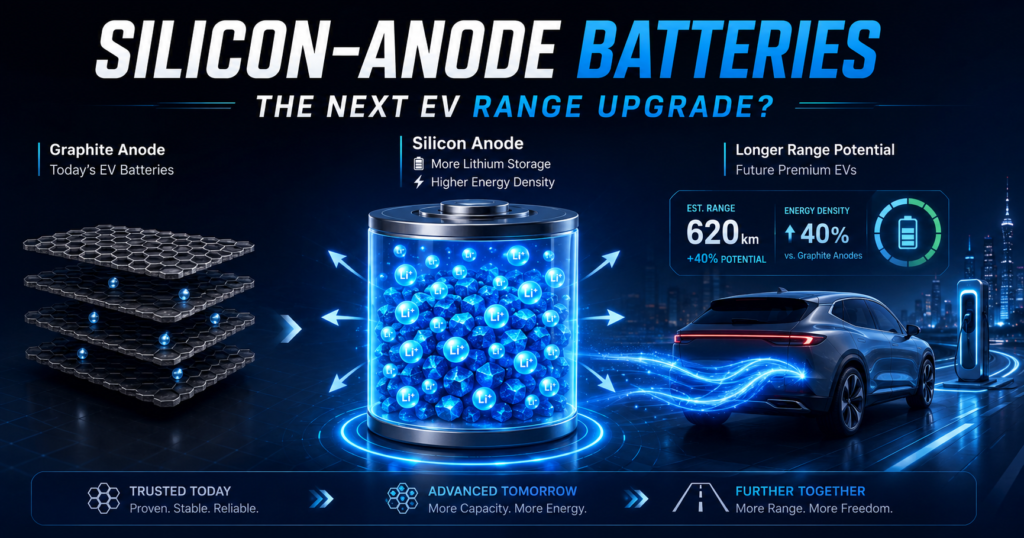
Silicon-anode batteries are one of the most promising near-term upgrades for electric vehicle battery technology. They are an upgraded version of lithium-ion batteries that replace some, or eventually most, of the traditional graphite in the anode with silicon-based material. The reason automakers care is simple: silicon can store far more lithium than graphite, which could mean higher energy density, longer driving range, faster charging, or smaller battery packs.
But there is a catch. Silicon expands significantly during charging, creating swelling, cracking, and cycle-life challenges. That is why most EV batteries today still rely mainly on graphite, with silicon added gradually in controlled amounts. The near-term future is likely not “pure silicon” everywhere, but silicon-enhanced graphite or silicon-carbon anodes in premium EVs first, followed by broader adoption later in the 2026–2030 period.
Introduction: Why Silicon Anodes Are Suddenly Getting So Much Attention
For years, most EV battery conversations have focused on the cathode side of the cell. That is where people usually hear terms like LFP, NMC, NCA, nickel-rich chemistry, cobalt reduction, and thermal stability. But quietly, one of the most important EV battery upgrades is happening on the other side of the cell: the anode.
Today’s lithium-ion EV batteries usually use graphite as the main anode material. Graphite has been reliable, manufacturable, and relatively stable for decades. It does the job well. But it also has a limit. If automakers want more range without simply making battery packs larger and heavier, they need better materials. That is where silicon-anode batteries come in.
Silicon has attracted intense interest because it can theoretically store about ten times more lithium than graphite. Panasonic Energy, for example, says silicon has “in theory 10 times the capacity of graphite,” while also noting that silicon expansion during charging has been a long-standing problem for the industry (Panasonics).
This is why companies such as Mercedes-Benz, Panasonic, Porsche-backed Group14, GM, and several battery startups are working on silicon-based anodes. Mercedes-Benz announced a supply agreement with Sila for high-silicon anode material for future electric G-Class models, while Panasonic signed an agreement to procure Sila’s Titan Silicon material for EV lithium-ion batteries (Mercedes-Benz, Panasonic).
Silicon anodes are not science fiction anymore. They are moving from laboratory promise toward automotive-scale production. But they are also not magic. The same material that allows more lithium storage also creates one of the most difficult mechanical problems in battery engineering: expansion. That tension is what makes silicon-anode batteries so important.
What Are Silicon-Anode Batteries?
A silicon-anode battery is still a lithium-ion battery. Lithium ions still move between the cathode and anode during charging and discharging. The electrolyte still carries ions through the cell. The battery management system still controls temperature, voltage, current, and safety limits. The difference is the anode material.
In a conventional lithium-ion EV battery, the anode is mostly graphite. During charging, lithium ions move into the graphite structure. During driving, those ions leave the anode and move back toward the cathode, releasing electrical energy.
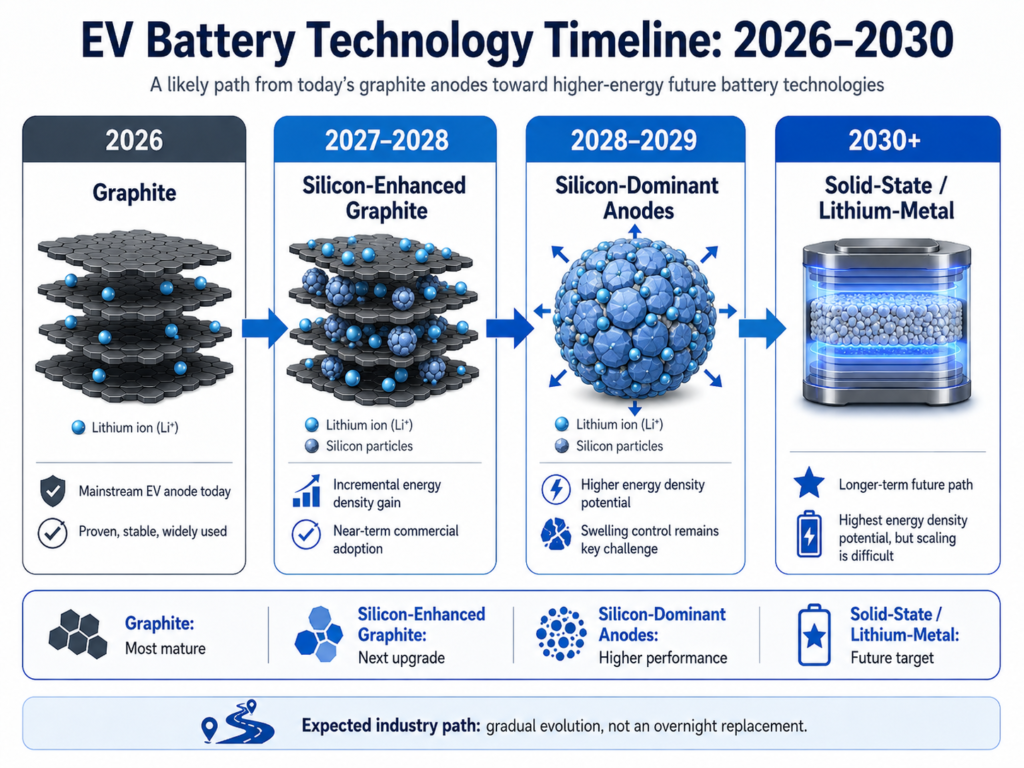
A silicon-anode battery replaces part of that graphite with silicon-based material. In some designs, silicon is added in small percentages to improve energy density. In more aggressive designs, silicon becomes a dominant part of the anode. Some companies describe their materials as silicon-carbon, silicon-dominant, silicon-composite, or high-silicon anode materials. This distinction matters because not all silicon-anode batteries are the same.
A battery with a small silicon additive is very different from a battery that replaces most graphite with silicon. The first approach is easier to commercialize because it keeps much of graphite’s stability. The second approach offers more performance upside, but also creates larger swelling, pressure, and cycle-life challenges. That is why the industry is moving gradually.
Graphite vs Silicon: Why the Anode Matters So Much
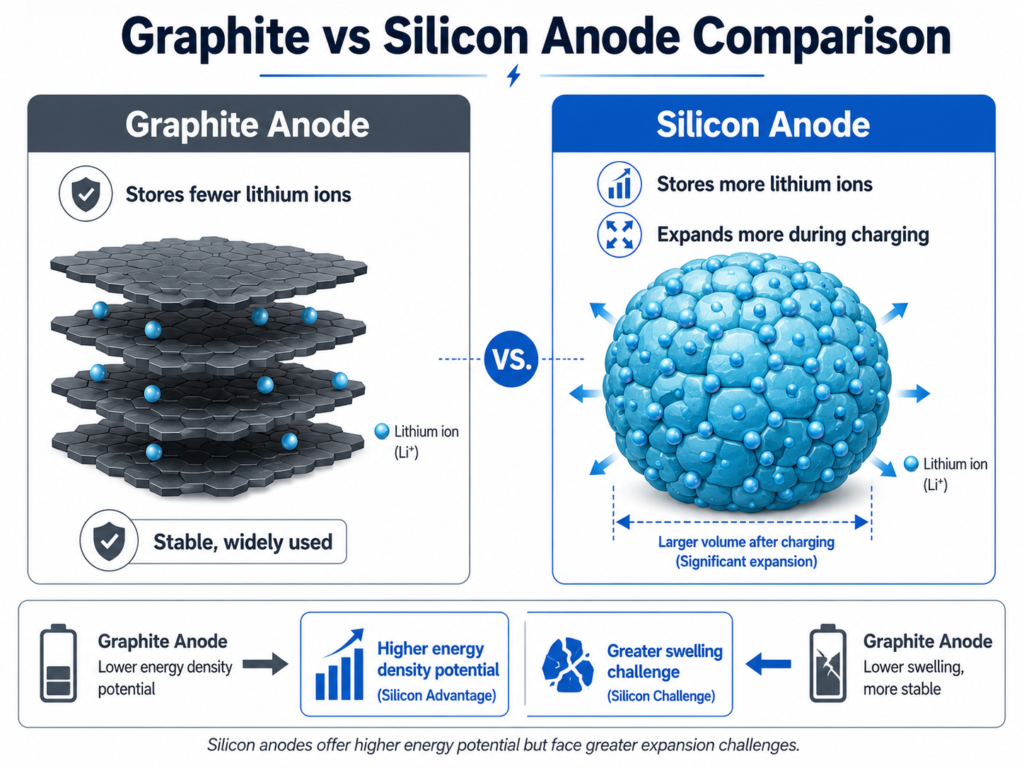
Graphite became the standard anode material because it is stable, relatively inexpensive, and predictable. It does not expand dramatically compared with silicon, and it can survive many charge-discharge cycles when paired with the right electrolyte and battery management strategy.
But graphite is also approaching its practical performance ceiling. Silicon, by contrast, can hold far more lithium. That means more energy can be stored in the same anode volume or weight. In an EV, that could translate into several possible benefits. The vehicle could offer longer range from the same battery pack size. Or the automaker could use a smaller battery pack while keeping the same range. A smaller pack could reduce weight, lower material demand, and improve efficiency.
This is especially important because simply increasing pack size is not always the best answer. A larger battery adds cost, mass, and thermal management complexity. It may improve range, but it can also reduce efficiency and make the vehicle more expensive.
Silicon offers a more elegant path: improve the cell itself. That is why Panasonic is targeting higher energy density using next-generation silicon materials. Panasonic stated that it aims to increase battery energy density from 800 Wh/L to 1,000 Wh/L by 2031 and described silicon incorporation as essential to that roadmap (Panasonic).
This is also why Porsche-backed Group14 is attracting serious industry attention. Reuters reported in 2025 that Group14 raised $463 million to scale silicon-based battery material production, and described its SCC55 silicon-carbon material as a replacement for graphite anodes that can help lithium-ion batteries charge faster and hold more energy (Reuters). For EV buyers, the technical details may sound distant. But the end goal is very practical: more usable range, less charging anxiety, and better packaging.
Why Silicon Can Improve Energy Density
Energy density is one of the most important metrics in EV battery design. Higher energy density means more energy can be stored in a given mass or volume. For EVs, this matters because battery packs are heavy, expensive, and space-limited.
Silicon helps because the anode becomes less of a bottleneck.
In many modern EV batteries, cathode chemistry still plays the biggest role in total energy density. That is why high-nickel NMC and NCA chemistries are commonly used in long-range EVs, while LFP batteries are often used where cost, safety, and cycle life are higher priorities. We discussed that tradeoff in detail in our earlier article, LFP vs NMC Batteries: Which EV Battery Is Better in 2026?
But once cathode improvements become harder and more expensive, the anode becomes a major opportunity. Replacing some graphite with silicon allows more lithium storage on the anode side, which can raise overall cell energy density.
Sila has claimed that its high-silicon anode material can improve energy density by 20% to 40% compared with current lithium-ion cell chemistries, depending on the application and cell design. Green Car Reports covered Mercedes-Benz’s planned use of Sila technology for an electric G-Class application and noted that higher energy density allows more energy storage in the same space.
That does not mean every EV with silicon will suddenly gain 40% more range. Vehicle range depends on many factors: cell chemistry, pack design, aerodynamics, weight, tires, drivetrain efficiency, thermal management, software, and usable battery buffer.
A more realistic expectation is that silicon anodes will first help premium EVs gain incremental but meaningful improvements. A future EV might use silicon anodes to add range without increasing pack size. Another might keep range similar but reduce pack weight. A performance EV might use silicon-enhanced cells to improve charging capability and power delivery. In other words, silicon anodes are not just about range. They are about giving engineers more design flexibility.
The Swelling Problem: Silicon’s Biggest Weakness
Silicon’s biggest advantage is also the source of its biggest problem. When silicon absorbs lithium during charging, it expands significantly. This repeated expansion and contraction can crack particles, damage the electrode structure, break electrical contact, and continuously reform the solid-electrolyte interphase layer, often called the SEI.
This matters because the SEI layer consumes lithium and electrolyte as it forms and reforms. If the surface keeps cracking, the battery keeps losing active lithium and usable capacity. Over time, this leads to faster degradation.
Recent research on silicon/graphite anodes continues to highlight this problem. A 2025 study summarized that lithium-ion batteries with silicon/graphite anodes can achieve higher energy density but face rapid capacity fade, resistance growth, and complex expansion behavior under different cycling conditions.
This is why silicon-anode batteries are not simply a matter of replacing graphite with silicon and calling it done. The whole cell must be engineered around the material.
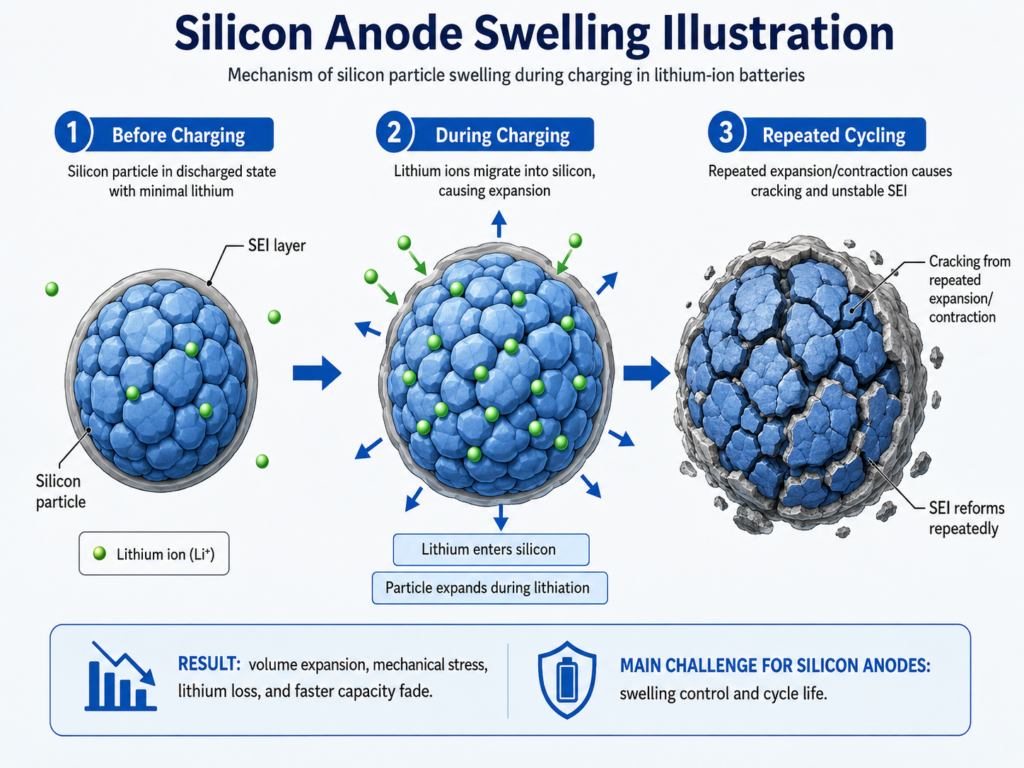
Battery makers use several strategies to control silicon swelling. Some use silicon-carbon composite particles. Some use engineered nano-structures. Others use advanced binders, coatings, electrolyte additives, pressure management, and carefully controlled charging strategies.
BASF and Group14 announced in 2025 that their combination of BASF’s binder and Group14’s SCC55 silicon battery material created a “drop-in-ready” solution for silicon-dominant anodes. Their test cells reportedly exceeded 1,000 cycles with 80% capacity remaining under standard room-temperature conditions, while cells tested at 45°C still achieved more than 500 cycles (BASF).
That kind of result is important because it addresses one of the biggest concerns around silicon: not whether it can store more energy, but whether it can do so reliably over years of real-world EV use.
Cycle Life: Why Long-Term Durability Is the Real Test
For a phone, a high-energy battery with a shorter life might still be acceptable if it delivers a thinner design or longer daily runtime. For an EV, the standard is much tougher.
An EV battery is expected to last for many years, often well beyond 100,000 miles. It must survive hot summers, cold winters, fast charging, long parking periods, vibration, high-power acceleration, regenerative braking, and thousands of partial cycles. That is why cycle life is one of the most important questions for silicon-anode batteries.
A silicon-rich cell that looks impressive in a lab test is not automatically ready for mass-market EVs. Automakers need to know how it behaves under real driving conditions. Does it swell too much over time? Does internal resistance increase? Does fast charging accelerate degradation? Does pressure inside the pouch or cylindrical cell remain manageable? Can the pack cooling system keep temperatures stable? Can the BMS estimate state of charge and state of health accurately as the cell ages? These are not small issues.
Silicon changes the mechanical behavior of the cell. A graphite-heavy cell still expands and contracts, but silicon can intensify that movement. That means pack-level engineering becomes more important. Cell compression, module design, thermal pathways, current limits, and diagnostic algorithms may all need to adapt.
This is also where silicon-anode batteries connect to topics we have already covered, such as Why EV Batteries Charge Slower Above 80% and EV Battery Preconditioning Explained. High charging speed is not just about the charger. It depends on the anode’s ability to accept lithium safely without excessive heat, plating, swelling, or long-term damage. Modern EVs already reduce charging power at high states of charge to protect battery health, especially when heat and voltage stress increase.
Silicon may help future batteries charge faster, but only if the cell design and BMS can manage the added stress.
Are Silicon-Anode Batteries Already in EVs?
The answer depends on how strictly we define “silicon-anode.” Small amounts of silicon have already appeared in some lithium-ion battery designs for years. Many battery makers do not publicly disclose exact anode recipes, so it is difficult to know the precise silicon content in every commercial EV cell.
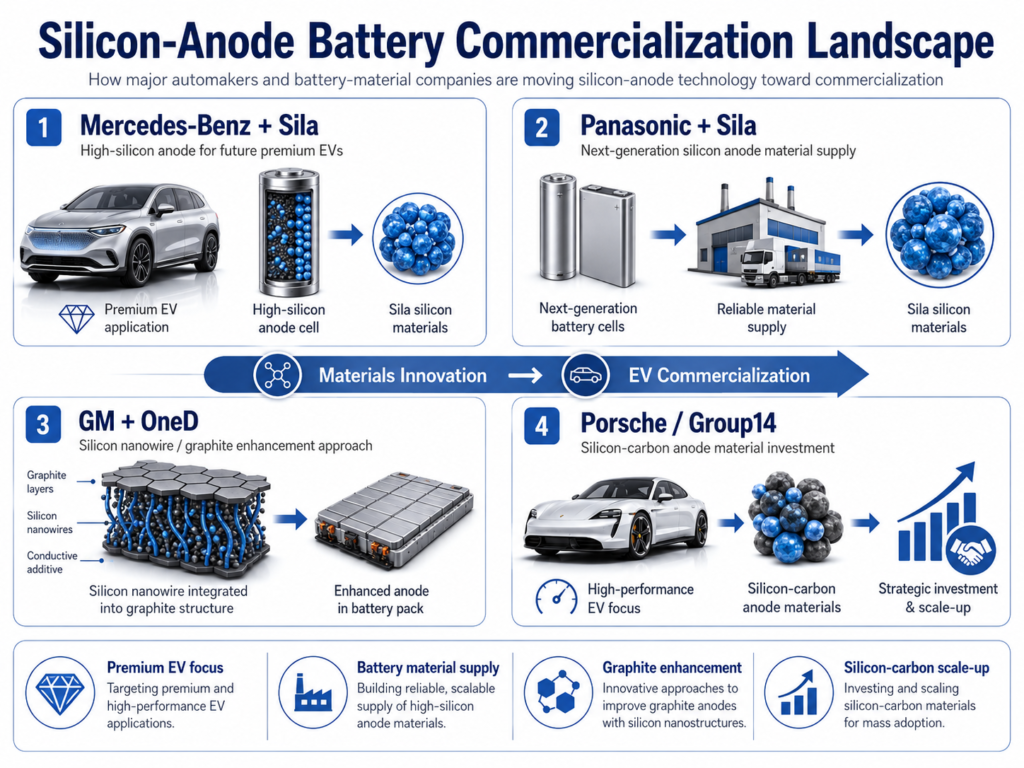
What is changing now is the move toward higher-silicon and silicon-dominant anodes. Mercedes-Benz and Sila have been one of the most visible examples. Mercedes-Benz announced a partnership with Sila for high-silicon anode materials targeted at future electric G-Class vehicles, with the goal of increasing energy density without compromising safety or other performance parameters (Mercedes-Benz).
Panasonic Energy’s agreement with Sila is another important signal because Panasonic is one of the most important EV battery suppliers in the industry. Panasonic said it plans to procure Sila’s next-generation nano-composite silicon anode material for EV lithium-ion batteries, aiming to improve energy density, range, and charging time (Panasonic).
GM has also explored silicon-anode technology. In 2022, GM announced a collaboration with OneD Battery Sciences focused on OneD’s SINANODE platform, which adds silicon nanowires into EV-grade graphite. GM said increasing energy density could enable smaller, lighter, more efficient battery packs with higher driving range at lower cost (GM News).
Porsche’s connection comes through Group14. Porsche announced an investment in Group14 in 2022, and Reuters later reported that Group14 raised a new $463 million financing round in 2025 as it scaled silicon battery material production (Porsche Newsroom).
So yes, silicon-anode technology is already entering the EV supply chain. But mass-market deployment is still gradual.
Why Premium EVs Will Likely Get Silicon First
New battery technologies usually do not start in the cheapest vehicles. They start where the performance benefit justifies the added cost and engineering risk. That is why silicon-anode batteries are likely to appear first in premium EVs, performance EVs, long-range models, and specialty vehicles where every mile of range matters.
Premium EV buyers are more likely to pay for longer range, faster charging, better acceleration, or reduced weight. Automakers also have more flexibility to absorb the cost of advanced materials in higher-margin vehicles.
This pattern is common in EV technology. Heat pumps, 800V architectures, silicon carbide inverters, advanced thermal systems, and high-nickel chemistries often appeared first in more expensive vehicles before spreading to broader segments. Silicon anodes could follow the same path.
By the late 2020s, the technology may move from premium models into more mainstream vehicles if production scales, costs fall, and long-term reliability is proven. That does not mean every affordable EV will use high-silicon anodes. LFP batteries will likely remain very important because they offer low cost, long cycle life, and good safety characteristics. But silicon-enhanced anodes could become a major upgrade for vehicles where range, charging speed, and packaging efficiency matter most.
Silicon Anodes vs Solid-State Batteries
Silicon-anode batteries are often discussed alongside solid-state batteries, but they are not the same thing. A silicon-anode battery improves the anode material while still usually using a liquid electrolyte. A solid-state battery changes the electrolyte, replacing liquid electrolyte with a solid material. Many future solid-state designs may also use lithium-metal anodes, which could offer even higher energy density than silicon-enhanced graphite.
But solid-state batteries remain difficult to manufacture at automotive scale. Interface stability, pressure control, dendrite formation, and dry-room manufacturing challenges are still major barriers. As discussed in our earlier article Solid-State Batteries Explained: Hype vs Reality in 2026, fully commercial solid-state EV batteries are still not widely available in 2026.
Silicon anodes may arrive sooner because they can improve today’s lithium-ion architecture rather than requiring a completely new battery manufacturing ecosystem. That is a big advantage.
In the real world, the next decade may not be a simple battle between “old lithium-ion” and “solid-state.” Instead, we may see a layered evolution: better cathodes, silicon-rich anodes, improved electrolytes, stronger binders, smarter BMS algorithms, better thermal management, and eventually semi-solid or solid-state designs. Silicon is part of that bridge.
What Silicon-Anode Batteries Could Mean for EV Owners
For EV owners, the benefits of silicon-anode batteries will depend on how automakers use the technology. One possibility is longer range. If the battery pack stays the same size but stores more energy, range increases. That is the version most people imagine.
Another possibility is a smaller battery pack. Instead of adding range, an automaker could reduce pack size while keeping range similar. That could lower weight, improve efficiency, and potentially reduce cost if silicon material pricing becomes competitive at scale.
A third possibility is faster charging. Silicon-based anodes may support improved charging performance if the cell is engineered properly. StoreDot, for example, has promoted silicon-dominant extreme-fast-charging cells, and in 2024 said its technology could combine high energy density with extreme-fast-charging capability (StoreDot).
But EV owners should be careful with hype. A silicon-anode battery does not automatically mean five-minute charging in every real-world condition. Charging speed still depends on battery temperature, charger capability, pack voltage, state of charge, BMS limits, thermal design, and long-term durability requirements. The better way to think about silicon is this: it gives battery engineers more room to improve the tradeoff between range, weight, charging speed, and cost.
The 2026–2030 Outlook: Evolution, Not Overnight Revolution
Silicon-anode batteries are one of the most realistic near-term upgrades in EV battery technology. Unlike some future chemistries that require entirely new supply chains or manufacturing processes, silicon can be blended into lithium-ion development pathways already familiar to the industry.
That does not make commercialization easy. Scaling advanced silicon materials requires consistent particle design, stable coatings, reliable binders, electrolyte compatibility, tight quality control, and pack-level validation. The swelling problem must be managed not just in one cell, but across thousands of cells in a vehicle battery pack.
Still, the industry momentum is real. Mercedes-Benz, Panasonic, GM, Porsche-backed Group14, Sila, BASF, StoreDot, and others are all working on different parts of the silicon-anode puzzle. Some are focused on materials. Some are focused on binders and manufacturing. Others are focused on automotive integration.
The most likely path is gradual adoption. First, more silicon-enhanced graphite anodes. Then higher-silicon composite anodes in premium vehicles. Later, if durability and cost targets are met, broader use across long-range and mainstream EVs.
By 2030, silicon may no longer sound like a futuristic battery breakthrough. It may simply become a normal part of advanced lithium-ion EV batteries.
Conclusion: Silicon Is Not a Miracle, But It Is a Big Deal
Silicon-anode batteries matter because they attack one of the biggest limits in today’s EV batteries: how much energy the anode can store. Graphite has been reliable, but it is nearing its practical ceiling. Silicon offers a path to higher energy density, better packaging, and potentially faster charging. That is why so many automakers and battery companies are investing in it.
But the challenge is equally clear. Silicon expands during charging. That expansion can damage the electrode, increase swelling, reduce cycle life, and complicate battery management. The companies that succeed will not be the ones that simply add the most silicon. They will be the ones that balance energy density, swelling control, cycle life, manufacturability, safety, and cost.
For EV buyers, silicon-anode batteries may not arrive as a dramatic “battery revolution” headline. Instead, they may show up as EVs that quietly drive farther, charge better, or use smaller and lighter packs. That kind of progress may sound less exciting than a miracle breakthrough. But in the EV industry, steady engineering improvements are often what change the market the most.
FAQ
Are silicon-anode batteries different from lithium-ion batteries?
Not completely. Most silicon-anode batteries are still lithium-ion batteries. The main difference is that the anode uses silicon-based material instead of relying only on graphite.
Why is silicon better than graphite?
Silicon can theoretically store much more lithium than graphite, which can improve energy density. That can help EVs gain range, reduce battery size, or improve performance.
What is the biggest problem with silicon-anode batteries?
The biggest challenge is expansion. Silicon swells significantly during charging, which can cause cracking, mechanical stress, capacity loss, and shorter cycle life if not properly managed.
Will silicon-anode batteries make EVs charge in five minutes?
Not automatically. Silicon may help improve fast charging, but real-world charging depends on battery temperature, pack voltage, charger power, state of charge, cell design, and BMS limits.
Are silicon-anode batteries commercially available now?
Some silicon-enhanced batteries are already commercial, and higher-silicon materials are moving into automotive supply chains. However, broad mass-market EV adoption is still developing.
Will silicon replace graphite completely?
In some future battery designs, silicon-dominant or graphite-free anodes may become possible. But in the near term, most EV batteries will likely use silicon blended with graphite or carbon-based materials.