
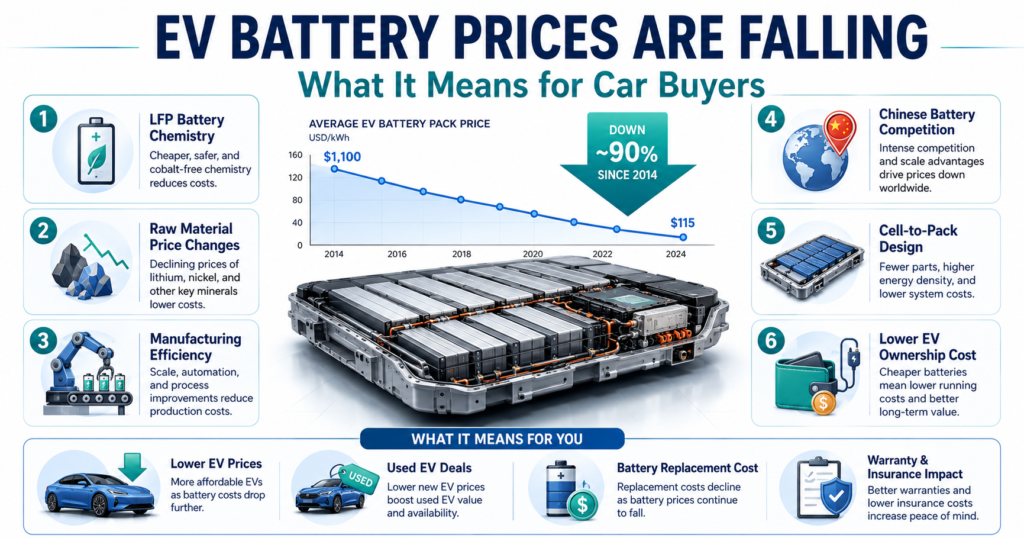
Quick Answer: Why Are EV Battery Prices Falling?
EV battery prices are falling because the battery industry is getting better at almost everything at once. More automakers are using lower-cost LFP batteries. Chinese battery makers have pushed global competition to a new level. Battery factories are improving yield and scale. Raw material prices have cooled from their 2022 highs. And newer pack designs remove unnecessary parts, helping automakers fit more battery into the same space for less money.
According to the IEA’s Global EV Outlook 2026, average battery prices declined by 8% in 2025, helped by manufacturing efficiency, chemistry shifts, technology improvements, intense competition, and relatively low critical mineral prices. BloombergNEF also reported that lithium-ion battery pack prices fell to $108/kWh in 2025, with some battery segments, especially stationary storage, falling even faster.
For car buyers, this does not mean every EV will suddenly become cheap. But it does mean the pressure is moving in the right direction. Lower battery costs can lead to cheaper entry-level EVs, better standard range, lower long-term repair risk, more affordable used EVs, and eventually more realistic battery replacement costs.
Introduction: The Battery Is Still the Price Story Behind EVs
EV battery prices 2026 are moving in a direction car buyers have been waiting for: down. Batteries are still the most expensive part of many electric vehicles, but the cost pressure is finally easing as LFP chemistry, manufacturing scale, raw material shifts, and simpler pack designs reshape the market.
When people ask why electric vehicles are still expensive, the answer almost always comes back to the battery. An EV battery pack is not just one part. It is a large, sealed, temperature-controlled, software-managed energy system. It includes battery cells, modules or cell groups, cooling plates, high-voltage wiring, sensors, safety structures, contactors, electronics, and a battery management system. In many EVs, it is the single most expensive component in the vehicle.
That is why battery prices matter so much. A $5,000 reduction in battery pack cost does not automatically become a $5,000 discount on the window sticker, but it gives automakers more room to work. They can lower prices, increase range, add features, improve margins, or offer stronger incentives.
This is already visible in the U.S. market. Kelley Blue Book data from Cox Automotive showed the average transaction price for a new EV in May 2026 was $54,532, down 4.0% year over year, marking the 11th consecutive month of annual EV price declines. Incentives were still a major part of the story, but the direction is important: EV prices are no longer moving only upward.
The big question for buyers is simple: if EV batteries are getting cheaper, when will that show up in real-world ownership costs? The answer is already beginning to appear, but not evenly.
Why EV Battery Prices Are Still Falling in 2026
Battery prices are not falling because of one single breakthrough. They are falling because several trends are stacking on top of each other. A decade ago, the EV industry was mostly focused on making high-energy nickel-based batteries good enough for long-range vehicles. Today, the industry is more mature. Automakers can choose between LFP, NMC, NCA, LMR under development, sodium-ion for some future low-cost applications, and different pack architectures depending on the vehicle.
That flexibility matters. It means not every EV needs the most expensive chemistry. A commuter car, compact crossover, delivery van, or city-focused EV does not need the same battery strategy as a 400-mile luxury SUV or heavy-duty electric truck.
At the same time, battery production has become a scale game. The companies that make millions of cells per day can spread engineering, factory, tooling, and quality-control costs across far more vehicles. That is one reason battery prices tend to fall as production volume rises.
The IEA’s 2026 battery outlook points to the same combination: manufacturing improvements, chemistry shifts, technology progress, market competition, and mineral-price changes all contributed to the 2025 price decline. Let’s break down the main reasons.
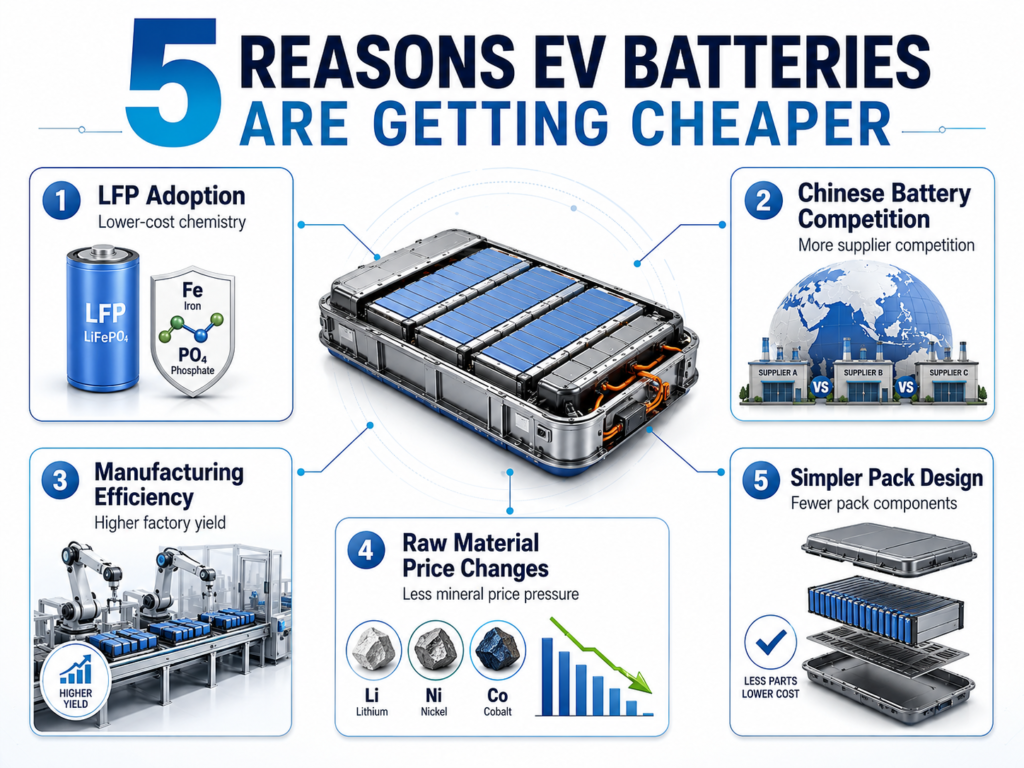
1. LFP Batteries Are Changing the Cost Structure
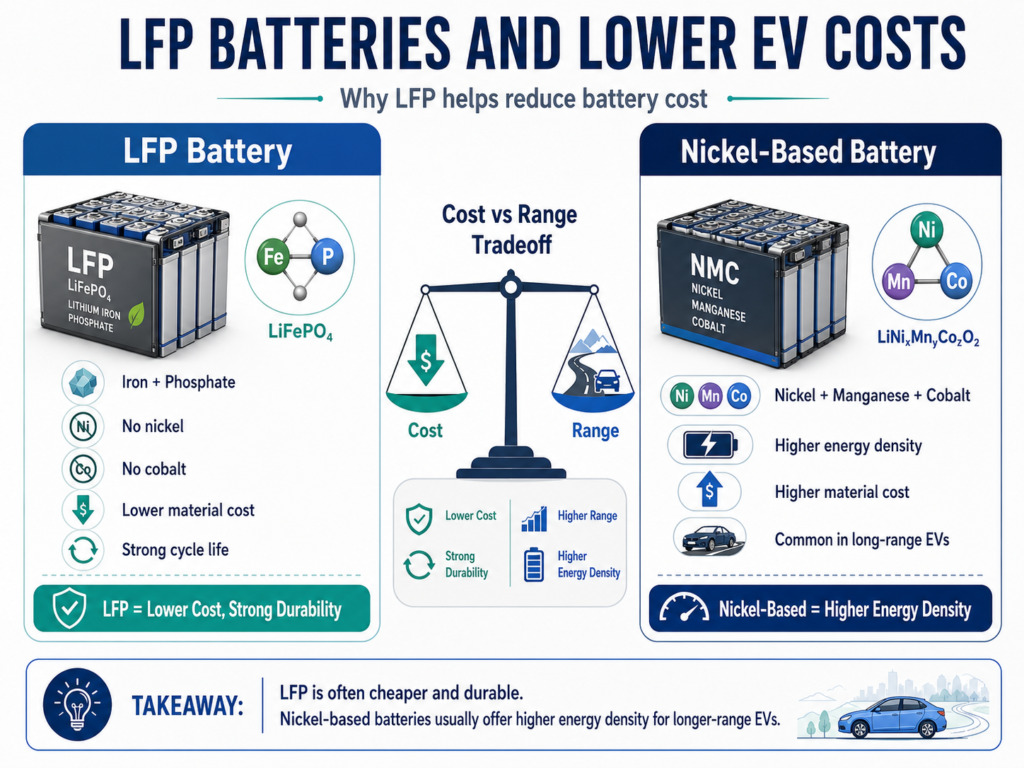
The biggest chemistry shift is the rise of LFP, or lithium iron phosphate. LFP batteries avoid nickel and cobalt, two materials that can be expensive and exposed to supply-chain volatility. Instead, they use iron and phosphate in the cathode. That usually makes LFP cheaper, more thermally stable, and often very durable over many charge cycles.
The tradeoff is energy density. LFP cells usually store less energy per kilogram than high-nickel NMC or NCA cells. That means an LFP pack may need to be larger or heavier to deliver the same driving range. But for many EVs, that tradeoff is acceptable. A standard-range EV does not need a giant premium battery. If the vehicle is designed around LFP from the beginning, the automaker can use the lower material cost to offer a more affordable trim while still giving buyers enough real-world range.
This is why LFP has become so important for affordable EVs, entry-level trims, commercial fleets, and energy storage systems. If you want a deeper chemistry comparison, our guide to LFP vs NMC batteries explains the range, cost, safety, and durability tradeoffs in more detail. For buyers, LFP’s rise is one of the clearest reasons EVs can become cheaper without waiting for solid-state batteries. The technology is already commercial. It is already being produced at huge scale. And it fits the needs of many mainstream vehicles.
2. Chinese Battery Competition Is Forcing Prices Down
Battery prices are also falling because competition has become intense, especially from China. China dominates large parts of the EV battery supply chain, including cell production and key battery components. The IEA’s 2025 outlook noted that China represented around 85% of global cathode active material production and more than 90% of anode active material production.
That scale gives Chinese battery makers a major cost advantage. Companies such as CATL, BYD, CALB, EVE Energy, and others are not just making batteries for one or two models. They are serving a massive domestic EV market, global automakers, electric buses, plug-in hybrids, commercial vehicles, and stationary storage projects.
When factories run at high volume and competitors fight for contracts, prices fall. This creates a complicated situation for U.S. buyers. On one hand, global competition helps lower battery costs. On the other hand, tariffs, trade rules, local-content requirements, and supply-chain policies can prevent some of those savings from reaching American consumers directly.
The IEA warned that higher tariffs could offset part of the battery price decline. For example, it noted that a 25% tariff could counteract the 20% average battery price decline seen in the previous year. So the global battery price may fall faster than the U.S. EV sticker price. That distinction matters. Batteries can get cheaper at the factory level while vehicles remain expensive because of tariffs, labor costs, software costs, dealer pricing, incentives, and automaker strategy. Still, the long-term pressure is clear. If one automaker can build a profitable LFP-based EV at a lower cost, competitors eventually have to respond.
3. Manufacturing Efficiency Is Improving
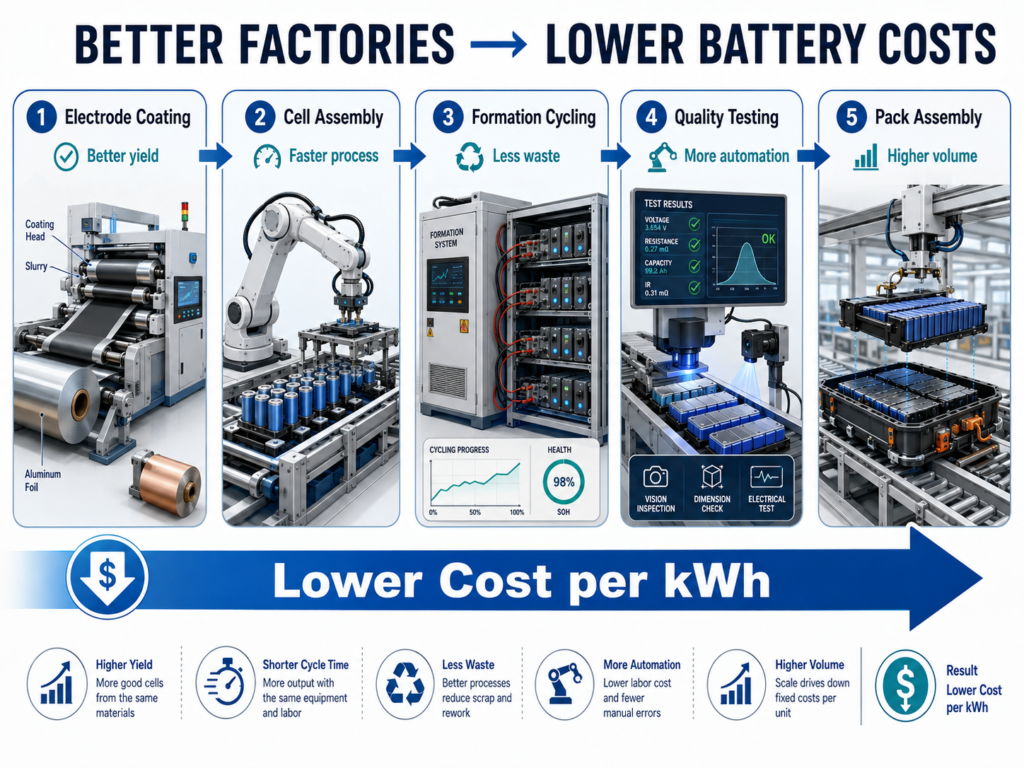
Battery manufacturing is extremely sensitive to efficiency. A battery factory is not just a warehouse full of cells. It includes electrode mixing, coating, drying, calendering, slitting, cell assembly, electrolyte filling, formation cycling, aging, testing, module assembly, pack assembly, and quality inspection.
Every small improvement matters. A slightly faster coating line, a shorter formation process, better dry-room control, fewer rejected cells, improved automation, or simpler pack assembly can reduce cost.
This is one reason battery prices fall gradually even without a dramatic chemistry breakthrough. The industry learns by doing. Argonne National Laboratory’s 2025 EV battery cost work estimated a 2025 volume-weighted R&D battery pack cost of $103/kWh for an average of NMC and LFP pack assumptions. That number is not the same as a retail replacement price or a dealer service quote, but it gives a useful engineering view of how far battery pack cost has moved.
This is also why newer battery factories matter. A modern plant designed around high-volume EV production can be much more efficient than an older plant adapted from earlier cell formats or lower-volume production. Formation cycling is a good example. It is one of the slowest and most expensive steps in lithium-ion battery manufacturing because cells must be carefully charged and discharged for the first time to form a stable SEI layer. For a deeper explanation, see our guide to EV Battery Formation Cycling: Why It Costs So Much.
For buyers, manufacturing efficiency is invisible. You will never see “better electrode yield” listed on a window sticker. But it can quietly lower the cost of the vehicle.
4. Raw Material Prices Have Cooled From Their Peaks
Battery material prices can move quickly. Lithium, nickel, cobalt, manganese, graphite, electrolyte salts, copper, aluminum, and other materials all affect battery cost. When lithium carbonate prices spiked during the EV boom, battery costs became harder to reduce. When lithium prices fell, cell makers gained room to lower prices again.
The IEA’s 2026 battery outlook says relatively low critical mineral prices helped put downward pressure on battery costs in 2025, even though lithium and cobalt increased during the year. That last detail is important. Battery prices are not tied to only one commodity. Lithium could rise while nickel falls. Cobalt could matter less if the industry uses more LFP. Graphite supply could become a bottleneck even if cathode materials are cheaper. The chemistry mix changes the exposure.
This is one reason LFP is so powerful from a cost perspective. It reduces dependence on nickel and cobalt. It does not eliminate lithium, but it changes the material-risk profile of the pack. For buyers, raw material prices usually show up with a delay. If lithium falls today, a car on the dealer lot next week may not be cheaper. Automakers sign supply contracts, build inventory, and price vehicles based on product strategy. But over time, lower material costs make lower EV prices more realistic.
5. Pack Design Is Getting Simpler
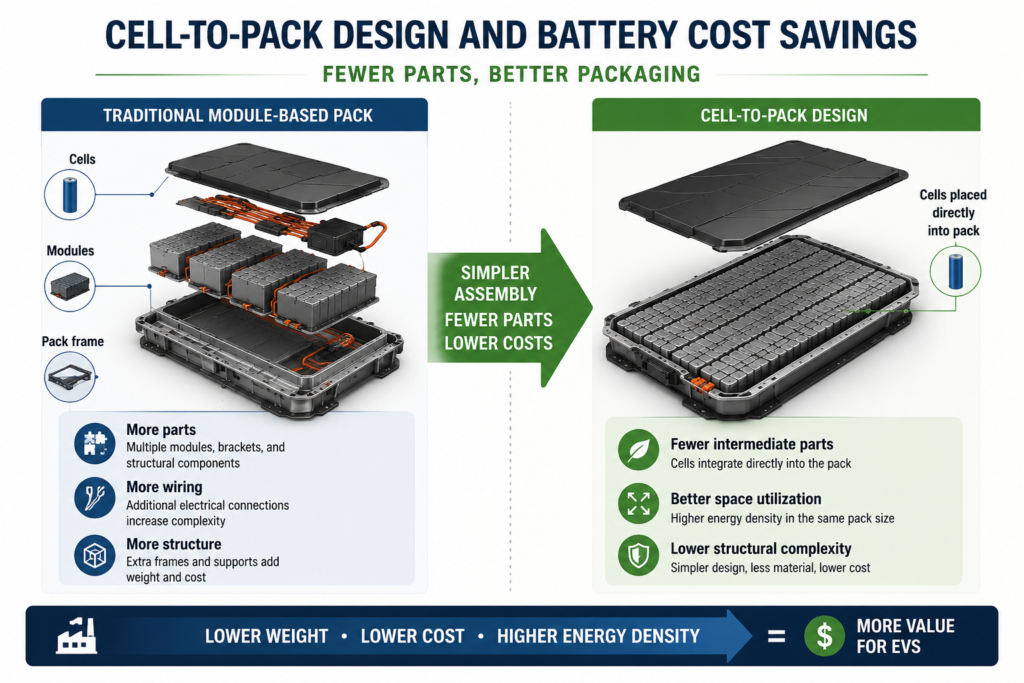
Battery cost is not just cell cost. Early EV battery packs often used a module-based design. Cells were grouped into modules, and modules were assembled into a pack. This made serviceability and manufacturing easier in some ways, but it also added extra structure, wiring, fasteners, cooling interfaces, and inactive material.
Newer designs increasingly try to remove unnecessary layers. Cell-to-pack designs place cells more directly into the pack structure. Blade-style LFP packs use long prismatic cells to improve packaging efficiency. Structural battery packs go a step further by making the battery part of the vehicle’s load-bearing structure.
The goal is not only lower cost. It is also better space utilization, fewer parts, lower mass, and sometimes improved stiffness. Our article on cell-to-pack vs structural battery packs explains how these architectures reduce complexity and why automakers are moving in this direction. There is a tradeoff, though. Simpler pack design can make manufacturing cheaper, but it may make repair more complicated. A highly integrated pack may be efficient to build but harder to repair after a crash or internal fault. That matters for insurance and used-car values, which we will come back to later.
Why Lower Battery Prices Do Not Immediately Mean Cheap EVs
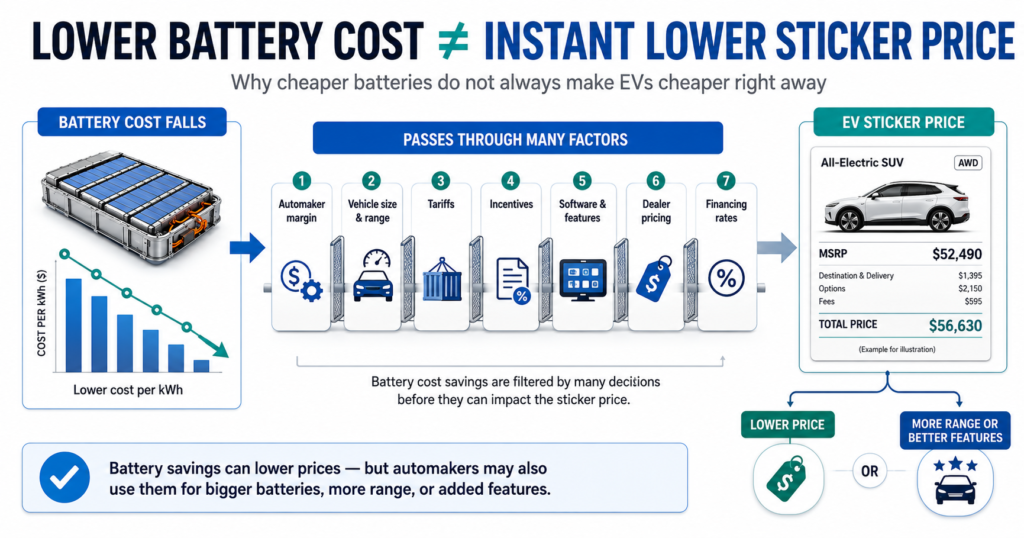
This is where expectations need to be realistic. A falling battery price does not automatically produce an equal drop in EV sticker price. There are several reasons. First, automakers may use lower battery costs to improve margins instead of lowering prices. Many EV programs are still trying to become consistently profitable. If battery costs fall, the first priority may be reducing losses.
Second, buyers often demand more range, more power, larger screens, premium interiors, advanced driver-assistance features, and faster charging. If battery cells get cheaper, automakers may install more capacity instead of lowering the price.
Third, EV pricing is affected by incentives, tax credits, tariffs, financing rates, dealer inventory, and brand positioning. The battery is critical, but it is not the whole vehicle.
This explains why the U.S. EV market can show falling battery costs and still have average EV transaction prices above the average new-vehicle price. Cox Automotive reported a May 2026 new EV average transaction price of $54,532, while the broader new-car market remained expensive as well.
The better way to think about battery prices is this: falling battery costs create the possibility of cheaper EVs, but competition determines how much of that savings reaches buyers. When competition is weak, automakers can keep prices high. When competition is strong, buyers see the benefit faster.
What This Means for New EV Buyers
For new EV buyers, falling battery prices should gradually improve three things: affordability, range, and choice. The first effect is more affordable entry-level EVs. Automakers can build standard-range models with LFP packs and price them below long-range versions. These vehicles may not have the longest road-trip range, but they can be excellent for commuting, local driving, and home charging.
The second effect is better standard equipment. If the battery costs less, automakers may offer more range at the same price. A vehicle that once needed an expensive long-range trim to feel practical may eventually offer similar daily usability in a lower trim.
The third effect is more competition. Lower battery costs make it easier for more brands to enter the EV market with credible products. That matters because buyers need choices beyond expensive luxury crossovers.
But buyers should not judge an EV only by battery size. A cheaper battery pack is not automatically better if the vehicle has poor efficiency, weak thermal management, slow charging, or limited warranty support. The real value comes from the whole system: battery chemistry, pack design, efficiency, charging curve, thermal management, software, warranty, and service network.
What This Means for Used EV Prices
Used EV prices are already being affected by lower new-EV prices. When new EVs get discounted, older used EVs usually lose value faster. This can be frustrating for current owners, but it can be good news for used buyers.
Reuters reported in March 2026 that falling prices, improved reliability, and better technology were steering more U.S. buyers toward used EVs. The report noted that used EV sales rose strongly, and the price premium between used EVs and gasoline vehicles had narrowed significantly.
This is one of the most important consumer effects of falling battery prices. It does not only reduce the cost of future new EVs. It also changes the value curve of older EVs. For a used buyer, that can create excellent opportunities. A three- or four-year-old EV may have most of its battery life remaining, especially if it has a strong thermal management system and a clean history.
Battery degradation fears are also becoming less dramatic than they were a decade ago. Many modern EV batteries lose range gradually rather than failing suddenly. Our guide to how long EV batteries last explains why battery health, warranty thresholds, and real-world range matter more than simple age. The key is inspection. A cheap used EV is not automatically a good deal. Buyers should check battery health, remaining warranty, charging history if available, accident history, recall status, and real-world range.
Will Battery Replacement Costs Fall Too?
Yes, but more slowly than many people expect. There is a major difference between battery manufacturing cost and battery replacement cost. A battery pack may cost an automaker around $100/kWh at a manufacturing or engineering cost level, but a customer replacement quote includes much more: parts markup, logistics, diagnostics, labor, coolant service, software pairing, taxes, dealer service rates, and sometimes structural repairs.
That is why a battery replacement can still cost thousands of dollars even when cell prices are falling. Over time, though, lower battery prices should help replacement costs come down. The effect will be strongest in three areas. First, remanufactured packs should become more common. Instead of replacing every failed pack with a brand-new unit, service networks can use tested, refurbished, or remanufactured packs. Second, module-level and sub-pack repairs may become more available for certain vehicles. This depends heavily on pack design. Some packs are easier to open, diagnose, and repair than others. Third, more end-of-life batteries will enter the market, creating a larger supply of used modules and serviceable parts.
Our article on EV battery replacement cost in 2026 goes deeper into why replacement quotes vary so widely by brand, pack size, warranty status, and repair approach. The short version: falling battery prices help, but they do not make battery replacement cheap overnight.
What About Battery Warranties?
Battery prices also affect warranties, but indirectly. If batteries become cheaper and more reliable, automakers can offer stronger warranty support with less financial risk. But that does not mean warranties will automatically become longer or more generous.
Most U.S. EV battery warranties still follow an 8-year/100,000-mile structure, often with a capacity threshold around 70%. Our EV battery warranty guide explains why this does not mean the battery will be replaced for normal range loss unless it falls below the stated warranty threshold.
Lower battery prices may make warranty repairs less painful for automakers. But buyers should still read the details carefully. Important questions include:
- Does the warranty cover defects only, or also capacity loss?
- What is the capacity threshold?
- Is the replacement battery new, refurbished, or equivalent?
- Does DC fast charging affect coverage?
- Does commercial use, rideshare use, or V2G use change the warranty terms?
- Is the warranty transferable to the next owner?
A cheaper battery does not replace a clear warranty.
Could Falling Battery Prices Reduce Insurance Costs?
This is possible, but not guaranteed. EV insurance costs are affected by battery prices, but also by repair complexity. If a battery pack is damaged in a crash, the insurer may need to decide whether the pack can be inspected, repaired, isolated, resealed, or replaced. Lower battery prices can reduce the cost of a total replacement. That should help over time.
But pack integration can push the other way. If a structural battery pack is expensive to inspect or difficult to repair after underbody damage, insurers may still treat the vehicle as high-risk. The same is true if replacement parts are limited or service procedures are slow.
This is the hidden tradeoff in modern EV design. Simpler, more integrated battery packs can lower manufacturing cost but may increase repair complexity. For buyers, this means insurance quotes matter. Before buying an EV, especially a newer model with a highly integrated pack, it is worth checking insurance costs for your location and driving profile.
Will Falling Battery Prices Hurt Resale Value?
In the short term, yes, they can. If new EV prices keep falling, used EV values may also decline. This is especially true for older models with shorter range, slower charging, older infotainment systems, or no remaining battery warranty.
But there is another side. Lower resale prices make used EVs more attractive to second owners. That can increase demand and help stabilize the market over time. The used EV market is still maturing. Gasoline vehicles have decades of resale-value history. EVs are newer, and buyers are still learning how to evaluate battery health, warranty coverage, charging speed, and software support.
As battery prices fall, resale value may become less about fear of battery failure and more about normal used-car factors: mileage, condition, brand reputation, software support, range, charging convenience, and repair history. That is a healthier market.
What Buyers Should Watch in 2026 and Beyond
The most important thing to watch is not just the average battery price. It is how automakers use lower battery costs. Some brands will use cheaper batteries to build truly affordable EVs. Others will use them to add more range or improve profit margins. Some will use LFP for base trims and higher-energy nickel-based chemistries for premium trims.
Buyers should also watch the spread between EV and gasoline vehicle prices. In early 2026, Kelley Blue Book reported that the EV premium over gas-powered vehicles had narrowed significantly, with one February 2026 report describing the gap between EV and ICE-plus vehicles as roughly $6,500, one of the lowest on record. That gap matters more than the battery price alone. If EVs approach price parity while keeping lower fuel and maintenance costs, the ownership argument becomes much stronger.
The other thing to watch is battery repair infrastructure. Lower cell prices are helpful, but consumers also need better diagnostics, more independent repair options, clearer warranty rules, and more transparent battery health reports. A future where batteries are cheaper but impossible to repair would still frustrate owners. A future where batteries are cheaper, more durable, easier to diagnose, and easier to remanufacture would be much better.
Practical Buying Advice
For a new EV buyer, falling battery prices mean patience can pay off, but waiting forever does not make sense. If an EV fits your budget, driving needs, charging setup, and warranty expectations today, it may still be a good purchase.
The smarter move is to compare trims carefully. A standard-range LFP version may be a better value than a long-range premium trim if most of your driving is local. On the other hand, if you regularly take long highway trips in cold weather, paying more for a larger pack and faster charging may still be worth it.
For a used EV buyer, falling prices are mostly good news. More supply and lower resale values can create strong deals. But battery condition matters. Ask for a battery health report when possible, check remaining warranty, review accident history, and test real-world range.
For current EV owners, falling battery prices can feel like a double-edged sword. Your resale value may be lower than expected, but your long-term replacement risk may also improve. As the service market matures, battery repair and remanufacturing should become more practical.
Conclusion: Cheaper Batteries Will Reshape EV Ownership
EV battery prices keep falling because the industry is scaling fast, learning quickly, and shifting toward lower-cost chemistries and simpler pack designs. LFP adoption, Chinese competition, manufacturing improvements, raw material changes, and cell-to-pack architectures are all pushing costs down.
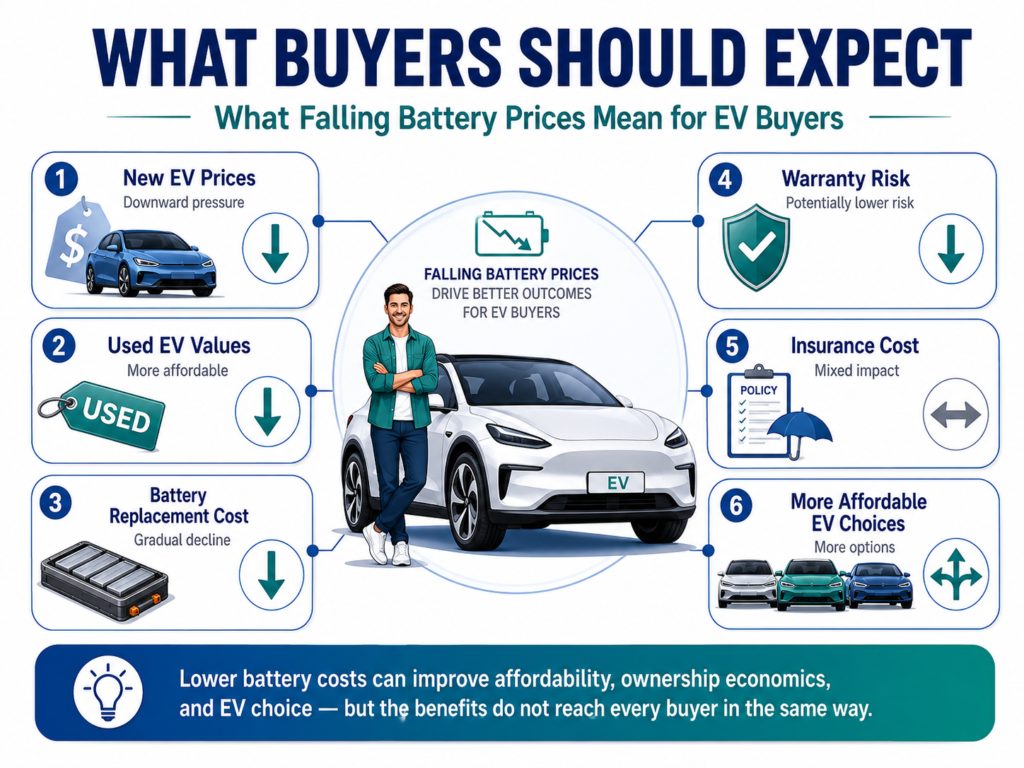
For car buyers, the impact will be gradual but important. New EVs should become more affordable. Used EVs should become more attractive. Battery replacement costs should slowly improve. Warranty risk may become easier for automakers to manage. And buyers should have more choices between low-cost commuter EVs, long-range family vehicles, and premium high-performance models.
But cheaper batteries do not solve everything. Vehicle pricing still depends on automaker strategy, tariffs, incentives, labor costs, software, repairability, and market demand. The best way to think about falling battery prices is not “EVs will instantly become cheap.” A more realistic view is this: every year batteries get cheaper, automakers have fewer excuses for making EVs expensive. And that is good news for buyers.
FAQs
Why are EV batteries getting cheaper?
EV batteries are getting cheaper because of larger production scale, more LFP battery adoption, stronger competition from Chinese battery makers, better manufacturing efficiency, lower material-cost pressure, and simpler pack designs. The IEA reported that average battery prices declined by 8% in 2025.
Will cheaper batteries make EVs cheaper?
Usually, yes, but not immediately or equally across all models. Automakers may use lower battery costs to reduce prices, increase range, improve margins, or offer larger incentives. Strong competition is what usually turns lower battery cost into lower consumer prices.
Are LFP batteries the main reason EV battery prices are falling?
LFP is one of the biggest reasons. LFP batteries avoid nickel and cobalt, which helps reduce material cost and supply-chain risk. They are especially useful for standard-range EVs, affordable models, commercial vehicles, and energy storage systems.
Will EV battery replacement costs fall?
Battery replacement costs should fall over time, but they will not drop as quickly as cell prices. Replacement costs include diagnostics, labor, logistics, pack design, dealer markup, software work, and sometimes coolant or structural repair.
Do falling battery prices hurt used EV resale value?
They can hurt resale value in the short term because cheaper new EVs put pressure on used prices. But that also makes used EVs more affordable for second owners, which can help grow the used EV market.
Should I wait for EV battery prices to fall more before buying?
It depends on your situation. If today’s EV prices, range, charging options, and warranty terms work for you, waiting may not be necessary. But if you are price-sensitive and do not urgently need a car, the next few years may bring more affordable EV options.