
Quick Answer
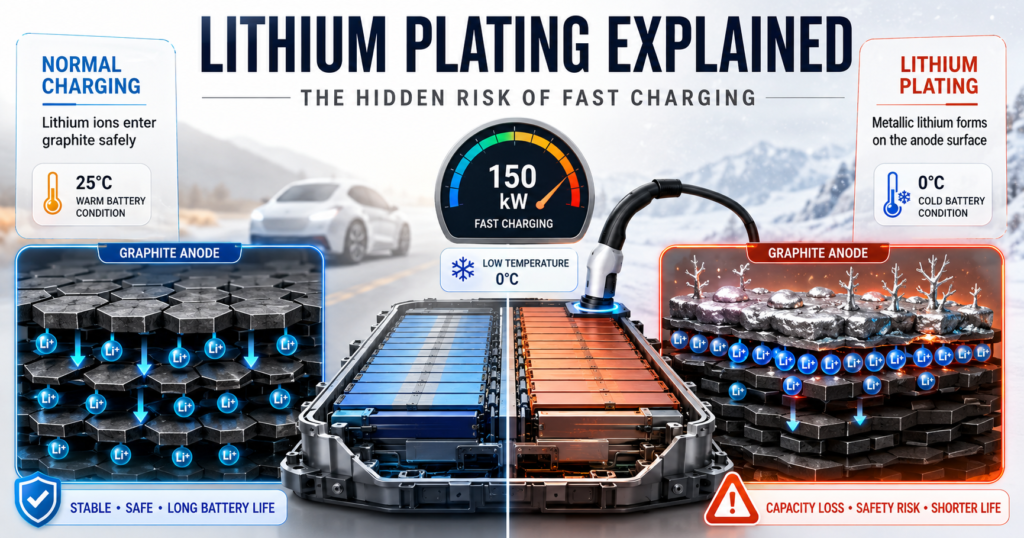
Lithium plating happens when lithium ions cannot move into the graphite anode fast enough during charging, so some lithium deposits as metallic lithium on the anode surface instead. This is more likely during cold-weather charging, very high charging power, high state of charge, or when the battery is already aged or poorly balanced.
For EV owners, lithium plating matters because it can permanently reduce battery capacity, increase internal resistance, accelerate degradation, and in severe cases contribute to internal short-circuit risk. Modern EVs use battery preconditioning, charge tapering, temperature monitoring, and BMS controls to reduce this risk, which is one reason fast charging often slows down in cold weather or above roughly 70–80% state of charge.
Introduction
Lithium plating is one of the hidden reasons EV batteries cannot always fast charge at maximum power, especially in cold weather or at high state of charge. Fast charging is one of the most important technologies behind modern electric vehicles. Nobody wants to sit at a charger for an hour if the car can safely add hundreds of miles in 15 or 20 minutes. That is why automakers are pushing higher-voltage battery packs, better cooling systems, smarter charging algorithms, and more advanced battery materials.
But there is a hidden problem behind fast charging that most EV owners never see directly: lithium plating. It is not as visible as range loss in winter. It is not as dramatic as a battery warning light. It usually does not happen from one normal charging session. But at the electrochemical level, lithium plating is one of the most important limits on how fast a lithium-ion battery can safely charge.
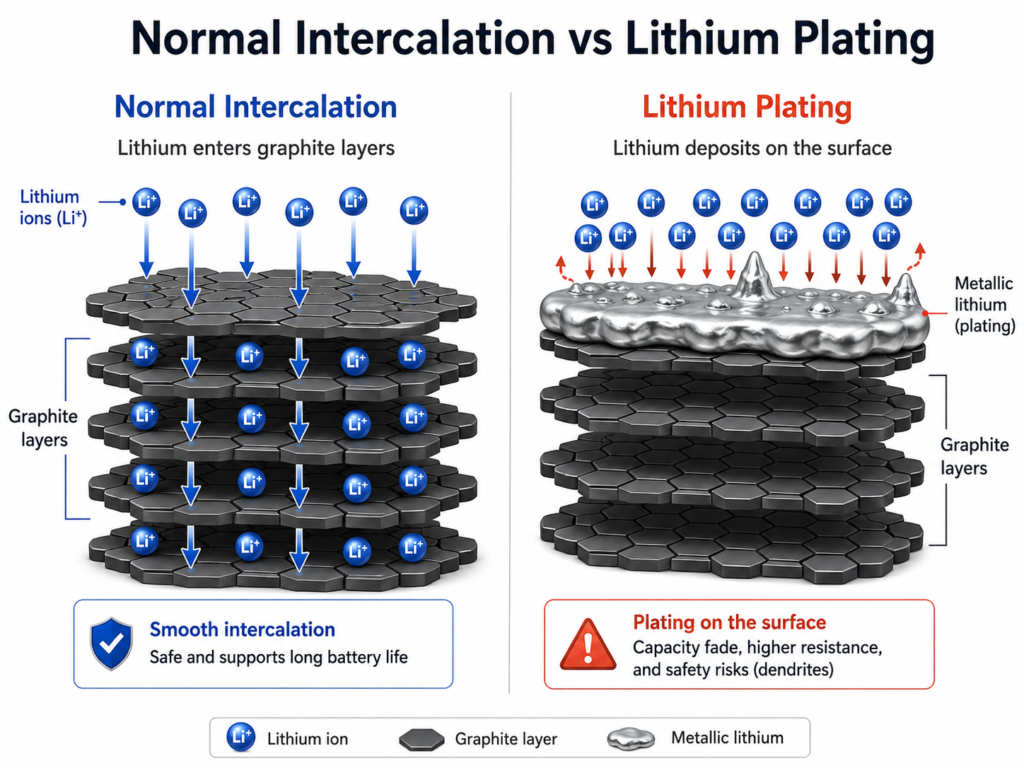
The basic issue is simple. During charging, lithium ions are supposed to move from the cathode, travel through the electrolyte, and insert themselves into the graphite anode. Under the right conditions, this process is smooth and reversible. Under stressful conditions, however, the anode may not accept lithium quickly enough. When that happens, lithium can deposit on the surface of the anode as metallic lithium instead of entering the graphite structure.
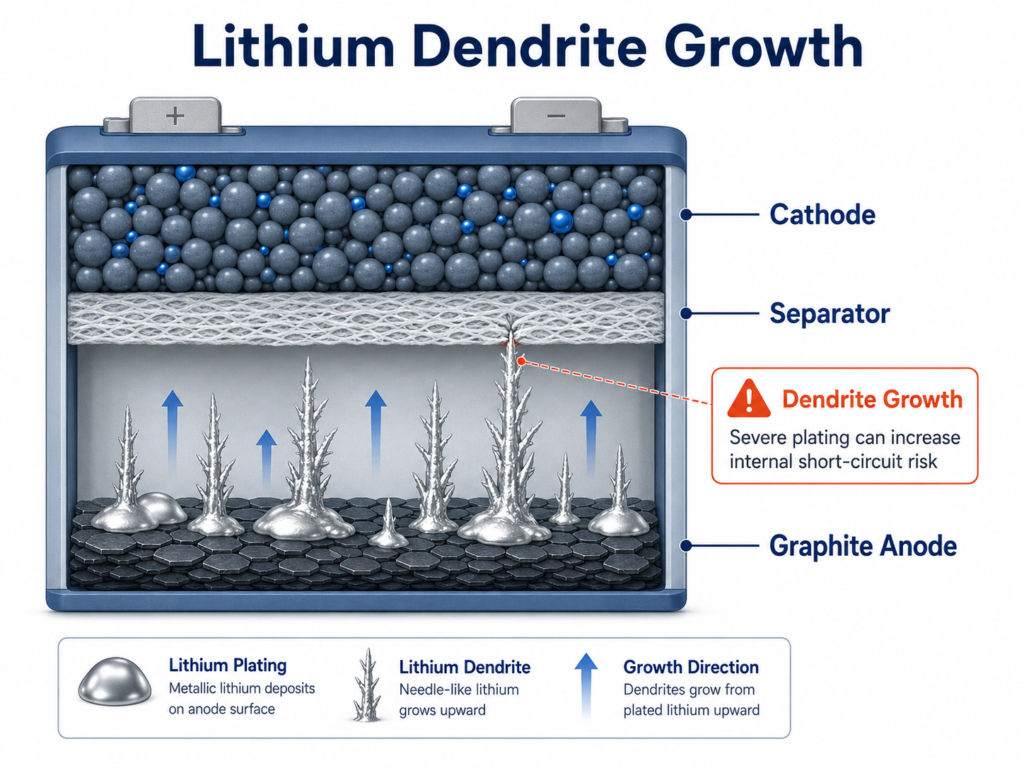
That metallic lithium is not where it is supposed to be. Once plating occurs, some of that lithium may be lost from normal battery operation. Some may react with the electrolyte. Some may form uneven surface deposits. In more serious cases, plated lithium can grow into needle-like structures called dendrites, which raise concerns about internal short circuits and safety.
This is why lithium plating is so important in EV battery engineering. It connects fast charging, winter charging, battery degradation, battery management systems, and long-term safety into one topic.
Why Lithium Plating Happens During Fast Charging
In a normal lithium-ion battery, lithium does not usually exist as metallic lithium during regular operation. Instead, lithium ions move back and forth between the positive electrode and the negative electrode.
When the battery is discharging, lithium ions leave the graphite anode and move toward the cathode. When the battery is charging, the process reverses. Lithium ions move back into the graphite anode and are stored between graphite layers. Lithium plating happens when this process does not go smoothly.
Instead of entering the graphite structure, some lithium ions gain electrons and deposit as metallic lithium on the anode surface. In simple terms, the battery is being charged faster than the anode can comfortably absorb lithium.
Researchers often describe lithium plating as one of the key barriers to extreme fast charging. Argonne National Laboratory’s work on extreme fast charging focuses on reducing the technical hurdles that prevent lithium-ion batteries from charging in 15 minutes or less, and lithium plating is one of the major concerns in that field (ANL, EurekAlert).
For an EV owner, this does not mean every DC fast charge is damaging the battery in a dramatic way. Modern EVs are designed to prevent unsafe charging conditions. The important point is that lithium plating is one of the reasons the car sometimes refuses to charge as fast as the charger can theoretically deliver. The car is not being slow for no reason. The battery management system is trying to keep the anode out of a dangerous operating region.
Internal link:
EV Battery Management System Explained: How Modern EV BMS Actually Work (2026)
Why Lithium Plating Happens
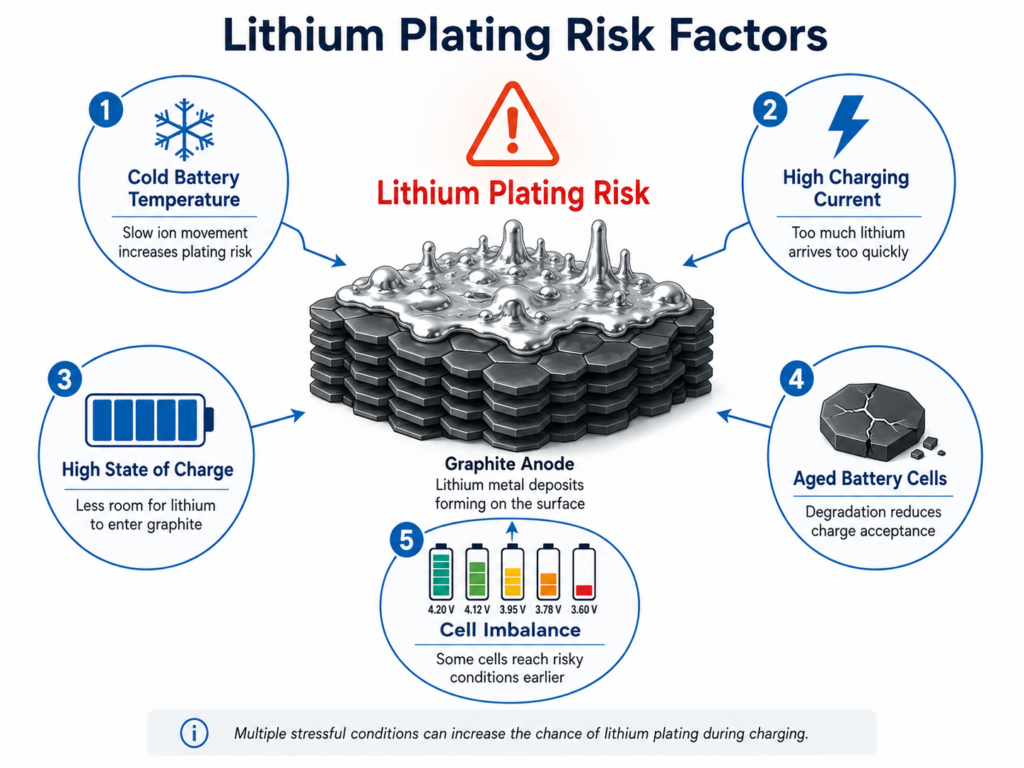
Lithium plating is not caused by one single factor. It usually appears when several conditions push the battery beyond its safe charge acceptance limit. The most common triggers are cold battery temperature, high charging current, high state of charge, aged cells, and uneven current distribution inside the cell. These conditions all make it harder for lithium ions to move smoothly into the anode.
A good way to think about it is traffic entering a parking garage. If cars arrive at a normal pace and there is enough space, everything flows smoothly. If too many cars arrive too quickly, or if the entrance is partially blocked, cars start piling up outside. In a battery, that “pileup” can become metallic lithium on the anode surface.
Cold Temperature Slows the Battery Down
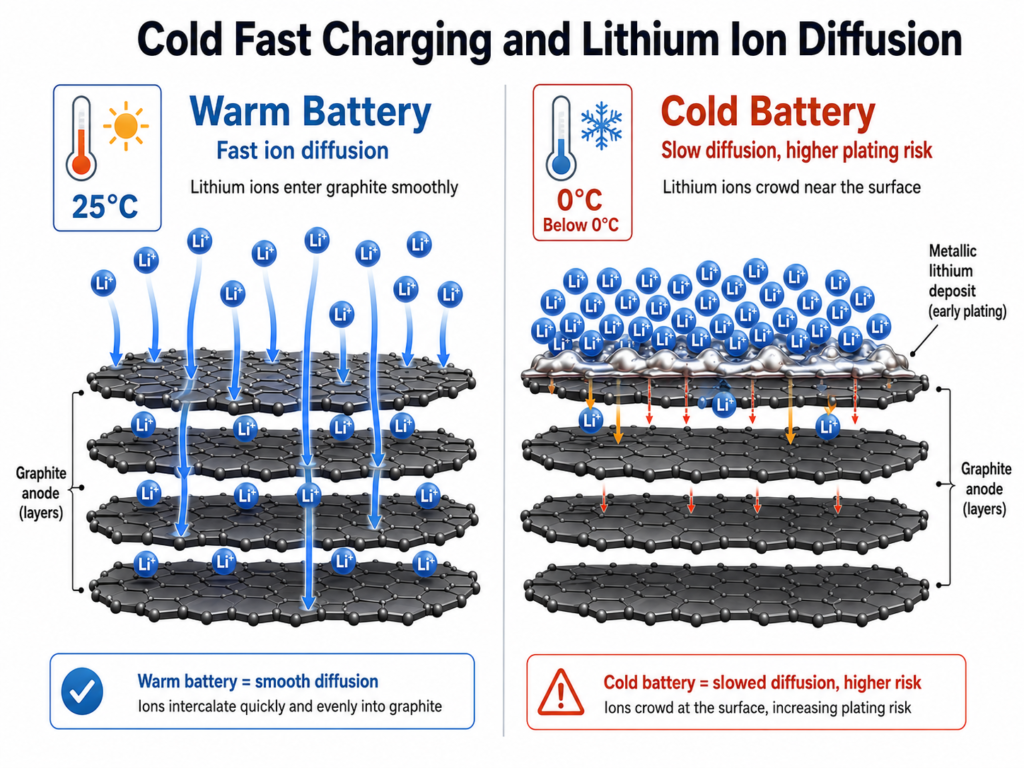
Cold weather is one of the biggest lithium plating risk factors. At low temperatures, lithium ions move more slowly through the electrolyte. The chemical reactions at the electrode surfaces also slow down. Graphite becomes less willing to accept lithium quickly. So if the battery is cold and a high charging current is applied, the anode can become overwhelmed.
This is why many EVs charge slowly in winter until the battery warms up. It is also why battery preconditioning matters so much before DC fast charging. Tesla’s owner materials, for example, recommend navigating to a charging location before arrival so the vehicle can prepare the battery for better charging conditions in cold weather (Tesla1, Tesla2). This is not only about convenience. It is also about protection. A warm battery can accept charge more safely than a cold battery.
Internal link:
EV Battery Preconditioning Explained: Why Fast Charging Slows in Winter (2026)
Why Fast Charging Increases Lithium Plating Risk
Fast charging increases lithium plating risk because it pushes a large amount of lithium toward the anode in a short period of time. At moderate charging speeds, lithium ions usually have enough time to enter the graphite structure. At very high charging speeds, the surface of the anode can become crowded before lithium has enough time to diffuse deeper into the graphite particles. This creates a local condition where plating becomes more likely.
Idaho National Laboratory research on fast-charging lithium-ion batteries describes lithium plating as a major issue because it can deplete usable lithium, worsen cell deterioration, and raise safety concerns. This is the central tradeoff of fast charging. Drivers want charging to be faster. Engineers want charging to be faster too. But the battery has electrochemical limits.
That is why a 350 kW charger does not mean every EV will actually charge at 350 kW. The charger may be capable of delivering that power, but the battery pack must be able to accept it safely. The final charging power depends on temperature, state of charge, cell chemistry, pack voltage, cell design, cooling capacity, and BMS strategy. In other words, the charger is only one side of the story. The battery decides how much power it can safely take.
Why High State of Charge Makes It Worse
Lithium plating risk usually becomes more serious at higher state of charge. When the battery is at a low or moderate state of charge, there is more available room in the graphite anode for incoming lithium. As the battery fills up, it becomes harder to insert lithium quickly. The anode becomes more crowded, and the voltage conditions become less favorable.
This is one of the reasons EV charging curves taper. Many EVs can accept high power from a low state of charge, then gradually reduce charging power as the battery approaches 70%, 80%, or higher. That slowdown can be frustrating during a road trip, but it is a normal part of protecting the battery. The charging taper is not only about heat. It is also about diffusion limits, voltage limits, cell balancing, and lithium plating avoidance.
Internal link:
Why EV Batteries Charge Slower Above 80% (And Why That’s Normal)
Lithium Plating vs Normal Battery Aging
Lithium plating is a form of battery degradation, but it is not the same as ordinary aging. Normal battery aging happens gradually through many mechanisms. The solid electrolyte interphase, often called the SEI layer, grows over time. Active lithium inventory slowly decreases. Electrode particles can crack. Electrolyte can degrade. Internal resistance can increase.
Lithium plating is different because it is strongly tied to charging conditions. It can happen when the battery is charged too quickly for its temperature, state of charge, or internal condition. That does not mean lithium plating always causes immediate failure. Some plated lithium can sometimes be stripped back during later discharge, depending on the condition and severity. But not all of it returns to normal operation. Some becomes “dead lithium,” meaning it is no longer useful for storing and releasing energy. Some reacts with electrolyte and contributes to additional SEI growth.
Over time, this can show up as reduced usable capacity, slower charging, increased heat generation, and higher cell imbalance. For EV owners, this is a reason repeated aggressive fast charging under poor conditions can age a battery faster than slower, moderate charging. The occasional road-trip DC fast charge is usually fine. The concern is repeated stress: cold battery, high power, high SOC, and little time for the pack to stabilize.
What Are Lithium Dendrites?
Dendrites are one of the reasons lithium plating gets so much attention. A dendrite is a tiny, branch-like or needle-like lithium structure that can grow from plated lithium under certain conditions. Instead of forming a smooth, uniform layer, lithium can deposit unevenly. Over time, those uneven deposits may extend outward.
The danger is that a dendrite could grow far enough to pierce or compromise the separator between the anode and cathode. The separator is a thin barrier that keeps the two electrodes physically apart while allowing ions to move through. If that barrier is breached, the result can be an internal short circuit. This is why dendrites are often discussed in the same conversation as lithium plating, internal shorts, and thermal runaway risk.
It is important not to exaggerate this for normal EV ownership. Modern EV packs have multiple layers of protection, including battery management software, thermal monitoring, current limits, voltage limits, contactors, fuses, pack structure, and cooling systems. Still, at the cell level, dendrite formation is one of the mechanisms engineers work hard to prevent.
A 2022 Nature Communications paper on onboard lithium plating detection describes fast charging as highly desirable for EV adoption, while also noting that charging protocols are often conservative because of the risk of hazardous lithium plating and related side reactions. That is the key point. Automakers are not simply trying to make charging slower. They are trying to keep the battery away from conditions where plating and dendrite growth become more likely.
Why Lithium Plating Can Be Dangerous
Lithium plating is dangerous because it affects both battery life and battery safety. The first problem is capacity loss. When lithium becomes trapped as inactive metallic lithium or reacts with electrolyte, there is less active lithium available to shuttle between electrodes. This reduces the amount of energy the battery can store.
The second problem is internal resistance growth. Plating and side reactions can make it harder for current to flow smoothly inside the cell. Higher resistance means more heat during charging and driving. It can also reduce power output and make fast charging slower over time.
The third problem is uneven aging. Lithium plating does not always occur uniformly across every part of every cell. Some regions may age faster than others. In a large EV battery pack with hundreds or thousands of cells, uneven aging makes battery management more difficult.
The fourth problem is safety risk. Severe lithium plating can contribute to dendrite formation, separator damage, and internal short circuits. This is not a common outcome in well-managed EV batteries, but it is serious enough that battery engineers design charging limits around it. This is also why lithium plating is such a major topic in fast-charging research. The industry wants shorter charging times, but not at the cost of long-term reliability or safety.
How the BMS Prevents Lithium Plating
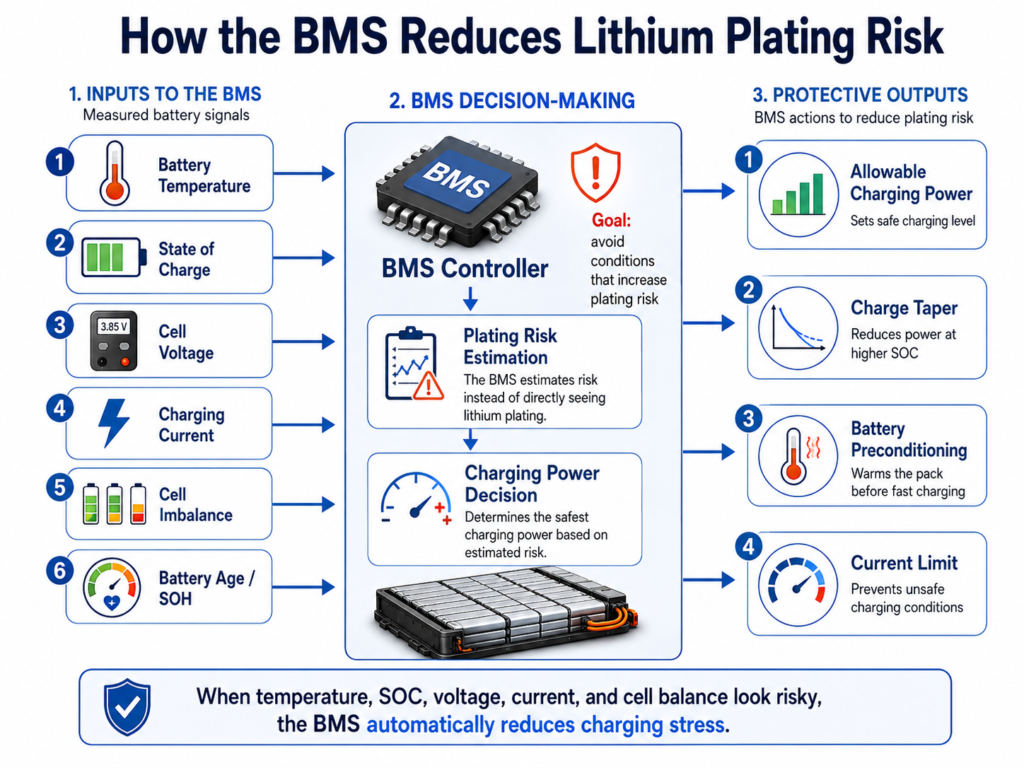
The battery management system is the main line of defense against lithium plating in an EV. The BMS does not directly “see” lithium plating in most production vehicles. Instead, it estimates risk using measurable signals such as battery temperature, cell voltage, current, state of charge, cell imbalance, and sometimes historical battery behavior.
Based on those signals, the BMS decides how much charging power the pack can safely accept. If the battery is cold, the BMS may reduce charging current. If the battery is near full, it may taper power. If one cell group is approaching a voltage limit before the others, it may slow charging to avoid overstressing that group. If the battery is too cold to charge safely, some EVs may delay or limit charging until the pack warms up.
This is why the same EV may charge very differently depending on conditions. A car that charges quickly at 40% SOC on a mild day may charge much more slowly at 75% SOC in freezing weather. From the driver’s perspective, it can feel inconsistent. From the battery’s perspective, it is protection.
Modern research is also moving toward better lithium plating detection and prediction. NREL has described work combining high-throughput cycling and physics-based modeling to better predict and prevent lithium plating under different electrode thicknesses, temperatures, and charging rates (NLR).
That direction matters because future EVs will likely rely on smarter charging control rather than simple fixed limits. The goal is not just to avoid plating by charging slowly. The better goal is to charge as fast as possible while staying safely below the plating boundary.
Why Battery Preconditioning Matters
Battery preconditioning is one of the most practical ways EVs reduce lithium plating risk. When an EV preconditions the battery before fast charging, it uses the thermal management system to bring the pack closer to an optimal temperature range. In cold weather, that usually means warming the battery before arrival at a DC fast charger.
This improves charging performance because lithium ions can move more easily in a warm battery. It also reduces stress on the anode because the graphite can accept lithium more safely.
Preconditioning is especially useful when the driver enters a fast charger as the navigation destination. Many EVs use that information to begin preparing the battery ahead of time. Tesla’s owner documentation, for example, explains that preconditioning warms the battery for improved performance and charging conditions.
The important owner takeaway is simple: in winter, the fastest charging session often starts before the car reaches the charger. If the EV has route-based battery preconditioning, use the built-in navigation system when heading to a fast charger. If the car offers scheduled departure or scheduled preconditioning, use it before cold-weather driving or charging. These features are not just comfort features. They are part of the battery protection strategy.
Can Lithium Plating Happen in LFP Batteries?
Lithium plating can happen in different lithium-ion chemistries, including LFP-based batteries, because the anode is often still graphite. The cathode chemistry changes from NMC to LFP, but the negative electrode may still face the same basic fast-charging limitation: lithium must enter graphite safely.
However, the overall risk depends on cell design, charging protocol, temperature, anode-to-cathode balance, electrolyte, pack thermal management, and BMS controls. It is not accurate to say that one chemistry is automatically immune.
LFP batteries have other advantages, such as strong cycle life and improved thermal stability compared with many nickel-rich chemistries. But when it comes to cold fast charging and graphite anode limitations, LFP batteries still need careful charging management. This is one of the reasons many EVs with LFP packs may still charge more slowly in cold weather or at higher SOC. The chemistry may be durable, but the electrochemical process still has limits.
Internal link:
LFP vs NMC Batteries: Which EV Battery Is Better in 2026?
What EV Owners Can Do to Reduce Lithium Plating Risk
Most EV owners do not need to obsess over lithium plating. The car already does most of the protection automatically. Still, a few habits can help reduce long-term stress. The most important habit is to avoid DC fast charging a very cold battery unless necessary. When possible, precondition the battery before fast charging in winter. If the car has built-in charger navigation, use it.
It also helps to avoid repeatedly fast charging all the way to 100% unless there is a real need. Charging from 10% to 60% or 10% to 80% is usually much easier on the pack than forcing the last 10–20% at a high state of charge. For road trips, shorter charging stops in the faster part of the curve are often better than waiting for a slow top-off.
For daily charging, Level 2 home charging is generally gentler than frequent high-power DC fast charging. That does not mean DC fast charging is bad. It means the battery experiences less stress when charging is moderate, temperature is controlled, and the pack is not pushed near full all the time.
In cold climates, it is also better to charge soon after driving if the battery is already warm, rather than letting the car sit outside in freezing temperatures and then trying to charge from a very cold state. These habits are not about fear. They are about making the BMS’s job easier.
The Future: Faster Charging Without Plating
The EV industry is not ignoring lithium plating. In fact, much of today’s fast-charging research is about pushing charging speed higher while reducing plating risk. Researchers are exploring better graphite designs, silicon-blended anodes, improved electrolytes, thinner electrodes, optimized charging protocols, advanced thermal management, and onboard plating detection. Some approaches focus on heating the battery quickly before fast charging. Others focus on cell materials that can accept lithium faster without plating.
A 2025 Nature Communications study on fast-charging lithium-ion batteries discusses the tradeoff between high energy density and fast-charge capability, noting that some fast-charging anode materials avoid lithium plating by operating at higher potentials but sacrifice energy density.
That tradeoff is important. A battery can be designed to charge very fast, but it may lose energy density. Another battery can store more energy, but it may be harder to fast charge safely. EV battery design is always a balance between range, cost, charging speed, life, safety, and manufacturability.
This is why future breakthroughs may not come from one magic material. They will likely come from better combinations: improved cell chemistry, smarter BMS algorithms, stronger thermal systems, higher-voltage packs, better charging infrastructure, and more accurate battery models. Fast charging will keep improving. But lithium plating will remain one of the hidden boundaries engineers must respect.
Conclusion
Lithium plating is one of the most important battery problems most EV owners never directly see. It happens when lithium ions cannot enter the graphite anode fast enough during charging and instead deposit as metallic lithium on the anode surface. This risk increases during cold-weather charging, high-power fast charging, high state of charge, and stressful battery conditions.
The danger is not just theoretical. Lithium plating can reduce usable capacity, increase internal resistance, accelerate degradation, and in severe cases contribute to dendrite growth and internal short-circuit risk. The good news is that modern EVs are built to manage this risk. Battery preconditioning, charge tapering, thermal management, voltage monitoring, and BMS current limits all work together to keep the battery within a safer operating window.
So when your EV slows down at a fast charger, especially in winter or above 80%, it is not necessarily a flaw. In many cases, it is the battery protecting itself. Fast charging is getting better every year. But the safest and longest-lasting EV batteries will still depend on a simple principle: lithium should go into the anode, not plate on top of it.
FAQ
Is lithium plating the same as battery degradation?
Lithium plating is one type of battery degradation, but it is not the only one. EV batteries also age through SEI growth, electrolyte degradation, electrode cracking, lithium inventory loss, and internal resistance growth. Lithium plating is especially associated with charging stress, particularly cold fast charging and high charging current.
Does DC fast charging always cause lithium plating?
No. Modern EVs limit charging power based on temperature, SOC, voltage, and battery condition. DC fast charging is not automatically harmful. The risk increases when the battery is cold, charged at very high current, near full, or already aged.
Why does my EV charge slowly in winter?
A cold battery has slower ion movement and slower electrochemical reactions. To reduce lithium plating risk and protect the battery, the BMS may limit charging power until the pack warms up. Battery preconditioning helps reduce this problem.
Can lithium plating be reversed?
Some plated lithium may be stripped back during later operation, but not all of it returns to normal battery function. Some can become inactive “dead lithium” or react with electrolyte, causing permanent capacity loss.
Is lithium plating a fire risk?
Lithium plating can contribute to safety risk if it becomes severe enough to form dendrites or internal shorts. In normal EV use, the BMS and thermal management system are designed to prevent the battery from operating in those dangerous conditions.