
Quick Answer
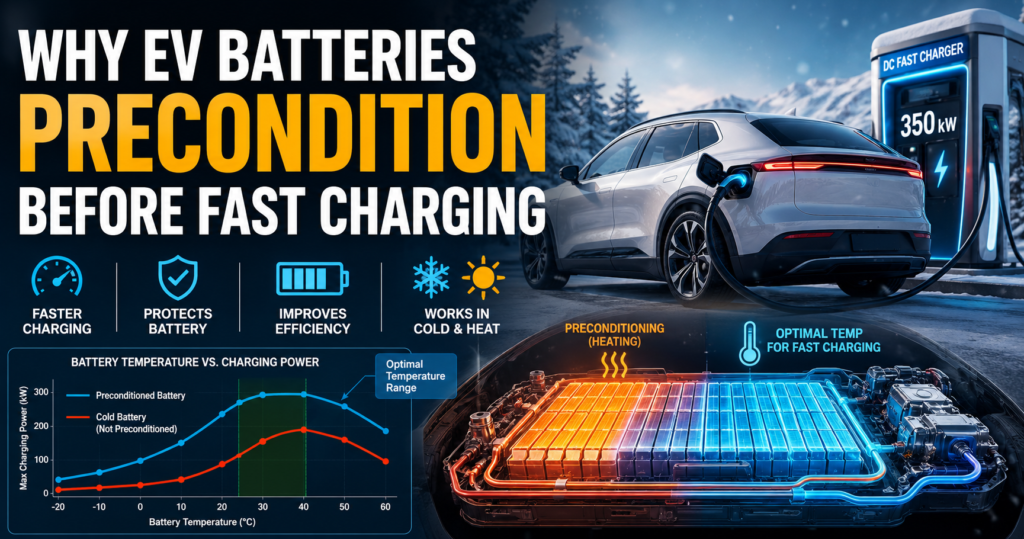
EV battery preconditioning has become one of the most important technologies in modern electric vehicles, especially for winter fast charging performance. If the battery is too cold or too hot, charging speeds can drop dramatically, efficiency decreases, and long-term battery degradation can accelerate.
That is why EVs from companies like Tesla, Hyundai Motor Group, General Motors, Rivian, and Lucid Motors now automatically heat or cool the battery before arriving at a fast charger.
Battery preconditioning has become one of the most important EV thermal management technologies, especially for winter driving and ultra-fast charging.
Why EV Charging Is More Complicated Than Most People Think
To many drivers, EV charging seems simple: Plug in the charger and wait. But inside the battery pack, a very complex electrochemical process is happening. Modern EV batteries must carefully manage cell temperature, charging current, internal resistance, voltage stability, lithium-ion movement, and thermal safety margins. This becomes even more critical during DC fast charging, where hundreds of kilowatts of power may enter the battery in a very short period of time.
If the battery temperature is not within the ideal range, the vehicle may intentionally slow charging speeds to protect the battery. That is exactly why battery preconditioning exists.
What Is EV Battery Preconditioning?
Battery preconditioning is the process of heating or cooling the battery pack before fast charging. The goal is simple: Bring the battery into its optimal charging temperature window before arriving at the charger.
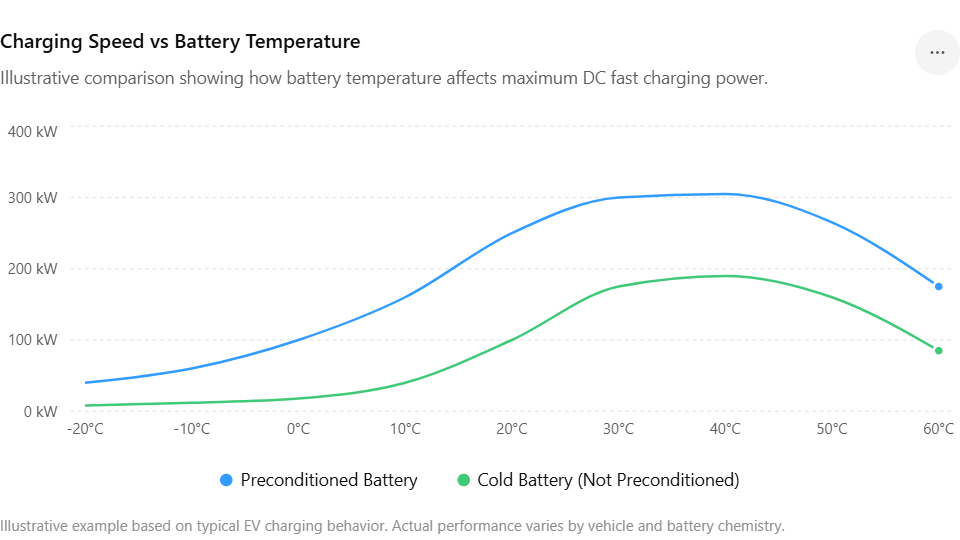
For most lithium-ion EV batteries, fast charging works best when the pack is roughly between 20°C to 40°C (68°F to 104°F). Outside this range, charging performance begins to decline.
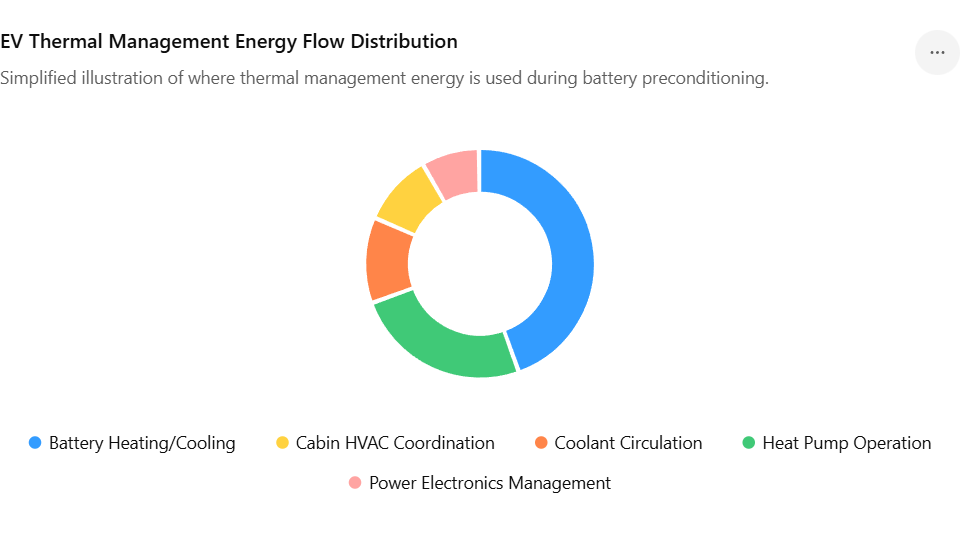
When drivers navigate to a DC fast charger, many EVs now automatically begin thermal preparation in the background. This process may involve battery heaters, coolant loops, heat pumps, refrigerant-based cooling, and waste heat recovery from motors and inverters. In many cases, the driver may not even realize it is happening.
Why Cold Batteries Charge So Slowly
Low temperatures are one of the biggest enemies of fast charging performance. Inside a cold lithium-ion battery, lithium-ion movement slows down, internal resistance increases, voltage stability worsens, or electrochemical reactions become less efficient. Most importantly, cold charging increases the risk of lithium plating.
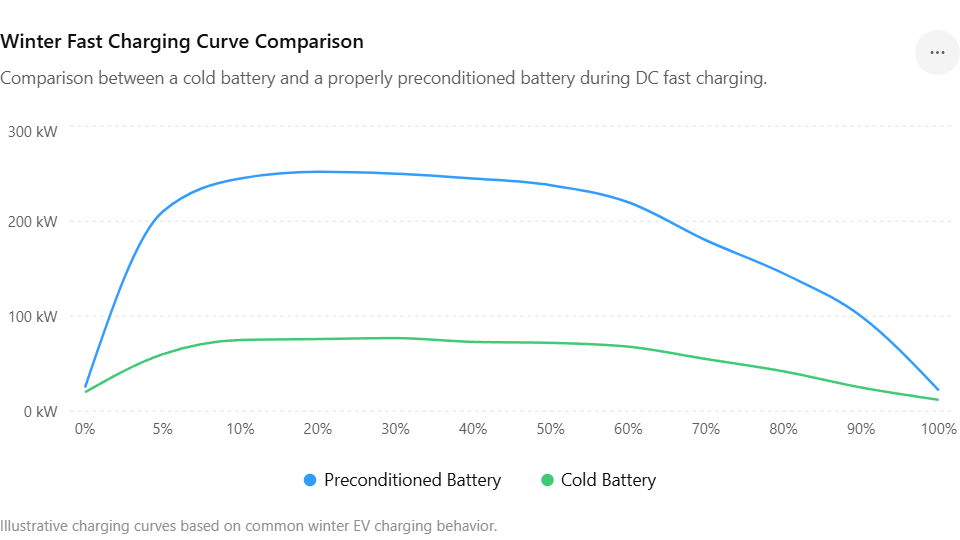
Lithium plating occurs when lithium deposits onto the anode surface instead of properly intercalating into the graphite structure. This can lead to faster battery degradation, permanent capacity loss, reduced charging performance, or safety risks over time. Because of this, EV battery management systems aggressively limit charging power when the battery is cold.
That is why a “350 kW charger” does not always mean your EV will actually charge at 350 kW. In winter, charging speeds may temporarily fall below 50–80 kW if the battery is not properly preconditioned.
How EV Makers Handle Battery Preconditioning
Different automakers use different thermal management strategies, but the overall goal is the same: Keep the battery in its ideal operating temperature range.
Tesla
Tesla Supercharging Support explains that Tesla vehicles automatically begin battery preconditioning when navigating to a Supercharger. In cold weather, Tesla may begin warming the battery 30–45 minutes before arrival to maximize charging performance. Tesla’s thermal management system is particularly advanced because it tightly integrates battery cooling, cabin HVAC, heat pump operation, navigation routing, and charging prediction algorithms. This is one reason Tesla vehicles often maintain relatively strong charging performance during winter road trips.
Hyundai/Kia E-GMP Platform
The 800V E-GMP platform used in vehicles like the Hyundai IONIQ 5, Kia EV6, and Kia EV9 relies heavily on battery preconditioning to support ultra-fast charging. According to Hyundai Battery Conditioning Guide, the system automatically activates battery conditioning when navigating to compatible DC fast chargers.
This became especially important after early owners noticed reduced winter charging speeds before software updates improved preconditioning behavior. Because 800V charging systems can accept extremely high charging power, battery temperature control becomes even more critical.
GM Ultium
Chevrolet Battery Preconditioning Guide describes how Ultium-based EVs condition the battery before fast charging. GM’s newer EV platform uses advanced liquid thermal management systems designed to improve fast charging consistency, battery longevity, cold-weather charging performance, and overall thermal stability. Vehicles like the Chevrolet Blazer EV, Equinox EV, Silverado EV, and Cadillac Lyriq increasingly rely on software-driven thermal optimization during charging sessions.
Rivian
Rivian Charging Support notes that charging performance depends heavily on battery temperature and state of charge. Rivian vehicles automatically prepare the battery when routing to fast chargers through the navigation system. This is particularly important for large battery packs used in adventure-oriented vehicles, where thermal management becomes more challenging during towing, winter driving, or off-road operation.
Lucid
Lucid emphasizes thermal efficiency and ultra-fast charging capability through its advanced battery architecture and cooling systems. Lucid’s high-efficiency battery architecture and advanced cooling systems help support very high charging rates while maintaining battery protection. As EV charging speeds continue increasing beyond 300 kW, thermal management sophistication becomes even more important.
Why Preconditioning Matters More Than Ever
Early EVs typically charged much slower than today’s vehicles. But modern EV charging is entering an entirely different era:
- 250 kW charging
- 300+ kW charging
- 800V architectures
- Larger battery packs
- High-performance silicon carbide inverters
- Next-generation thermal systems
The faster the charging speed, the more sensitive the battery becomes to temperature conditions. Battery preconditioning is no longer just a convenience feature. It is now a core enabling technology for modern EV fast charging.
New Battery Chemistries Are Changing the Conversation
Battery chemistry also affects how important preconditioning becomes.
LFP Batteries
Lithium Iron Phosphate (LFP) batteries are becoming increasingly common because they offer lower cost, better cycle life, and improved thermal stability.
However, LFP batteries generally suffer more from cold-weather charging limitations compared to many NMC batteries. That is one reason preconditioning has become especially important for some LFP-equipped EVs.
Related article:
LFP vs NMC Batteries: Which EV Battery Is Better in 2026?
Silicon-Anode and Next-Generation Batteries
Newer battery technologies using silicon-rich anodes, semi-solid-state designs, or high-nickel cathodes may improve charging performance, but they also introduce new thermal challenges. As the industry pushes toward 10-minute charging, 400+ kW charging, or higher energy density, thermal management and preconditioning will become even more critical.
The Hidden Connection Between Preconditioning and Winter Range
Battery preconditioning is closely related to winter EV range performance. In cold weather, EVs must spend energy to heat the cabin, warm the battery, maintain cell performance, and prevent excessive degradation. That is why winter range often decreases significantly.
Related article:
Why EV Range Drops in Winter
Heat pump systems are also deeply connected to battery thermal management efficiency.
Related article:
EV Heat Pumps Explained: The Secret to Better Winter Range
Conclusion
Battery preconditioning is becoming one of the defining technologies behind modern EV fast charging. Without proper thermal preparation, charging slows down, efficiency drops, and long-term battery degradation risks increase.
As EV charging speeds continue rising and battery technologies evolve, thermal management systems will become even more sophisticated.
For many drivers, battery preconditioning may seem invisible. But behind the scenes, it is one of the most important reasons modern EVs can charge as quickly and reliably as they do.
FAQ
Does battery preconditioning use extra energy?
Yes. The vehicle consumes energy to heat or cool the battery before charging. However, the faster charging speeds and improved efficiency usually outweigh the energy cost.
Can I manually enable battery preconditioning?
Some EVs allow manual activation, but many vehicles automatically trigger it when navigating to a DC fast charger.
Does preconditioning help in hot weather too?
Yes. Preconditioning is not only about heating. In hot weather, the system may cool the battery before charging to prevent overheating and charging slowdowns.
Is battery preconditioning important for daily Level 2 charging?
Usually no. Preconditioning is most important for high-power DC fast charging sessions.