
Quick Answer
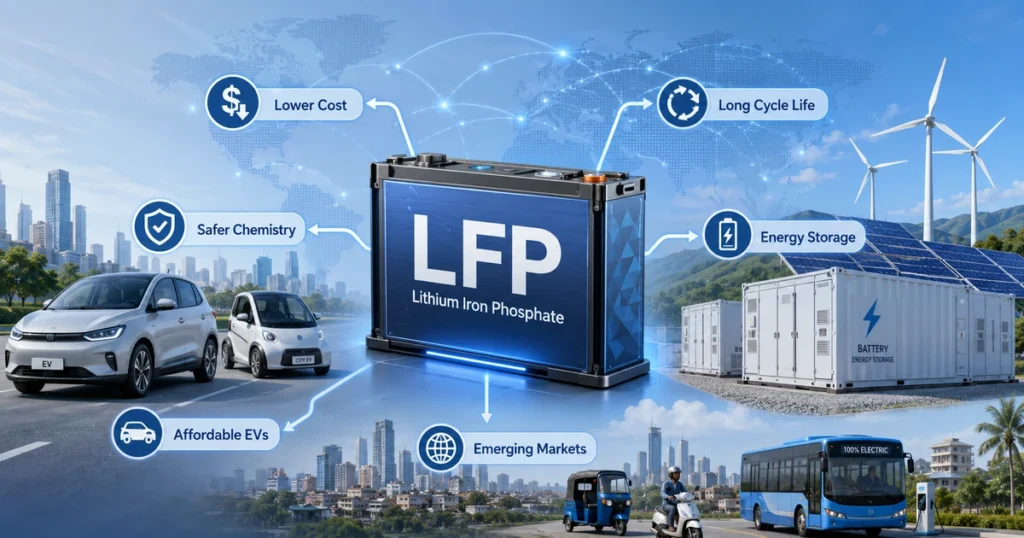
LFP batteries are taking over the global EV market because they solve one of the biggest problems facing electric vehicles today: cost. For years, lithium iron phosphate batteries were treated as the “budget” option. They had lower energy density than nickel-based batteries, so many people assumed they would stay limited to short-range EVs, buses, and lower-cost Chinese models.
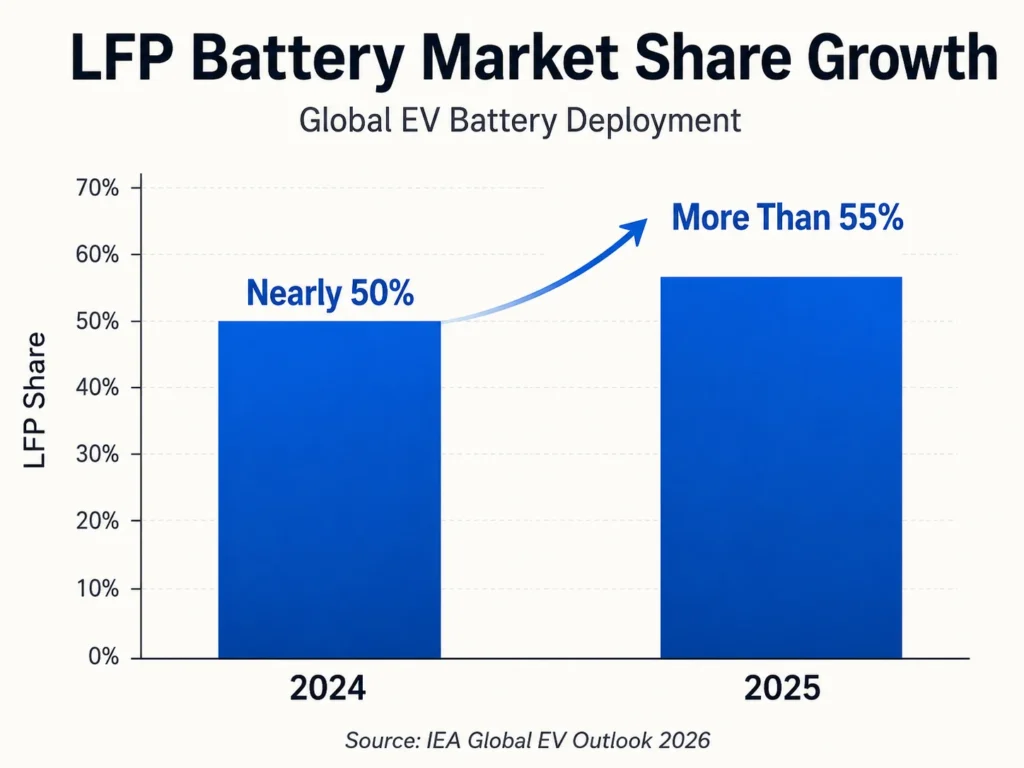
That view is now outdated. According to the International Energy Agency’s Global EV Outlook 2026, LFP batteries accounted for more than 55% of global EV battery deployment in 2025, up from nearly 50% in 2024. In other words, LFP is no longer a side chemistry. It has become the center of the global EV battery market.
The reason is not just chemistry. It is the combination of lower material cost, strong safety characteristics, long cycle life, simpler supply chains, rapid Chinese manufacturing scale, and rising demand for affordable EVs and energy storage systems.
For a broader comparison between LFP and nickel-based batteries, see our related guide: LFP vs NMC Batteries: Which EV Battery Is Better in 2026?
Introduction: LFP Is No Longer the “Cheap Battery”
A few years ago, LFP batteries were often described in a slightly dismissive way. They were cheaper, yes. They were safer, yes. They lasted a long time, yes. But they were also seen as heavy, lower-range, and mostly useful for entry-level EVs. If an automaker wanted a premium long-range vehicle, the assumption was simple: use a nickel-rich chemistry such as NMC or NCA.
That assumption is changing fast. LFP batteries are now appearing across a much wider part of the market. They are used in affordable EVs, mainstream EVs, commercial vehicles, electric buses, grid-scale storage systems, and increasingly in vehicles aimed at emerging markets. They are also central to the strategies of companies such as BYD, CATL, Tesla, Ford, Stellantis, and many Chinese EV brands expanding globally.
This does not mean LFP is perfect. It still has real limitations, especially when it comes to energy density and cold-weather charging performance. Long-range luxury EVs and high-performance vehicles will continue to use nickel-based batteries where the extra energy density is worth the cost.
But the global EV market is not made only of long-range luxury EVs. Most buyers want something more basic: a practical electric car that is affordable, reliable, safe, and good enough for daily driving. That is exactly where LFP works best.
What Are LFP Batteries?
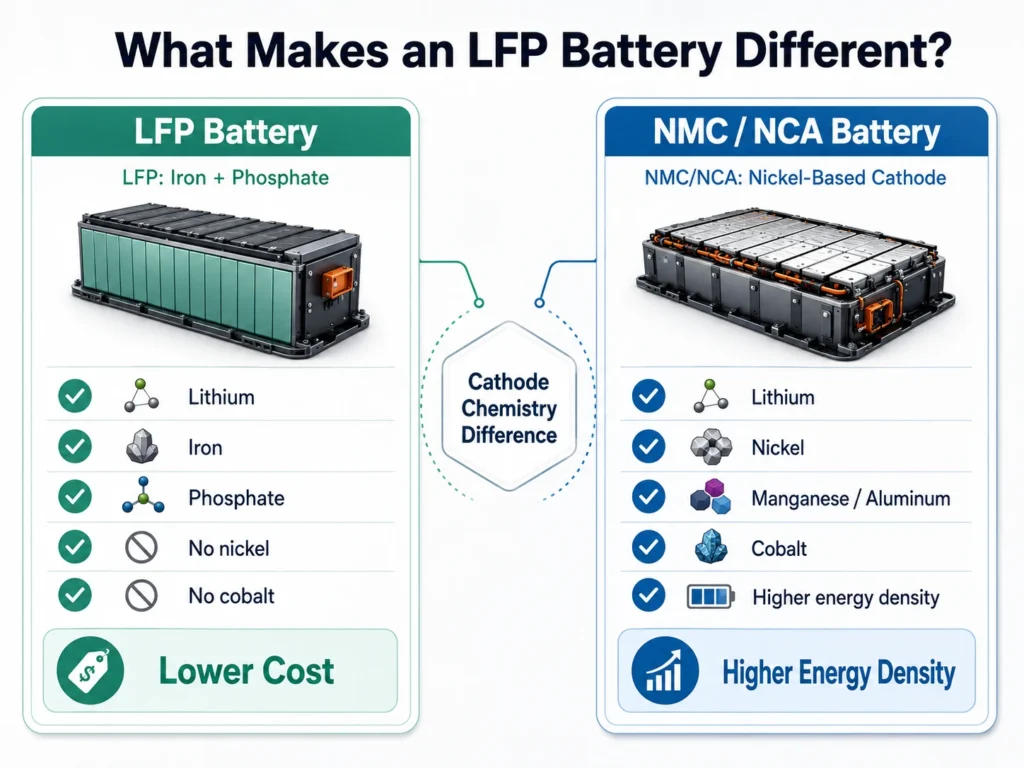
LFP stands for lithium iron phosphate. It is a type of lithium-ion battery that uses lithium iron phosphate as the cathode material. That may sound like a small technical detail, but cathode chemistry has a major impact on cost, performance, safety, and supply chain risk. In nickel-based batteries such as NMC or NCA, the cathode depends heavily on materials such as nickel and cobalt. Those materials can provide high energy density, but they also add cost, supply complexity, and sustainability concerns.
LFP takes a different path. It does not use nickel or cobalt in the cathode. Instead, it relies on iron and phosphate, which are generally more abundant and less expensive. That gives LFP several practical advantages:
- Lower material cost
- Better thermal stability
- Long cycle life
- Reduced exposure to nickel and cobalt price volatility
- Strong fit for lower-cost EVs and stationary storage
The tradeoff is energy density. LFP cells usually store less energy per kilogram than high-nickel cells. That means an LFP pack may need to be physically larger or heavier to deliver the same driving range. For many years, that weakness limited LFP’s appeal in passenger EVs. But pack design has improved. Cell-to-pack layouts, prismatic cells, blade-style designs, and better vehicle efficiency have helped make LFP good enough for many mainstream EVs. That phrase — “good enough” — is important. In the real EV market, good enough at the right price often wins.
The Market Has Shifted From Maximum Range to Affordability
The first wave of modern EV adoption was driven by range anxiety. Early buyers wanted reassurance that an EV could replace a gasoline car. Automakers responded by building larger batteries, pushing headline range numbers higher, and using energy-dense nickel-based chemistries.
That made sense at the time. But it also made many EVs expensive. Now the market is entering a different phase. EVs are no longer judged only by maximum range. Buyers are asking more practical questions:
- Can I afford it?
- Will the battery last?
- Can I charge it at home?
- Is the vehicle safe?
- Will the replacement cost be reasonable?
- Does the range meet my real driving needs?
This is where LFP becomes powerful. Many drivers do not need 350 or 400 miles of range every day. A practical EV with 230 to 300 miles of real-world range may be enough for commuting, errands, school drop-offs, local trips, and occasional highway driving. If using LFP helps reduce the purchase price, many buyers will accept the tradeoff. That is why LFP is becoming so important for mainstream EV adoption. It helps automakers move from “EVs as premium technology products” toward “EVs as normal cars.”
This also connects directly with the broader battery cost trend discussed in our article: Why EV Battery Prices Keep Falling — And What It Means for Car Buyers.
Why LFP Batteries Are Winning the Global EV Market on Cost
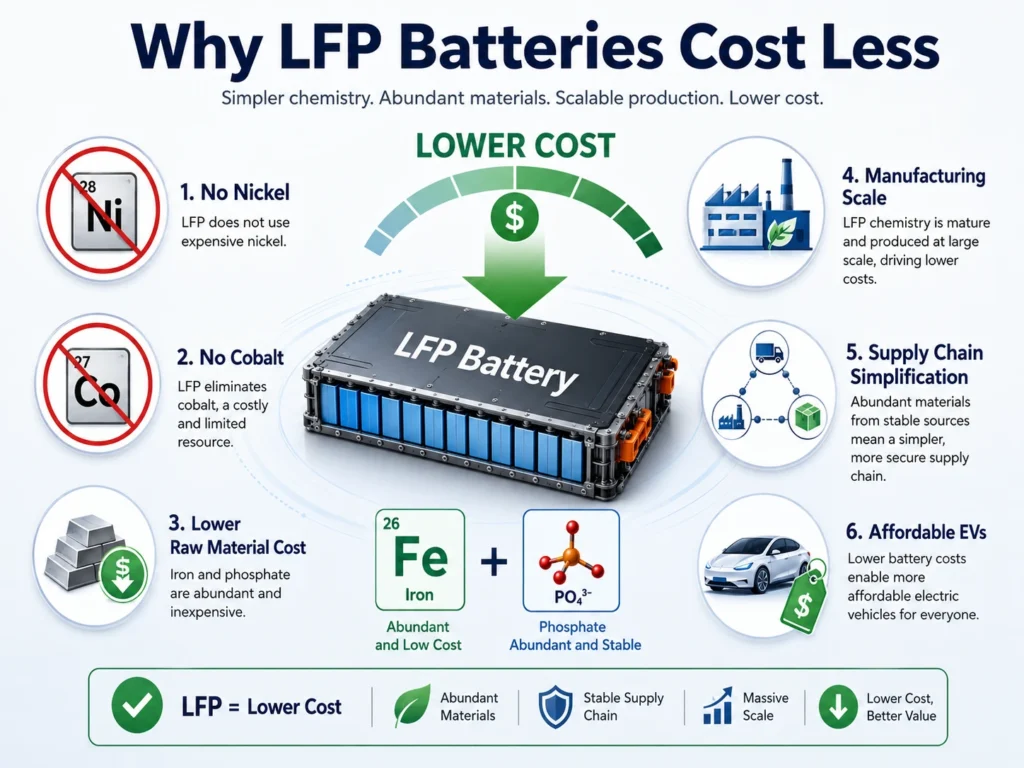
The EV industry talks a lot about charging speed, range, and battery breakthroughs. But for mass-market adoption, cost may be the most important factor. Battery packs remain one of the most expensive parts of an electric vehicle. Even modest reductions in battery cost can make a big difference in vehicle pricing, profit margins, and consumer adoption.
LFP has a natural cost advantage because it avoids nickel and cobalt. Iron and phosphate are not rare miracle materials, but that is exactly the point. LFP does not depend on the same expensive and geopolitically sensitive materials that helped make nickel-based batteries costly and supply-chain intensive.
The IEA reported that in 2025, LFP battery packs were more than 40% cheaper on average than NMC alternatives per kWh. Some of that gap comes from stationary storage applications, where energy density is less important and LFP dominates. But the basic message is clear: LFP is helping pull battery costs down.
BloombergNEF also reported that average lithium-ion battery pack prices fell again in 2025, reaching $108/kWh, with China showing especially low battery prices due to lower input costs, overcapacity, intense competition, and strong use of LFP cells. You can read BloombergNEF’s summary here: New Record Lows for Battery Prices.
For automakers, this matters in two ways. First, cheaper batteries can make EVs more affordable. Second, cheaper batteries can protect margins in a market where EV price competition is getting more intense. This is especially important in China, where competition among EV brands is extremely aggressive. But the same pressure is spreading globally. As Chinese EVs expand into Europe, Southeast Asia, Latin America, and other markets, automakers everywhere are being forced to think harder about cost. LFP is one of the most practical tools they have.
Safety and Thermal Stability Make LFP Attractive
Cost is the main driver, but safety is another major reason LFP is gaining ground. All EV batteries require careful engineering. No chemistry is automatically safe if the pack is poorly designed, poorly cooled, physically damaged, or badly managed by software. Still, chemistry matters.
LFP batteries are generally more thermally stable than high-nickel chemistries. They tend to be less prone to oxygen release at high temperatures, which can reduce the risk of severe thermal runaway behavior compared with some nickel-rich cathodes.
This does not mean an LFP pack cannot fail. It can. But LFP gives engineers a wider safety margin, especially for vehicles designed around cost, durability, and everyday use. That is one reason BYD’s Blade Battery became so influential. BYD combined LFP chemistry with a long blade-shaped cell and a space-efficient pack architecture. The point was not just to make a cheaper battery. It was to make LFP more practical for real EV packaging while emphasizing safety and durability. BYD describes its battery and vehicle technologies on its official site here: BYD Global.
The broader lesson is that LFP’s rise is not just about cathode chemistry. It is also about pack architecture. Better packaging helps offset LFP’s lower energy density, making it useful in more vehicle segments than before.
For more on how pack design is changing EV batteries, see our article: Cell-to-Pack vs Structural Battery Pack: 7 Key Differences You Should Know.
LFP Batteries Usually Offer Strong Cycle Life
Another reason LFP is expanding is durability. LFP batteries are known for strong cycle life, meaning they can often handle many charge and discharge cycles before losing a significant amount of capacity. This makes them attractive for vehicles that are charged frequently or driven heavily. That includes:
- Daily commuter EVs
- Ride-hailing vehicles
- Delivery vans
- Electric buses
- Fleet vehicles
- Entry-level EVs kept for many years
- Energy storage systems that cycle regularly
For many owners, this matters more than having the highest possible range on day one. A battery that lasts a long time can reduce long-term ownership anxiety. It may also support better resale value if buyers trust that the pack will remain usable for many years.
Of course, LFP batteries still degrade. Heat, high state of charge, fast charging, deep cycling, and calendar aging still matter. LFP is not magic. But the chemistry is well suited to repeated daily use, which fits the real behavior of many EV owners.
This is also why many LFP-equipped EVs recommend charging to 100% periodically. LFP has a relatively flat voltage curve, which makes state-of-charge estimation more difficult than with some nickel-based chemistries. Charging to full from time to time can help the battery management system recalibrate. That does not mean owners should leave the pack sitting at 100% for long periods in hot weather, but it does mean LFP ownership habits can differ from NMC ownership habits.
For a deeper look at long-term battery aging, see: How Long Do EV Batteries Last? Real-World Data and Battery Degradation in 2026.
China Turned LFP Into a Global Manufacturing Weapon
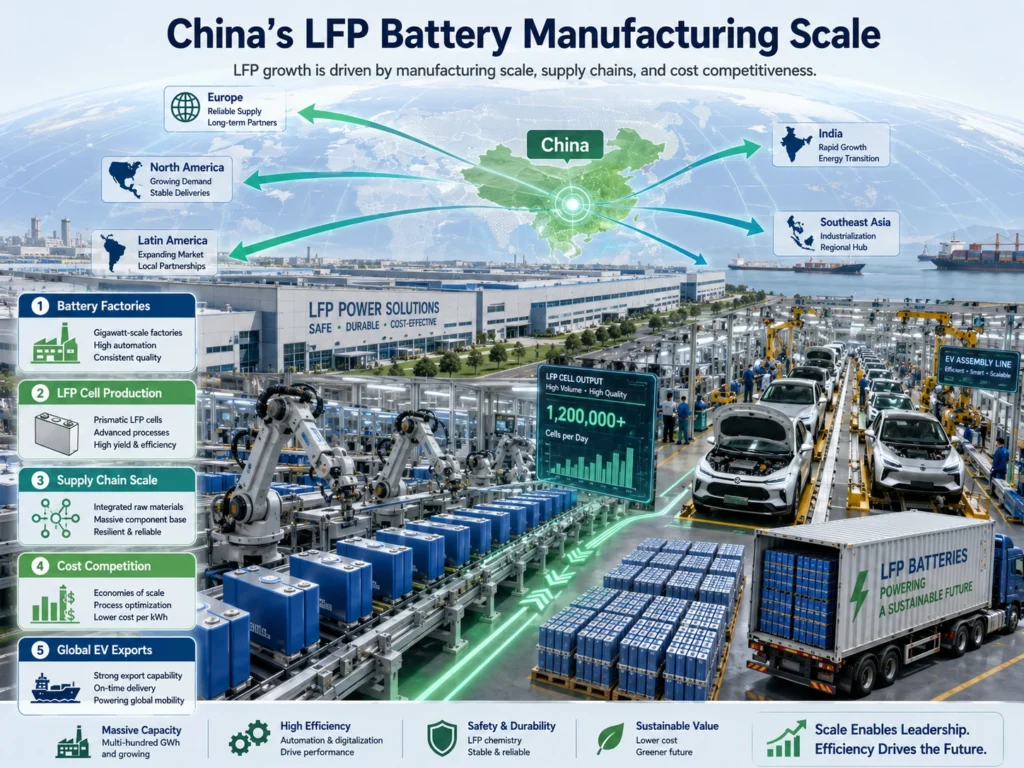
LFP’s rise cannot be separated from China’s battery industry. China did not simply adopt LFP. It industrialized it. Companies such as CATL and BYD helped scale LFP production, improve pack design, reduce cost, and integrate batteries into affordable EV platforms. This created a feedback loop: more production lowered cost, lower cost supported more EV sales, more EV sales justified more production, and the cycle continued.
The result is a major structural advantage. The IEA notes that LFP deployment remains heavily concentrated in China, although adoption is expanding rapidly in emerging markets and developing economies. It also notes that production of LFP cathode materials and related supply-chain expertise remains highly concentrated in China.
That concentration is both a strength and a risk. It is a strength because Chinese companies have made LFP extremely competitive. It is a risk because other regions now depend heavily on Chinese LFP technology, components, and know-how.
Europe and the United States are trying to respond. Ford, for example, has been developing LFP production in Michigan. Ford says its BlueOval Battery Park Michigan is on track to ship LFP batteries in 2026 for mainstream consumer automotive use. You can read Ford’s update here: BlueOval Battery Park Michigan Hits Hiring and LFP Production Milestones.
Stellantis and CATL have also announced a joint venture for a large-scale LFP battery plant in Spain, with production planned by the end of 2026 and potential capacity up to 50 GWh. Stellantis describes the project here: Stellantis and CATL LFP Battery Plant in Spain. These moves show that LFP is no longer just a Chinese domestic strategy. It is becoming a global industrial priority.
LFP Is Spreading Beyond Low-Cost EVs
The old view of LFP was simple: cheap chemistry for cheap cars. That is no longer accurate. Yes, LFP is still extremely important for affordable EVs. But it is also moving into mainstream vehicles because the definition of “mainstream” is changing. A mainstream EV does not need to be the longest-range vehicle on the market. It needs to be priced well, reliable, efficient, safe, and practical. LFP fits that formula.
Many automakers now use a mixed battery strategy. A standard-range version may use LFP, while a long-range or performance version uses NMC, NCA, or another higher-energy chemistry. This allows the same vehicle family to serve different buyers. For example, a driver who mostly commutes locally may choose the lower-cost LFP trim. Another driver who regularly takes long highway trips may choose the long-range nickel-based version.
That is not a weakness. It is good product planning. The EV market is becoming more like the gasoline market. Not every vehicle needs the same engine, fuel tank size, or performance target. In the same way, not every EV needs the same battery chemistry. This is why the future will not be one battery chemistry replacing all others. It will be chemistry segmentation.
LFP will dominate where cost, durability, and safety matter most. NMC and other nickel-based chemistries will remain important where range, weight, and performance matter more. Sodium-ion may eventually take some lower-cost and cold-weather niches. Solid-state may enter premium applications first if it reaches commercial scale.
For more on that broader chemistry landscape, see: Why There Will Not Be One Winning EV Battery Chemistry.
Energy Storage Is Helping LFP Scale Even Faster
One of the most important but underappreciated reasons LFP is growing is stationary battery storage. Grid-scale energy storage does not have the same constraints as EVs. A stationary battery does not need to be lightweight. It does not need to fit under a vehicle floor. It does not need to maximize driving range. It mainly needs to be low-cost, durable, safe, and able to cycle reliably.
That is almost a perfect match for LFP. The IEA notes that electric vehicles still account for more than 70% of lithium-ion battery deployment, while battery energy storage accounts for over 15% and is becoming increasingly important for power system flexibility. You can read the IEA commentary here: Global battery markets are growing strongly — and so are the supply risks.
This matters for EVs because battery markets are connected. When LFP demand rises in energy storage, it supports larger manufacturing scale, more supplier investment, better process control, and lower cost. Those improvements can then benefit EV batteries as well. That is why the rise of LFP should not be viewed only through the lens of passenger cars. LFP is becoming a general-purpose battery platform for both mobility and energy storage.
This trend is closely related to our previous article: EV Battery Storage Boom: Why Battery Companies Are Moving Beyond Cars.
Emerging Markets Are a Perfect Fit for LFP
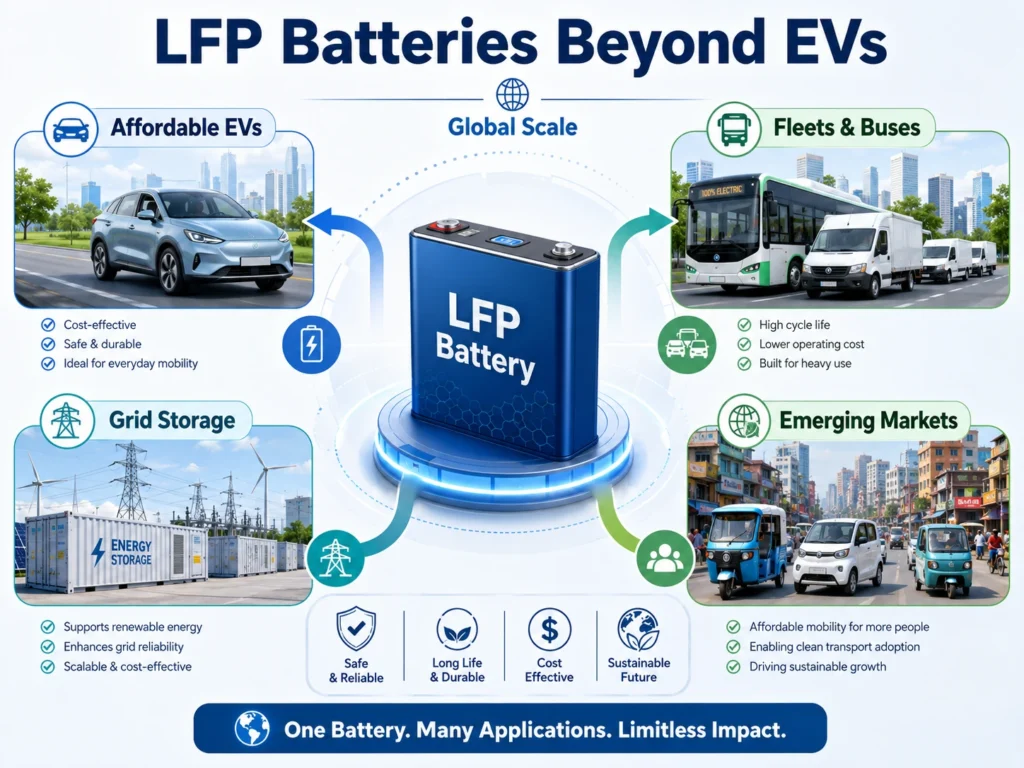
LFP also fits the needs of emerging EV markets. In countries where EV adoption is still developing, affordability often matters more than extreme range. Buyers may be more price-sensitive. Charging networks may still be expanding. Many drivers may use smaller vehicles for city and regional travel rather than long-distance highway trips. LFP works well in that environment.
The IEA reported that LFP batteries now power two-thirds of electric car sales in emerging markets and developing economies, double the share in 2023. It also noted that LFP adoption has expanded quickly in regions such as Southeast Asia, India, and Latin America. This is one reason Chinese EV exports matter so much. Many Chinese automakers have built competitive low-cost EV platforms around LFP. As those vehicles enter global markets, LFP spreads with them.
For consumers, this could be a major turning point. If LFP helps bring EVs closer to gasoline-car pricing in more markets, it could accelerate adoption far beyond premium buyers. That does not mean every region will follow China’s exact path. Local policy, tariffs, charging infrastructure, supply-chain rules, and consumer preferences will all shape adoption. But the technical and economic logic is strong: affordable EV markets favor affordable battery chemistries.
The Main Weakness: Lower Energy Density
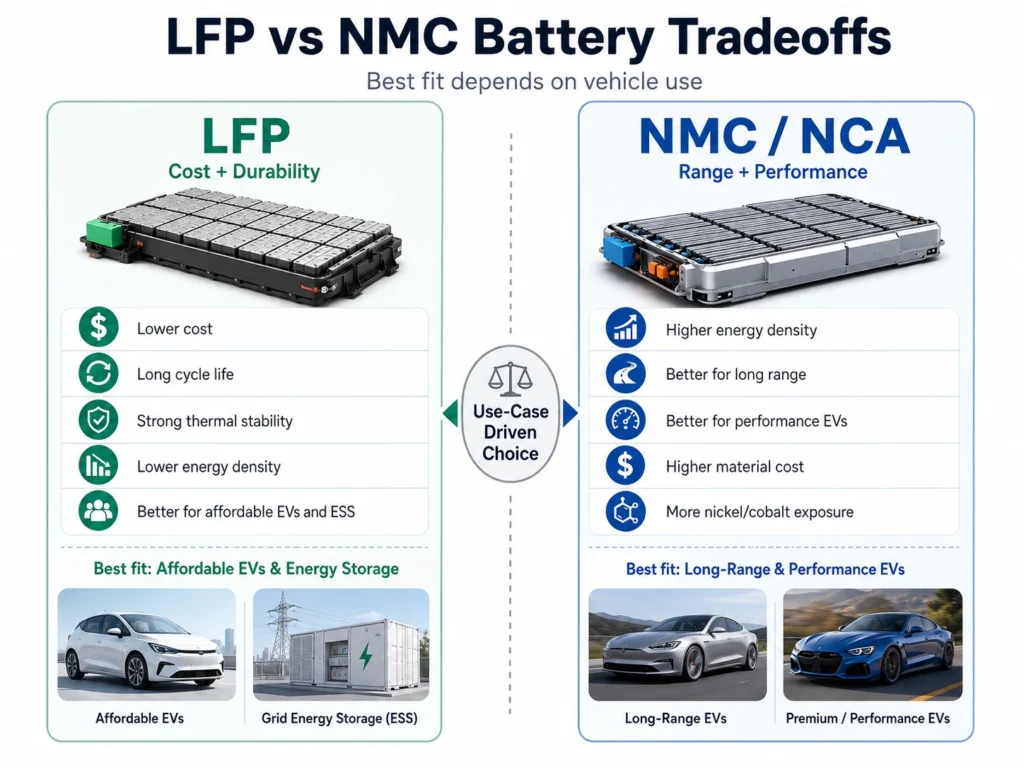
LFP’s rise does not erase its weaknesses. The biggest limitation is still energy density. Compared with high-nickel chemistries, LFP usually stores less energy per unit of weight and volume. That can make it harder to build very long-range EVs without increasing pack size and vehicle weight.
For a compact city car, that may not matter much. For a large pickup, luxury SUV, or high-speed long-distance vehicle, it matters a lot. Weight affects efficiency, handling, tire wear, payload, and charging energy. Pack volume affects vehicle design and passenger space. This is why many premium EVs still rely on nickel-based batteries.
There is also a cold-weather tradeoff. LFP batteries can show more noticeable performance and charging limitations in freezing conditions, especially if the pack is not properly preconditioned. A good thermal management system can reduce this issue, but it does not remove the chemistry difference entirely.
So the future is not “LFP everywhere.” The more realistic future is “LFP wherever it makes sense.” And as EV design improves, that “wherever” keeps getting larger.
LFP May Also Change EV Ownership Habits
LFP’s rise could change how people think about owning and charging an EV. With many nickel-based batteries, owners are often told to keep daily charging below 80% unless they need the full range. That advice is meant to reduce stress from high state of charge, especially when the battery sits full for long periods.
With LFP, the advice can be slightly different. Many LFP-equipped EVs recommend charging to 100% periodically for state-of-charge calibration. This can make ownership feel simpler for some drivers. Still, there is an important nuance. Charging an LFP battery to 100% is not the same as saying high state of charge never matters. Heat and time still affect batteries. Leaving any lithium-ion battery full for long periods in hot weather is not ideal.
The practical advice is simple: follow the automaker’s recommendation. If the manual says to charge the LFP pack to 100% regularly, do that. But do not treat LFP as indestructible. LFP gives owners more flexibility. It does not eliminate battery care entirely.
What LFP Means for Automakers
For automakers, LFP is not just a battery choice. It is a business strategy. A company that uses LFP can potentially lower vehicle cost, reduce exposure to nickel and cobalt markets, simplify thermal safety margins, and offer more affordable trims. That can be especially valuable as EV incentives change and price competition intensifies.
But LFP also creates strategic challenges. If the LFP supply chain is concentrated in China, automakers outside China face sourcing risk. Tariffs, trade rules, local content requirements, and technology transfer restrictions can all affect battery planning. That is why companies are trying to localize LFP production. Ford’s Michigan LFP plans and the Stellantis-CATL Spain joint venture are examples of how the industry is trying to bring LFP closer to major vehicle production markets.
The challenge is that manufacturing LFP at low cost is not easy. China’s advantage did not appear overnight. It came from scale, supplier networks, engineering learning, and intense competition. Other regions can build LFP capacity, but matching China’s cost structure will take time.
What LFP Means for EV Buyers
For buyers, LFP is mostly good news. It can help make EVs cheaper, safer, and more durable. It may also reduce anxiety about battery replacement because LFP packs are well suited for long cycle life.
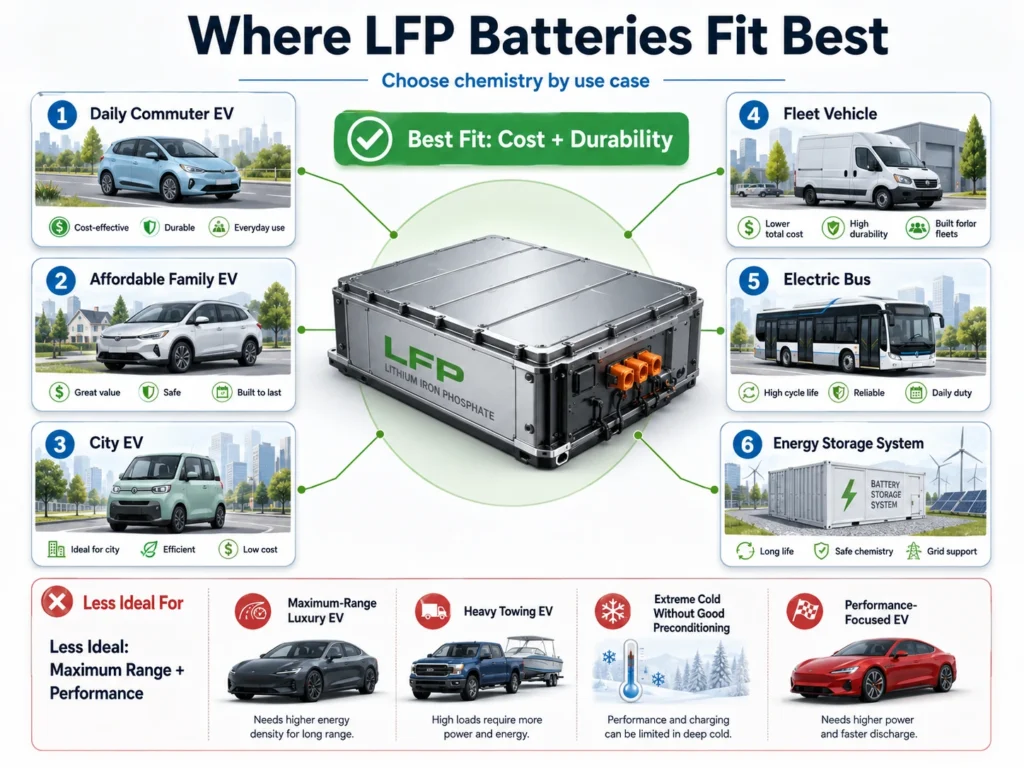
But buyers should still understand the tradeoffs. An LFP EV may be a great choice if you mostly drive locally, charge at home, want lower cost, and care about long-term durability. It may also be attractive if you plan to keep the vehicle for many years. A nickel-based EV may still be better if you need maximum highway range, live in a very cold climate, tow frequently, or want a premium performance vehicle.
The key is not to ask, “Is LFP better than NMC?” The better question is, “Which battery chemistry fits this vehicle and my driving needs?” That is the direction the EV market is heading. Battery chemistry is becoming part of vehicle segmentation, just like engine size used to be.
Will LFP Keep Growing?
LFP is likely to keep growing, but its growth will not be perfectly smooth. Several forces support continued expansion:
- EV affordability is becoming more important.
- Energy storage demand is rising quickly.
- Automakers want to reduce nickel and cobalt exposure.
- Chinese battery makers continue to scale LFP aggressively.
- Emerging markets favor lower-cost EV platforms.
- Pack design improvements are reducing LFP’s traditional limitations.
At the same time, there are risks. Very low LFP prices may not be sustainable if suppliers are operating with thin or negative margins. Supply chains remain concentrated. Trade restrictions could slow adoption in some regions. And new chemistries such as sodium-ion, LMFP, LMR, and solid-state batteries could change the market again over time. Still, LFP has already crossed an important line. It is no longer an alternative chemistry waiting for acceptance. It is now the chemistry shaping the global EV market.
Conclusion: LFP Is Winning the Practical EV Market
LFP batteries are taking over the global EV market because they match what the next phase of EV adoption needs. The first phase of EV growth was about proving that electric cars could be exciting, long-range, and technologically advanced. Nickel-based batteries played a major role in that story. The next phase is different. It is about affordability, scale, durability, safety, and global access. That is where LFP shines.
LFP will not replace every battery chemistry. Premium long-range EVs, performance vehicles, heavy towing applications, and some cold-weather markets will still need higher-energy batteries. But for mainstream EVs, affordable EVs, fleets, buses, emerging markets, and energy storage, LFP has become the practical default. That is why LFP is not just taking market share. It is changing what the EV market is becoming.
FAQs
Are LFP batteries better than NMC batteries?
Not always. LFP batteries are usually better for cost, durability, safety, and frequent daily use. NMC batteries are usually better for maximum range, lower weight, and high-performance EVs. The best choice depends on the vehicle and how you drive.
Why are LFP batteries cheaper?
LFP batteries avoid nickel and cobalt in the cathode. They use iron and phosphate, which are generally lower-cost materials. LFP also benefits from massive manufacturing scale, especially in China.
Do LFP batteries last longer?
LFP batteries often have strong cycle life and can be well suited for high-mileage use. However, they still degrade over time. Temperature, charging habits, depth of discharge, and battery management all matter.
Are LFP batteries safe?
LFP batteries are generally known for strong thermal stability compared with high-nickel chemistries. However, pack design, cooling, software, crash protection, and manufacturing quality are still critical.
Why do some LFP EVs recommend charging to 100%?
LFP batteries have a flatter voltage curve, which can make state-of-charge estimation more difficult. Charging to 100% periodically can help the battery management system recalibrate. Owners should still follow the automaker’s specific guidance.
Will LFP replace all EV batteries?
No. LFP will likely dominate many affordable and mainstream EVs, but nickel-based batteries will remain important for long-range, high-performance, and premium vehicles. The future EV market will use multiple chemistries depending on cost, range, performance, and region.