
Quick Answer
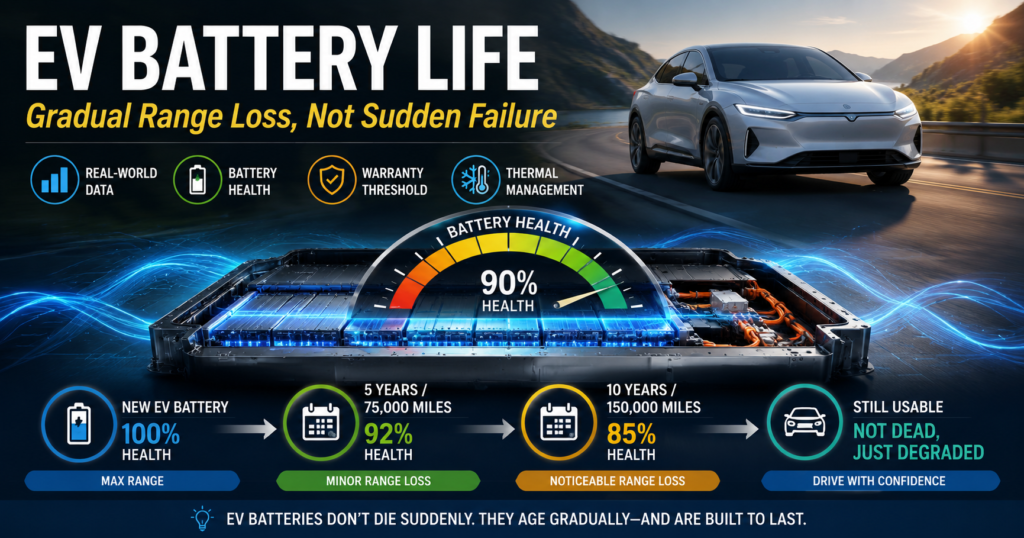
Most modern EV batteries should last 12 to 20 years under normal use, and many packs are likely to outlast the first owner of the vehicle. In mileage terms, a realistic expectation for many modern EVs is roughly 150,000 to 300,000 miles, although climate, charging habits, battery chemistry, software, and thermal management can make a big difference.
The better question is not, “Will the battery suddenly die?” In most cases, it will not. A better question is, “How much usable range will the battery lose over time?” Real-world battery data from Geotab’s updated 2026 analysis shows an average degradation rate of about 2.3% per year across more than 22,700 vehicles, while other large datasets show many used EVs still staying well above common warranty thresholds even after years of driving. That means EV battery aging is real, but for most drivers, it is usually gradual, manageable, and far less dramatic than many early EV fears suggested.
Introduction: EV Battery Life Is No Longer a Guess
How long do EV batteries last in real-world driving? In 2026, the answer is usually much longer than many first-time EV buyers expect. For years, EV battery life was one of the biggest unknowns in electric vehicle ownership. Buyers worried that an EV might behave like an old smartphone: great when new, noticeably weaker after a few years, and eventually expensive to replace.
That comparison is understandable, but it is not very accurate. An EV battery is not managed like a phone battery. It is larger, more expensive, more carefully cooled, more conservatively controlled, and protected by a battery management system that constantly monitors voltage, current, temperature, state of charge, and safety limits. Modern EVs are designed so the battery pack does not normally operate at the absolute edge of its physical limits.
Now that first-generation EVs are getting older and newer EVs are accumulating high mileage, the industry finally has more real-world evidence. The picture is becoming clearer: most EV batteries do lose capacity, but they usually do it slowly. Total battery failure is much less common than ordinary range loss.
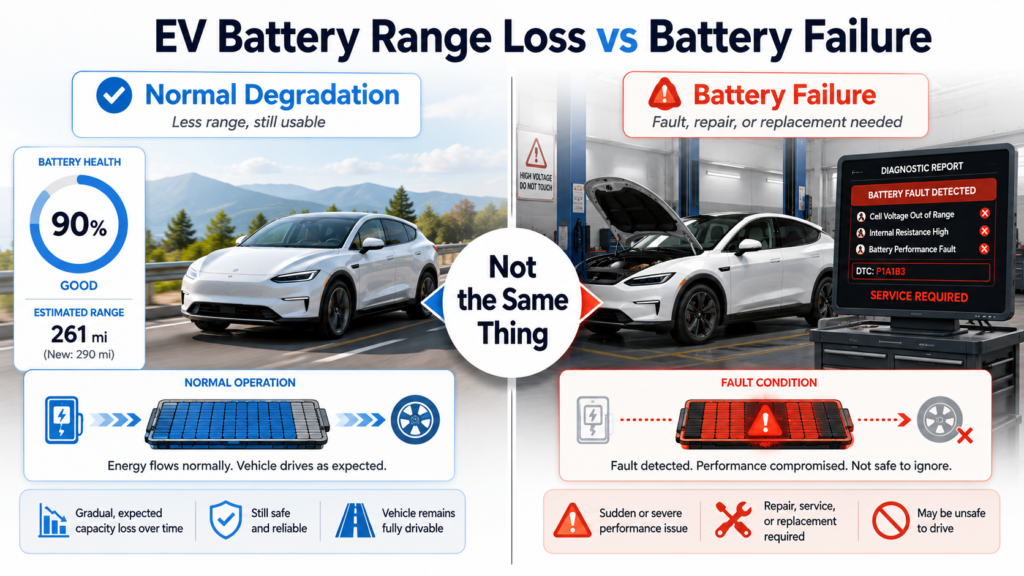
That distinction matters. A battery that has lost 8% or 12% of its usable capacity may not feel brand new, but it is not “dead.” It can still power the vehicle safely and reliably. In fact, many EVs remain useful long after their original rated range has dropped slightly.
For a deeper explanation of the difference between normal range loss and actual failure, see our related guide: EV Battery Degradation: 7 Reasons Range Loss Usually Isn’t Failure.
What “EV Battery Life” Actually Means
When people ask how long an EV battery lasts, they often mean several different things at once. Some drivers are asking when the battery will fail completely. Others want to know when the range will become noticeably worse. Used EV buyers may be asking when the car will become too risky to own. Automakers, meanwhile, usually define battery durability around warranty thresholds, such as retaining a minimum percentage of original capacity for a certain number of years or miles.
These are related questions, but they are not the same. In everyday ownership, EV battery life usually means the period during which the battery still provides enough range, charging performance, and reliability for the owner’s needs. For one driver, a 250-mile EV that drops to 220 miles may still be perfectly fine. For another driver with a long highway commute in winter, that same loss may feel more limiting. This is why battery degradation should not be treated as a simple pass-or-fail condition. It is more like tire wear or engine aging. The vehicle remains usable, but its performance changes gradually.
The key metric is usually State of Health, or SOH. A battery at 100% SOH is close to its original usable capacity. A battery at 90% SOH has lost roughly 10% of its usable capacity. That does not mean the car lost exactly 10% of its EPA range in every condition, because temperature, speed, tires, HVAC use, and driving style also affect real-world range. Still, SOH is a useful way to think about long-term battery condition.
What Real-World Data Says in 2026
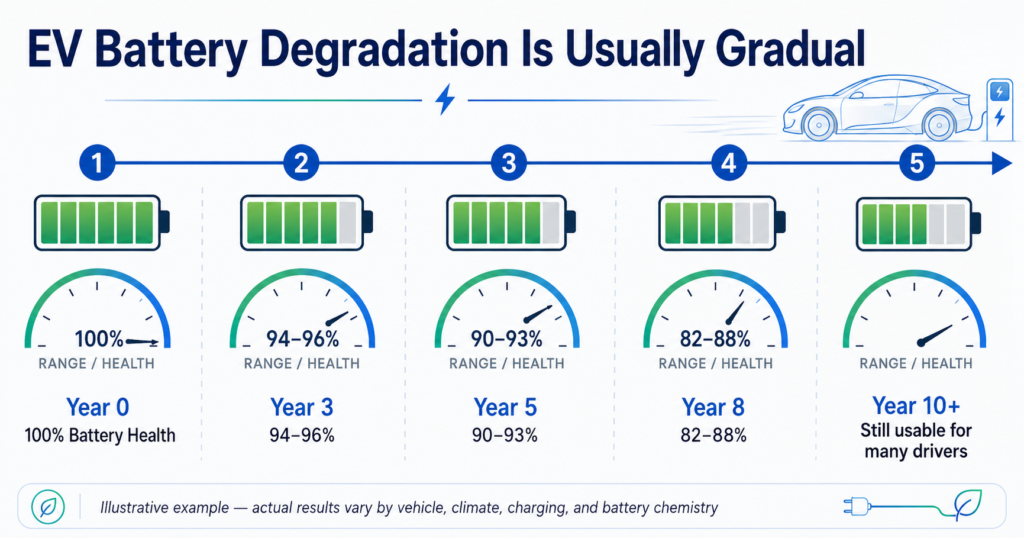
The strongest reason to be less afraid of EV battery life today is that we now have more real-world data than we did a decade ago. Geotab’s updated 2026 EV battery health analysis, based on more than 22,700 vehicles, found an average degradation rate of about 2.3% per year. That is higher than Geotab’s earlier 2024 estimate of 1.8% per year, partly because the dataset changed and fast-charging usage increased, but it still points to gradual aging rather than widespread early failure.
A separate 2025 Battery Performance Index from Generational, based on more than 8,000 battery health assessments in the UK, reported an average battery health of 95.15% across all tested vehicles. It also found that 8- to 9-year-old vehicles showed about 85% median capacity, and high-mileage EVs above 100,000 miles often returned 88–95% battery health.
That does not mean every EV battery will age perfectly. Some vehicles degrade faster than others. Early EVs with small battery packs, weaker thermal management, or less advanced battery software can show more noticeable aging. But the overall trend is encouraging: modern EV batteries are generally lasting longer than many shoppers expected.
Recurrent’s 2025 analysis also points out an important change in the market: newer EVs have much larger battery packs than early models. Between 2015 and 2024, average battery sizes increased significantly, which gives newer EVs more range buffer before degradation becomes a practical ownership problem.
That last point is easy to overlook. A 24 kWh early EV that loses 15% capacity may feel severely limited because it did not have much range to begin with. A modern 75 kWh or 100 kWh EV can lose the same percentage and still remain practical for many drivers.
A Real Example: Volkswagen ID.3 After 160,000 Kilometers
One useful real-world example comes from Volkswagen’s ID.3 endurance test with ADAC in Germany. After four years and more than 160,000 kilometers of testing, the ID.3 Pro S still had 91% net battery capacity. Volkswagen also noted that the car was not treated gently: more than 40% of its charging sessions used rapid charging, and the vehicle was sometimes left at 100% state of charge for extended periods.
This is not proof that every EV will retain 91% capacity after 100,000 miles. It is one vehicle model, one pack design, and one test environment. But it is a useful counterpoint to the idea that EV batteries automatically collapse after a few years.
It also shows why battery software, thermal control, and pack design matter. A modern EV does not simply expose its cells directly to whatever the driver demands. The vehicle constantly manages charging power, temperature, and usable capacity windows to slow degradation. That hidden protection is one of the reasons EV battery aging can look less dramatic in the real world than many people expected.
Why Real-World Driving May Be Easier on Batteries Than Lab Tests
Another interesting development comes from Stanford and SLAC researchers, who reported that EV batteries exposed to more realistic driving patterns may last longer than expected compared with traditional constant-current lab testing. Their point was not that batteries never age. Rather, real driving includes a mix of city trips, highway use, rest periods, acceleration, regenerative braking, and parked time, which can differ significantly from simplified lab cycling.
This matters because battery life estimates are often based on controlled tests. Controlled tests are useful because they isolate variables, but they do not always represent how people actually drive. A typical EV does not discharge from 100% to near zero every day and then recharge immediately at maximum power. Many owners drive 30 to 50 miles, park for hours, charge overnight, and only occasionally fast charge on road trips. That pattern can be relatively gentle compared with aggressive laboratory cycling.
Of course, some real-world usage is harder on batteries. A ride-share driver in Phoenix who fast charges daily and parks in heat is not the same as a commuter in Michigan who charges at home overnight. This is why averages are helpful, but individual battery life still depends heavily on use case.
The Main Causes of EV Battery Degradation
EV battery degradation comes from several overlapping mechanisms. You do not need to understand every electrochemical detail to take care of an EV, but the basics help explain why some habits matter more than others.
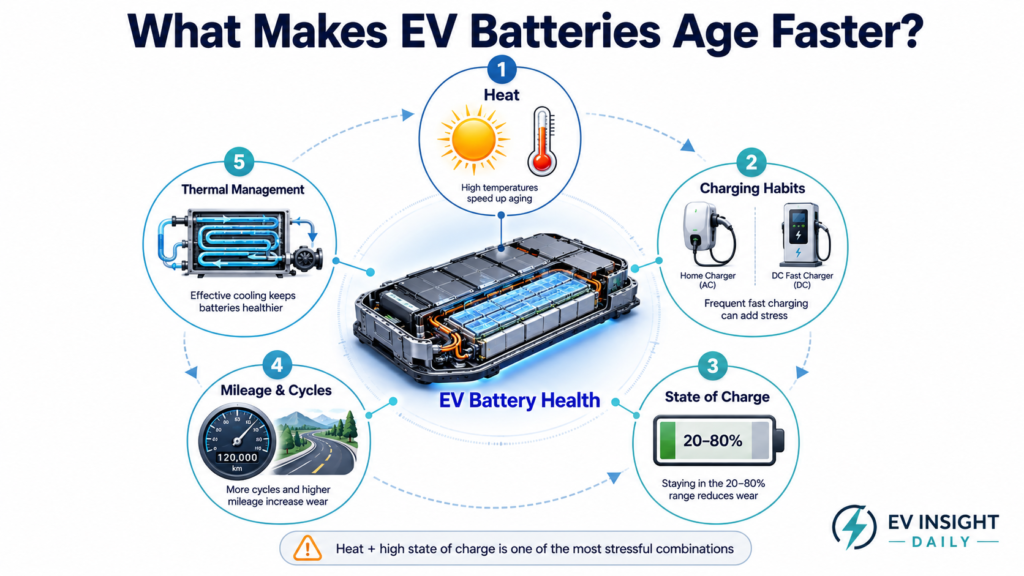
The first factor is calendar aging. Batteries age even when they are not being driven. Time, temperature, and state of charge all matter. A battery parked at a high state of charge in hot weather generally ages faster than one stored at a moderate charge in mild conditions.
The second factor is cycle aging. This comes from charging and discharging the battery. Every mile driven uses some portion of the battery’s lifetime, but modern EV packs are designed for many cycles. Shallow daily cycling is usually not a major problem.
The third factor is temperature. Heat accelerates side reactions inside lithium-ion cells. Cold does not usually age the battery as quickly by itself, but charging a cold battery too aggressively can increase lithium plating risk.
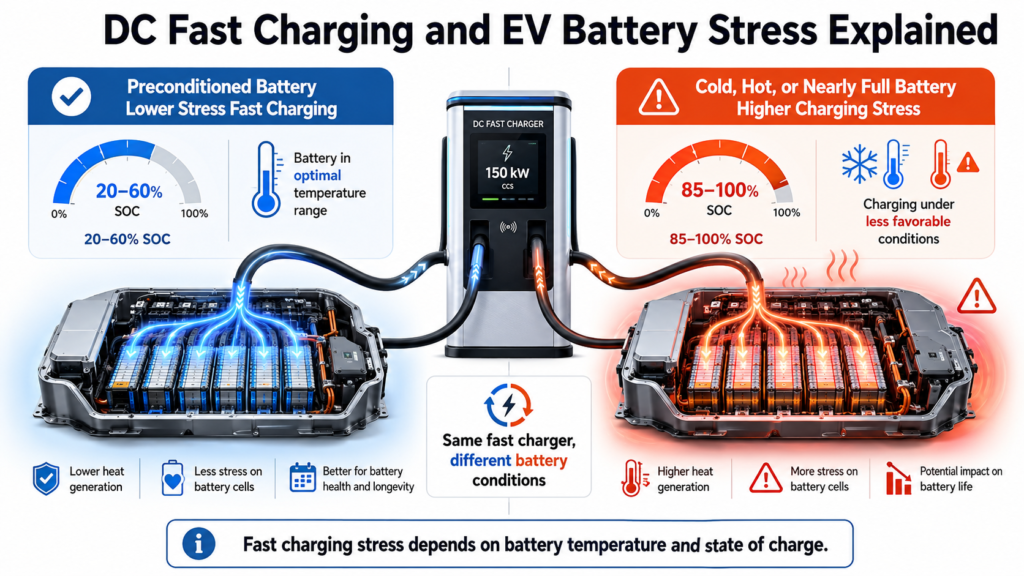
The fourth factor is charging behavior. Frequent DC fast charging does not automatically ruin a modern EV battery, but repeated high-power charging under poor thermal conditions can increase stress. That is why many EVs precondition the battery before fast charging and reduce charging power when the pack is too cold, too hot, or already at a high state of charge.
For a more detailed explanation of charging-related degradation, see our guide: Why Fast Charging Degrades EV Batteries in 2026.
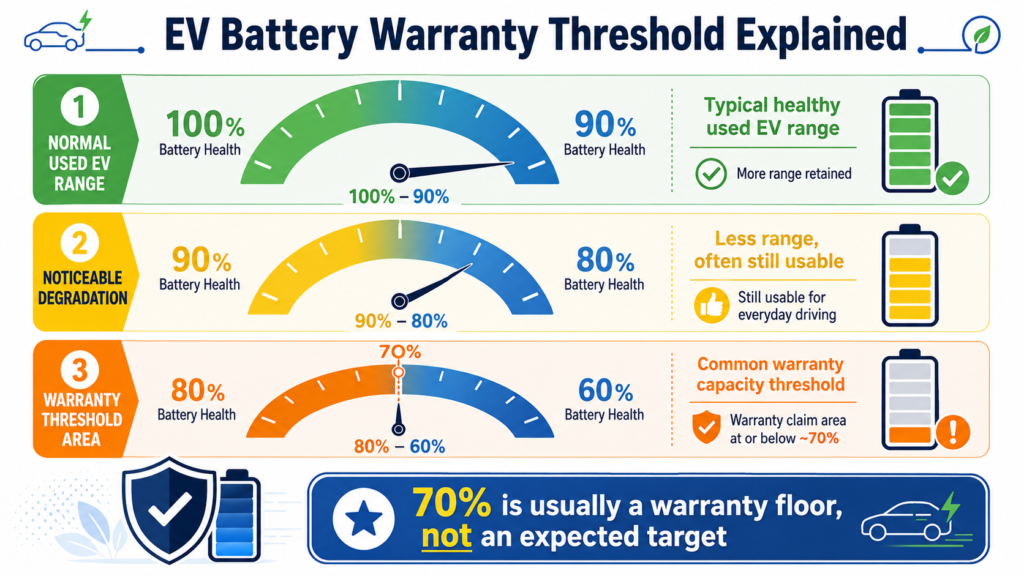
Why Battery Warranties Usually Use 70%
In the U.S., many EV battery warranties are built around an 8-year/100,000-mile structure, although exact terms vary by brand, model, trim, and model year. The U.S. Department of Energy’s Alternative Fuels Data Center notes that several manufacturers offer 8-year/100,000-mile EV battery warranties, and many automaker warranty pages use similar coverage periods.
Tesla’s current warranty page lists different mileage limits depending on the vehicle. Model 3 RWD, Model Y RWD, and Model Y AWD are listed at 8 years or 100,000 miles with minimum 70% battery capacity retention. Some premium, AWD, and performance versions of Model 3 and Model Y are listed at 8 years or 120,000 miles, while Model S, Model X, and Cybertruck are listed at 8 years or 150,000 miles, also with minimum 70% retention. Chevrolet’s EV ownership page lists an 8-year/100,000-mile Propulsion Battery Limited Warranty for Chevy EVs.
The important detail is that a warranty threshold is not the same as an expected degradation target. A 70% capacity warranty does not mean the automaker expects the battery to lose 30% capacity during the warranty period. It means that if the battery falls below the stated threshold during the covered period, it may qualify for warranty service under the warranty terms. In practice, many EV batteries stay well above that level. That is why a used EV with 88% or 92% battery health may still be very normal, even if the car no longer has the exact same range it had when new.
For a deeper breakdown of warranty fine print, see our guide: EV Battery Warranties Explained: What They Really Cover in 2026.
How Many Miles Can an EV Battery Last?
Mileage estimates are tricky because batteries age from both time and use. A low-mileage EV parked for years in a hot climate at 100% charge may not be healthier than a higher-mileage EV driven regularly and charged sensibly.
Still, for many modern EVs, 150,000 miles should be a reasonable expectation rather than an extreme outcome. Many packs will likely go beyond 200,000 miles, especially in vehicles with good thermal management and moderate charging habits. Some may reach 300,000 miles while still usable, though not necessarily with original range.
The key is that “lasting” does not mean “remaining perfect.” A battery at 85% SOH can still be useful. If the vehicle originally had 300 miles of real-world range, 85% battery capacity might still support roughly 255 miles under similar conditions. For many owners, that is still plenty.
The situation is different for older short-range EVs. If a first-generation EV started with 80 miles of real-world range, even modest degradation could make it inconvenient. That is one reason early EV battery aging stories can sound worse than what many current EV owners are likely to experience. Modern EVs simply start with more usable range.
Does Fast Charging Shorten EV Battery Life?
Fast charging can increase battery stress, but the answer is more nuanced than “fast charging is bad.” A modern EV does not blindly accept maximum charging power from 0% to 100%. The battery management system controls the charging curve. It may accept high power when the battery is warm and at a lower state of charge, then gradually reduce power as the pack fills up. This is why charging from 10% to 60% can be much faster than charging from 80% to 100%.
The real concern is repeated fast charging under stressful conditions. Cold batteries, very high charging power, high state of charge, and poor thermal management can increase degradation risk. In cold weather, the biggest concern is lithium plating, where metallic lithium can form on the anode surface instead of safely entering the graphite structure. That is why EVs with strong battery preconditioning can fast charge better and age more gracefully. The vehicle warms or cools the pack before charging, then limits current based on what the cells can safely accept.
For most owners, occasional road-trip fast charging is not something to fear. Daily fast charging as the main charging method may be worth thinking about more carefully, especially in extreme climates.
Does Charging to 100% Damage the Battery?
Charging to 100% is not automatically harmful, but keeping a lithium-ion battery at a very high state of charge for long periods can increase calendar aging, especially in hot weather.
This is why many EVs recommend a daily charging limit around 70%, 80%, or 90%, depending on chemistry and manufacturer guidance. For long trips, charging to 100% is usually fine. The better habit is to time the charge so the vehicle reaches 100% shortly before departure instead of sitting full for many hours or days.
There is one important exception: many LFP battery vehicles recommend charging to 100% periodically, sometimes even weekly, because LFP voltage behavior makes state-of-charge calibration more difficult. That does not mean LFP batteries are immune to aging. It simply means the best charging routine can differ by chemistry. For daily use, the simplest rule is this: do not overthink it, but avoid leaving the battery full in hot weather when you do not need the range.
Climate May Matter More Than Mileage
Two EVs with the same mileage can have very different battery health. Climate is one reason. Hot climates can accelerate battery aging because elevated temperatures increase unwanted side reactions inside lithium-ion cells. This is especially important when the vehicle is parked at a high state of charge. A battery sitting at 95% charge in intense summer heat is under more stress than the same battery sitting at 50% in a mild garage.
Cold climates create a different issue. Cold temperatures temporarily reduce range because the battery is less efficient and the cabin needs heat. That temporary winter range loss is not the same as permanent degradation. However, charging a cold battery too quickly can increase long-term risk, which is why modern EVs limit power or precondition the battery.
This is where thermal management becomes critical. Liquid-cooled battery packs, smart preconditioning, and conservative charging controls can reduce stress in both hot and cold conditions. In other words, battery life is not only about the cells. It is also about the system around the cells.
How to Make an EV Battery Last Longer
The best EV battery habits are not complicated. You do not need to baby the car every day, and you do not need to treat every charging session like a science experiment. For daily driving, use a moderate charge limit when you do not need full range. Park in shade or a garage during extreme heat when possible. Use scheduled charging so the battery does not sit full overnight unnecessarily. Let the car precondition before DC fast charging in cold weather. Avoid repeated deep discharges to very low state of charge unless needed.
Most importantly, follow the manufacturer’s guidance for your specific vehicle and chemistry. A Tesla Model Y with NMC or NCA cells, a Chevy Equinox EV, a Hyundai IONIQ 5, and an LFP-based EV may not all have the same ideal charging routine.
The good news is that modern EVs already protect themselves. The driver’s job is mostly to avoid the most stressful patterns: high heat, high state of charge, repeated fast charging in poor conditions, and leaving the battery near empty for long periods.
What This Means for Used EV Buyers
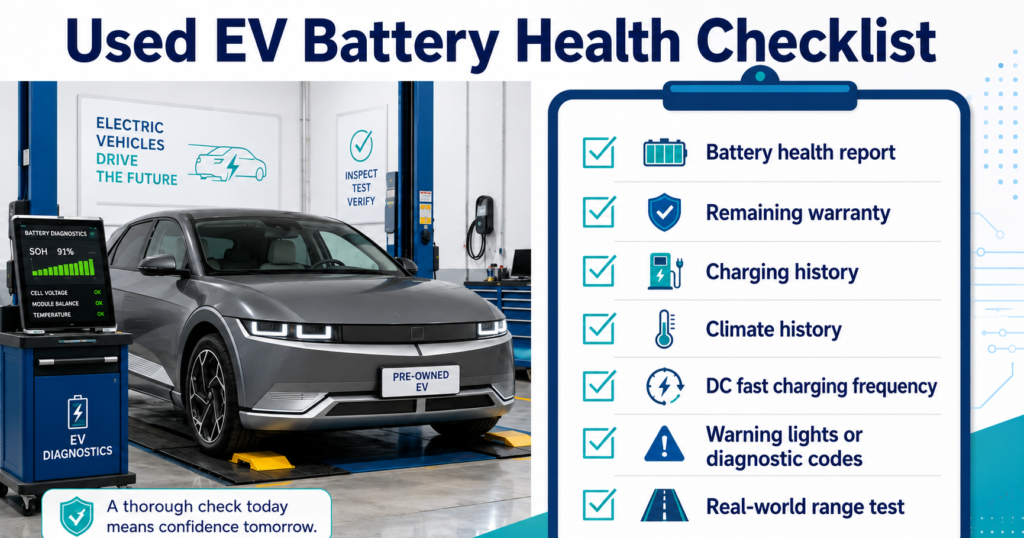
Battery life is especially important in the used EV market. A used EV can be a great deal, but buyers should think differently than they would with a gasoline car. Mileage still matters, but it is not the only thing that matters. A battery health report, service history, climate history, charging habits, and remaining warranty coverage may be just as important. A high-mileage EV with strong battery health can be a better buy than a low-mileage EV that spent years sitting fully charged in a hot climate.
The Generational 2025 Battery Performance Index is encouraging for used EV buyers because it found that mileage alone was not a reliable predictor of battery health and that many 100,000-mile-plus EVs still showed strong SOH. That said, used EV shoppers should not rely only on the dashboard range estimate. Guess-o-meter range can change with driving style, weather, tires, and recent energy use. A proper battery health report or diagnostic scan is more useful.
As battery passports and standardized battery health reporting become more common, used EV buying should become easier. Until then, buyers should ask for battery health information whenever possible.
Conclusion: EV Batteries Usually Fade, Not Fail
The best way to think about EV battery life in 2026 is simple: most EV batteries are not disposable parts waiting to fail after the warranty expires. They are long-life components that slowly lose capacity over time.
Real-world data now shows that many EV batteries remain healthy well beyond the early years of ownership. Some degradation is normal. A small amount of range loss does not mean the battery is defective. In many cases, the rest of the vehicle may become old before the battery becomes unusable.
For most drivers, a modern EV battery should comfortably last through the typical ownership period. With reasonable charging habits, good thermal management, and a little attention to heat and state of charge, many packs should remain useful for 150,000 miles, 200,000 miles, or more.
The battery will age. But in most modern EVs, it will not age like a smartphone. It will age more like a well-managed, software-protected energy system designed for years of daily use.
FAQs
How long do EV batteries usually last?
Most modern EV batteries are expected to last around 12 to 20 years, depending on climate, mileage, charging habits, chemistry, and thermal management. Many will remain usable well beyond 150,000 miles.
Do EV batteries need to be replaced after 8 years?
Usually, no. The 8-year period is commonly a warranty period, not an expected replacement date. Many EV batteries remain well above warranty capacity thresholds after 8 years.
What battery health is considered good for a used EV?
There is no single universal number, but 90% or higher is generally strong for a used EV. Around 80–90% may still be perfectly usable depending on the vehicle’s original range and the buyer’s needs.
Is 70% battery health bad?
A battery at 70% health has lost a significant amount of usable capacity, but it may still function. The reason 70% matters is that many warranties use it as a minimum capacity threshold during the warranty period.
Does DC fast charging ruin EV batteries?
Occasional DC fast charging does not ruin a modern EV battery. Repeated fast charging under high heat, very cold battery conditions, or high state of charge can increase stress, but modern battery management systems reduce risk by controlling charging power.
Should I charge my EV to 100%?
Charging to 100% is fine when you need the range, especially before a trip. For daily use, many lithium-ion EVs are happier with a lower charge limit. LFP-based EVs may have different recommendations, so follow your owner’s manual.
— Updated for 2026 with newer real-world EV battery degradation data, warranty information, and used EV battery health insights.