
Electric vehicle batteries have improved dramatically over the past few years, but many buyers still ask the same question:
Should I choose an EV with an LFP battery or an NMC battery?
In 2026, this has become one of the most important differences between electric vehicles. Tesla, BYD, Hyundai, Ford, GM, and many other automakers are now using different battery chemistries depending on vehicle price, range targets, and market strategy.
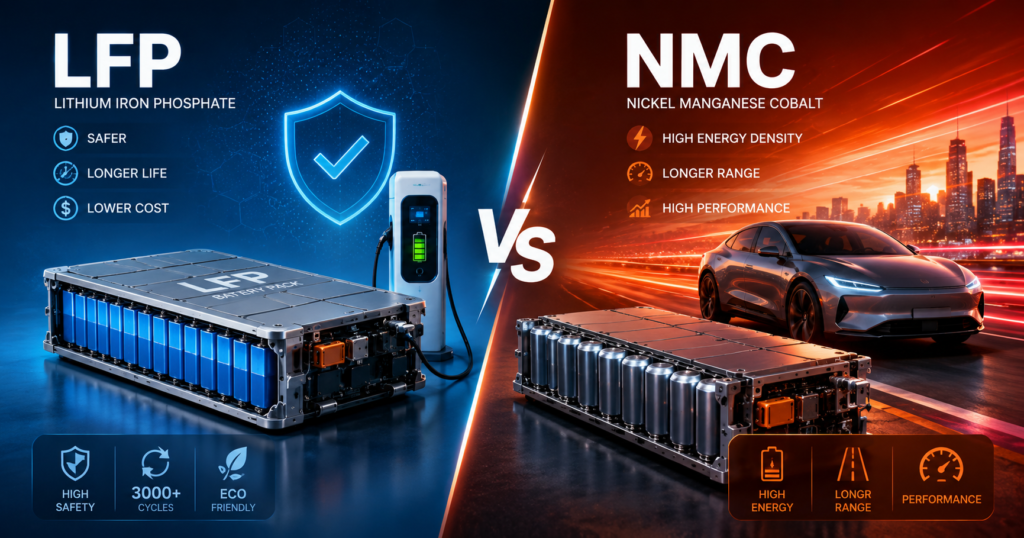
While both LFP and NMC are lithium-ion batteries, they are designed with very different priorities in mind. LFP batteries focus on durability, safety, and lower cost, while NMC batteries prioritize higher energy density and longer driving range.
In this article, we will compare LFP and NMC batteries using real-world EV examples, recent industry trends, and the latest battery research.
Quick Answer: LFP vs NMC Batteries
For most daily drivers, LFP batteries are becoming increasingly attractive because they are:
- Safer
- Cheaper
- More durable
- Better suited for frequent charging
However, NMC batteries still offer important advantages for premium EVs because they provide:
- Higher energy density
- Longer driving range
- Better cold-weather performance
- Higher performance capability
As of 2026, many automakers now use both battery chemistries depending on vehicle trim and target market. Tesla, for example, commonly uses LFP batteries in standard-range vehicles and nickel-based batteries in long-range or performance models. (Find My Electric, InsideEVs)
What Are LFP Batteries?
LFP stands for Lithium Iron Phosphate (LiFePO4). This chemistry has rapidly gained popularity in the global EV market, especially in China and lower-cost EV segments.
The biggest advantages of LFP batteries are safety, cycle life, and cost efficiency. Unlike nickel-based batteries, LFP batteries do not require cobalt or high nickel content, which reduces both cost and supply-chain concerns.
LFP batteries are also known for excellent thermal stability. They are generally less prone to thermal runaway and battery fires compared to nickel-based chemistries. This is one reason why BYD’s Blade Battery technology has received significant attention in recent years. (Energy Storage and Saving, Electrifying, The Washington Post)
Another major advantage is lifespan. Many LFP batteries can exceed 3,000–5,000 charge cycles under favorable conditions, making them attractive for high-mileage drivers, fleet vehicles, and long-term ownership. (MOTORWATT, EV Super)
However, LFP batteries typically have lower energy density than NMC batteries. This means larger and heavier battery packs are usually required to achieve the same driving range.
What Are NMC Batteries?
NMC stands for Nickel Manganese Cobalt. This chemistry has dominated premium EVs for years because it offers significantly higher energy density.
Higher energy density allows automakers to deliver longer range without excessively increasing vehicle weight. This is particularly important for luxury EVs, high-performance vehicles, and long-distance driving applications.
Tesla’s 4680 battery cells and many premium EV platforms use nickel-based chemistries because they can achieve substantially higher Wh/kg values compared to LFP batteries. Recent teardown studies comparing Tesla 4680 cells and BYD Blade cells reported cell-level energy densities around 241 Wh/kg for Tesla’s nickel-based cells versus approximately 160 Wh/kg for BYD’s LFP Blade cells. (Cell Reports Physical Science, zecar)
NMC batteries also tend to perform better in cold climates, where LFP batteries can experience more noticeable charging and range limitations.
The downside is that NMC batteries are generally more expensive and may degrade somewhat faster under repeated fast charging and high-temperature conditions.
LFP vs NMC: Key Differences
1. Energy Density and Driving Range
This remains the biggest advantage of NMC batteries.
Because NMC batteries store more energy per kilogram, they are ideal for long-range EVs and performance-oriented vehicles. Premium EVs from Tesla, Hyundai, Lucid, Mercedes-Benz, and Porsche continue relying heavily on nickel-based chemistries for this reason.
LFP batteries, meanwhile, are becoming common in affordable EVs and standard-range models where lower cost and durability are prioritized over maximum range. (The Electric Car Scheme, Electrifying, MOTORWATT)
2. Battery Lifespan and Degradation
LFP batteries generally have a clear advantage in long-term cycle life.
Recent industry analyses suggest that LFP batteries can often withstand two to three times more full charge cycles than typical NMC batteries before reaching significant degradation levels. (MOTORWATT, The Washington Post)
This is one reason why many EV experts believe LFP batteries are particularly well suited for:
- Daily commuting
- Ride-sharing fleets
- Commercial EVs
- Long-term ownership
NMC batteries still offer excellent durability, but repeated DC fast charging and sustained high temperatures may accelerate aging more noticeably over time.
3. Safety and Thermal Stability
LFP batteries are widely considered safer because they are more thermally stable and less likely to enter thermal runaway conditions.
This advantage has become increasingly important as automakers prioritize battery safety, structural battery packs, and simplified cooling architectures.
BYD’s Blade Battery has become one of the most well-known examples of LFP safety-focused design. Multiple studies and demonstrations have highlighted its strong resistance to overheating and nail penetration testing. (Energy Storage and Saving, EV Super)
NMC batteries remain safe when properly engineered, but they typically require more sophisticated thermal management systems.
4. Cold Weather Performance
Cold weather remains one of the main weaknesses of LFP batteries.
In freezing temperatures, LFP batteries can experience slower charging speeds and larger temporary range reductions. This is one reason why some automakers still prefer NMC batteries in colder regions.
However, battery preconditioning systems and improved thermal management software have significantly reduced these disadvantages in newer EV platforms. (Electrifying, The Electric Car Scheme)
Why More Automakers Are Switching to LFP
One of the biggest battery industry trends in 2025–2026 is the rapid expansion of LFP adoption worldwide.
Recent industry data suggests that LFP batteries surpassed nickel-based chemistries in global EV deployments for the first time in 2025. (InsideEVs)
Several factors are driving this shift:
- Lower battery costs
- Reduced dependence on cobalt and nickel
- Improved safety
- Longer cycle life
- Better suitability for affordable EVs
Tesla, Ford, BYD, Rivian, and several Chinese automakers have increasingly adopted LFP batteries in standard-range vehicles. (Battery Technology, The Washington Post)
At the same time, premium long-range EVs still rely heavily on nickel-based batteries because range remains a major selling point.
What About Solid-State and Lithium-Metal Batteries?
Although LFP and NMC dominate the EV market today, the industry continues investing heavily in next-generation technologies such as solid-state and lithium-metal batteries.
Solid-state batteries aim to replace liquid electrolytes with solid materials, potentially improving safety, charging speed, and energy density. Companies including Toyota, QuantumScape, and Samsung SDI continue targeting commercialization later this decade. (The Electric Car Scheme)
Lithium-metal batteries could theoretically deliver even higher energy density, making them attractive for long-range EVs and future aviation applications. However, major technical challenges involving dendrite formation, manufacturing scalability, and long-term stability still remain.
For the foreseeable future, LFP and NMC batteries are expected to remain the dominant EV battery chemistries worldwide.
Final Verdict: Which EV Battery Is Better?
There is no universal winner between LFP and NMC batteries because the better option depends on how you use your EV.
LFP batteries are often the better choice for drivers who prioritize:
- Lower vehicle cost
- Long-term durability
- Safety
- Frequent charging
- Daily commuting
Meanwhile, NMC batteries remain ideal for buyers who prioritize:
- Maximum driving range
- High performance
- Cold-weather capability
- Premium EV features
In 2026, both chemistries are improving rapidly, and many automakers are strategically using both depending on the vehicle segment. Rather than asking which battery is universally better, the more useful question may be:
Which battery chemistry best matches your driving needs?
Pingback: EV Battery Degradation in Hot Weather (2026 Guide) - evinsightdaily.com