
Quick Answer
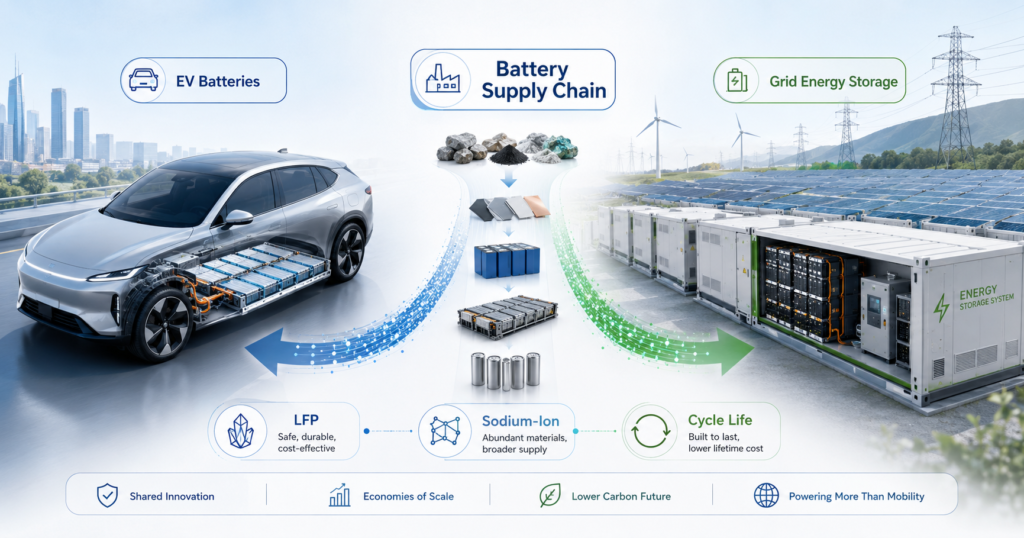
EV battery storage is quickly becoming one of the biggest growth stories in the battery industry. For years, battery makers focused mainly on electric cars, but grid energy storage is now becoming too large to treat as a side business. EV battery companies are moving into grid energy storage because the battery market is no longer only about electric cars. As EV demand becomes less predictable, battery storage for power grids, data centers, renewable energy, and commercial facilities is becoming one of the fastest-growing battery markets in the world.
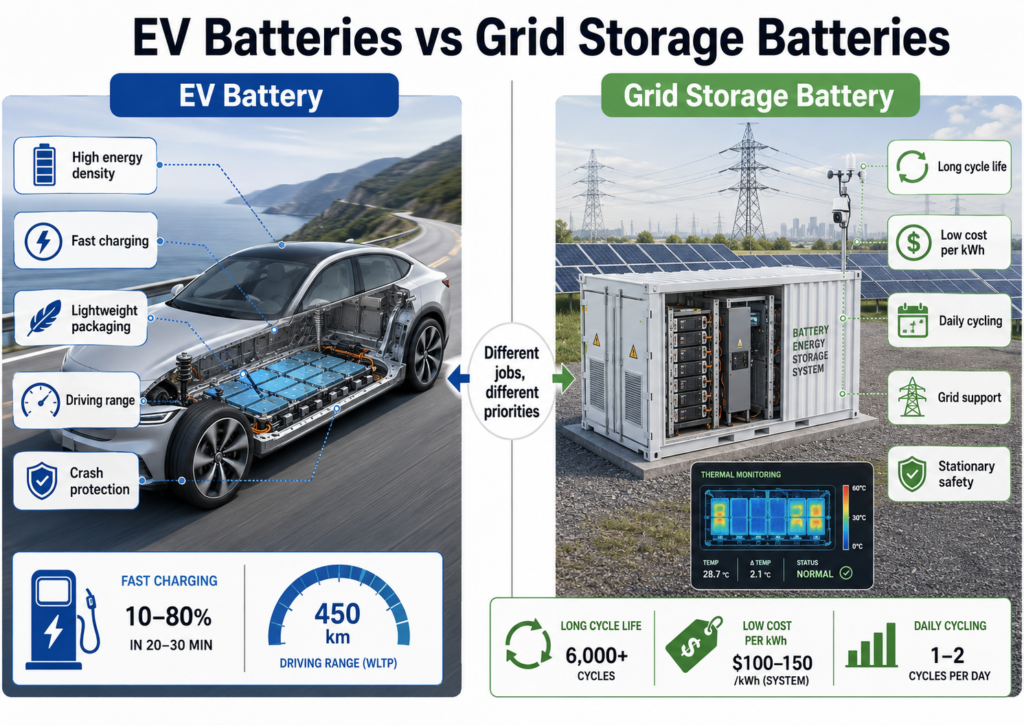
The key difference is that EV batteries must prioritize driving range, weight, fast charging, and crash safety. Grid storage batteries care more about cost, cycle life, safety, reliability, thermal management, and long-term operating economics. That is why LFP batteries already dominate stationary storage, and sodium-ion batteries may become especially attractive where energy density matters less than cost and material availability.
This does not mean EV batteries and grid batteries are completely separate industries. They share factories, materials, cell formats, manufacturing knowledge, BMS software, and safety lessons. But the best battery for a 300-mile EV is not always the best battery for a 20-foot container sitting next to a solar farm.
Introduction: The Battery Industry Is Growing Beyond Cars
For years, the battery story was mostly an EV story. Automakers needed more batteries. Battery companies built more factories. Lithium, nickel, cobalt, graphite, separator, electrolyte, and cathode suppliers all followed the same basic logic: electric vehicles would be the main demand engine.
That is still true in a broad sense. EVs remain the largest high-value battery market, and the race to make cheaper, longer-lasting, faster-charging EV batteries is far from over.
But something important is changing. Grid-scale energy storage is becoming too large to treat as a side business. The International Energy Agency says 108 GW of new battery storage capacity was deployed globally in 2025, about 40% more than in 2024, and LFP batteries accounted for around 90% of deployments. Wood Mackenzie separately estimated 106 GW of new energy storage capacity in 2025, a 43% year-over-year increase.
That is a major shift. Battery companies are no longer asking only, “How many EVs will automakers sell next year?” They are also asking, “How much storage will utilities, solar developers, data centers, factories, and grid operators need?”
CATL, the world’s largest battery maker, has been unusually clear about this direction. Reuters reported in June 2026 that CATL expects energy storage to grow from about 25% of its global sales today to roughly 50% by 2030. Only five years earlier, energy storage was about 2% of CATL’s battery sales. That tells us something important: this is not just a temporary backup plan for a weak EV cycle. Battery storage is becoming a second center of gravity for the entire battery supply chain.
Why EV Battery Storage Is Different From Grid Storage
An EV battery lives a hard and complicated life. It has to fit under the vehicle floor. It must survive vibration, potholes, crashes, winter road trips, summer fast charging, towing, parking in the sun, and years of daily driving. It must deliver high power when the driver accelerates, accept high power during DC fast charging, and still maintain enough capacity after many years to satisfy warranty requirements.
That means EV battery design is full of tradeoffs. Energy density matters because every extra pound affects range and efficiency. Fast charging matters because drivers compare charging stops with gasoline refueling. Pack packaging matters because passenger space, aerodynamics, and crash structure are all connected to battery size. Thermal management matters because the battery has to work in Arizona heat, Michigan winter, and everything in between.
Grid storage batteries have a different life. A containerized battery energy storage system does not need to move. It does not care about vehicle range. It does not need to accelerate from 0 to 60 mph. It usually does not need to charge from 10% to 80% in 18 minutes.
Instead, it needs to operate predictably for years while cycling almost every day. It may store solar energy during the afternoon and discharge it during evening demand. It may stabilize grid frequency, reduce peak demand, support a data center, or provide backup power during short grid disruptions.
For a grid battery, a little extra weight is not a big problem. A slightly larger container may be acceptable if the chemistry is cheaper and safer. What matters most is the cost per usable kilowatt-hour over the system’s lifetime. That is why the best EV battery is not automatically the best grid battery.
Can Automakers Use EV Cells Directly in Energy Storage Systems?
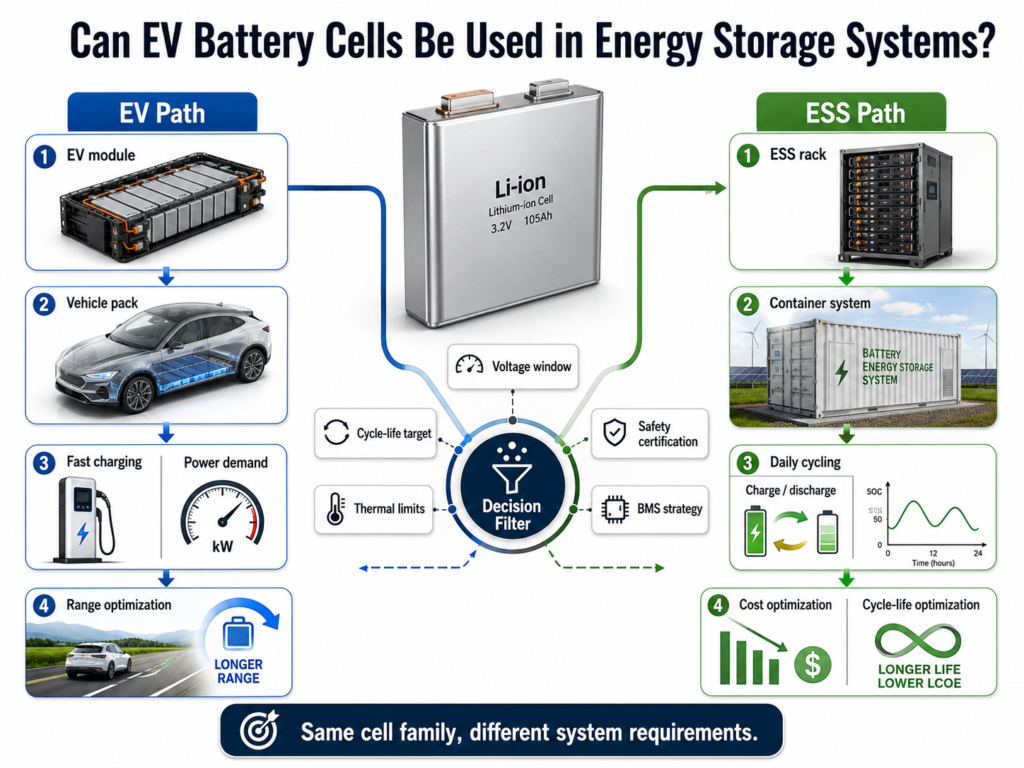
The simple answer is: sometimes, but not always. A lithium-ion cell originally designed for an EV can technically be used in a stationary battery system if the voltage window, thermal limits, cycle-life expectations, safety certification, and control strategy are appropriate. In fact, many stationary storage systems have historically used cells that were closely related to EV cells.
But “can be used” is not the same as “ideal.” An EV cell may be optimized for high power, fast charging, tight packaging, and automotive-grade validation. A grid storage cell may be optimized for lower cost, longer cycle life, lower degradation per cycle, easier thermal control, and better economics in a large rack or container.
This is why battery makers are increasingly developing dedicated ESS cells rather than simply dumping unused EV cells into stationary products. A grid storage project is a financial asset. If the system degrades faster than expected, the project owner loses revenue. If it has safety problems, the cost can be much worse than replacing a few modules.
Reuters reported in April 2026 that converting EV battery factories to energy storage production can be costly and time-consuming, and that energy storage demand alone may not fully solve EV battery overcapacity. That matters because ESS is not just a plug-and-play escape route for every underused EV factory.
The manufacturing tools may overlap. The chemistry knowledge may overlap. The cell formats may overlap. But the customer requirements are different enough that serious battery companies are building ESS as its own market.
Why Cycle Life and Cost Matter More Than Energy Density
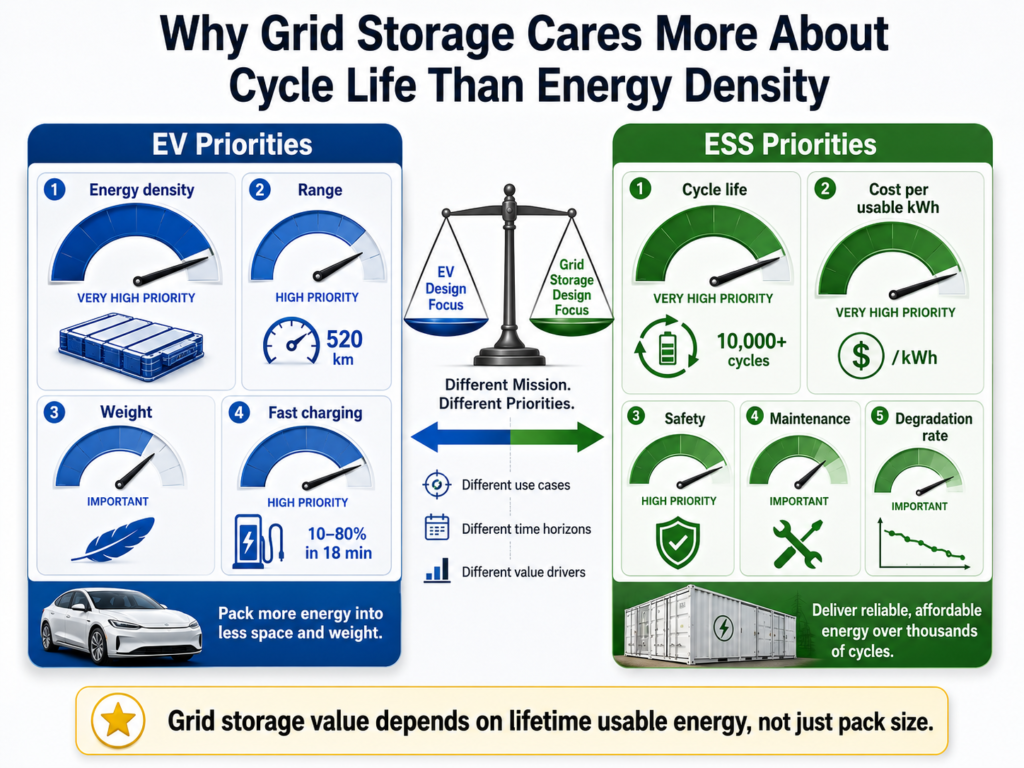
For EV owners, energy density is easy to understand. A more energy-dense battery can help deliver more range without making the vehicle too heavy or too expensive.
For grid storage, energy density is less exciting. A battery container sitting next to a solar farm does not need to squeeze every watt-hour into a vehicle floor. It can be larger, heavier, and less elegant as long as the economics work. That shifts the design target from maximum range to maximum lifetime value.
The most important question becomes: How many usable kilowatt-hours can this system deliver over its life for each dollar invested? That depends on several factors:
- Initial cell and system cost
- Cycle life
- Calendar aging
- Round-trip efficiency
- Thermal management energy
- Maintenance cost
- Fire protection requirements
- Degradation under real operating profiles
- Revenue from grid services or energy arbitrage
This is where LFP has become so powerful. LFP batteries are generally less energy dense than many NMC batteries, but they are cheaper, more thermally stable, and well suited to frequent cycling. That is almost exactly what stationary storage needs. The IEA’s 2026 battery storage update notes that LFP now accounts for around 90% of global battery storage deployments because it is typically cheaper and better suited to frequent cycling than more energy-dense chemistries often used in EVs.
For related background, see EV Insight Daily’s guide to LFP vs NMC batteries, which explains why LFP’s lower energy density can be acceptable when safety, cost, and cycle life matter more.
LFP Is Becoming the Workhorse of Stationary Storage
LFP’s rise in energy storage is not surprising. It avoids nickel and cobalt, two materials that can create cost volatility and supply-chain concerns. It has strong thermal stability compared with many nickel-rich chemistries. It can deliver long cycle life when managed properly. It also benefits from massive manufacturing scale, especially in China.
In EVs, LFP has one major drawback: lower energy density. That can reduce range or require a larger pack. In a compact commuter EV, that may be acceptable. In a long-range pickup truck or premium SUV, it may not be.
In grid storage, that drawback is much less important. If an LFP container is slightly larger than an NMC container, the project may still work if the system is cheaper, safer, and longer-lasting. Utilities do not care whether the battery can fit under a sleek crossover floor. They care whether it can charge and discharge reliably for years.
This is also why some battery trends that look “less advanced” from an EV perspective are actually very advanced from a grid perspective. A chemistry does not need the highest specific energy to win. It needs the best fit for the job.
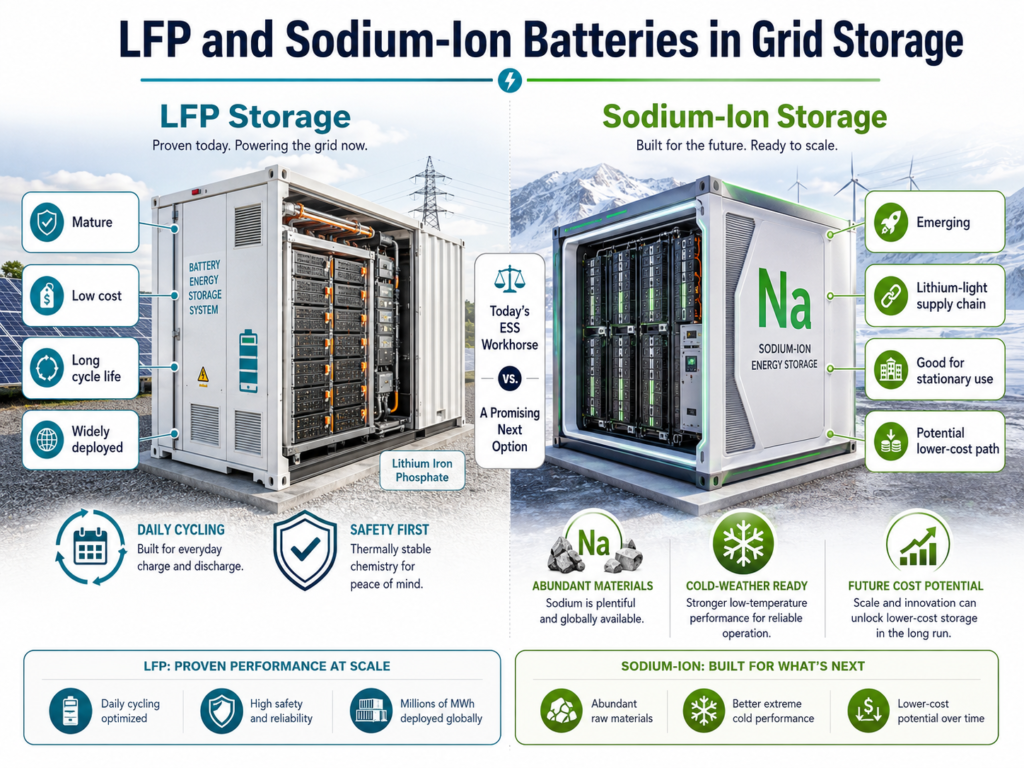
Sodium-Ion Could Become a Serious ESS Chemistry
Sodium-ion batteries are one of the most interesting parts of the storage boom. For EVs, sodium-ion faces a clear challenge: lower energy density than today’s best lithium-ion cells. That makes it less attractive for long-range EVs, especially in markets where buyers expect 300+ miles of range.
But stationary storage changes the equation. If a battery is sitting on the ground, sodium-ion’s lower energy density is less of a dealbreaker. Its potential advantages—lower dependence on lithium, strong cold-weather performance, abundant raw materials, and possible cost benefits at scale—become more important.
CATL has been pushing this direction aggressively. In 2026, the company announced that its Naxtra sodium-ion platform had reached GWh-scale industrialization, and it highlighted a three-year, 60 GWh sodium-ion energy storage order with HyperStrong.
That does not mean sodium-ion will immediately replace LFP. LFP is mature, cheap, widely manufactured, and already trusted by many ESS developers. Sodium-ion still needs production scale, proven field data, supply-chain maturity, and bankability.
But the logic is strong. If sodium-ion can become cost-competitive and durable, grid storage may be one of its best early markets. For a deeper explanation, see EV Insight Daily’s recent article on sodium-ion batteries entering mass production.
Container Thermal Management Is a Big Deal
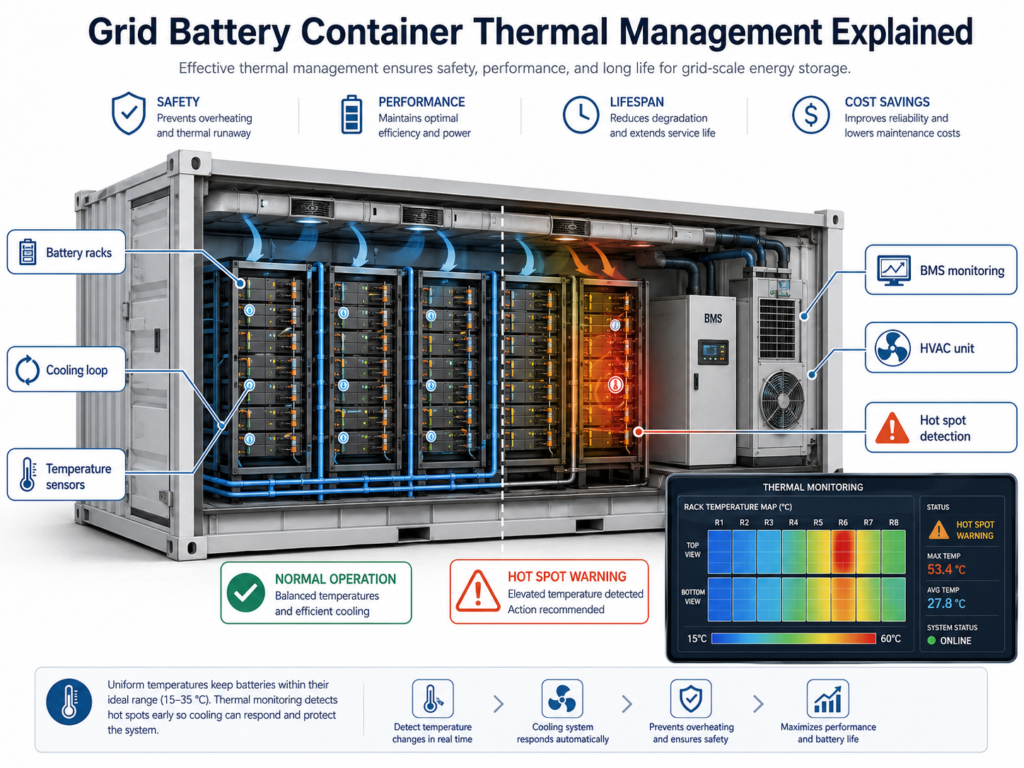
A battery container may look simple from the outside. It is often just a large rectangular unit filled with racks, modules, power electronics, sensors, ducts, cooling equipment, and fire protection systems.
Inside, it is much more complicated. Thousands of cells must operate within safe temperature limits. The system has to manage heat during charging and discharging. It must avoid hot spots, detect abnormal behavior early, and prevent a small fault from becoming a container-level event.
Thermal management in ESS is different from EV thermal management. An EV battery pack has limited space but benefits from vehicle-level integration. It can use coolant loops, refrigerant circuits, heat pumps, cabin HVAC interaction, and driving airflow. A stationary container has more physical room, but it may sit outdoors in extreme heat, cold, dust, humidity, or coastal air. It may also cycle heavily during peak grid demand, exactly when ambient temperatures are high.
Air cooling can be simpler and cheaper, but liquid cooling can offer better temperature uniformity and control for high-power or high-density systems. The right choice depends on power level, chemistry, climate, container design, maintenance strategy, and safety requirements.
This is one of the reasons Tesla’s newer storage products emphasize factory-integrated systems and simplified thermal architectures. In 2025, Tesla introduced Megablock and Megapack 3 concepts aimed at faster installation and lower construction complexity, with Tesla claiming a simplified thermal system in Megapack 3 (The Verge). The broader lesson is clear: ESS is not just “a lot of batteries in a box.” Thermal design is central to performance, degradation, safety, and project economics.
Stationary Battery Fire Propagation Is a Different Safety Problem
Battery fires are rare relative to the amount of storage being deployed, but they matter because the consequences can be serious.
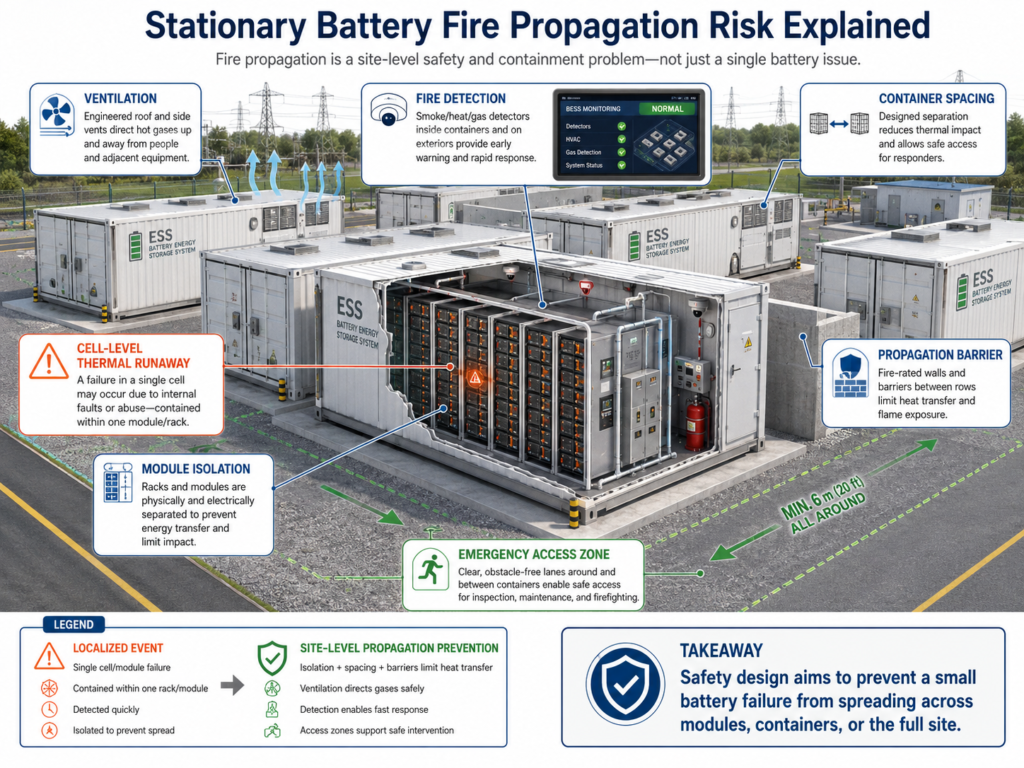
In an EV, the pack is designed around crash protection, isolation monitoring, venting paths, thermal barriers, and passenger safety. In stationary storage, the concern is different: how to prevent a cell-level thermal runaway event from spreading to modules, racks, containers, nearby containers, or surrounding infrastructure. NFPA describes thermal runaway as a rapid, uncontrolled release of heat energy from a battery cell when the cell generates more heat than it can dissipate.
That definition sounds simple, but the system-level challenge is not simple at all. A stationary battery site may contain dozens or hundreds of containers. If one container experiences a thermal event, the site design must help prevent propagation. That involves spacing, ventilation, detection, emergency response planning, fire suppression strategy, deflagration control, and clear coordination with local fire departments.
For readers familiar with EV safety, this is similar in principle but different in scale. An EV pack is a mobile, enclosed, crash-tested system. A grid battery site is a stationary power asset integrated with the electrical grid. Both require battery safety engineering, but the failure scenarios and emergency response requirements are not identical.
This is why battery companies are investing in dedicated ESS testing centers. CATL opened a $440 million energy storage testing center in southern China to simulate grid operations and study fire risks in storage systems (Reuters). That is exactly the kind of investment the industry needs if ESS is going to scale safely.
EV Demand Volatility Is Pushing Battery Makers to Diversify
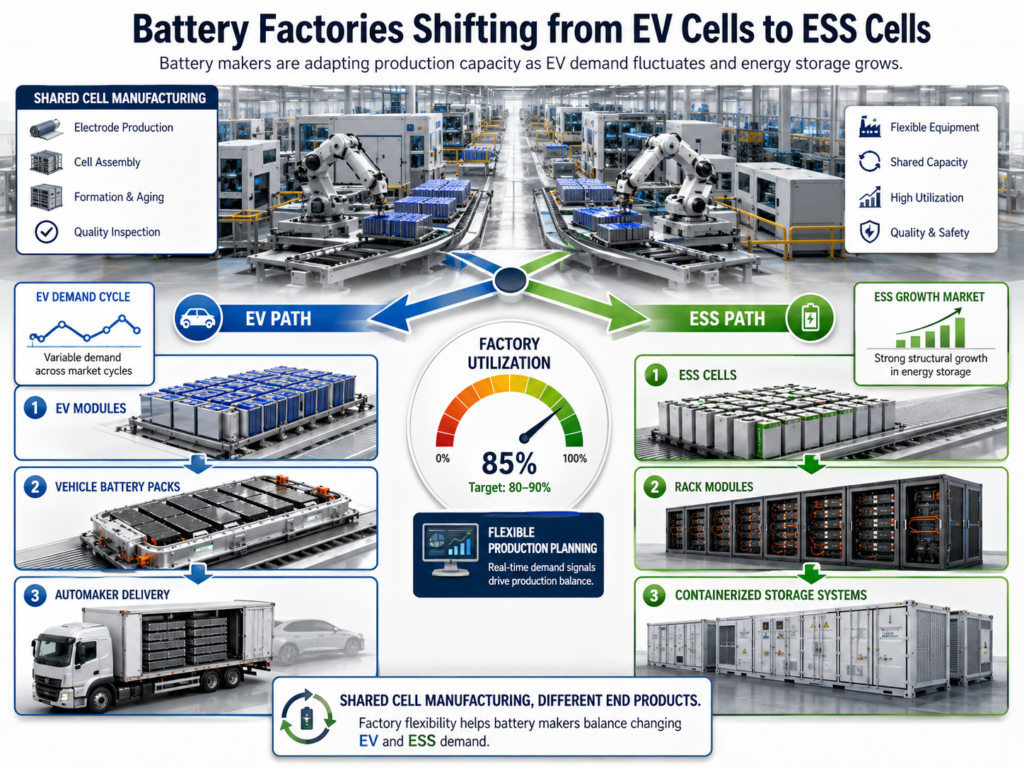
The EV market is still growing long term, but it is no longer moving in a perfectly smooth upward line. Some regions are growing quickly. Others are slowing. Consumer demand can shift with interest rates, incentives, charging infrastructure, model availability, politics, fuel prices, and automaker pricing decisions. Battery factories, however, are expensive and need high utilization.
That creates a problem. A battery plant cannot easily pause and wait for demand to return. If EV production slows, underused capacity becomes financially painful. ESS gives battery makers another market for cells, modules, and system integration.
This does not mean every EV battery line can instantly become an ESS line. As mentioned earlier, conversion can be expensive and technically involved. But the strategic value is obvious: a battery company that can serve both EV and stationary storage customers has more flexibility than one tied only to vehicle production cycles.
Tesla is a good example. Its energy storage deployments reached 46.7 GWh in 2025, up 49% year over year, even as its vehicle business faced more uneven demand (Utility Drive). This is not only about Tesla. Reuters reported that lithium producers are increasingly optimistic about battery storage demand because it is helping offset some weakness and volatility in EV-related demand. Fastmarkets estimated that lithium demand from energy storage is growing at about 40% annually. In other words, ESS is becoming a stabilizer for the battery industry.
Why Battery Companies Want the ESS Market
Battery makers like ESS for several reasons. First, the market is growing quickly. Utilities need storage to balance solar and wind. Data centers need reliable power. Industrial sites want backup power and demand-charge reduction. Grid operators need fast-response resources.
Second, ESS projects can be huge. A single grid storage project can require hundreds of megawatt-hours or even gigawatt-hours of batteries. That scale is attractive for manufacturers trying to keep factories fully loaded.
Third, ESS customers often care more about total lifecycle cost than headline performance. That allows battery makers to optimize around durability, safety, and manufacturing cost rather than chasing maximum energy density.
Fourth, ESS can create recurring business beyond cells. Companies can sell containers, inverters, software, controls, service contracts, monitoring, energy trading tools, and long-term maintenance.
Tesla’s large Megapack agreement with NatPower is a good example of how storage can become a full system business rather than just a battery sale. Reuters reported in June 2026 that NatPower and Tesla reached a deal for the first phase of a battery storage plan involving 25 GWh of storage in Italy and Britain. That type of project shows why ESS is attractive. It is not just about selling cells. It is about selling grid infrastructure.
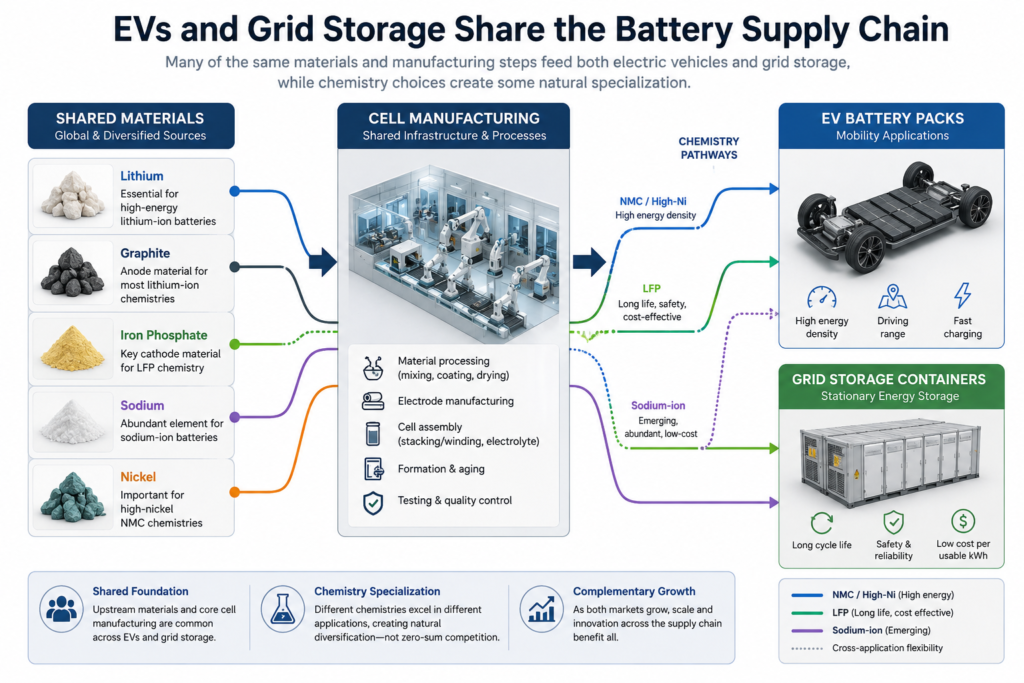
Will EVs and the Grid Compete for the Same Battery Supply Chain?
Yes, but the answer is complicated. EVs and grid storage both need battery cells, cathode materials, anode materials, separators, electrolyte, current collectors, manufacturing equipment, power electronics, and software expertise. When battery demand rises quickly in both markets, competition for supply can increase.
But the two markets do not always need the same exact battery. Long-range EVs may still prefer high-energy chemistries such as NMC, NCA, or future manganese-rich and solid-state designs. Affordable EVs and many ESS systems may prefer LFP. Future stationary storage may absorb sodium-ion cells that would not be ideal for long-range passenger EVs.
That chemistry split matters. If ESS increasingly uses LFP and sodium-ion while premium EVs use higher-energy lithium-ion chemistries, the supply-chain overlap becomes less direct. But if both EVs and ESS compete for the same LFP cells, shortages or price spikes can happen.
The U.S. market shows why this is important. Reuters reported in April 2026 that U.S. battery storage installations reached 58 GWh in 2025 and that developers still rely heavily on imports, especially from China, even as domestic assembly capacity expands (Reuters).
That means battery storage can strengthen the clean-energy transition, but it can also expose supply-chain bottlenecks. The long-term solution is not to choose EVs or grid storage. It is to diversify chemistries, expand recycling, localize key parts of the supply chain, improve manufacturing yield, and use each chemistry where it makes the most sense.
EV Insight Daily’s article on battery passports is relevant here because future battery tracking will likely matter not only for vehicles, but also for stationary storage systems that use similar materials and may later enter second-life or recycling pathways.
What This Means for EV Owners
For EV owners, the storage boom may seem far away. After all, a grid battery container is not the same thing as the pack under your vehicle. But the connection is real. As ESS grows, battery companies gain more experience with LFP, sodium-ion, thermal management, BMS software, degradation modeling, and large-scale safety testing. Some of that knowledge can flow back into EVs.
The storage boom may also help reduce battery costs by improving factory utilization and increasing demand for lower-cost chemistries. If battery makers can sell into both EV and ESS markets, they may be more willing to invest in large factories, better process control, and cheaper cell designs.
There is also a second-life angle. Not every retired EV battery is suitable for reuse in stationary storage, but some packs may find second-life applications after automotive service. That depends on pack condition, chemistry, safety validation, economics, and certification requirements.
For more background, see EV Insight Daily’s article on EV battery repair, remanufacturing, and recycling.
Conclusion: The Battery Business Is Becoming Bigger Than EVs
EVs started the modern battery boom, but they will not be the only market that defines its future. Grid storage is now growing fast enough to influence battery chemistry choices, factory planning, raw-material demand, safety standards, and corporate strategy. LFP has already become the workhorse of stationary storage. Sodium-ion is emerging as a serious candidate for applications where weight and volume matter less than cost, safety, and supply flexibility.
This does not mean battery makers are abandoning EVs. Cars, trucks, and commercial vehicles will remain central to battery demand. But the battery industry is becoming more balanced. Instead of one giant EV-driven market, it is turning into a broader energy infrastructure industry.
That may be good news. A more diversified battery market can make factories more resilient, accelerate cost reduction, and create more chemistry choices. It can also help the electric grid absorb more renewable energy, support data centers, reduce peak demand, and improve energy reliability.
The important thing is to understand the distinction. EV batteries and grid storage batteries share the same technological family, but they are not identical products. One is built to move people. The other is built to stabilize power systems. Both will shape the future of batteries.
FAQs
Are EV batteries and grid storage batteries the same?
They are related, but not exactly the same. Both often use lithium-ion cells, BMS controls, thermal management, and similar manufacturing processes. However, EV batteries prioritize range, weight, fast charging, and crash safety, while grid storage batteries prioritize cost, cycle life, reliability, safety, and long-term operating economics.
Can old EV batteries be reused for grid storage?
Sometimes. A retired EV battery may still have useful capacity for stationary applications, but it must be tested, graded, integrated, certified, and monitored properly. Not every used EV pack is economically or technically suitable for second-life storage.
Why is LFP popular in grid storage?
LFP is popular because it is relatively low cost, thermally stable, durable, and well suited to frequent cycling. Its lower energy density is less of a problem in stationary storage than in long-range EVs.
Will sodium-ion replace lithium-ion in grid storage?
Not immediately. Sodium-ion still needs more production scale and field data. But it could become important in stationary storage because it uses abundant materials and does not need the same energy density as EV batteries.
Does grid storage compete with EVs for battery materials?
Yes, partly. EVs and grid storage can compete for lithium, graphite, LFP cells, manufacturing equipment, and battery supply contracts. Over time, chemistry diversification, sodium-ion growth, recycling, and localized production may reduce some of that pressure.
Are battery storage containers safe?
They can be safe when properly designed, tested, installed, monitored, and maintained. The key risks involve thermal runaway, fire propagation, electrical faults, and emergency response. Modern systems use BMS controls, thermal management, spacing, detection, ventilation, and fire-safety standards to reduce risk.