
Quick Answer
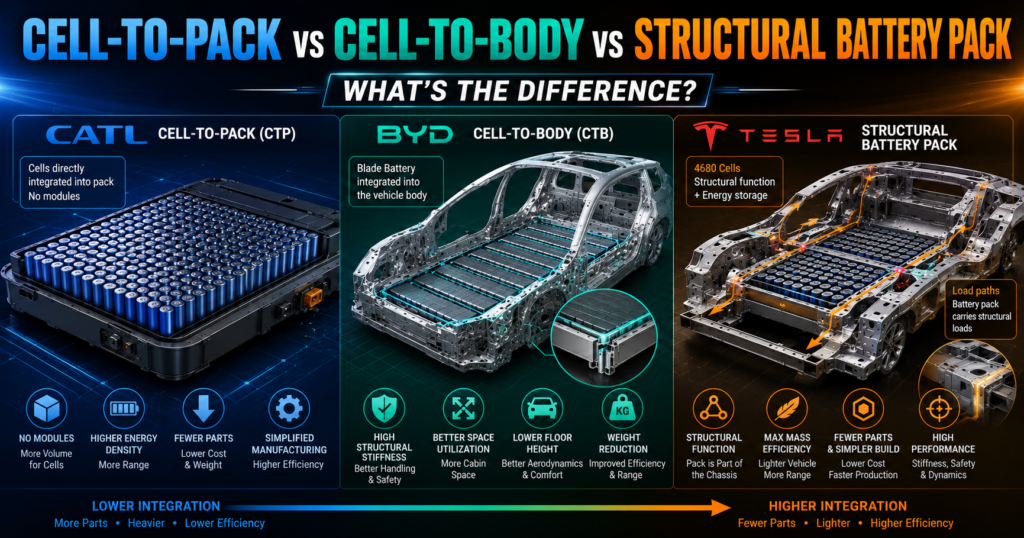
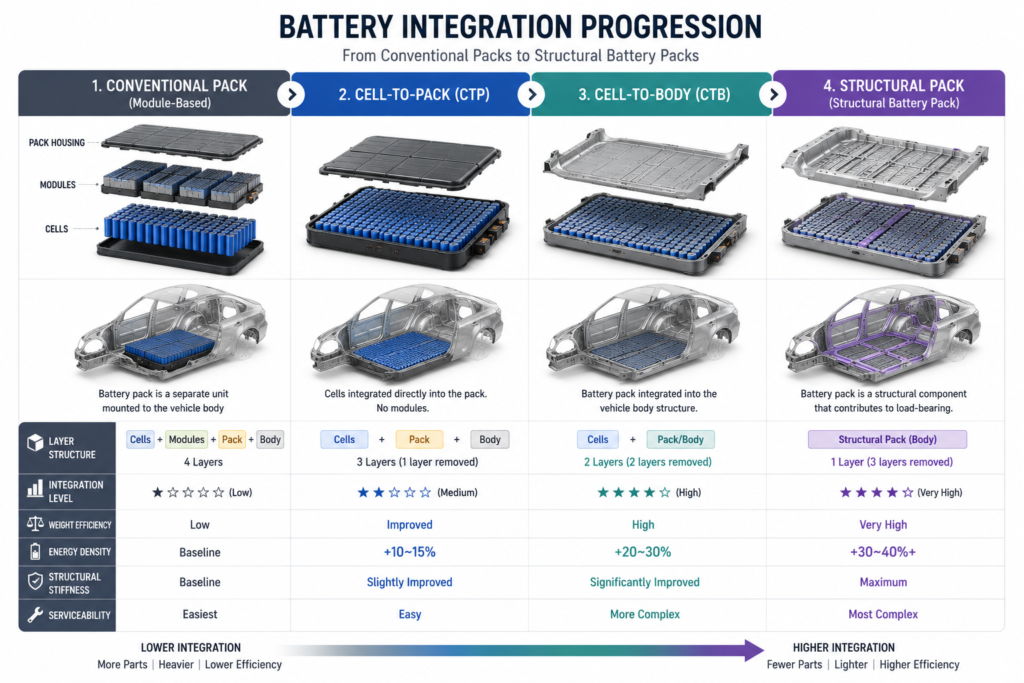
The traditional EV battery pack contains four layers: cells, modules, pack housing, and vehicle body. New battery architectures are eliminating some of these layers to improve energy density, reduce cost, and increase structural efficiency.
- Cell-to-Pack (CTP) removes battery modules and places cells directly into the pack.
- Cell-to-Body (CTB) integrates the battery pack directly into the vehicle body structure.
- Structural Battery Pack goes even further by making the battery pack itself a load-bearing structural component of the vehicle.
Companies such as CATL, BYD, and Tesla are leading this transition, but each approach involves different engineering tradeoffs.
Introduction
Cell-to-Pack vs Structural Battery Pack is becoming one of the most important engineering discussions in the EV industry. As automakers push for higher efficiency, lower cost, and better vehicle integration, battery architecture is becoming just as important as battery chemistry. For years, EV battery innovation was mostly about chemistry. The industry focused on questions like LFP or NMC, higher nickel content, silicon anodes, or solid-state batteries.
But as battery technology matured, automakers discovered another opportunity for improvement: battery architecture. Even if two vehicles use identical battery cells, the way those cells are packaged can dramatically affect vehicle range, manufacturing cost, weight, crash safety, structural stiffness, and interior space. This is why terms like Cell-to-Pack (CTP), Cell-to-Body (CTB), and Structural Battery Pack have become some of the most important engineering concepts in modern EV development.
In fact, they are now central to the strategies of battery giants such as CATL, BYD, and Tesla. As discussed in our article on Tesla and BYD battery strategy, battery architecture is becoming just as important as battery chemistry.
The Traditional EV Battery Pack
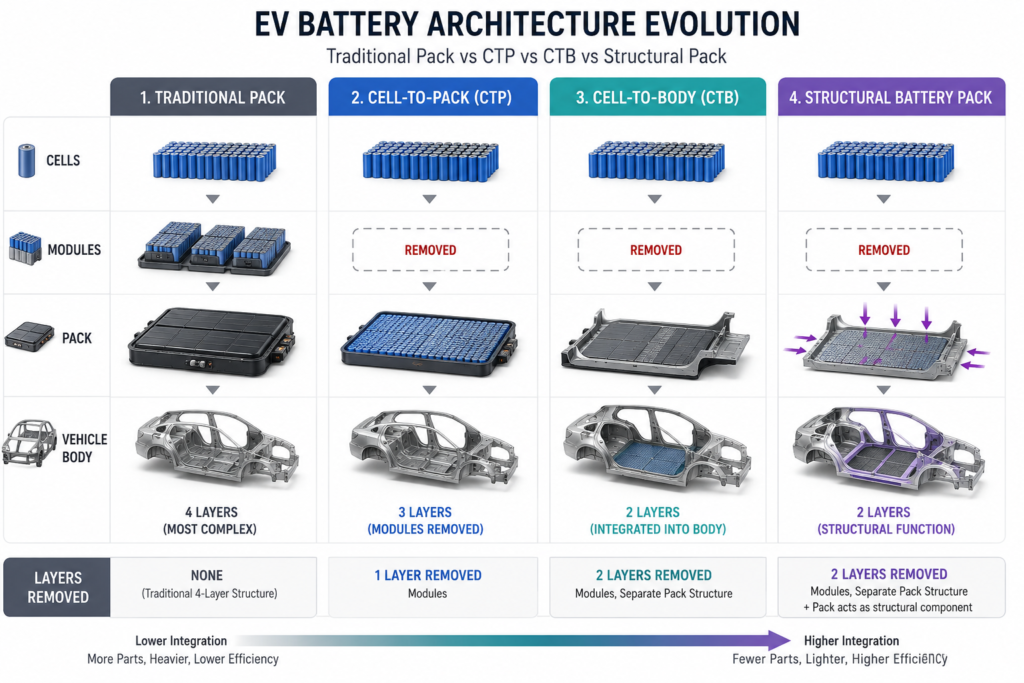
To understand these newer designs, it helps to start with the conventional battery structure. Most early EVs used four hierarchical levels: 1. Battery Cells, 2. Battery Modules, 3. Battery Pack, and 4. Vehicle Body. The modules acted as intermediate building blocks.
A typical arrangement looked like this: Cells → Modules → Pack → Vehicle. This design made manufacturing easier because modules could be assembled separately and tested before pack integration.
However, it also introduced significant inefficiencies. Every module required metal housings, electrical connectors, cooling interfaces, and structural supports. All of those components added weight without storing energy. Engineers often refer to this as inactive mass. The more inactive mass inside a battery pack, the lower the overall energy density of the vehicle.
Why Battery Architecture Matters
Battery cells are expensive. Anything that allows automakers to fit more cells into the same volume can improve vehicle performance and economics. Consider two battery packs with identical cells. If one design eliminates unnecessary structural components, it can increase usable battery capacity, reduce pack weight, improve range, or lower manufacturing cost. The result is often more impactful than a small chemistry improvement. This realization triggered the industry’s shift toward Cell-to-Pack architectures.
Cell-to-Pack (CTP): Removing the Module
What Is Cell-to-Pack?
Cell-to-Pack (CTP) eliminates battery modules entirely. Instead of arranging cells into modules first, cells are integrated directly into the battery pack. The architecture becomes Cells → Pack → Vehicle. One entire layer disappears.
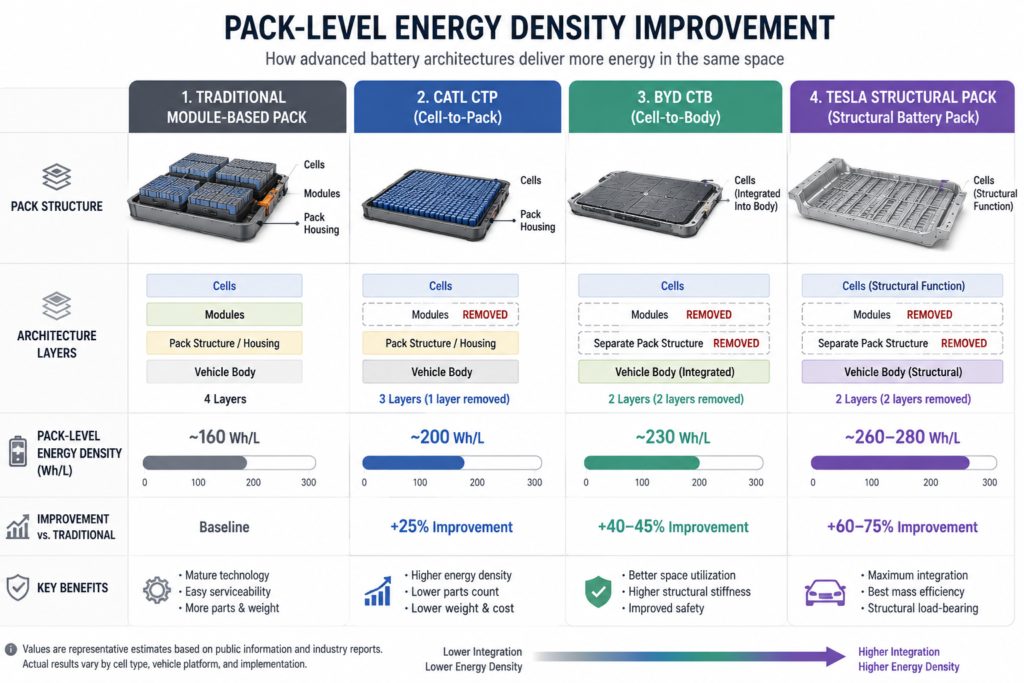
This may sound simple, but the impact is significant. Without modules fewer parts are required, manufacturing becomes simpler, weight decreases, or pack energy density improves. CATL pioneered this approach and has continued refining it through multiple generations. According to CATL, newer CTP designs substantially improve volume utilization compared with conventional module-based battery packs. For EV manufacturers, that means more battery capacity without increasing vehicle size.
Advantages of Cell-to-Pack
The biggest advantage is packaging efficiency. Because module housings are removed, more of the battery pack volume can be occupied by energy-storing cells. Benefits include higher pack-level energy density, lower manufacturing cost, reduced weight, fewer components, and improved packaging flexibility. This is one of the reasons many automakers have adopted CATL battery systems.
Challenges of Cell-to-Pack
The engineering challenge is thermal management. Modules traditionally provide structural separation, thermal isolation, and easier serviceability. When modules disappear, engineers must redesign cooling systems, mechanical supports, and fault containment strategies. A thermal event that affects one cell must still be prevented from propagating across the entire pack. As we discussed in our article on EV battery fire safety, thermal propagation remains one of the most critical battery engineering concerns.
BYD Blade Battery and Cell-to-Body (CTB)
Many people assume the Blade Battery is simply an LFP battery. That is only partially true. The Blade Battery is both an LFP chemistry innovation and a packaging innovation. BYD’s long blade-shaped cells allow the company to eliminate much of the traditional module structure. The result resembles an advanced Cell-to-Pack design.
What Is Cell-to-Body?
Cell-to-Body (CTB) goes one step further. Instead of mounting a battery pack underneath the vehicle body, the battery becomes integrated into the body structure itself. The architecture becomes Cells → Pack → Body Integration. In a CTB design, the battery pack contributes to overall vehicle stiffness. This reduces structural redundancy. Rather than having battery structure or vehicle floor structure, engineers combine them into a single integrated system. BYD introduced CTB in vehicles such as the BYD Seal.
Benefits of Cell-to-Body
The primary benefit is improved space utilization. Because the battery is integrated directly into the vehicle body, floor height can be reduced, cabin space increases, structural stiffness improves, and weight can decrease. BYD has reported substantial increases in torsional rigidity using CTB designs. Higher stiffness often improves ride quality, handling, and noise and vibration performance. These are benefits that consumers can actually feel.
Engineering Challenges of CTB
The closer the battery becomes to the vehicle structure, the more complicated repairs become. Engineers must carefully consider crash damage, manufacturing tolerances, battery replacement procedures, and structural serviceability. A design that improves efficiency may also increase repair complexity. This tradeoff is becoming increasingly important as insurance companies and repair shops gain more experience with advanced EV architectures.
Tesla’s Structural Battery Pack
Tesla took integration even further. Its Structural Battery Pack concept is one of the most ambitious battery architectures currently in production. The system was introduced alongside Tesla’s 4680 battery cell program (Inside EV, Tesla Manufacturing).
What Makes It Structural?
In a conventional vehicle, the battery pack is carried by the vehicle structure. In Tesla’s approach, the battery pack becomes part of the vehicle structure. The pack is designed to carry loads that would traditionally be handled by dedicated structural members.
The architecture effectively becomes Cells → Structural Pack → Vehicle. The battery is no longer simply an energy storage system. It becomes part of the chassis.
Why Tesla Chose This Approach
Tesla’s objective was straightforward: Reduce parts. The company has repeatedly emphasized manufacturing simplification as a major competitive advantage. The Structural Pack supports this goal by reducing components, reducing assembly steps, lowering manufacturing cost, improving stiffness, and reducing vehicle mass. Tesla combines this strategy with large front and rear gigacastings. Together, these technologies dramatically reduce vehicle part count.
Potential Advantages
Tesla has stated that Structural Packs can provide improved torsional rigidity, better mass efficiency, reduced vehicle weight, simplified assembly, and lower production cost. From a manufacturing perspective, the approach is elegant. Instead of building separate systems and bolting them together, engineers design one system that performs multiple functions.
Potential Drawbacks
The challenge is repairability. If the battery pack is part of the vehicle structure, repairs become more complex. Questions arise such as “What happens after a severe crash?”, “Can the pack be repaired economically?”, or “How should collision centers evaluate damage?” These concerns remain active topics across the automotive industry. Even supporters of Structural Packs acknowledge that serviceability may become a larger issue over time.
Comparing CATL, BYD, and Tesla
The three companies are pursuing similar goals but through different engineering philosophies.
Battery architecture integration level
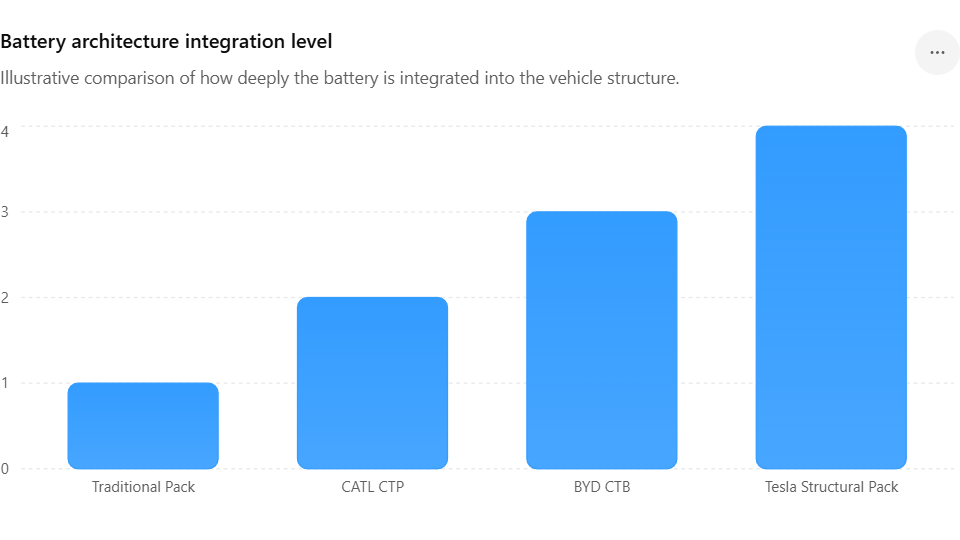
Illustrative comparison of how deeply the battery is integrated into the vehicle structure.01234Traditional PackCATL CTPBYD CTBTesla Structural Pack
CATL
Focus:
- Packaging efficiency
- Manufacturing scalability
- Higher pack energy density
Architecture:
- Cell-to-Pack
Best known for:
- Broad industry adoption
BYD
Focus:
- Battery and vehicle co-design
- Structural integration
- Cost-effective LFP implementation
Architecture:
- Cell-to-Body
Best known for:
- Blade Battery
Tesla
Focus:
- Manufacturing simplification
- Structural integration
- Reduced part count
Architecture:
- Structural Battery Pack
Best known for:
- 4680 platform strategy
Which Architecture Will Win?
The answer may be all of them. Different automakers face different priorities. Premium brands may prioritize performance, structural stiffness, and weight reduction. Mass-market manufacturers may prioritize cost, manufacturing flexibility, and serviceability. Commercial vehicles may prioritize repairability and durability.
As a result, multiple architectures are likely to coexist for many years. What is clear is that the traditional cell-module-pack approach is gradually disappearing. The industry is moving toward deeper levels of integration.
The Bigger Picture: Battery Architecture Is Becoming a Competitive Advantage
For many years, battery discussions focused almost entirely on chemistry. But in 2026, architecture is becoming equally important. The race is no longer just about better cells, better cathodes, or better electrolytes. It is also about better packaging, better structural integration, and better manufacturing efficiency. This shift explains why companies such as CATL, BYD, and Tesla continue investing heavily in battery architecture innovation. Future breakthroughs may not come solely from new chemistry. They may come from smarter ways of integrating batteries into the vehicle itself.
Conclusion
Cell-to-Pack, Cell-to-Body, and Structural Battery Packs represent three stages in the evolution of EV battery integration. CATL’s Cell-to-Pack architecture removes modules to improve packaging efficiency. BYD’s Cell-to-Body design integrates the battery more deeply into the vehicle structure. Tesla’s Structural Battery Pack turns the battery itself into a load-bearing component of the chassis.
Each approach aims to achieve the same objective: more range, lower cost, less weight, and greater manufacturing efficiency. As EV competition intensifies, battery architecture may become one of the most important differentiators between manufacturers—just as important as battery chemistry itself.