
Quick Answer
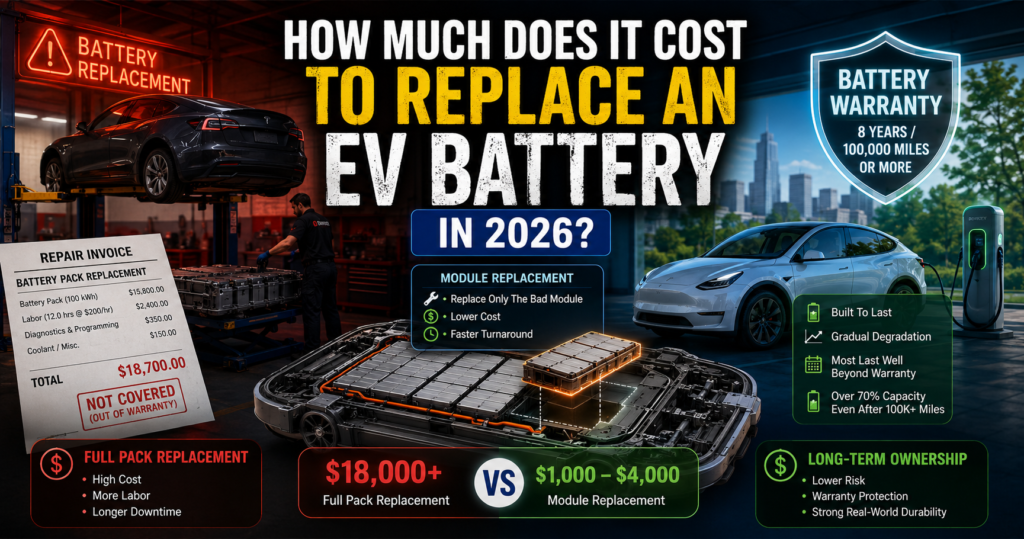
EV battery replacement cost in 2026 typically ranges from $5,000 to over $20,000 depending on the vehicle, battery size, and whether the repair involves a single module or a full battery pack replacement. However, most EV owners never pay for a full battery replacement because modern EV batteries are lasting much longer than expected and are usually covered by long battery warranties (MOTORWATT, KBB, Recurrent)
For many vehicles, partial repairs or refurbished battery options can reduce costs dramatically.
Why EV Battery Replacement Is Still One of the Biggest Consumer Concerns
Even in 2026, one of the most searched EV questions is still “What happens if the battery dies?” That concern makes sense. The battery is the single most expensive component in an electric vehicle, and stories about $15,000 or $20,000 repair bills spread quickly online.
But the real-world picture is far less dramatic than many people assume. Modern EV batteries are proving to be far more durable than early skeptics expected. Most batteries lose capacity gradually rather than failing suddenly, and outright replacement remains relatively uncommon. In fact, several large EV studies show that only a small percentage of vehicles require full battery replacement outside of accidents or warranty claims (SolarTech, Business Insider).
At the same time, repair options are improving:
- Module-level repairs are becoming more common
- Refurbished battery packs are expanding in availability
- Battery prices continue to fall
- More independent EV repair shops now exist
- Automakers are designing newer packs with lower service costs in mind
Still, replacement costs vary enormously depending on the vehicle. Let’s break down what EV battery replacement actually costs in 2026.
What Determines EV Battery Replacement Cost?
Several factors influence replacement pricing.
1. Battery Size
Larger batteries cost more in general. A compact EV with a 50–60 kWh pack is far cheaper to repair than a large SUV or performance EV with a 100+ kWh pack. For example, smaller EVs may use packs costing under $8,000 while large luxury EV packs can exceed $20,000. Battery chemistry also matters. LFP batteries are generally cheaper than high-nickel NMC packs.
Related:
LFP vs NMC Batteries: Which EV Battery Is Better in 2026?
2. Labor Costs
Battery replacement is not a simple “drop-in” procedure. Technicians often must remove underbody shielding, disconnect high-voltage systems, reprogram battery management systems, calibrate cooling systems, and perform safety validation testing. Labor alone can cost several thousand dollars. Tesla service rates, for example, are commonly reported between roughly $150–$255 per hour depending on region (Find My Electric).
3. Full Pack vs Module Replacement
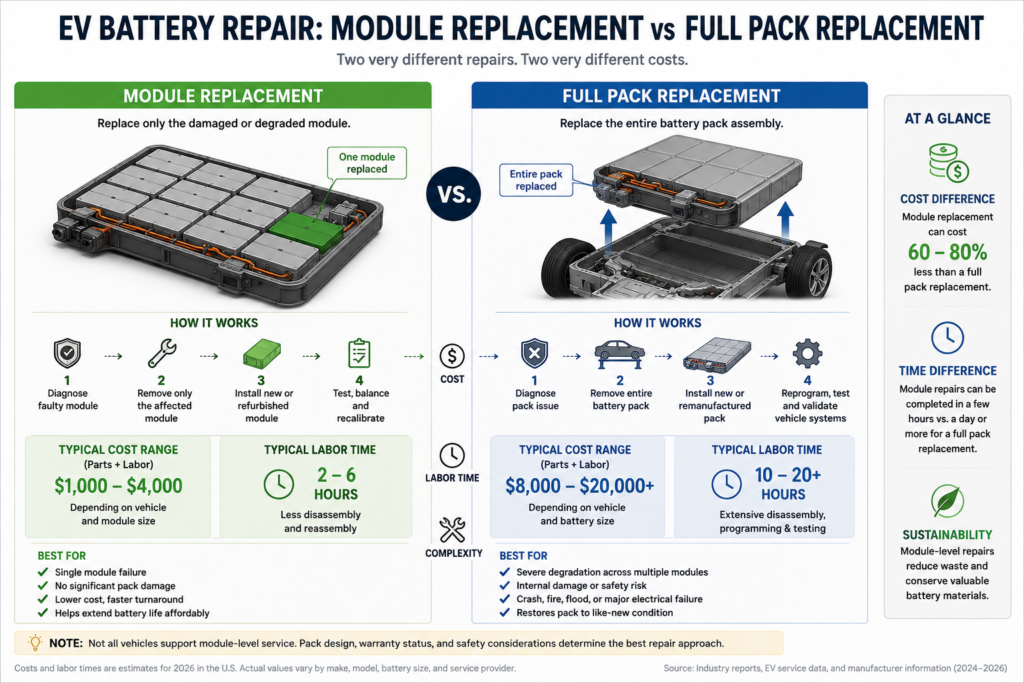
This is becoming one of the biggest differences in EV repair costs. Some repairs require replacing the entire battery pack. Others only require replacing damaged modules. That distinction can save owners thousands of dollars. Recent industry discussions increasingly focus on module-level repairability because replacing a single degraded section is dramatically cheaper than swapping the entire pack (Underhood Service).
Full Pack Replacement vs Module Replacement
Full Pack Replacement
This is the expensive scenario most people imagine. The entire battery assembly is removed and replaced with a new or remanufactured pack. Typical reasons include severe degradation, internal short circuits, crash damage, water intrusion, or thermal propagation events. Full pack replacement costs can range from:
| Vehicle Type | Estimated Cost Range |
|---|---|
| Compact EV | $5,000–$10,000 |
| Mid-size EV | $10,000–$16,000 |
| Luxury / Large Pack EV | $15,000–$25,000+ |
These numbers include both parts and labor (MOTORWATT, EV, Insurify).
Module Replacement
Many modern battery packs contain multiple modules. If only one module fails, technicians may replace only the damaged section instead of the entire pack. Benefits include lower repair cost, reduced waste, faster turnaround time, or improved insurance repairability.
But module replacement is not always straightforward. Older and newer modules can age differently, potentially causing balancing or performance issues over time (Underhood Service). Still, this repair strategy is becoming increasingly important as EV fleets age.
Real-World EV Battery Replacement Examples in 2026
Tesla
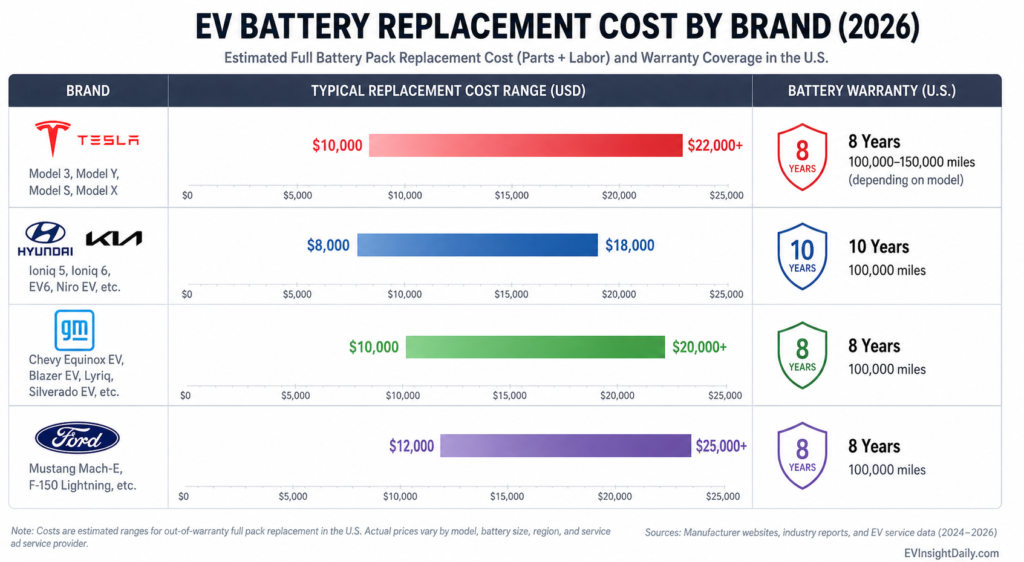
Tesla remains the most discussed brand when it comes to battery replacement costs. Estimated out-of-warranty replacement ranges:
| Tesla Model | Estimated Replacement Cost |
|---|---|
| Model 3 | ~$10,000–$15,000 |
| Model Y | ~$12,000–$16,000 |
| Model S/X | ~$15,000–$22,000+ |
Some older reports online mention lower figures, but those often referred only to individual modules rather than full packs (Find My Electric, Recurrent, Greentec Auto).
Tesla battery warranties generally include 8 years or 100,000–150,000 miles depending on model. Official warranty details can be found at Tesla Vehicle Warranty.
Related:
How Long Do EV Batteries Last? Real-World Data and Battery Degradation (2026)
Hyundai / Kia
Hyundai and Kia EVs are gaining a strong reputation for battery durability and warranty coverage. Many Hyundai EVs include 10-year / 100,000-mile battery warranties in the U.S. Battery replacement costs vary widely depending on model and battery size, but complete pack replacement may range from roughly $8,000–$18,000. The good news is that Hyundai has increasingly emphasized modular battery repairability in newer EV platforms. Official Hyundai EV warranty information can be found at Hyundai Warranty Overview.
General Motors (GM)
GM’s Ultium-based vehicles use large modular battery architectures designed partly around service flexibility. Vehicles include Chevrolet Equinox EV, Blazer EV, Cadillac Lyriq, and Silverado EV. GM has also discussed lowering future EV battery costs through simplified module strategies and lower-cost chemistries like LFP (The Verge, The Wall Street Journal). Estimated future replacement costs are expected to decline as Ultium production scales further. Official GM EV information can be found at Chevrolet EV Technology.
Ford
Ford EV battery replacement pricing depends heavily on the model. Approximate ranges:
| Ford EV | Estimated Cost |
|---|---|
| Mustang Mach-E | ~$12,000–$18,000 |
| F-150 Lightning | Potentially $15,000–$25,000+ |
Large trucks naturally require massive battery packs, which significantly increases replacement costs. Ford battery warranties generally cover 8 years / 100,000 miles. Official Ford EV warranty info can be found at Ford EV Support and Warranty.
Why Most EV Owners Never Replace Their Battery
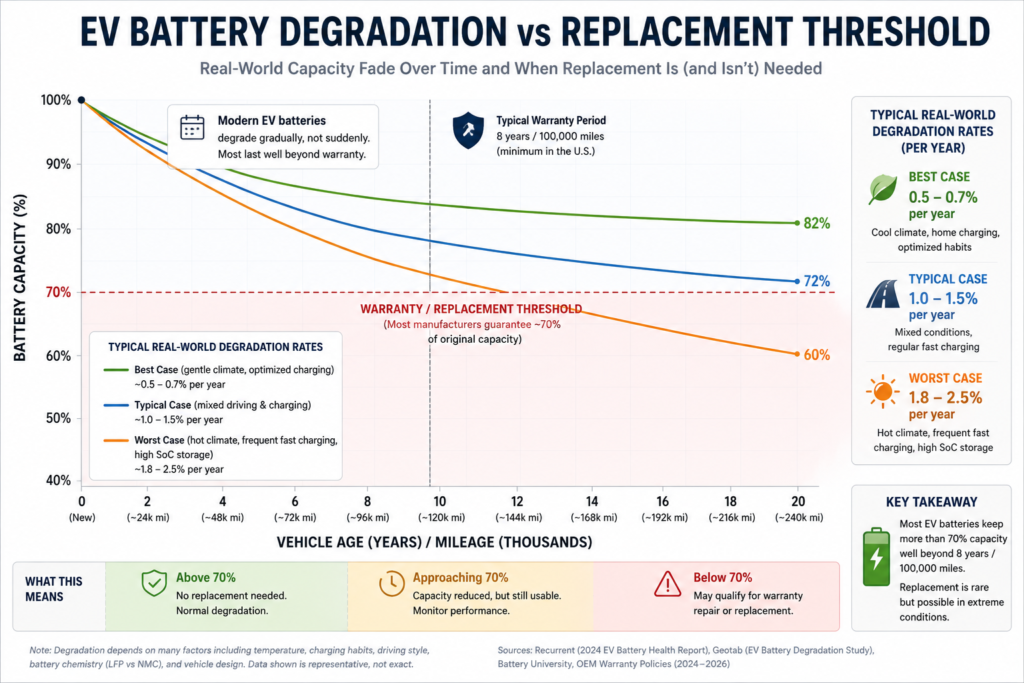
This is the most important point that many headlines ignore. Complete EV battery replacement is still relatively rare. Most EV batteries degrade slowly over many years rather than suddenly failing. Typical degradation patterns ~5–10% loss after many years, gradual decline rather than catastrophic failure, or most vehicles remain usable long after warranty expiration. Large fleet studies continue to show surprisingly strong long-term battery durability (Solar Tech, Recurrent). Many EVs on the road today still retain well over 80% battery capacity after 100,000+ miles.
Related:
Why Fast Charging Degrades EV Batteries Faster (And How Modern EVs Prevent It)
EV Battery Warranties in 2026
Battery warranties are a major reason why EV battery replacement anxiety is often overstated. In the U.S., EV batteries are federally required to carry at least 8 years / 100,000 miles. California CARB states often require even longer coverage. Most manufacturers additionally guarantee minimum retained battery capacity, often around 70%. This means manufacturers may repair or replace the battery if degradation exceeds warranty thresholds.
Common warranty coverage includes manufacturing defects, excessive degradation, certain internal failures. However, usually physical crash damage, flood damage, or unauthorized modifications are not covered.
Refurbished and Used EV Batteries Are Becoming a Huge Industry
One of the biggest changes in 2026 is the rise of refurbished battery options. Instead of buying an entirely new battery pack, owners increasingly have access to remanufactured packs, salvage batteries, module replacements, or reconditioned modules. These options can reduce repair costs dramatically. Some aftermarket suppliers claim refurbished Tesla battery solutions can reduce costs by 30–50% compared to new OEM packs (Greentec Auto). This trend matters especially for older EVs whose resale value may not justify a brand-new factory battery.
Insurance Is Quietly Becoming Part of the EV Battery Story
Another growing issue is collision-related battery damage. In some cases, relatively minor underbody damage can trigger extremely expensive battery inspections or replacements. That’s one of the reasons EV insurance costs can sometimes be higher than comparable gas vehicles (Wired, Business Insider).
However, the industry is slowly improving better battery shielding, improved repair procedures, expanded technician training, better diagnostic tools, and more module-level repair capability. All of these changes are helping reduce unnecessary battery write-offs.
Why EV Battery Replacement Costs Should Keep Falling
Battery replacement costs are still high today, but long-term trends point downward. Several factors are helping:
Lower Cell Prices
Battery prices continue to decline as manufacturing scales globally.
LFP Adoption
Lower-cost LFP batteries reduce replacement expense.
Better Repairability
More automakers are designing serviceable battery architectures.
Recycling and Second-Life Markets
Recovered materials and reused modules help reduce replacement costs.
Independent EV Repair Shops
The repair ecosystem is expanding beyond dealerships. In other words, today’s battery replacement costs likely represent the high point rather than the long-term future.
The Bigger Picture: EV Batteries Are Lasting Longer Than Expected
The biggest misconception around EV ownership is that batteries routinely “die” after a few years. That simply is not matching real-world data. Modern EV battery management systems are extremely sophisticated. They carefully control temperature, charging speed, state of charge, thermal balancing, and cell protection.
Related:
Why EV Batteries Degrade in Hot Weather (2026 Guide)
As a result, many EV batteries are lasting much longer than early expectations. The conversation is now shifting away from “Will the battery survive?” toward “How affordable and repairable will batteries become over time?” And that’s actually good news for long-term EV ownership.
Conclusion
Yes, EV battery replacement can be expensive in 2026. A full battery pack replacement may cost anywhere from $5,000 to well over $20,000 depending on the vehicle.
But the bigger reality is this:
- Most EV owners never need a full replacement
- Battery warranties are extensive
- Modern batteries degrade slowly
- Module-level repair is becoming more common
- Refurbished battery markets are expanding
- Costs are gradually declining.
In many ways, the EV battery replacement story is evolving similarly to hybrid batteries years ago. Consumers were initially worried about massive replacement costs, but real-world durability turned out to be far better than expected. And the same trend now appears to be happening with EVs.
FAQ
How long do EV batteries typically last?
Most modern EV batteries are expected to last 10–20 years depending on usage, climate, and charging behavior. Many still retain over 80% capacity after 100,000 miles.
Does insurance cover EV battery replacement?
If the battery is damaged in a collision or covered event, insurance often covers replacement or repair. Normal degradation is not covered by insurance.
Can EV batteries be repaired instead of replaced?
Yes. Increasingly, technicians can replace individual modules or repair specific battery sections rather than replacing the entire pack.
Are refurbished EV batteries safe?
Properly tested refurbished batteries can be safe and significantly cheaper than new packs. Quality varies depending on the supplier and certification process.
Which EV brands have the best battery warranties?
Tesla, Hyundai, Kia, Ford, GM, and several other major automakers now offer battery warranties around 8 years / 100,000 miles or longer (Recharged, KBB).