
Quick Answer
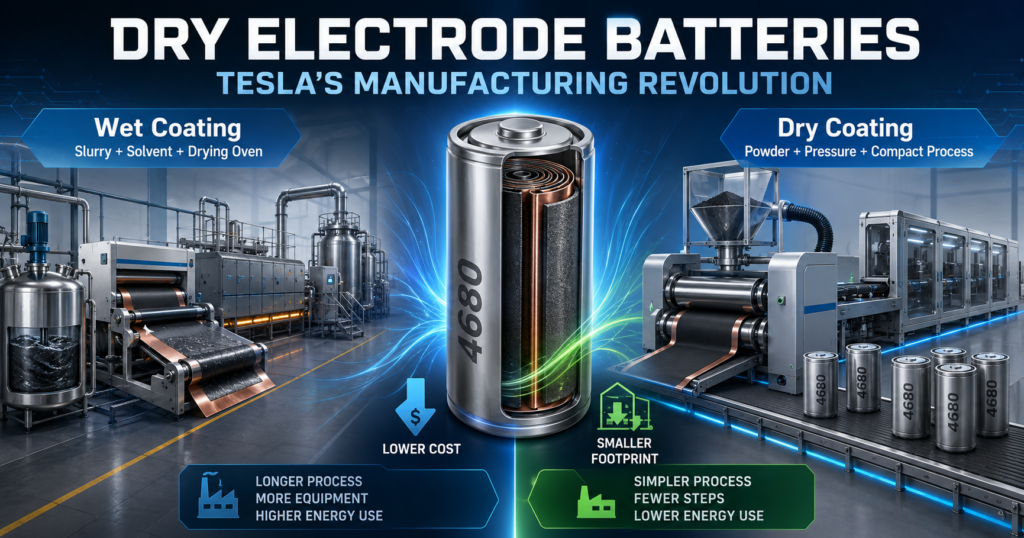
Dry electrode batteries are not a new battery chemistry. They are a new way to manufacture battery electrodes. In a conventional lithium-ion battery factory, electrode materials are mixed into a wet slurry, coated onto metal foil, dried in long ovens, and then compressed into the final electrode structure. Dry electrode manufacturing tries to remove much of that wet coating and drying process by forming the electrode from dry powder materials instead.
The reason this matters is simple: battery manufacturing is expensive, energy-intensive, and difficult to scale. If dry electrode technology works reliably at high volume, it could reduce factory size, lower energy use, eliminate some solvent-related costs, improve production speed, and make EV battery cells cheaper to produce.
Tesla’s 4680 battery program made dry electrode technology famous because Tesla acquired Maxwell Technologies in 2019 and later made dry electrode manufacturing one of the core promises behind its next-generation battery strategy. In its Q4 and FY 2025 update, Tesla stated that it now produces dry-electrode 4680 cells with both anode and cathode made in Austin.
That does not mean dry electrode batteries will instantly make EVs dramatically cheaper. The technology still has manufacturing challenges, especially around electrode uniformity, mechanical strength, binder distribution, and high-volume yield. But if Tesla and other battery makers can scale it successfully, dry electrode production could become one of the most important battery manufacturing changes of the decade.
Introduction: Why Dry Electrode Batteries Matter
Most EV battery discussions focus on chemistry. People compare LFP vs NMC batteries, solid-state batteries, sodium-ion batteries, silicon-anode batteries, or Tesla 4680 cells. Those topics matter, but they are only part of the story. A battery cell is not just a chemistry recipe. It is also a manufactured product.
That distinction is important. Two battery cells can use similar chemistry but have very different cost, performance, consistency, and scalability depending on how they are made. In the EV industry, manufacturing is often where promising battery ideas either become real products or stay stuck in the laboratory.
Dry electrode batteries sit exactly in that manufacturing gap. The idea sounds simple: remove the liquid solvent-heavy coating process and make electrodes in a drier, faster, more compact way. In practice, it is one of the hardest manufacturing problems in modern battery production.
That is why Tesla’s progress with dry electrode technology has attracted so much attention. Tesla’s 4680 cell was never just about making a bigger cylindrical battery. It was supposed to combine several changes at once: a larger cell format, tabless current collection, structural pack integration, simplified manufacturing, and eventually dry electrode production.
For a deeper look at Tesla’s broader battery strategy, see our related article:
Tesla vs BYD Battery Strategy in 2026: Which Is Better?
Dry electrode manufacturing may not be as easy to explain as range, charging speed, or battery chemistry. But it could become one of the hidden reasons future EVs become cheaper, easier to build, and less dependent on massive battery factory footprints.
What Is an Electrode in an EV Battery?
To understand dry electrode batteries, we need to start with the basic structure of a lithium-ion cell. Inside a typical EV battery cell, there are two electrodes: the anode and the cathode. The anode is usually graphite-based, sometimes with silicon added. The cathode may use NMC, NCA, LFP, LMFP, or another lithium-containing chemistry. Between them is a separator soaked with electrolyte.
During charging, lithium ions move from the cathode to the anode. During driving, they move back from the anode to the cathode, releasing electrical energy. The active materials do the electrochemical work, but the electrode itself is not just active material. It usually contains a carefully engineered mixture of active material, conductive carbon, binder, and porosity. This mixture must be coated onto a metal current collector. The anode normally uses copper foil. The cathode usually uses aluminum foil.
That coating must be uniform. It must stick well to the foil. It must maintain enough pores for lithium-ion transport. It must provide electronic pathways through the electrode. It must survive repeated swelling, shrinking, heating, cooling, charging, and discharging. In other words, the electrode is not just a layer of powder. It is a highly engineered composite film. That is why changing the way electrodes are manufactured is such a big deal.
How Conventional Wet Electrode Coating Works
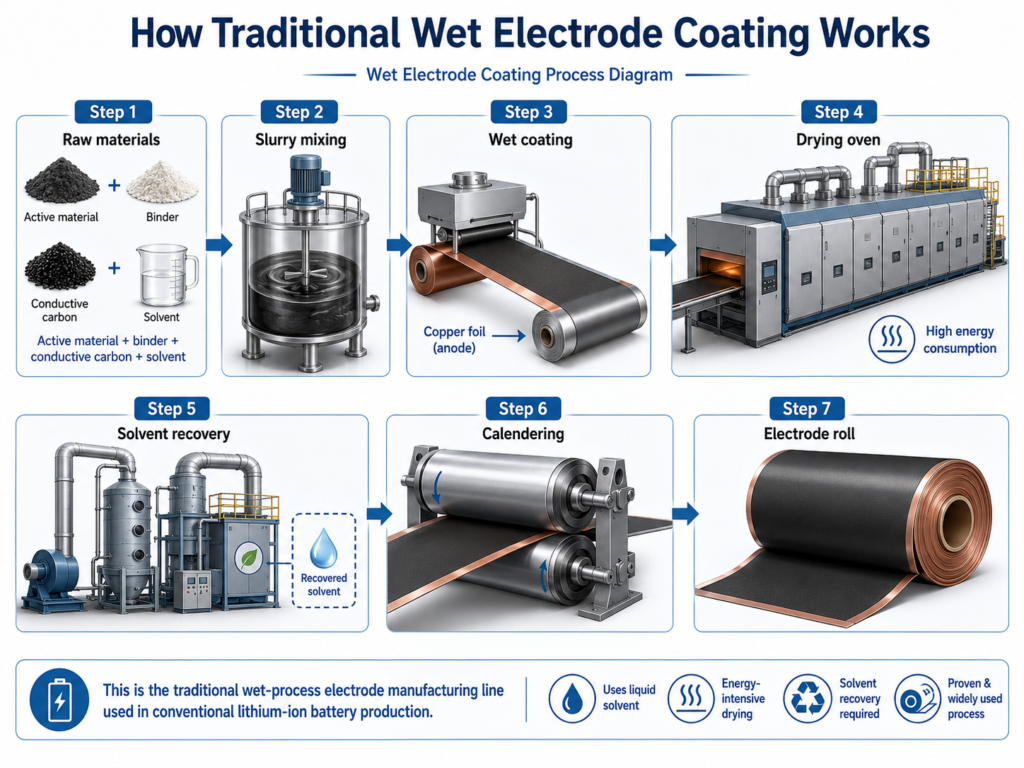
Most lithium-ion batteries today are made using a wet electrode coating process. In a simplified version, the process looks like this: The active material, binder, conductive additive, and solvent are mixed into a slurry. That slurry is coated onto a metal foil. The coated foil passes through a long drying oven where the solvent evaporates. The dry electrode is then compressed through calendering rollers to achieve the right density, thickness, and porosity.
This process is well understood and widely used. It has been optimized over many years. But it also comes with several drawbacks. The first drawback is the solvent. Many cathode manufacturing processes use N-methyl-2-pyrrolidone, commonly called NMP. NMP is effective, but it requires careful handling, recovery, and environmental controls. It also adds cost and complexity to the factory.
The second drawback is drying. Drying is not a small side step. Large battery factories need long drying ovens, solvent recovery systems, air handling systems, temperature control, and significant floor space. The electrode cannot simply be heated as aggressively as possible because drying too fast can affect binder distribution, adhesion, cracking, and electrode quality.
The third drawback is time. Wet coating introduces a process bottleneck. Even if the coating head can run quickly, the coated electrode still has to be dried properly before the next steps.
The fourth drawback is energy use. Evaporating solvent at large scale requires substantial energy. For companies trying to reduce the carbon footprint of battery manufacturing, removing or reducing this drying burden is attractive.
This is why dry electrode manufacturing has become so interesting. It does not just promise a small improvement. It targets one of the most expensive and space-consuming parts of battery cell production.
External reference:
Argonne National Laboratory — Taking battery manufacturing to the next level
What Are Dry Electrode Batteries?
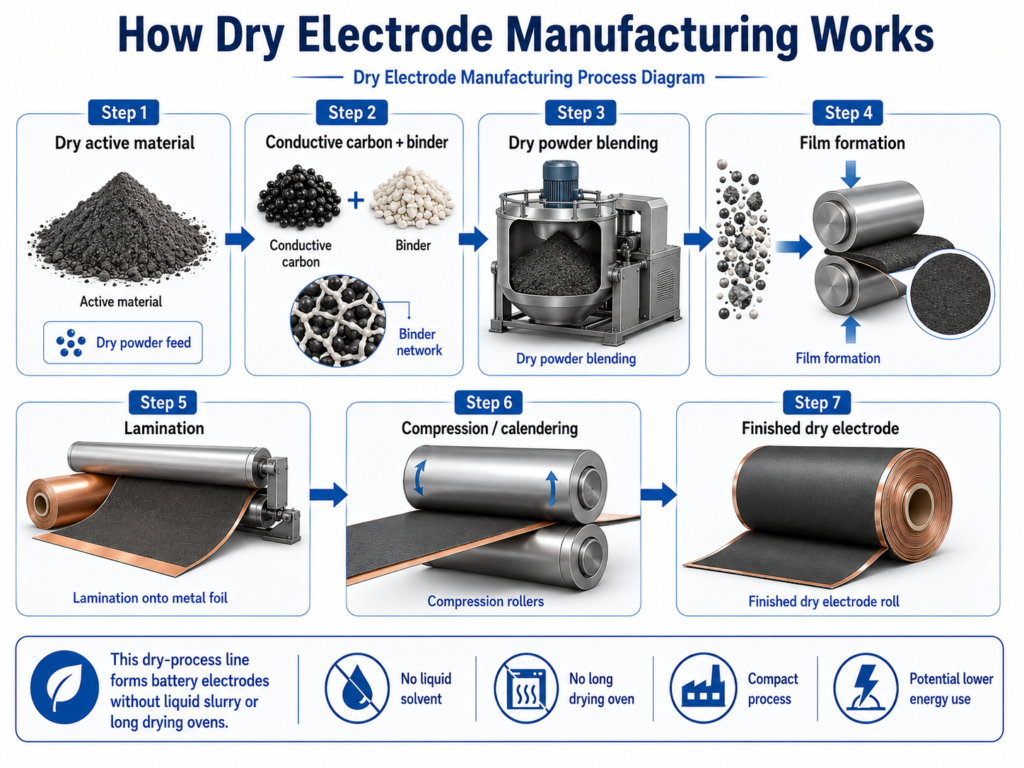
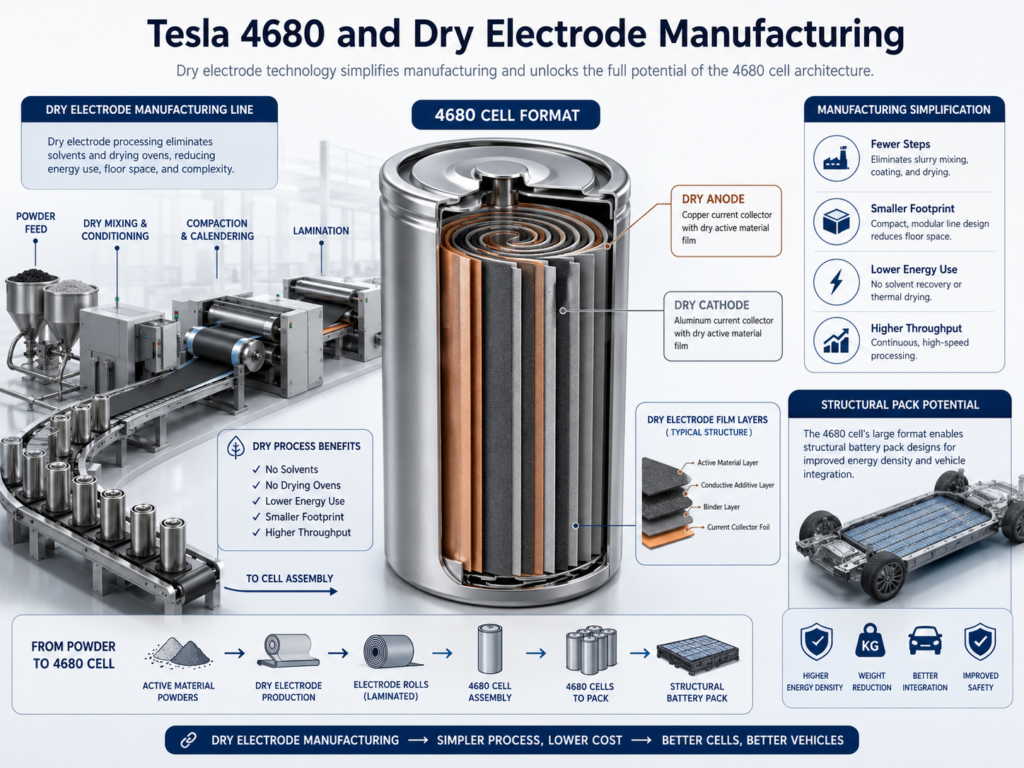
Dry electrode manufacturing replaces the traditional wet slurry process with a solvent-free or near-solvent-free process. Instead of mixing electrode materials into a liquid slurry, the dry process uses powder-based materials and binders that can form a stable electrode film without the same large drying step.
Different companies and research groups use different approaches. Some use dry powder mixing and fibrillated binders. Some use electrostatic deposition. Some form a free-standing dry electrode film first and then laminate it onto the current collector. Others use variations designed for specific chemistries or production equipment.
The common goal is the same: create a high-quality electrode without relying on large amounts of solvent and long drying ovens. This sounds straightforward, but it is difficult because the wet process provides something useful: it helps distribute materials evenly. In a slurry, particles, binder, and conductive additives can be mixed and coated relatively uniformly. Once the solvent evaporates, the remaining structure becomes the electrode.
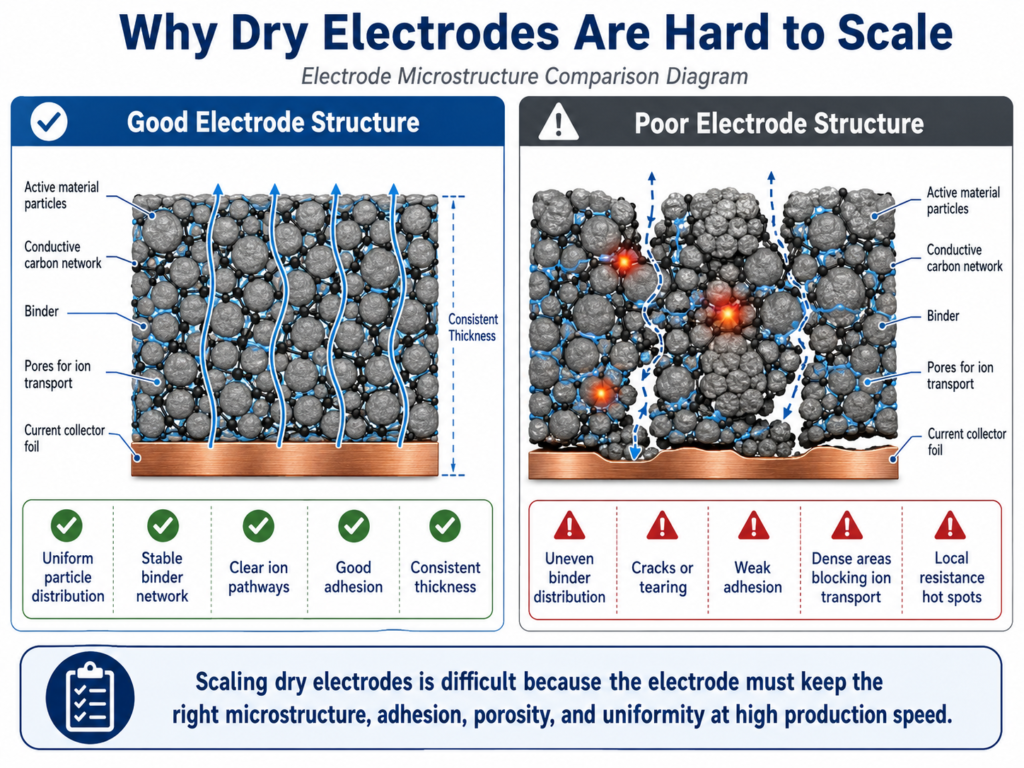
In a dry process, the manufacturer has to create that same level of uniformity without the same liquid mixing and drying behavior. That is hard. The dry electrode must still have strong adhesion to the current collector. It must not crack, tear, or delaminate. It must maintain consistent thickness. It must have a good conductive network. It must allow lithium ions to move efficiently. It must also be manufacturable at high speed with low scrap rates. That is the real challenge. Dry electrode manufacturing is not simply “removing liquid.” It is replacing an entire process that controls electrode microstructure.
External reference:
ORNL — Carbon fiber boosts dry-processed battery performance
Why Tesla Cares So Much About Dry Electrodes
Tesla helped make dry electrode manufacturing famous because of its 4680 battery program. When Tesla acquired Maxwell Technologies in 2019, one of the most interesting parts of that acquisition was Maxwell’s dry battery electrode technology. Tesla later presented dry electrode manufacturing as a key part of its battery cost-reduction roadmap.
The idea fit Tesla’s larger strategy. Tesla does not only want better battery cells. It wants cheaper, faster, more vertically integrated battery production. Dry electrode manufacturing supports that goal because it could reduce factory complexity and help Tesla produce more cells in a smaller footprint.
For Tesla, this matters because battery supply affects everything: vehicle cost, margins, Cybertruck production, future affordable EVs, robotaxi ambitions, energy storage, and domestic supply chain resilience.
The 4680 cell itself is already a manufacturing bet. Larger cylindrical cells reduce the number of cells needed per pack compared with smaller formats. Structural battery packs can reduce pack-level complexity. Dry electrode manufacturing could then reduce cell production complexity.
These pieces are connected. A 4680 cell made with conventional wet electrode manufacturing is still useful. But a 4680 cell made with mature dry electrode manufacturing is closer to the original manufacturing revolution Tesla promised.
In its Q4 and FY 2025 update, Tesla stated: “We now produce dry-electrode for 4680 cells with both anode and cathode made in Austin.” That is important because dry cathode production has generally been viewed as more difficult to scale than dry anode production.
External reference:
Tesla Q4 and FY 2025 Update PDF
Wet Coating vs Dry Coating: The Practical Difference
For EV owners, the difference between wet coating and dry coating is invisible. You do not see it on the dashboard. Your car does not show whether its electrodes were made with slurry coating or dry processing.
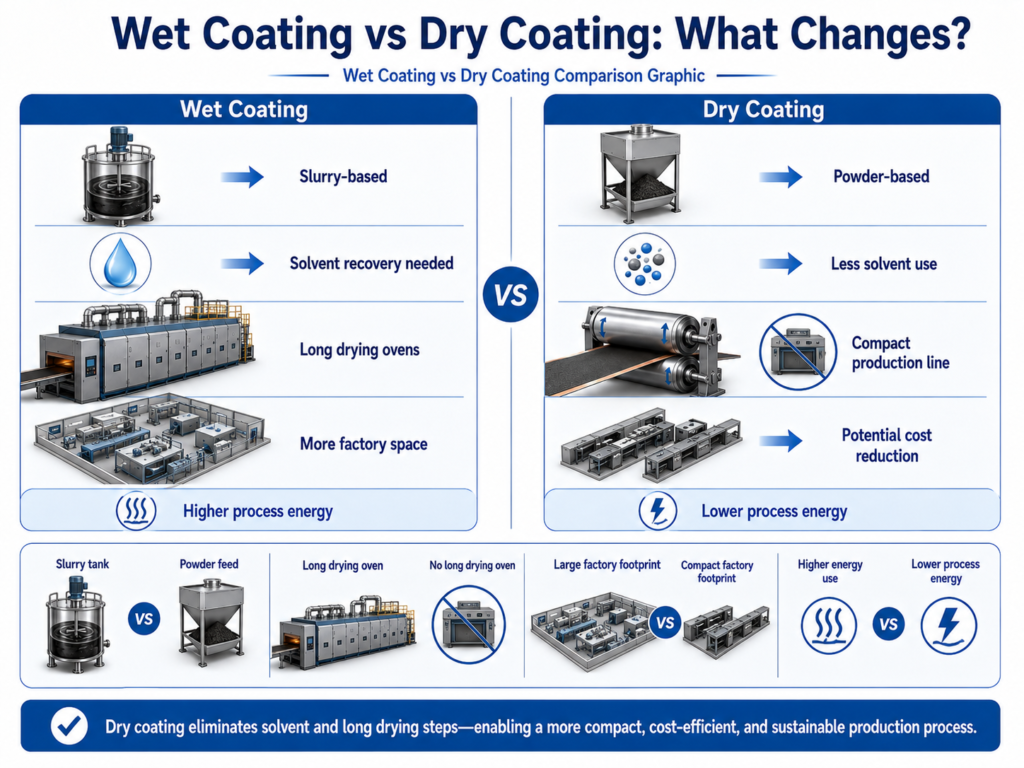
But at the factory level, the difference can be huge. Wet coating depends on slurry preparation, solvent handling, coating, drying, solvent recovery, and then electrode finishing. Dry coating tries to simplify that chain by removing or reducing the solvent and drying steps.
This can affect several areas at once. A dry process may require less factory floor space because it can reduce the need for long drying ovens. It may reduce energy use because there is less solvent to evaporate. It may reduce environmental-control costs because there is less solvent recovery and handling. It may improve throughput if the process can run fast and consistently. It may also reduce capex because the production line can be more compact.
However, the word “may” is important. Dry electrode production is only cheaper if it works at high yield. If the process creates too much scrap, inconsistent coatings, poor adhesion, or performance problems, the theoretical cost savings can disappear quickly.
Battery manufacturing is unforgiving. A small defect at the electrode level can become a major cell quality issue later. For EVs, that is especially serious because cells must survive years of vibration, temperature changes, fast charging, and high-power operation.
So the dry electrode question is not just, “Can it make an electrode?” The real question is, “Can it make millions of high-quality electrodes every week, at high speed, with low scrap, consistent performance, and long cycle life?” That is where the challenge becomes industrial rather than scientific.
Why Dry Electrode Manufacturing Could Reduce Battery Cost
Battery costs are affected by materials, cell design, factory utilization, yield, labor, energy, equipment, and supply chain logistics. Dry electrode manufacturing does not solve all of those problems, but it attacks several important ones.
The most obvious cost benefit is removing parts of the wet coating system. Drying ovens are large, expensive, and energy-intensive. Solvent recovery equipment also adds cost. If a factory can eliminate or shrink those systems, the production line can become more compact.
A smaller production line can matter more than it sounds. Battery factories are enormous. Any process that reduces floor space can reduce building cost, utilities, air handling complexity, and line integration difficulty.
Dry processing may also improve production speed. If the electrode does not need a long drying stage, the line may move faster or require fewer parallel lines to reach the same output. That could improve capital efficiency.
There is also a working-capital angle. Faster production means less material sitting in intermediate process stages. In high-volume manufacturing, time inside the factory is money.
Finally, dry electrode technology could help reduce the environmental cost of battery manufacturing. EVs already reduce tailpipe emissions because they have no tailpipe. But battery production still has an environmental footprint. Reducing solvent use, energy use, and equipment intensity can improve the overall sustainability story.
This does not mean dry electrode batteries are automatically “green batteries.” Mining, refining, cathode production, electricity sources, factory efficiency, and recycling still matter. But dry electrode manufacturing is one of the more practical ways to reduce the burden of cell production itself.
External reference:
ORNL — Advanced electrode processing for lithium-ion battery manufacturing
Why Dry Electrodes Are Hard to Scale
If dry electrode manufacturing has so many advantages, why has it taken so long? The answer is quality control. In battery manufacturing, making one good cell in a lab is very different from making millions of good cells in a factory. Dry electrode technology has to solve several problems at the same time.
One major issue is film strength. Dry-processed electrode films can be more fragile during handling. They may tear, crack, or develop defects if the binder network is not strong enough. ORNL researchers have specifically worked on improving the mechanical strength and conductivity of dry-processed films by using carbon fiber reinforcement.
Another issue is uniformity. A battery electrode needs consistent material distribution across its thickness and width. If active material, binder, or conductive carbon is unevenly distributed, local resistance can increase. That can affect power delivery, heat generation, capacity utilization, and long-term aging.
Adhesion is also critical. The electrode coating must stay attached to the current collector. Poor adhesion can lead to delamination, higher resistance, capacity loss, or safety concerns.
Then there is porosity. A dense electrode can store a lot of energy, but if it is too dense, lithium ions may struggle to move through it quickly. A porous electrode may support better ion transport, but too much porosity can reduce energy density. Manufacturing has to find the right balance.
This is why dry electrode technology is more than a cost-cutting trick. It is a microstructure engineering problem. A good dry electrode needs the right mechanical strength, electronic conductivity, ionic pathways, adhesion, thickness, density, and durability. Getting all of that right at automotive scale is difficult.
External reference:
Nature Scientific Reports — Solvent-Free Manufacturing of Electrodes for Lithium-ion Batteries
Dry Electrodes and Tesla 4680 Cells
Tesla’s 4680 cell is often discussed as if it were only a cell-size change. That misses the bigger picture. The 4680 cell is larger than the older 2170 cylindrical cell. Its name comes from its approximate dimensions: 46 mm diameter and 80 mm height. A larger cell can reduce the total number of cells in a pack, which can simplify some pack-level design and assembly steps.
But Tesla’s 4680 strategy also includes structural integration and manufacturing simplification. That is where dry electrode manufacturing matters.
Tesla’s long-term goal appears to be a cell that is not only larger, but also cheaper and faster to manufacture. A 4680 cell built using mature dry electrodes could potentially reduce production cost compared with a similar cell made with conventional wet coating. It could also support Tesla’s broader effort to localize more of the battery supply chain in the United States. This is especially relevant because Tesla has been trying to reduce dependence on external cell suppliers while also scaling energy storage and future vehicle platforms.
Still, it is important not to overstate the impact. A dry-electrode 4680 cell does not automatically make every Tesla cheaper overnight. Vehicle price depends on many factors: battery material costs, production yield, vehicle demand, factory utilization, tariffs, software content, labor, and overall business strategy.
Dry electrode manufacturing is one piece of the puzzle. But it is a meaningful piece because it targets the production process itself. If battery factories become simpler and more efficient, EV cost reduction becomes more realistic over time.
Related internal article:
Cell-to-Pack vs Structural Battery Pack: 7 Key Differences You Should Know
Is Dry Electrode Technology Only for Tesla?
No. Tesla is the most visible company associated with dry electrode manufacturing, but the technology is not only a Tesla story. Battery researchers, national laboratories, startups, and major cell manufacturers are all exploring ways to reduce solvent use, improve electrode processing, and lower manufacturing cost.
That makes sense because every battery maker faces the same pressure. EVs need cheaper batteries. Energy storage systems need cheaper batteries. Automakers want local supply chains. Governments want cleaner manufacturing. Battery companies want higher throughput and lower capital cost. Dry electrode manufacturing is attractive because it addresses factory cost rather than only chemistry cost.
Chemistry improvements are important, but they often come with tradeoffs. A new cathode may improve energy density but increase cost. A new anode may improve range but create swelling or cycle-life challenges. A solid-state battery may improve safety and energy density but require entirely new manufacturing methods.
Dry electrode manufacturing is different because it can potentially be applied to existing lithium-ion chemistries. In theory, it could help NMC, NCA, LFP, silicon-containing anodes, and future battery systems. That makes it a platform technology.
Of course, each chemistry has different requirements. A dry process that works well for one electrode formulation may not automatically work for another. LFP, high-nickel cathodes, graphite anodes, and silicon-rich anodes all behave differently during processing. So dry electrode technology is not one universal recipe. It is a family of manufacturing approaches.
How Dry Electrode Batteries Could Affect EV Owners
Most EV owners will never ask whether their battery was made with dry electrodes. They will care about price, range, charging speed, warranty, reliability, and safety.
Dry electrode manufacturing could affect owners indirectly in several ways. The first impact could be lower vehicle cost. If dry electrode production reduces manufacturing cost at scale, automakers may be able to lower battery pack cost. Since the battery is one of the most expensive parts of an EV, even modest cost reductions matter.
The second impact could be more stable supply. If battery factories become more compact and easier to scale, automakers may be able to increase domestic battery production faster. That could reduce dependence on long global supply chains.
The third impact could be faster innovation. A simpler manufacturing process can sometimes make it easier to test new electrode formulations and scale them. That could help future batteries move from pilot production to mass production more quickly.
The fourth impact could be environmental. If less solvent and less energy are required during production, the manufacturing footprint of EV batteries could improve.
But drivers should be cautious about dramatic claims. Dry electrode manufacturing does not change the basic rules of battery care. Fast charging still creates heat. High state of charge can still increase stress over time. Cold charging can still increase lithium plating risk. Thermal management and BMS controls still matter.
For more on how battery controls protect EV batteries during charging, see:
EV Battery Management System Explained: How Modern EV BMS Actually Work
Dry Electrodes vs Solid-State Batteries
Dry electrode batteries and solid-state batteries are sometimes discussed together, but they are not the same thing. A dry electrode battery is usually still a lithium-ion battery with liquid electrolyte. The “dry” part refers mainly to the electrode manufacturing process, not necessarily the electrolyte inside the finished cell. A solid-state battery replaces the liquid electrolyte with a solid electrolyte. That is a much bigger change to cell design, interfaces, manufacturing, and safety behavior.
This distinction matters because dry electrode technology may reach mass production sooner than many solid-state batteries. It improves how today’s batteries are made. Solid-state batteries aim to change what the battery is.
That does not make one more important than the other. They solve different problems. Dry electrode manufacturing is about factory efficiency, cost, energy use, and scalability. Solid-state batteries are about energy density, safety potential, lithium-metal compatibility, and long-term chemistry innovation.
In the near term, dry electrode manufacturing may have a more immediate impact on mainstream EVs because it can be applied to existing battery types. Solid-state batteries may become important later, especially in premium vehicles or specialized applications, but they still face difficult scale-up challenges.
Related article:
Solid-State Batteries Explained: Hype vs Reality in 2026
The Biggest Misunderstanding About Dry Electrode Batteries
The biggest misunderstanding is thinking that dry electrode batteries are a completely new kind of battery chemistry. They are not. A dry-electrode 4680 cell can still be a lithium-ion cell. It can still use nickel-based cathode chemistry. It can still have graphite or silicon-containing anodes. It can still use liquid electrolyte.
The manufacturing process changes, but the electrochemistry may remain familiar. That is why dry electrode technology is both less flashy and more important than many people realize. It does not sound as futuristic as solid-state batteries or sodium-ion batteries. It does not immediately promise a 700-mile EV or five-minute charging.
Instead, it focuses on the factory. And in the EV industry, factory improvements can be just as powerful as chemistry breakthroughs. Toyota became famous for production systems. Tesla became famous partly because it rethought vehicle manufacturing, software integration, and battery packaging. BYD became a battery and EV giant partly because it mastered vertical integration and cost control. Dry electrode manufacturing belongs in that same category. It is not only a battery technology. It is a manufacturing strategy.
What to Watch Next
The most important thing to watch is not just whether Tesla can make dry-electrode cells. Tesla has already stated that it is producing dry-electrode 4680 cells with both anode and cathode made in Austin. The more important question is how well the process scales.
Several signs will matter. One is production volume. If dry-electrode 4680 production supports more Model Y, Cybertruck, energy storage, or future vehicle production, that would suggest the process is maturing.
Another is cost. Tesla and other manufacturers may not disclose exact cell cost, but gross margin trends, battery sourcing strategy, and factory expansion plans can give clues.
A third is yield. Battery factories can look impressive from the outside, but yield determines whether the process is economically successful. High scrap rates can destroy the advantage of a new manufacturing method.
A fourth is chemistry flexibility. If dry electrode methods work across different cathode and anode materials, the technology becomes much more valuable.
A fifth is adoption beyond Tesla. If more battery companies, equipment suppliers, and automakers move toward dry electrode production, that would suggest the industry sees it as more than a Tesla-specific experiment.
Dry electrode batteries are still in the scale-up phase, but the direction is clear. Battery innovation is moving beyond chemistry alone. The next phase of EV battery competition will be about chemistry, architecture, software, supply chain, and manufacturing all working together.
Conclusion
Dry electrode batteries are one of the most important battery manufacturing ideas in the EV industry. They do not represent a brand-new chemistry. Instead, they change how electrodes are made. By reducing or eliminating solvent-heavy wet coating and long drying steps, dry electrode manufacturing could reduce factory size, lower energy use, cut production cost, and improve scalability.
Tesla’s 4680 program brought this technology into the spotlight. The company’s confirmation that it now produces dry-electrode 4680 cells with both anode and cathode made in Austin is a major milestone. But the real test is not whether dry electrodes can be made. The test is whether they can be made at massive scale with high yield, consistent quality, and competitive cost.
For EV owners, the impact will be indirect but important. If dry electrode manufacturing succeeds, future EVs could become cheaper to build, easier to scale, and potentially cleaner to produce. Battery breakthroughs are not always about dramatic new materials. Sometimes, the most important revolution happens inside the factory.
FAQ
Are dry electrode batteries the same as solid-state batteries?
No. Dry electrode batteries usually refer to batteries made with a dry electrode manufacturing process. They can still use liquid electrolyte. Solid-state batteries use a solid electrolyte and involve a much bigger change in cell design.
Why is Tesla’s dry electrode process important?
Tesla’s dry electrode process is important because it could reduce battery manufacturing cost, factory size, energy use, and solvent-related complexity. It is also closely tied to Tesla’s 4680 battery strategy.
Do dry electrode batteries charge faster?
Not automatically. Charging speed depends on cell chemistry, electrode design, internal resistance, thermal management, BMS limits, and pack architecture. Dry electrode manufacturing may improve production efficiency, but it does not automatically guarantee faster charging.
Are dry electrode batteries cheaper?
They have the potential to be cheaper at scale because they can reduce drying, solvent recovery, factory space, and energy use. However, the cost benefit depends heavily on production yield and quality.
Are dry electrode batteries already in production?
Tesla stated in its Q4 and FY 2025 update that it now produces dry-electrode 4680 cells with both anode and cathode made in Austin. Other companies and research groups are also working on dry electrode manufacturing, but broad industry-wide adoption is still developing.
Does dry electrode manufacturing improve battery life?
Not automatically. Battery life depends on chemistry, electrode microstructure, thermal management, charging behavior, and BMS control. A well-made dry electrode can perform well, but poor manufacturing quality could hurt durability.
Why is wet coating still used if dry coating is better?
Wet coating is mature, reliable, and already optimized for mass production. Dry coating has attractive benefits, but it is harder to scale with consistent quality. Battery makers will not switch unless dry processing proves it can meet automotive standards at high volume.