
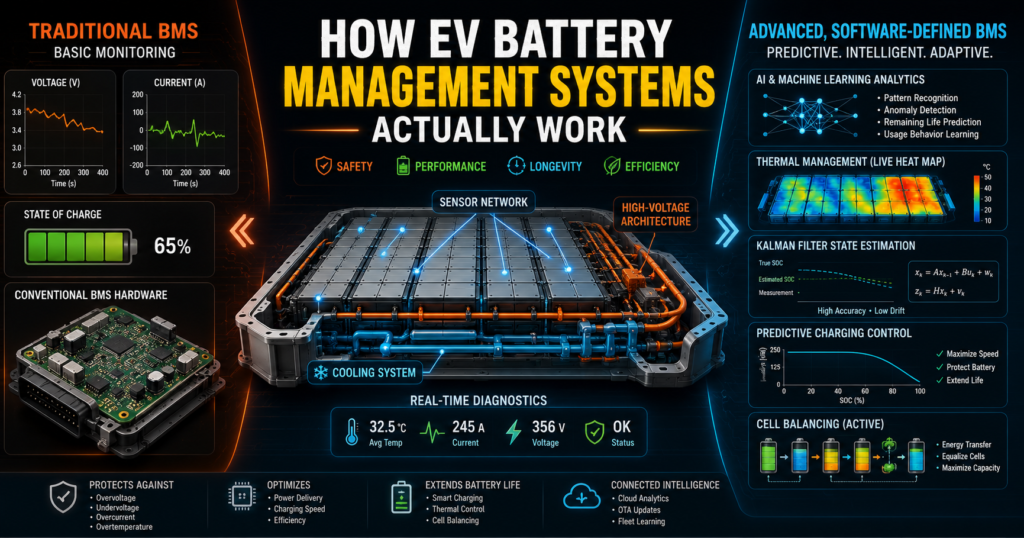
Quick Answer
A Battery Management System (BMS) is the electronic “brain” of an EV battery pack. It continuously monitors voltage, current, temperature, charging behavior, and cell health to keep the battery safe, efficient, and long-lasting.
Modern EV BMS software does far more than basic monitoring. It uses advanced estimation algorithms, predictive thermal control, safety diagnostics, and balancing strategies to maximize battery life while preventing dangerous conditions such as overcharging, overheating, or thermal runaway. Without a BMS, modern electric vehicles simply would not be practical.
Why the BMS Is One of the Most Important Parts of an EV
When most people think about EV technology, they focus on battery chemistry, charging speed, or driving range. But the real intelligence behind an EV battery is the Battery Management System. A modern EV battery pack may contain hundreds to thousands of individual lithium-ion cells, high-voltage electrical systems, multiple temperature zones, cooling circuits, fast charging hardware, safety disconnect systems, and real-time estimation software. Managing all of that safely and efficiently is incredibly difficult. That is exactly what the BMS does.
In many ways, the BMS acts like the operating system of the battery pack. It constantly makes decisions about how much power can safely be used, how quickly the battery can charge, whether the pack is too hot or too cold, which cells are aging faster, whether a fault condition exists, or how to maximize long-term battery life. Modern EVs from Tesla, General Motors, Hyundai Motor Company, and Rivian all rely heavily on sophisticated BMS software to deliver performance, range, and durability.
The Core Functions of a Modern EV BMS
At a high level, a BMS performs six major functions:
- State of Charge (SOC) estimation
- State of Health (SOH) estimation
- Thermal monitoring and control
- Cell balancing
- Safety protection and fault detection
- Power and charging control
These sound simple on paper. In reality, they are extremely complex engineering problems.
1. State of Charge (SOC) Estimation
Why SOC Is Harder Than It Sounds
Drivers expect their EV battery gauge to work like a fuel gauge. But lithium-ion batteries are much more complicated than gasoline tanks. A battery’s voltage changes nonlinearly with temperature, aging, current load, and chemistry. Two batteries at the same voltage may actually have very different remaining capacities depending on operating conditions. That means the BMS cannot simply “measure remaining energy directly.” Instead, it must estimate it.
Coulomb Counting
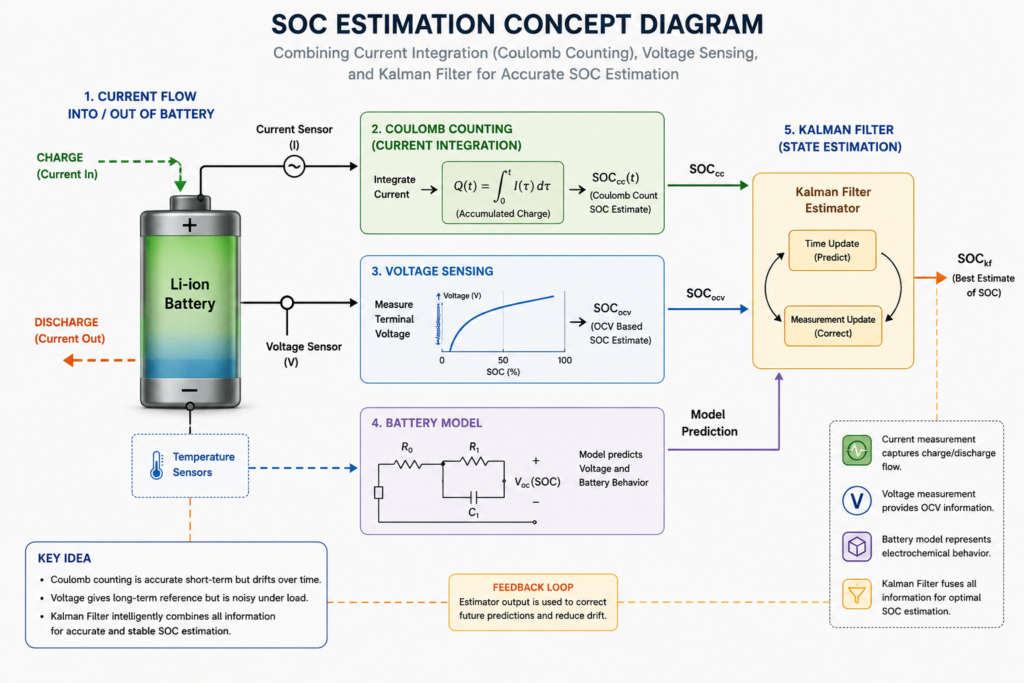
One of the most basic SOC estimation methods is called Coulomb counting. The BMS measures current flowing into and out of the battery over time:
In simple terms, charging adds energy, driving removes energy, and the BMS continuously integrates current flow. This works reasonably well in the short term. But small measurement errors accumulate over time. That means modern EVs cannot rely on Coulomb counting alone.
Open Circuit Voltage (OCV) Estimation
When the battery rests for long enough, the BMS can estimate SOC using open-circuit voltage curves. Different lithium-ion chemistries have characteristic voltage-vs-SOC relationships. However, this method has limitations: batteries rarely rest long enough during real-world driving, temperature strongly affects voltage behavior, and LFP battery cells have especially flat voltage curves. This is one of the reasons LFP-based EVs sometimes show less accurate range estimates at mid-state-of-charge levels.
Kalman Filters and Model-Based Estimation
Modern EVs increasingly rely on model-based estimation methods such as Kalman filters. Rather than trusting a single sensor reading, the BMS combines current measurements, voltage measurements, temperature data, battery models, and historical behavior to continuously estimate battery state. The idea is similar to how aircraft navigation systems fuse multiple sensors together. This allows the BMS to correct drift and improve estimation accuracy under dynamic conditions.
Many modern EV battery systems now use Extended Kalman Filters (EKF), Unscented Kalman Filters (UKF), physics-based electrochemical models, and data-driven estimation methods. This is one of the least visible — but most important — parts of EV technology.
2. State of Health (SOH) Estimation
What SOH Actually Means
SOC tells you how full the battery is right now. SOH tells you how much the battery has aged. For example, a new 100 kWh battery may store nearly 100 kWh. After years of use, it may only store 88–92 kWh. That reduction is battery degradation. The BMS continuously estimates this degradation over the life of the vehicle.
Why SOH Estimation Is Difficult
Battery aging is influenced by many factors such as fast charging frequency, high temperatures, deep discharge cycles, calendar aging, charging habits, battery chemistry, and driving patterns. No two EV batteries age exactly the same way. That makes SOH estimation a major engineering challenge.
Modern SOH Estimation Techniques
Modern EV BMS systems increasingly use internal resistance tracking, capacity fade estimation, incremental capacity analysis, electrochemical impedance analysis, and machine learning approaches. Internal resistance growth is especially important because it affects heat generation, power delivery, and fast charging capability. Higher resistance means more heat losses:
This relationship becomes critical during high-power acceleration or DC fast charging. Recent research on machine-learning-based battery lifetime prediction and battery lifespan modeling continues to improve how engineers diagnose battery health and estimate long-term degradation.
3. Thermal Management and Thermal Estimation
Temperature Is One of the Biggest Enemies of Battery Life
One of the most important jobs of the BMS is thermal management. Lithium-ion batteries operate best within a relatively narrow temperature range. If they are too cold, charging becomes difficult, power output drops, and lithium plating risk increases. On the other hand, if they are too hot, degradation accelerates, resistance increases, and thermal runaway risk rises. Modern EVs therefore rely heavily on active thermal management systems.
The BMS Does More Than Read Temperature Sensors
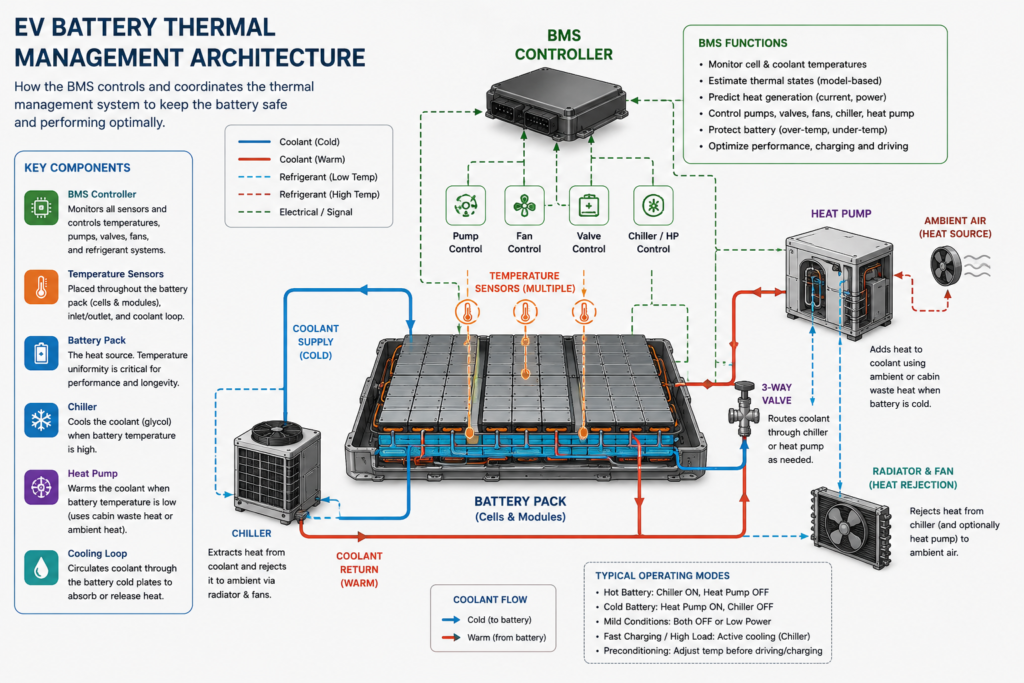
Many people assume the BMS simply reads a few thermistors. In reality, advanced systems often estimate internal battery temperatures that cannot be directly measured. This matters because surface temperature is not always equal to internal cell temperature, hotspots may form inside modules, and fast charging creates localized heat generation. Modern BMS software often combines sensor measurements, thermal models, cooling system data, and current flow information to estimate internal thermal states. This becomes especially important in ultra-fast charging, high-performance EVs, large battery packs, and extreme climates.
Predictive Thermal Management
Newer EV platforms increasingly use predictive control strategies. Instead of reacting after temperatures rise, the vehicle predicts future thermal conditions and prepares in advance. Examples include battery preconditioning before DC fast charging, predictive cooling during track driving, navigation-linked thermal preparation, and charging optimization based on ambient conditions. This is why vehicles like the Porsche Taycan or Hyundai Ioniq 5 can sustain relatively high charging speeds.
The BMS is constantly coordinating with cooling pumps, refrigerant systems, radiators, HVAC systems, and power electronics to manage battery temperature in real time.
For more on this topic, see:
- EV Heat Pumps Explained: The Secret to Better Winter Range
- Why EV Batteries Charge Slower Above 80% (And Why That’s Normal)
4. Cell Balancing
Why Cell Balancing Matters
An EV battery pack is only as strong as its weakest cell. Even small manufacturing differences cause cells to age differently over time. Without balancing, some cells would overcharge, some cells would overdischarge, pack capacity would shrink faster, and safety risks would increase. The BMS therefore continuously balances cells to maintain uniform behavior.
Passive vs Active Balancing
Passive Balancing
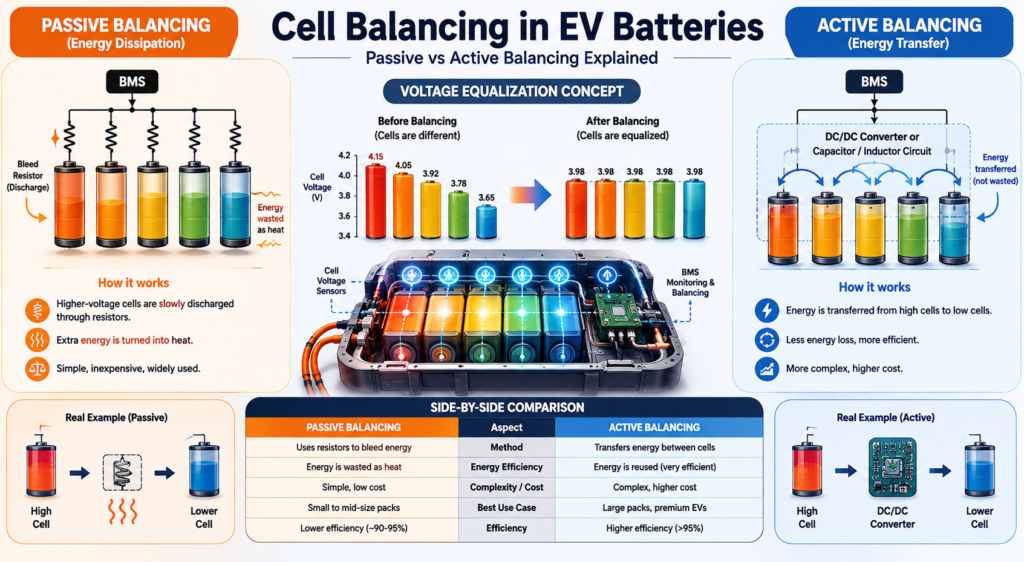
Most EVs today use passive balancing. The BMS slightly discharges higher-voltage cells through resistive circuits to match weaker cells. Advantages of passive balancing include simplicity, reliability, and low cost. However, it dissipates small amounts of energy as heat.
Active Balancing
Some advanced systems use active balancing. Instead of burning excess energy as heat, energy transfers between cells. Advantages of active balancing include higher efficiency and potentially better battery pack utilization. However, it generally comes with higher cost and greater complexity. As EV packs become larger and more expensive, active balancing may become more common in future architectures.
5. Safety Logic and Fault Detection
Safety Is the Highest Priority
Modern EV batteries contain enormous amounts of stored energy. A large battery pack may contain energy equivalent to several kilograms of TNT. The BMS therefore prioritizes safety above everything else.
What the BMS Monitors
The BMS continuously checks for overvoltage, undervoltage, overcurrent, short circuits, isolation faults, sensor failures, thermal runaway indicators, cooling system failures, abnormal voltage drift, and unexpected impedance growth. If dangerous conditions appear, the BMS can limit power, reduce charging speed, trigger warnings, open contactors, and electrically isolate the battery pack. In severe cases, the system can shut down the vehicle entirely.
Thermal Runaway Prevention
One of the most critical responsibilities of the BMS is preventing thermal runaway propagation. Modern EVs now use multiple layers of protection such as module isolation, cooling barriers, gas venting paths, redundant sensors, and fast fault detection logic. This is one of the reasons modern EV battery fires remain relatively rare compared to public perception.
For more detail:
- EV Battery Fire: Do EV Batteries Catch Fire More Often Than Gas Cars? (2026 Data)
- Why EV Batteries Swell — And Why You Should Never Ignore It (2026 Guide)
External references:
6. Fast Charging Control
Why Charging Curves Are Controlled So Carefully
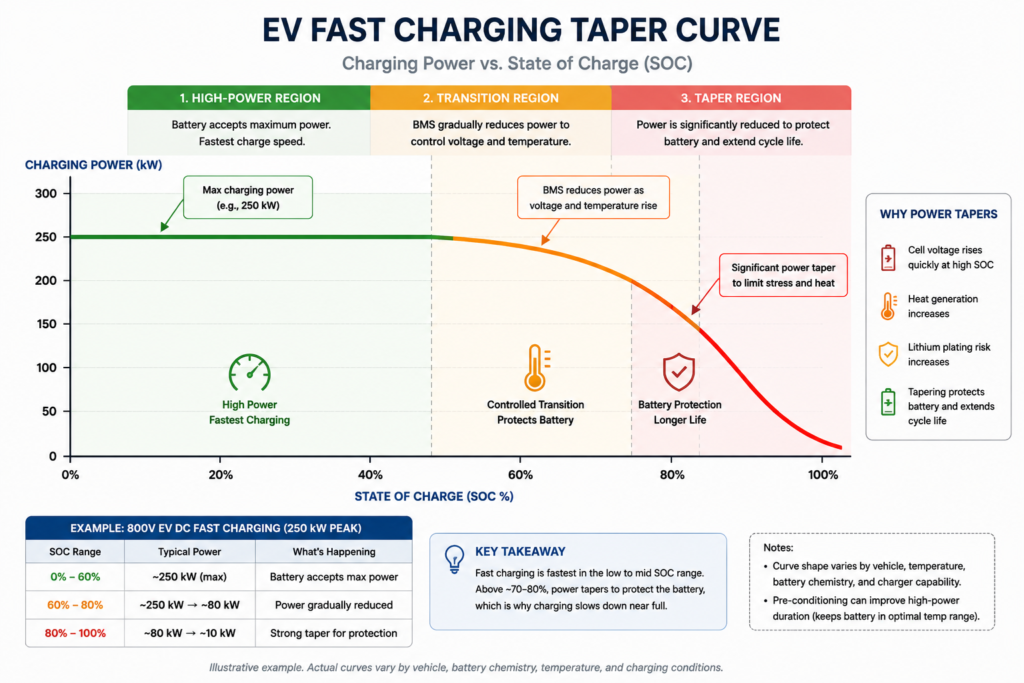
Many drivers wonder why charging slows down above 70–80%. The answer is largely controlled by the BMS. At high SOC levels, cell voltage rises rapidly, internal resistance increases, heat generation grows, and lithium plating risk rises. The BMS therefore reduces charging power to protect the battery. This charging taper is intentional. Without it, long-term degradation would increase significantly.
The BMS Coordinates the Entire Charging Process
During DC fast charging, the BMS communicates continuously with the charger, thermal systems, and vehicle control modules. It determines maximum allowable current, maximum voltage, thermal limits, cooling requirements, and charge taper behavior. Modern 800V EVs rely especially heavily on advanced BMS software because charging power levels can exceed 250–350 kW.
For related reading:
The Future of EV Battery Management Systems
The BMS Is Becoming More Software-Driven
Early EV battery systems were largely hardware-focused. Modern systems are increasingly software-defined. Future BMS technologies are expected to include AI-assisted diagnostics, cloud-connected battery analytics, fleet learning, physics-informed machine learning, real-time impedance tracking, and digital twin battery models. This shift is becoming especially important as EV battery costs remain one of the largest portions of total vehicle cost.
Why Software May Matter More Than Chemistry
Battery chemistry still matters enormously. But increasingly, the quality of the BMS software determines charging performance, battery lifespan, cold-weather behavior, safety margins, long-term reliability. Two EVs using similar battery cells can perform very differently depending on how intelligently the BMS manages the pack. This is one of the reasons some automakers achieve better real-world battery longevity than others even when using similar suppliers.
Final Thoughts
Modern EV battery management systems are far more sophisticated than most people realize. A modern BMS is not just a protection circuit. It is a real-time estimation system, a thermal control coordinator, a safety supervisor, a predictive charging controller, and a battery diagnostics platform.
And as EV technology continues evolving, the BMS will likely become even more important. In many ways, the future of EV performance may depend just as much on software intelligence as on battery chemistry itself.
FAQs
What does a BMS do in an EV?
A Battery Management System monitors and controls the EV battery pack. It estimates battery charge, tracks battery health, manages temperatures, balances cells, and prevents unsafe operating conditions.
Can an EV run without a BMS?
Not safely. Modern lithium-ion battery packs require continuous monitoring and protection. Without a BMS, batteries could become unstable, overheat, or degrade rapidly.
Why does EV charging slow down above 80%?
The BMS intentionally reduces charging power at high state-of-charge levels to reduce heat, avoid lithium plating, and protect long-term battery life.
What is the difference between SOC and SOH?
SOC (State of Charge) indicates how full the battery currently is. SOH (State of Health) indicates how much the battery has aged relative to when it was new.
Do all EVs use cell balancing?
Yes. Modern EV battery packs require cell balancing to maintain consistent voltage levels and maximize pack longevity and safety.