
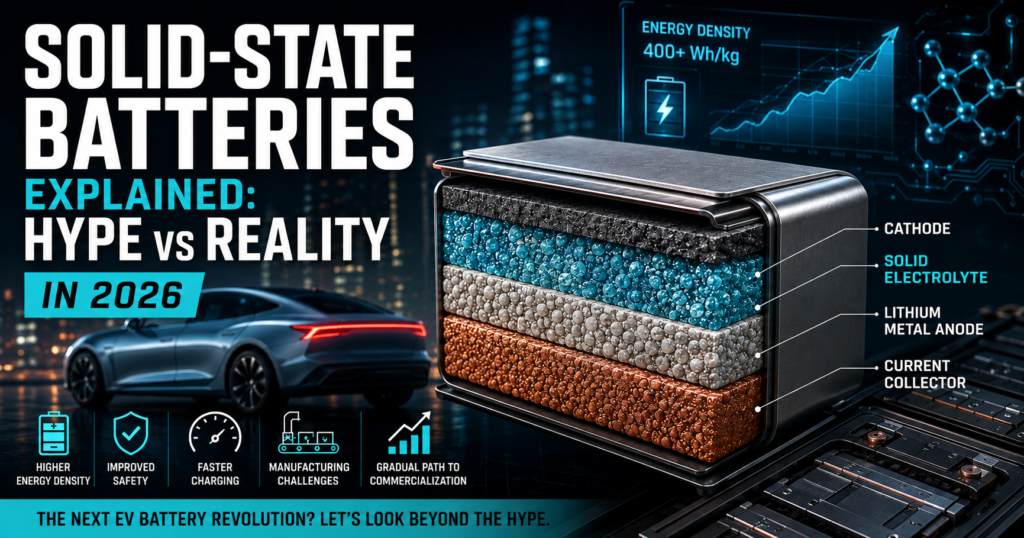
For years, solid-state batteries have been described as the “holy grail” of electric vehicles. Automakers and battery startups continue promising EVs with longer range, ultra-fast charging, improved safety, and lower fire risk. Toyota, QuantumScape, Samsung SDI, CATL, and several other companies are aggressively investing in the technology, with some targeting more than 1,000 km (620 miles) of driving range in future EV platforms, according to Electrek.
But despite the excitement, fully commercial solid-state EV batteries are still not widely available in 2026. So what is actually happening behind the scenes? And why has mass production proven so difficult?
The answer is more complicated than many headlines suggest.
What Makes Solid-State Batteries Different?
Conventional lithium-ion batteries use a liquid electrolyte to transport lithium ions between the cathode and anode during charging and discharging. Solid-state batteries replace that liquid with a solid electrolyte made from sulfide, oxide, polymer, or hybrid materials, as described by Yahoo Finance battery market analysis.
The biggest advantage is that solid electrolytes may enable the use of lithium-metal anodes, which theoretically provide much higher energy density than today’s graphite-based batteries.
Potential Advantages of Solid-State Batteries
| Feature | Conventional Li-ion | Solid-State Target |
|---|---|---|
| Electrolyte | Liquid | Solid |
| Typical Anode | Graphite | Lithium Metal |
| Energy Density | ~250–300 Wh/kg | 400+ Wh/kg |
| Fire Risk | Moderate | Lower |
| Fast Charging | Limited by heat/plating | Potentially improved |
| Thermal Stability | Moderate | Higher |
This is one reason why solid-state batteries are attracting so much attention from the EV industry. Higher energy density could improve vehicle range while also reducing battery pack size and weight, according to IDTechEx solid-state battery report.
Why the Industry Is So Excited
The EV market is entering a stage where incremental improvements to conventional lithium-ion batteries are becoming increasingly difficult and expensive. Solid-state batteries are viewed as a potential “next-generation leap” rather than another chemistry update.
However, many discussions about solid-state batteries focus almost entirely on range improvements while ignoring the thermal and mechanical engineering challenges involved.
As discussed in our earlier article on EV battery degradation in hot weather, thermal stress remains one of the biggest long-term challenges for modern lithium-ion batteries. Solid-state batteries are often presented as a possible solution because of their improved thermal stability and reduced flammability.
Unlike conventional liquid electrolytes, most solid electrolytes are less volatile and less prone to combustion under abuse conditions, according to a review paper published on arXiv.
This becomes increasingly important as EV charging power continues increasing beyond 250–350 kW levels. Faster charging generates more heat, larger thermal gradients, and stronger lithium plating tendencies inside cells — all of which directly impact long-term battery durability.
The Biggest Problem: Interfaces
The largest obstacle facing solid-state batteries is not creating a laboratory prototype. Many companies have already demonstrated promising small-scale cells.
The real challenge is manufacturing millions of automotive-grade cells that remain stable over thousands of charge-discharge cycles.
Unlike liquid electrolytes that naturally fill microscopic gaps, solid electrolytes require extremely intimate physical contact between layers.
This becomes difficult because battery materials continuously expand and contract during operation. Lithium-metal anodes, in particular, can experience significant volume changes during charging and discharging, according to research summarized by Market Intelo.
That creates several engineering problems:
- Increased interface resistance
- Mechanical cracking
- Localized current concentration
- Reduced cycle life
- Capacity degradation
Ironically, lithium dendrite growth can still occur in some solid-state systems despite the popular assumption that solid electrolytes completely eliminate dendrites. Researchers from Nature Reviews Materials have highlighted this issue as one of the major long-term challenges for lithium-metal batteries.
This is one reason many battery engineers remain cautious about overly optimistic commercialization timelines.
Manufacturing Is Harder Than Most People Realize
Another major challenge is large-scale manufacturing.
Many sulfide-based solid electrolytes are highly sensitive to moisture and require extremely dry production environments. Some manufacturing processes require dew points below -40°C to -70°C, according to Market Intelo battery manufacturing research.
That dramatically increases manufacturing complexity and cost.
Key Manufacturing Challenges
- Expensive dry-room infrastructure
- New coating and lamination processes
- High-pressure cell stacking
- Difficult quality control
- Lower production throughput
- New thermal management strategies
Interestingly, many of the thermal and fast-charging limitations discussed in conventional lithium-ion batteries — especially in NMC-based systems — are also influencing how companies design next-generation semi-solid batteries.
For example, while NMC batteries offer higher energy density, they also tend to generate greater thermal stress under aggressive charging conditions compared to LFP chemistries. We discussed this tradeoff in detail in our earlier comparison of:
As a result, many companies are now quietly shifting toward semi-solid battery architectures instead of fully all-solid-state systems.
Semi-Solid Batteries May Arrive First
One of the most important industry developments in 2026 is the growing focus on semi-solid batteries.
Rather than eliminating liquid electrolyte entirely, semi-solid systems reduce liquid content while improving manufacturability and reliability.
This hybrid approach offers several practical advantages:
- Easier scaling using existing factories
- Lower interface resistance
- Improved cycle life
- Lower production risk
- Faster commercialization timelines
In reality, the first “solid-state EVs” consumers see may not be fully solid-state at all.
Companies such as CATL and several Chinese battery manufacturers are increasingly emphasizing semi-solid approaches because they provide a more realistic transition path from today’s lithium-ion production lines, according to Future Green Tech analysis.
Who Is Leading the Race?
Several companies are currently competing aggressively in the solid-state battery market:
- Toyota
- QuantumScape
- Samsung SDI
- CATL
- Solid Power
- ProLogium
- Factorial Energy
Toyota continues focusing heavily on sulfide-based electrolytes, while QuantumScape is pursuing lithium-metal architectures with ceramic separators. Meanwhile, CATL and BYD appear increasingly interested in semi-solid solutions that may be easier to commercialize at scale, according to XT Battery industry overview.
The biggest misconception surrounding solid-state batteries is that mass adoption is imminent. In reality, most experts expect a gradual transition that will likely begin with semi-solid architectures before fully solid-state systems become mainstream.
Estimated Solid-State EV Battery Commercialization Timeline
Industry expectations for gradual adoption of solid-state and semi-solid EV batteries.
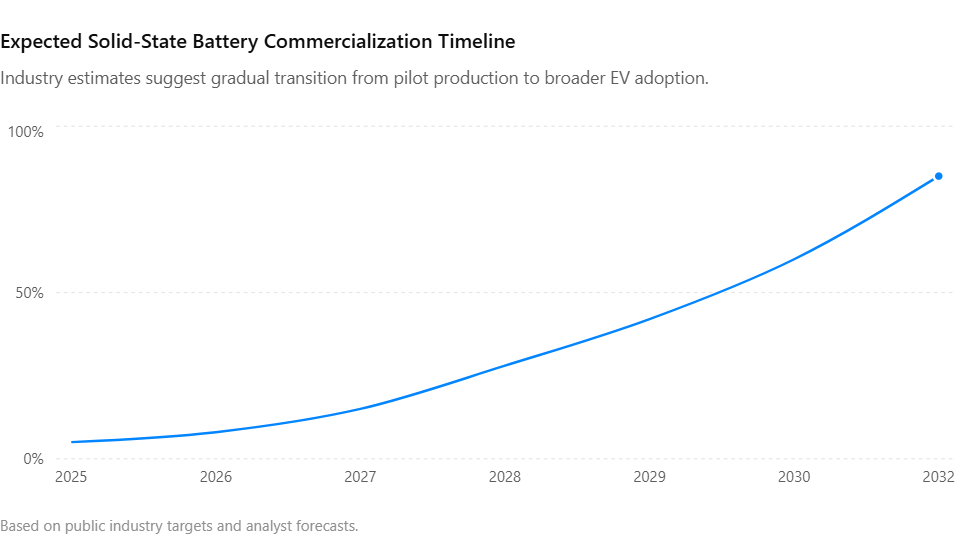
Still, despite major progress, most analysts now expect widespread automotive adoption closer to the late 2020s or early 2030s rather than an immediate breakthrough.
The Reality Behind the Hype
Solid-state batteries are not fake technology. They likely represent a genuine long-term evolution of EV battery systems. But the engineering reality is far more complicated than simply replacing liquid electrolyte with a solid material.
While solid-state batteries promise major improvements in safety and energy density, they do not completely eliminate thermal challenges. In fact, as discussed in our earlier article on EV battery degradation in hot weather, thermal gradients and charging-related stress remain critical factors in long-term battery reliability.
The future of EV batteries will likely involve a gradual evolution that combines:
- Semi-solid architectures
- Advanced lithium-ion chemistries
- Silicon-rich anodes
- Improved thermal management
- AI-driven battery diagnostics
- Smarter charging control systems
In other words, the next decade will probably bring steady engineering evolution rather than an overnight battery revolution.