
Quick Answer
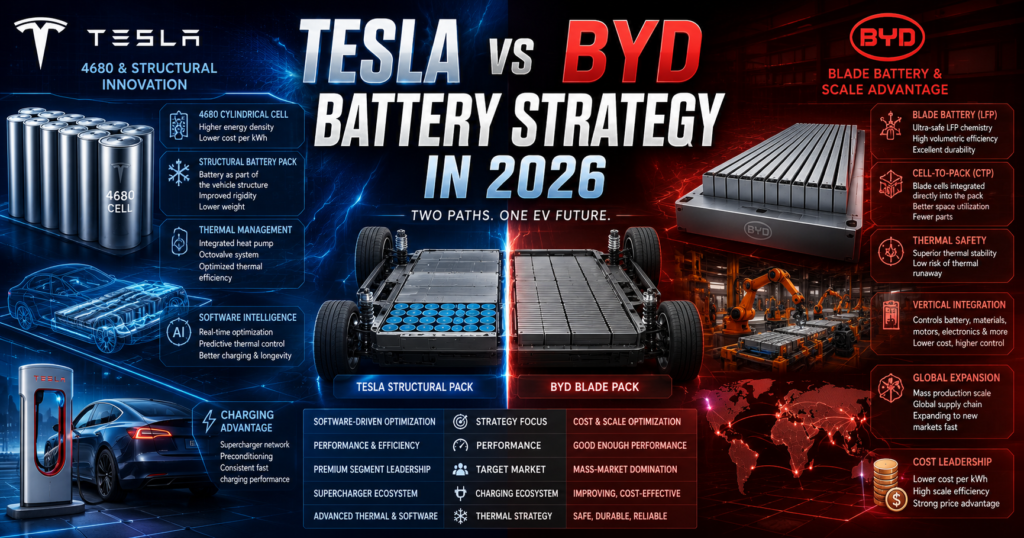
Tesla vs BYD battery strategy has become one of the most important topics in the EV industry in 2026. Tesla and BYD are taking very different approaches to EV batteries, manufacturing, charging, and thermal management. Tesla focuses heavily on software-driven optimization, high-performance battery architecture, 4680 structural battery integration, thermal efficiency, and manufacturing automation. On the other hand, BYD focuses on cost-efficient vertical integration, blade Battery safety, aggressive LFP deployment, in-house supply chain control, and scalable global production.
In 2026, Tesla still leads in software integration and high-end vehicle efficiency, while BYD is rapidly dominating the affordable EV segment with low-cost, highly scalable LFP-based platforms.
Introduction
A few years ago, most EV discussions revolved around a single question: “Who makes the best battery?” In 2026, that question has evolved into something much larger: “Which battery strategy actually wins the EV market?” That shift matters because the global EV industry is no longer just a technology race. It has become a manufacturing race, a supply-chain race, and increasingly, a cost-optimization race. And no two companies illustrate this better than Tesla and BYD.
Tesla helped push modern EVs into the mainstream through software-centric engineering, long-range performance, and advanced thermal management. BYD, meanwhile, built a massive vertically integrated ecosystem around affordability, manufacturing scale, and LFP battery deployment.
Today, the two companies are converging in some areas while diverging sharply in others. Both now use LFP batteries extensively. Both are pursuing tighter battery-pack integration. Both are scaling globally at enormous speed. But the philosophy behind their battery strategies remains fundamentally different.
Tesla’s Battery Strategy in 2026
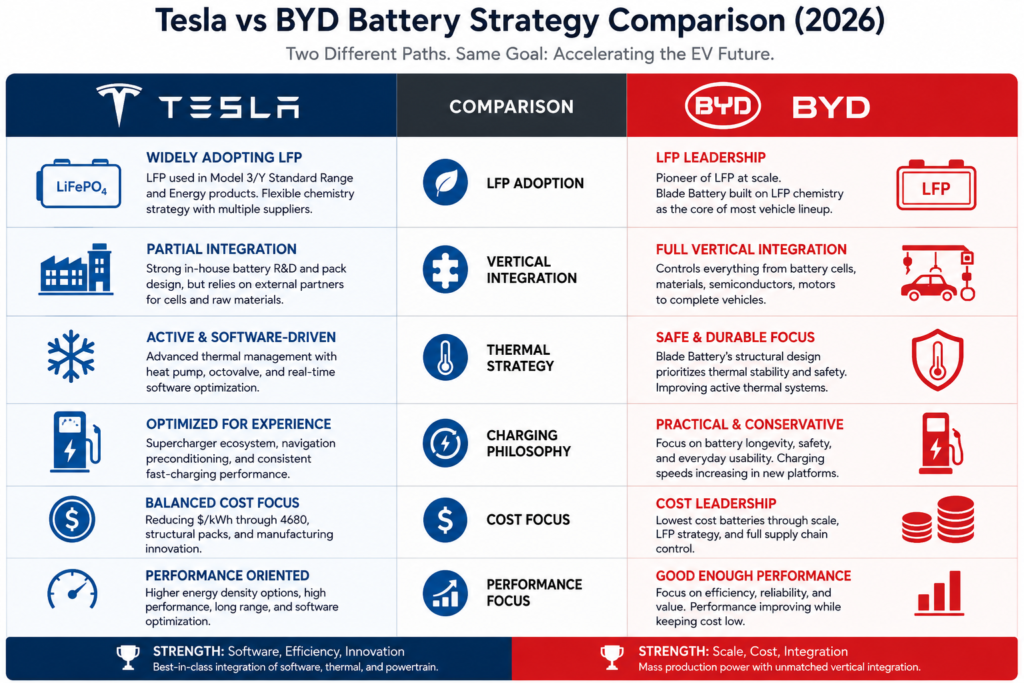
Tesla’s battery strategy has gradually shifted from “maximum range at any cost” toward a more balanced approach focused on manufacturing efficiency, cost reduction, scalable architectures, energy density where it matters, and software-controlled optimization. That evolution became especially visible after Tesla expanded LFP adoption across its standard-range lineup.
Tesla’s Big Shift Toward LFP
Tesla once relied almost entirely on nickel-rich chemistries such as NCA (Nickel Cobalt Aluminum). That made sense in the early EV era because Tesla prioritized maximum range, high power output, performance driving, and premium positioning.
But as EV adoption scaled globally, cost became increasingly important. LFP batteries offered several advantages such as lower cost, reduced dependence on nickel and cobalt, longer cycle life, better thermal stability, and improved safety margins.
Tesla now uses LFP batteries extensively in Standard Range Model 3, Standard Range Model Y (certain regions), and Energy storage applications. Tesla itself acknowledged the shift during investor discussions and Battery Day follow-ups (Tesla Q4 Shareholder Updates). This transition mirrors a broader industry trend discussed in one of our previous articles:
The 4680 Battery Cell: Tesla’s Long-Term Bet
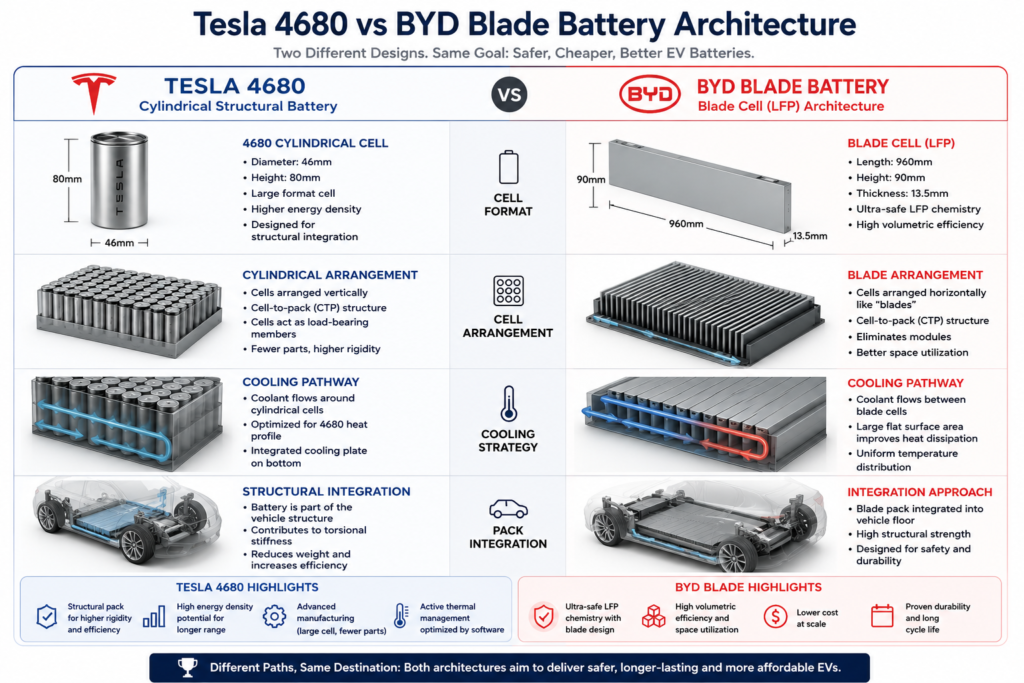
While Tesla expanded LFP usage, it simultaneously continued pushing one of its most ambitious battery projects: the 4680 cell. The 4680 format is designed around several goals: higher manufacturing efficiency, structural battery integration, reduced pack complexity, lower cost per kWh, improved thermal pathways, and higher production scalability.
Unlike conventional cylindrical cells, Tesla’s 4680 strategy is deeply connected to vehicle architecture itself. Instead of treating the battery pack as a separate module, Tesla increasingly treats the battery as a structural component of the vehicle. This helps reduce vehicle mass, simplify manufacturing, improve rigidity, and lower parts count. Tesla discussed this concept extensively during Battery Day and subsequent manufacturing updates (Tesla Battery Day Presentation, Tesla Engineering Blog).
However, the 4680 rollout has also been slower and more difficult than many expected. Manufacturing challenges remain significant because dry electrode production is difficult at scale, yield optimization takes time, thermal expansion management becomes more complex, and large-format cells create different cooling requirements. This is one of the reasons Tesla continues using multiple chemistries and suppliers simultaneously instead of fully transitioning to a single solution.
BYD’s Battery Strategy in 2026
BYD’s approach looks very different. Instead of prioritizing maximum performance first, BYD focused aggressively on manufacturing scale, battery safety, cost efficiency, vertical integration, and supply chain independence. That strategy now looks extremely effective in the global EV market.
The Blade Battery Changed BYD’s Global Reputation
For years, many Western consumers underestimated BYD’s battery technology. That changed after the introduction of the Blade Battery. The Blade Battery is essentially an LFP-based cell-to-pack architecture optimized for space efficiency, thermal stability, mechanical robustness, and lower production cost.
One reason the Blade Battery attracted enormous attention was BYD’s nail penetration demonstration, which showed remarkably low thermal runaway behavior compared with some conventional lithium-ion designs (BYD Blade Battery Overview). The Blade design helped BYD solve one of the traditional weaknesses of LFP batteries: lower volumetric energy density. By redesigning pack architecture itself, BYD improved packaging efficiency enough to make LFP viable for a broader range of vehicles. This became a major turning point for the industry.
BYD’s Real Advantage: Vertical Integration
Battery chemistry alone does not explain BYD’s growth. The company’s biggest strength may actually be vertical integration. BYD manufactures batteries, semiconductors, electric motors, power electronics, vehicle platforms, and some raw-material processing components. That level of control gives BYD major advantages such as faster cost reduction, supply-chain resilience, reduced supplier dependency, faster production scaling, and better pricing flexibility.
In many ways, BYD operates more like a combined battery company and vehicle manufacturer than a traditional automaker. This is particularly important during periods of lithium price volatility and geopolitical supply-chain uncertainty (BYD Official Global Site, International Energy Agency Global EV Outlook 2025).
LFP Adoption: Tesla and BYD Are Surprisingly Similar Here
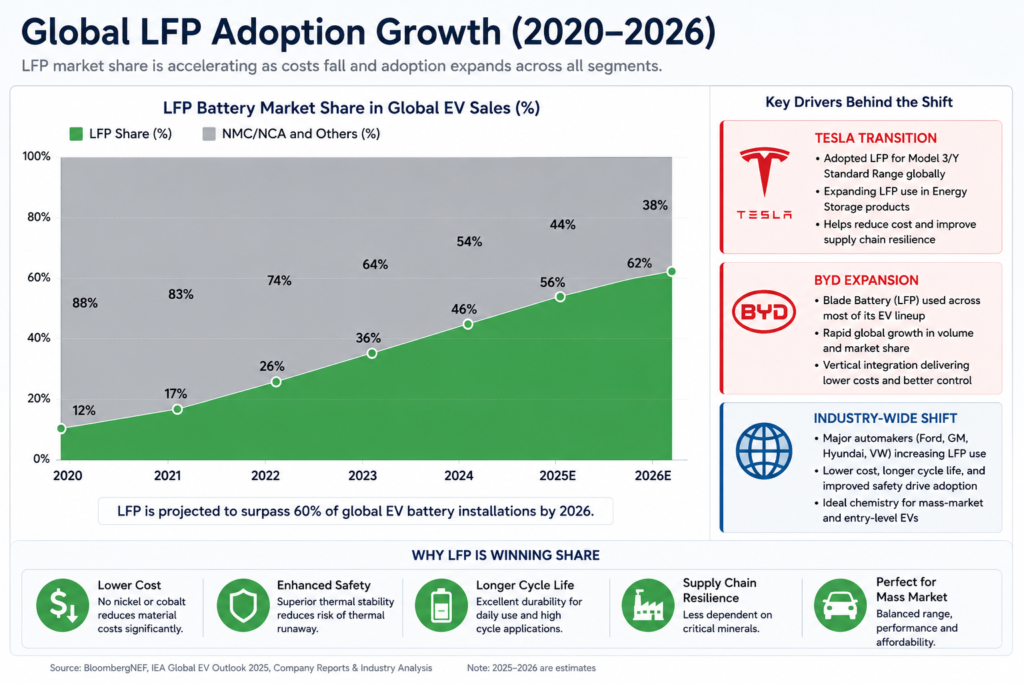
One of the most interesting developments in 2026 is that Tesla and BYD increasingly agree on one major issue: LFP batteries make tremendous sense for mass-market EVs. A few years ago, many analysts believed LFP would remain mostly limited to lower-cost Chinese EVs. That prediction turned out to be very wrong.
Today, LFP has become mainstream globally because it offers lower cost, excellent durability, better thermal stability, long cycle life, lower fire risk, and reduced cobalt dependency. This shift is happening across the industry. Ford, GM, Hyundai, and other automakers are also investing heavily in LFP-based strategies (Why EV Batteries Degrade Faster in Hot Weather). The biggest difference is that BYD built its entire growth strategy around LFP much earlier than most competitors. Tesla adapted to the trend later, but very aggressively.
Tesla vs BYD: Different Charging Philosophies
The charging strategies of Tesla and BYD also reveal major philosophical differences.
Tesla’s Approach
Tesla prioritizes charging consistency, thermal protection, real-world efficiency, network integration, and predictable fast-charging curves. Tesla’s Supercharger ecosystem remains one of the company’s biggest advantages. Instead of chasing peak charging numbers alone, Tesla focuses heavily on reliable charging behavior, navigation-integrated preconditioning, battery temperature optimization, and reduced degradation risk. Tesla’s software ecosystem plays a huge role here. The vehicle continuously adjusts pack temperature, charging current, cell balancing, and power taper behavior. This is closely related to topics discussed in:
BYD’s Approach
BYD’s charging strategy is somewhat different. Historically, BYD focused more on battery longevity, safety, cost efficiency, and everyday usability. Many BYD vehicles traditionally did not emphasize ultra-high charging peaks the way some premium EV makers did. However, this has started changing rapidly. Newer BYD platforms increasingly support higher charging power, improved thermal control, faster DC charging, and more advanced pack integration. Still, BYD generally appears more conservative than Tesla regarding aggressive fast-charging optimization. That may partly reflect the company’s focus on fleet durability, lower-cost segments, and global market scalability.
Thermal Management: Tesla Still Leads in Software Integration
One area where Tesla continues to stand out is thermal management integration. Tesla treats thermal management as a fully integrated software-and-hardware problem. This includes heat pump optimization, predictive preconditioning, dynamic coolant routing, real-time pack temperature modeling, and drive-unit thermal coordination. Tesla’s octovalve and integrated thermal architecture attracted major attention because they combined multiple thermal loops into a highly optimized system (Tesla Heat Pump and Octovalve Explained)
Related article:
BYD has also improved thermal management significantly, especially in newer global platforms. But Tesla still appears to have an edge in system-level thermal optimization, software coordination, real-time efficiency tuning, and energy management integration. That advantage becomes especially noticeable during winter driving, repeated fast charging, high-performance driving, and long-distance road trips.
Cost vs Performance: The Core Strategic Difference
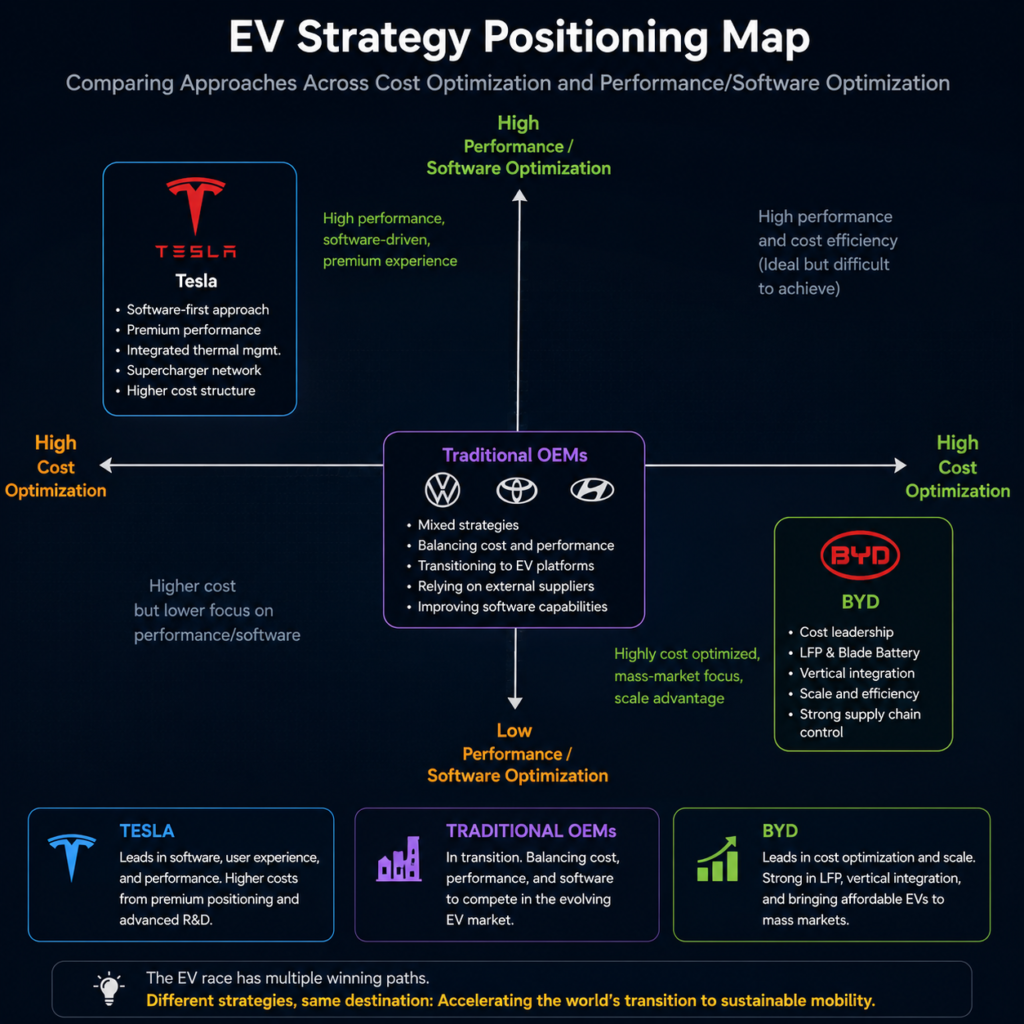
Ultimately, the Tesla vs BYD battery debate comes down to one core issue: what matters more in the future EV market? Maximum technological optimization? Or massive manufacturing scale at lower cost? Tesla still leans more toward premium engineering, vehicle efficiency, software sophistication, and performance optimization. BYD leans more toward scalable affordability, manufacturing dominance, vertical integration, and supply-chain control. And importantly, both strategies are working. Tesla remains one of the world’s most influential EV technology companies. BYD, meanwhile, has become one of the world’s largest EV manufacturers by volume.
Why the Global EV Market Is Moving Toward BYD’s Philosophy
One of the biggest industry shifts in 2025–2026 is that many automakers are increasingly adopting ideas that look more like BYD’s strategy than Tesla’s original strategy. That includes wider LFP adoption, cell-to-pack architectures, manufacturing simplification, lower-cost EV platforms, and reduced reliance on high-nickel chemistries. There are several reasons for this: EV price competition has intensified, consumers care more about affordability, battery raw materials remain expensive, and governments increasingly prioritize scalable adoption.
This does not mean Tesla is losing influence. In fact, Tesla continues influencing software-defined vehicles, thermal integration, charging ecosystems, manufacturing automation, and vehicle efficiency engineering. But the industry is no longer chasing only maximum range. Instead, automakers increasingly focus on “good enough” range, lower production cost, faster manufacturing scale, and better margins. That shift strongly favors LFP-centric strategies.
Can Tesla and BYD Both Win?
Surprisingly, yes. The global EV market is now large enough for multiple battery philosophies to succeed simultaneously. Tesla’s strengths remain software ecosystem, charging network integration, thermal engineering, vehicle efficiency, brand perception. On the other hand, BYD’s strengths remain battery manufacturing scale, cost optimization, vertical integration, aggressive global expansion, and LFP leadership. In reality, the future EV market will likely combine elements of both strategies. Some automakers may prioritize Tesla-style software integration. Others may prioritize BYD-style manufacturing efficiency. And increasingly, many companies are trying to do both.
Conclusion
Tesla and BYD are no longer simply competing as car companies. They are competing as two entirely different visions of how the EV industry should evolve. Tesla believes deeply in software-centric optimization, structural integration, advanced thermal engineering, and high-efficiency vehicle platforms. BYD believes deeply in vertical integration, manufacturing scale, affordable LFP deployment, and supply-chain control.
In 2026, neither strategy has clearly “won.” But together, they are reshaping the entire battery industry faster than almost anyone expected. And perhaps the biggest surprise of all is this: Despite their differences, both companies are increasingly converging on one major idea — the future of mass-market EVs will likely rely heavily on safer, cheaper, and more scalable battery architectures rather than simply chasing maximum range numbers.
FAQ
Does Tesla use BYD batteries?
Yes. In some markets and vehicle configurations, Tesla has sourced LFP batteries from BYD and CATL, particularly for standard-range vehicles.
Is BYD’s Blade Battery safer than Tesla batteries?
The Blade Battery’s LFP chemistry and structural design offer strong thermal stability and excellent safety characteristics. However, Tesla also uses highly advanced thermal management and safety systems. Both companies prioritize battery safety, but with different engineering approaches.
Why is LFP becoming more popular?
LFP batteries offer lower cost, long cycle life, better thermal stability, and reduced cobalt and nickel usage. Those advantages are becoming increasingly important as EV adoption scales globally.
Is Tesla abandoning 4680 batteries?
No. Tesla continues investing heavily in 4680 development, but scaling production has proven more difficult than initially expected.
Which company has the better long-term battery strategy?
That depends on market priorities. If the future favors software integration, premium efficiency, and high-performance EVs, Tesla may retain an advantage. If the future favors affordable mass-market EVs, manufacturing scale, and low-cost global expansion, BYD’s strategy could become even more influential.