
Quick Answer
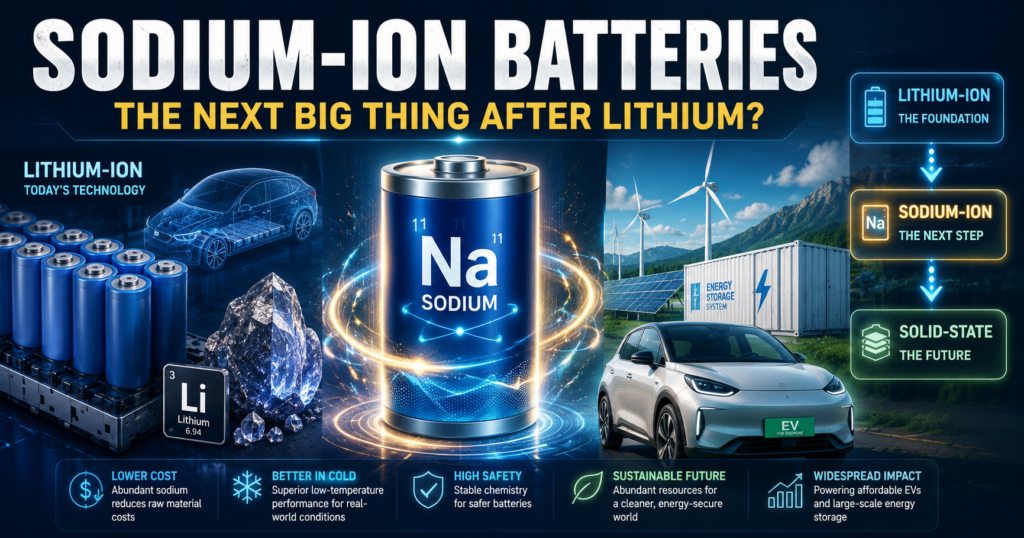
Sodium-ion batteries are increasingly viewed as one of the most promising battery technologies after solid-state batteries. They use sodium instead of lithium, offering lower material costs, improved cold-weather performance, and reduced dependence on critical minerals such as lithium, nickel, and cobalt. While sodium-ion batteries currently have lower energy density than most lithium-ion batteries, rapid improvements from companies such as CATL and commercial deployments by JAC suggest that sodium-ion technology could become a major option for affordable EVs and energy storage during the second half of this decade.
Introduction
For years, the future of electric vehicles seemed to revolve around a single question: When will solid-state batteries arrive? Solid-state batteries continue to attract enormous attention because of their potential for higher energy density, faster charging, and improved safety. However, despite years of research, large-scale commercialization remains challenging.
Meanwhile, another battery technology has quietly moved from research laboratories into real vehicles. That technology is the sodium-ion battery. Until recently, sodium-ion batteries were often dismissed as an interesting but impractical alternative to lithium-ion cells. Their energy density lagged behind existing lithium batteries, making them difficult to justify for EV applications.
But the landscape is changing rapidly. Over the past two years, major battery manufacturers and automakers have accelerated sodium-ion development. Chinese battery giant CATL has launched its new Naxtra sodium-ion battery platform, while automakers such as JAC have already begun commercial deployment in production vehicles. Industry observers increasingly view sodium-ion batteries as a realistic complement to lithium-ion technology rather than a distant science project (CATL, Reuters).
The question is no longer whether sodium-ion batteries work. The real question is where they fit into the future EV ecosystem.
What Is a Sodium-Ion Battery?
A sodium-ion battery works in a surprisingly similar way to a lithium-ion battery. Both technologies store and release energy by moving positively charged ions between two electrodes during charging and discharging.
The primary difference is simple: lithium-ion batteries use lithium ions while sodium-ion batteries use sodium ions. At first glance, this may not seem like a significant change. After all, lithium and sodium belong to the same group of elements in the periodic table.
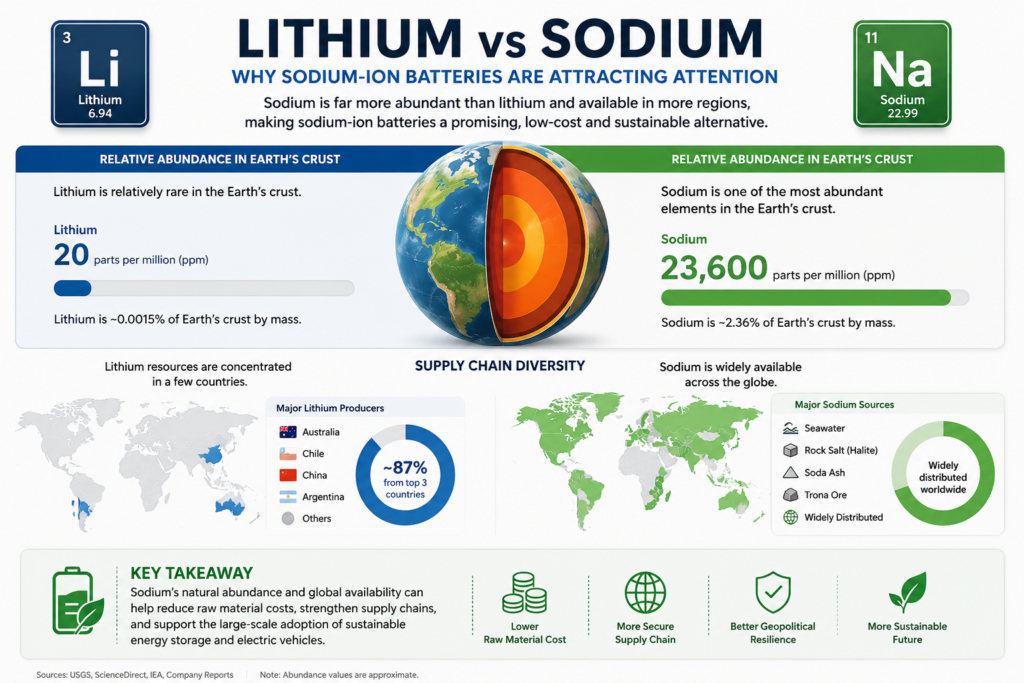
However, sodium offers several important advantages. Unlike lithium, sodium is one of the most abundant elements on Earth. It can be extracted from seawater and widely available mineral resources. This abundance creates the potential for a more stable and diversified supply chain.
In contrast, lithium production remains concentrated in a relatively small number of regions around the world, making battery supply chains vulnerable to geopolitical and market fluctuations. As EV adoption continues to increase globally, many researchers believe battery manufacturers will eventually need multiple battery chemistries rather than relying exclusively on lithium. That is where sodium-ion technology becomes particularly interesting.
Why Is the Industry Suddenly Interested in Sodium-Ion Batteries?
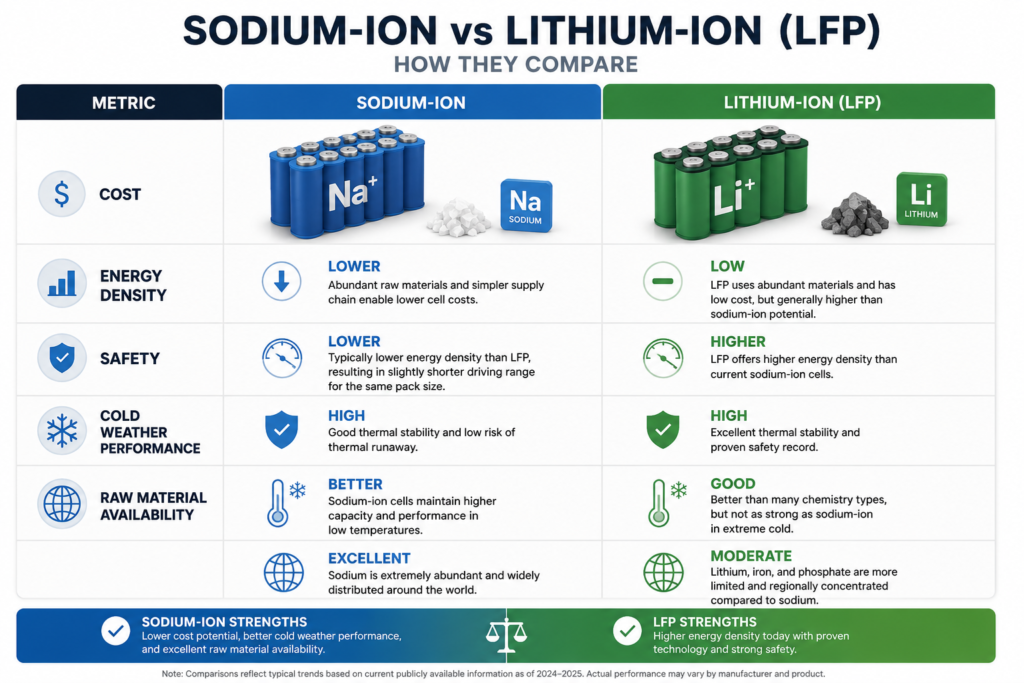
Several factors have pushed sodium-ion batteries into the spotlight. The first is cost. Over the last decade, lithium prices experienced extreme volatility as EV demand surged. Although lithium prices have softened recently, automakers remain concerned about long-term supply stability. Sodium offers a potential path toward lower raw-material costs because it avoids many of the critical materials associated with modern lithium batteries.
The second factor is safety. Many sodium-ion chemistries demonstrate strong thermal stability. While no battery technology is completely immune to failure, sodium-ion cells may reduce some of the thermal runaway risks associated with high-energy lithium batteries.
The third factor is cold-weather performance. One of the biggest challenges facing EV owners in northern climates is reduced battery performance during winter. Sodium-ion batteries have shown promising low-temperature behavior, maintaining higher usable capacity at sub-freezing temperatures compared with some lithium-based chemistries. JAC’s sodium-ion battery vehicles have specifically highlighted strong cold-weather performance as one of their key advantages (Gasgoo Auto News, CnEVPost). For drivers living in regions with harsh winters, this characteristic could become a significant selling point.
The Biggest Advantage: Sodium Is Everywhere
The most important long-term advantage of sodium-ion batteries may not be performance. It may be availability. Lithium is relatively scarce compared with sodium. Sodium is one of the most abundant elements on Earth and is widely distributed across many countries. This matters because battery manufacturing is increasingly becoming a strategic industry.
Governments and automakers want battery supply chains that are more resilient, less dependent on a small number of mining regions, and less vulnerable to geopolitical disruptions. A battery chemistry built around abundant sodium could help achieve these goals.
This does not necessarily mean lithium will disappear. Instead, sodium-ion batteries could reduce pressure on lithium demand while providing additional options for manufacturers.
The Main Challenge: Energy Density
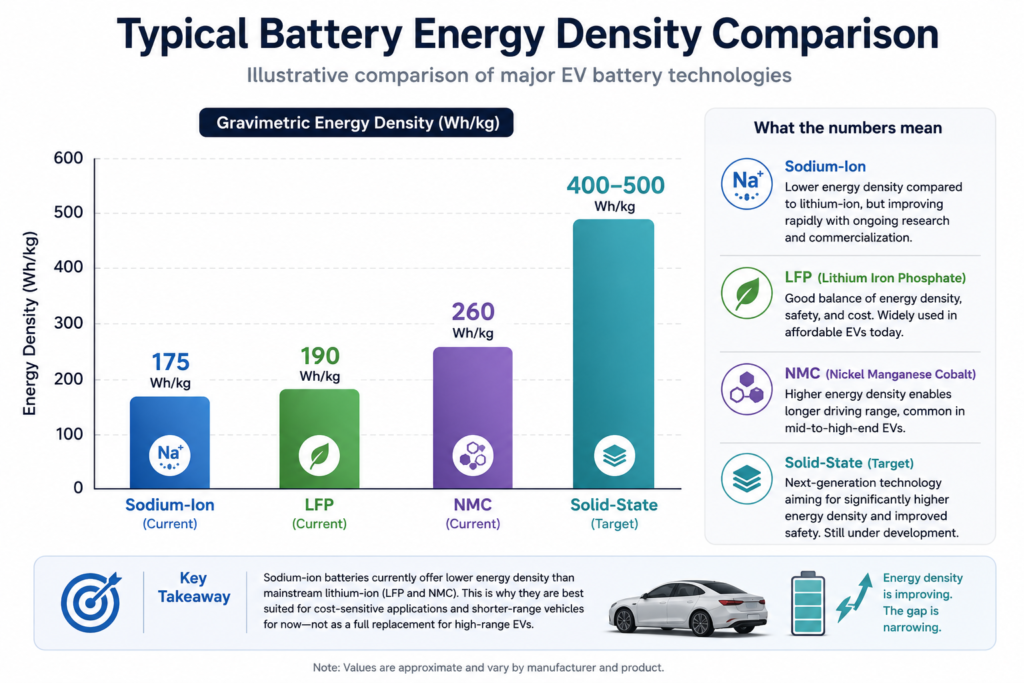
Despite all the excitement, sodium-ion batteries still face a significant limitation: Energy density. In simple terms, energy density determines how much energy can be stored in a given amount of weight or volume. Higher energy density generally translates into longer driving range, lower battery weight, and better vehicle efficiency. Historically, sodium-ion batteries struggled because sodium ions are larger and heavier than lithium ions. This limited how much energy could be packed into each cell.
Recent progress has narrowed the gap considerably. CATL announced that its Naxtra sodium-ion battery achieves approximately 175 Wh/kg, approaching the range of some LFP battery systems. The company claims a driving range of roughly 500 km for passenger vehicle applications, representing a major milestone for sodium-ion technology (CATL, Reuters).
However, sodium-ion batteries still generally trail advanced lithium-ion chemistries in energy density. As a result, sodium-ion technology is unlikely to replace premium long-range EV batteries in the near future. Instead, it may find success in applications where cost, durability, and cold-weather performance matter more than maximum range.
CATL Is Betting Big on Sodium-Ion Batteries
When the world’s largest battery manufacturer invests heavily in a new technology, the industry pays attention. CATL first introduced its sodium-ion battery program several years ago, but recent announcements suggest the company sees genuine commercial potential.
In 2025, CATL launched its new sodium-ion battery brand called Naxtra and announced large-scale production plans. The company reported energy density levels reaching 175 Wh/kg, along with strong safety characteristics and the ability to operate across a wide temperature range (CATL, Reuters).
CATL has gone even further by suggesting that sodium-ion batteries could eventually capture a meaningful portion of the market currently served by LFP batteries (Reuters).. That is a bold statement. LFP batteries have become the dominant battery chemistry for many affordable EVs due to their combination of safety, durability, and low cost.
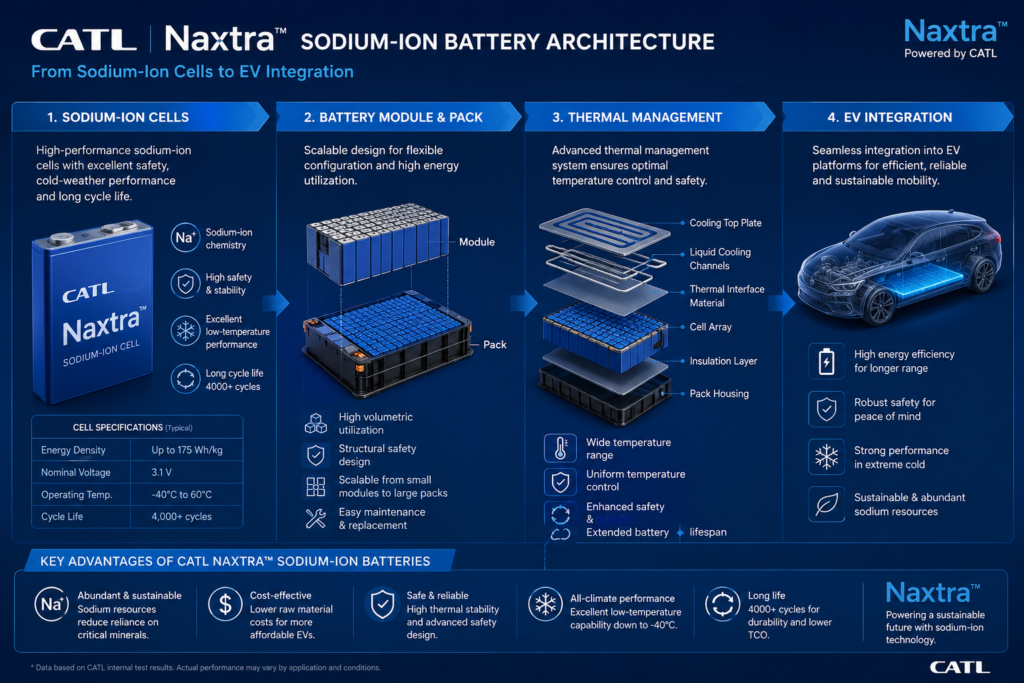
For sodium-ion batteries to compete directly with LFP, manufacturers must demonstrate not only technical feasibility but also meaningful cost advantages at scale. The fact that CATL is pursuing this path suggests that the company believes those economics may eventually work.
JAC Already Put Sodium-Ion Batteries Into Production Vehicles
While many future battery technologies remain confined to laboratories and prototype demonstrations, sodium-ion batteries have already entered real-world vehicles. Chinese automaker JAC, through its Yiwei brand, delivered what is widely recognized as one of the world’s first mass-produced sodium-ion battery EVs. The vehicle uses sodium-ion cells supplied by HiNa Battery and demonstrates that commercial deployment is already possible (Gasgoo Auto News, ArenaEV).
The initial vehicle targeted urban mobility rather than long-distance travel. That decision makes sense. Early sodium-ion batteries are particularly well suited for city cars, short-range commuter vehicles, fleet applications, commercial vehicles, and energy storage systems. These markets place less emphasis on maximum range and more emphasis on affordability and reliability. In many cases, reducing battery cost by a few thousand dollars may be more valuable than adding another 50 or 100 miles of range.
What About BYD?
BYD has not been as publicly vocal about sodium-ion batteries as CATL in recent years. Instead, the company has focused heavily on expanding its Blade Battery platform and improving LFP technology. That strategy has been highly successful. Today, BYD is one of the largest EV manufacturers in the world, and its Blade Battery remains one of the industry’s most influential battery designs.
However, most industry analysts expect BYD to continue evaluating sodium-ion technology because the chemistry aligns closely with the company’s emphasis on affordability, safety, and large-scale manufacturing. Even if BYD does not aggressively commercialize sodium-ion batteries immediately, it would be surprising if the company ignored a technology that could potentially reduce battery costs further in the future.
The broader trend is what matters. Nearly every major battery manufacturer is now exploring multiple battery chemistries simultaneously rather than betting on a single solution.
Where Sodium-Ion Batteries May Be Used First
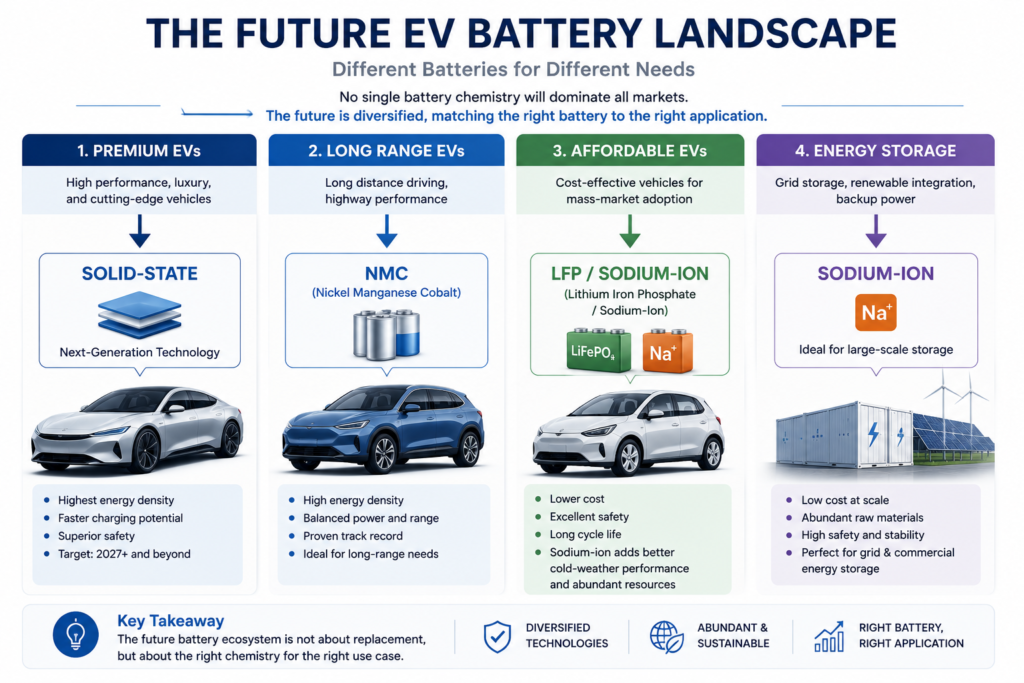
Many people assume every new battery technology is trying to replace lithium-ion batteries entirely. That is probably the wrong way to think about sodium-ion batteries. Instead, the future battery market may become increasingly specialized. Different chemistries will serve different applications. For example,
High-performance EVs: These vehicles will likely continue using advanced lithium-ion chemistries and eventually solid-state batteries because energy density remains critical.
Affordable EVs: Sodium-ion batteries could become attractive if they achieve meaningful cost advantages while providing acceptable driving range.
Cold-climate vehicles: Strong low-temperature performance could make sodium-ion batteries particularly appealing in northern regions.
Grid-scale energy storage: This may ultimately become the largest market opportunity.
Stationary storage systems care far less about weight and volume than passenger vehicles. Cost, safety, durability, and material availability often matter more. This is one of the reasons CATL has already secured major sodium-ion energy storage agreements (Electrek, CnEVPost).
Will Sodium-Ion Batteries Replace Lithium-Ion Batteries?
Probably not. At least not entirely. The battery industry is moving toward diversification rather than replacement. A decade ago, many experts expected one chemistry to dominate the market. Today, the reality looks different. We already see NMC batteries, NCA batteries, LFP batteries, LTO batteries, solid-state development, and sodium-ion batteries, etc. Each technology offers different strengths and weaknesses.
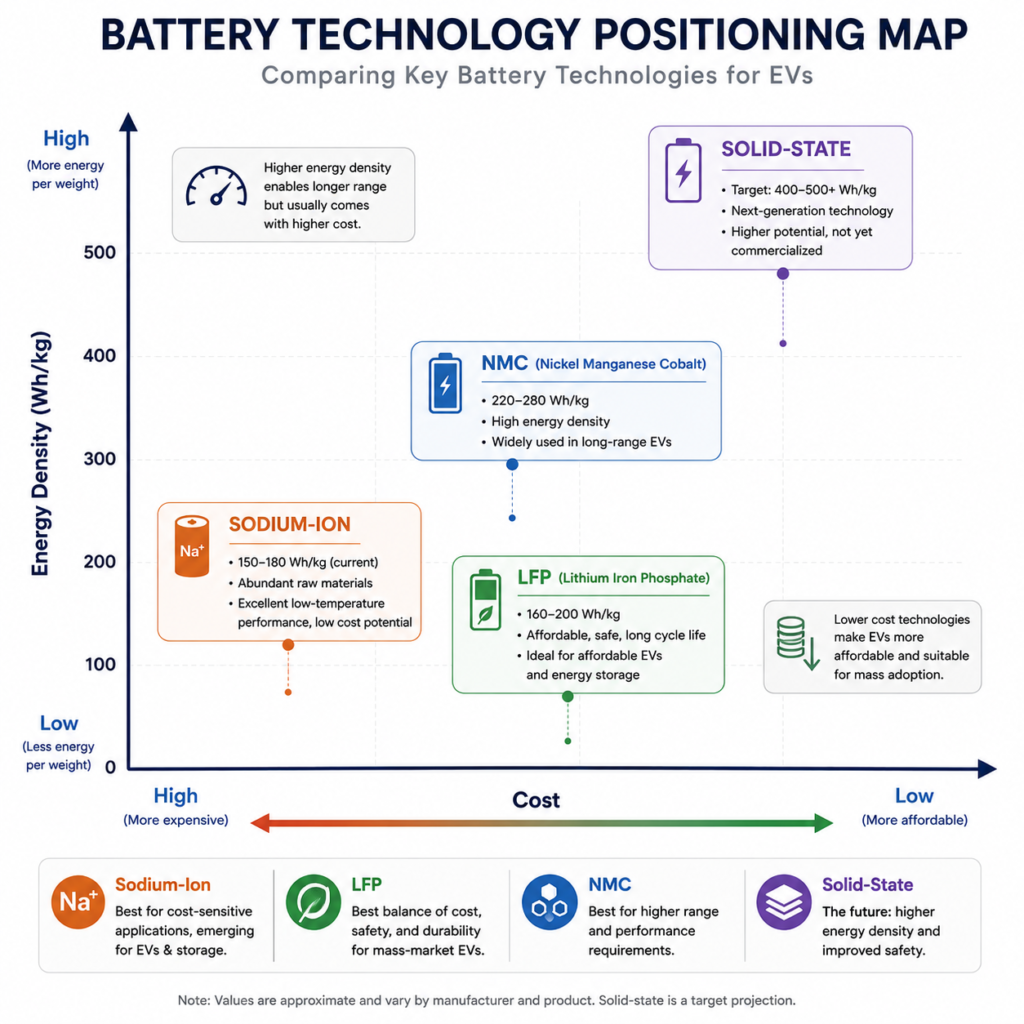
Sodium-ion batteries may eventually become the preferred choice for specific market segments, while lithium-ion batteries continue dominating others. The winners will not necessarily be the batteries with the highest energy density. They will be the batteries that best match the requirements of each application.
Conclusion
For years, solid-state batteries dominated discussions about the future of EV energy storage. Yet one of the most important battery developments of the past few years may be happening in parallel.
Sodium-ion batteries are moving from research papers into commercial products. Companies such as CATL are investing heavily in large-scale production. Automakers like JAC have already placed sodium-ion batteries into production vehicles. New announcements continue to improve energy density, safety, and cold-weather performance (CATL, Gasgoo Auto News, Reuters).
The technology is not likely to replace lithium-ion batteries overnight. However, it may become one of the most important complementary battery chemistries of the next decade. If solid-state batteries represent the industry’s long-term moonshot, sodium-ion batteries may represent something equally important: A practical, scalable, and potentially affordable solution that can be deployed much sooner.
Related Articles
How Long Do EV Batteries Last? Real-World Data and Battery Degradation (2026)
LFP vs NMC Batteries: Which EV Battery Is Better in 2026?
Solid-State Batteries Explained: Hype vs Reality in 2026