
Quick Answer
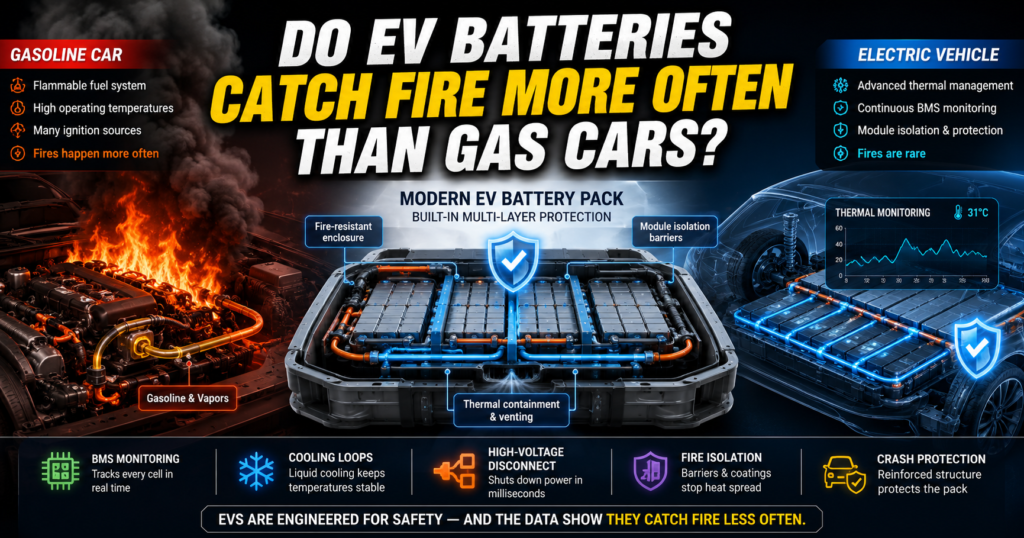
No — current real-world data suggests that electric vehicles (EVs) catch fire less often than gasoline-powered vehicles.
That does not mean EV battery fires are impossible. Lithium-ion battery fires can happen, especially after severe crashes, manufacturing defects, or extreme thermal events. However, multiple studies and insurance datasets continue to show that internal combustion engine (ICE) vehicles experience fires far more frequently overall.
The difference is that EV fires tend to receive significantly more media attention because battery fires behave differently and are harder to extinguish once thermal runaway begins.
Why EV Battery Fires Receive So Much Attention
When a gasoline vehicle catches fire, most people already understand the basic cause: fuel leaks, oil ignition, engine overheating, exhaust-related fires, or electrical short circuits.
But EV battery fires feel newer and more dramatic. Videos showing battery packs reigniting hours later naturally attract attention online. Part of the concern comes from the term thermal runaway, which sounds far more alarming than a typical engine fire.
In reality, thermal runaway is simply a chain reaction inside lithium-ion cells where heat generation exceeds the battery’s ability to dissipate heat. If unmanaged, temperatures rise rapidly and neighboring cells can become involved. This is a reason modern EVs invest heavily in liquid cooling systems, battery isolation architecture, fire-resistant pack structures, cell venting pathways, or advanced battery management systems (BMS). Many of these systems were discussed in our earlier article about EV thermal systems:
What the Real Fire Data Shows
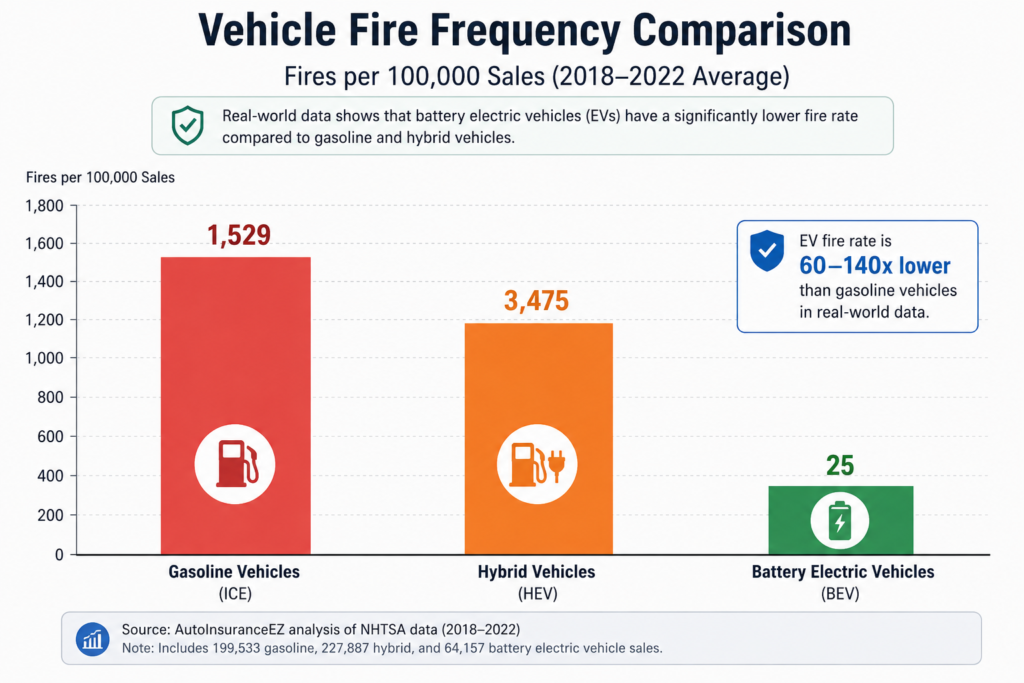
Several studies over the past few years have compared vehicle fire frequency across EVs, hybrids, and gasoline vehicles. One widely cited dataset came from AutoInsuranceEZ Vehicle Fire Analysis. The analysis suggested hybrid vehicles had the highest fire rate, gasoline vehicles followed, and battery electric vehicles had the lowest rate. The exact numbers vary depending on methodology, but the broader trend has remained relatively consistent across multiple analyses. Additional reporting from NTSB and NFPA also supports the idea that EV fires are relatively uncommon compared to overall gasoline vehicle fires.
One important detail is often overlooked. There are still far more gasoline vehicles on the road than EVs. As EV adoption grows, the absolute number of EV fires may rise simply because there are more EVs in operation. That does not necessarily mean EVs are becoming less safe.
Why Gasoline Cars Catch Fire So Often
People sometimes forget how inherently flammable gasoline vehicles are. A traditional ICE vehicle contains highly flammable liquid fuel, hot exhaust systems, engine oil, transmission fluid, pressurized fuel lines, and thousands of combustion events every minute. Gasoline vapors are extremely easy to ignite. In fact, many vehicle fires happen completely unrelated to crashes. According to NFPA Vehicle Fire Statistics, common causes include mechanical failures, electrical malfunctions, fuel system leaks, or overheated components.
By contrast, EVs eliminate several traditional fire sources entirely such as no gasoline tank, no engine oil combustion, no exhaust system temperatures, or fewer moving drivetrain parts. This is one of the reasons many engineers expected EV fire frequency to be relatively low from the beginning.
Why EV Battery Fires Are Different
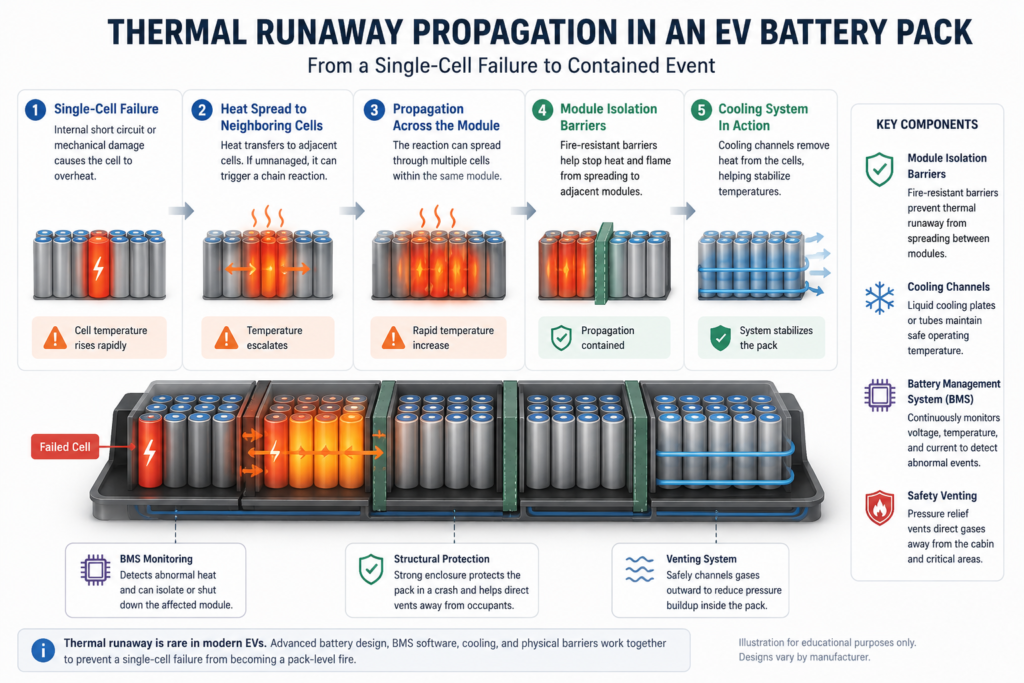
Although EV fires may occur less frequently, they behave differently once they start. The biggest reason is thermal runaway propagation. Inside a lithium-ion battery pack are hundreds or thousands of individual cells. If one cell becomes unstable due to mechanical damage, internal short circuit, overcharging, manufacturing defects, or extreme overheating, it can release heat rapidly. That heat may then spread to nearby cells. This cascading effect is what makes battery fires difficult to extinguish.
Unlike gasoline fires, EV battery packs can sometimes reignite hours later, continue generating heat internally, require large amounts of water for cooling, or produce toxic gases during combustion. This is why firefighters now receive specialized EV fire training. For example, NFPA EV Emergency Response Training has become increasingly important as EV adoption grows.
Modern EV Batteries Are Far Safer Than Early Designs
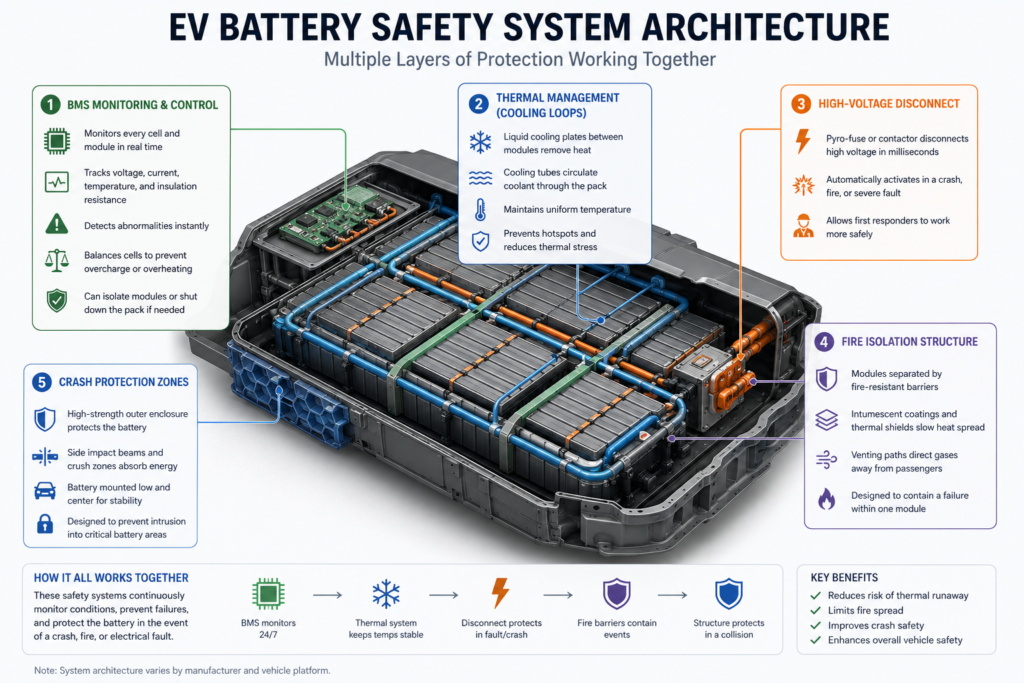
Battery safety technology improved dramatically between early EV generations and modern platforms. Today’s EVs use multiple overlapping protection layers.
1. Advanced Battery Management Systems (BMS)
Modern BMS software continuously monitors cell voltage, current, temperature, charging behavior, and thermal gradients. If abnormal behavior is detected, the system can reduce charging power, isolate modules, shut down the pack, or activate cooling systems. This software layer is one of the biggest reasons catastrophic failures remain rare.
2. Liquid Cooling Systems
Thermal management plays a huge role in battery safety. Modern EVs use sophisticated liquid cooling systems to maintain stable temperatures during fast charging, high-speed driving, hot weather operation, or repeated acceleration events. Without proper cooling, localized hotspots can develop inside cells. You can read more about this in our related article (Why EV Batteries Charge Slower Above 80%). Battery temperature control is one of the main reasons modern EV packs survive hundreds of fast charging cycles safely.
3. Improved Cell Chemistry
Not all lithium-ion batteries behave the same way.
LFP Batteries
Lithium iron phosphate (LFP) batteries are generally more thermally stable, less prone to oxygen release, and lower risk during overheating. This is one of the reasons many automakers increasingly use LFP chemistry in standard-range EVs.
NMC Batteries
Nickel manganese cobalt (NMC) batteries offer higher energy density, longer driving range, and better performance. But they typically require more aggressive thermal management. We discussed these chemistry tradeoffs in detail (LFP vs NMC Batteries Explained).
Are EV Fires Increasing?
In absolute numbers, probably yes. But context matters. EV adoption in the United States has accelerated rapidly since 2021. Millions more EVs are now operating compared to just a few years ago. As a result, more EV crashes occur, more EV battery failures are observed, and more emergency responders encounter EVs. This naturally increases media visibility.
However, current evidence still does not support the idea that EVs are more fire-prone than gasoline vehicles overall. In fact, several large automakers continue publishing improved battery safety statistics as pack designs mature.
The Role of Fast Charging
Fast charging is sometimes blamed for battery fires, but the reality is more nuanced. DC fast charging generates more heat than slower Level 2 charging. Higher temperatures accelerate battery aging, electrolyte stress, and internal resistance growth.
However, modern EVs carefully manage charging speed based on battery temperature, state of charge, or cell condition. This is why charging slows above 80%. It is not just about protecting battery lifespan — it is also a safety strategy. Battery preconditioning systems further help stabilize temperatures before charging sessions.
Related reading:
What Happens During Thermal Runaway?
At a simplified level, thermal runaway looks like this:
- Cell damage or overheating begins
- Internal temperature rises rapidly
- Electrolyte decomposition starts
- Gas generation increases
- Pressure builds inside the cell
- Heat spreads to neighboring cells
The process becomes self-sustaining once heat generation exceeds heat dissipation. Modern battery pack engineering focuses heavily on preventing the propagation stage.
Why Some EV Fire Videos Look So Extreme
Battery fires often produce dramatic visuals because cells vent gases under pressure, flames can jet outward intermittently, reignition may occur, or packs contain stored electrochemical energy. Gasoline fires can also be catastrophic, but people are already familiar with them. A single EV fire video can spread globally within hours, creating the impression that such events happen constantly. Statistically, they remain relatively rare.
What Firefighters Are Doing Differently
Emergency response protocols for EVs have evolved rapidly. Modern responders now use thermal imaging cameras, battery isolation procedures, extended monitoring periods, large-volume cooling methods, and specialized containment zones. Some departments even use immersion containers for severely damaged EVs after crashes. Organizations such as IAFC have expanded EV-specific guidance significantly in recent years.
Are Solid-State Batteries Safer?
Potentially, yes. Solid-state batteries are widely viewed as a major future safety improvement because they replace flammable liquid electrolytes with solid materials. Potential benefits include lower fire risk, reduced thermal runaway propagation, and improved thermal stability. However, large-scale commercial deployment is still developing. We covered this topic in detail (Solid-State Batteries Explained: Hype vs Reality).
The Bigger Picture: EV Safety Continues to Improve
Modern EV battery packs are among the most heavily monitored systems ever installed in consumer vehicles. Automakers now combine real-time software monitoring, advanced thermal modeling, crash isolation systems, structural battery protection, and high-voltage disconnect systems with increasingly mature manufacturing processes. Battery safety remains one of the automotive industry’s biggest engineering priorities. And despite the headlines, current evidence still suggests that EVs are not more likely to catch fire than gasoline vehicles overall.
Conclusion
EV battery fires are real, but they are also widely misunderstood. Gasoline vehicles still experience fires more frequently in overall real-world operation. The difference is that EV battery fires behave differently and attract far more public attention.
Modern EVs now include sophisticated thermal management systems, advanced BMS software, crash protection structures, and safer battery chemistries that dramatically reduce fire risk compared to earlier generations. As battery technology continues improving — especially with developments in LFP and future solid-state batteries — EV safety is likely to improve even further over the next decade.
The bigger story is not that EVs are unusually dangerous. It is that battery safety engineering has become one of the most rapidly advancing areas in the entire automotive industry.
FAQ
Are EV fires harder to extinguish?
Yes. Lithium-ion battery fires can reignite and often require extended cooling to stop thermal runaway propagation completely.
Do Teslas catch fire more often than other cars?
Current public data does not show Tesla vehicles catching fire more frequently than gasoline vehicles overall. Media visibility often amplifies isolated incidents.
Which EV battery chemistry is safest?
LFP batteries are generally considered more thermally stable than high-nickel chemistries such as NMC.
Can fast charging cause EV fires?
Fast charging alone usually does not cause fires. Modern EVs carefully control charging temperatures and charging power to maintain safety.