
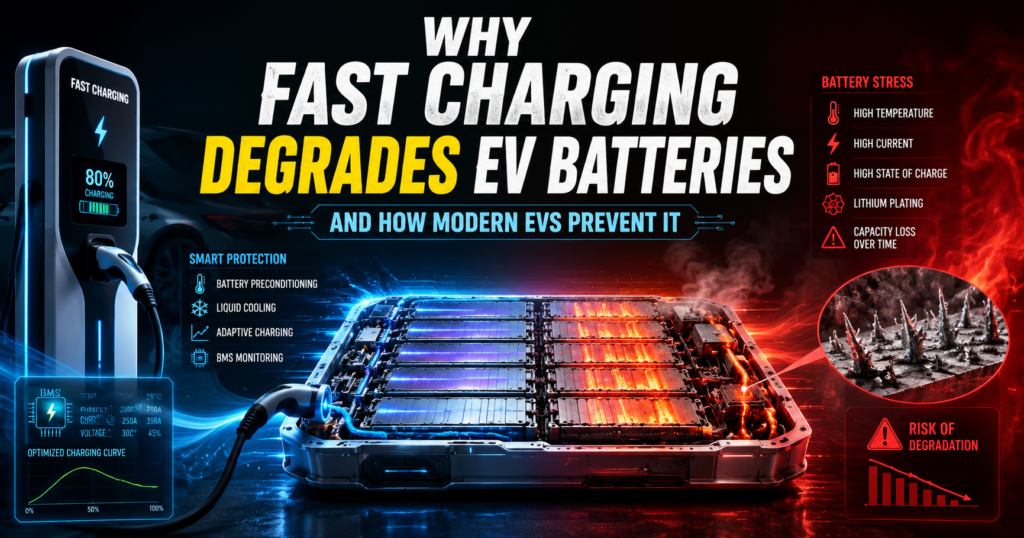
Fast charging degrades EV batteries faster under high heat, high current, and high state of charge conditions. In China, some next-generation EV batteries can reportedly charge from 10% to 80% in under five minutes, while automakers continue pushing toward “gasoline-like” refueling times. But behind the convenience of ultra-fast charging lies one of the biggest engineering challenges in modern EVs: battery degradation (Geotab, Michigan News).
The common belief is that fast charging itself destroys batteries. In reality, the issue is far more complex. Modern EV battery systems are not simply fighting charging speed — they are fighting heat, lithium plating, thermal gradients, and electrochemical instability. The future of EV charging will likely depend less on raw charging power and more on intelligent battery management.
What Actually Happens During DC Fast Charging?
During DC fast charging, extremely high current flows into the battery pack over a short period of time. A typical Level 2 home charger may deliver around 7–11 kW, while modern DC fast chargers now exceed 250–350 kW.
This rapid energy transfer increases internal resistance losses and heat generation inside the cells. As charging rates rise, lithium ions struggle to intercalate smoothly into the graphite anode. When the anode cannot absorb ions quickly enough, metallic lithium can deposit on the surface instead. This phenomenon is known as lithium plating, and it is one of the primary causes of accelerated battery degradation during fast charging (Battery University1, Battery University2, Journal of Energy Storage, UW-Madison Engineering)
Lithium plating becomes especially severe under three conditions:
- high charging current
- low battery temperature
- high state of charge (SOC)
This is why many EVs charge extremely quickly from 10% to around 60%, then gradually slow down above 80%.
Why Heat Is the Real Enemy
One major reason fast charging degrades EV batteries is the excessive heat generated during high-power charging sessions. Contrary to popular belief, charging speed alone is not the main issue. Temperature is often the dominant factor.
Fast charging increases:
- electrode temperature
- thermal gradients between cells
- electrolyte decomposition
- mechanical stress inside electrodes
These conditions accelerate side reactions that permanently reduce battery capacity over time.
Recent research has shown that uneven temperature distribution inside battery packs can significantly worsen lithium plating and long-term degradation, particularly in high-energy battery architectures (Univ. Louisville, eTransportation).
High battery temperature is also one of the biggest contributors to long-term battery aging during summer driving. We discussed this further in our guide on EV battery degradation in hot weather.
Geotab’s updated 2026 fleet analysis found that vehicles relying heavily on high-power DC fast charging above 100 kW experienced noticeably higher degradation rates compared with vehicles primarily using AC or lower-power charging. The study analyzed more than 22,700 EVs across 21 models using real-world telematics data (Geotab, Charged EVs, GlobeNewswire).
Still, the results were not catastrophic. Even under increasing fast-charging usage, modern EV batteries continued showing relatively strong long-term durability.
Lithium Plating: The Silent Battery Killer
At high SOC, the graphite anode becomes increasingly saturated, leaving less room for lithium ions. If charging continues aggressively, metallic lithium begins accumulating on the anode surface rather than storing safely inside the material structure.
Over time, plated lithium can:
- reduce usable lithium inventory
- increase internal resistance
- create dendrites
- increase thermal runaway risk
Modern battery research is heavily focused on suppressing lithium plating through:
- improved electrolyte chemistry
- advanced anode materials
- adaptive charging algorithms
- model-based charging control
Researchers at the University of Wisconsin recently demonstrated new mechanistic models explaining how lithium plating initiates during fast charging, potentially enabling safer and longer-lasting batteries in future EVs (UW-Madison Engineering).
Meanwhile, researchers at the University of Michigan demonstrated battery modifications that allowed charging up to 500% faster at subfreezing temperatures while minimizing lithium plating formation (Michigan News).
How Modern EVs Prevent Fast-Charging Damage
Modern EVs are far smarter than many drivers realize.
Today’s battery management systems (BMS) continuously monitor:
- cell voltage
- current
- temperature
- charging power
- SOC window
- thermal gradients
The charging curve shown on an EV charger is intentionally nonlinear. The vehicle aggressively reduces charging power as battery temperature or SOC rises.
For example:
- battery preconditioning warms or cools the pack before charging
- liquid cooling systems remove localized heat buildup
- adaptive charging algorithms dynamically limit current
- cell balancing minimizes uneven degradation
Some advanced systems now incorporate model-based charging strategies that actively estimate lithium plating risk in real time (eTransportation, TWAICE).
This is one reason why real-world EV battery life has generally exceeded early expectations.
Why LFP Batteries Often Handle Fast Charging Better
Battery chemistry also matters.
LFP (Lithium Iron Phosphate) batteries typically offer:
- better thermal stability
- lower thermal runaway risk
- improved cycle life
Compared with high-nickel NMC or NCA batteries, LFP cells generally tolerate repeated fast charging more effectively, although they often have lower energy density.
Battery chemistry plays a major role in fast-charging durability. We compared the differences in our detailed guide on LFP vs NMC batteries.
A 2025 Carnegie Mellon study comparing LFP, NMC, and NCA batteries under various fast-charging scenarios found that degradation sensitivity differed dramatically by chemistry. LFP batteries showed particularly strong durability even under aggressive charging conditions (CMU Engineering and Public Policy, ResearchGate, CMU Vehicle Electrification Group).
This tradeoff explains why many automakers increasingly use LFP batteries in vehicles optimized for frequent charging and daily commuting.
Is Fast Charging Actually Bad in 2026?
The short answer is: occasionally, no — constantly, yes.
Modern EVs are designed to survive fast charging. Occasional road-trip charging is unlikely to cause dramatic degradation.
However, frequent high-power charging under poor thermal conditions — especially:
- in hot weather
- in freezing temperatures
- at very high SOC
- without battery preconditioning
can accelerate long-term aging.
Although frequent DC fast charging can increase degradation, most modern EV batteries still maintain strong durability over many years of operation. You can read more in our analysis of how long EV batteries last.
The industry’s direction is now shifting toward smarter charging rather than simply faster charging. The next decade will likely focus on:
- predictive BMS control
- AI-assisted charging optimization
- improved electrolytes
- solid-state batteries
- advanced thermal architectures
rather than raw charging power alone.
Final Thoughts
Fast charging is not inherently destructive. The real challenge is managing the electrochemical and thermal stress created during ultra-high-power charging events.
Modern EVs already use remarkably sophisticated battery protection systems, and future EV platforms will become even more intelligent. As battery technology evolves, the gap between charging convenience and battery longevity is steadily shrinking.
Although modern EVs are becoming smarter, fast charging degrades EV batteries more quickly when charging conditions are consistently aggressive.
The future of EV charging may not simply be faster.
It may be smarter.