
Quick Answer: Why Do Electric Trucks Need Different Battery Technology?
Electric truck batteries are not just larger versions of passenger EV batteries. They are designed for heavier payloads, longer duty cycles, repeated high-power charging, and commercial uptime.
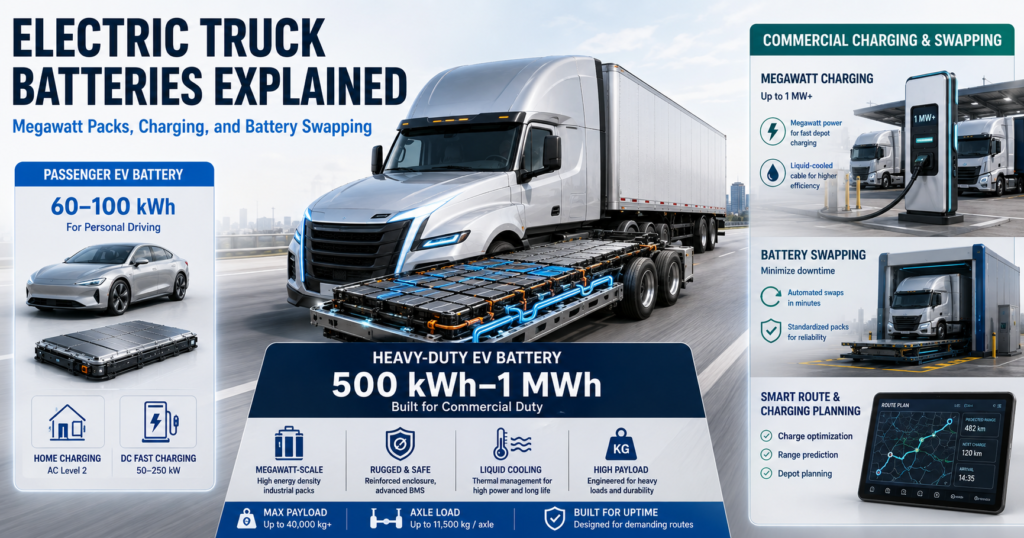
A passenger EV may use a 60–100 kWh battery pack. A modern electric heavy-duty truck can use several hundred kilowatt-hours, and long-range Class 8 electric trucks can approach the 500 kWh to 1 MWh range depending on route, payload, and efficiency. Tesla says the Semi can travel up to 500 miles at about 1.7 kWh per mile, which implies an extremely large battery system even though Tesla does not publicly list the pack size on its main Semi page. Volvo’s VNR Electric, aimed more at regional-haul duty cycles, lists a 565 kWh battery capacity with 452 kWh usable energy and up to 275 miles of operating range.
That size changes everything. The battery affects payload, axle weight, charging infrastructure, thermal management, fire safety, route planning, and total cost of ownership. This is why heavy-duty EVs are becoming one of the most technically interesting parts of the electric vehicle market.
Why Electric Truck Batteries Need Different Technology
Most EV owners think about battery size in terms of range. A larger battery usually means more miles between charges. For electric trucks, range still matters, but it is only one part of the story.
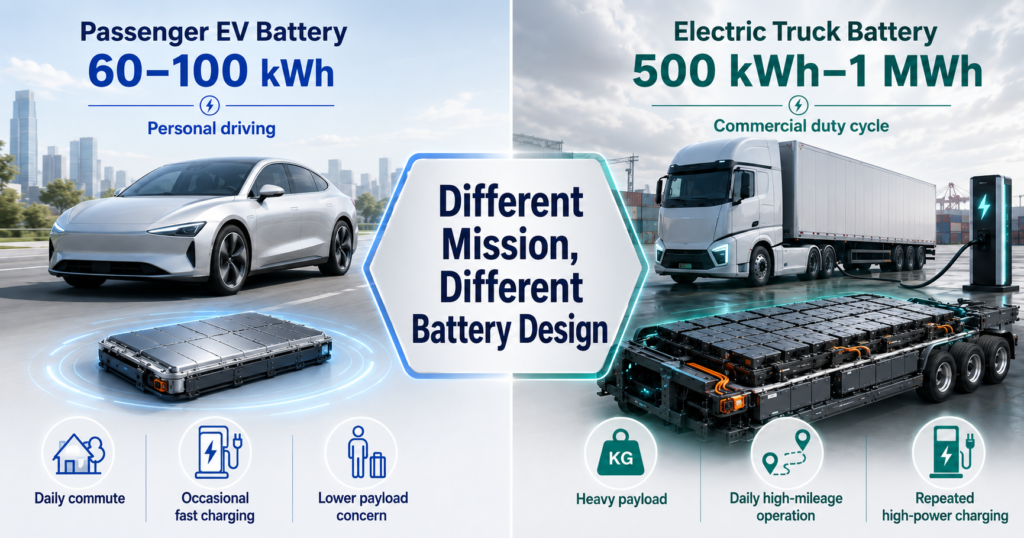
A commercial truck is a business tool. It has to move freight, meet delivery windows, survive high daily mileage, and avoid downtime. A passenger EV that charges slowly on a road trip may frustrate the driver. A truck that charges slowly can cost a fleet real money because the driver, trailer, cargo, and delivery schedule are all tied together. That is the first big difference. Electric trucks are designed around duty cycles, not just EPA range numbers.
A local delivery truck may return to the same depot every night. A drayage truck may run repeated short trips between a port and warehouse. A regional tractor may cover 150–300 miles per day with predictable stops. A long-haul truck may need to cover hundreds of miles while carrying heavy freight and staying within hours-of-service rules.
Those use cases need different battery strategies. Some trucks can use moderate-sized packs and overnight depot charging. Others need large battery packs, megawatt-class charging, or battery swapping to stay productive. That is why the electric truck market is developing differently from the passenger EV market.
The Battery Pack Is Much Larger Than a Passenger EV Pack
A typical passenger EV battery might be somewhere around 60–100 kWh. Some large electric SUVs and pickup trucks go beyond that, but they are still small compared with heavy-duty electric trucks. For a Class 8 electric truck, a 500 kWh pack is not unusual. For longer-range applications, the pack may approach the 1 MWh class. This is not because truck makers are trying to win a range-number marketing contest. It is because moving 60,000–80,000 pounds at highway speed takes a lot of energy.
Tesla’s stated Semi efficiency of 1.7 kWh per mile is actually impressive for such a large vehicle, but it still means 500 miles requires a very large amount of stored energy. Volvo’s VNR Electric shows the more regional side of the market: a 565 kWh battery system, 452 kWh usable energy, and up to 275 miles of range.
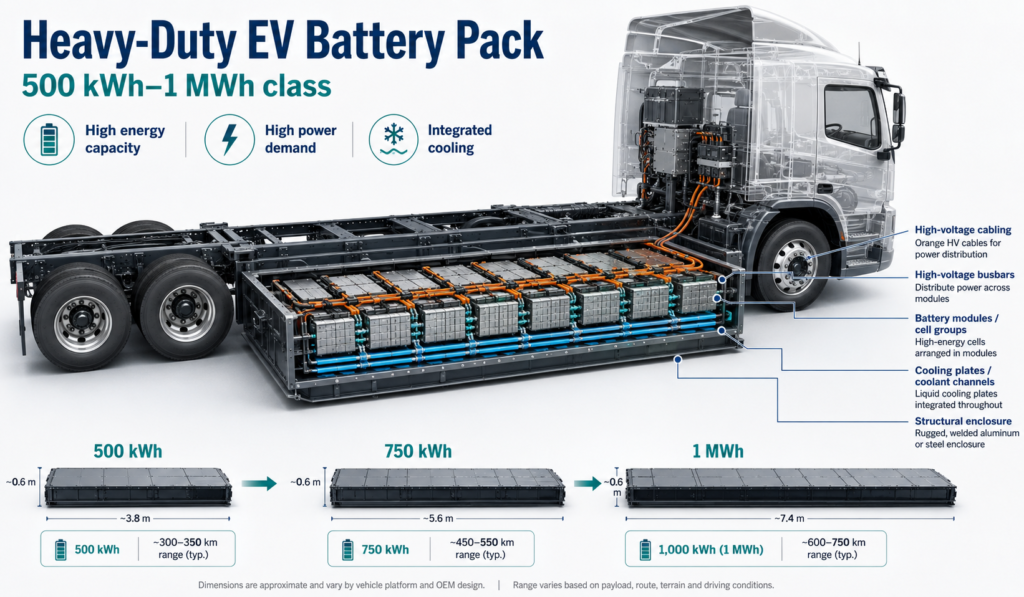
This difference is easy to miss. A 75 kWh passenger EV pack might support daily commuting for a full week. A heavy truck can consume that much energy in a short portion of a workday. The pack also has to deliver high power. A truck climbing a grade with heavy cargo may demand hundreds of kilowatts from the battery. Then, on the way down, regenerative braking can push large amounts of energy back into the pack. That means the battery must handle high discharge power and high charge power repeatedly, not just once in a while.
Payload and Axle Weight Are Central Design Constraints
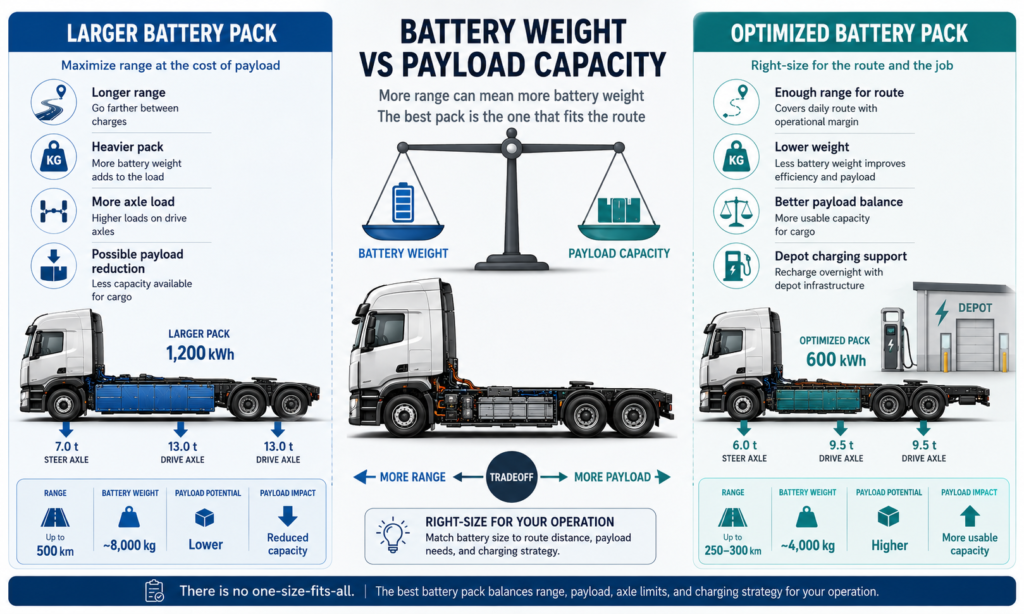
In a passenger EV, a heavier battery mostly affects efficiency, cost, and handling. In a commercial truck, battery weight can directly affect revenue. A truck has legal weight limits. If the battery pack is too heavy, the fleet may have to reduce payload. That matters because freight companies often make money by moving as much cargo as possible within legal limits.
This is why battery energy density matters so much for electric trucks. A higher-energy-density pack can provide more range with less weight. But the chemistry with the highest energy density is not always the best choice. Fleets also care about cost, cycle life, charging speed, safety, and durability.
There is no single perfect answer. Nickel-rich chemistries can help when maximum range and lower weight are the top priorities. LFP batteries can be attractive when durability, cost, and safety are more important than maximum energy density. That tradeoff is similar to passenger EVs, but the stakes are higher because every pound of battery weight can affect freight capacity.
A 2025 Canadian review of electric long-haul truck battery technologies noted that payload penalty remains a real concern for long-range battery-electric trucks, even though it is expected to improve as battery energy density and vehicle design improve. In short, an electric truck battery is not only an energy storage device. It is also part of the vehicle’s business model.
Commercial Vehicle Cycle Life Matters More Than Most Drivers Realize
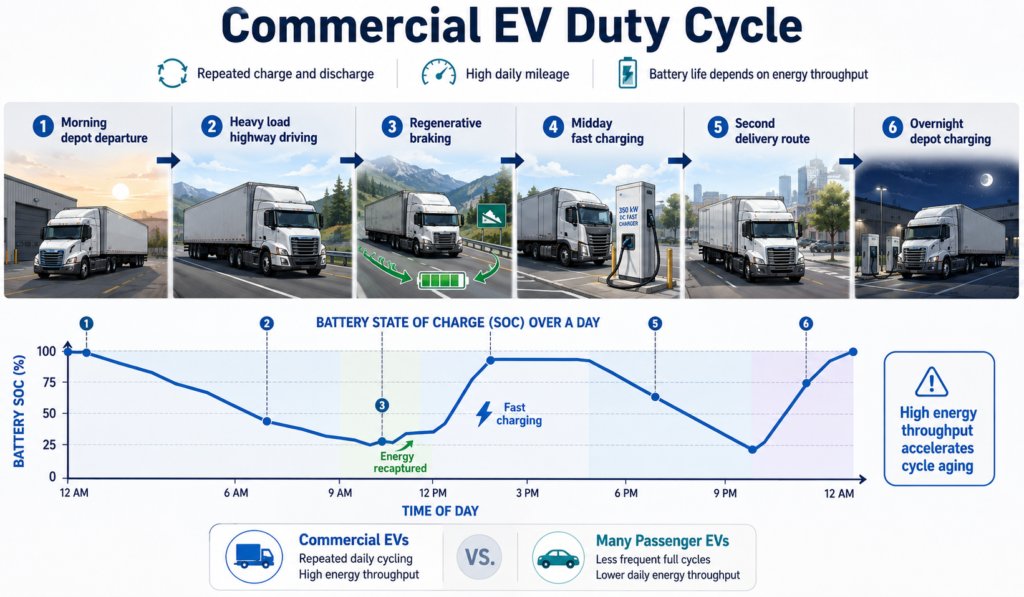
Passenger EVs usually age slowly because most owners drive 10,000–15,000 miles per year. A commercial truck can accumulate that mileage much faster. This changes how we should think about battery life. For a passenger EV, calendar aging often matters a lot. The battery spends years sitting in different states of charge and temperatures. For a commercial truck, cycle aging can become more important because the pack may be charged and discharged deeply many times per week.
A truck battery may experience frequent high-power acceleration, hill climbing, regenerative braking, and fast charging. The battery has to survive not just many miles, but many energy-throughput cycles. That is one of the reasons CATL’s TECTRANS commercial vehicle battery line emphasizes long life and fast charging. CATL says its TECTRANS-T heavy-duty truck products include a Superfast Charging Edition with a 4C peak charging rate and a Long Life Edition aimed at extended commercial operation.
This focus makes sense. Fleet buyers usually care less about flashy performance claims and more about whether the battery can last through years of demanding service. If the truck is supposed to operate almost every day, the battery must be designed for high uptime, predictable aging, and serviceability.
Repeated High-Power Charging Is a Bigger Challenge
Fast charging a passenger EV during a road trip is occasional for many drivers. Fast charging an electric truck may be part of the daily operating plan. That creates more thermal and electrochemical stress. High current increases heat generation inside cells, busbars, connectors, and cables. It can also increase lithium plating risk if the battery is too cold, too full, or charged too aggressively. The battery management system has to control charging power carefully so the truck gets back on the road quickly without damaging the pack.
This is where truck batteries need more robust engineering than many passenger EV packs. The pack may need stronger cooling plates, more coolant flow, better thermal sensors, higher-current contactors, more durable connectors, and more conservative charging logic under certain conditions.
Fast charging also becomes a site-level issue. A depot charging 30 trucks overnight is not the same as a homeowner charging one EV in a garage. The fleet has to think about transformer capacity, demand charges, charger scheduling, backup power, and whether trucks are parked long enough to charge.
NACFE’s Run on Less – Electric DEPOT project showed that fleets can scale beyond one or two battery-electric trucks, but it also emphasized that depot charging and infrastructure planning become central parts of fleet operations.
Megawatt Charging: Why Trucks Need More Than Regular DC Fast Charging
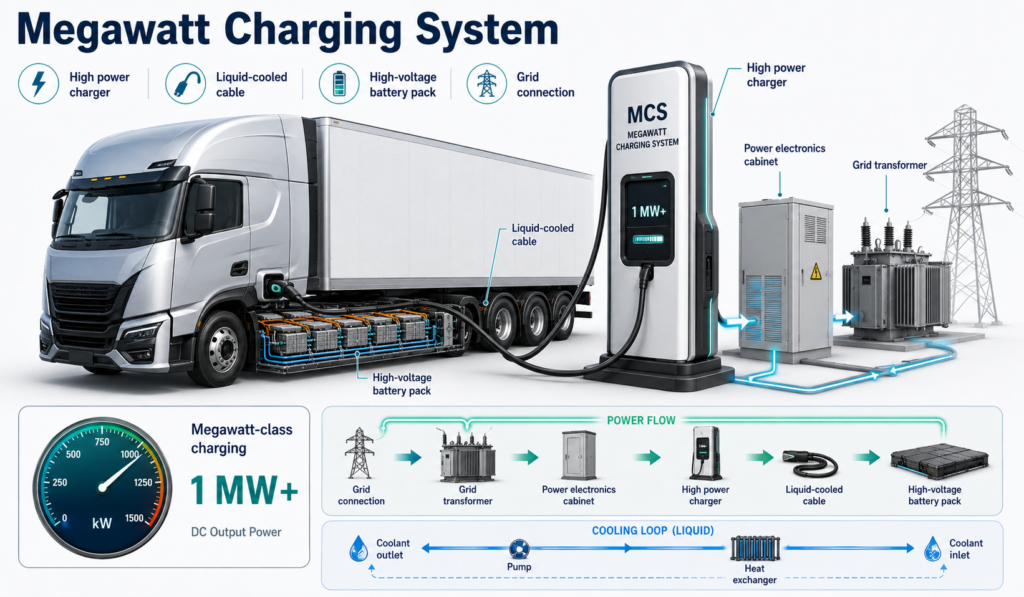
Today’s passenger EV fast chargers often operate around 150–350 kW. That can be plenty for cars. For heavy trucks, it may not be enough. Imagine a truck needs to add 400 kWh during a break. At 250 kW, that could take well over an hour under ideal conditions, and real charging curves usually taper. For commercial trucking, that delay may be too long.
This is why the Megawatt Charging System, often called MCS, is so important. CharIN describes MCS as a high-power charging solution created to support heavy-duty vehicles such as trucks and buses, with other possible uses in marine and aviation applications. CharIN also continued dedicated MCS testing activities in 2025 as the industry worked toward interoperable high-power charging for heavy transport.
Megawatt charging is not only about bigger chargers. It requires the entire system to be designed for high power: the vehicle inlet, cable, connector, cooling, insulation, pack voltage, battery cells, contactors, power electronics, and grid connection. This is one of the reasons heavy-duty EVs may move toward higher-voltage architectures. Higher voltage allows the same power with lower current, which can reduce resistive losses and make cable management more practical. But higher voltage also requires careful safety design, insulation monitoring, and service procedures.
Megawatt charging could make electric trucks much more practical for regional and long-haul routes. But it will not remove the need for planning. Even if a charger can deliver very high power, the local grid still has to support it.
Depot Charging May Be the Real Starting Point
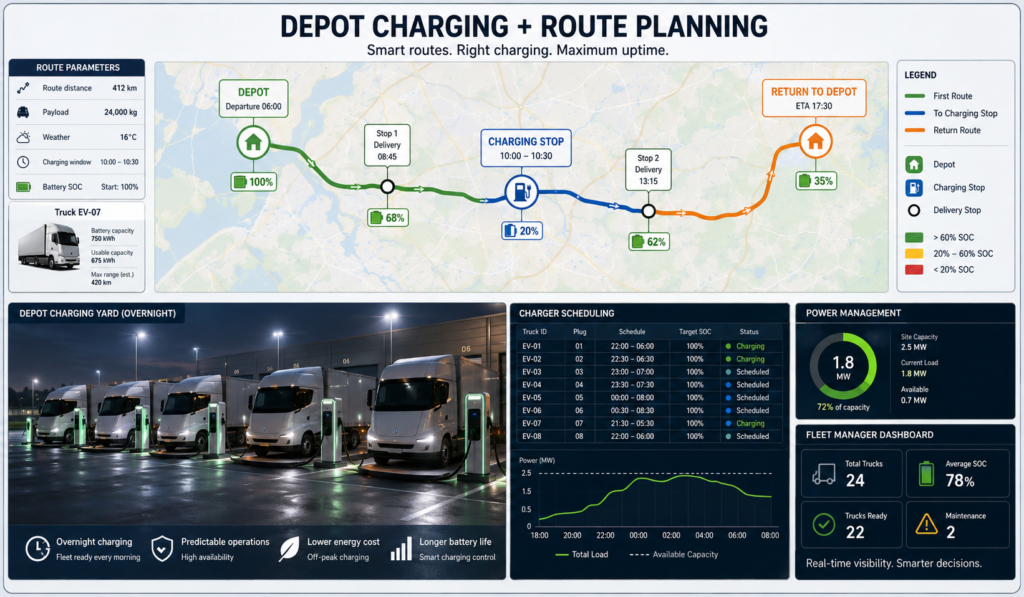
For many fleets, depot charging is more realistic than public highway charging in the early stage. A depot gives the operator control. Trucks return to a known location. Charging can be scheduled overnight or between shifts. Maintenance teams can monitor equipment. Energy contracts can be negotiated. Solar, stationary storage, or managed charging can be added later. This is why early electric truck deployments often focus on return-to-base applications. Delivery vans, yard tractors, drayage trucks, refuse trucks, buses, and regional tractors are easier to electrify than unpredictable long-haul routes.
NREL has also highlighted that medium- and heavy-duty EV charging requires fast, reliable, and scalable infrastructure as more commercial EVs enter service (NLR). That point is important because the truck battery itself is only one piece of the system. A great battery cannot solve a weak charging plan. Depot charging also changes how fleets think about battery size. A truck does not always need maximum range if it can reliably charge during known dwell times. In many cases, the best battery is not the biggest possible pack. It is the smallest pack that can complete the route reliably while preserving battery life and operational flexibility. That is where route planning becomes part of battery management.
Route Planning Is Battery Management for Fleets
Passenger EV route planning usually means finding chargers on a road trip. Commercial EV route planning is more complicated. A fleet has to consider route distance, payload, elevation, weather, traffic, charger availability, driver schedules, delivery windows, and battery state of charge. It also has to decide whether trucks should charge overnight, during loading, during driver breaks, or at public charging sites.
For electric trucks, energy consumption can vary significantly depending on payload and route. A truck running empty is not the same as a truck carrying heavy freight through hills in winter. Wind, temperature, tire condition, and highway speed can also make a noticeable difference. This means fleets need software, not just chargers. A good route plan can reduce battery stress by avoiding unnecessary deep discharges, minimizing emergency fast charging, and keeping trucks within a predictable operating window.
Recent research on electric truck charging coordination has shown why this matters. A 2024 study on distributed charging coordination for electric trucks found that communicating estimated waiting times between trucks and charging stations could significantly reduce average waiting time in simulation. A 2026 study on charging station location planning also emphasized that future demand and grid capacity uncertainty strongly affect where high-power truck charging should be deployed. In plain English, electric trucking is not just about putting a battery in a truck. It is about coordinating vehicles, batteries, chargers, drivers, routes, and the grid.
Battery Swapping: Why It Makes More Sense for Trucks Than Cars
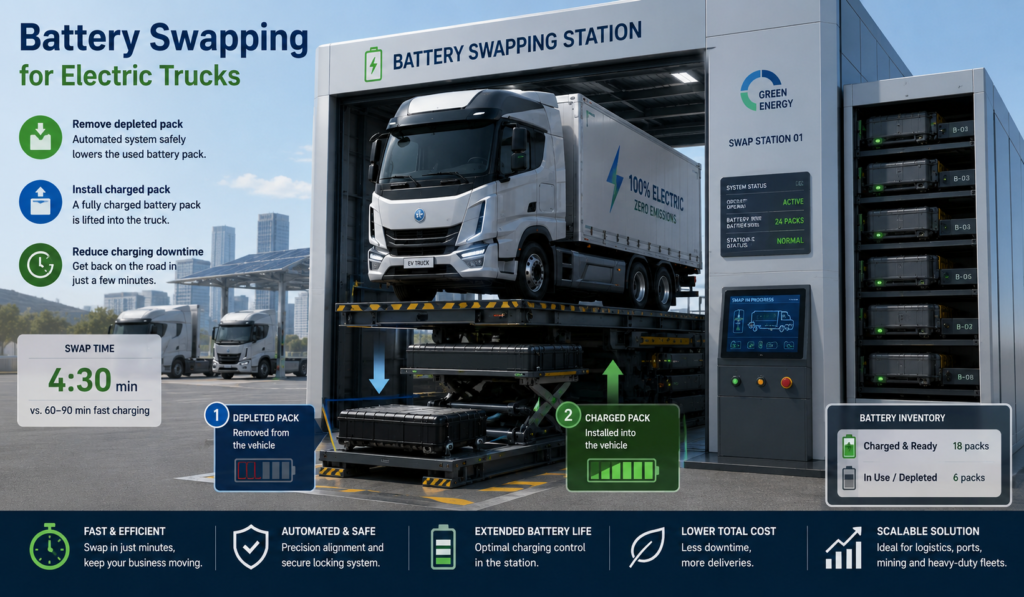
Battery swapping has had mixed results in the passenger EV world. For trucks, it may be more practical. A heavy-duty truck battery is expensive, heavy, and time-sensitive. If a swap station can replace a depleted pack with a charged one in a short time, the truck can get back on the road without waiting for a long charging session. That can be valuable in ports, mines, logistics hubs, and fixed freight corridors.
China has been especially active in electric truck battery swapping. ICCT reported that China encouraged battery-swapping technology for trucks and that swap-capable vehicles made up a large share of China’s electric truck sales in 2022, especially in short-haul uses such as ports, mining sites, and urban logistics. CATL’s Qiji battery swapping program for commercial vehicles has also expanded quickly, with plans to grow truck swap networks across major freight corridors (Charged EVs).
Battery swapping is not a perfect solution. It requires standardized battery packs, expensive stations, extra inventory batteries, and strong coordination between truck makers, battery suppliers, and fleet operators. It may work best when many trucks use the same routes and similar battery formats.
Research comparing battery swapping and fast charging for heavy-duty trucks found that swapping can improve transportation efficiency by reducing downtime, but it may require more batteries in the system. That is the core tradeoff. Swapping can save time, but the infrastructure and battery inventory have to be managed carefully. For long-haul trucking, battery swapping may be most realistic in corridor-based operations where trucks repeatedly move between known hubs. For highly variable routes, megawatt charging may be more flexible.
China Is Moving Fast in Electric Heavy Trucks
Electric heavy-duty trucks are no longer a niche experiment, especially in China. Reuters reported in June 2026 that China is targeting new-energy vehicles to make up 40% of new heavy truck sales by 2030, with a plan for 3,000 charging and battery swap stations as part of a “zero-carbon highway” network. The same report noted that electric models already made up nearly a third of China’s new heavy truck sales in 2025.
The International Energy Agency also reported that global electric truck sales grew almost 80% in 2024, with China leading the market while progress in Europe and the United States was slower. This matters for battery technology because China’s electric truck market is large enough to push battery makers, charger companies, and fleet operators to solve real-world problems quickly. Battery swapping, high-power charging, LFP packs, sodium-ion batteries for lighter commercial vehicles, and standardized commercial battery systems are all developing faster because the market is moving beyond pilot projects.
For U.S. readers, the key takeaway is not that China’s solution will copy directly into the U.S. market. The takeaway is that heavy-duty EV technology is entering a scale-up phase. As production volume increases, battery designs will become more specialized for commercial use.
Thermal Management Is More Demanding Than in Passenger EVs
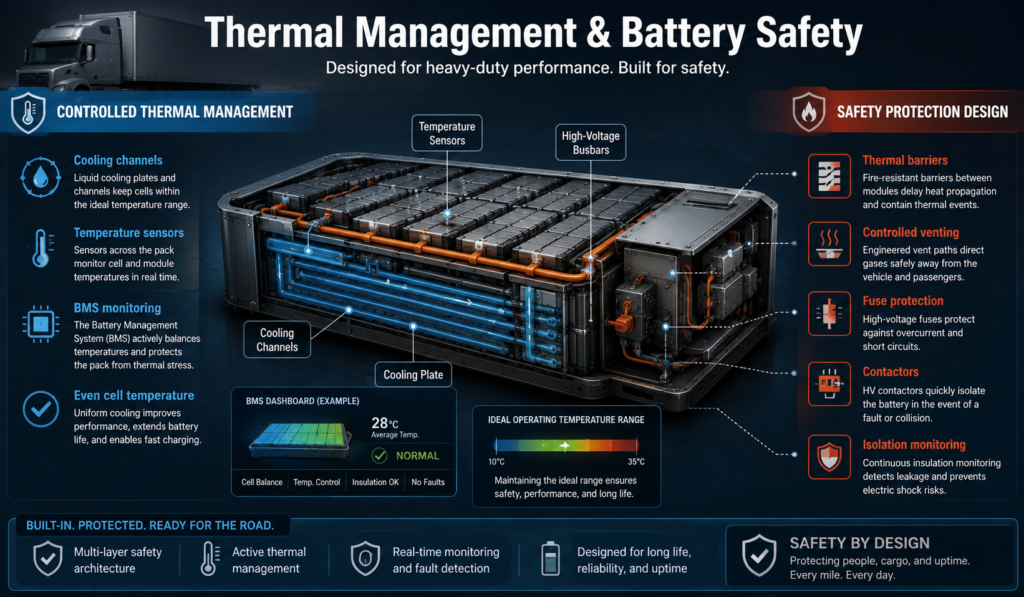
Large electric truck packs generate serious heat during both driving and charging. During acceleration or hill climbing, high current flows out of the battery. During fast charging or regenerative braking, high current flows back in. In both directions, heat is generated inside the cells and electrical connections. If that heat is not controlled, the battery may age faster, reduce power, slow charging, or in extreme cases face safety risks.
Thermal management in electric trucks has to deal with several difficult conditions. The pack is large, so temperature uniformity is harder. The truck may fast charge repeatedly. The vehicle may operate in hot depots, cold winters, steep grades, or dusty industrial environments. Unlike a passenger car, the truck may run nearly every day for long hours.
A good thermal system does more than prevent overheating. It also keeps the cells in a temperature range where charging is efficient and aging is controlled. This is especially important before high-power charging. If the pack is too cold, fast charging can increase lithium plating risk. If it is too hot, fast charging may accelerate degradation or trigger power limits. This is why battery preconditioning is not just a comfort feature for heavy-duty EVs. It can be an operational requirement.
Fire Safety and Serviceability Are Bigger Fleet Concerns
EV battery fires are rare compared with the number of vehicles on the road, but heavy-duty trucks require special attention because the packs are large and the vehicles often operate near warehouses, depots, ports, and freight yards.
A larger battery stores more energy. That does not automatically mean it is unsafe, but it does mean pack design, fault detection, isolation, venting, and emergency response planning matter. Heavy-duty battery packs need strong mechanical protection because trucks experience vibration, road debris, loading shocks, and harsh duty cycles. They also need careful electrical protection because high-voltage systems in trucks may handle much higher power than passenger EVs.
Safety is not only about the cell chemistry. LFP can offer strong thermal stability, but pack-level safety still depends on the full design: cell spacing, cooling plates, barriers, vent paths, sensors, BMS logic, fuses, contactors, isolation monitoring, and crash protection. For fleets, serviceability is also important. If one module or component fails, can it be diagnosed quickly? Can the truck return to service without replacing the entire pack? Can the battery data show whether the issue came from a cell, cooling loop, connector, charger, or operating condition? These questions matter because downtime is expensive.
LFP, NMC, and Future Chemistries in Electric Trucks
Electric trucks may use different battery chemistries depending on the application. LFP is attractive for many commercial vehicles because it is generally lower cost, durable, and thermally stable. It is especially useful for trucks that operate on predictable routes and charge frequently. The tradeoff is lower energy density compared with nickel-rich chemistries, which can make the pack heavier for the same range.
NMC or other nickel-rich chemistries can help when range and weight are the top priorities. Long-haul trucks may benefit from higher energy density if payload and range are critical. But these chemistries may cost more and require careful thermal and charging management.
Sodium-ion batteries may also play a role, especially in light commercial vehicles, cold-weather use, and lower-cost applications where maximum energy density is not the main requirement. CATL has already been positioning commercial vehicle battery products around specific use cases rather than one universal chemistry. The future is likely to be mixed. Heavy-duty EVs will not all use the same battery chemistry. A port truck, delivery box truck, regional semi, refuse truck, and long-haul tractor have different needs.
The Real Question Is Not “Can Electric Trucks Work?”
A few years ago, many people asked whether battery-electric trucks were even realistic. In 2026, the better question is where they work best first. The strongest early cases are predictable routes, depot-based operations, regional haul, ports, urban delivery, and fleets with enough scale to justify charging infrastructure. Long-haul trucking is harder, but megawatt charging, larger battery packs, and corridor planning are making it more realistic.
Battery swapping may become important in specific markets where standardization and route density make it practical. Megawatt charging may become the more flexible solution for highway corridors. Depot charging will likely remain the backbone for many fleets because it gives operators the most control. The battery technology is improving, but the winning solution is not just a better cell. It is a better system.
Conclusion: Electric Truck Batteries Are Built for Work, Not Just Range
Electric truck batteries are different because electric trucks live different lives. A passenger EV battery mainly has to provide range, comfort, and long-term durability for personal use. A heavy-duty electric truck battery has to support freight movement, payload, charging schedules, thermal stress, fleet uptime, and business economics.
That is why heavy-duty EVs need large battery packs, high cycle life, robust thermal management, megawatt charging capability, depot charging strategies, and sometimes battery swapping. The technology is moving quickly, especially in China, where electric heavy trucks are scaling faster than many analysts expected (Reuters, IEA).
For fleets, the best electric truck will not always be the one with the biggest battery. It will be the one whose battery, charger, route, payload, and operating schedule fit together. That is the real shift. Electric trucking is not only a vehicle transition. It is an energy system transition.
FAQs
How big are electric truck batteries?
Many medium- and heavy-duty electric trucks use battery packs in the several-hundred-kWh range. Some Class 8 electric trucks can approach the 500 kWh to 1 MWh class depending on range and use case. Volvo’s VNR Electric lists a 565 kWh battery capacity, while Tesla’s Semi range and efficiency claims imply a very large pack for its 500-mile version (Volvo Trucks, Tesla Semi).
Why can’t electric trucks just use passenger EV batteries?
They can use similar lithium-ion chemistry, but the pack design must be different. Trucks need higher energy capacity, higher power capability, stronger cooling, more robust mechanical protection, longer cycle life, and charging systems designed for commercial uptime.
What is megawatt charging?
Megawatt charging is high-power DC charging designed for large electric vehicles such as heavy-duty trucks and buses. The Megawatt Charging System is being developed to make high-power charging more practical and interoperable for commercial transport (CharIN).
Is battery swapping better than fast charging for electric trucks?
It depends on the route and fleet model. Battery swapping can reduce downtime, which is valuable for commercial trucks, but it requires standardized batteries, swap stations, and extra battery inventory. Fast charging is more flexible, but trucks may need larger packs or longer charging stops (arXiv).
Are electric truck batteries safe?
Modern electric truck batteries are designed with thermal management, battery monitoring, electrical isolation, crash protection, and safety controls. However, because truck packs are large and operate under demanding conditions, fire safety, diagnostics, and service procedures are especially important.
Related Articles
How Long Do EV Batteries Last? Real-World Data and Battery Degradation (2026)
LFP vs NMC Batteries: Which EV Battery Is Better in 2026?
EV Battery Preconditioning Explained: Why Fast Charging Slows in Winter (2026)
EV Battery Degradation in Hot Weather (2026 Guide)