
Quick Answer
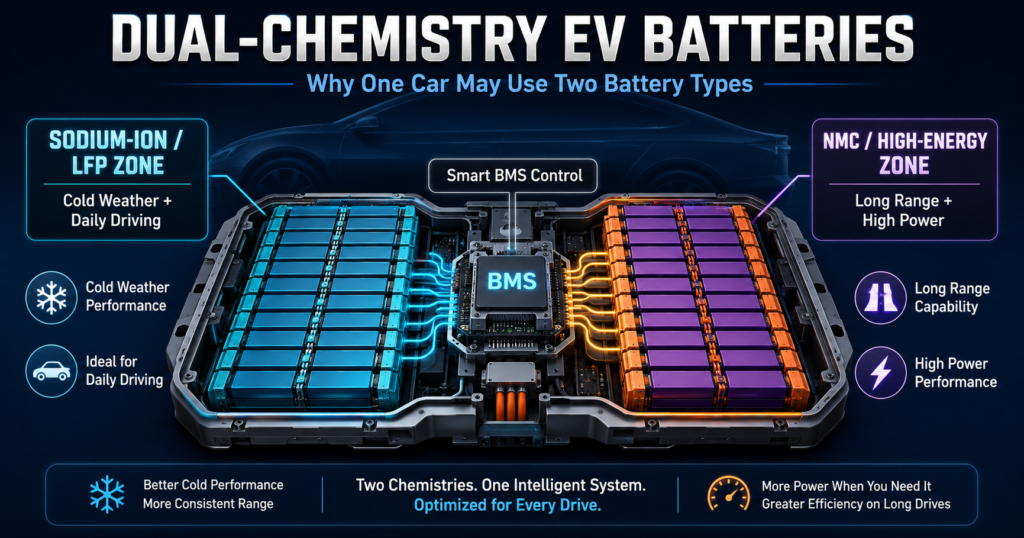
Dual-chemistry EV batteries use two different types of battery cells in the same vehicle battery system. Instead of relying on one chemistry for every job, an automaker could combine cells with different strengths.
For example, sodium-ion cells could help with cold-weather performance and cost, while LFP cells provide durability and everyday range. Another design could combine LFP cells for lower-cost daily driving with NMC cells for higher energy density, stronger acceleration, or longer highway trips.
The idea sounds simple, but it is technically difficult. Different chemistries often have different voltage curves, temperature behavior, charge limits, degradation patterns, and safety requirements. That means the BMS, cooling system, pack layout, and power electronics must become more sophisticated.
Dual-chemistry packs are not guaranteed to become common in every EV. But they may make sense in vehicles where one battery chemistry alone cannot deliver the right mix of range, cold-weather performance, fast charging, safety, and cost.
Introduction: Why Use Two Battery Types in One EV?
Dual-chemistry EV batteries are an emerging battery pack concept where one electric vehicle uses two different cell chemistries instead of relying on a single battery type. Most EV buyers assume a car has one battery chemistry. A Tesla Model 3 might use LFP in one version and NCA or NMC-based cells in another. A BYD model may use LFP Blade cells. A premium long-range EV may use nickel-rich cells. That is how the EV market has mostly worked: choose one chemistry, design the pack around it, and optimize the vehicle from there.
But battery design is becoming more complicated. Automakers no longer want a battery that is only good at one thing. They want lower cost, high range, fast charging, strong acceleration, long cycle life, better cold-weather behavior, better safety, and easier supply chain management. The problem is that one chemistry rarely wins in every category.
LFP batteries are durable, relatively affordable, and thermally stable, but they usually have lower energy density than nickel-rich chemistries. NMC batteries can store more energy in a smaller and lighter package, but they tend to cost more and depend more heavily on nickel and cobalt supply chains. Sodium-ion batteries may improve cold-weather performance and reduce lithium dependence, but their energy density is still generally behind today’s best lithium-ion cells.
That is where dual-chemistry battery packs become interesting. Instead of asking one chemistry to do everything, the pack can divide the work. CATL has already pushed this idea into the spotlight. In April 2025, CATL announced its Freevoy Dual-Power Battery and described a “cross-chemistry system design” with two independent energy zones. The company also discussed Sodium-LFP, LFP-LFP, and NCM-LFP/NCM-NCM dual-power solutions, showing that this is not just a theoretical engineering concept.
This does not mean every future EV will have two battery chemistries. It does mean the industry is moving beyond the simple question of “Which chemistry is best?” The better question may become: “Which chemistry should handle which job?”
What Are Dual-Chemistry EV Batteries?
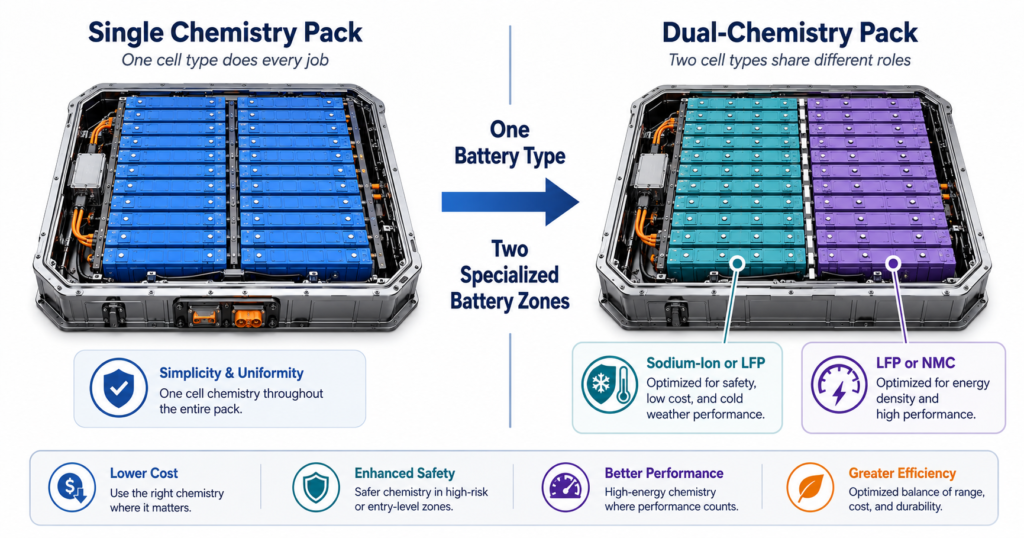
A dual-chemistry battery pack is a battery system that uses two different cell chemistries inside one vehicle. That could mean sodium-ion plus LFP. It could mean LFP plus NMC. It could even mean two versions of the same broad chemistry family with different design priorities, such as one cell optimized for power and another optimized for energy.
The key point is not simply that two cell types exist in the same vehicle. The key point is that the battery system is designed to use them in a coordinated way. One part of the pack may be used more often for daily driving. Another part may be reserved for long-distance range, high power demand, cold-weather operation, or fast charging support. In CATL’s description of its Freevoy Dual-Power architecture, the pack has two independent energy zones and can regulate how those zones are used based on driving status and user habits.
A simple way to think about it is this: A traditional EV battery pack is like one large fuel tank. A dual-chemistry pack is more like a vehicle with two specialized energy reservoirs. One may be better for efficiency and durability. The other may be better for peak power, long range, or cold-weather performance. That creates opportunities, but it also creates new engineering problems.
Why One Chemistry Is Not Always Enough
Every battery chemistry is a compromise. LFP batteries are attractive because they avoid nickel and cobalt, offer strong cycle life, and are known for good thermal stability. That is why LFP has become popular in lower-cost EVs, standard-range models, and vehicles where durability matters more than maximum range. EV Insight Daily already covered this tradeoff in detail in LFP vs NMC Batteries: Which EV Battery Is Better in 2026?.
But LFP’s lower energy density can become a problem in larger vehicles or long-range EVs. If an automaker wants 350 to 450 miles of range, it may need a larger and heavier LFP pack than an equivalent nickel-rich pack. That extra weight affects efficiency, packaging, suspension tuning, and sometimes cost.
NMC batteries solve part of that problem by storing more energy per unit mass and volume. That makes them useful for premium EVs, long-range highway models, performance vehicles, and vehicles where packaging space is tight. Argonne has described how nickel-rich cathode design can support higher energy density, although managing reactivity and stability remains part of the engineering challenge.
Sodium-ion batteries bring a different set of advantages. Sodium is more abundant than lithium, and sodium-ion cells may perform well in cold conditions. CATL says its Naxtra sodium-ion passenger EV battery reaches up to 175 Wh/kg and can operate across a wide temperature range, with strong usable power retention at extremely low temperatures.
But sodium-ion’s main limitation is still energy density. Even if the newest sodium-ion cells approach LFP territory, they are not likely to replace high-nickel lithium-ion cells in every long-range EV soon. So instead of choosing only one chemistry, automakers may start combining them.
Sodium-Ion + LFP: A Practical Cold-Weather Combination
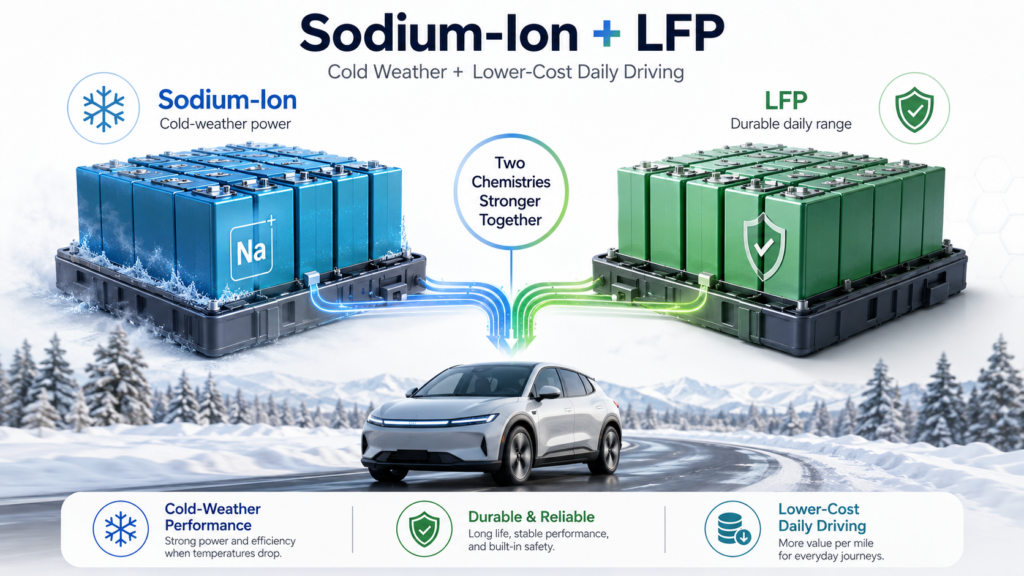
One of the most interesting dual-chemistry combinations is sodium-ion plus LFP. This pairing makes sense because the two chemistries could complement each other. LFP is already cost-effective, durable, and widely used. Sodium-ion could add better low-temperature performance and reduce reliance on lithium-based materials.
CATL specifically described a Sodium-LFP Dual-Power Battery that combines Naxtra sodium-ion technology with an LFP-based system. According to CATL, the goal is to use sodium-ion’s low-temperature performance while still delivering extended range through the LFP portion of the battery.
This could be useful in markets where winter performance matters. In cold weather, battery internal resistance rises, charging power is restricted, regenerative braking may be limited, and range can drop. A chemistry that can deliver stronger power at low temperatures could improve drivability before the full pack reaches its ideal operating temperature.
CATL’s separate Freevoy hybrid battery announcement also emphasized sodium-ion technology for low-temperature performance, including operation in extreme cold and full-temperature-range BMS control to manage the differences between lithium-ion and sodium-ion behavior.
For an everyday driver, the benefit might be simple: better cold-start performance, less dramatic winter range loss, and more predictable power delivery in freezing conditions. That does not mean sodium-ion cells magically eliminate winter range loss. Cabin heating, tire drag, air density, and battery conditioning still matter. But sodium-ion could give engineers another tool to reduce the battery-related part of the problem.
LFP + NMC: Low Cost Meets Long Range
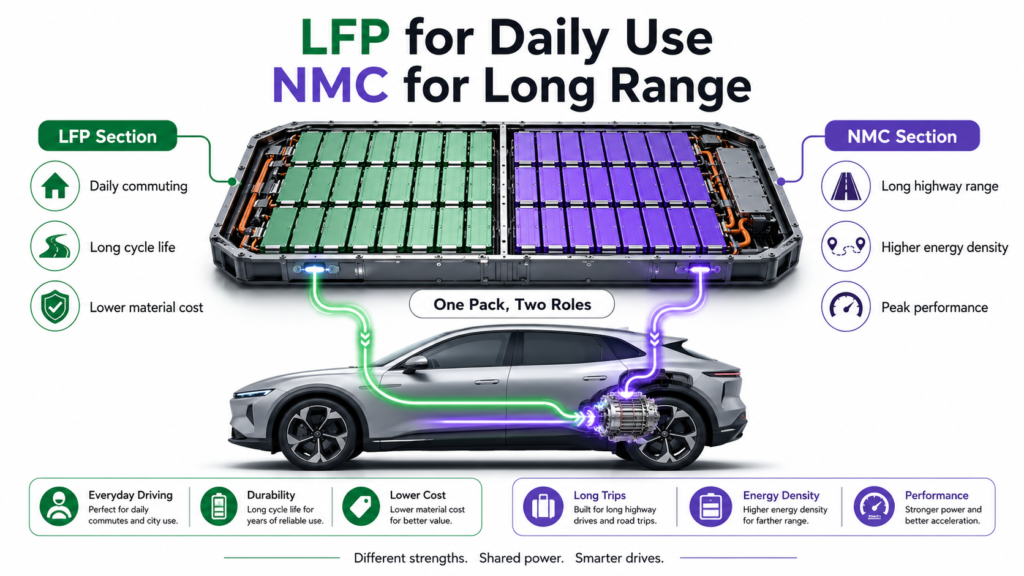
Another possible dual-chemistry design is LFP plus NMC. This combination is easy to understand from a consumer perspective. LFP could handle most daily driving because it is durable, affordable, and well suited for frequent charging. NMC could serve as the higher-energy portion of the pack, providing extra range or stronger power when needed.
Imagine a driver who commutes 35 miles per day. Most of that driving could rely on the LFP portion of the battery. On a road trip, the NMC portion could help extend range without forcing the entire pack to use expensive high-nickel cells. This type of design could also let automakers tune vehicles more precisely. A lower-cost EV might use mostly LFP with a smaller NMC section. A premium EV might use more NMC but still include an LFP section for durability or cost control.
However, LFP and NMC do not behave the same way. Battery University lists typical nominal voltage differences between common lithium-ion chemistries, with LFP around 3.2–3.3 volts and NMC around 3.6–3.7 volts. That voltage difference matters. You cannot simply wire random LFP and NMC cells together as if they were interchangeable AA batteries. The pack architecture has to account for different voltage windows, state-of-charge behavior, current limits, and aging patterns.
That is why a practical LFP + NMC pack would likely need separated energy zones, dedicated control logic, and careful power conversion or switching strategies.
Power Cells vs Energy Cells
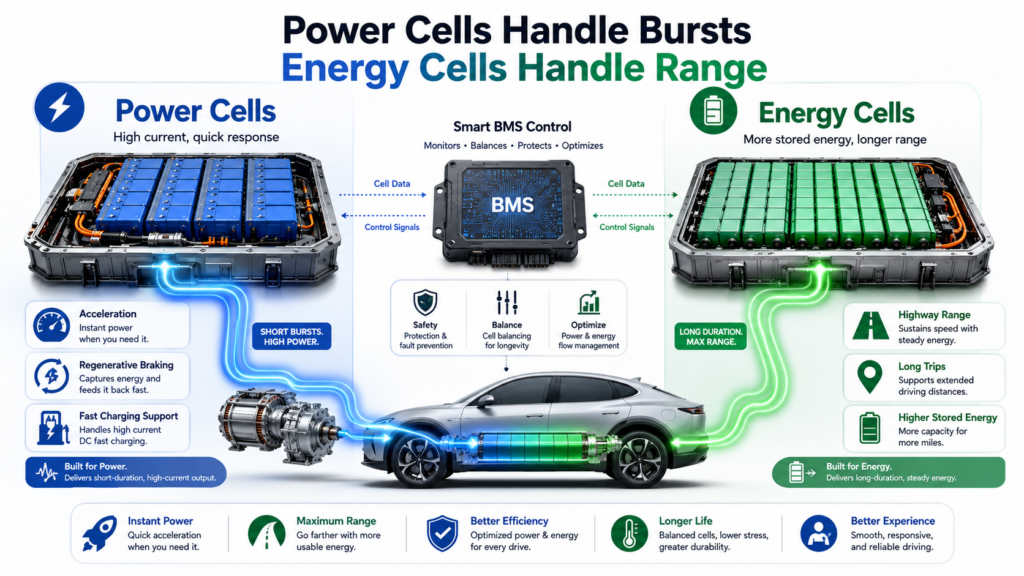
Dual-chemistry packs are not only about chemistry names. They are also about function. Some cells are better at delivering high power. Others are better at storing large amounts of energy. In EV engineering, this creates a useful distinction between power cells and energy cells. A power cell is designed to deliver or accept high current. It is useful for acceleration, regenerative braking, fast charging, towing bursts, and cold-weather drivability. A power-focused cell may sacrifice some energy density to improve rate capability, heat generation, or durability under high load.
An energy cell is designed to store as much usable energy as possible. It is useful for long highway range and reducing pack size or weight. Energy-focused cells may not be as comfortable with repeated high-current operation unless the thermal system and BMS carefully protect them.
A dual-chemistry pack could use this split intentionally. The power section could handle short bursts, heavy acceleration, and difficult temperature conditions. The energy section could supply steady cruising range.
In normal driving, the driver might never notice the split. The vehicle would simply feel smooth. Behind the scenes, the BMS would decide which section should provide power, how much current each section should carry, and when to rebalance the system. This is where software becomes just as important as cell chemistry.
The Voltage Problem: Why Mixed Chemistries Are Hard to Manage
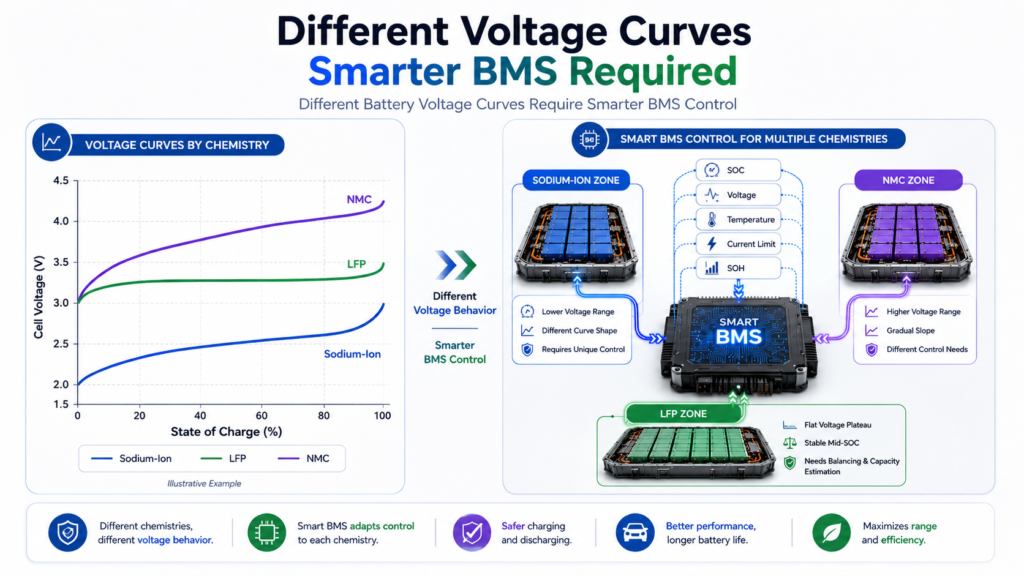
The biggest technical challenge in dual-chemistry packs is that different cells do not share the same voltage behavior. A battery cell’s voltage is not just a simple fuel gauge. It changes with state of charge, temperature, current, aging, and chemistry. LFP has a relatively flat voltage curve across much of its usable SOC range. NMC usually has a more sloped voltage curve. Sodium-ion cells may operate in a different voltage window depending on cathode and anode design.
This matters because EV battery packs contain many cells connected in series and parallel. If one group reaches its voltage limit before another group, the BMS must reduce current or stop charging. If one group depletes earlier, the vehicle cannot simply keep pulling energy from it without risking damage.
That problem already exists in single-chemistry packs, which is why cell balancing is necessary. In a mixed-chemistry pack, the problem becomes more complex because the BMS is not just correcting small differences among similar cells. It is coordinating cell groups that may have fundamentally different voltage-SOC relationships.
The BMS must estimate SOC separately for each chemistry. It must estimate power limits separately. It must track temperature separately. It must also understand how each section ages over time. This is one of the reasons CATL’s Freevoy announcement repeatedly emphasizes system control, independent energy zones, and BMS intelligence rather than only cell chemistry.
For readers who want the foundation first, our article on How Battery Management Systems Actually Work in Modern EVs is a useful internal link to add here.
Balancing Becomes More Complicated
Balancing is the process of keeping cells or cell groups aligned so the battery pack can use its capacity safely. In a normal lithium-ion pack, balancing usually deals with small differences between cells of the same chemistry. Some cells may have slightly more capacity. Some may age faster. Some may reach the voltage limit earlier. The BMS corrects those differences over time.
In a dual-chemistry pack, balancing is more than trimming small mismatches. The BMS may need to coordinate two energy zones with different voltage curves, different thermal behavior, and different charge acceptance.
Passive balancing may not be enough in some designs because it simply burns off excess energy from higher-voltage cells as heat. Active balancing, power conversion, or zone-level energy management may become more attractive because the system may need to move usable energy more intelligently. This is not impossible. It is just more expensive and more software-heavy.
The BMS also has to decide how to use the pack over the life of the vehicle. If the sodium-ion section is used heavily in winter and the LFP section is used heavily in normal commuting, they may age differently. If the NMC section is reserved for road trips and peak power, it may see fewer cycles but more high-voltage stress. The vehicle’s control strategy must avoid creating an imbalance that becomes worse every year. This is where dual-chemistry packs become a long-term durability challenge, not just a launch-day performance feature.
Pack Structure: Two Energy Zones Instead of One Big Block
A dual-chemistry battery pack will likely not be a random mix of cells scattered throughout the pack. A more realistic design would separate the chemistries into zones. One zone could contain sodium-ion cells. Another zone could contain LFP or NMC cells. Each zone could have its own sensors, contactors, cooling circuits, current paths, and safety isolation strategy.
CATL described its dual-power architecture as having two independent energy zones and mentioned dual high-voltage, dual low-voltage, dual structure, dual thermal management, and dual thermal runaway safety protection. That kind of language matters because pack structure is not just packaging. It affects safety, serviceability, cooling, crash behavior, and cost.
If one chemistry has different thermal runaway characteristics, the pack may need different fire barriers or venting paths. If one section heats faster during charging, it may need more aggressive cooling. If one section is optimized for cold performance, it may need a different heating strategy.
This also affects manufacturing. A single-chemistry pack can be optimized around one cell type, one module design, and one assembly process. A dual-chemistry pack may require more parts, more validation, more testing, and more quality control. That added complexity must be justified by real vehicle-level benefits.
Cooling and Heating: The Thermal System Gets Harder
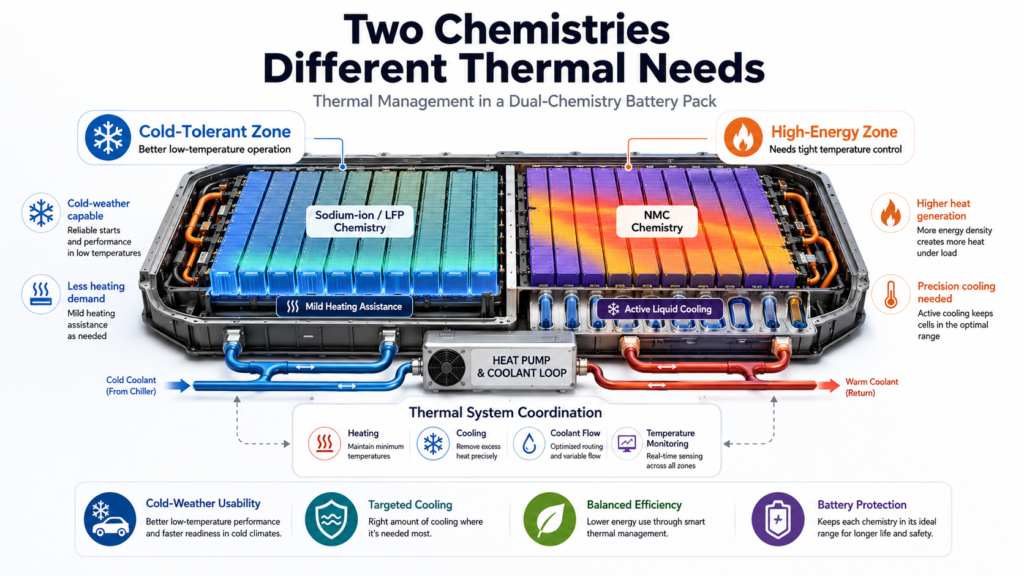
Battery thermal management is already one of the most important systems in an EV. It affects range, charging speed, safety, and long-term degradation. A dual-chemistry pack makes thermal management harder because different cells may prefer different operating conditions. One chemistry may tolerate cold better. Another may need tighter temperature control during fast charging. One section may generate more heat under high power. Another may be more sensitive to high-temperature aging.
In a single-chemistry pack, engineers try to keep cells within a reasonably uniform temperature range. In a dual-chemistry pack, uniform temperature may not always be the best goal. The system may need to warm one zone faster, cool another zone more aggressively, or limit current differently depending on the operating condition.
This is especially important during DC fast charging. Charging power is limited by temperature, voltage, lithium-ion transport, and the risk of lithium plating. We covered those physics in EV Battery Charging Power: 4 Reasons It Must Taper.
A dual-chemistry pack may reduce some limitations if the power-focused section can accept current more easily. But it may also create new limits if the two zones cannot be charged efficiently at the same time. In other words, dual chemistry does not remove the need for thermal management. It makes thermal management more strategic.
Safety: More Flexibility, More Validation
Dual-chemistry packs could improve safety in some ways. For example, LFP and sodium-ion chemistries are often discussed as safer alternatives to high-nickel lithium-ion cells because of their material-level stability. CATL has also emphasized safety in its Naxtra sodium-ion battery announcements, including performance in abusive tests and cold conditions.
But adding a second chemistry also means adding more interfaces, more control states, and more failure modes to validate. Engineers must ask difficult questions. What happens if one energy zone fails? Can the vehicle limp home on the other zone? How should the pack isolate a fault? How does the system prevent one zone from overcharging the other? What happens after a crash? How does emergency service identify and handle a mixed-chemistry pack?
These questions are solvable, but they require testing. A dual-chemistry pack may eventually be safer and more resilient than a conventional design. But it will not be safer simply because it contains two chemistries. Safety comes from the full system: cells, pack structure, BMS, thermal management, contactors, fusing, diagnostics, and crash protection.
Will Dual-Chemistry Packs Improve Fast Charging?
They might, but not automatically. One possible advantage is that the pack can route more charging load to the section that can safely accept higher current. If one chemistry has better low-temperature charging behavior or lower resistance at a given condition, the BMS could prioritize that section early in the session.
CATL’s Freevoy Super Hybrid Battery announcement mentions 4C fast charging and more than 280 km of range added in 10 minutes for its hybrid-focused product. It also says sodium-ion technology is used to improve low-temperature behavior.
However, fast charging is not just a chemistry problem. It also depends on pack voltage, charger capability, cable current, cooling capacity, SOC, cell design, and vehicle software. A dual-chemistry battery might charge faster in certain windows but slower or more complexly in others. For example, the BMS may need to charge the two zones at different rates. It may need to pause or taper one zone while continuing another. It may need DC-DC conversion or internal switching to keep both sections within safe limits.
So the real benefit may not be “charging is always faster.” The better benefit may be “charging is more optimized across a wider range of conditions.” That could be especially valuable in winter.
Does the Extra Cost Make Sense?
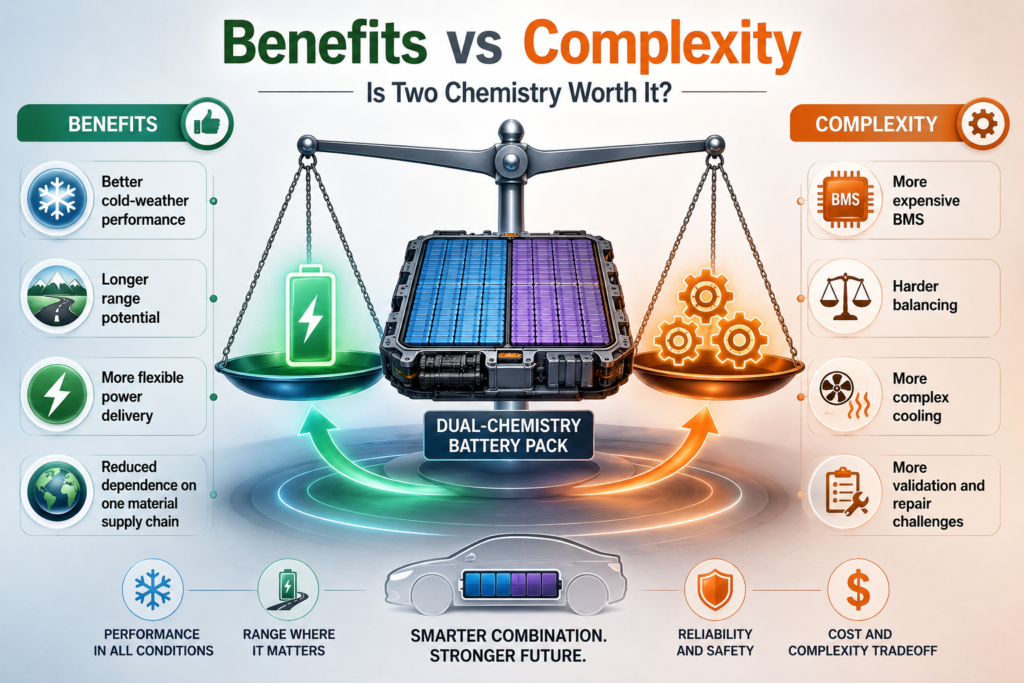
This is the central question. Dual-chemistry packs add complexity. They may require more sensors, more contactors, more wiring, more sophisticated BMS software, more validation, and more complicated manufacturing. They may also make repair and recycling more difficult because the pack contains multiple material streams.
So why would automakers bother? The answer is that some vehicle segments may benefit more than others. A low-cost city EV probably does not need a complicated dual-chemistry pack. A simple LFP or sodium-ion pack may be enough. The same may be true for basic commuter vehicles where cost matters more than maximum range or performance.
But a larger EV, cold-weather EV, long-range family vehicle, premium SUV, electric truck, or future autonomous vehicle may have more demanding requirements. It may need long range, strong low-temperature power, fast charging, safety redundancy, and long cycle life in one package.
CATL has framed its multi-power approach as a move from “parameter driven” batteries to “demand driven” batteries, meaning packs can be customized for different user needs rather than optimized around a single headline number.
That may be the strongest argument for dual chemistry. It is not about making the battery more complicated for its own sake. It is about matching battery behavior to real driving needs.
What This Could Mean for EV Owners
For EV owners, dual-chemistry batteries could eventually change how vehicle specs are explained. Today, buyers mostly compare range, charging speed, warranty, and battery chemistry. In the future, an EV window sticker might describe a battery system with a daily-driving zone and an extended-range zone. Or it may advertise better winter power because part of the pack uses sodium-ion cells. Owners may not need to understand every detail. The vehicle software would manage the complexity automatically.
But the ownership experience could feel different. An EV might hold power better in freezing weather. It might maintain more consistent acceleration at low SOC. It might charge more predictably on road trips. It might also use different battery sections differently depending on whether the driver is commuting, towing, fast charging, or preparing for a long trip.
There could also be new maintenance and resale questions. A used EV buyer may eventually need to know the health of each battery zone, not just one overall SOH number. A warranty may need to define coverage for each chemistry. Battery repair shops may need more detailed diagnostic tools. That is why dual-chemistry batteries are not just a battery supplier story. They could eventually affect ownership, service, resale value, and battery health reports.
Will Every EV Use a Dual-Chemistry Battery?
Probably not. The EV industry rarely moves toward maximum complexity when a simpler solution works. If an LFP pack can deliver the required range, price, durability, and safety, there may be no reason to add a second chemistry. If a high-nickel pack is needed for a premium long-range vehicle, automakers may prefer to improve that pack rather than combine it with another chemistry.
Dual-chemistry batteries are more likely to appear where the benefits are clear. That could include cold-weather markets, high-end long-range EVs, EREVs, PHEVs, electric trucks, fleet vehicles, or vehicles with advanced driver-assistance systems that need highly reliable power delivery.
CATL and CHANGAN’s 2026 sodium-ion passenger vehicle announcement also suggests sodium-ion is moving from lab discussion toward actual vehicle deployment, with CATL calling it part of a broader dual-chemistry era where sodium-ion and lithium-ion complement each other.
That phrase is important. Sodium-ion does not need to replace lithium-ion to matter. It may become valuable because it works alongside lithium-ion. The same logic applies to LFP and NMC. The future may not be one winner. It may be smarter combinations.
Conclusion: The Future Battery Pack May Be Less Like One Big Battery and More Like an Energy System
Dual-chemistry EV batteries are one of the clearest signs that battery innovation is moving beyond simple chemistry labels. For years, the EV conversation has focused on which battery is better: LFP or NMC, lithium-ion or sodium-ion, solid-state or conventional lithium-ion. But real vehicles are more complicated than that. A battery that is perfect for daily commuting may not be perfect for winter fast charging. A battery that is ideal for long range may not be ideal for cost. A chemistry that performs well in cold climates may not offer the highest energy density.
Dual-chemistry packs try to solve that problem by letting different cells do different jobs. Sodium-ion plus LFP could improve affordability and cold-weather usability. LFP plus NMC could balance daily durability with longer-range capability. Power cells and energy cells could work together to improve acceleration, charging, and highway range.
The tradeoff is complexity. The BMS becomes harder to design. Balancing becomes more important. Cooling and heating must be more carefully controlled. Manufacturing, safety validation, repair, and recycling all become more complicated.
So dual-chemistry batteries will not be the right answer for every EV. But for vehicles that need a wider performance envelope, they may become an important next step. The future EV battery pack may not be defined by a single chemistry. It may be defined by how intelligently multiple chemistries work together.
FAQs
What is a dual-chemistry EV battery?
A dual-chemistry EV battery uses two different battery chemistries in one vehicle battery system. For example, a pack may combine sodium-ion and LFP cells, or LFP and NMC cells. The goal is to use each chemistry where it performs best.
Why would an EV use sodium-ion and LFP together?
Sodium-ion cells may offer strong cold-weather performance and lower dependence on lithium, while LFP cells offer durability, safety, and reasonable cost. Combining them could help an EV perform better in winter while still keeping the pack relatively affordable.
Why combine LFP and NMC batteries?
LFP can be useful for lower-cost daily driving and long cycle life, while NMC can provide higher energy density for longer range or stronger performance. A combined pack could use LFP for routine use and NMC for higher-demand situations.
Are dual-chemistry battery packs harder to manage?
Yes. Different chemistries can have different voltage curves, temperature limits, charge behavior, and aging patterns. The BMS must manage each section carefully and coordinate power flow between them.
Will dual-chemistry batteries make EVs cheaper?
Not always. The pack itself may cost more because it needs more complex hardware and software. The idea only makes sense if the vehicle-level benefits, such as better range, cold-weather performance, or reduced material cost, justify the added complexity.
Are dual-chemistry EV batteries available now?
The concept is beginning to move from theory toward commercial products. CATL has announced dual-power battery architecture and sodium-ion battery developments, including Sodium-LFP and NCM-LFP/NCM-NCM dual-power solutions. Broad adoption will depend on cost, validation, manufacturing readiness, and automaker demand.