
Quick Answer
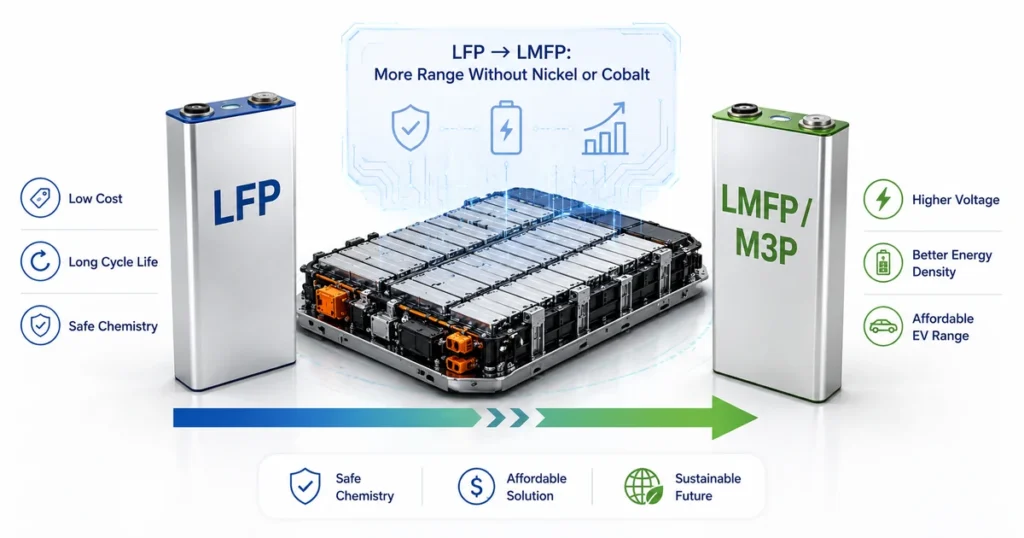
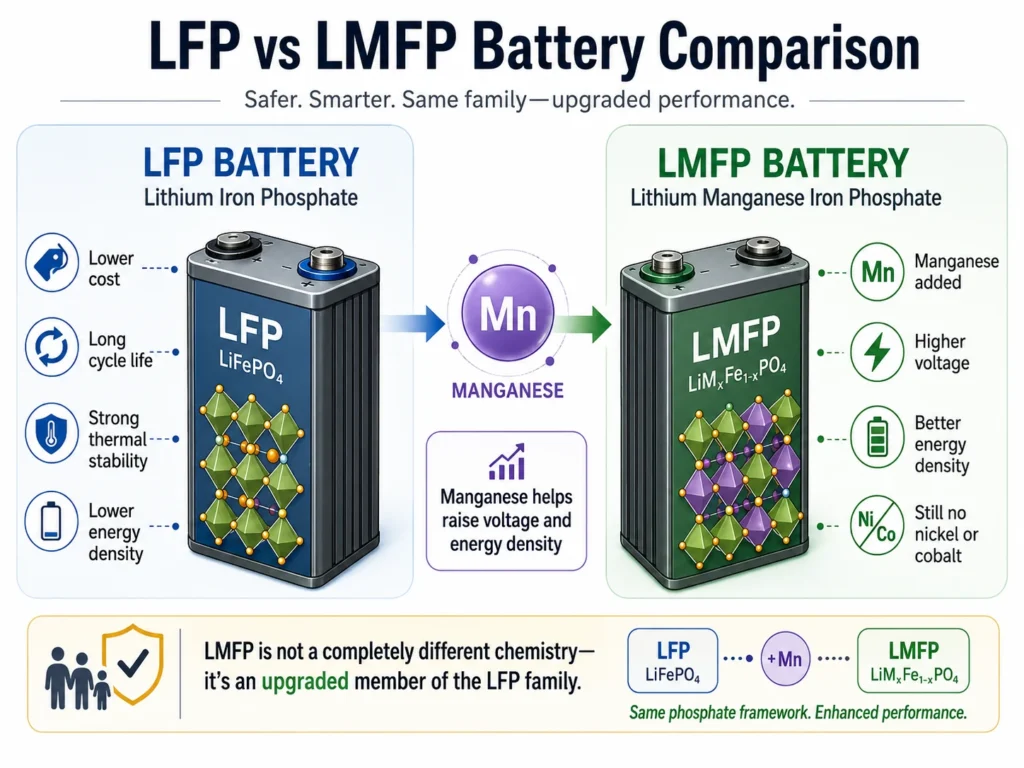
LMFP batteries, short for lithium manganese iron phosphate batteries, are best understood as an upgraded version of LFP. They keep many of the reasons LFP batteries have become popular — lower cost, strong thermal stability, long cycle life, and no nickel or cobalt in the cathode — while adding manganese to raise operating voltage and improve energy density.
That matters because LFP’s biggest weakness has always been range. LFP is affordable and durable, but it usually stores less energy per kilogram than nickel-rich chemistries such as NMC or NCA. LMFP tries to close part of that gap without giving up the practical advantages that made LFP so important in the first place.
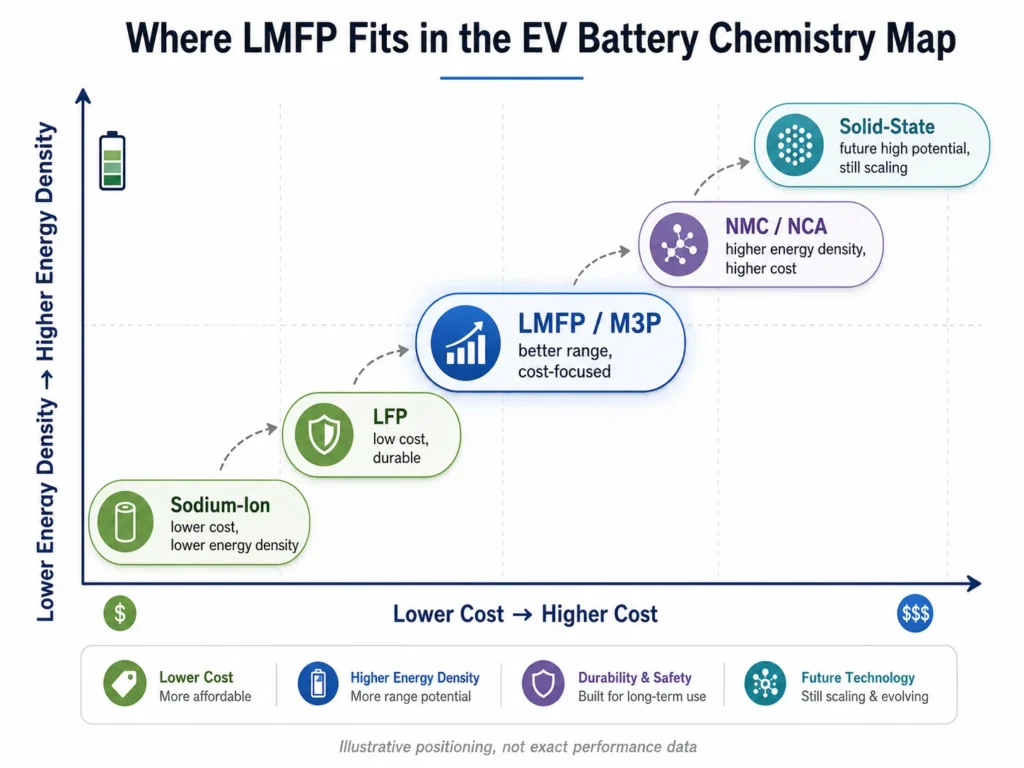
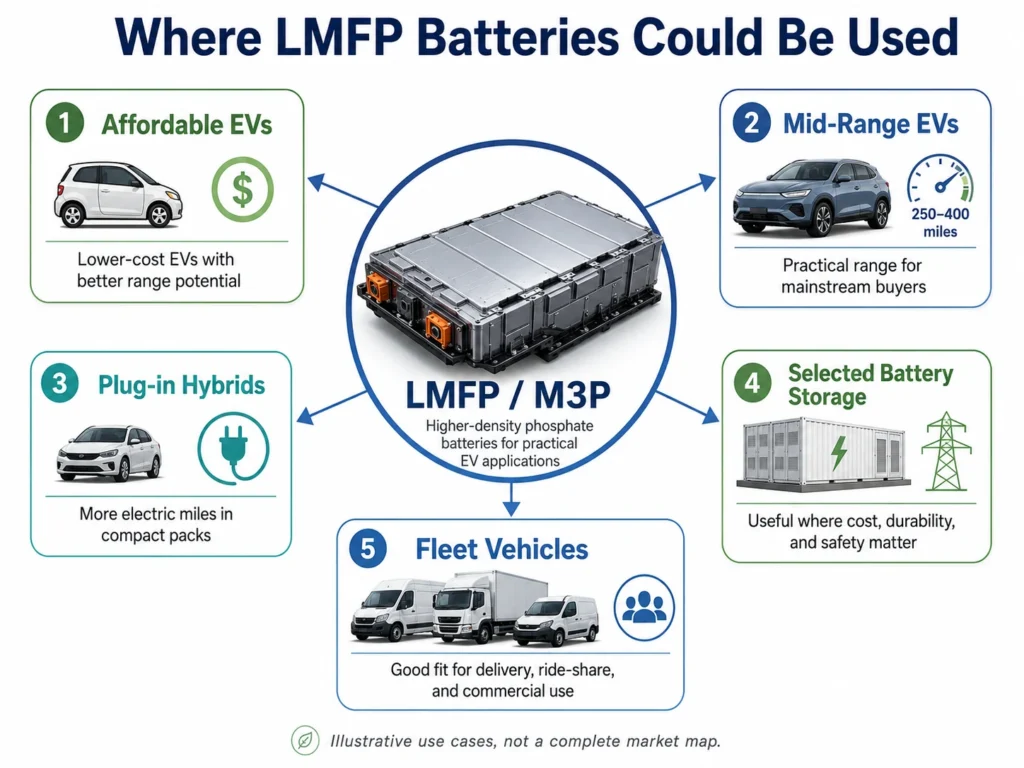
This does not mean LMFP will replace every EV battery chemistry. It is more likely to sit between standard LFP and higher-energy nickel-based batteries. For affordable EVs, mid-range EVs, plug-in hybrids, and some energy storage applications, LMFP could become one of the most important battery chemistries of the next few years.
Introduction: Why LMFP Is Suddenly Getting More Attention
LMFP batteries are becoming one of the most practical next steps after LFP because they aim to improve energy density without giving up LFP’s cost, safety, and durability advantages. LFP batteries became the cost leader. Nickel-rich batteries remained important for long-range and premium EVs. Sodium-ion batteries started moving from pilot projects toward real commercial use. Solid-state batteries kept attracting attention as a possible long-term breakthrough.
But between today’s mainstream LFP and tomorrow’s more advanced chemistries, there is another technology that deserves more attention: LMFP. LMFP stands for lithium manganese iron phosphate. Chemically, it is closely related to LFP, or lithium iron phosphate. The difference is that part of the iron in the cathode is replaced with manganese. That sounds like a small materials change, but it can shift the performance balance in an important way.
Standard LFP is already winning because it is practical. It avoids nickel and cobalt, performs well in terms of safety and durability, and has become extremely cost competitive. The International Energy Agency noted in its Global EV Outlook 2026 battery section that LFP packs were more than 40% cheaper on average than NMC alternatives in 2025, although part of that difference reflects the storage-heavy applications where LFP is often used.
That cost advantage is a big reason LFP has moved from “budget battery” to mainstream global EV chemistry. If you want more background on that shift, see our earlier article on why LFP batteries are taking over the global EV market.
LMFP builds on the same trend. It does not try to reinvent the lithium-ion battery from scratch. Instead, it asks a more practical question: Can we keep much of what makes LFP attractive, but improve the energy density enough to make it useful in more EVs? That is why LMFP may be one of the most realistic “next step” battery technologies after LFP.
What Are LMFP Batteries?
An LMFP battery is a lithium-ion battery that uses a lithium manganese iron phosphate cathode. The cathode is the positive electrode of the battery, and it plays a major role in determining cost, energy density, voltage, safety behavior, and long-term durability.
In a standard LFP battery, the cathode material is lithium iron phosphate. In an LMFP battery, some of the iron is replaced with manganese. The result is often written chemically as LiMnFePO₄, although the exact manganese-to-iron ratio can vary by supplier and cell design.
The reason manganese is useful is that manganese operates at a higher voltage than iron in the phosphate structure. Higher voltage can increase the amount of energy the cell stores, even if the basic cathode family remains similar.
That is the core idea behind LMFP:
- LFP gives you stability and cost advantages.
- Manganese gives you a higher-voltage pathway.
- LMFP tries to combine both.
In recent technical literature, LMFP is often described as an enhanced variation of LFP with the potential for roughly 10% to 20% higher energy density, depending on material design, cell format, electrolyte, and manufacturing quality. A 2025 review in Energy Materials and Devices describes LMFP as offering energy density 10%–20% greater than LFP, while still being connected to the broader phosphate battery family.
That improvement may not sound dramatic compared with bold solid-state battery claims. But in the EV industry, a 10% to 20% improvement can be very meaningful if it comes without a major cost penalty or manufacturing reset.
Why LFP Needed an Upgrade
LFP batteries are popular for good reasons. They are generally cheaper than nickel-rich batteries, they avoid cobalt and nickel in the cathode, they are known for strong thermal stability, and they can deliver long cycle life when managed properly. That is why LFP has become especially attractive for:
- Affordable EVs
- Standard-range models
- Fleet vehicles
- Plug-in hybrids
- Stationary battery storage
- Markets where cost matters more than maximum range
But LFP has one obvious weakness: lower energy density.
In simple terms, an LFP pack usually needs more weight or volume to store the same amount of energy as a higher-energy nickel-based pack. Automakers can work around this using efficient pack design, cell-to-pack architecture, thinner cells, better thermal integration, and smarter vehicle efficiency. But chemistry still matters.
This is where LMFP becomes interesting. It does not try to turn LFP into an ultra-premium long-range battery overnight. Instead, it tries to reduce LFP’s range disadvantage enough to make it more competitive in a wider set of vehicles. For example, imagine two affordable EVs using similar pack designs. One uses standard LFP. The other uses LMFP with a modest energy-density improvement. The LMFP version may be able to offer a slightly longer driving range using the same pack size, or it may offer the same range with fewer cells. Either outcome can matter.
For consumers, that could mean fewer “standard range only” compromises. For automakers, it could mean more flexibility in designing affordable EVs without moving all the way back to expensive nickel-rich chemistries.
LMFP vs LFP: What Actually Changes?
The easiest way to understand LMFP is to compare it with LFP directly. Both belong to the phosphate battery family. Both are attractive because they avoid nickel and cobalt in the cathode. Both are generally associated with good safety behavior compared with many high-nickel chemistries. Both can be used in lower-cost EVs and energy storage systems.
The key difference is voltage. LFP typically operates around a lower voltage plateau. LMFP adds manganese, which introduces a higher-voltage redox reaction. That higher voltage can increase energy density because energy is related to both capacity and voltage.
A simple way to think about it is this:
- LFP is the reliable, cost-effective baseline.
- LMFP is the higher-voltage version that tries to stretch the range.
However, the manganese addition also creates engineering challenges. Manganese-based phosphate materials can have lower electronic conductivity and more complicated lithium-ion diffusion behavior. They may also require careful particle design, carbon coating, electrolyte optimization, and cell engineering to deliver good real-world performance.
So LMFP is not just “LFP plus manganese equals better battery.” It is more accurate to say LMFP is a promising upgrade path that depends heavily on materials processing and manufacturing execution. That matters because battery chemistry on paper is not the same as battery chemistry in a production vehicle. A cell can look excellent in laboratory testing but still struggle when scaled to millions of cells, exposed to different temperatures, fast charging, vibration, calendar aging, and warranty expectations. This is why LMFP’s future depends less on the basic idea and more on whether manufacturers can produce it consistently at scale.
Where CATL’s M3P Battery Fits In
When people talk about LMFP, they often mention CATL’s M3P battery technology. M3P is not always described as a simple textbook LMFP cell, but it is widely discussed as part of the same “phosphate-plus-manganese” direction.
CATL has described M3P as evolving from LFP while offering higher energy density. In a 2022 CATL article, CATL chairman Robin Zeng said the company’s M3P battery “retains the quality of high safety and long service life of LFP batteries” while increasing cell energy density by about 20% through material innovation. You can read CATL’s own statement here: Robin Zeng: Advanced Green Battery is the Inevitable Trend of Industry Development.
Reuters later reported that CATL planned mass production and delivery of M3P batteries, describing them as having greater energy density than LFP and lower cost than nickel- and cobalt-based batteries. That Reuters report is available here: China’s CATL to start mass output of M3P batteries.
More recently, CATL and Li Auto announced a strategic cooperation in 2025 that explicitly listed M3P batteries alongside NCM, LFP, and sodium-ion batteries. That does not tell us exactly which future vehicles will use which chemistry, but it does show that M3P is being treated as part of CATL’s broader commercial technology portfolio, not just a lab concept. CATL’s announcement is here: Li Auto and CATL Establish Comprehensive Strategic Partnership.
For EV buyers, the important point is not the branding itself. Whether a company calls the chemistry LMFP, M3P, or something similar, the goal is the same: make phosphate-based batteries more energy dense without losing the cost and durability advantages that made LFP successful.
Why LMFP Could Be Important for Affordable EVs
The EV market is entering a difficult but important phase. Early adopters were often willing to pay more for long range, new technology, and premium features. The next wave of EV growth depends much more on affordability.
That makes chemistry choice critical. Nickel-rich batteries can deliver excellent range, but they are more exposed to nickel and cobalt supply chains. LFP reduces that pressure, but it can limit range or require larger packs. Sodium-ion may become important in low-cost and cold-weather applications, but it is still developing its manufacturing base and energy density.
LMFP sits in a practical middle zone. It could allow automakers to build EVs that are still relatively affordable but offer better range than standard LFP versions. That is especially useful for compact crossovers, sedans, small SUVs, and plug-in hybrids where cost and packaging are both important. The difference may not always show up as a headline-grabbing 700-mile EV. More likely, LMFP could help with quieter improvements:
- A standard-range EV becomes a more comfortable mid-range EV.
- A plug-in hybrid gets more electric-only range without a much larger pack.
- A low-cost EV keeps its price target while reducing range anxiety.
- A battery pack becomes slightly smaller, lighter, or easier to package.
Those incremental gains are not as exciting as a miracle battery announcement. But they are exactly the kind of improvements that often matter most in real production vehicles. This is similar to the broader battery strategy we discussed in Why There Will Not Be One Winning EV Battery Chemistry. The future is unlikely to be one chemistry replacing all others. It is more likely to be a toolbox: LFP for cost and durability, LMFP for better affordable range, NMC or LMR for higher energy density, sodium-ion for selected low-cost or cold-weather use cases, and solid-state for future premium applications if manufacturing challenges are solved.
LMFP vs NMC: Can It Replace Nickel-Rich Batteries?
LMFP is not a direct replacement for every NMC battery. NMC batteries, especially high-nickel versions, still offer strong energy density. That makes them useful for long-range EVs, performance vehicles, large SUVs, luxury vehicles, and applications where pack size and weight are major constraints.
LMFP’s advantage is different. It aims to offer enough energy density improvement over LFP while keeping costs lower and reducing reliance on nickel and cobalt. So the more realistic question is not: Will LMFP replace NMC everywhere? A better question is: How many EVs currently using NMC could switch to LMFP without disappointing buyers? For some premium long-range vehicles, the answer may be “not many.” If buyers expect maximum range, fast charging, high performance, and towing capability, nickel-rich batteries may remain attractive.
But for mainstream EVs where price matters more than extreme range, LMFP could be very competitive. A 250-mile to 350-mile practical EV using a lower-cost phosphate-based chemistry may be more important to the market than a very expensive 500-mile vehicle. This is why LMFP is strategically interesting. It does not need to beat NMC at everything. It only needs to be good enough in range while being better in cost, safety, supply-chain simplicity, and durability. That is often how battery technologies win in the real world.
LMFP vs Sodium-Ion: Competitors or Complements?
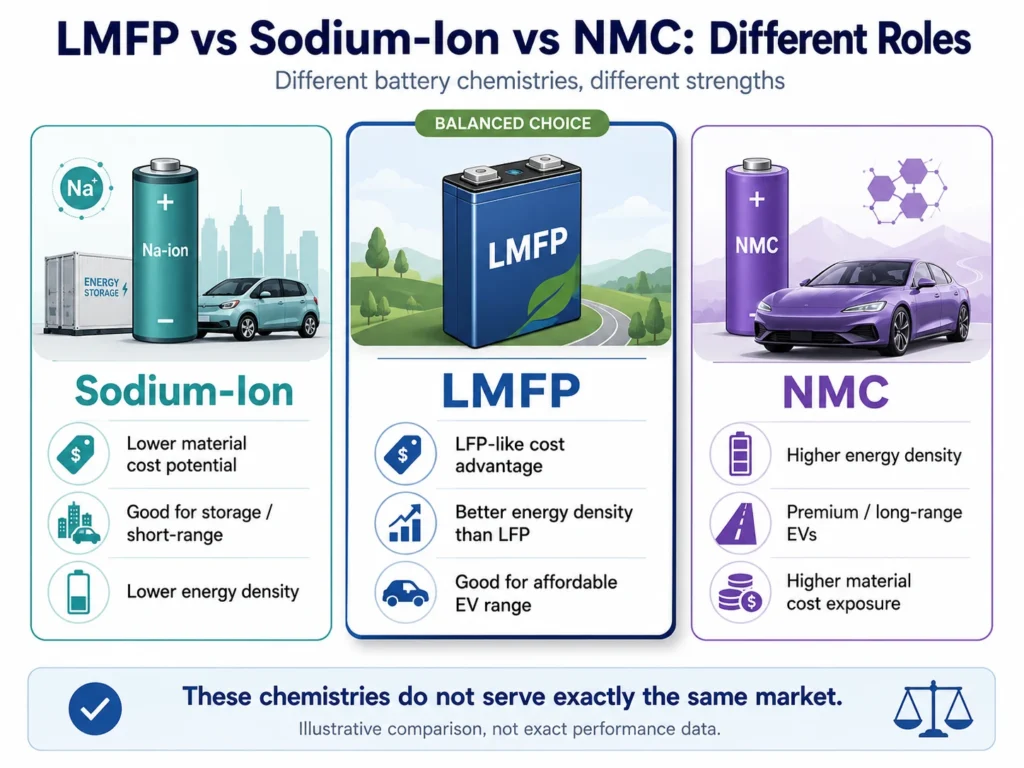
Sodium-ion batteries are another major trend in affordable batteries. They use sodium instead of lithium as the charge-carrying ion, which could eventually reduce pressure on lithium supply and improve cost stability. They may also offer attractive cold-weather behavior and strong safety characteristics.
But sodium-ion has a different challenge: lower energy density than lithium-ion in many early commercial designs. That means sodium-ion and LMFP may overlap in some markets, but they are not identical competitors. Sodium-ion may be especially useful for:
- Stationary storage
- Low-speed or short-range EVs
- Cold-climate applications
- Hybrid battery packs
- Markets where lithium supply flexibility matters
LMFP may be better suited for:
- Mainstream affordable EVs
- Mid-range passenger vehicles
- Plug-in hybrids
- Applications where lithium-ion manufacturing compatibility matters
- Vehicles that need more range than sodium-ion can easily provide
In other words, sodium-ion could pressure the lower end of the LFP market, especially where weight and volume are less important. LMFP could pressure the upper end of the LFP market, where automakers want more range without switching to expensive nickel-rich cathodes. That makes LMFP and sodium-ion more like neighboring tools than one-for-one replacements.
For more background, see our article on sodium-ion batteries in 2026, where we explain why sodium-ion is becoming practical but is unlikely to replace LFP everywhere in the near future.
What Are the Main Advantages of LMFP Batteries?
The first advantage is improved energy density compared with standard LFP. This is the main reason LMFP exists. If an automaker can get a meaningful energy-density boost while keeping the cost close to LFP, LMFP becomes very attractive.
The second advantage is material flexibility. Like LFP, LMFP avoids nickel and cobalt in the cathode. That can reduce exposure to volatile commodity markets and supply-chain concerns. It also fits the industry’s broader move toward lower-cost, more abundant battery materials.
The third advantage is compatibility with the existing lithium-ion ecosystem. LMFP is not as radical as solid-state batteries. It does not require automakers to redesign every part of the battery system from the ground up. This makes it more likely to scale earlier than technologies that require completely new manufacturing processes.
The fourth advantage is safety positioning. Phosphate-based cathodes are generally known for strong thermal stability. That does not mean an LMFP pack is automatically risk-free. Pack safety still depends on cell design, separators, electrolyte, BMS software, cooling, mechanical protection, and abuse testing. But LMFP starts from a chemistry family with a strong safety reputation.
The fifth advantage is market timing. EV makers need better affordable batteries now, not only in the 2030s. LMFP could arrive as a near-term improvement while solid-state batteries continue road testing and manufacturing development. For more on that longer-term path, see our article on solid-state battery road testing.
What Are the Challenges Holding LMFP Back?
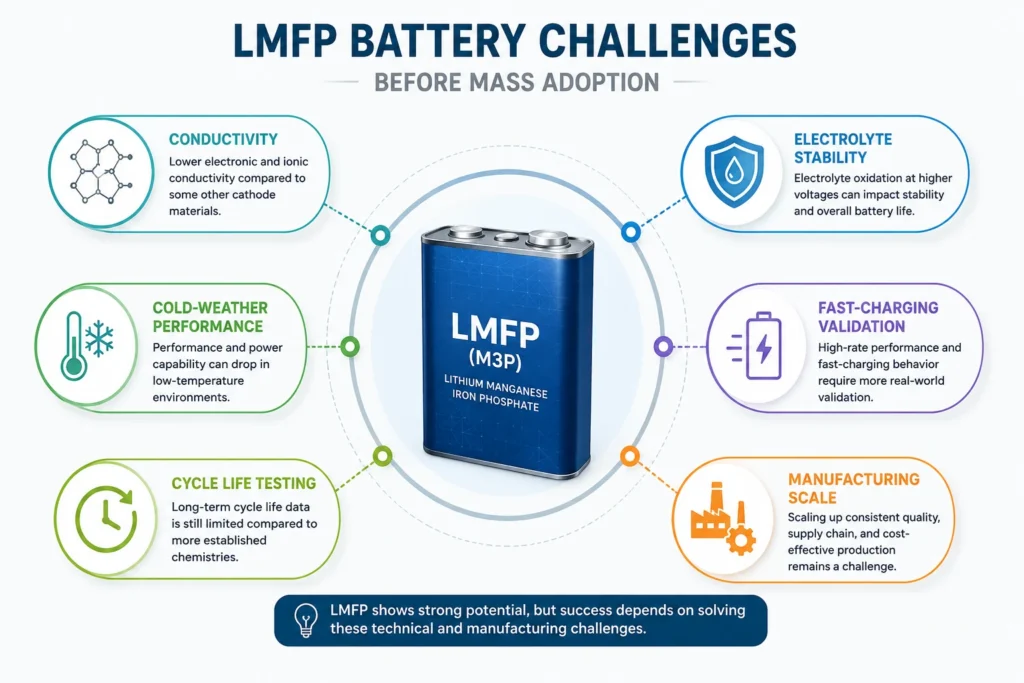
LMFP sounds straightforward, but it is not easy to commercialize well. One challenge is conductivity. Manganese-rich phosphate materials can struggle with electronic conductivity and lithium-ion transport. Battery companies often need coatings, particle-size control, doping, and careful electrode design to make the material perform well.
Another challenge is voltage compatibility. Higher voltage can improve energy density, but it also places more stress on electrolyte stability and cell design. A higher-voltage cathode is only useful if the rest of the cell can handle it over thousands of cycles.
A third challenge is low-temperature and high-power performance. LFP already has cold-weather limitations in some applications. LMFP has to prove that it can deliver acceptable real-world performance across winter driving, fast charging, and repeated high-power use.
A fourth challenge is production consistency. A chemistry that works well in pilot production still has to be made at high yield, at low cost, with consistent quality. Battery manufacturing is unforgiving. Small variations in materials, coating thickness, moisture, formation cycling, and cell aging can affect performance.
Finally, LMFP has to compete against a moving target. Standard LFP is not standing still. CATL’s Shenxing LFP battery, for example, shows how much can still be improved within LFP through fast-charging design, pack integration, and materials engineering. At the same time, NMC, LMR, silicon anodes, sodium-ion, and semi-solid batteries are all evolving. LMFP’s opportunity is real, but it has to earn its place in a crowded chemistry roadmap.
Will LMFP Improve EV Range?
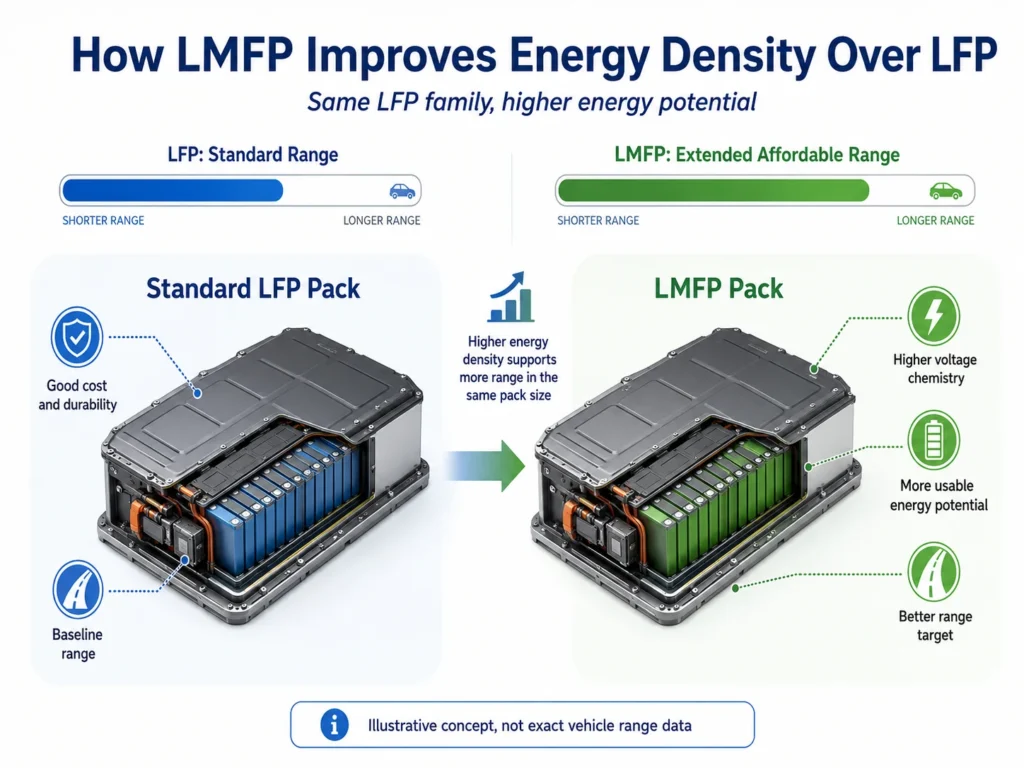
In many cases, yes — but expectations should be realistic. LMFP may improve range compared with standard LFP if the pack size and vehicle efficiency remain similar. A 10% to 20% cell-level energy-density improvement does not always translate into a 10% to 20% vehicle-range improvement because the full battery pack includes structure, cooling, electronics, protection, and unused buffers.
Still, even a smaller vehicle-level improvement can matter. For example, if an LFP-based EV has an EPA-rated range around 260 miles, an LMFP-based version might help push that vehicle closer to a more comfortable range target without switching to a much more expensive chemistry. The exact result would depend on cell design, pack architecture, vehicle efficiency, usable capacity, and software limits. This is where LMFP could be especially useful. Many drivers do not need a 500-mile EV. They need an affordable EV that feels less compromised during highway trips, winter driving, or years of battery aging. If LMFP helps standard-range EVs become “good enough” for more buyers, that could be more important than a dramatic range record.
Could LMFP Be Used in Energy Storage?
Yes, but the case is different from EVs. Stationary energy storage does not care as much about weight or volume. That is why LFP already dominates many grid-scale battery storage systems. The IEA reported that LFP accounted for over 90% of global battery energy storage systems in 2025 in its commentary on global battery markets and supply risks.
For grid storage, the key priorities are usually cost, cycle life, safety, availability, and system-level reliability. If standard LFP is already extremely cheap and durable, LMFP must justify itself. Higher energy density may help where land, container volume, shipping cost, or installation footprint matter, but the economics must work.
Sodium-ion may also become a serious competitor in storage, especially if it can offer lower cost, good safety, and strong temperature performance. That is why LMFP may be more compelling in EVs than in the lowest-cost grid storage projects, at least initially.
For more context on how EV battery companies are expanding beyond vehicles, see our article on why EV battery companies are betting big on grid energy storage.
What LMFP Means for EV Owners
Most EV owners do not need to memorize battery chemistry names. But chemistry still affects the ownership experience. If LMFP becomes common, owners may see EVs that feel like an improved version of today’s LFP models. They may be affordable, durable, and less dependent on nickel and cobalt, but with better range than many standard LFP vehicles.
Charging behavior will still depend on the full pack design. An LMFP battery is not automatically a faster-charging battery just because it has higher energy density. Fast charging depends on electrode design, thermal management, BMS limits, cell temperature, state of charge, charger capability, and degradation targets.
Battery life will also depend on use conditions. LMFP may inherit some of LFP’s durability strengths, but real-world performance will depend on how each manufacturer designs and manages the pack. For buyers, the practical advice is simple: do not judge a vehicle only by the chemistry label. Look at the rated range, warranty, charging curve, thermal management system, usable battery capacity, real-world owner data, and how the vehicle fits your driving habits. A good LMFP pack could be excellent. A poorly engineered LMFP pack would not automatically be better than a well-engineered LFP or NMC pack.
Is LMFP the Next Step After LFP?
In many ways, yes. LMFP is one of the most logical next steps after LFP because it improves the exact weakness that limits LFP: energy density. It does this without moving completely away from the phosphate battery family, and without relying on nickel and cobalt in the cathode. That makes it more realistic than many “breakthrough battery” headlines. LMFP is not trying to change everything at once. It is trying to improve a battery chemistry that already works.
But LMFP is not the final answer for all EVs. Premium long-range EVs may continue using nickel-rich chemistries or future high-energy alternatives. Sodium-ion may grow in short-range EVs and energy storage. Solid-state batteries may eventually serve premium or specialized applications if manufacturing scale and cycle life improve. LMR, silicon anodes, and other cathode/anode improvements will also compete for attention. The better way to think about LMFP is this:
- LFP made affordable EV batteries mainstream.
- LMFP could make affordable EV batteries more range-competitive.
- That is a smaller promise than a battery revolution, but it may be more important in the real market.
Conclusion: LMFP Is Not Hype, but It Is Not Magic Either
LMFP batteries are important because they represent a practical battery evolution. They build on LFP’s strengths — cost, safety, durability, and material simplicity — while targeting LFP’s biggest weakness: lower energy density.
If manufacturers can scale LMFP with good quality, stable cycle life, acceptable cold-weather performance, and competitive cost, it could become a major chemistry for mainstream EVs. It may not replace NMC in every long-range vehicle, and it may not stop sodium-ion from growing in storage or low-cost applications. But it could occupy one of the most commercially valuable spaces in the battery market: affordable EVs with better real-world range. That is why LMFP deserves attention. It is not a miracle battery. It is something more believable: an incremental improvement with a clear purpose, a strong market need, and a realistic path to production.
For EV buyers, LMFP could eventually mean more affordable EVs that no longer feel quite as range-limited as earlier LFP models. For automakers, it could become another tool in the battery chemistry toolbox. And for the broader EV market, it shows that the next big battery improvement may not come from replacing lithium-ion entirely. It may come from making today’s most practical chemistry just a little better.
FAQs
What does LMFP stand for?
LMFP stands for lithium manganese iron phosphate. It is a lithium-ion battery cathode chemistry closely related to LFP, but with manganese added to improve voltage and energy density.
Is LMFP better than LFP?
LMFP can offer higher energy density than LFP, which may help improve EV range. However, it also brings engineering challenges related to conductivity, voltage stability, electrolyte design, and manufacturing quality. A well-designed LMFP battery may outperform standard LFP in range, but it is not automatically better in every application.
Is CATL’s M3P battery the same as LMFP?
CATL’s M3P is commonly discussed as part of the same phosphate-plus-manganese battery direction, although CATL’s exact material formulation is proprietary. The main idea is similar: improve on LFP by increasing energy density while keeping many of LFP’s cost, safety, and durability advantages.
Will LMFP replace NMC batteries?
Not completely. NMC batteries still offer strong energy density and are likely to remain important for long-range, premium, and performance EVs. LMFP is more likely to compete in affordable and mid-range EVs where cost and range both matter.
Will LMFP replace sodium-ion batteries?
Probably not. LMFP and sodium-ion solve different problems. LMFP improves lithium-ion phosphate batteries for better range. Sodium-ion aims to reduce lithium dependence and may be especially useful in stationary storage, cold climates, and lower-cost applications.
Are LMFP batteries safer than NMC batteries?
LMFP belongs to the phosphate battery family, which is generally known for strong thermal stability. However, battery safety depends on the full cell and pack design, not just the cathode chemistry. Separators, electrolyte, cooling, BMS software, mechanical protection, and manufacturing quality all matter.
When will LMFP batteries appear in EVs?
Some LMFP-related technologies, including CATL’s M3P, have already moved into commercialization discussions and partnerships. Wider adoption will depend on automaker validation, production scale, cost, warranty confidence, and consumer demand for affordable EVs with better range.