
Quick Answer
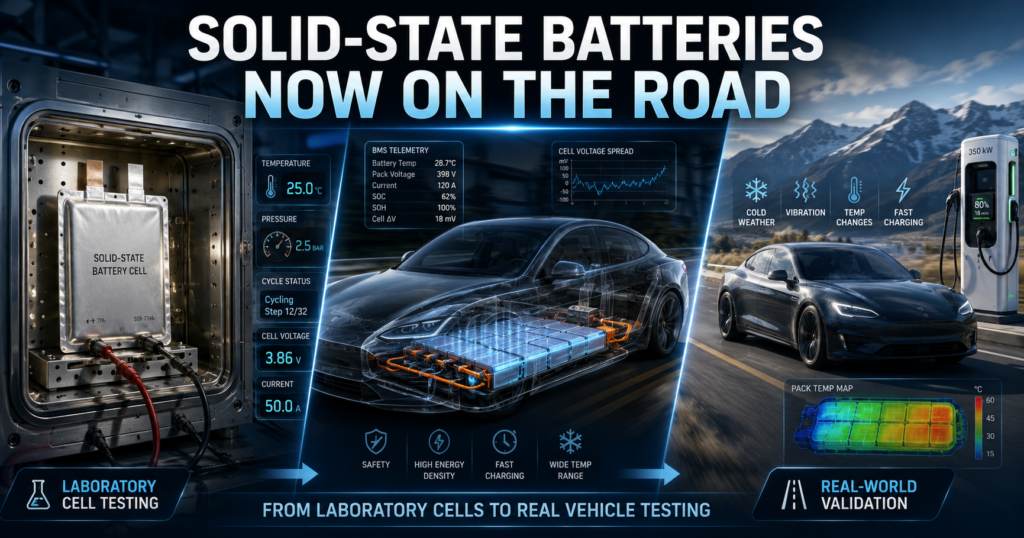
Solid-state battery road testing has officially begun, marking an important shift from controlled laboratory experiments to full vehicle validation. On June 11, 2026, Stellantis and Factorial announced that Factorial’s FEST solid-state cells had been installed in a Dodge Charger Daytona development vehicle and that road testing was underway. The companies previously reported that their 77Ah cells achieved 375 Wh/kg, charged from 15% to more than 90% in 18 minutes at room temperature, operated between -30°C and 45°C, and completed more than 600 cycles while progressing toward automotive qualification.
Those are promising results, but they do not mean a production-ready solid-state EV is about to arrive at dealerships. Cell-level performance is only the beginning. Engineers must now prove that the cells can survive vibration, changing temperatures, fast charging, repeated acceleration, mechanical pressure changes, crashes, manufacturing variation, and years of real-world use inside a complete battery pack. Road testing is therefore not the finish line. It is the point where solid-state battery development becomes much more difficult—and much more relevant.
Solid-State Batteries Have Finally Left the Lab
For years, solid-state battery announcements followed a familiar pattern. A company would reveal a small laboratory cell with impressive energy density, rapid charging, or promising cycle life. The results often attracted attention, but the cells remained far removed from something that could power a production vehicle.
That gap is now starting to narrow. According to the official Stellantis announcement, Stellantis and Factorial have integrated FEST solid-state cells into a Dodge Charger Daytona development vehicle based on the STLA Large platform. The companies describe it as the first automotive integration of this technology in North America.
The test vehicle uses a new mechanical battery-pack architecture developed to accommodate the solid-state cells. Stellantis also modified the pack design and vehicle control systems before beginning a road-testing and calibration program.
That detail matters more than the headline performance numbers. Putting a solid-state cell into a vehicle is not simply a matter of replacing a conventional lithium-ion cell with a new one of the same size. Cell dimensions, voltage behavior, heat generation, expansion, compression requirements, charging limits, and failure characteristics can all be different. Those differences affect nearly every part of the battery system. The road test therefore represents a transition from chemistry development to vehicle development.
Mercedes-Benz has also demonstrated how quickly this transition is progressing. In 2025, a lightly modified EQS equipped with a lithium-metal solid-state battery completed a 1,205-kilometer—or roughly 749-mile—drive from Stuttgart, Germany, to Malmö, Sweden, without recharging. Mercedes reported that the vehicle still showed 137 kilometers of remaining range at the end of the trip. The Mercedes-Benz technical overview describes the drive as a demonstration of the technology rather than the launch of a production battery.
These programs show that solid-state batteries are no longer limited to coin cells or small laboratory prototypes. They are becoming large enough, powerful enough, and stable enough to operate in real vehicles. But a successful demonstration drive does not answer the most difficult questions.
Why Solid-State Battery Road Testing Is Different from Lab Testing
A laboratory battery test is designed to control variables. Engineers can hold the cell at a selected temperature, apply a precise current profile, maintain a specific mechanical pressure, and stop the test when measurements move outside predetermined limits.
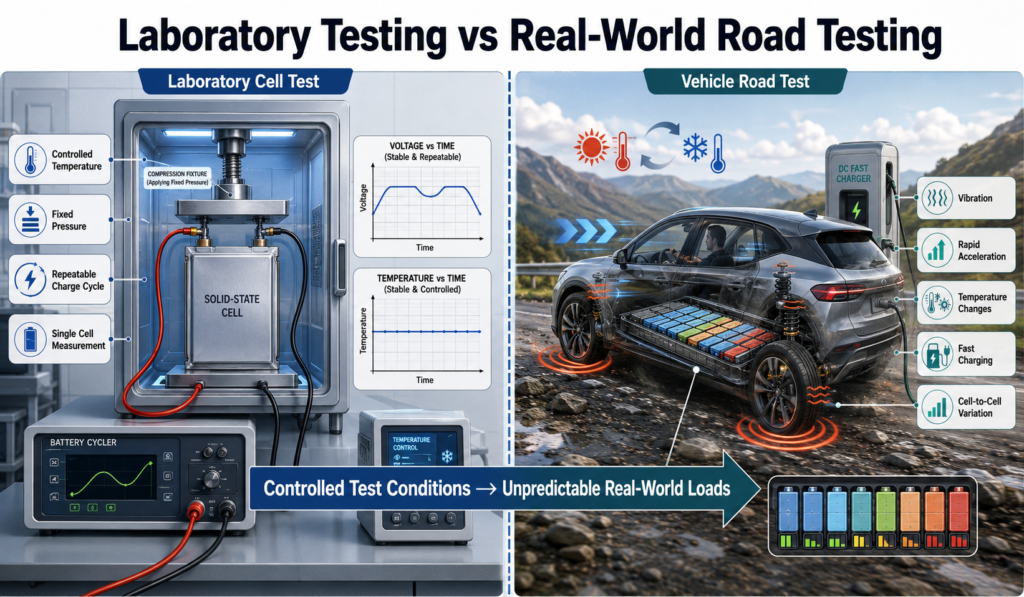
A vehicle does almost the opposite. During a single drive, a battery may experience highway cruising, hard acceleration, regenerative braking, a fast-charging session, rough pavement, changing ambient temperature, and long periods of rest. Different parts of the pack may warm and cool at different rates. Some cells may carry slightly more current than others because of manufacturing tolerances, electrical resistance, or thermal gradients.
Even the published 18-minute charging result needs context. Stellantis and Factorial reported that the validated 77Ah FEST cells charged from 15% to more than 90% in 18 minutes at room temperature. That is a cell-level result under controlled conditions. It is not yet a confirmed charging time for the Dodge development vehicle.
A complete EV charging session also depends on pack voltage, charging-station capability, cable current limits, cooling-system capacity, cell temperature, state of charge, and the safety margins programmed into the Battery Management System. The difference is similar to testing an aircraft engine on a test stand and then installing it in an airplane. The test stand can prove that the engine works. Flight testing must prove that the engine works as part of a much larger system.
For a solid-state battery, road testing helps engineers answer questions that are difficult to reproduce perfectly in the laboratory: How does the pack respond to thousands of small road impacts? Does performance change after repeated cold starts? Does mechanical pressure remain uniform after the cells have been charged and discharged hundreds of times? Can the cooling system prevent localized hot spots during fast charging? Does the BMS accurately estimate state of charge during aggressive driving?
A battery can perform well in a controlled cycle-life test and still encounter unexpected problems when placed in a moving vehicle.
Why Solid-State Cells Are Difficult to Put Into a Real Pack
The main appeal of solid-state batteries is straightforward. Replacing a flammable liquid electrolyte with a solid electrolyte may improve safety and enable lithium-metal anodes with much higher energy density than conventional graphite anodes.
The physical behavior of the cell, however, creates new complications. Liquid electrolyte naturally flows into small gaps and maintains ionic contact between active materials. Solid materials cannot repair gaps in the same way. If layers separate, crack, or lose contact, local resistance may increase. Current can then become concentrated in smaller areas, producing uneven aging and additional heat.
A battery pack must hold hundreds of cells in a mechanically stable arrangement while allowing for manufacturing tolerances, thermal expansion, cell expansion, crash loads, and long-term material changes. The structure cannot be so loose that cells lose contact or move during vibration. It also cannot be so rigid that expansion creates damaging stress.
Stellantis has not publicly disclosed the full design of its development pack. The company does state that the pack uses a patented mechanical architecture designed specifically to accommodate the solid-state cells.
That suggests the mechanical system is not a minor packaging detail. It is part of the battery technology itself. Traditional EV battery packs already require careful structural design. Pouch and prismatic lithium-ion cells can swell as they age, while cylindrical cells must be supported against vibration and efficiently connected to cooling structures. Solid-state lithium-metal cells can add stricter requirements for maintaining contact between internal layers.
A cell may look electrochemically promising on a laboratory fixture while being impractical for a vehicle if it requires excessive external pressure, heavy compression plates, or complicated hardware. Any added structure reduces the pack-level energy-density advantage that made the cell attractive in the first place. This is why cell energy density and pack energy density should never be treated as the same number.
The reported 375 Wh/kg figure applies to the FEST cell. Once engineers add cell enclosures, compression hardware, busbars, cooling components, sensors, impact protection, fire barriers, contactors, wiring, and the pack housing, the energy density of the complete system will be lower.
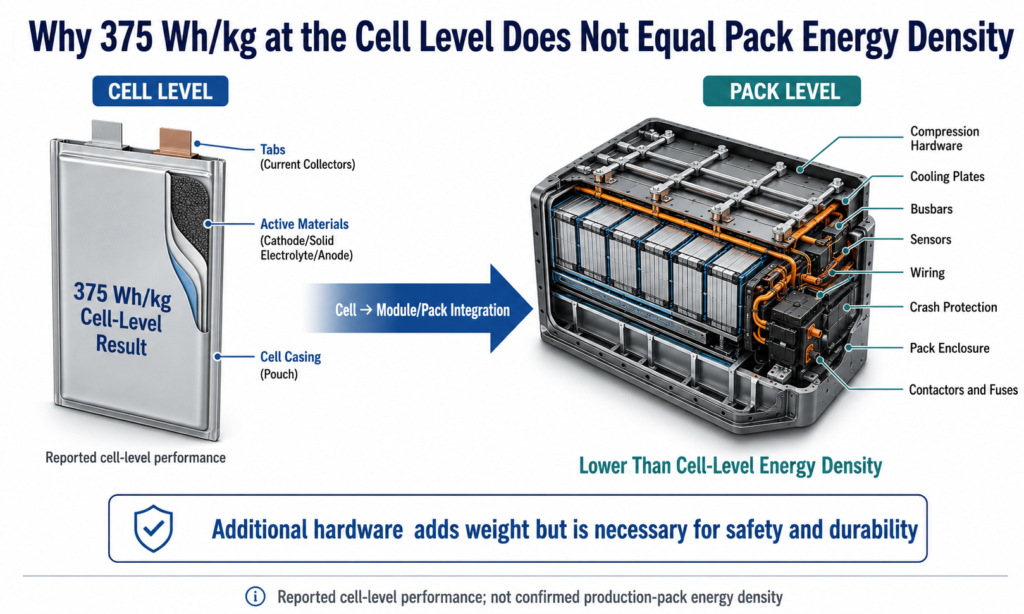
The important question is not whether a solid-state cell can outperform a conventional cell by itself. It is whether the completed battery pack still delivers a meaningful weight, range, cost, or safety advantage after all required hardware has been included.
Pressure Management May Be One of the Deciding Factors
Mechanical pressure is one of the least visible but most important parts of solid-state battery operation. As lithium moves during charging and discharging, battery electrodes change in volume. Lithium-metal interfaces can be especially sensitive to uneven contact. If pressure becomes too low, microscopic gaps may form between layers. If pressure becomes too high, the cell may experience mechanical damage, separator deformation, or accelerated failure.
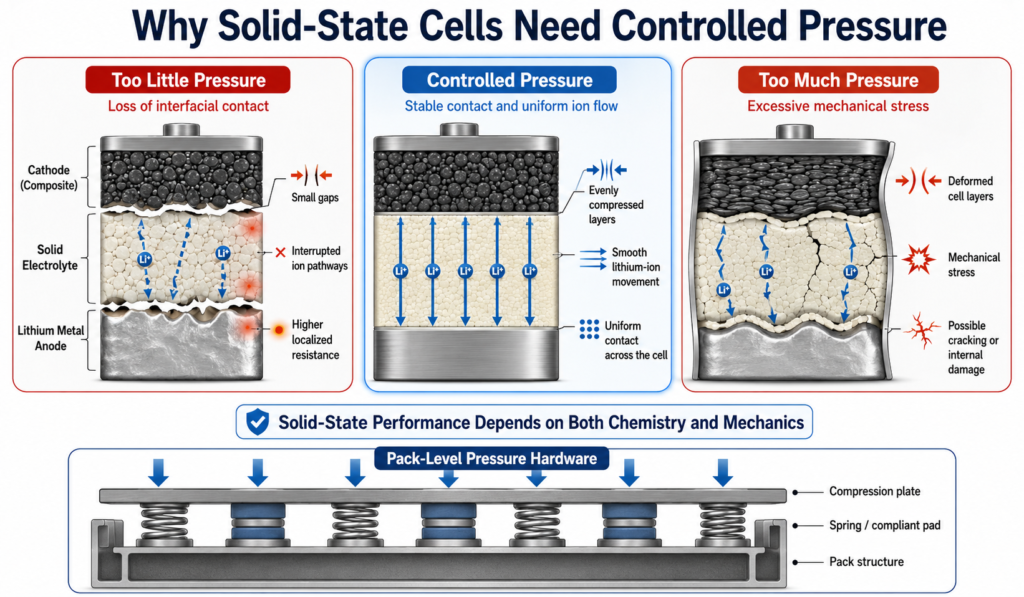
The ideal pressure is not necessarily constant throughout the battery’s life. A new cell may behave differently from a cell that has completed hundreds of cycles. Temperature also changes material dimensions and stiffness. Fast charging can create temporary expansion that differs from slower charging. Manufacturing variation means two cells from the same production line may not respond in exactly the same way.
A practical vehicle pack may need compression plates, compliant pads, springs, or other structures that maintain pressure within an acceptable range. Engineers must then determine how that pressure is distributed across the pack during cornering, vibration, temperature changes, and collisions.
This creates an engineering tradeoff. A stronger compression structure may improve cell contact but add mass. A lighter structure may preserve energy density but provide less control over cell movement. A highly rigid system may maintain pressure when new but become less effective as cells age or dimensions change.
Pressure monitoring could eventually become another source of battery-health information. Sensors might detect abnormal swelling or loss of contact before the change becomes visible in voltage data. Production vehicles, however, cannot rely on a large number of expensive laboratory-grade pressure sensors. Automakers will need a practical combination of mechanical design, limited sensing, cell modeling, and diagnostic software.
We covered the broader role of compression hardware and swelling control in EV Battery Pressure Management: Why Compression and Swelling Matter. Solid-state packs could make this mechanical problem even more closely connected to electrochemical performance.
Solid-State Batteries Still Need Thermal Management
Solid-state batteries are often described as batteries that do not overheat or catch fire. That description is too simple. Removing or reducing flammable liquid electrolyte may lower some risks, but a solid-state cell still produces heat because of internal resistance, electrochemical reactions, high current, and nonuniform current distribution. Lithium metal can also react aggressively under certain failure conditions.
Thermal management remains essential for three reasons. First, temperature affects power and charging performance. Ion transport through solid materials can slow at low temperatures, depending on the electrolyte chemistry. A cell that charges quickly at room temperature may require a more conservative current limit after sitting outside during a Michigan winter. Factorial and Stellantis reported cell operation from -30°C to 45°C, which is encouraging. Road testing must now show how much usable power and charging capability remain available near those limits—not merely whether the cell continues to function.
Second, temperature uniformity can be as important as average temperature. A pack with an average temperature of 25°C may still contain cells at 20°C and others at 30°C. Those cells can age at different rates and accept different amounts of charging current. Over time, the imbalance may reduce the usable capacity of the entire pack.
Third, cooling hardware must work together with the pressure-management structure. A cooling plate needs good thermal contact with the cells, while compression components need to maintain mechanical contact. Adding a thick compliant pad may help distribute pressure but increase thermal resistance. Increasing clamping force may improve heat transfer but create more mechanical stress.
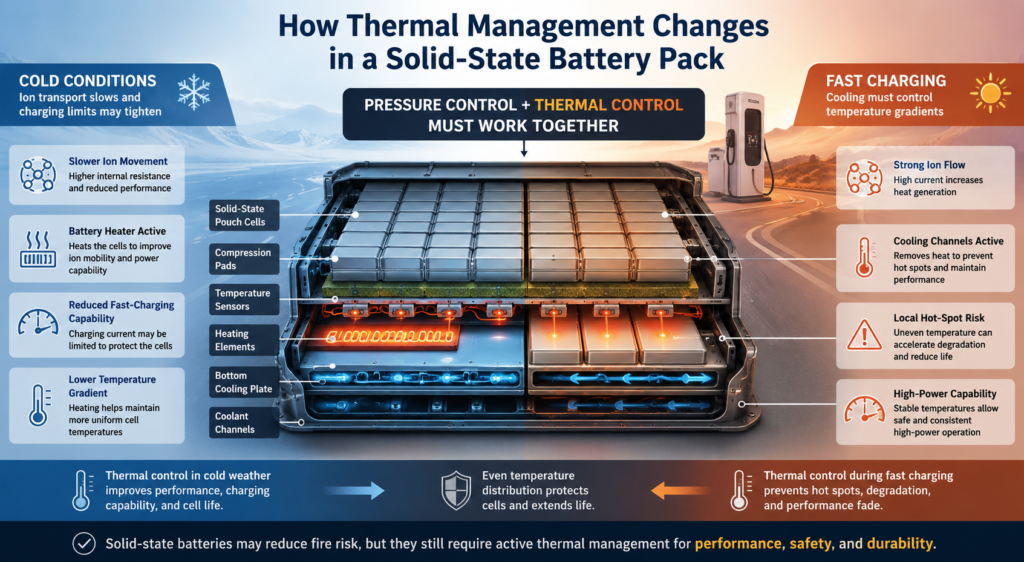
Solid-state packs may therefore use different cooling-channel layouts, interface materials, heating strategies, and temperature targets than conventional lithium-ion packs. The thermal system may become smaller if the cells tolerate higher temperatures or produce less heat in some conditions. It may also become more sophisticated if narrow temperature and pressure windows are required for fast charging. The phrase “solid-state” does not eliminate thermal management. It changes the problem engineers are trying to solve.
The BMS Must Learn a New Battery
Installing a new chemistry into a vehicle also means developing new Battery Management System software. A BMS does not directly measure how much energy remains inside a cell. It estimates state of charge by combining current measurements, voltage, temperature, historical behavior, and a mathematical model of the battery. State of health, power capability, and fast-charging limits also depend on models and calibration data.
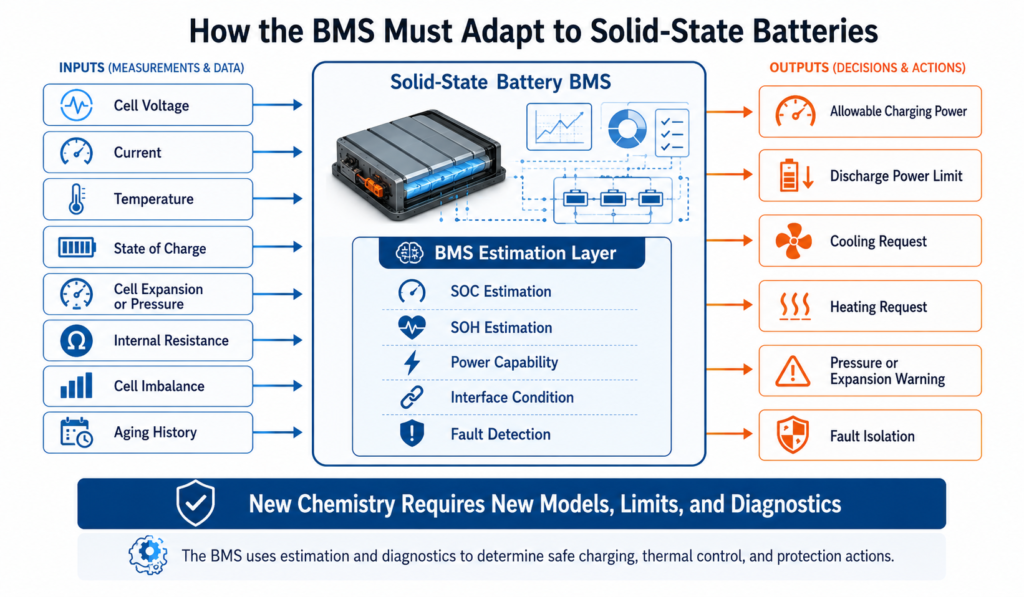
Those models are chemistry-specific. A solid-state lithium-metal cell may have a different open-circuit-voltage curve, internal resistance, relaxation behavior, temperature sensitivity, and degradation pattern than an NMC-graphite or LFP-graphite cell. Algorithms calibrated for a conventional lithium-ion battery cannot simply be copied into the new vehicle.
During road testing, engineers can compare BMS predictions with measured pack behavior. They will look for estimation errors after fast charging, cold soaking, aggressive driving, and long rest periods. They will also study how cell-to-cell differences develop over time.
Charging control is another major calibration task. The BMS must decide how much charging power the battery can safely accept at every moment. That decision may depend on state of charge, cell temperature, pressure, voltage spread, estimated lithium-interface condition, aging, and cooling capacity. An 18-minute laboratory charge does not mean the production BMS will permit the same current in every environment.
Early test vehicles are likely to use conservative limits. Engineers can gradually expand the operating window after collecting enough evidence that the cells remain stable. This process may make prototype charging performance appear less dramatic than the cell’s theoretical capability, but it is necessary for durability and safety.
Fault detection must also change. Conventional BMS diagnostics look for overvoltage, undervoltage, excessive temperature, isolation faults, abnormal resistance, and rapid self-discharge. Solid-state systems may need additional indicators for loss of interfacial contact, uneven pressure, internal cracking, or lithium-metal instability.
Our detailed guide to how modern EV battery management systems work explains why battery software is much more than a simple voltage monitor. Solid-state vehicles will likely require even closer coordination between electrochemical estimation, thermal control, charging control, and mechanical diagnostics.
Crash Safety Must Be Proven at the Vehicle Level
Solid-state batteries have a credible path toward improved safety, particularly if they reduce the amount of volatile liquid electrolyte in the pack. But safety claims still have to be validated in a complete vehicle. A crash can crush cells, tear electrical connections, puncture the pack, damage cooling lines, or expose high-voltage components. Even if the electrolyte itself is less flammable, the battery still stores a large amount of electrical and chemical energy.
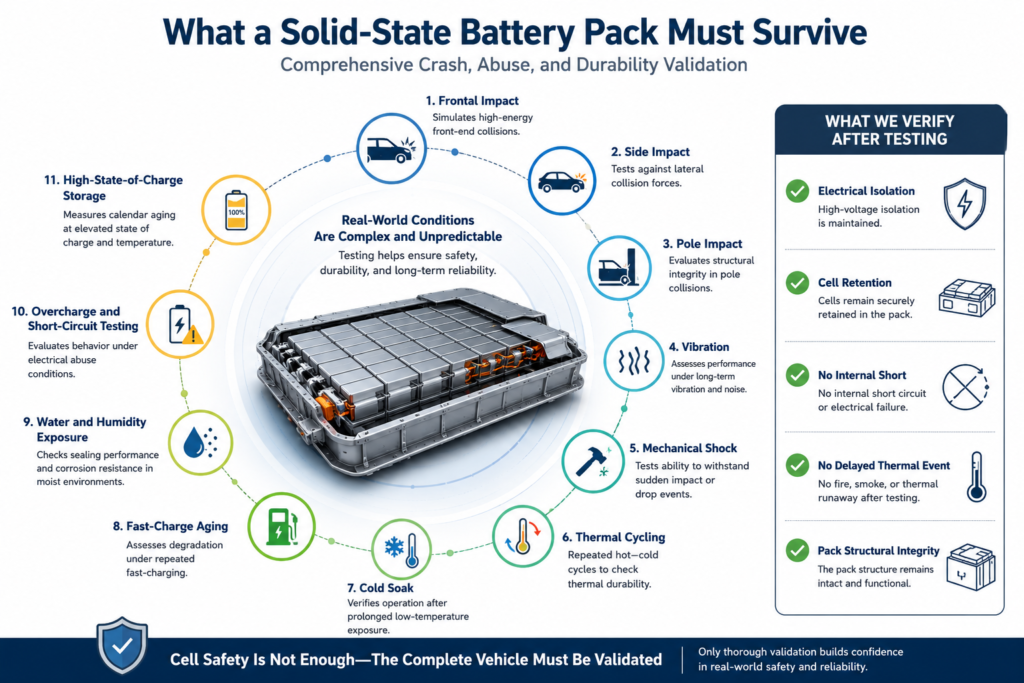
In the United States, EVs must meet federal requirements related to high-voltage protection, battery retention, and post-crash electrical safety. NHTSA’s FMVSS No. 305 laboratory test procedure describes requirements involving electrolyte spillage, propulsion-battery retention, and electrical isolation after crash testing.
Internationally, UN Regulation No. 100 includes safety requirements for rechargeable electrical energy storage systems. The broader validation process can include vibration, mechanical shock, thermal shock, fire resistance, overcharge, over-discharge, and other abuse conditions.
Solid-state packs will not automatically receive different treatment simply because the electrolyte is solid. Automakers still need to demonstrate that the battery remains electrically isolated, structurally retained, and acceptably safe during and after severe impacts.
Engineers must also examine delayed failure. A damaged cell may not immediately show smoke, voltage collapse, or a temperature spike. Internal cracks can develop into a problem after the crash, particularly if the vehicle is moved, charged, or stored. Road and durability testing can help establish diagnostic thresholds and post-crash inspection procedures before vehicles reach customers.
For more background on high-voltage disconnection, pack protection, and delayed battery damage, see our guide to what happens to an EV battery after a crash.
Durability Testing Is About More Than Cycle Life
The reported FEST cells completed more than 600 cycles while progressing toward automotive qualification. That result is meaningful, especially for a large-format 77Ah lithium-metal cell. It still does not provide a complete prediction of vehicle life.
A cycle count depends heavily on how the test is performed. Six hundred full cycles from a low to high state of charge create a different aging pattern than thousands of shallow cycles. Fast charging, cold charging, high-temperature storage, high state of charge, and repeated high-power acceleration can produce very different degradation mechanisms.
A vehicle battery also spends much of its life parked. Calendar aging continues when the car is not being driven, particularly at high temperature or high state of charge. Engineers therefore need a combination of cycling tests, storage tests, thermal tests, vibration tests, and real-world fleet data.
The U.S. Department of Energy explains that standardized battery test procedures are used to compare cycle life, performance, and abuse tolerance under repeatable conditions. Its Advanced Battery Development, System Analysis, and Testing program also highlights the role of cell, module, and pack testing in evaluating automotive batteries.
Road-test vehicles add the messy conditions that standardized laboratory procedures cannot fully capture. Engineers may deliberately operate vehicles in hot, cold, humid, high-altitude, urban, and highway environments. Some vehicles may undergo repeated fast charging, while others may be used for towing or aggressive performance testing. The purpose is not simply to accumulate miles. It is to identify failure modes before customers do.
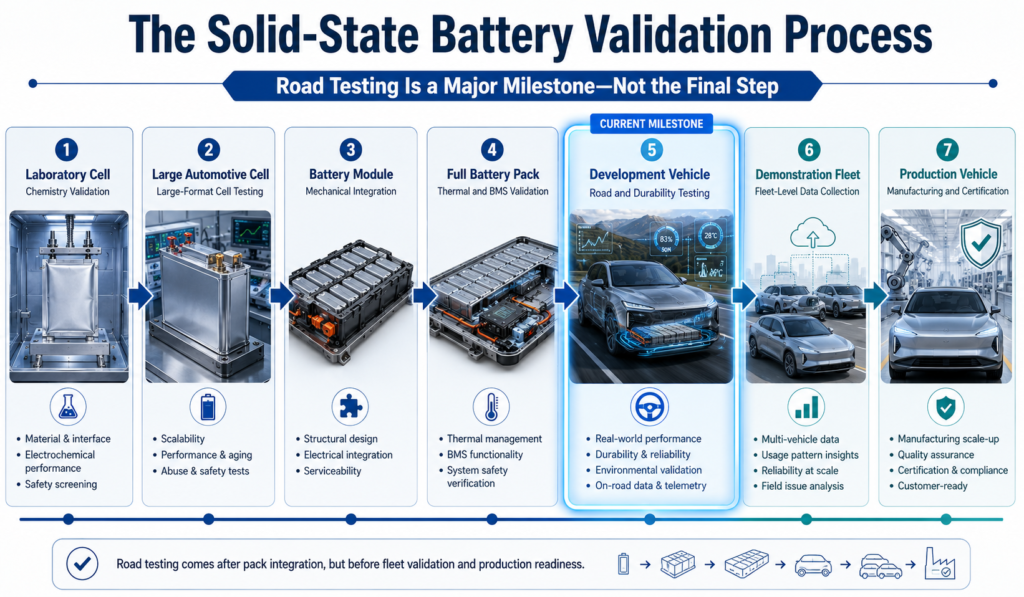
What Must Happen After Solid-State Battery Road Testing?
A successful road test would be a major accomplishment, but several stages would still remain before mass production. The first is design refinement. Data from the development vehicles may lead to changes in cell chemistry, pack compression, cooling, electrical connections, sensors, or control software. Even a small change can trigger another round of testing because battery components interact so closely.
The second is fleet expansion. One development vehicle can prove that integration is possible. A larger demonstration fleet is needed to reveal manufacturing variation and expose the battery to a wider range of drivers and environments.
The third is automotive qualification. Cells and packs must pass performance, durability, vibration, environmental, electrical, and abuse tests. The exact program depends on the automaker, market, vehicle, and battery design.
The fourth is manufacturing validation. A company must demonstrate that it can repeatedly build cells with consistent thickness, electrolyte quality, interfacial contact, capacity, resistance, and safety characteristics. Producing a few excellent cells is very different from producing thousands per day with high yield.
The fifth is supply-chain and cost validation. Lithium metal, solid-electrolyte materials, specialized separators, dry-room requirements, and quality-control equipment must be available at automotive scale. The pack must also provide enough customer value to justify its cost.
Finally, the battery system must be integrated into a production-intent vehicle and certified for sale. That includes crash testing, charging interoperability, service procedures, warranty planning, recycling strategy, factory tooling, technician training, and emergency-response guidance.
Any one of these stages can delay a launch. This does not make the current road tests unimportant. It means the road tests are the start of the final and most demanding part of development.
Are Solid-State Batteries Finally Ready?
They are ready for serious vehicle development. That is different from being ready for mass-market production. The Stellantis-Factorial program shows that automotive-scale solid-state cells can be integrated into an existing vehicle platform. The Mercedes-Benz EQS demonstration shows that lithium-metal solid-state technology can deliver remarkable driving range in a carefully prepared test vehicle. Those are significant advances compared with the small prototype cells that dominated solid-state battery news several years ago.
Still, several questions remain unanswered publicly. We do not yet know the full pack-level energy density, the amount of compression hardware required, cold-weather fast-charging performance, long-term degradation under mixed driving, production yield, or the cost of a high-volume pack.
We also do not know when ordinary customers will be able to buy a vehicle using these specific cells. The most realistic conclusion is that solid-state batteries have entered a new phase. The debate is no longer only about whether the chemistry can work. It is increasingly about whether complete vehicles can deliver the promised advantages reliably, safely, and affordably. That shift is worth paying attention to.
Conclusion
Solid-state batteries are beginning to cross one of the largest gaps in battery development: the gap between a successful cell and a functional vehicle. Stellantis and Factorial have moved FEST cells into a Dodge Charger Daytona development vehicle and begun road testing. Their previously announced cell results—375 Wh/kg, an 18-minute charge from 15% to more than 90%, operation from -30°C to 45°C, and more than 600 cycles—provide a strong technical foundation.
The next steps may be harder. Engineers must prove that pressure remains controlled, thermal gradients remain manageable, BMS estimates stay accurate, charging limits protect the cells, and the pack survives vibration, crashes, weather, aging, and manufacturing variation. They must then reproduce that performance at high volume and at a cost customers can afford.
Solid-state batteries are closer to production than they were a few years ago, but road testing should not be confused with commercial readiness. It is better understood as the moment when the technology finally begins its most important test: life outside the laboratory.
FAQs
Are solid-state batteries being tested in real cars?
Yes. Stellantis and Factorial announced on June 11, 2026, that FEST solid-state cells had been integrated into a Dodge Charger Daytona development vehicle and that road testing had begun. Mercedes-Benz also completed a 1,205-kilometer demonstration drive in 2025 with a solid-state-battery EQS test vehicle.
Does the Factorial battery really charge in 18 minutes?
Factorial and Stellantis reported that a validated 77Ah cell charged from 15% to more than 90% in 18 minutes at room temperature. This was a controlled cell-level result, not a confirmed charging time for a production vehicle or the complete Dodge development pack.
What does 375 Wh/kg mean?
It means the validated cell could store 375 watt-hours of energy per kilogram of cell mass. Pack-level energy density will be lower after adding cooling, compression hardware, wiring, sensors, crash protection, and the battery enclosure.
Why do solid-state batteries need pressure?
Solid battery layers need close physical contact for ions to move efficiently. Charging, discharging, temperature changes, and aging can alter cell dimensions. Pack hardware may therefore need to maintain controlled pressure without damaging the cells.
Do solid-state batteries need cooling?
Yes. They may reduce some thermal and fire risks, but they still generate heat and remain sensitive to temperature. Cooling and heating are required for consistent power, fast charging, durability, and cell-to-cell uniformity.
When will solid-state EVs be available?
Development vehicles are now being tested, but broad availability will depend on qualification, manufacturing yield, durability, safety validation, and cost. Limited production could arrive before mass-market adoption, which is likely to be gradual rather than immediate.