
Quick Answer
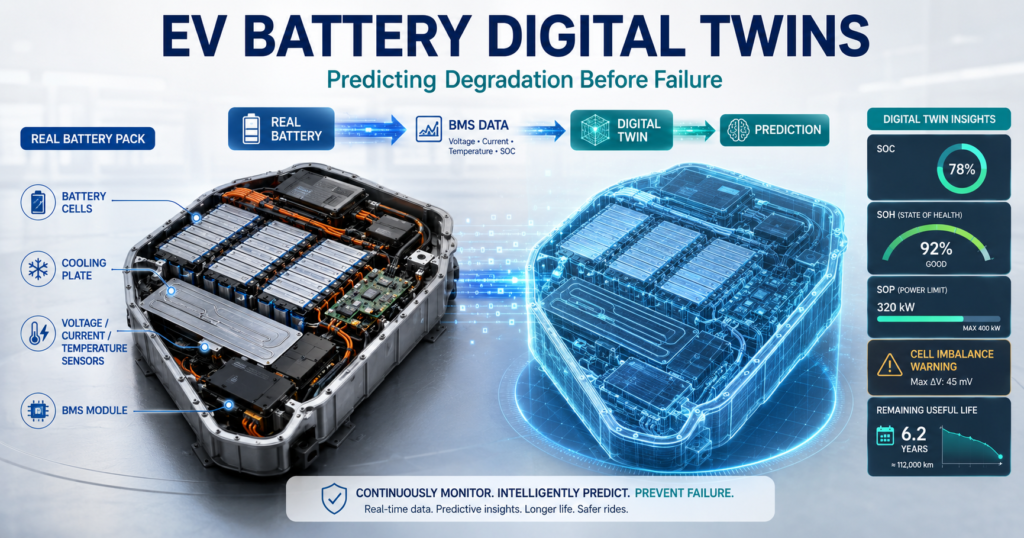
An EV battery digital twin is a software-based virtual copy of a real EV battery pack that uses vehicle data to predict battery degradation, failure risk, and remaining useful life.
A traditional Battery Management System, or BMS, mostly focuses on keeping the battery safe right now. A digital twin goes further. It can help estimate battery State of Charge, State of Health, State of Power, remaining useful life, abnormal cell behavior, and possible failure risk before the driver notices a problem.
Digital twins will not magically predict every battery failure. Battery packs are complex, sensor data is imperfect, and rare failures are hard to forecast. But when physics-based models, real-world fleet data, onboard estimation, and cloud analytics are combined carefully, digital twins can make EV batteries safer, easier to diagnose, and more predictable over their lifetime.
Introduction: The Next Step After the BMS
EV battery digital twin technology is becoming one of the most important software tools for predicting battery degradation, failure risk, and remaining useful life before a problem becomes obvious to the driver. Most EV owners know that their car has some kind of battery management system. They may not know exactly how it works, but they understand the basic idea: the car watches the battery, limits charging when needed, controls temperature, and protects the pack from unsafe operation.
That is already impressive. A modern EV battery pack is not just a large box of cells. It is a tightly controlled electrochemical system with hundreds or thousands of cells, cooling plates, sensors, contactors, fuses, software, and safety logic. The BMS has to estimate battery condition every second while the driver accelerates, charges, parks in the sun, fast charges in winter, or leaves the vehicle sitting for weeks.
But the EV industry is moving beyond “monitor and protect.” The next step is “predict and prevent.” That is where battery digital twins come in. A battery digital twin is a living software model of a real battery. It is not just a static simulation from the design stage. It is continuously updated with real vehicle data, so the virtual battery learns how the actual battery is aging, how it responds to fast charging, how it behaves in cold weather, and whether one cell group is starting to drift away from the rest of the pack.
This is why digital twins are becoming important for automakers, fleet operators, battery suppliers, service centers, used EV buyers, and eventually everyday EV owners. A digital twin may help answer questions that a simple dashboard cannot answer well:
- Is this battery aging normally?
- Is one module becoming weaker than the rest?
- How much power can the pack safely deliver today?
- How much life is left before the pack falls below a useful threshold?
- Is the battery showing early signs of an internal fault?
- Could a thermal issue be developing before it becomes dangerous?
These are difficult questions. They cannot be answered by a single voltage reading or one battery health percentage. They require data, models, uncertainty estimates, and a careful understanding of how lithium-ion batteries actually degrade.
For a good foundation, this article builds naturally on our earlier guide, EV Battery Management System Explained. The BMS is the real-time control layer. The digital twin is the predictive intelligence layer that can sit above it, beside it, or partly inside it.
What Is an EV Battery Digital Twin?
A battery digital twin is a virtual representation of a physical battery system that stays connected to real-world data. In simple terms, imagine that every EV battery has a software “shadow.” The real battery is under the floor of the vehicle. The digital version lives in the vehicle computer, in the cloud, or in both places. As the real battery charges, discharges, heats up, cools down, and ages, the digital version updates its own internal state.
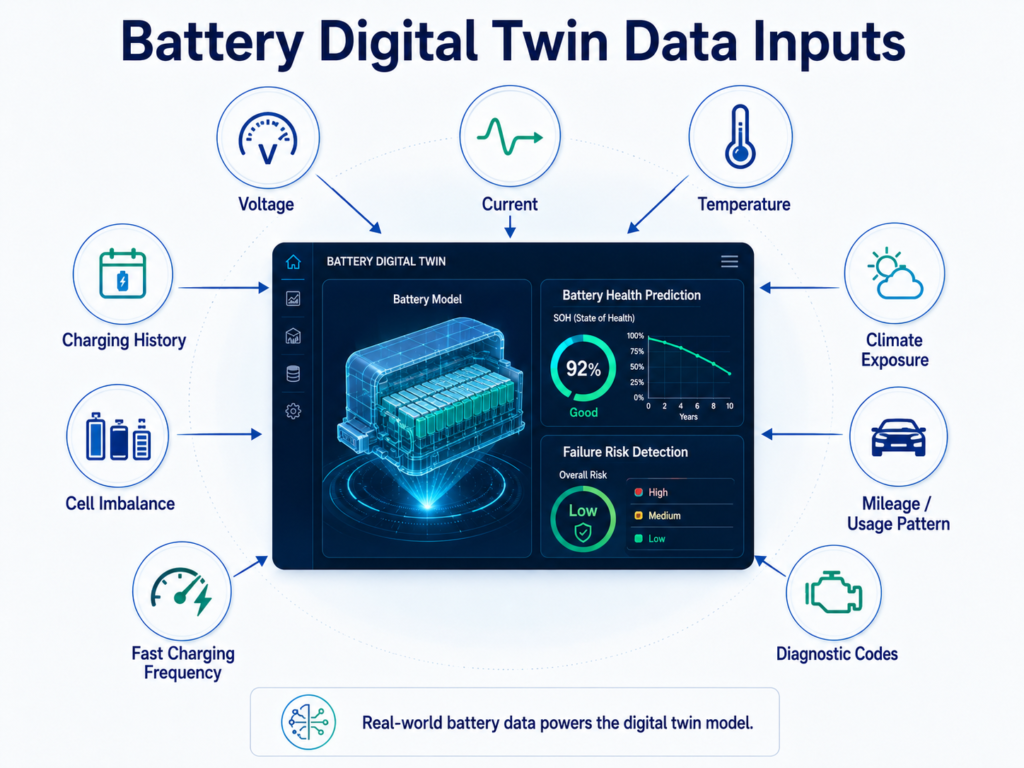
The goal is not to create a perfect copy of every atom inside the battery. That would be impossible in a production vehicle. Instead, the goal is to build a useful model that captures the most important behavior of the pack. A digital twin may track:
- pack voltage and current
- cell group voltages
- module temperatures
- coolant temperature
- charging rate
- discharge power
- cell imbalance
- estimated internal resistance
- estimated usable capacity
- driving and charging patterns
- temperature exposure over time
- fast charging history
- rest periods and storage behavior
- diagnostic trouble codes
- unusual voltage or thermal behavior.
The National Renewable Energy Laboratory describes a digital twin for EV batteries as a digital representation of the battery and its components in its EV battery life cycle management report: NREL EV Lithium-Ion Battery Life Cycle Management. That definition sounds simple, but it has major implications. Once a battery has a digital representation, software can compare the expected behavior of the battery with the actual behavior of the battery. If the battery behaves differently from the model, that difference can become useful diagnostic information.
For example, if the model expects one cell group to recover voltage normally after a high-power acceleration event, but the real cell group shows slower recovery, higher resistance, or abnormal temperature rise, the system may flag that area for closer monitoring.
This is different from waiting for a warning light. A warning light usually means something has already crossed a diagnostic threshold. A digital twin tries to notice the trend before the threshold is crossed.
How the Real Battery and Virtual Battery Stay Connected
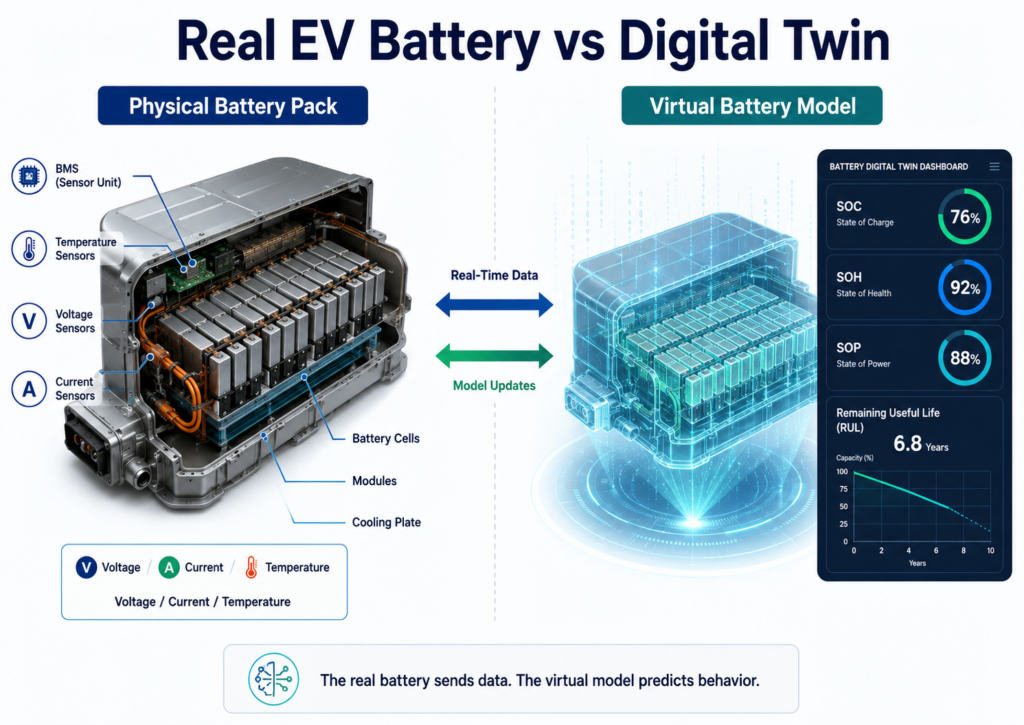
A digital twin needs a continuous connection between the physical battery and the virtual model. In an EV, that connection begins with the sensors and electronics already used by the BMS. The BMS measures pack current, pack voltage, individual cell group voltages, and temperatures at different points in the battery. It also knows when the vehicle is charging, how much power is flowing, how long the battery has rested, and whether the pack is heating or cooling.
Those measurements are the “real world” side of the digital twin. The virtual side is the model. The model takes the same inputs and predicts how the battery should behave. When the real battery and the virtual model agree closely, the system has confidence that the battery is behaving normally. When they begin to disagree in a meaningful way, the system can investigate why.
This comparison is powerful because batteries often give subtle warning signs before obvious failure. A weak cell group may show slightly faster voltage drop under load. A cooling problem may show up as a temperature pattern that does not match the expected heat generation. A cell with rising internal resistance may heat more than neighboring cells during fast charging. A sensor fault may appear as an impossible temperature jump or voltage reading that does not match the pack’s electrical behavior.
The digital twin does not need to “see” inside the cell directly. It uses external measurements to infer internal condition. That is similar to how a doctor uses heart rate, blood pressure, blood tests, and imaging to understand what is happening inside the body. The data does not show everything, but the right model can make the data far more meaningful.
The Data That Matters: Voltage, Current, and Temperature
At the center of battery digital twin technology are three basic measurements: voltage, current, and temperature. They sound simple, but they contain a lot of information. Voltage tells the system how the battery responds electrically. In an EV pack, the BMS usually measures the voltage of cell groups rather than every individual cell. When one group behaves differently from the others, it may indicate imbalance, capacity loss, higher resistance, wiring issues, sensor error, or early fault behavior.
Current tells the system how hard the battery is working. High current during acceleration, regenerative braking, towing, fast charging, or cold-weather operation creates more stress than gentle driving. The same voltage response means different things depending on the current level.
Temperature tells the system how much thermal stress the battery is experiencing. Heat accelerates many aging reactions. Cold temperatures can reduce power capability and increase lithium plating risk during charging. Temperature gradients inside the pack can also cause cells to age unevenly.
These signals become much more useful when viewed together. A voltage drop under high current may be normal during hard acceleration. The same voltage drop under mild load may suggest increased resistance. A temperature rise during fast charging may be expected. A temperature rise in one module while the rest of the pack stays cool may suggest a cooling contact problem, sensor issue, or local internal resistance increase. This is why digital twins matter. They do not look at one number in isolation. They look at patterns.
For readers who want a deeper explanation of why charging stress changes with SOC, temperature, and lithium movement inside the cell, our article Why EV Batteries Charge Slower Above 80% is a useful companion.
Electrochemical Models vs Equivalent Circuit Models
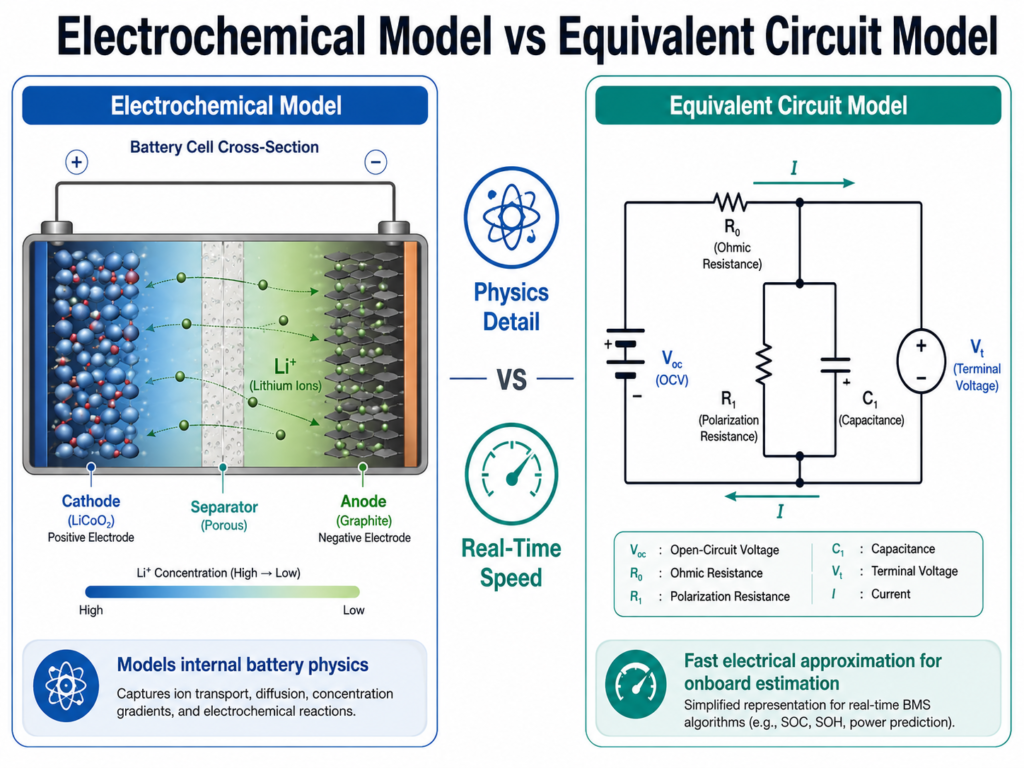
Not all battery digital twins use the same type of model. In practice, the two most common model families are electrochemical models and equivalent circuit models. An electrochemical model tries to represent the internal physics and chemistry of the cell. It may describe lithium-ion movement, electrode behavior, diffusion limits, concentration gradients, reaction rates, heat generation, and aging mechanisms.
This type of model is powerful because it connects the software to the real causes of battery behavior. It can help explain why a battery becomes power-limited in cold weather, why fast charging becomes harder at high SOC, or why lithium plating risk increases under certain conditions.
The downside is complexity. Full electrochemical models can be computationally expensive and difficult to calibrate. A vehicle does not have unlimited computing power, and it needs answers quickly. That is why simplified electrochemical models or reduced-order models are often used in practical systems.
An equivalent circuit model takes a different approach. Instead of modeling detailed chemistry, it represents the battery as a combination of electrical components such as voltage sources, resistors, and capacitors. These components mimic the battery’s voltage response under different loads.
Equivalent circuit models are popular because they are fast, practical, and suitable for onboard estimation. They can estimate SOC, internal resistance, power capability, and dynamic voltage response without requiring a full electrochemical simulation.
The downside is that equivalent circuit models are more abstract. They can tell you that resistance increased, but they may not directly tell you whether the cause is loss of lithium inventory, loss of active material, contact degradation, electrolyte changes, or another mechanism.
In real digital twin systems, the best approach is often not one or the other. It is a hybrid. The vehicle may use a fast equivalent circuit model onboard for real-time estimation, while the cloud may use more advanced physics-based or data-driven models to analyze longer-term trends. Machine learning may then help detect patterns across thousands or millions of vehicles.
A 2025 review in Batteries discusses how artificial intelligence and digital twin technologies are being used for state estimation, lifecycle optimization, and cloud-edge battery management: Artificial Intelligence and Digital Twin Technologies for Intelligent Lithium-Ion Battery Management Systems. The important point is this: a useful digital twin does not need to be the most complicated model possible. It needs to be accurate enough, fast enough, explainable enough, and reliable enough for the decision it supports.
Onboard Estimation vs Cloud Analytics
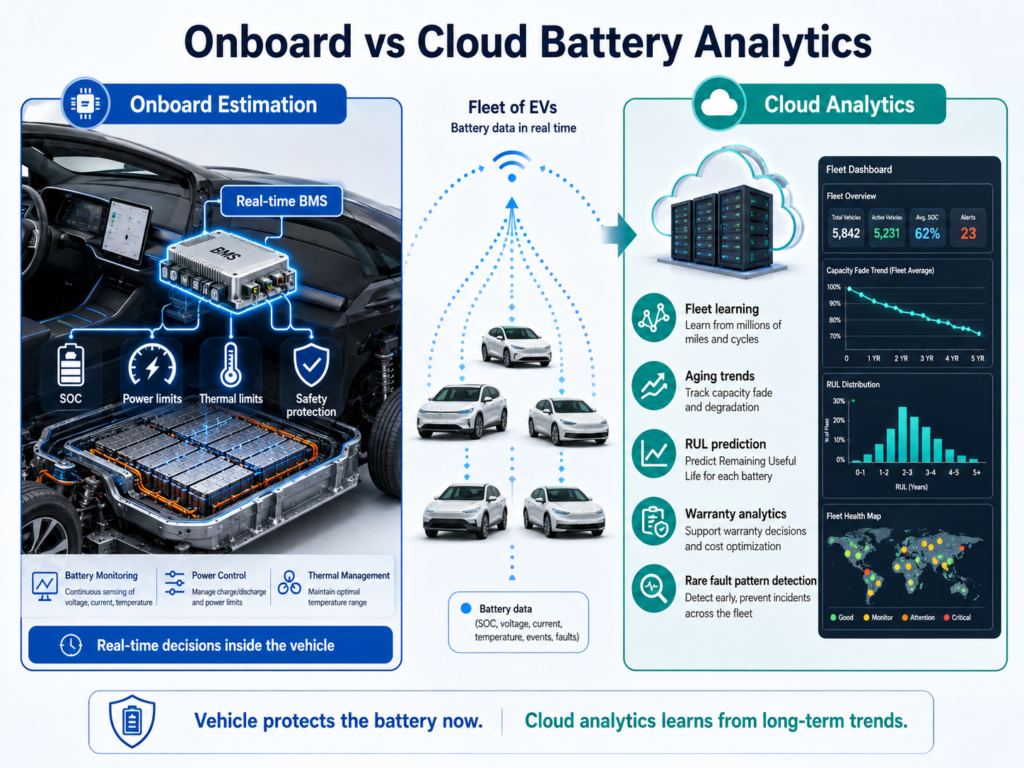
Battery digital twins can live in two places: onboard the vehicle and in the cloud. The onboard side is responsible for fast, safety-critical decisions. It cannot wait for a server response when the driver floors the accelerator or plugs into a DC fast charger. The vehicle needs to know immediately how much current is safe, how much power is available, and whether the battery is within its operating limits.
Onboard estimation is usually used for real-time values such as:
- SOC, or State of Charge
- available charge power
- available discharge power
- cell balancing needs
- thermal limits
- short-term fault detection
- immediate safety protection.
The cloud side is better for long-term learning. It can process large amounts of data from many vehicles, compare similar packs, look for aging trends, and update models over time. A cloud-based system can ask questions that one vehicle alone cannot answer easily. For example:
- Does this pack age faster than similar packs in the same climate?
- Are vehicles using a certain charging pattern showing more imbalance?
- Are vehicles using a certain charging pattern showing more imbalance?
- Are vehicles using a certain charging pattern showing more imbalance?
- Is one production batch showing a slightly different resistance trend?
- Do certain thermal conditions predict earlier capacity loss?
- Is a rare fault pattern appearing across a small number of vehicles?
This is where fleet learning becomes valuable. One car may not have enough data to confidently identify a subtle aging mechanism. A million cars may show the pattern clearly.
AVL describes a battery lifetime prediction toolchain that combines battery testing, aging simulation, vehicle fleet tracking, and analytics: AVL Battery Lifetime Prediction for Electric Vehicle Fleets. This does not mean every EV should send every piece of battery data to the cloud. Privacy and cybersecurity matter, and we will come back to that later. But technically, cloud analytics can make digital twins much more powerful because battery aging is slow, variable, and strongly affected by real-world use.
SOC, SOH, and SOP: The Three Battery States Digital Twins Care About
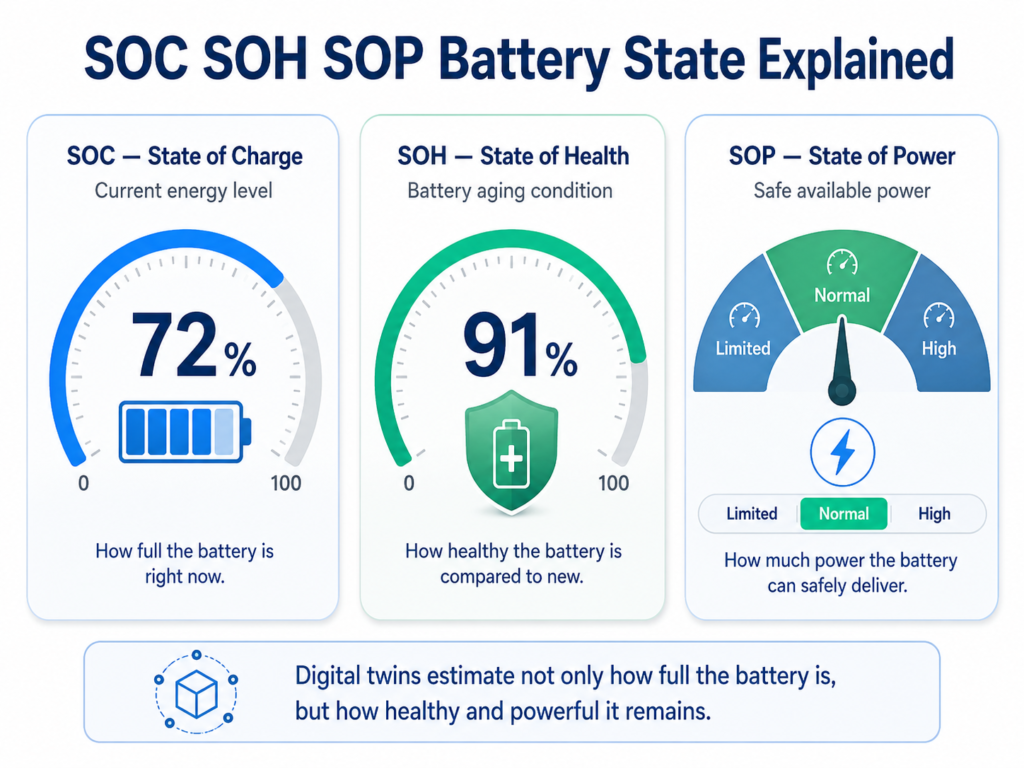
Digital twins are often discussed in terms of three battery states: SOC, SOH, and SOP. SOC means State of Charge. It is the battery’s current energy level, roughly similar to a fuel gauge. But SOC is not measured directly. The BMS estimates it using current integration, voltage behavior, temperature, rest periods, and models.
SOH means State of Health. It describes how much the battery has aged compared with when it was new. Most people think of SOH as remaining capacity, but that is only part of the story. A battery can have acceptable capacity but reduced power capability due to higher resistance. It can also have cell imbalance, uneven aging, or thermal issues that affect real-world performance.
SOP means State of Power. It estimates how much power the battery can safely deliver or accept at a given moment. SOP depends on SOC, temperature, resistance, voltage limits, current limits, thermal limits, and aging state.
A digital twin improves these estimates because it has more context. For example, two batteries may both show 90% SOH by capacity. But one battery may have low resistance, good balance, and stable temperature behavior. The other may have higher resistance, more cell imbalance, and a history of high-temperature fast charging. A simple SOH percentage may make them look similar. A digital twin can show that they are not the same. This matters for used EVs, warranties, fleet management, and repair decisions.
For more background on why battery health is not just one number, see our guide: EV Battery SOH Explained.
Detecting Cell Problems Before They Become Pack Problems
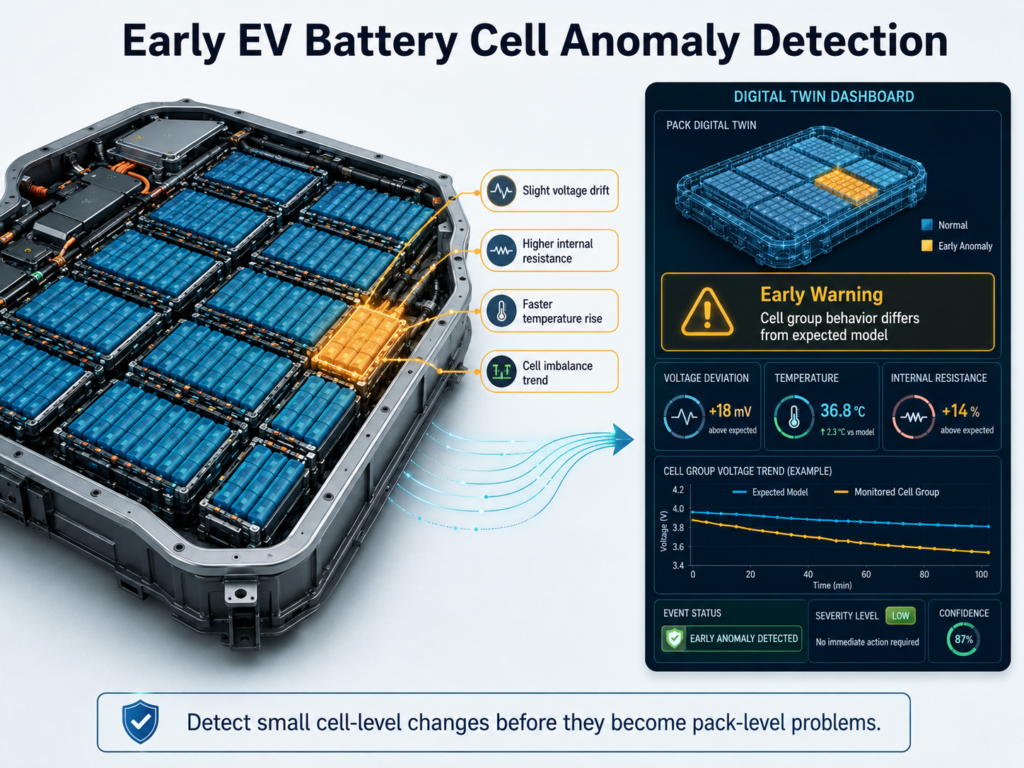
One of the most valuable uses of a battery digital twin is early anomaly detection. In a large EV battery pack, not every cell ages at exactly the same rate. Small differences come from manufacturing variation, local temperature differences, pressure differences, current distribution, cooling contact, and usage history.
Most variation is normal. A digital twin becomes useful when it can distinguish normal variation from unusual behavior. A weak cell group may begin to show:
- slightly faster voltage drop during acceleration
- slower recovery after load
- higher heat generation
- greater voltage deviation near low SOC
- more frequent balancing needs
- higher estimated resistance
- unusual behavior after fast charging.
These signs may be too small to trigger a traditional warning light. But if the digital twin knows how that specific pack normally behaves, and how similar packs behave across the fleet, it can identify when one area is drifting away from the expected pattern.
This is the difference between a snapshot and a movie. A single diagnostic test is a snapshot. It may say the battery looks okay today. A digital twin watches the trend over months and years. It can see whether the battery is stable, gradually aging, or changing in a way that deserves attention.
Exponent’s 2026 article on EV battery digital twins explains that combining real-time sensor measurements with electrochemical and thermal models, machine learning, and historical fleet data can help detect abnormal voltage drift, imbalance, and emerging faults earlier: Turn EV Battery Data Into Reliable Digital Twins.
This kind of early detection could be especially valuable for fleets. A delivery company, rideshare fleet, rental company, or commercial EV operator does not want unexpected downtime. If software can identify a pack that needs service before it fails, the vehicle can be scheduled for maintenance instead of being removed from service unexpectedly.
Can Digital Twins Warn About Thermal Runaway?
Thermal runaway is one of the most serious battery safety concerns. It happens when heat generation inside a cell becomes self-accelerating, potentially leading to fire, gas release, or propagation to neighboring cells.
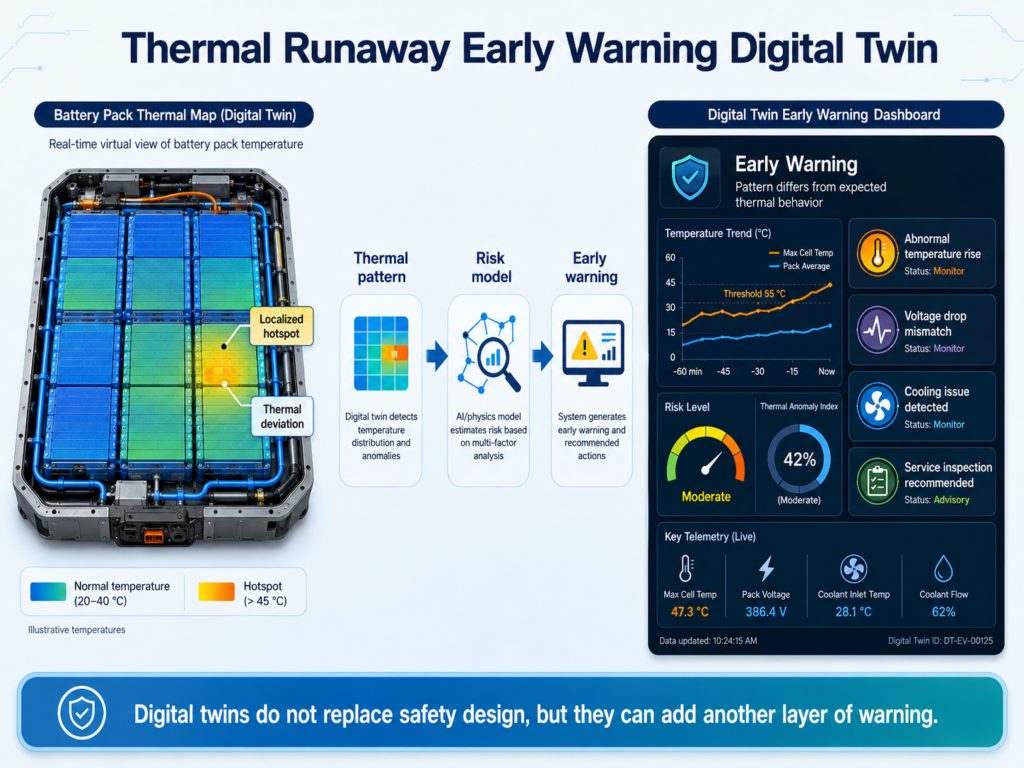
A digital twin cannot guarantee that thermal runaway will always be predicted in advance. Some failures can happen quickly, especially if there is severe physical damage, an internal short circuit, manufacturing defect, or external abuse. However, digital twins can help identify conditions that increase risk. The system may look for warning signs such as:
- unexpected local temperature rise
- temperature rise that does not match current flow
- abnormal voltage drop in one cell group
- rapid resistance increase
- unusual self-discharge behavior
- cooling system underperformance
- sensor disagreement
- patterns associated with internal short development
- post-crash thermal instability.
Thermal warning is difficult because the earliest signs can be subtle, and false alarms are a serious problem. If a system warns too often, drivers and service teams may stop trusting it. If it warns too late, it does not help enough. That is why digital twins for safety need strong engineering guardrails. A machine learning model alone is not enough. The prediction must be connected to battery physics, validated with test data, monitored in the field, and designed to fail safely.
Battery safety standards and test methods still matter. UL describes UL 9540A as a test method for evaluating thermal runaway fire propagation in battery energy storage systems: UL 9540A Test Method. For EV propulsion batteries, UL also lists UL 2580 among standards used for EV battery testing and compliance: UL EV Battery Testing.
In other words, digital twins do not replace physical battery safety design. They add another layer of intelligence on top of good cells, good pack structure, thermal barriers, cooling design, mechanical protection, and conservative BMS limits.
For related background, see EV Battery Crash Safety and EV Battery Repair: Can a Dead Battery Be Restored?.
Predicting Remaining Useful Life
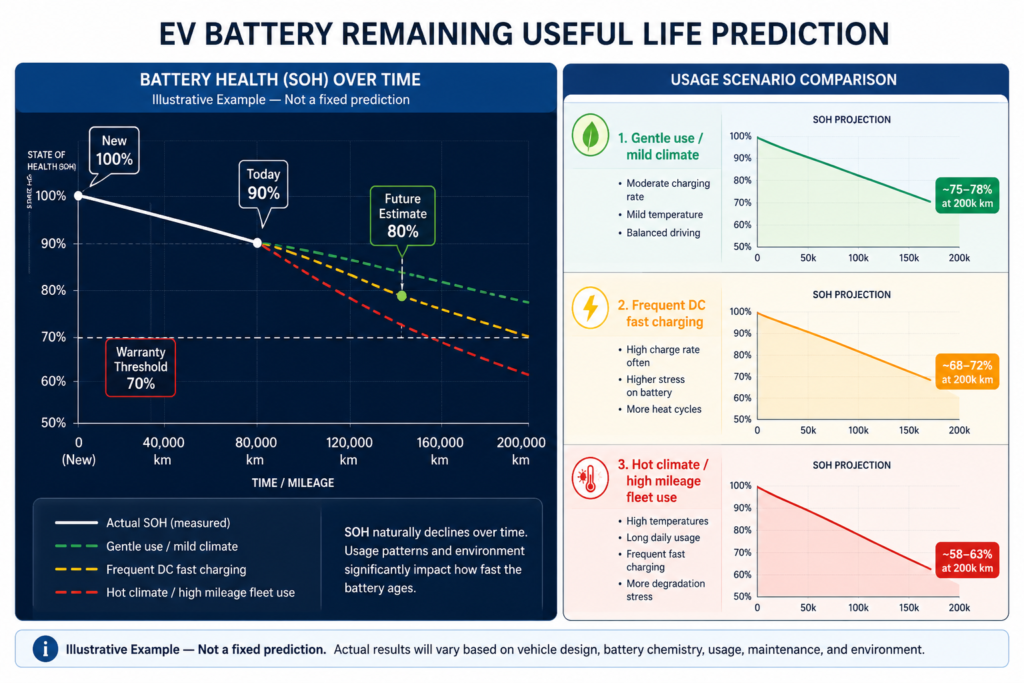
Remaining useful life, often called RUL, is one of the biggest promises of battery digital twin technology. The idea is simple: instead of saying “your battery is at 88% health today,” the system tries to estimate how long the battery will remain useful under expected future conditions.
That second part is important. RUL is not a fixed number. It depends on how the battery will be used. A battery used gently in a mild climate may have many years of useful life left. The same battery used for high-mileage rideshare driving, frequent DC fast charging, heavy towing, or high-temperature storage may age faster. A digital twin can improve RUL prediction because it can combine:
- the battery’s current condition
- its past usage history
- its charging behavior
- climate exposure
- thermal stress
- cell imbalance
- internal resistance trends
- capacity fade trends
- comparison with similar batteries
- future use assumptions.
This is useful for owners, but it may be even more valuable for fleets and used EV markets. A used EV buyer wants to know whether the battery is healthy. A fleet operator wants to know when a vehicle should be retired, reassigned, or serviced. A finance company wants to estimate residual value. A battery recycler or second-life operator wants to know whether a pack is worth refurbishing.
NREL’s EV battery life cycle management report notes that battery state of health is important for stakeholders across the battery life cycle, including reuse, transport, safety, and second-life decisions: NREL EV Lithium-Ion Battery Life Cycle Management. This connects directly with the growing discussion around battery passports. A battery passport may eventually provide a digital record of battery origin, chemistry, performance, and health-related information. Our article Battery Passport Explained covers that broader topic.
A digital twin and a battery passport are not the same thing. The passport is more like a record. The digital twin is more like a predictive model. But in the future, they may work together.
Why Digital Twins Are Harder Than They Sound
The idea of a battery digital twin sounds clean: collect data, run a model, predict failure. Real batteries are not that simple. First, batteries age through multiple mechanisms. Capacity loss can come from loss of lithium inventory, loss of active material, SEI growth, electrolyte degradation, lithium plating, particle cracking, current collector corrosion, and other effects. These mechanisms can interact.
Second, sensor data is limited. A production EV does not measure everything inside every cell. It measures external signals and estimates internal condition. That means uncertainty is always present.
Third, real-world use is messy. Drivers fast charge at different temperatures. Some park outside in Arizona heat. Some drive short trips in Michigan winter. Some tow trailers. Some charge to 100% every day. Some rarely fast charge. Digital twins have to handle all of that variation.
Fourth, rare failures are hard to predict because there may not be much training data. A common aging trend can be learned from thousands of vehicles. A rare internal defect may not appear often enough to model confidently.
Fifth, software must avoid false confidence. A model can be precise and still be wrong if it is used outside its valid range. For example, a model trained mostly on mild-climate vehicles may not perform well for vehicles that spend years in extreme heat.
This is why strong digital twin systems need uncertainty estimates, validation rules, physics constraints, and ongoing monitoring. The best systems do not simply output a number. They also know how confident they are. A good digital twin should be able to say, in effect: “Based on the available data, this battery appears to be aging normally, but the uncertainty is high because the vehicle has not had enough rest periods for accurate capacity estimation.” That kind of honesty matters.
The Role of EIS and Advanced Diagnostics
Most production EVs rely mainly on voltage, current, and temperature data. But advanced diagnostics may add more information in the future. One promising method is electrochemical impedance spectroscopy, or EIS. EIS measures how a battery responds to small electrical signals at different frequencies. That response can reveal information related to internal resistance, charge transfer behavior, diffusion, and aging mechanisms.
In a lab, EIS is already a powerful battery diagnostic method. The challenge is making it practical, fast, low-cost, and robust enough for vehicle use. If onboard EIS or simplified impedance-based diagnostics become more common, digital twins could become much more accurate. Instead of estimating battery condition only from normal driving and charging behavior, the system could occasionally perform diagnostic measurements that are more directly tied to internal electrochemical changes.
This could help distinguish between different aging modes. For example, two batteries may show similar capacity loss, but one may be limited mainly by increased resistance while another may be limited by lithium inventory loss. That difference matters for power capability, fast charging, warranty interpretation, and second-life value.
For everyday drivers, the details may stay hidden. The dashboard may simply show battery health or service recommendations. But behind the scenes, digital twins could use advanced diagnostics to make those estimates more reliable.
What This Means for EV Owners
For EV owners, battery digital twins may eventually make EV ownership feel less mysterious. Today, many owners only see range estimates, charge percentage, and maybe a service warning. That leaves a lot of uncertainty. If range drops, is the battery aging? Is it cold weather? Tire pressure? Driving speed? Software estimation? A digital twin can help separate these factors. In the future, EV owners may see more useful battery information, such as:
- battery health trend over time
- estimated usable capacity
- power limitation explanation
- fast charging impact
- thermal history summary
- cell imbalance alerts
- recommended charging habits
- service recommendations before failure
- remaining useful life estimate.
Automakers may not show every detail because too much technical information can confuse drivers. But even a simple message like “battery health is normal for age and mileage” could reduce anxiety.
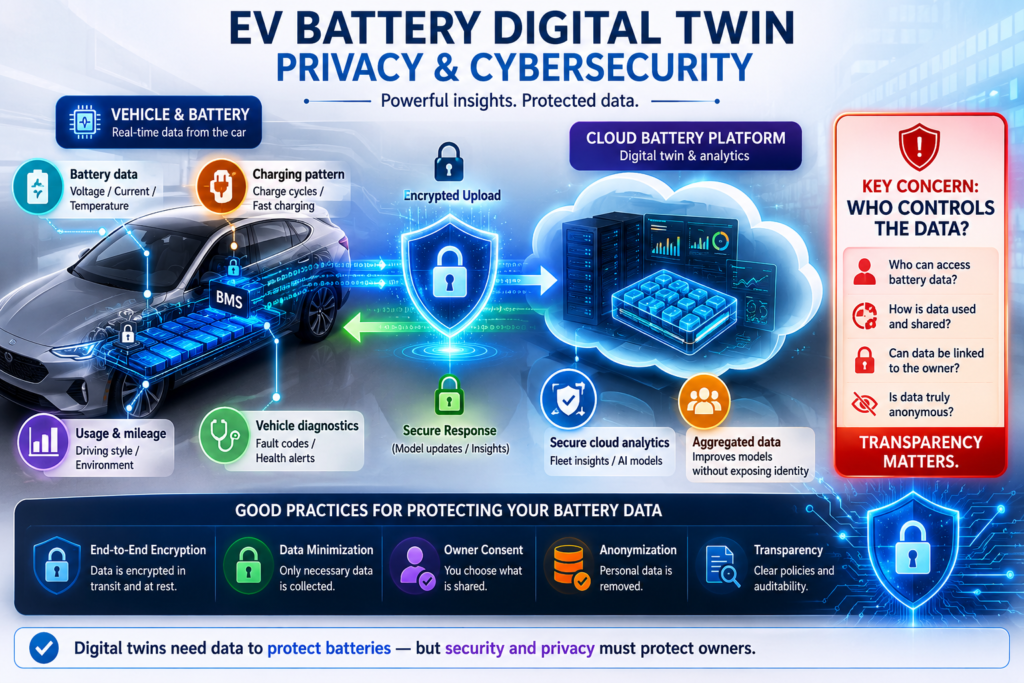
Digital twins may also make warranty claims clearer. If a battery falls below a warranty threshold, a detailed operational history can help determine whether the issue is normal degradation, a manufacturing defect, abnormal use, or a serviceable module-level problem. This does raise an important question: who controls the data?
Privacy and Cybersecurity Concerns
Battery digital twins depend on data. That creates benefits, but it also creates privacy and cybersecurity concerns. Battery data may sound harmless at first. It is not a text message or a phone contact list. But battery usage patterns can reveal more than people expect. Charging times, energy consumption, location-related charging behavior, commute patterns, driving style, and fleet operation schedules may all be inferred from vehicle data if it is not properly protected.
Connected vehicles are already a cybersecurity concern. NHTSA’s 2022 cybersecurity best practices emphasize the safety importance of cybersecurity for modern vehicles: NHTSA Cybersecurity Best Practices for the Safety of Modern Vehicles. ISO/SAE 21434 also defines cybersecurity engineering requirements for road vehicles across the lifecycle, from development to production, operation, maintenance, and decommissioning: ISO/SAE 21434.
For digital twins, this means automakers need to think carefully about:
- what data is collected
- how often it is uploaded
- whether it is anonymized
- who can access it
- how long it is stored
- how it is encrypted
- how cloud systems are protected
- how service centers use the data
- whether owners can view or delete certain data
- how software updates affect the model.
There is also an AI governance angle. If a digital twin uses machine learning to influence service decisions, warranty decisions, or safety warnings, the model should be tested, documented, monitored, and updated responsibly. NIST’s AI Risk Management Framework is a useful reference for thinking about trustworthiness, risk, and oversight in AI systems: NIST AI Risk Management Framework. A digital twin should help owners, not become a black box that makes unexplained decisions.
Will Digital Twins Replace the BMS?
No. Digital twins will not replace the BMS. They will enhance it. The BMS is still responsible for direct battery protection. It measures signals, controls contactors, limits current, manages balancing, coordinates thermal control, and keeps the pack inside safe operating limits.
A digital twin adds a predictive layer. It helps the system understand where the battery is headed, not just where it is now. A simple way to think about it is this: The BMS is the battery’s nervous system. The digital twin is the battery’s long-term memory and predictive brain. The BMS reacts in real time. The digital twin learns over time. Together, they can make EV batteries more reliable, safer, and easier to manage.
What Needs to Improve Before Digital Twins Become Common?
Battery digital twins are already being developed, tested, and used in parts of the industry. But for them to become common across everyday EVs, several things need to improve.
- Sensor quality must be good enough. Poor measurements lead to poor predictions.
- Models must be validated across real climates, chemistries, pack designs, and driving patterns.
- Cloud systems must be secure and privacy-conscious.
- Automakers need clear ways to explain battery health to consumers without oversimplifying it.
- Service centers need tools that translate digital twin outputs into practical repair steps.
- Used EV marketplaces need standardized health reporting that does not mislead buyers.
Regulators and standards organizations may eventually need clearer guidance on how battery health predictions should be used in warranties, safety decisions, and second-life applications. The technology is promising, but trust will matter as much as accuracy. Drivers will not accept a battery health score if they do not understand it. Service technicians will not rely on a prediction if it cannot be explained. Automakers will not use digital twin outputs for safety decisions unless the system is robust, validated, and protected against cyber risks.
Conclusion: Software Will Not Stop Battery Aging, But It Can Make It Predictable
EV battery digital twins are one of the most important next steps in battery management. They do not change the chemistry inside the cell. They do not eliminate degradation. They cannot prevent every rare failure. But they can make battery behavior more visible, more understandable, and more predictable.
That matters because EV batteries are long-life assets. They may serve one owner, then a second owner, then a fleet, then a second-life storage system, and finally a recycling stream. At each stage, knowing the true condition of the battery becomes valuable.
The future of EV battery management will not be only about bigger packs, faster charging, or new chemistries. It will also be about better software. A well-designed digital twin can connect real-world data with physics-based models, onboard estimation, cloud analytics, and predictive diagnostics.
For drivers, that could mean fewer surprises. For fleets, it could mean less downtime. For automakers, it could mean better warranty management and safer products. For the used EV market, it could mean more trust. The battery pack under the floor may still look like hardware. But in the next generation of EVs, some of the most important battery improvements may happen in software.
FAQs
What is an EV battery digital twin?
An EV battery digital twin is a software model that represents a real EV battery pack. It uses real vehicle data, such as voltage, current, temperature, charging history, and aging behavior, to estimate battery condition and predict future performance or failure risk.
Is a digital twin the same as a BMS?
No. The BMS is the real-time system that monitors and protects the battery. A digital twin is a predictive model that can use BMS data, vehicle history, and analytics to estimate degradation, remaining useful life, and abnormal behavior.
Can a digital twin predict battery failure before it happens?
Sometimes, but not always. A digital twin can detect abnormal trends such as voltage drift, rising resistance, unusual temperature behavior, or cell imbalance. However, rare or sudden failures may still be difficult to predict.
Can a digital twin warn about thermal runaway?
It can help detect risk factors and abnormal patterns that may precede a thermal event, but it cannot guarantee perfect thermal runaway prediction. Physical safety design, pack protection, BMS limits, and testing standards remain essential.
Will EV owners see digital twin data on the dashboard?
Some information may appear as battery health reports, service recommendations, or improved range and charging predictions. Automakers may keep the deeper technical details hidden to avoid confusing drivers.
Does a battery digital twin require cloud data?
Not always. Some digital twin functions can run onboard the vehicle. However, cloud analytics can improve long-term learning by comparing many vehicles, climates, charging habits, and aging patterns.
What are the risks of battery digital twins?
The main risks are poor data quality, inaccurate models, overconfidence in AI predictions, privacy concerns, cybersecurity threats, and unclear ownership of vehicle data. These systems need strong validation and secure data handling.