
Quick Answer
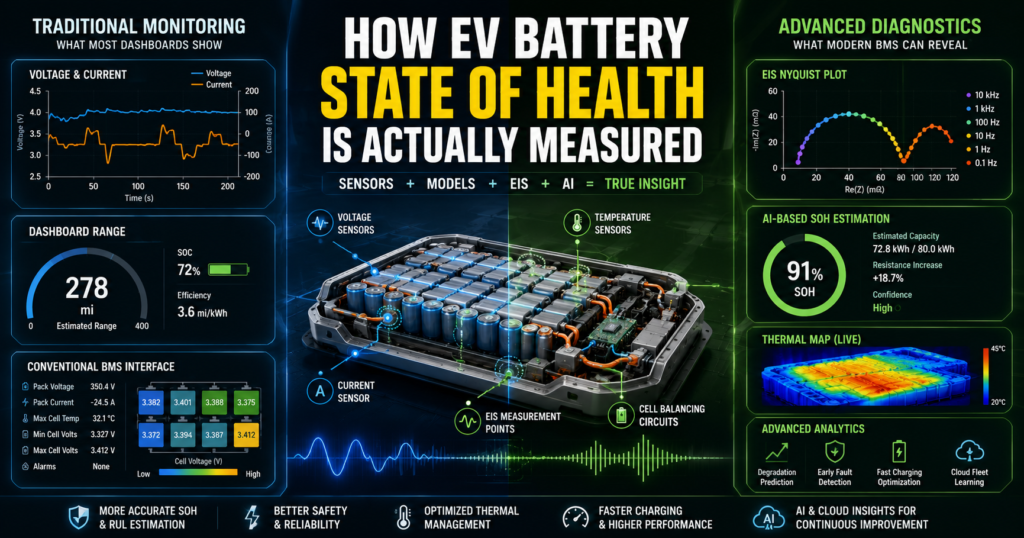
EV battery SOH (State of Health) is one of the most important metrics in modern electric vehicles, yet most drivers never see how it is actually measured. EV battery SOH is not measured using a single sensor or dashboard estimate. Modern battery management systems (BMS) combine multiple techniques — including capacity tracking, internal resistance measurement, coulomb counting, voltage analysis, model-based estimation, and increasingly electrochemical impedance spectroscopy (EIS) — to estimate how much a battery has degraded over time.
In simple terms:
- A brand-new battery starts near 100% SOH
- As the battery ages, usable capacity drops and resistance rises
- The BMS continuously estimates degradation using software models and real-world driving data
- The range shown on your dashboard is not the same thing as true battery SOH.
Understanding how SOH is measured helps explain why EV batteries often last longer than many people expect — and why battery diagnostics are becoming one of the most important technologies in modern EVs.
Why EV Battery SOH Matters More Than Most Drivers Realize
When people talk about EV battery degradation, they usually focus on one question: “How much range has the car lost?” But engineers look at battery health very differently. A battery can still show decent range while internally aging in ways that affect fast charging performance, thermal behavior, power delivery, cold-weather operation, long-term reliability, or safety margins. That is why automakers and battery suppliers spend enormous effort estimating battery State of Health (SOH) as accurately as possible.
In modern EVs, SOH affects warranty decisions, charging limits, thermal management strategies, remaining useful life prediction, second-life battery valuation, and used EV pricing. And as the EV market matures, SOH transparency is becoming increasingly important for consumers and regulators alike. A recent 2026 study even suggested that BMS-reported SOH values across different manufacturers may not always correlate well with independently measured battery degradation (arXiv).
What Is EV Battery State of Health (SOH)?
At the most basic level, SOH is an estimate of how much a battery has degraded compared to when it was new. There are two major ways engineers define SOH:
1. Capacity-Based SOH
This is the most common definition.
As an example, if a new battery capacity is 80 kWh and the current usable capacity is 72 kWh, then the result is SOH = 90%. This definition directly relates to how much energy the battery can still store.
2. Resistance-Based SOH
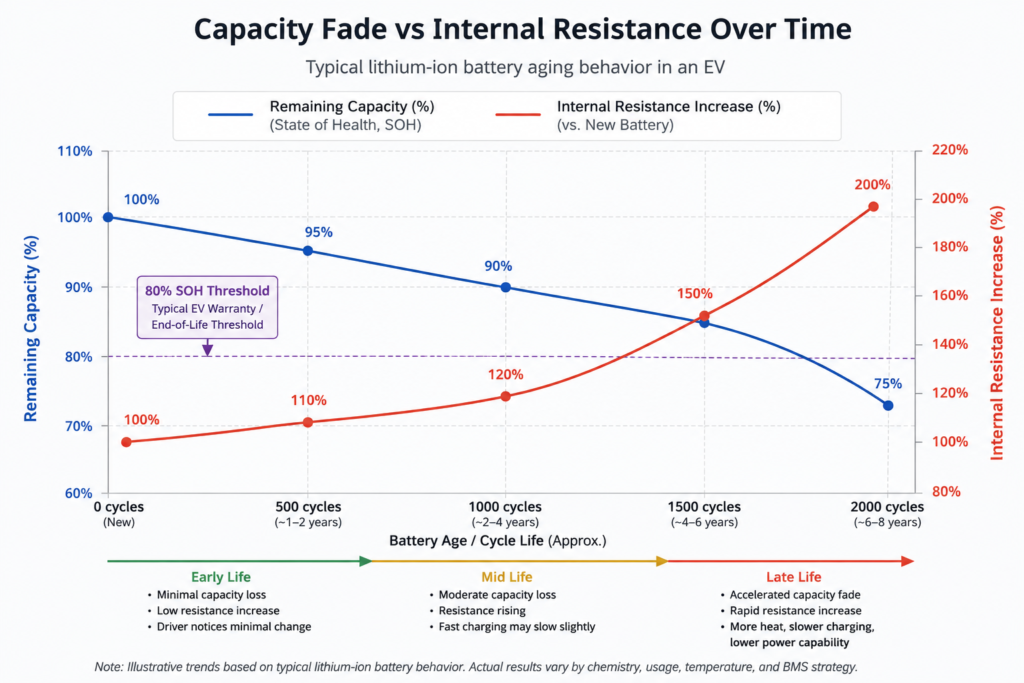
As lithium-ion batteries age, internal resistance increases. Higher resistance causes more heat generation, reduced fast charging performance, lower power capability, or reduced efficiency. Some BMS algorithms therefore estimate SOH using impedance or resistance growth instead of capacity loss alone (Nature, PMC). In reality, modern systems often combine both approaches.
Why Measuring SOH Is Surprisingly Difficult
If measuring battery health were easy, every EV would show perfectly accurate battery diagnostics. But lithium-ion batteries are incredibly complex electrochemical systems. Battery aging depends on temperature history, fast charging frequency, depth of discharge, average SOC, driving behavior, cell chemistry, manufacturing variation, thermal gradients, or calendar aging. Even two identical EVs driven in different climates can age very differently. That is one of the reasons why modern SOH estimation increasingly relies on large-scale vehicle datasets and AI-assisted models rather than simple equations alone. A 2025 Nature Communications study analyzed operational data from 300 EVs over three years to improve real-world SOH estimation accuracy.
Capacity Fade: The Most Direct Indicator of Aging
The clearest sign of battery aging is capacity fade. Over time, lithium inventory decreases, active material degrades, side reactions grow, and electrodes become less efficient. The result is simple: the battery stores less usable energy.
How Capacity Is Actually Measured
In laboratory testing, true capacity measurement is straightforward:
- Fully charge the battery
- Fully discharge it at controlled conditions
- Measure total extracted energy.
But real EVs rarely operate under ideal conditions. Drivers do not fully charge every day, rarely discharge to 0%, or drive under varying temperatures and loads. So production BMS systems cannot rely solely on full-cycle measurements. Instead, they estimate capacity indirectly using operational data collected over months or years.
Coulomb Counting: Tracking Battery Charge Flow
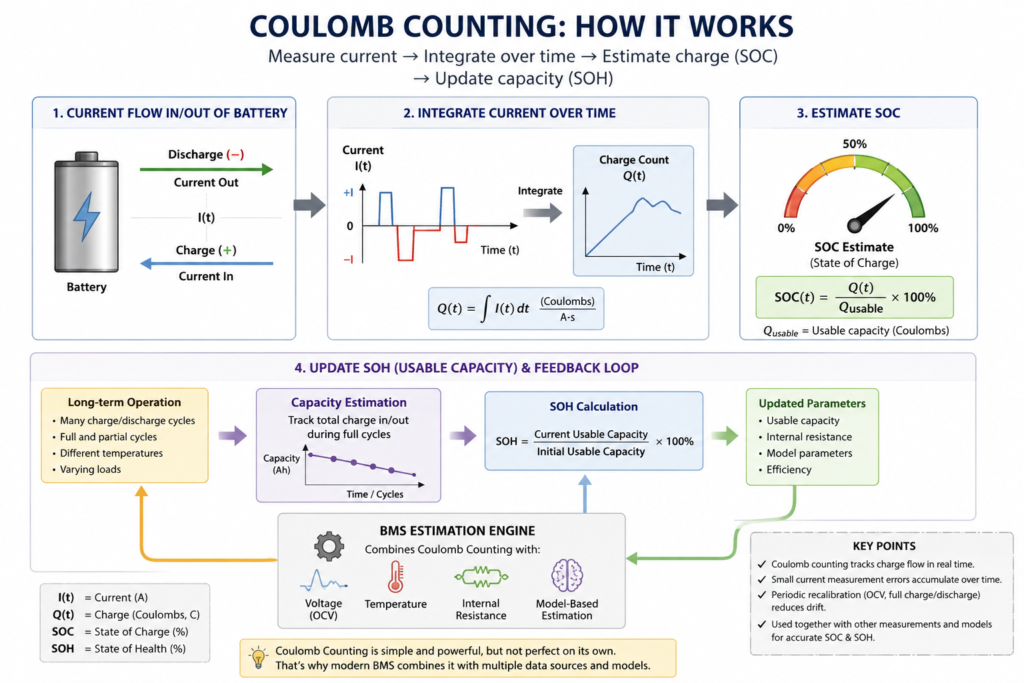
One of the oldest and most widely used methods is coulomb counting. The idea is simple:
- Measure current entering and leaving the battery
- Integrate current over time
- Estimate how much charge was stored or removed
Mathematically:
where = charge and = battery current.
Why Coulomb Counting Alone Is Not Enough
Coulomb counting has several weaknesses:
Sensor Drift
Tiny current measurement errors accumulate over time.
Temperature Effects
Battery efficiency changes with temperature.
Unknown Initial Conditions
If the initial SOC estimate is wrong, errors propagate.
Aging Effects
The battery’s usable capacity changes continuously as it degrades. Because of this, coulomb counting is usually combined with additional estimation methods.
OCV Methods: Using Voltage to Estimate Battery Health
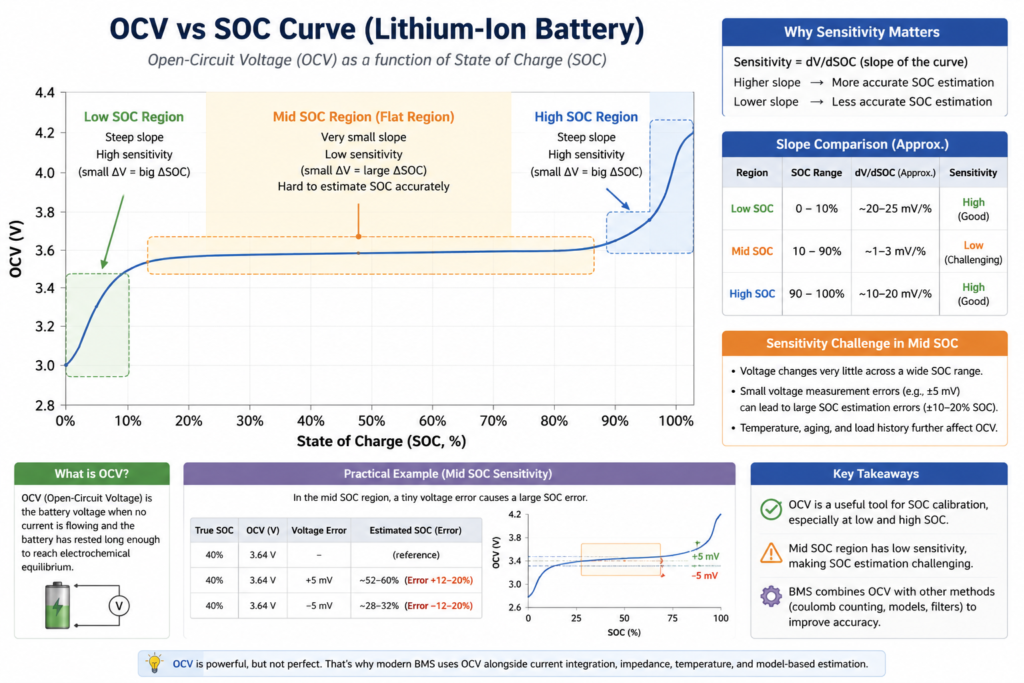
Another common approach uses open-circuit voltage (OCV). Lithium-ion batteries have characteristic voltage curves that vary with SOC. After the battery rests, voltage stabilizes and the stabilized voltage correlates with SOC. BMS systems use these voltage relationships to recalibrate estimation errors.
The Problem With OCV in Real Vehicles
OCV estimation works well in controlled environments. But EVs rarely sit long enough for true equilibrium. Modern EV operation includes constant driving, thermal gradients, regenerative braking, and dynamic loads. That means real-world voltage measurements are often distorted by transient effects. This is why OCV alone cannot accurately determine SOH.
Internal Resistance: One of the Most Important Aging Signals
As batteries age, internal resistance increases. This affects nearly everything drivers notice charging speed, power output, heat generation, efficiency, and cold-weather behavior. The heat generation relationship is especially important:
where = heat generation, = current, and = resistance.
Even modest resistance increases can significantly increase heat during fast charging or hard acceleration.
How BMS Measures Resistance
BMS systems often estimate resistance by analyzing voltage drop during load changes, pulse current response, dynamic current transients, or fast charging behavior. This allows the system to estimate how the battery’s electrochemical behavior changes over time.
Model-Based SOH Estimation
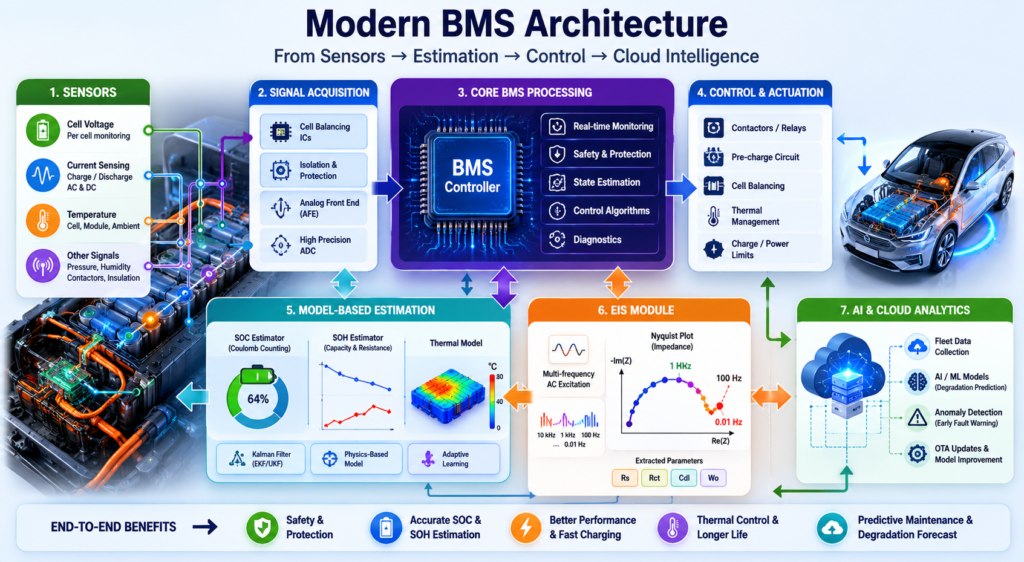
Modern EVs increasingly rely on model-based estimation techniques. These systems combine physics-based battery models, real-time sensor data, thermal models, historical usage patterns, and adaptive estimation algorithms. Instead of measuring SOH directly, the BMS estimates hidden battery states mathematically.
Kalman Filters and Advanced Estimation
Many advanced BMS systems use estimation algorithms such as Extended Kalman Filters (EKF), Unscented Kalman Filters (UKF), or Particle Filters. These techniques continuously update battery state estimates using incoming measurements. The approach is conceptually similar to how aircraft navigation systems estimate position from noisy sensor data. For EV batteries, these algorithms estimate SOC, SOH, internal resistance, available power, and thermal states in real time.
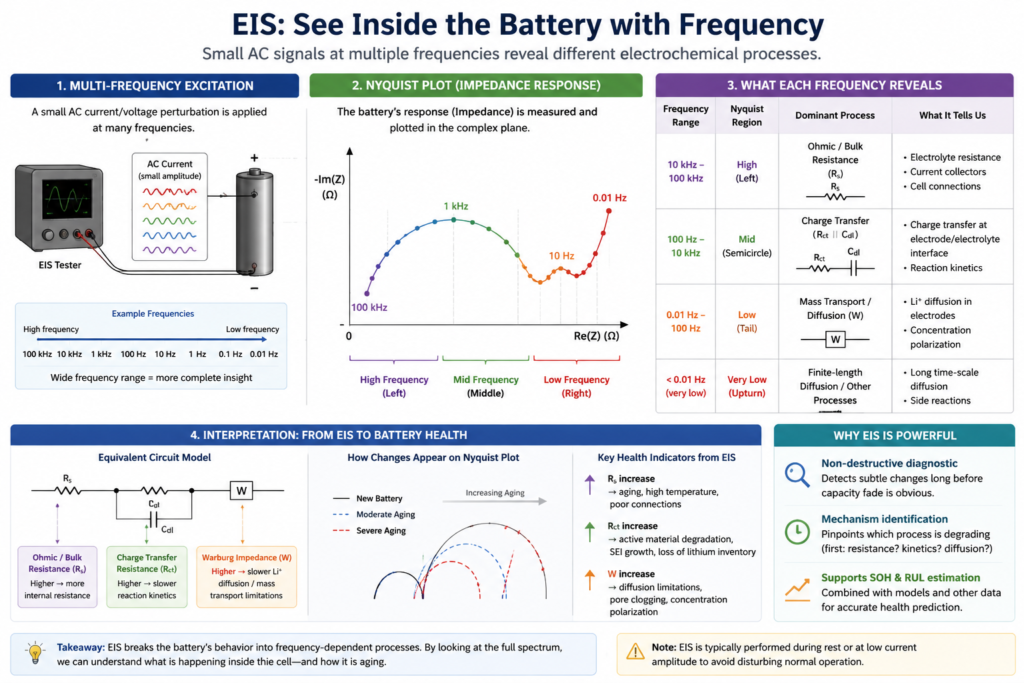
Electrochemical Impedance Spectroscopy (EIS): The Future of Battery Diagnostics
Among all SOH estimation methods, EIS is attracting enormous attention. And for good reason, EIS provides much deeper electrochemical insight than traditional voltage/current measurements.
What Is EIS?
Electrochemical Impedance Spectroscopy applies small AC excitation signals across multiple frequencies and measures how the battery responds. The battery behaves differently at different frequencies because different electrochemical processes dominate. EIS can reveal information about charge transfer resistance, diffusion behavior, SEI layer growth, lithium plating, internal aging mechanisms, and thermal behavior. In many ways, EIS acts like a “medical scan” for batteries.
Why EIS Is Becoming Important in EVs
Historically, EIS was mostly limited to laboratories because it required expensive equipment and long testing times. But that is changing rapidly. Several recent studies and automotive suppliers are now pushing toward production-ready EIS-enabled BMS systems (SAE, MDPI, SAE Mobility Engineering). Marelli, for example, announced an EIS-based BMS platform designed to improve real-time estimation of SOH, SOC, internal temperature, and safety conditions. The company claims the system could improve battery longevity and help detect early degradation patterns (SAE Mobility Engineering).
Why EIS Is So Powerful
Traditional BMS measurements mainly observe voltage, current, and temperature. But many degradation mechanisms happen internally long before major capacity loss becomes obvious.
EIS can detect subtle electrochemical changes earlier. That means earlier fault detection, better degradation prediction, more accurate SOH estimation, improved fast charging control, or better thermal management. This is one of the reasons many researchers believe EIS will become increasingly important in next-generation EV battery platforms (Spectroscopy, PMC, JECST).
Why Dashboard Range Is NOT True SOH
One of the biggest misconceptions among EV owners is assuming “My displayed range equals battery health.” That is not true. Dashboard range estimates depend on many factors such as recent driving efficiency, weather, HVAC usage, tire condition, driving style, elevation, or speed history. A temporary drop in displayed range does not necessarily mean battery degradation. Likewise, two EVs with identical SOH may display very different range estimates depending on driving conditions.
Why Some EVs Hide SOH Information
Many automakers do not expose detailed SOH data directly to drivers. Why? Because SOH estimation itself is uncertain. Different manufacturers use different algorithms, different filtering approaches, different calibration methods, and different definitions of “usable capacity.”
Recent research even found weak correlation between some BMS-reported SOH values and independently measured degradation in certain EV platforms. This is becoming increasingly important as used EV markets grow.
AI and Machine Learning Are Changing SOH Estimation
Traditional battery estimation relied heavily on physics-based models. Now AI and machine learning are increasingly entering production battery systems. Modern approaches use fleet-wide operational data, neural networks, transformer models, pattern recognition, and multi-modal sensor fusion. The goal is simple: use real-world driving data from thousands of EVs to improve estimation accuracy.
Several recent studies have shown promising results using machine learning for SOH prediction with very low estimation error (Nature, arXiv, arXiv). But production deployment still faces challenges such as Computational cost, validation requirements, safety certification, and edge-case reliability. So most near-term systems will likely combine physics-based and AI-based methods rather than replacing one entirely.
The Real Future of EV Battery Diagnostics
Battery diagnostics are evolving far beyond simple voltage monitoring. Future EVs will likely use combinations of physics-based models, fleet learning, cloud analytics, EIS measurements, AI-assisted diagnostics, and real-time adaptive estimation. This matters not only for drivers, but also for battery warranties, insurance, second-life battery markets, residual value estimation, fast charging optimization, or predictive maintenance. As EV adoption grows, accurate SOH estimation may become one of the defining technologies of next-generation battery management systems.
Conclusion
Measuring EV battery State of Health is far more complicated than checking remaining range. Modern BMS systems combine multiple estimation techniques — including capacity tracking, resistance analysis, coulomb counting, voltage methods, physics-based modeling, and increasingly EIS-based diagnostics — to estimate how a battery is aging over time.
Despite enormous progress, SOH estimation is still an active area of research. That is partly because lithium-ion batteries are highly dynamic systems influenced by temperature, usage history, charging behavior, and electrochemical aging mechanisms that are difficult to observe directly.
However the technology is advancing quickly. As AI, cloud analytics, and EIS-enabled BMS platforms mature, future EVs will likely provide much deeper and more accurate battery health insight than today’s systems. For EV owners, that is good news. Because better battery diagnostics ultimately mean better safety, longer battery life, more reliable used EV valuation, faster charging optimization, and lower ownership uncertainty. And that may become one of the biggest hidden advantages of next-generation EV technology.
Related article
How Long Do EV Batteries Last? Real-World Data and Battery Degradation (2026)
Why Fast Charging Degrades EV Batteries Faster (And How Modern EVs Prevent It)
EV Battery Degradation in Hot Weather (2026 Guide)