
Quick Answer
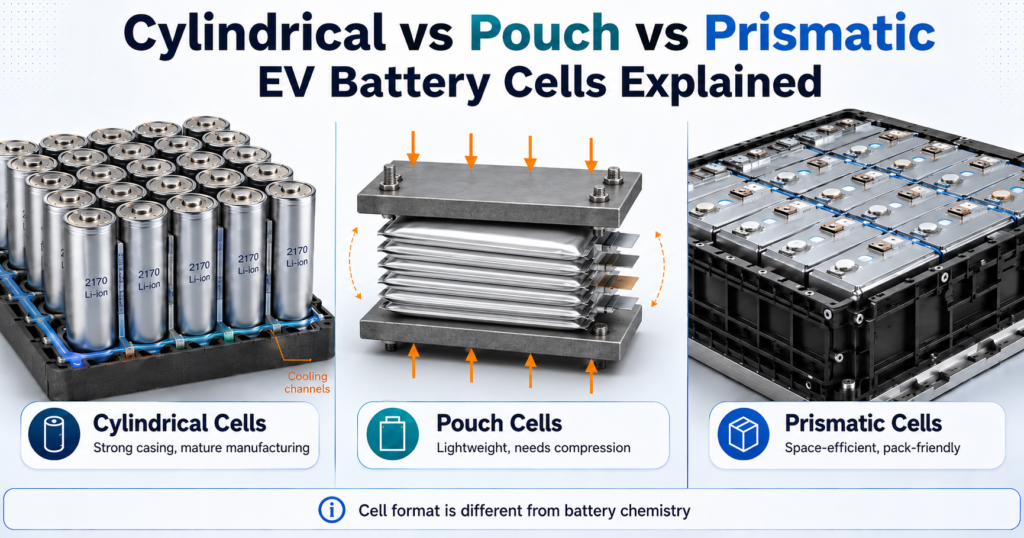
EV makers switch between cylindrical, pouch, and prismatic battery cells because each format changes the way a battery pack is designed, cooled, manufactured, protected, and repaired.
Cylindrical cells are strong, mature, and relatively easy to cool, but they can waste space between round cells. Pouch cells are lightweight and space-efficient, but they need careful compression because they can swell over time. Prismatic cells use rigid rectangular cases, making them attractive for dense packaging, cell-to-pack designs, and large EV platforms.
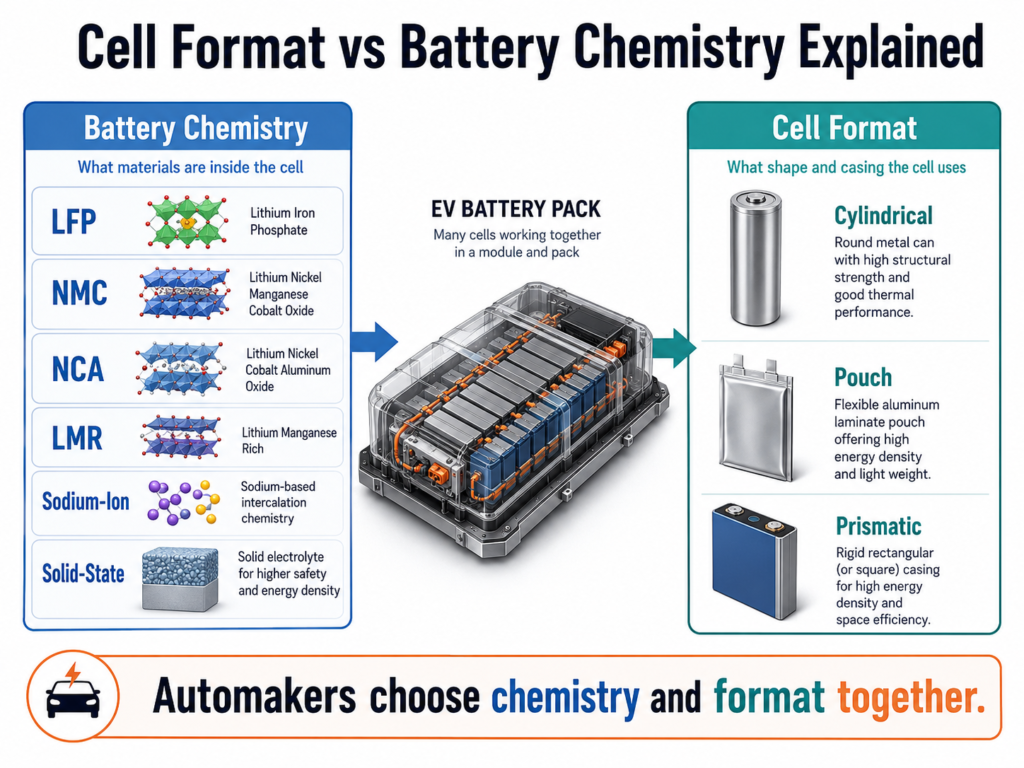
The most important point is this: cell format and battery chemistry are not the same thing. LFP, NMC, LMR, sodium-ion, and solid-state describe chemistry. Cylindrical, pouch, and prismatic describe the physical shape and packaging of the cell. Automakers choose both together depending on cost, range, safety, manufacturing strategy, cooling needs, and vehicle architecture.
Introduction: EV Batteries Are Not Just About Chemistry
When people compare EV batteries, they usually focus on chemistry. They ask whether a car uses LFP or NMC. They wonder if solid-state batteries will replace lithium-ion. They compare nickel, manganese, cobalt, iron phosphate, silicon anodes, and sodium-ion cells.
That is important, but it is only half the story. The other half is the cell format. An EV battery cell can be shaped like a small metal cylinder, a thin flexible pouch, or a rectangular metal box. Cylindrical vs pouch vs prismatic EV batteries may look like a simple packaging choice, but cell format affects nearly every part of an electric vehicle battery pack. Those shapes sound simple, but they affect almost everything around the cell: how much space the battery pack uses, how heat moves, how swelling is controlled, how fast the pack can be assembled, how easy it is to repair, and whether the battery can become part of the vehicle structure.
This is why automakers keep changing their battery strategies. Tesla pushed cylindrical cells further with 2170 and 4680 formats. BYD built its Blade Battery around long LFP cells and cell-to-pack style integration. GM, after using large-format pouch cells in many Ultium-based EVs, has announced plans with LG Energy Solution to commercialize lithium-manganese-rich, or LMR, prismatic cells for future electric trucks and full-size SUVs. GM says pre-production is expected in late 2027, with U.S. commercial production planned by 2028.
That shift does not mean one cell format has “won.” It means automakers are learning that the best cell format depends on the vehicle. A compact affordable EV may need one answer. A long-range pickup may need another. A high-performance EV, a structural pack, and a low-cost city car may all point in different directions.
Cell Format vs Battery Chemistry: A Common Misunderstanding
Before comparing cylindrical, pouch, and prismatic batteries, it helps to separate two ideas that often get mixed together.
Battery chemistry describes what materials are used inside the cell. Examples include lithium iron phosphate, known as LFP; nickel manganese cobalt, known as NMC; nickel cobalt aluminum, known as NCA; and newer lithium-manganese-rich chemistries, often called LMR.
Cell format describes the physical container and shape of the cell. That is where cylindrical, pouch, and prismatic cells come in.
These two choices are related, but they are not the same. An LFP battery can be prismatic. It can also be pouch or cylindrical. A nickel-based battery can be cylindrical, pouch, or prismatic. A future LMR battery can be designed in different shapes, but GM and LG Energy Solution are specifically targeting prismatic cells for their announced LMR strategy.
This matters because people sometimes say “BYD uses LFP” as if that fully explains the Blade Battery. It does not. BYD’s Blade Battery is an LFP battery, but it is also a packaging strategy built around long, blade-shaped cells that support high space efficiency and cell-to-pack style integration. BYD describes its Blade Battery as an LFP battery designed for safety, long life, and compact packaging.
The same is true with Tesla. Tesla’s 4680 story is not only about chemistry. It is also about a larger cylindrical format, tabless-style current collection, manufacturing simplification, and structural pack ambition. Early coverage of Tesla’s Battery Day highlighted the 4680’s larger cylindrical shape and its role in structural battery integration. So when automakers switch formats, they are not simply chasing a new battery buzzword. They are trying to match chemistry, vehicle size, cooling design, factory process, cost target, and pack architecture.
Cylindrical EV Batteries: Strengths and Tradeoffs
Cylindrical cells are the most familiar lithium-ion battery shape. They look like metal tubes. Smaller versions are used in many consumer electronics, while EVs use larger automotive-grade formats such as 18650, 2170, and 4680 cells.
Tesla helped make cylindrical cells famous in EVs. Instead of using a small number of large cells, early Tesla packs used thousands of small cylindrical cells connected into a sophisticated battery system. Over time, Tesla moved from 18650 cells to larger 2170 cells, and then introduced the 4680 format for its next-generation strategy.
The biggest advantage of cylindrical cells is mechanical strength. A cylinder is naturally good at handling internal pressure. The metal can gives the cell a robust structure, which can make swelling less visible at the pack level compared with flexible pouch cells.
Cylindrical cells also offer a mature manufacturing base. The industry has been producing cylindrical lithium-ion cells for decades, and the process is highly automated. That can help with consistency, quality control, and manufacturing learning curves.
Thermally, cylindrical cells have another advantage: their curved metal surface gives engineers predictable paths for heat transfer. Cooling can be applied around the cell, between cell rows, or through plates and channels that contact the cell sides. In a well-designed pack, the small size of each cell also helps limit the energy contained in a single cell.
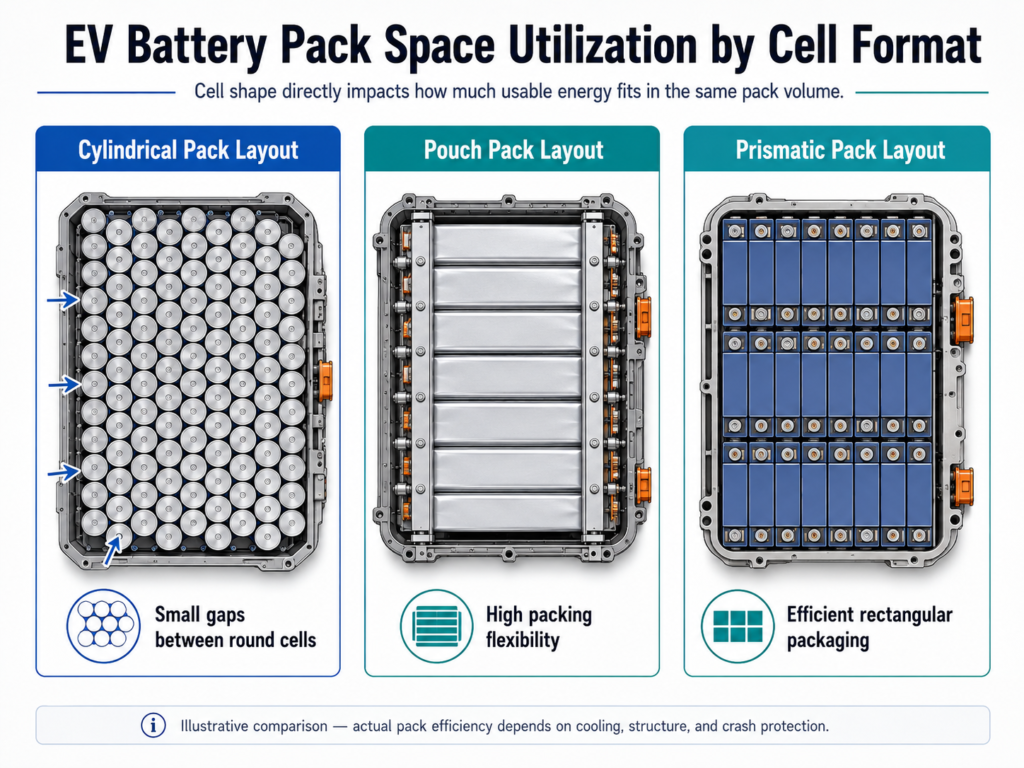
But cylindrical cells have one obvious problem: circles do not fill rectangular space perfectly. When round cells are packed together, there are small gaps between them. Engineers can use those spaces for cooling channels, structural foam, adhesives, or thermal materials, but the geometry still creates a packing penalty. That is one reason prismatic and pouch cells are attractive for automakers trying to maximize usable pack volume.
Cylindrical packs also require many electrical connections. A pack with thousands of cells needs careful welding, monitoring, current distribution, and fault management. Tesla’s advantage has been its ability to engineer around that complexity at scale. But for automakers that want fewer, larger cells and simpler module construction, cylindrical cells may not always be the easiest path.
What Are Pouch Cells?
Pouch cells look very different. Instead of a rigid metal can, the active materials are sealed inside a flexible laminated pouch. They are thin, flat, and lightweight. This format has been popular among several EV makers because it can deliver excellent packaging flexibility. Pouch cells can be made in large rectangular shapes, allowing engineers to fill pack volume efficiently. They also avoid some of the inactive metal casing mass found in cylindrical and prismatic cells.
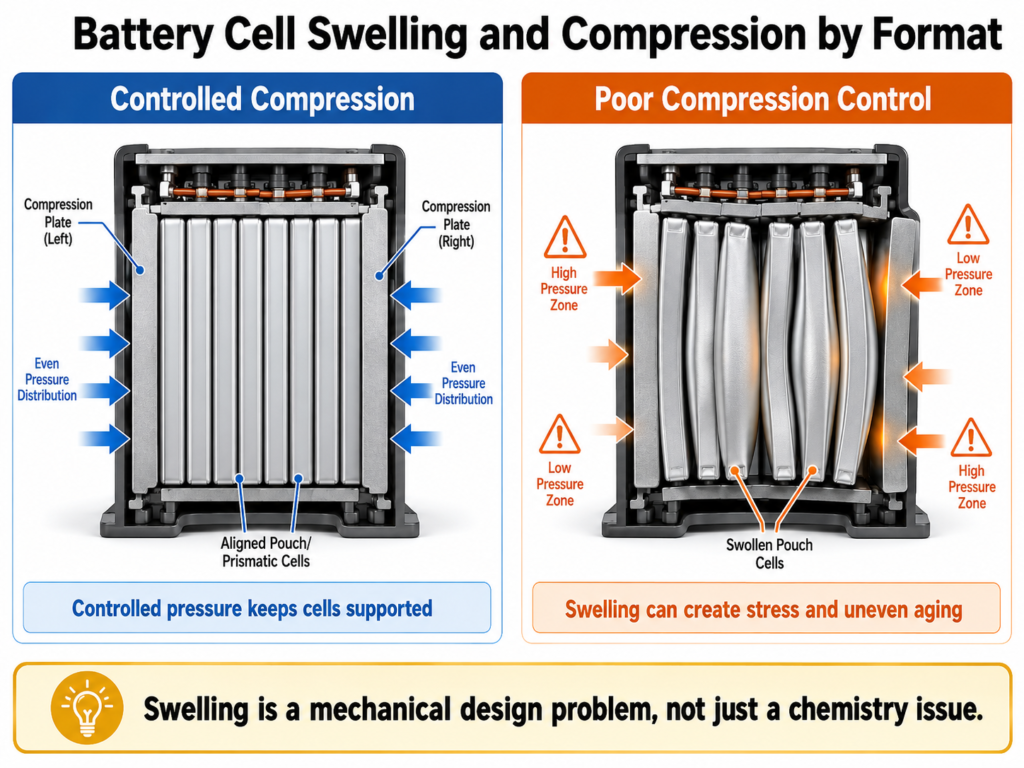
That sounds ideal, but pouch cells come with a major engineering requirement: compression. Lithium-ion cells can expand and contract during cycling. Gas generation, electrode expansion, aging, and state-of-charge changes can all influence cell swelling. With a pouch cell, the flexible exterior does not provide much mechanical restraint by itself. That means the pack or module structure must apply the right amount of pressure to keep the cell supported.
Too little compression can allow cell layers to separate or deform. Too much compression can create mechanical stress, affect transport inside the cell, and reduce life. Research on pouch cell compression has shown that mechanical pressure during pack integration can significantly affect cycle life and irreversible swelling (ResearchGate).
Pouch cells can also create thermal challenges because they are large and flat. Heat may not spread uniformly across the whole cell area, especially at high charge or discharge rates. Recent research on large-format pouch cells has highlighted that spatial variations in current, temperature, state of charge, and degradation can affect performance, particularly at high C-rates.
That does not mean pouch cells are bad. It means they require careful mechanical and thermal design. A well-designed pouch-cell pack can be very efficient. A poorly designed one can suffer from swelling, uneven pressure, cooling imbalance, or difficult serviceability. This is why pouch cells often appear in vehicles where the automaker has strong pack engineering and a clear compression strategy.
What Are Prismatic Cells?
Prismatic cells are rectangular cells in rigid cases, usually aluminum or steel. They look more like flat metal boxes than cylinders or flexible pouches. Their biggest appeal is straightforward: rectangular cells fit well into rectangular packs.
Because EV battery packs are usually wide, flat structures under the vehicle floor, prismatic cells can use space efficiently. They can reduce wasted volume compared with cylindrical cells and reduce the need for thousands of small cell connections. Compared with pouch cells, their rigid casing provides more mechanical structure. This combination explains why prismatic cells are becoming more important in modern EV battery strategies.
Prismatic cells are especially attractive for cell-to-pack designs, where automakers reduce or eliminate traditional modules and place cells more directly into the pack structure. Fewer modules can mean fewer parts, less duplicated structure, and better space utilization. Out article on Cell-to-Pack vs Structural Battery Pack explains this architecture shift well and would be a natural internal link from this section.
However, prismatic cells are not magic. Large rectangular cells can develop temperature gradients if cooling is not designed well. Heat may need to travel across a wider cell area than in a smaller cylindrical cell. A 2025 review of prismatic battery thermal management systems notes that air and liquid cooling strategies remain central topics for prismatic lithium-ion cells.
Prismatic cells can also swell. Their rigid cases help contain expansion, but the forces do not disappear. Instead, swelling can become a pack-level pressure management issue. That connects directly to our article on EV battery pressure management, because cell format changes how compression and structural support must be handled. In short, prismatic cells offer excellent pack integration potential, but they still demand serious cooling, pressure, and manufacturing control.
Pack Space Utilization: Why Shape Matters
A battery pack is not just a box filled with energy. It also needs cooling plates, busbars, sensors, voltage isolation, crash protection, sealants, adhesives, venting paths, structural supports, and service access.
Cell format determines how much room is left for all of that. Cylindrical cells can be highly reliable and easy to manufacture, but they create small unused gaps between round cells. Engineers may use those gaps intelligently, but from a pure volume perspective, cylinders are not the most efficient way to fill a flat rectangular pack.
Pouch cells can use space very well because they are thin and flat. They can be stacked tightly, which helps pack-level energy density. But the pack must include compression plates, frames, pads, or other structures to manage swelling and pressure.
Prismatic cells also use space efficiently because they have rectangular shapes and rigid cases. This makes them attractive for large packs where every millimeter of underfloor height matters.
This is one of the reasons GM’s LMR prismatic announcement is important. GM specifically connected LMR chemistry with the “manufacturing and space efficiency benefits of prismatic cells” for future electric trucks. The company says this combination could help future trucks deliver more than 400 miles of range while reducing pack cost compared with today’s high-nickel packs. That is the key takeaway: range is not only about cell chemistry. It is also about how efficiently cells fit inside the vehicle.
Thermal Management: Cooling Is Different for Every Format
Every EV battery has to manage heat. Too cold, and charging slows down. Too hot, and degradation accelerates. Too uneven, and some cells age faster than others.
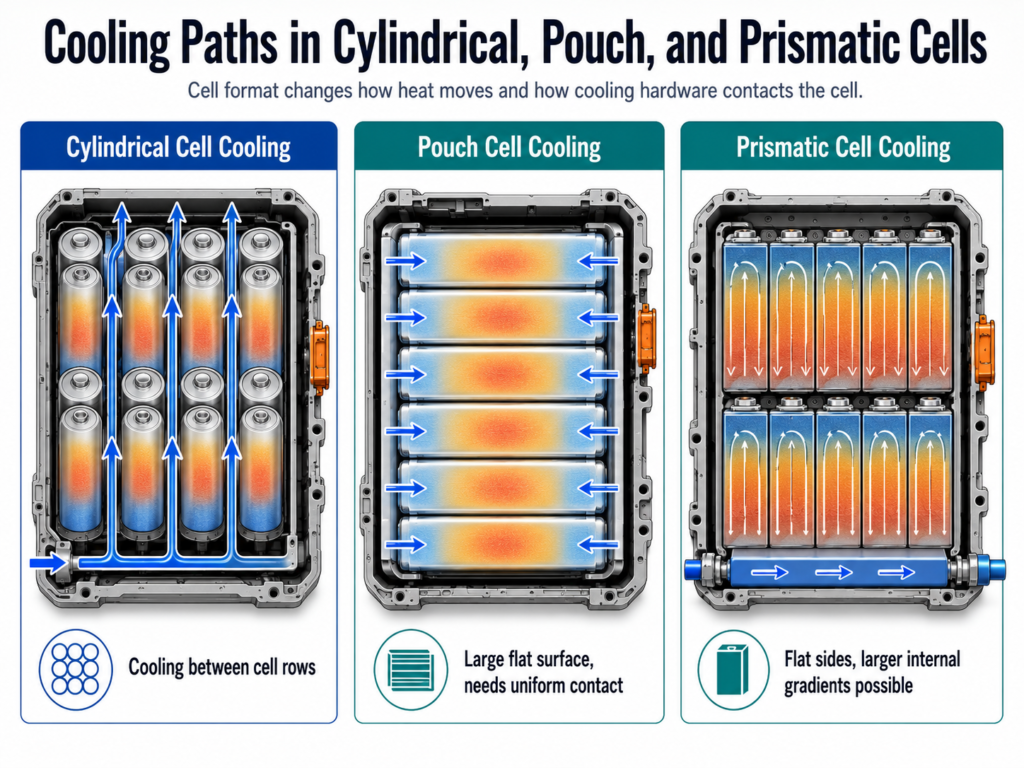
Cell format changes the cooling problem. Cylindrical cells are relatively small, so each cell has a manageable heat path. Cooling can be placed around the cell sides or between rows. The round shape can also help create consistent mechanical contact when designed correctly. However, a cylindrical pack may contain thousands of cells, so the challenge becomes consistency across a very large population.
Pouch cells have broad flat surfaces, which can be good for cooling if cooling plates contact them properly. But large pouch cells can also develop non-uniform temperature and current distribution across the cell plane. That becomes more important during fast charging or high-power driving.
Prismatic cells sit somewhere in between. Their flat sides are attractive for cooling plate contact, and their rectangular shape works well for dense packs. But because they are often large-format cells, engineers must pay attention to internal gradients. Recent prismatic thermal management research continues to focus on temperature uniformity as well as maximum temperature control. This is why two EVs with the same chemistry can charge differently. The pack voltage, cooling system, cell size, tab design, electrode design, and BMS limits all matter. Cell format is part of that bigger system.
Swelling and Compression: The Hidden Mechanical Problem
Battery swelling is one of the least visible but most important cell-format issues. In a phone, swelling is obvious because the screen may lift. In an EV, the battery pack is sealed, reinforced, and mounted under the vehicle. The driver may never see what is happening inside.
But engineers have to design for it from the beginning. Pouch cells are the most obvious case because their soft exterior requires external support. The pack structure must keep the cell stack aligned and compressed without over-stressing it.
Prismatic cells also need swelling management. Their metal cases are stiffer, but aging and gas generation can still increase internal pressure and create dimensional changes. Testing-equipment supplier ZwickRoell notes that pouch and prismatic lithium-ion cells can expand as they age, increasing pressure in the pack and affecting electrical performance.
Cylindrical cells generally contain swelling inside the metal can more effectively, but they are not immune to internal pressure or mechanical aging. The difference is that the pack-level design problem looks different.
This is why cell format influences pack architecture. A pouch-cell pack may need compression plates. A prismatic pack may need controlled spacing and swelling allowance. A cylindrical pack may need potting, cooling gaps, and strong current-collection structures. The battery is electrochemical, but the pack is also mechanical.
Manufacturing Yield and Cost: The Factory Side of Cell Format
Automakers do not choose cell formats only for engineering elegance. They also choose them for factory reality. A battery cell format must be manufacturable at high volume with good yield. Small differences in defect rate matter when a factory produces millions or billions of cells.
Cylindrical cells benefit from mature manufacturing processes. Their shape is standardized, production equipment is well developed, and quality control methods are proven. This is one reason cylindrical cells remain attractive even when their pack space utilization is not perfect.
Pouch cells can be efficient in material use, but sealing, stacking, gas management, and swelling control all require careful process control. Large-format pouch cells can also make each individual cell more valuable, so losing one cell to a defect can be more costly than losing one small cylindrical cell.
Prismatic cells can reduce the number of cells per pack and simplify some pack-level assembly steps. But prismatic cell manufacturing also requires high precision in casing, stacking or winding, electrolyte filling, sealing, and formation.
The industry trend is not simply “everyone is moving to prismatic.” It is more subtle. Battery companies are diversifying. SK On, historically known for pouch cells, was reported by Reuters in 2024 to be in talks to supply prismatic EV batteries while also exploring cylindrical development. That kind of diversification tells us something important. Automakers want options. Battery suppliers want to support multiple formats because different customers and vehicle platforms require different tradeoffs.
Module, Cell-to-Pack, and Structural Pack Compatibility
Cell format also affects how easily a battery can move from traditional modules to cell-to-pack or structural designs. Traditional EV packs often use this layout:
Cells become modules.
Modules become a pack.
The pack mounts into the vehicle.
This approach helps serviceability and manufacturing organization, but it adds extra structure. Extra structure can mean extra cost, weight, and volume. Cell-to-pack removes some of that intermediate structure. Cell-to-body and structural packs go even further by integrating the battery more deeply into the vehicle.
Prismatic cells are naturally attractive here because their rectangular shape and rigid casing make them easier to organize into large, dense arrays. BYD’s Blade Battery is a strong example. BYD describes long, flat blade-shaped cells arranged in a compact structure without intermediate modules, and says Cell-to-Body versions can integrate the battery into the vehicle frame.
Cylindrical cells can also support structural packs, but the design is different. Tesla’s 4680 strategy was built partly around the idea that larger cylindrical cells could become part of a structural battery pack concept.
Pouch cells can be used in advanced packs too, but they usually need more compression and support structure. That does not rule them out. It simply means the mechanical design must be carefully integrated.
The real lesson is that cell format and pack architecture are now linked. Automakers are no longer choosing cells in isolation. They are choosing cells, pack structure, cooling, crash design, manufacturing process, and vehicle platform together.
Repairability: Bigger Cells Can Be Easier and Harder
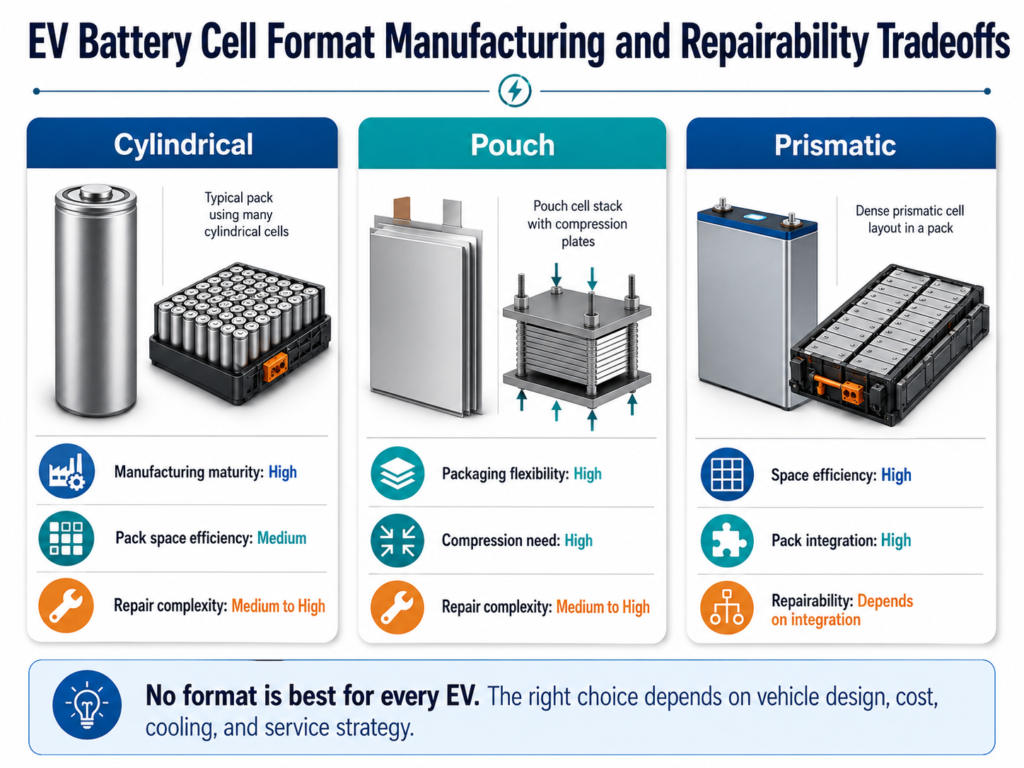
Repairability is another tradeoff where there is no perfect answer. A pack with many small cylindrical cells may have excellent redundancy, but individual cell-level repair is usually not practical for normal service centers. The pack may be designed as a replaceable unit or module-level repair may be possible depending on the design.
A pouch-cell pack may use larger cells grouped into modules. In theory, fewer larger cells can make diagnosis more direct. In practice, swelling, adhesives, cooling plates, and module construction can make repair difficult.
Prismatic packs can reduce part count and improve pack integration, but highly integrated cell-to-pack designs may make module-level replacement harder. If cells are bonded into the pack structure, repairability can suffer even if manufacturing efficiency improves.
This is the tension automakers face. Consumers want lower battery costs and easier repairs. Automakers want fewer parts, lighter packs, better packaging, and lower manufacturing cost. Those goals do not always point in the same direction.
That is why the battery passport and repairability conversation is becoming more important. Our article on battery passports already explains how pack design, cell format, cooling plates, adhesives, and structural components can affect disassembly and recycling. The more integrated the battery becomes, the more important it is to design repair, diagnostics, and recycling pathways from the beginning.
GM’s Prismatic Strategy: Why It Matters
GM’s move toward LMR prismatic cells is one of the clearest recent examples of chemistry and format being chosen together. The chemistry target is LMR: more manganese, less nickel and cobalt, and a cost-performance position between LFP and high-nickel chemistries. The format target is prismatic: rigid rectangular cells that can improve manufacturing and space efficiency.
GM and LG Energy Solution say the LMR prismatic cells are intended for future GM electric trucks and full-size SUVs. GM says the technology could deliver 33% higher energy density than the best-performing LFP-based cells at comparable cost, while helping future electric trucks achieve more than 400 miles of range.
That is significant because trucks and SUVs are difficult EV applications. They need large battery packs, long range, towing capability, durability, and cost control. A chemistry-only improvement may not be enough. The pack must also fit efficiently into the vehicle and be manufacturable at scale.
This is where prismatic cells make strategic sense. Large rectangular cells can reduce part count, simplify pack layout, and improve volume utilization. If LMR chemistry delivers enough energy density at lower material cost, the prismatic format helps turn that chemistry into a vehicle-level advantage. This does not mean GM will use prismatic cells for every EV. It means GM is matching the format to the job.
Tesla 4680 vs BYD Blade vs Pouch Cells
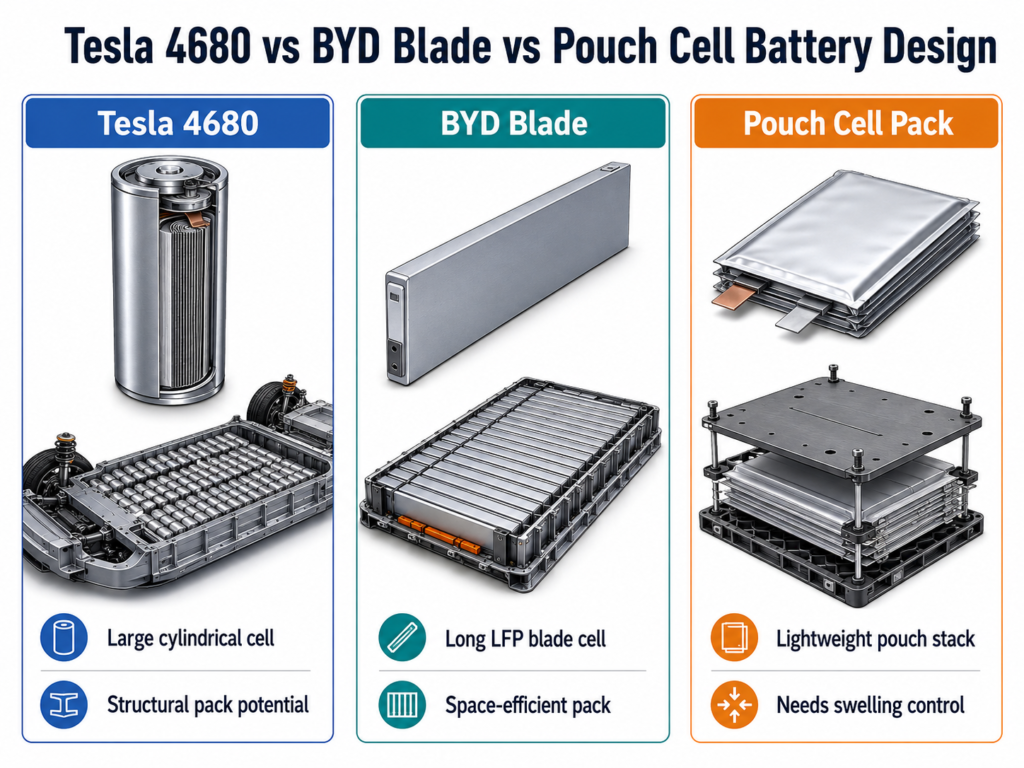
Tesla’s 4680, BYD’s Blade Battery, and conventional pouch-cell packs show three very different philosophies. Tesla’s 4680 approach is built around a large cylindrical cell. The idea is to reduce cell count compared with smaller cylindrical formats, improve current collection, simplify some manufacturing steps, and support structural pack concepts. Panasonic, a major Tesla supplier, prepared for 4680 battery production in Japan, and Reuters reported that the larger cells have about five times the capacity of earlier 2170 cells.
BYD’s Blade Battery takes a different path. It uses LFP chemistry and long blade-shaped cells designed for safety, long life, and efficient packaging. BYD says the design improves space efficiency and supports compact pack construction.
Pouch-cell packs represent another approach. They can be lightweight and space-efficient, and they have been used in many long-range EV platforms. But they depend heavily on compression management, swelling control, and careful thermal design.
None of these approaches is automatically superior. Tesla’s cylindrical strategy makes sense when manufacturing scale, thermal control, and structural integration are optimized around that format. BYD’s Blade strategy makes sense when LFP safety, cost, and space efficiency are the priority. Pouch cells make sense when lightweight packaging and large-format cell integration are engineered well. The winner depends on the vehicle.
Conclusion: Automakers Are Not Switching Randomly
When an automaker changes from pouch to prismatic, or from small cylindrical cells to larger cylindrical cells, it can look like a sudden strategy shift. In reality, it is usually the result of many linked engineering and business decisions.
Cell format affects space utilization, cooling, swelling, compression, manufacturing yield, pack structure, crash design, and repairability. Chemistry affects energy density, cost, safety, cycle life, charging behavior, and material sourcing. The best EV battery strategy combines both.
That is why the future will not belong to only one cell format. Cylindrical cells will remain important where manufacturing maturity, mechanical robustness, and thermal consistency matter. Pouch cells will continue to be useful where lightweight packaging and flexible design are valuable. Prismatic cells will likely keep gaining attention as automakers push toward cell-to-pack layouts, lower part counts, and better volume efficiency.
The bigger trend is not cylindrical versus pouch versus prismatic. The bigger trend is that EV batteries are becoming more integrated with the vehicle itself. Cell format is no longer just a supplier choice. It is becoming a core part of EV platform strategy.
FAQs
Are cylindrical, pouch, and prismatic batteries different chemistries?
No. They are cell formats, not chemistries. Chemistry refers to materials such as LFP, NMC, NCA, or LMR. Format refers to the physical shape and casing of the cell.
Which EV battery cell format is best?
There is no single best format. Cylindrical cells are strong and mature. Pouch cells are lightweight and flexible. Prismatic cells are space-efficient and attractive for cell-to-pack designs. The best choice depends on the vehicle and manufacturing strategy.
Why does Tesla use cylindrical cells?
Tesla has built deep expertise around cylindrical cells, high-volume manufacturing, thermal design, and pack integration. Its 4680 strategy uses a larger cylindrical format to reduce cell count and support structural pack concepts.
Why is BYD’s Blade Battery important?
BYD’s Blade Battery combines LFP chemistry with long, blade-shaped cells designed for safety, long life, and efficient packaging. It is both a chemistry story and a cell-format story.
Why is GM moving toward prismatic cells?
GM and LG Energy Solution plan to commercialize LMR prismatic cells for future electric trucks and full-size SUVs. The strategy combines manganese-rich chemistry with prismatic packaging to improve cost, energy density, and space efficiency.
Do prismatic cells make EV batteries easier to repair?
Not always. Prismatic cells can reduce part count and simplify layout, but highly integrated cell-to-pack designs may be harder to repair at the module level. Repairability depends on pack design, adhesives, cooling structure, diagnostics, and service strategy.