
Quick Answer
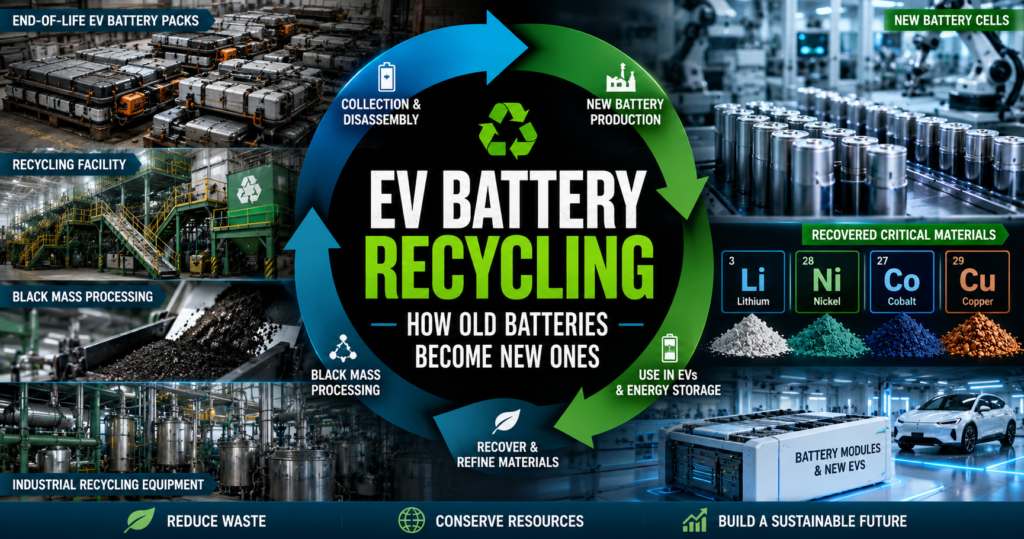
EV battery recycling has become one of the most important topics in the electric vehicle industry. Critics often argue that EV batteries will eventually become a massive waste problem, but the reality is far more complex. In reality, modern EV batteries contain valuable materials such as lithium, nickel, cobalt, copper, and graphite that can often be recovered and reused.
Battery recycling technologies have improved rapidly over the last few years, and 2026 is shaping up to be one of the most important years yet for battery recycling. Companies such as Redwood Materials and Li-Cycle have helped accelerate the industry’s development, while automakers are increasingly pursuing closed-loop supply chains that turn old batteries into new battery materials. The result is that EV batteries are gradually becoming part of a circular economy rather than a disposable product.
Introduction
Whenever electric vehicles are discussed online, one question inevitably appears: “What happens when the battery dies?” Many EV skeptics assume millions of batteries will eventually end up in landfills, creating an environmental disaster.
The reality is quite different. Unlike gasoline, which is burned once and gone forever, battery materials remain valuable after a battery reaches the end of its automotive life. Lithium, nickel, cobalt, copper, aluminum, and graphite can all potentially be recovered and reused. This is one of the reasons battery recycling has become one of the most important trends in the EV industry. As EV adoption continues to grow worldwide, governments, automakers, and recycling companies are investing heavily in technologies that can recover critical materials and reduce dependence on mining. In fact, many experts now view battery recycling as a strategic supply-chain issue rather than simply a waste-management problem.
The Future of EV Battery Recycling in 2026 and Beyond
There are three major reasons why battery recycling is becoming increasingly important.
1. Critical Minerals Are Valuable
Modern lithium-ion batteries contain materials that are expensive and often difficult to source. Examples include lithium, nickel, cobalt, copper, and graphite, etc. Demand for these materials has increased dramatically due to EV production, energy storage systems, consumer electronics, and grid-scale batteries. Recovering materials from used batteries can help supplement future supply chains and reduce reliance on newly mined resources.
2. Battery Production Scrap Is Growing
Interestingly, most battery recycling today does not come from old EVs. Instead, a large portion comes from manufacturing scrap generated during battery production. As gigafactories expand across North America and Europe, large quantities of production scrap are being recycled and returned to the battery supply chain. Companies such as Redwood Materials have built their business around recovering these valuable materials and reintroducing them into battery manufacturing.
3. Millions of EV Batteries Will Eventually Reach End of Life
Most EV batteries last much longer than many people expect. As discussed in our previous article (How Long Do EV Batteries Last? Real-World Data and Battery Degradation (2026)), many modern EV batteries are expected to remain usable for well over a decade. However, even a battery that has degraded below automotive requirements still contains significant quantities of valuable materials. That creates a strong economic incentive to recycle rather than dispose of it.
The EV Battery Recycling Process
The recycling process begins long before valuable metals are recovered.
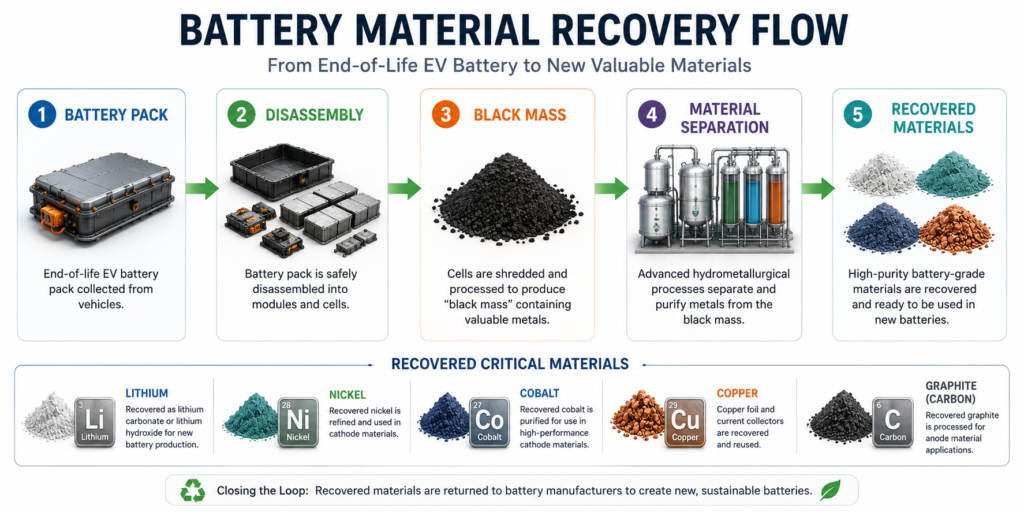
Step 1: Collection and Transportation
Batteries are collected from end-of-life EVs, warranty replacements, manufacturing scrap, damaged battery packs, or consumer electronics. Because lithium-ion batteries can pose fire risks, transportation and handling procedures are tightly regulated.
Step 2: Disassembly
The battery pack is typically dismantled into smaller components. This process may involve pack-level disassembly, module removal, and cell separation. Many recycling companies are investing in automation to reduce labor costs and improve safety.
Step 3: Mechanical Processing
The battery materials are shredded and separated. Materials such as copper, aluminum, plastics, and steel can often be separated mechanically before chemical recovery begins. The remaining mixture is commonly called black mass. Black mass contains many of the battery’s valuable active materials, including lithium, nickel, cobalt, manganese, and graphite.
What Is Hydrometallurgy?
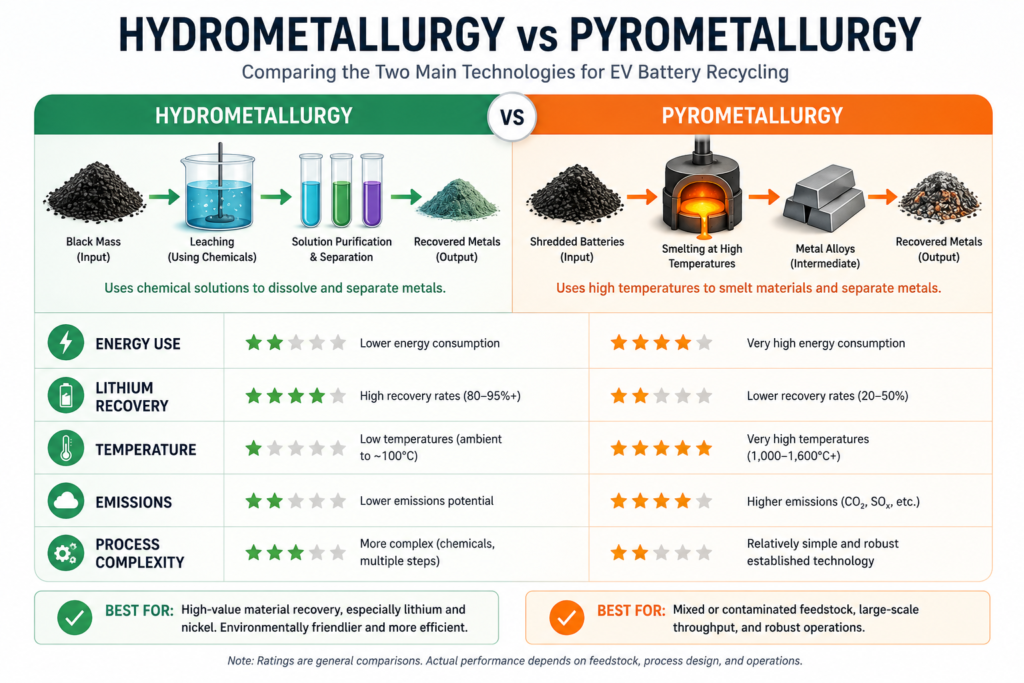
Hydrometallurgy has become one of the most discussed battery recycling technologies in recent years. Instead of using extremely high temperatures, hydrometallurgical processes use chemical solutions to dissolve and separate valuable metals. Its simplified process is shown below:
- Black mass is collected.
- Chemical solutions dissolve metal compounds.
- Metals are selectively separated.
- Battery-grade materials are produced.
The recovered materials can then be used to manufacture new batteries.
Advantages of Hydrometallurgy
Hydrometallurgy offers several benefits such as higher recovery rates, lower energy consumption, better lithium recovery, and reduced emissions compared with some thermal processes. Because lithium is becoming increasingly valuable, the ability to efficiently recover lithium is a major advantage. Many next-generation recycling facilities are focusing heavily on hydrometallurgical methods.
Challenges
Hydrometallurgy is not perfect. Challenges include chemical handling requirements. process complexity, wastewater treatment, and capital investment. Even so, many industry analysts believe hydrometallurgy will play a dominant role in future battery recycling infrastructure.
What Is Pyrometallurgy?
Pyrometallurgy is one of the oldest battery recycling approaches. Rather than dissolving materials chemically, pyrometallurgical processes use extremely high temperatures to recover valuable metals. In simple terms, batteries are smelted in furnaces.
How It Works
The batteries are processed at temperatures often exceeding 1,000°C. This allows valuable metals to be separated into recoverable streams. Historically, pyrometallurgy has been widely used because it can handle mixed battery chemistries and contaminated materials.
Advantages
Benefits include mature industrial process, ability to process mixed feedstocks, robust operation, and established infrastructure.
Limitations
However, pyrometallurgy has several drawbacks such as high energy consumption, lower lithium recovery, higher operating temperatures, and potentially higher emissions. As a result, many modern facilities are moving toward hydrometallurgical or hybrid approaches.
The Rise of Closed-Loop Recycling
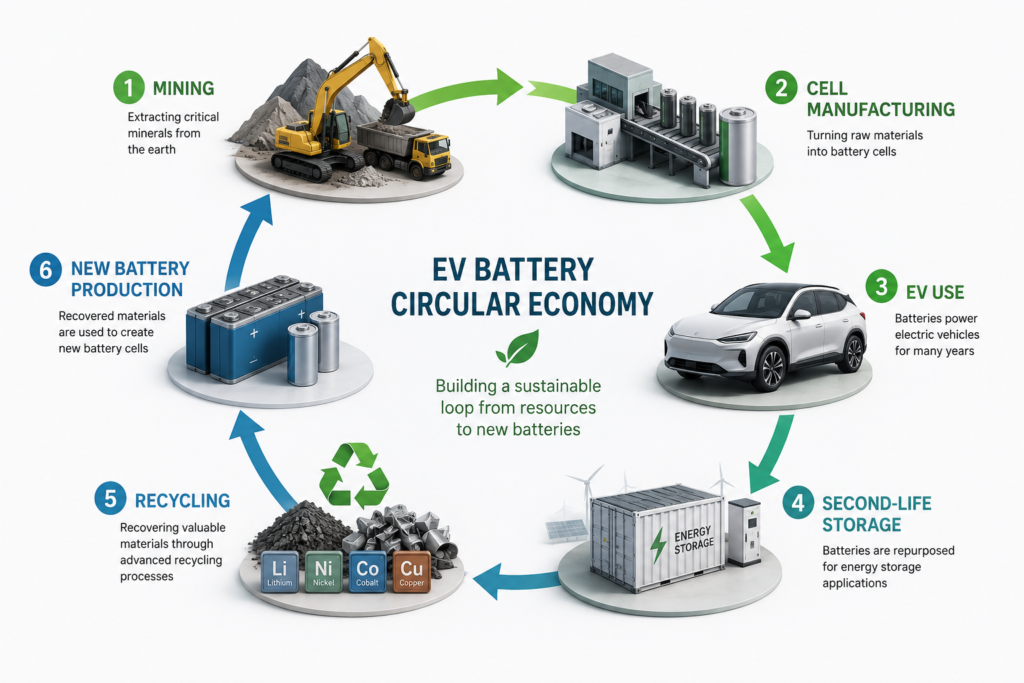
One of the most important trends in 2026 is the growth of closed-loop recycling. Closed-loop recycling means materials recovered from old batteries are used to produce new batteries.
Instead of following a linear path:
Mine → Manufacture → Use → Dispose
the industry aims for:
Mine → Manufacture → Use → Recycle → Manufacture Again
This circular approach reduces waste while improving material security.
Why Automakers Care
Battery materials represent a significant portion of EV costs. Recycling can potentially reduce raw material volatility, improve supply-chain resilience, reduce dependence on imports, and lower environmental impact. For automakers, recycling is increasingly viewed as a strategic business decision rather than simply an environmental initiative.
Redwood Materials: Building a Circular Battery Supply Chain
One of the most influential companies in battery recycling today is Redwood Materials. Founded by Tesla co-founder and former CTO JB Straubel, Redwood has become a major player in North America’s battery ecosystem. Its mission extends beyond recycling. The company aims to create a domestic circular battery supply chain that recovers materials and manufactures battery components using those recovered resources (Redwood Materials News).
According to Redwood, the company recovers critical materials including lithium, nickel, cobalt, and copper, etc. and reintroduces them into battery manufacturing (The Washington Post). The company has established partnerships across the automotive and battery industries and continues expanding its role in both recycling and battery material production (Reuters).
What Happened to Li-Cycle?
No discussion of battery recycling would be complete without mentioning Li-Cycle. Li-Cycle helped popularize the industry’s “Hub and Spoke” recycling model. The concept involved regional “Spoke” facilities processing batteries into black mass and central “Hub” facilities recovering battery materials. For several years, Li-Cycle was considered one of North America’s most promising battery recycling companies. The company also received support through U.S. Department of Energy financing initiatives (The Department of Energy).
However, the company faced significant financial challenges and entered bankruptcy proceedings in 2025 before being acquired by Glencore (Glencore, Canary Media). While Li-Cycle’s difficulties attracted headlines, they do not indicate that battery recycling itself is failing. Instead, they highlight how challenging it can be to scale large industrial recycling operations. The broader battery recycling industry continues to expand rapidly.
Can EV Batteries Be Reused Before Recycling?
Another growing trend is second-life battery applications. An EV battery may no longer be ideal for vehicle use after significant degradation. However, it may still retain 70–80% of its original capacity or adequate performance for stationary storage. These batteries can be repurposed for solar energy storage, commercial backup power, grid support systems, or data center energy storage.
Only after this second-life phase ends are the batteries fully recycled. Companies including Redwood Materials have recently expanded their focus into second-life battery energy storage systems as part of a broader circular economy strategy (Business Insider, Canary Media).
The Future of Battery Recycling in 2026 and Beyond
Battery recycling is transitioning from a niche industry to a critical component of the EV supply chain.
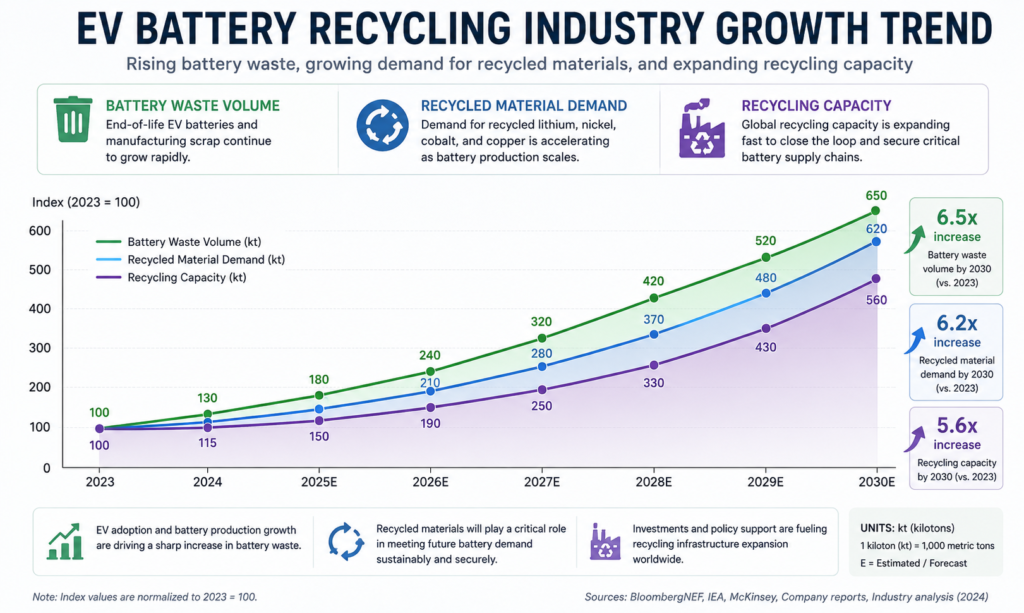
Several trends are shaping the market:
Increased Lithium Recovery
Historically, lithium recovery was challenging. New recycling technologies are improving lithium recovery rates and making recovered lithium economically attractive.
More Domestic Processing
Governments increasingly view battery materials as strategic resources. North America and Europe are investing heavily in domestic recycling infrastructure to reduce supply-chain vulnerabilities.
Gigafactory Integration
Many battery manufacturers are integrating recycling directly into production facilities. Manufacturing scrap can be recycled immediately and returned to production, reducing waste and lowering material costs.
Closed-Loop Supply Chains
Perhaps the biggest trend is the move toward fully circular battery ecosystems. Future batteries may increasingly contain materials recovered from previous generations of batteries. This could eventually reduce dependence on newly mined materials while improving long-term sustainability.
Conclusion
The idea that EV batteries will simply pile up in landfills is increasingly outdated. In reality, battery recycling has become one of the most important developments in the EV industry.
Modern recycling technologies such as hydrometallurgy and pyrometallurgy are enabling valuable materials to be recovered from end-of-life batteries and manufacturing scrap. Meanwhile, companies like Redwood Materials are pushing the industry toward a true closed-loop supply chain, while the lessons learned from Li-Cycle illustrate both the opportunities and challenges involved in scaling battery recycling.
As EV adoption continues to grow, battery recycling will likely become a major source of lithium, nickel, cobalt, copper, and other critical materials. In other words, the future of EV batteries may not be a landfill. It may be another EV battery.
Related Articles
How Long Do EV Batteries Last? Real-World Data and Battery Degradation (2026)
LFP vs NMC Batteries: Which EV Battery Is Better in 2026?
EV Battery SOH Explained: How State of Health Is Actually Measured in 2026
EV Battery Management System Explained: How Modern EV BMS Actually Work (2026)
Solid-State Batteries Explained: Hype vs Reality in 2026