
Quick Answer
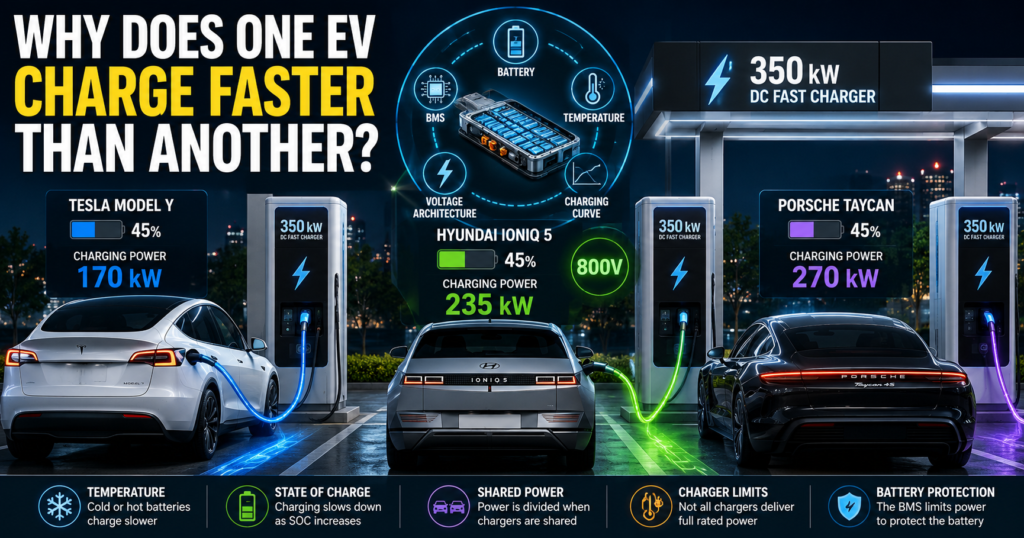
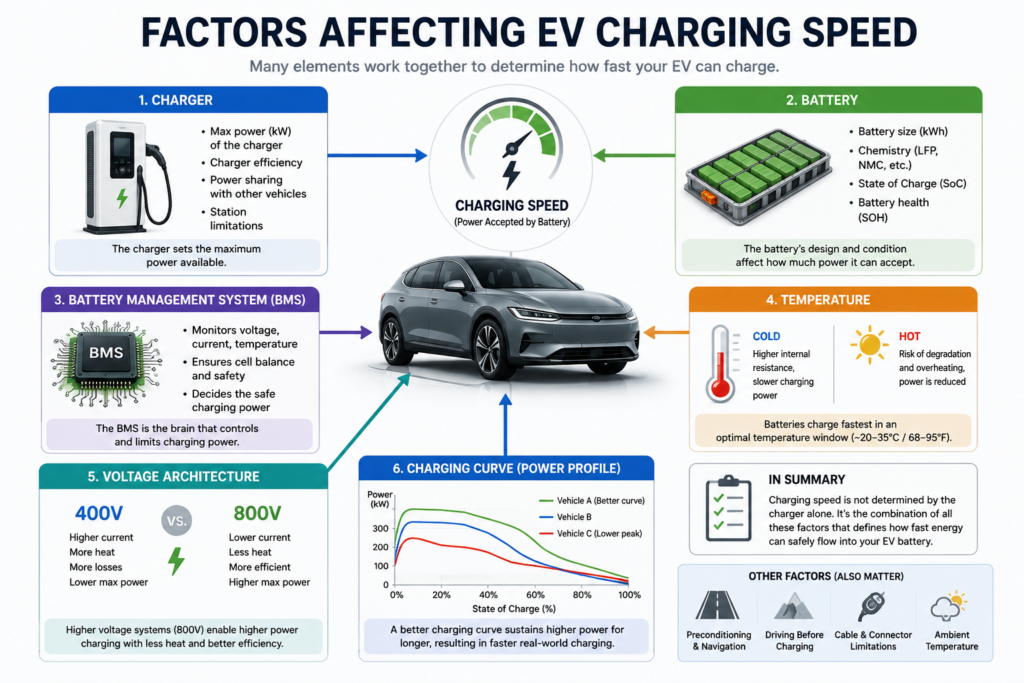
Many EV owners assume charging speed is determined solely by the charger they plug into. In reality, charging speed depends on a combination of factors including battery chemistry, battery size, thermal management, voltage architecture (400V vs 800V), battery temperature, state of charge, and the vehicle’s charging curve.
This is why a Hyundai IONIQ 5 can often charge significantly faster than a Tesla Model Y under ideal conditions, even when both are connected to the same high-power DC fast charger. The charger is only part of the equation—the vehicle itself ultimately determines how much power it can accept.
Introduction
Why some EVs charge faster than others is one of the most common questions among new EV buyers. It’s a fair question. You might pull into a charging station and see an IONIQ 5, Kia EV6, Porsche Taycan, Tesla Model Y, Ford Mustang Mach-E, and Rivian R1T all connected to similar chargers. Yet some vehicles finish charging and leave long before others.
The difference isn’t marketing hype. There are real engineering reasons why charging performance varies so dramatically between EVs. Understanding those reasons can help you choose the right EV, set realistic charging expectations, and avoid frustration when your vehicle doesn’t reach the charging speeds shown in advertisements.
The Charger Does Not Control Everything
A common misconception is that a 350 kW charger automatically delivers 350 kW to any EV. It doesn’t. Think of the charger as a water pipe and the battery as a container. The pipe may be capable of delivering a huge amount of water, but the container determines how quickly it can safely accept that flow. If your EV is designed to accept only 150 kW, plugging into a 350 kW charger won’t magically make it charge at 350 kW. The vehicle’s battery management system (BMS) continuously determines how much charging power can be safely accepted based on battery conditions. In many cases, the vehicle—not the charger—is the limiting factor.
Why Some EVs Charge Faster Than Others: IONIQ 5 vs Tesla Model Y
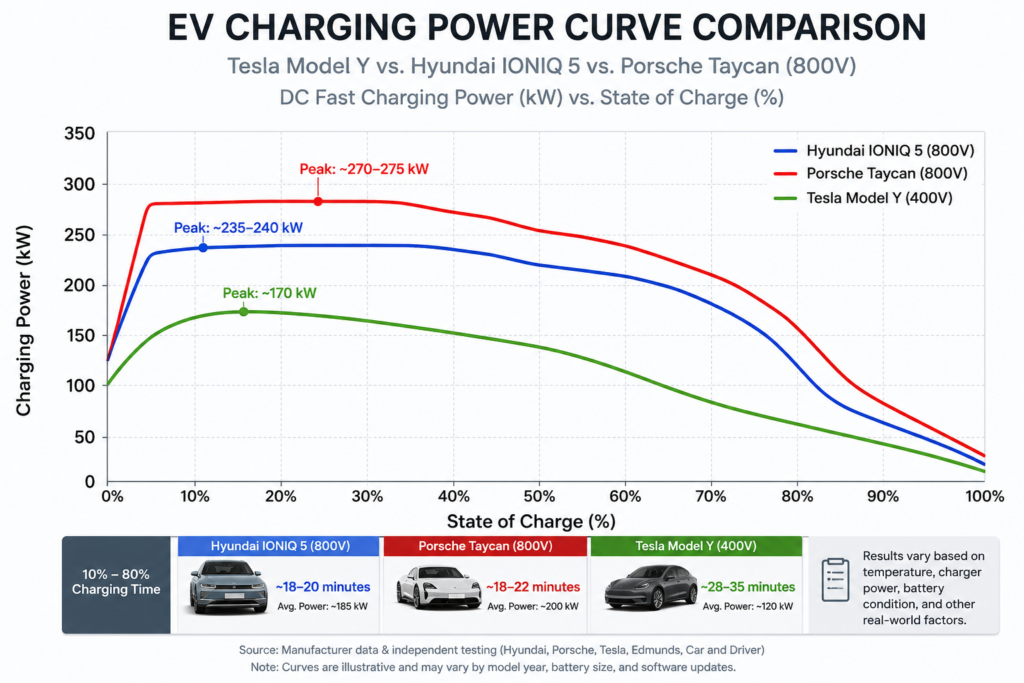
This question appears frequently in search results and EV forums. The answer largely comes down to voltage architecture. The Hyundai IONIQ 5 uses Hyundai’s E-GMP platform with an 800-volt battery architecture, while most Tesla Model Y variants use a 400-volt architecture. Hyundai’s platform supports both 400V and 800V charging and can charge from 10% to 80% in approximately 18–20 minutes under ideal conditions on a 350 kW charger (Hyundai News, Hyundai USA).
Meanwhile, Tesla vehicles are extremely efficient and benefit from the extensive Supercharger network, but their charging behavior follows a different design philosophy focused on overall road-trip efficiency rather than achieving the highest peak charging number (Tesla Supercharging, Tesla Supercharger). The key point is that charging speed is not determined by peak power alone. What matters more is how long a vehicle can sustain high charging power.
Peak Charging Speed Is Often Misleading
Automakers love advertising peak charging rates. You’ll often see claims like 150 kW charging, 250 kW charging, or 350 kW charging. However, peak power may last only a few minutes. A more useful metric is the charging curve. The charging curve shows how charging power changes as the battery fills. Two vehicles may both reach 250 kW momentarily, yet one may complete a 10%–80% charging session significantly faster because it maintains higher power for longer. Imagine two runners:
- Runner A sprints briefly and then slows dramatically.
- Runner B runs slightly slower but maintains that pace consistently.
Runner B often reaches the finish line first. EV charging works similarly. This is why experienced EV owners often pay more attention to 10–80% charging time than maximum charging power.
Battery Temperature Matters More Than Most Drivers Realize
Temperature is one of the biggest factors affecting charging speed. Lithium-ion batteries operate best within a relatively narrow temperature range. When batteries are too cold internal resistance increases, charging efficiency decreases, lithium plating risks increase, and charging power is restricted. On the other hand, when batteries are too hot, degradation accelerates, thermal protection systems reduce charging power, and charging speed is limited to protect battery life. This is why battery preconditioning has become increasingly important.
Modern EVs often warm or cool the battery before arriving at a fast charger so that charging can begin immediately at higher power levels. If you’ve already read our article on EV battery preconditioning, you’ve seen how temperature preparation can dramatically improve charging performance. Tesla, Hyundai, Kia, Rivian, Lucid, and many newer EVs now use some form of battery preconditioning before DC fast charging (Tesla Supercharger, Tesla Charging).
Battery Size Also Influences Charging Speed
Here’s something many new EV buyers don’t realize. A larger battery can often accept more charging power. Consider two hypothetical vehicles: Vehicle A: 50 kWh battery and Vehicle B: 100 kWh battery. Even if both batteries are designed with similar cell technology, the larger battery may safely absorb more total power because that energy is distributed across more cells. This doesn’t always happen, but battery capacity frequently influences charging capability. It’s one of the reasons larger premium EVs often achieve higher charging rates than smaller, budget-focused models.
Battery Chemistry Plays a Major Role
Not all lithium-ion batteries are identical. Today’s EV market primarily uses LFP (Lithium Iron Phosphate), NMC (Nickel Manganese Cobalt), and NCA (Nickel Cobalt Aluminum). Each chemistry has different characteristics related to energy density, cost, thermal behavior, charging performance, and long-term durability. Some chemistries tolerate aggressive charging better than others. Others prioritize longevity over charging speed. If you’d like a deeper explanation of battery chemistry differences, see LFP vs NMC Batteries: Which EV Battery Is Better in 2026?. As battery technology continues evolving, charging performance differences between chemistries may become even more significant.
The Battery Management System Is Constantly Making Decisions
Drivers often think the battery itself determines charging speed. In reality, the Battery Management System (BMS) acts as the gatekeeper. The BMS continuously monitors cell voltages, cell temperatures, current flow, state of charge, and battery health. Based on this information, the BMS decides how much charging power can safely enter the battery. Even when a charger can provide more power, the BMS may intentionally reduce charging speed to protect the battery. This protective behavior helps maximize battery lifespan while minimizing safety risks. For a deeper look at how modern BMS systems work, see EV Battery Management System Explained: How Modern EV BMS Actually Work (2026).
Why Your EV May Charge Slower Than Advertised
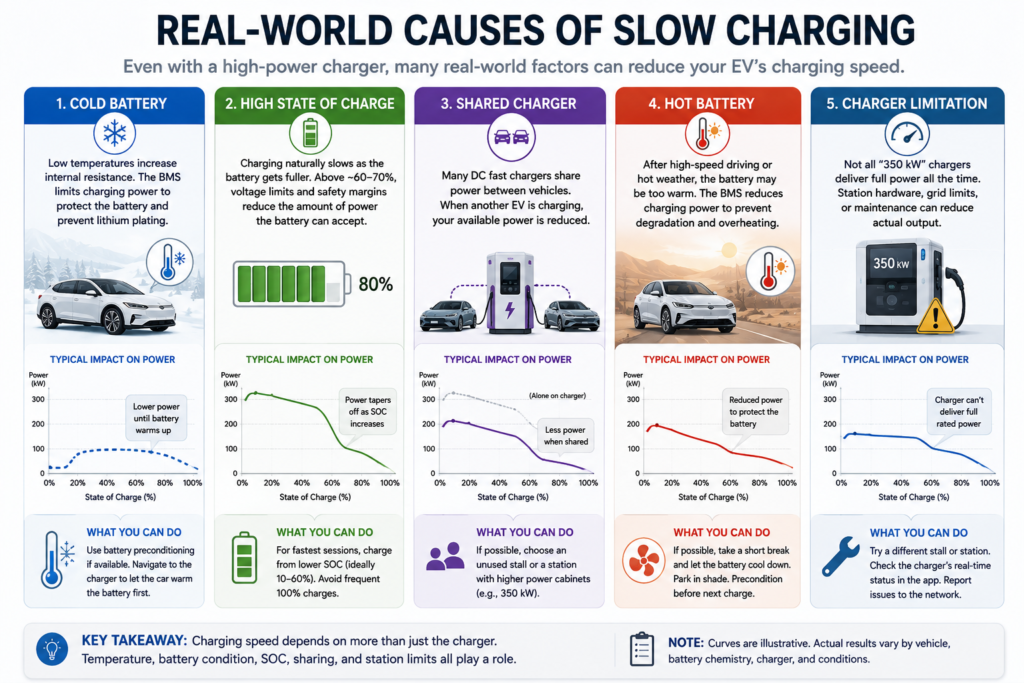
This is another extremely common search query. Manufacturers usually publish charging figures under ideal conditions such as optimal battery temperature, high-power charger, low state of charge, no charger sharing, or mild ambient temperatures. Real-world conditions rarely match those assumptions. Your charging session may be slower because the battery is cold, the battery is already above 60–70% state of charge, the charger is power-limited, another vehicle is sharing power from the same charging cabinet, the battery pack is hot after extended driving, the charging station itself may be experiencing limitations, etc. In many cases, the vehicle is functioning normally. The advertised number simply represents the best-case scenario rather than what drivers experience every day.
Why Charging Always Slows Near Full
Many first-time EV owners become concerned when charging speed drops dramatically above 80%. This behavior is completely normal. As battery state of charge increases, cell voltage rises closer to its safe maximum limit. To prevent overcharging, the charging process gradually transitions from high-current charging to lower-current charging. The closer the battery gets to full, the more carefully energy must be added. This is why charging from 10% to 60% can be surprisingly fast, while charging from 80% to 100% can take almost as long. We covered this topic in detail in Why EV Batteries Charge Slower Above 80% (And Why That’s Normal). Tesla explicitly notes that charging speeds slow as the battery fills and that reaching 100% generally takes much longer than reaching 80% (Tesla Supercharging, Tesla Supercharger).
The Hidden Advantage of 800V Architectures
Over the last few years, 800V systems have become one of the biggest trends in EV engineering. Higher voltage allows the same power to be delivered with lower current. Lower current reduces resistive losses, cable heating, connector heating, and cooling requirements. This makes it easier to sustain very high charging power. Hyundai’s E-GMP platform, used in the IONIQ 5 and IONIQ 6, was specifically designed around this concept and supports ultra-fast charging on both 400V and 800V infrastructure (Hyundai News, Hyundai). If you’d like a deeper technical explanation, see 400V vs 800V EV: Why Higher Voltage Matters. As more manufacturers move toward 800V platforms, charging times across the industry are likely to continue improving.
Charging Speed Is Becoming a Competitive Battleground
A few years ago, EV marketing focused heavily on driving range. Today, charging performance is becoming just as important. Many buyers are discovering that A vehicle with slightly less range but much faster charging may actually be more convenient on long trips. Manufacturers are responding by investing heavily in better thermal management, improved charging curves, advanced battery chemistry, higher-voltage architectures, and smarter battery preconditioning. The result is that modern EVs are charging substantially faster than models introduced just a few years ago.
Conclusion
When people ask why some EVs charge faster than others, the answer is rarely a single factor. Charging speed depends on a complex interaction between battery chemistry, battery size, thermal management, BMS strategy, charging curve design, voltage architecture, and battery temperature. This is why two vehicles connected to the exact same charger can exhibit dramatically different charging behavior. It’s also why comparing only peak charging power can be misleading.
The fastest-charging EVs are not necessarily the ones with the biggest advertised number. They are the vehicles that combine efficient thermal management, intelligent battery control, and optimized charging curves to maintain high charging power throughout the session. As battery technology continues to improve, the gap between today’s charging experience and traditional refueling will likely keep shrinking.