
Quick Answer
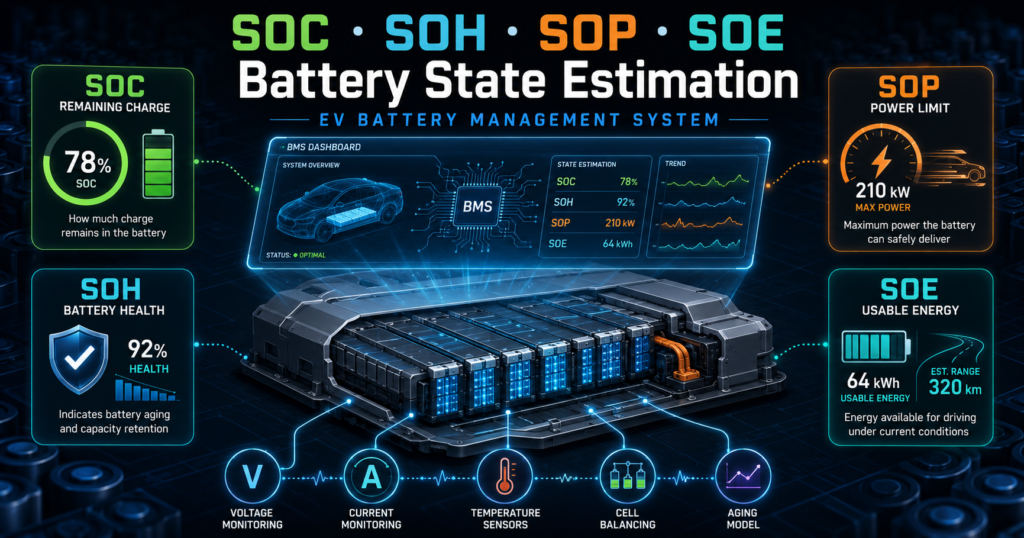
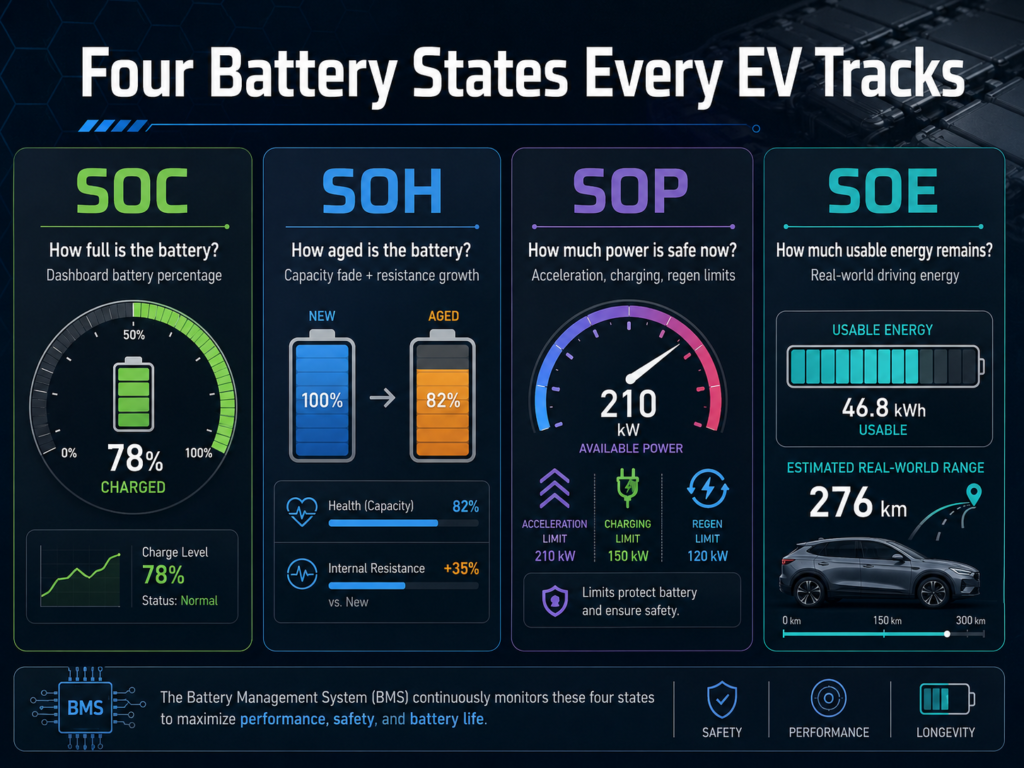
SOC SOH SOP SOE battery estimates are four key values that help an electric vehicle understand what its battery can safely do. SOC, or State of Charge, tells the EV roughly how full the battery is. SOH, or State of Health, estimates how much the battery has aged compared with when it was new. SOP, or State of Power, tells the vehicle how much power the battery can safely deliver or accept right now. SOE, or State of Energy, estimates how much usable energy is actually available for driving, heating, cooling, and other vehicle loads.
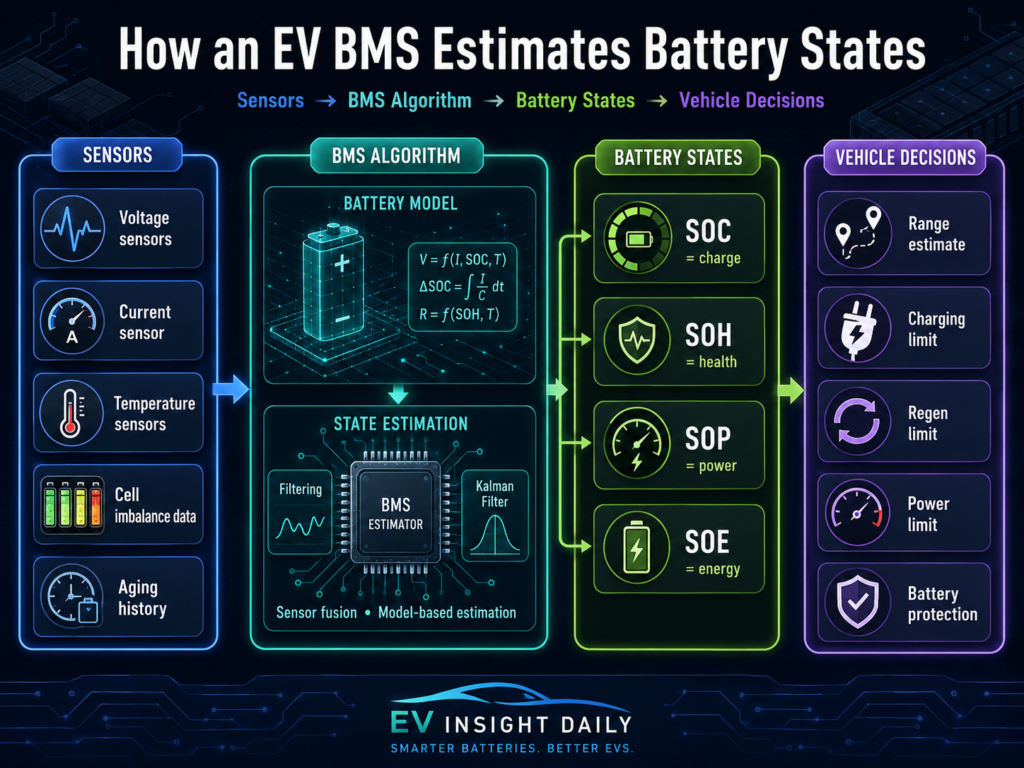
The important part is that none of these values comes from a simple fuel-gauge sensor. A modern EV battery management system, or BMS, estimates them using voltage, current, temperature, cell imbalance, aging history, and software algorithms. That is why two EVs showing the same battery percentage can behave very differently in cold weather, during fast charging, or after years of use.
Introduction: Your EV Battery Is Not Just a Big Fuel Tank
Most EV drivers know one battery number better than any other: the percentage on the dashboard. At 80%, the car feels ready for a normal day. At 30%, you may start thinking about your next charging stop. At 5%, the dashboard suddenly feels more serious. But inside the vehicle, the battery system is not only asking, “How full is the battery?” It is asking several questions at the same time.
How much charge is left? How much usable capacity has the battery lost over time? How much power can the battery safely provide for acceleration? How much regenerative braking can it accept? How much real energy remains after temperature, voltage limits, aging, and cell imbalance are considered?
Those questions are answered through battery state estimation. The four most important terms are SOC, SOH, SOP, and SOE. They sound technical, but they directly affect things EV owners notice every day: range estimate, fast charging speed, acceleration, regenerative braking, cold-weather performance, battery warranty, and long-term degradation.
The U.S. Department of Energy explains that rechargeable batteries store and release energy through the movement of ions and electrons between electrodes. That basic electrochemical process is what makes lithium-ion batteries work, but an EV cannot directly “see” every reaction happening inside the cells. It has to estimate battery condition from measurable signals such as voltage, current, and temperature. You can read the DOE’s battery basics overview here: DOE Explains…Batteries. That is where the BMS becomes one of the most important pieces of software in the car.
EV Insight Daily has already covered the broader BMS topic in EV Battery Management System Explained: How Modern EV BMS Actually Work. This article goes one layer deeper by focusing on the four “state” values that turn raw battery measurements into useful vehicle decisions.
What the BMS Actually Does
A battery management system is the control brain of the high-voltage battery pack. It monitors the pack, protects the cells, estimates usable limits, balances cell groups, communicates with the rest of the vehicle, and helps decide when power or charging should be limited.
In a modern EV, the BMS is not just a safety switch. It is constantly interpreting battery behavior. It measures cell voltages. It measures pack current. It reads temperature sensors across different areas of the battery. It watches how cells respond during charging and discharging. It tracks how much current has flowed in and out over time. It estimates resistance growth, capacity fade, and imbalance. Then it turns all of that information into limits the rest of the vehicle can use.
For example, the motor inverter may ask for high power during a highway merge. The onboard charging system may ask whether the pack can accept a certain DC fast-charging current. The thermal management system may ask whether the battery needs heating or cooling. The dashboard may ask how much range to display.
The BMS has to answer all of those questions without pushing the battery outside safe voltage, current, temperature, and aging limits. That is why SOC, SOH, SOP, and SOE are not just engineering acronyms. They are the software layer that makes the battery usable in the real world.
SOC: State of Charge Is the Battery Percentage, But It Is Not Simple
SOC stands for State of Charge. It is the battery’s estimated charge level, usually shown as a percentage. In simple terms, SOC is the EV version of a fuel gauge. A battery at 80% SOC has more available charge than the same battery at 30% SOC.
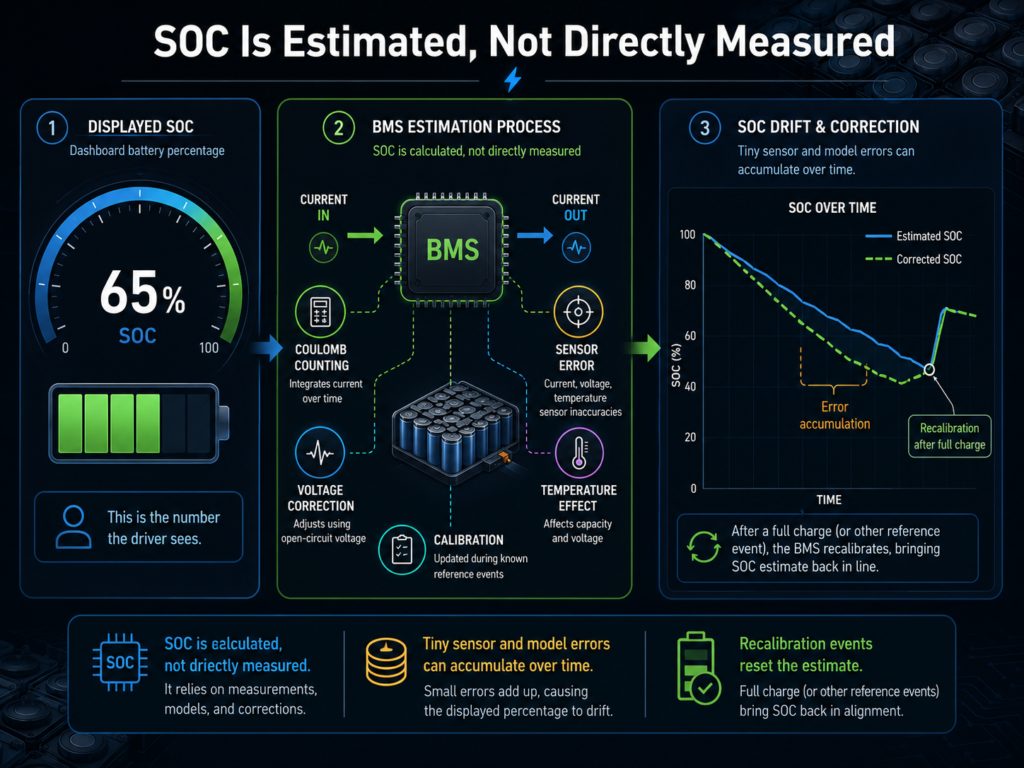
But unlike gasoline in a tank, battery charge is not measured by a float sensor. There is no simple device inside each cell that says, “I am exactly 63% full.” Instead, the BMS estimates SOC. One basic method is coulomb counting. The system measures current flowing into and out of the battery and integrates that current over time. If current flows out during driving, SOC goes down. If current flows in during charging or regenerative braking, SOC goes up.
That sounds straightforward, but real batteries make it difficult. Current sensors have small errors. Battery capacity changes with age. Voltage response changes with temperature. Some battery chemistries, especially LFP batteries, have relatively flat voltage curves across much of their operating range, which makes voltage-based SOC correction harder.
BioLogic’s explanation of battery state indicators defines State of Charge as the ratio of remaining charge to the maximum charge the battery can deliver, expressed as a percentage. Their overview also explains why SOC and SOH are different measurements, even though drivers often mix them together. You can read it here: What are SOC and SOH of a battery, how to measure them?
In everyday EV ownership, SOC affects the number drivers see most often. But the car’s true usable range depends on more than SOC alone. A 75% battery on a warm spring day may deliver excellent range. The same 75% battery on a freezing morning may deliver less usable energy because some energy goes to cabin heating, the pack has higher resistance, and the BMS may limit available power until the battery warms up. That is why SOC is important, but incomplete.
Why SOC Can Drift Over Time
SOC estimation can drift because it is an estimate, not a direct measurement. If the BMS relies heavily on coulomb counting, tiny current measurement errors can accumulate. If the vehicle is used mostly between 40% and 70%, the BMS may have fewer opportunities to recalibrate near the top or bottom of the pack. If the battery is cold, voltage response may look different from normal. If the battery has aged, the original capacity assumption may no longer be accurate.
Battery University explains a related issue in its fuel-gauge discussion: a displayed state-of-charge value does not automatically guarantee runtime, because actual runtime depends on the battery’s usable capacity and condition. That article is not EV-specific, but the basic point applies strongly to electric vehicles. You can read it here: BU-602: How does a Battery Fuel Gauge Work? This is one reason EVs sometimes adjust displayed range after a full charge, after a software update, after a long road trip, or after a period of unusual driving.
Recent battery research continues to focus on better SOC estimation because conventional model-based methods can struggle with open-circuit-voltage accuracy, computational load, and changing battery conditions. A 2024 research paper from UC Berkeley researchers proposed a “Relax, Estimate, and Track” method to improve SOC and SOH estimation by briefly resting the cell during charging. You can find the paper here: Relax, Estimate, and Track: a Simple Battery State-of-charge and State-of-health Estimation Method. For drivers, the practical lesson is simple: SOC is usually useful, but it is not laboratory-grade truth.
SOH: State of Health Measures Battery Aging
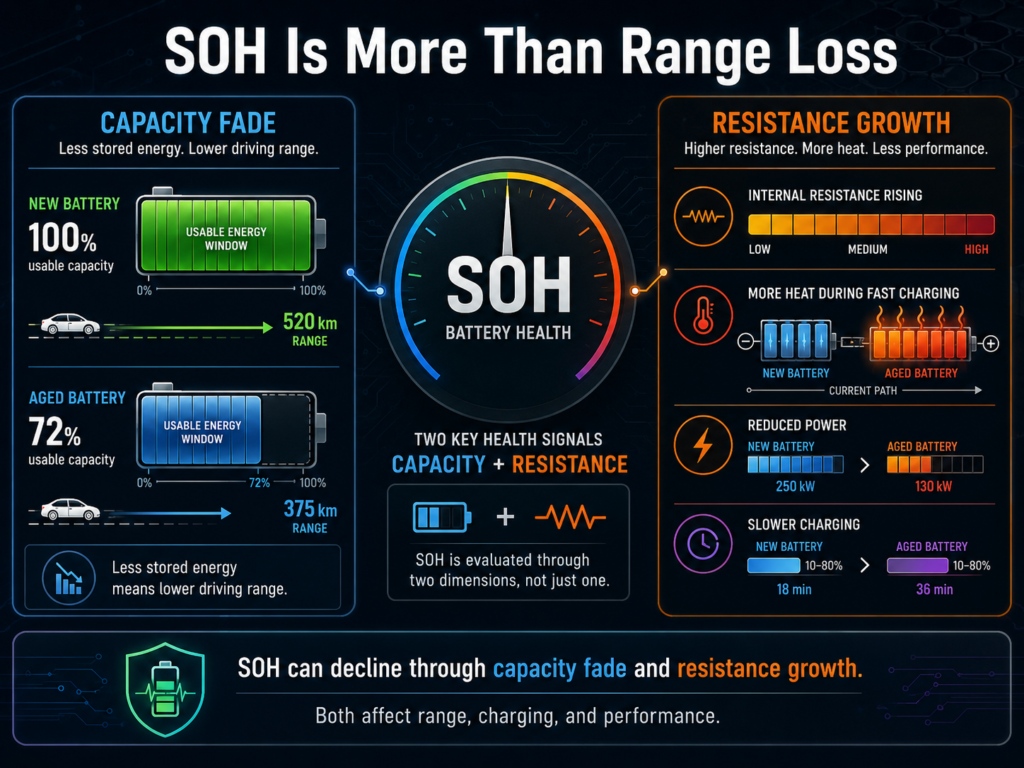
SOH stands for State of Health. If SOC asks, “How full is the battery right now?” SOH asks, “How much has this battery changed since it was new?” This is one of the most misunderstood EV battery metrics. A new battery may start near 100% SOH. Over time, the battery loses some usable capacity and may gain internal resistance. Capacity fade reduces how much energy the pack can store. Resistance growth affects heat generation, fast charging performance, power output, and efficiency. SOH tries to summarize that aging.
There are two common ways to think about SOH. One is capacity-based SOH. If a battery originally had 80 kWh of usable capacity and now has 72 kWh under comparable test conditions, it may be described as having about 90% capacity-based SOH. The second is resistance-based SOH. If internal resistance rises significantly, the battery may still store a decent amount of energy, but it may deliver less peak power, generate more heat, or charge more slowly.
This is why SOH is not always a single perfect number. A 2025 Nature Communications paper on EV battery state-of-health evaluation explains that SOH is commonly defined by either capacity relative to initial capacity or internal resistance relative to a new battery. You can read the open-access study here: Multi-modal framework for battery state of health evaluation using open-source electric vehicle data.
EV Insight Daily has already covered this topic in detail in EV Battery SOH Explained: How State of Health Is Actually Measured in 2026. That article focused on capacity fade, internal resistance, coulomb counting, voltage analysis, model-based estimation, and EIS. This article takes a wider view by explaining how SOH connects with SOC, SOP, and SOE inside the full vehicle control strategy.
SOH Is Not Just About Range
Many drivers think SOH only affects range. That is partly true, but incomplete. A lower-SOH battery usually stores less energy, so the vehicle may travel fewer miles on a full charge. But aging also affects how the pack behaves under stress.
An older battery may heat up more during fast charging. It may accept less regenerative braking when cold or near full. It may deliver less peak acceleration at low SOC. It may have more cell-to-cell variation, which means the weakest cell group can limit the whole pack. That last point matters more than most people realize.
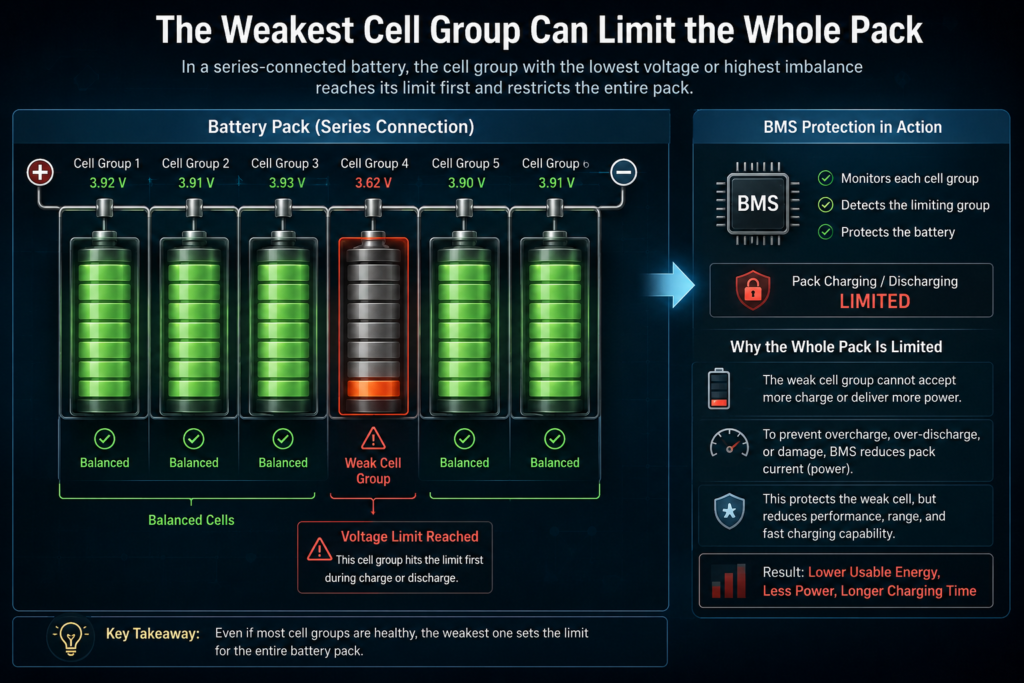
An EV battery pack is made of many cells connected in series and parallel. The pack is only as usable as its most limiting cell groups. If one cell group reaches a voltage limit earlier than the others, the BMS may stop charging or discharging even though other cells still have room. This is why battery balancing is not just a background maintenance function. It directly affects usable energy, charging behavior, and long-term consistency.
The need for clearer battery health reporting is also becoming more important as more EVs enter the used market. A 2025 paper argues that the industry still lacks a fully standardized vehicle-level SOH definition and proposes capacity- and energy-based metrics for EV battery pack assessment. You can read it here: Why we need a standardized state of health definition for electric vehicle battery packs. That point matters for drivers because two vehicles may both claim “90% battery health,” while the underlying meaning of that number can vary depending on how it was measured.
SOP: State of Power Explains Acceleration, Fast Charging, and Regen Limits
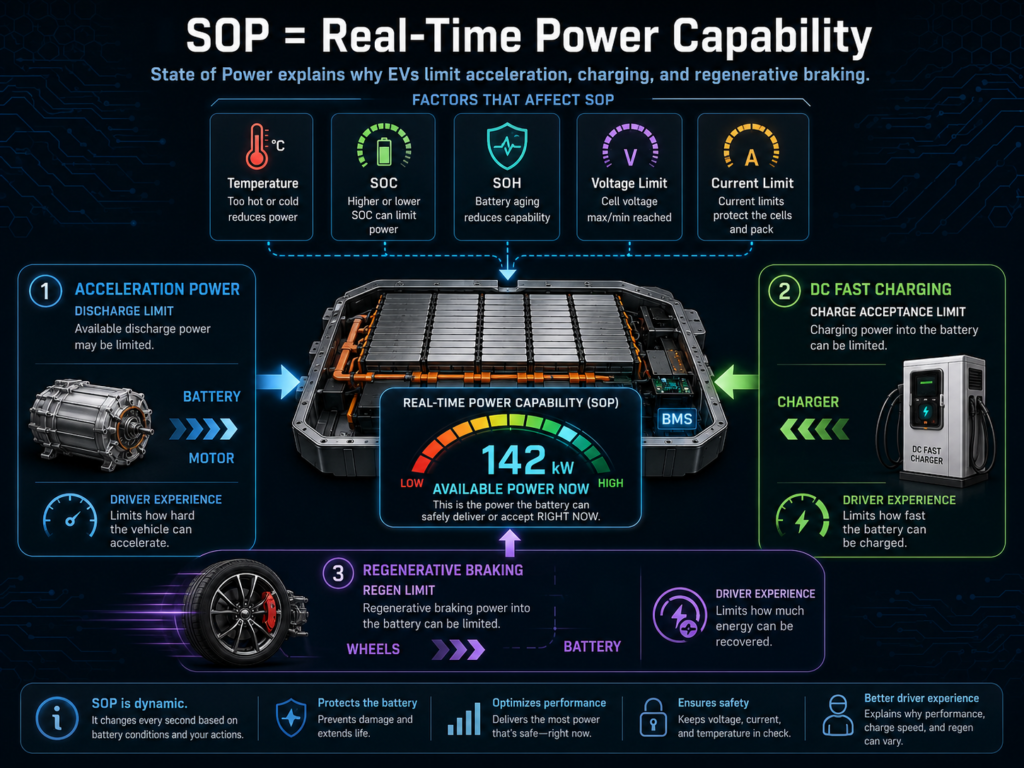
SOP stands for State of Power. It estimates how much power the battery can safely deliver or accept at a given moment. This is different from SOC. A battery can be 70% full but still have limited power if it is very cold. A battery can be 90% full and unable to accept much regenerative braking because there is not enough voltage headroom. A battery can have enough energy for driving but reduced peak output because it is hot, old, imbalanced, or close to a voltage limit.
SOP is the BMS answer to practical questions like these:
- Can the battery safely provide high power for acceleration right now?
- Can it accept strong regenerative braking on a downhill road?
- Can it accept 150 kW, 250 kW, or more from a DC fast charger?
- Can it support full performance in cold weather?
BatteryDesign.net describes State of Power as a key BMS output that accounts for SOC, SOH, temperature, and other parameters to estimate how much power a pack can deliver over a short window such as 10 or 30 seconds. You can read their explanation here: State of Power. In a driver’s daily experience, SOP shows up as power limiting.
You may see reduced acceleration when the battery is very cold. You may see reduced regenerative braking when the pack is full. You may see charging speed taper as SOC rises. You may notice that an older EV still has usable range but does not fast charge quite like it did when new. Those are not random behaviors. They are BMS decisions based on real-time power limits.
Why Temperature Has Such a Big Effect on SOP
Temperature changes nearly everything about battery behavior. At low temperatures, lithium-ion movement slows, internal resistance rises, and charging becomes more difficult. If the BMS allowed high charging power into a cold battery, the risk of lithium plating could increase. During driving, a cold pack may also deliver less peak power until it warms up.
At high temperatures, the concern changes. The battery may be able to deliver power, but doing so could generate more heat and accelerate degradation. The BMS may reduce charging or discharging power to protect the cells. This is why thermal management and battery state estimation are deeply connected. The car is not only trying to keep the battery comfortable. It is trying to keep SOC, SOH, SOP, and SOE estimates valid under changing conditions.
This also explains why preconditioning matters before DC fast charging. A properly warmed battery can often accept higher power safely. A cold battery may have the same SOC but a much lower charge-acceptance limit.
EV Insight Daily’s article Lithium Plating Explained: The Hidden Enemy of Fast Charging explains why cold temperature, high current, and high SOC can create difficult charging conditions. Our article Can EV Batteries Really Charge in 6 Minutes? Fast-Charging Claims Explained also explains why cell-level fast-charging claims do not directly translate to full-pack vehicle charging. SOP is one of the hidden reasons. A vehicle has to respect real-time pack-level power limits, not just what one lab cell can do under ideal conditions.
SOE: State of Energy Is the Range Number’s Quiet Partner
SOE stands for State of Energy. It is often less familiar than SOC or SOH, but it is extremely important for real-world EV range. SOC is about charge. SOE is about usable energy. That distinction matters because charge and energy are not exactly the same thing. Battery energy depends on voltage as well as charge. A simplified relationship is:
Energy ≈ Voltage × Charge
As a battery discharges, voltage changes. As temperature changes, usable voltage behavior changes. As the battery ages, resistance increases and usable energy can drop. As cells become imbalanced, the pack may hit voltage limits earlier than expected.
SOE tries to estimate how much usable energy remains after those factors are considered. This is closer to what drivers actually care about. You do not drive on percentage points. You drive on usable kilowatt-hours. A technical paper in Batteries & Supercaps describes State of Energy as an important measure of residual energy in lithium-ion batteries and explains why accurate SOE estimation matters for diagnostics and operation. You can read the abstract here: Understanding the Energy Potential of Lithium-Ion Batteries.
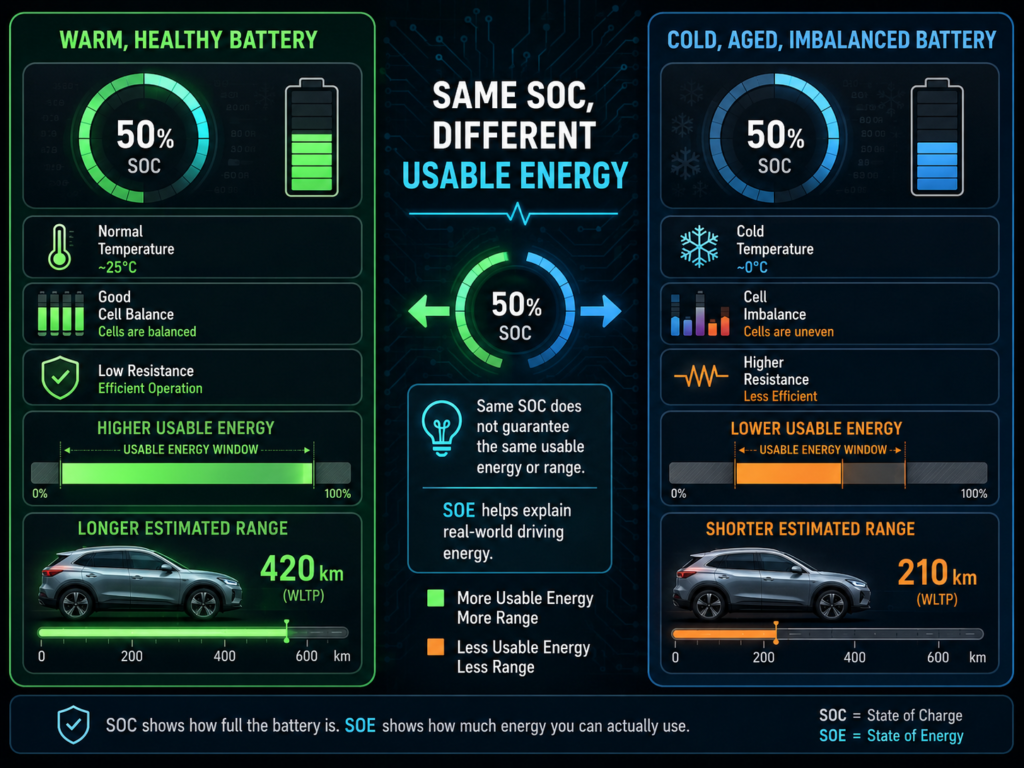
For a practical EV example, imagine two vehicles both showing 50% SOC. One has a healthy, warm battery with well-balanced cells. The other has an older, cold battery with higher resistance and more imbalance. The SOC number may look similar, but the usable energy available for propulsion, cabin heating, and accessories may be different. SOE helps bridge that gap.
It also matters for route planning. A smart range estimate needs more than SOC. It needs usable energy, recent efficiency, terrain, speed, weather, HVAC load, battery temperature, and sometimes charger arrival targets. This is why modern EV range estimates are software products, not simple math.
SOC vs SOE: Why 50% Does Not Always Mean Half the Range
A common assumption is that 50% SOC means exactly half the range remains. In real driving, that is only sometimes true. At moderate temperatures on flat roads, the relationship may look fairly close. But in cold weather, at high highway speeds, while towing, or during mountain driving, the range estimate can change quickly.
The battery may still be at 50% SOC, but the car’s energy consumption per mile may rise. The battery may also have less usable energy because of temperature-dependent limits. Meanwhile, HVAC demand may take a larger share of available energy.
SOE is especially useful because it connects battery physics to vehicle-level range estimation. A battery pack is not just a container of charge. It is a system with voltage limits, current limits, thermal limits, and aging limits. SOE is an attempt to translate that complex system into usable energy.
This is also why a range estimate can improve after the battery warms up, after driving style changes, or after navigation recalculates expected energy use. The battery percentage may not change much, but the vehicle’s estimate of usable energy and expected consumption can change.
How SOC, SOH, SOP, and SOE Battery Estimates Work Together
SOC, SOH, SOP, and SOE are easiest to understand separately, but in a real EV they are coupled. SOC influences SOP because a battery near empty may not safely deliver the same peak discharge power as one in the middle of its SOC range. SOC also affects regenerative braking because a nearly full pack has less room to accept energy.
SOH influences SOC because the BMS needs to know the battery’s current capacity to estimate percentage accurately. If the pack has lost capacity but the BMS still assumes the original value, the SOC estimate can drift. SOH also influences SOP. As resistance rises with age, the battery may produce more heat at the same current. That can reduce peak power, fast charging ability, and regen acceptance.
SOE depends on SOC, SOH, voltage, temperature, and usable operating limits. A battery with lower SOH may show the same SOC but provide less real energy. SOP depends on nearly everything: SOC, SOH, temperature, voltage limits, current limits, internal resistance, thermal constraints, and cell imbalance. This is why BMS software is difficult. It is not simply calculating four independent numbers. It is estimating a moving system.
A 2025 review in Batteries describes SOC and SOH estimation as a complex and evolving challenge for EVs, especially as algorithms combine battery models, data-driven methods, and real-world operating data. You can read it here: State of Charge and State of Health Estimation in Electric Vehicles.
Why Cell Imbalance Can Limit the Whole Pack
Cell imbalance is one of the most practical reasons battery estimates become complicated. In an ideal pack, every cell group would age identically, charge identically, discharge identically, and stay at the same temperature. Real packs are not ideal. Small manufacturing differences, temperature gradients, uneven current paths, and aging variation can cause some cell groups to drift away from others.
When cells are connected in series, the BMS must protect every cell group. It cannot let one group overcharge just because the rest of the pack still has room. It cannot let one weak group over-discharge just because the dashboard still shows energy remaining. That means the weakest or most limiting cell group can reduce usable pack capacity, charge acceptance, discharge power, and energy availability.
Balancing helps. Passive balancing bleeds small amounts of energy from higher-voltage cells so lower cells can catch up. Active balancing can move energy between cells, although it adds cost and complexity. Either way, balancing supports more accurate SOC and SOE estimates and helps maintain usable capacity.
This becomes more important as EVs age. A new pack may have very small cell differences. After years of fast charging, hot summers, cold winters, and thousands of drive cycles, those differences can become more meaningful.
This is one reason battery diagnostics are becoming more valuable. EV Insight Daily’s article EV Battery Digital Twin: How Software Predicts Degradation and Failure covers how software models can compare real battery behavior against expected battery behavior to detect degradation patterns earlier.
Why Automakers Do Not Show All These Numbers to Drivers
Most EVs show SOC. Some show estimated range. A few provide battery health information, though often in limited form. Very few show detailed SOP or SOE values directly to the driver. There is a reason. These estimates are useful, but they can also confuse people if presented without context. A single SOH number may not explain whether degradation is capacity fade, resistance growth, imbalance, or temperature-related temporary limitation. A real-time SOP number may change minute by minute. SOE may depend heavily on driving conditions.
Automakers usually translate these states into driver-friendly behavior instead. If SOP is low, the car may reduce acceleration or regenerative braking. If battery temperature is not ideal, the car may precondition the pack before fast charging. If SOE is lower than expected, the navigation system may recommend an earlier charging stop. If SOH drops below a warranty threshold, the service system may perform a diagnostic procedure.
In other words, drivers see the result of battery state estimation, even when they do not see the raw values. That may change over time. As used EVs become more common, buyers may want better battery transparency. A simple odometer reading does not tell the full battery story. Battery health, energy capacity, fast-charging behavior, imbalance, and power capability may all matter.
EV Insight Daily’s Battery Passport Explained: 7 Key Facts for EV Owners covers this broader shift toward more transparent battery data across the vehicle lifecycle.
Why This Matters More as EVs Get Older
The first phase of modern EV adoption focused heavily on range, charging networks, and purchase price. The next phase will also be about battery transparency. As more EVs enter the used market, buyers will want to know more than mileage. They will want to understand usable capacity, charging behavior, thermal history, cell balance, and whether the BMS-reported health number is reliable.
This connects directly to battery passports, second-life battery use, warranty decisions, insurance, fleet management, and used EV valuation. A used EV with 90% capacity-based SOH may still be excellent. But if it has poor power capability, high imbalance, or unusual temperature history, the full story is more complicated. On the other hand, a vehicle with some range loss may still be perfectly useful if its power capability, cell balance, and charging behavior remain strong.
Battery software will increasingly shape how owners, buyers, fleets, insurers, and recyclers understand EV value. This is why SOC, SOH, SOP, and SOE are not just engineering terms. They are becoming part of how the industry defines trust in used EVs.
The Future: Better Models, More Data, and Smarter Diagnostics
Battery state estimation is improving quickly. Traditional BMS algorithms rely heavily on voltage, current, temperature, coulomb counting, equivalent-circuit models, and correction tables. Newer approaches may add impedance measurements, cloud-based fleet learning, machine learning, physics-informed models, and digital twins.
The 2025 Nature Communications study mentioned earlier used open-source EV data to evaluate battery SOH with a multi-modal framework. That reflects a broader industry trend: battery diagnostics are moving from simple dashboard numbers toward richer software-based interpretation.
Researchers are also exploring ways to make SOC and SOH estimation faster and more practical under real charging conditions. The “Relax, Estimate, and Track” method is one example of how estimation research is trying to reduce the limitations of traditional open-circuit-voltage methods.
There is also growing interest in measuring more internal battery behavior. Some future systems may use more advanced sensing, such as impedance, pressure, strain, acoustic signals, or embedded thermal measurements. Not every technology will reach mass-market EVs soon, because cost and reliability matter. But the direction is clear: battery software is becoming more sophisticated. The EV battery of the future will not only be better because of chemistry. It will also be better because the vehicle understands the battery more accurately.

What EV Owners Should Take Away
Most drivers do not need to calculate SOC, SOH, SOP, or SOE manually. But understanding the difference between them makes EV behavior much easier to interpret. SOC explains the dashboard percentage. SOH explains long-term aging. SOP explains power limits, charging limits, and regenerative braking limits. SOE explains why usable range depends on more than battery percentage. This also helps avoid common misunderstandings.
A reduced charging speed does not always mean something is broken. The BMS may be protecting the battery because the pack is cold, hot, nearly full, or aging. Reduced regenerative braking near 100% SOC is normal because the battery has less room to accept energy. A range estimate that changes with weather is not necessarily a bad battery; it may reflect changes in usable energy and vehicle efficiency.
The best ownership habits still come back to practical basics. Avoid leaving the battery at very high or very low SOC for long periods when not needed. Use preconditioning before fast charging when available. Do not worry about occasional DC fast charging. Pay attention to unusual changes in range, charging speed, warning lights, or performance. And when comparing used EVs, do not look only at mileage. Battery condition is more than one number.
Conclusion
SOC, SOH, SOP, and SOE are the hidden battery software layer behind every EV. SOC tells the car how much charge is left. SOH estimates how much the battery has aged. SOP determines how much power the battery can safely deliver or accept right now. SOE estimates how much usable energy remains for real driving.
Together, they turn a complex electrochemical system into something drivers can use every day without thinking about voltage limits, current limits, temperature gradients, resistance growth, lithium plating risk, or cell imbalance. That is the real achievement of modern EV battery management. The battery is not just a pack of cells under the floor. It is a measured, modeled, protected, and constantly updated system.
As EVs become more powerful, charge faster, last longer, and enter the used market in larger numbers, these software-defined battery states will matter even more. Chemistry gets most of the headlines, but state estimation is one of the quiet technologies that makes modern electric vehicles practical.
FAQs
What is the difference between SOC and SOH?
SOC tells you how full the battery is right now. SOH tells you how much the battery has aged compared with when it was new. A battery can be at 80% SOC and still have 90% SOH, because one number is about current charge and the other is about long-term health.
What is SOP in an EV battery?
SOP means State of Power. It estimates how much power the battery can safely deliver for acceleration or accept during charging and regenerative braking. SOP changes with temperature, SOC, SOH, voltage limits, current limits, and cell imbalance.
What is SOE in an EV battery?
SOE means State of Energy. It estimates how much usable energy remains in the battery. SOE is closely related to real-world range because it accounts for voltage behavior, usable capacity, temperature effects, and battery limits.
Why does my EV limit regenerative braking when the battery is full?
When the battery is near full, there is less room to accept more energy. The BMS limits regenerative braking to prevent cell voltage from rising too high. This is normal behavior and is one reason many EVs have weaker regen at very high SOC.
Why does cold weather reduce power and charging speed?
Cold batteries have higher resistance and slower lithium-ion movement. The BMS may reduce discharge power, fast charging current, or regenerative braking to protect the cells until the battery warms up.
Is SOH the same as battery warranty capacity?
Not always. Many warranties use a capacity threshold, often around 70%, but SOH can be defined in different ways. Some SOH estimates focus on capacity, while others include resistance, power capability, or diagnostic models.
Can the BMS measure SOC and SOH directly?
No. The BMS estimates these values using measurable signals such as voltage, current, temperature, and time, along with battery models and algorithms. That is why calibration, software quality, and real-world data matter.