
Quick Answer
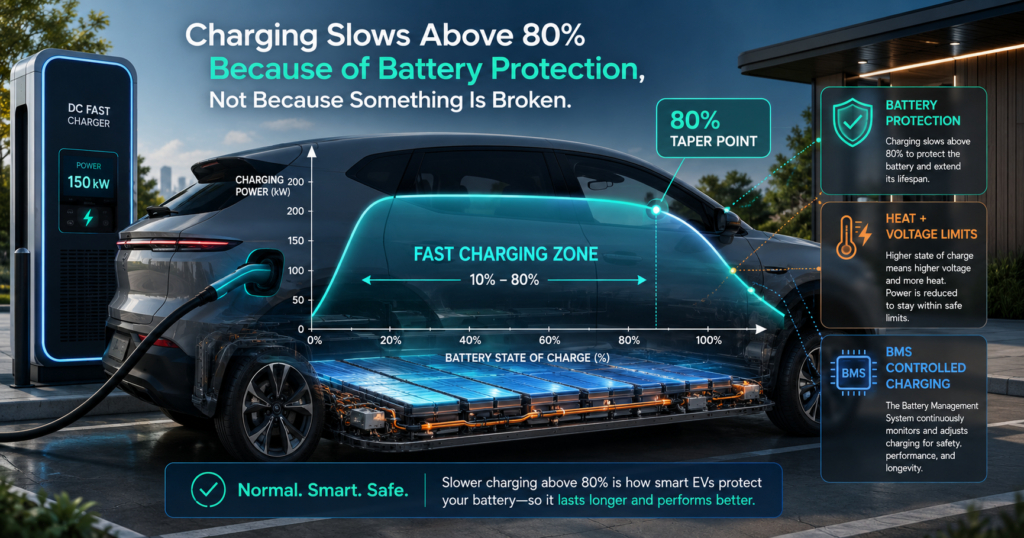
EV batteries charge slower above 80% because the battery management system reduces charging power as the pack gets closer to its upper voltage limit. This slowdown is called charging taper, and it is a normal part of lithium-ion battery protection.
A DC fast charger may be capable of 150 kW, 250 kW, or even 350 kW, but the vehicle does not accept that power all the way to 100%. The car constantly adjusts charging current based on battery temperature, state of charge, cell voltage, battery age, and safety limits. Tesla explains this clearly in its Supercharging support page, noting that charging rates vary based on battery state of charge and temperature, and that charging slows as the battery fills up.
For daily driving, many EV owners are better off charging to around 70–80% instead of waiting at a fast charger for the final 20%. Chevrolet, for example, says charging to 80% or less for daily use can help promote battery health and maintain regenerative braking performance in its EV charging support guide. Ford Canada also notes that setting the maximum charge level to no more than 90% can help prolong EV battery life in its maximum charge level support article. The short version is simple: your EV is not broken when charging slows above 80%. It is protecting the battery.
Introduction: The 80% Charging Mystery
One of the first surprises many new EV owners experience happens at a public DC fast charger. The session starts fast. The screen may show 120 kW, 180 kW, or even more than 200 kW. The battery climbs quickly from 10% to 40%, then 50%, then 60%. Everything feels impressive.
Then the car reaches 75% or 80%, and the charging speed drops. Sometimes it drops gradually. Sometimes it feels dramatic. A car that was charging at 180 kW may fall to 90 kW, then 60 kW, then 35 kW as it approaches full. The last 20% can feel painfully slow compared with the first 60%.
This is where many drivers ask the same question: Why do EV batteries charge slower above 80%? The answer is not that the charger is weak. It is not usually a problem with the charging cable. It is not a sign that the battery is failing. In most cases, it is exactly what the EV was designed to do.
Lithium-ion batteries do not behave like empty fuel tanks. A gas tank can be filled at roughly the same speed until the pump clicks off. A battery is different. It is an electrochemical system with voltage limits, thermal limits, internal resistance, cell balancing requirements, and aging mechanisms that become more sensitive as state of charge rises. That is why EV charging is not a straight line. It is a curve.
For a broader look at the factors that control fast charging speed, see our related guide: Why Some EVs Charge Faster Than Others.
EV Charging Is Not Constant: It Follows a Charging Curve
When automakers advertise fast charging, they usually use numbers like:
- “10% to 80% in 18 minutes.”
- “Up to 200 miles in 15 minutes.”
- “10% to 80% in under 30 minutes.”
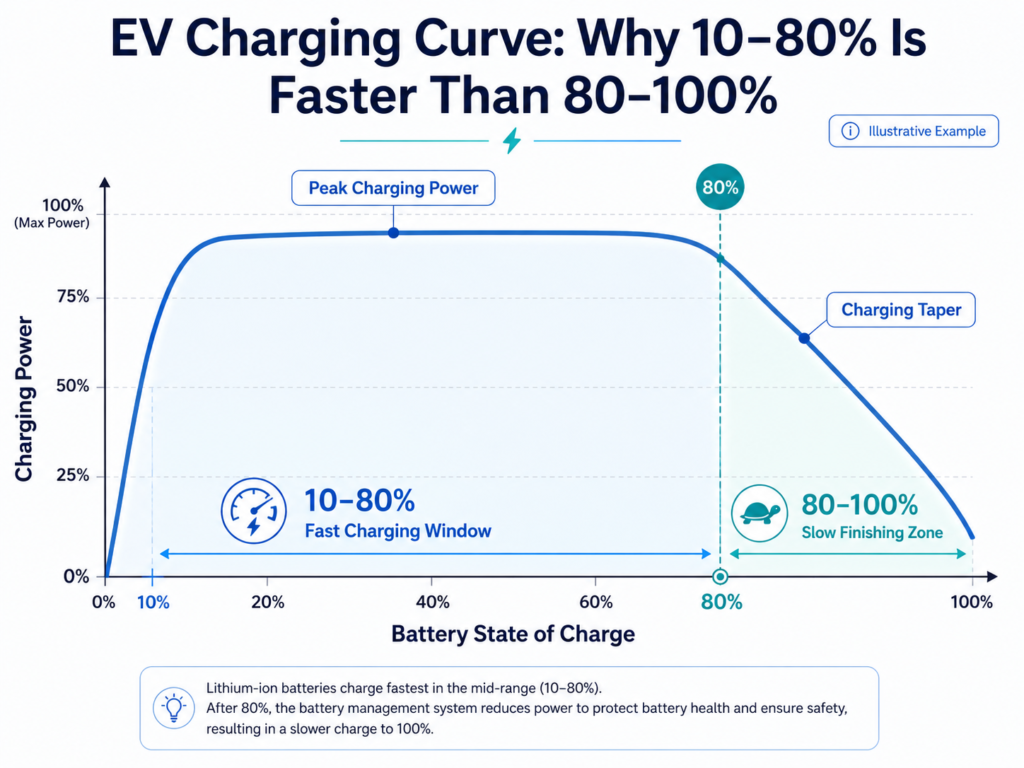
These numbers are useful, but they can also be misleading if you assume the vehicle charges at the same speed from 0% to 100%. It does not. Most modern EVs follow a charging curve that looks roughly like this:
| Battery State of Charge | Typical Charging Behavior |
|---|---|
| 5–20% | Charging ramps up if the battery temperature is ready |
| 20–50% | Fastest charging zone for many EVs |
| 50–70% | Still strong, but often beginning to decline |
| 70–80% | Taper becomes more noticeable |
| 80–100% | Charging slows significantly |
The exact curve depends on the vehicle, battery chemistry, pack size, voltage architecture, thermal management system, software calibration, charger capability, and weather. Some EVs hold high power longer than others. A well-designed 800V vehicle may maintain strong charging power deeper into the session than an older 400V EV. Some cars are excellent from 10% to 60% but drop sharply after that. Others are less dramatic but never hit extremely high peaks.
That is why peak charging power alone does not tell the whole story. A vehicle that briefly reaches 250 kW may not necessarily charge faster overall than a vehicle that peaks lower but holds its charging power longer. This is also why “10–80%” became the common benchmark. It captures the practical fast-charging window before the slowest part of the session begins.
Why EV Batteries Charge Slower Above 80%
The 80% number is not magic. Nothing suddenly breaks at 81%. The battery does not become unsafe the moment it crosses that line. Instead, 80% is a practical point where several things begin to overlap:
- The battery voltage is high.
- The anode is becoming more filled with lithium.
- The risk of lithium plating becomes more important under stressful conditions.
- Heat is harder to manage at high charging current.
- Cell balancing may become more important.
- Charging speed often drops enough that public fast charging becomes less time-efficient.
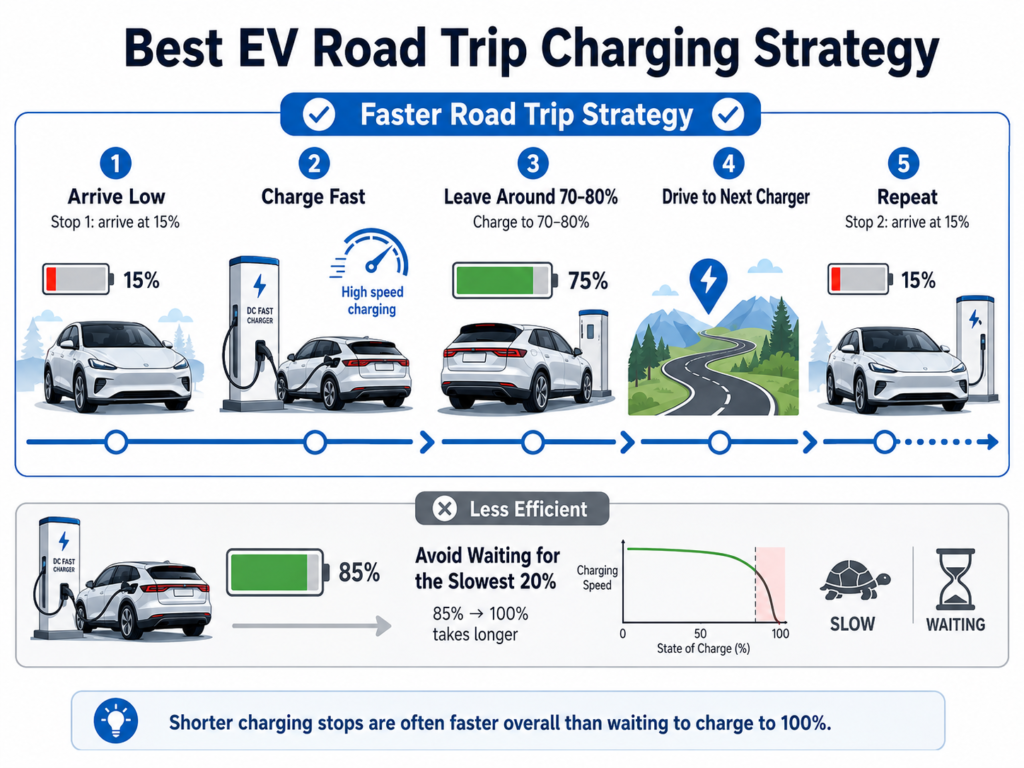
This is why many EV navigation systems plan road trips around short charging stops instead of long sessions to 100%. The car may recommend arriving at a charger with a lower state of charge, charging to 60–80%, then moving on to the next stop. That strategy often gets you to your destination faster than waiting for a full charge.
Tesla’s Supercharging page says charging to 100% usually takes significantly longer than reaching 80%, and it also notes that charging slows as the battery fills up. That is exactly the behavior most EV drivers see in real life.
For road trips, the faster strategy is often:
- Arrive low.
- Charge in the fast part of the curve.
- Leave before the slowest taper.
- Repeat if needed.
That may feel different from gasoline driving, but it is one of the habits that makes EV road trips smoother.
The Basic Battery Physics: Why a Nearly Full Battery Accepts Power More Slowly
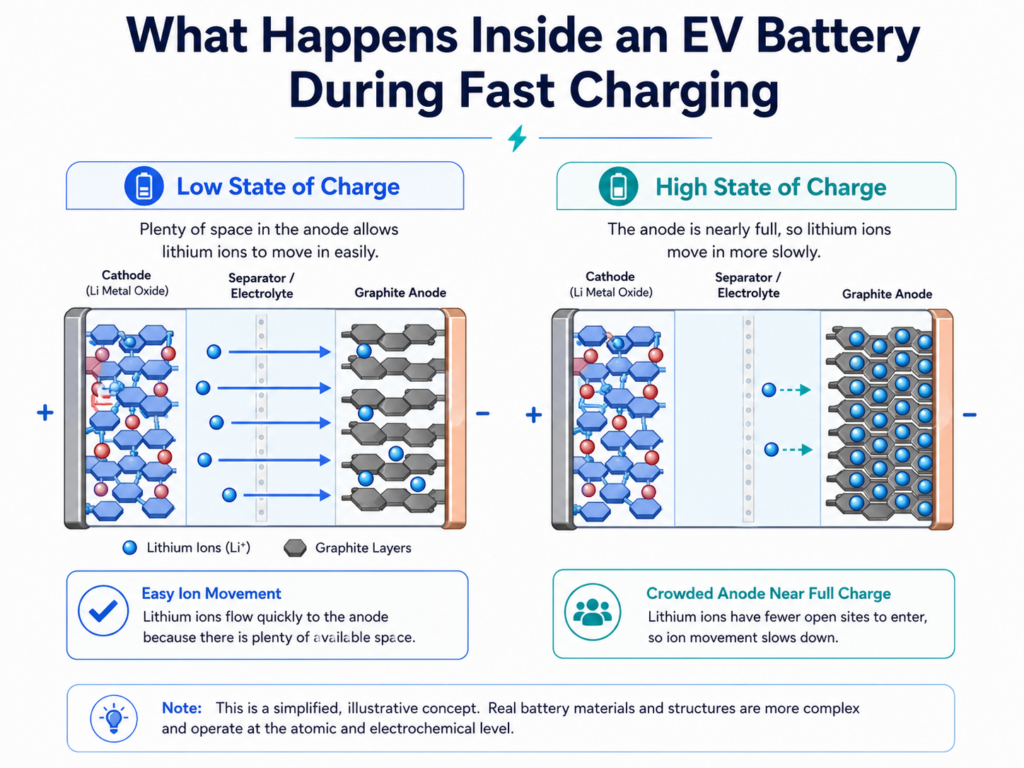
To understand why charging slows above 80%, it helps to picture what is happening inside a lithium-ion cell. During charging, lithium ions move from the cathode through the electrolyte and into the anode. In many EV batteries, that anode is mostly graphite. The lithium ions need to enter the graphite structure and settle into available sites.
At lower state of charge, there is more available room. The battery can accept current more easily. At higher state of charge, the anode is already crowded with lithium. The cell voltage is higher. The battery is closer to its upper limit. Trying to push in more lithium too quickly becomes more stressful. This is one reason charging current must taper. The BMS reduces the current so lithium ions can continue entering the anode safely instead of being forced into unwanted side reactions.
The process is a little like filling a theater. When the room is mostly empty, people can enter quickly and find seats easily. When the room is nearly full, everyone slows down because open seats are harder to find and movement becomes more constrained. A battery is much more complex than a theater, but the analogy helps explain why the final portion of charging naturally takes longer.
CC-CV Charging: The Real Pattern Behind Fast Charging
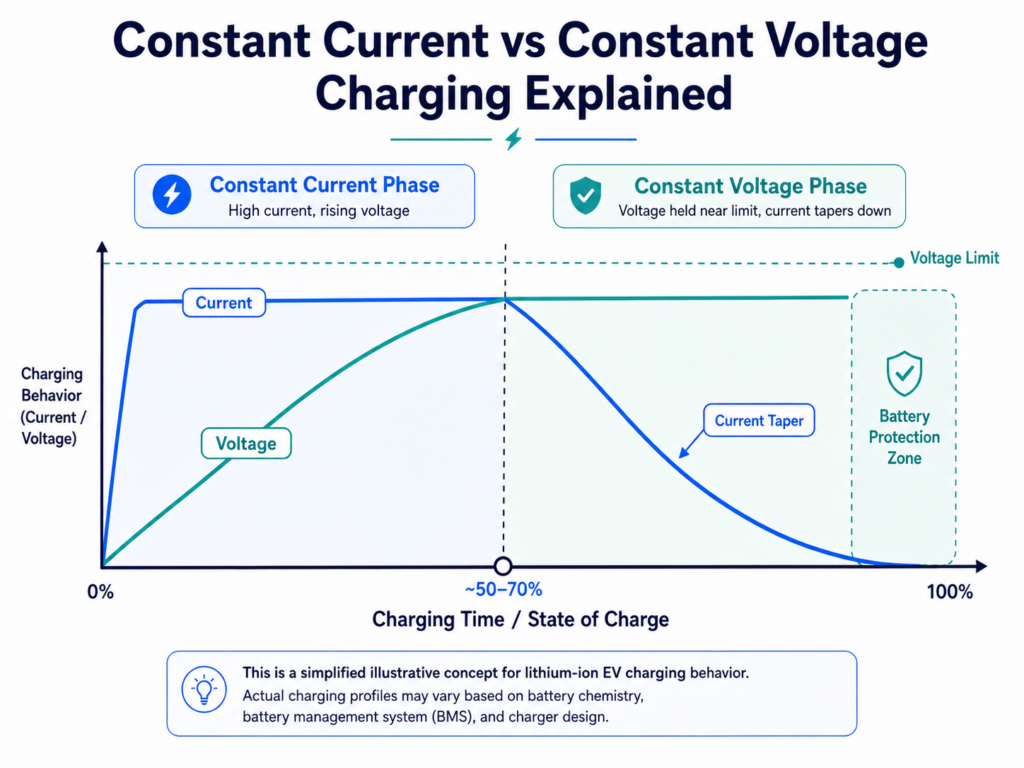
Most lithium-ion charging is often described using two broad phases:
- Constant Current, often called CC.
- Constant Voltage, often called CV.
In the constant-current phase, the battery can accept a relatively high current while voltage rises. This is where DC fast charging feels fast. In the constant-voltage phase, the battery is near its upper voltage limit. The charger holds voltage near the target level, and current gradually decreases. This is where charging slows.
EV fast charging is more sophisticated than a simple textbook CC-CV profile because the vehicle may adjust current continuously based on temperature, cell limits, pack behavior, and software strategy. Still, CC-CV is a useful framework. The first part of the charge is energy transfer. The last part is controlled finishing.
That finishing stage is not wasted time. It helps the pack stay within safe voltage limits, reduces stress, and allows the BMS to manage cell-to-cell differences. But from a driver’s point of view, it can feel slow because each added percentage point takes longer. This is why charging from 10% to 60% may feel quick, while 85% to 100% feels much slower.
Lithium Plating: One of the Biggest Reasons Charging Must Slow Down
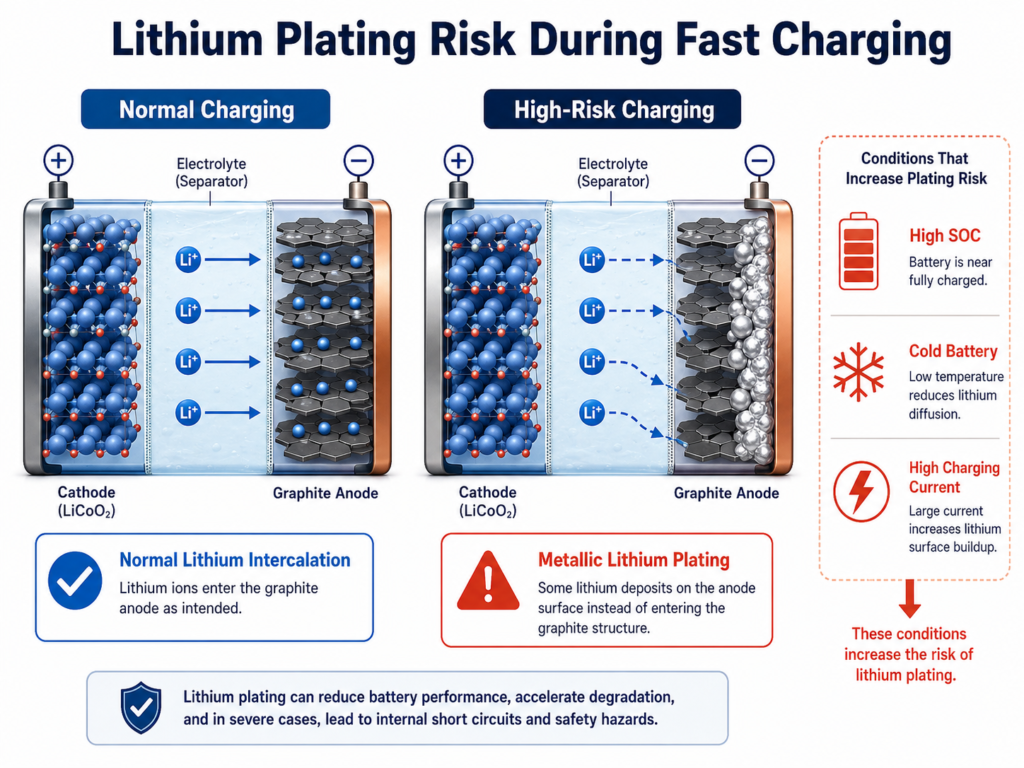
Lithium plating is one of the most important technical reasons EVs reduce charging power at high state of charge. Under normal charging, lithium ions enter the graphite anode. Under stressful conditions, some lithium can deposit as metallic lithium on the anode surface instead. That is lithium plating.
Lithium plating is undesirable because it can:
- Reduce usable battery capacity.
- Increase internal resistance.
- Make the battery age faster.
- Reduce charging performance over time.
- Create safety concerns in severe cases.
Lithium plating is more likely when charging current is high, the battery is cold, or the battery is already at a high state of charge. Those three factors are exactly why EVs are careful near the top of the battery.
The National Renewable Energy Laboratory has discussed how lithium plating changes with electrode thickness, temperature, and charging rates in its research on faster lithium-ion charging. NREL described this work in Modeling a Faster Future for Lithium-Ion Batteries, which explains how physics-based modeling can help predict and prevent lithium plating in future cell designs and charging protocols.
For a deeper explanation of this topic, see our related article: Lithium Plating Explained: Why Fast Charging Can Damage EV Batteries.
Heat Makes the 80% Slowdown Even More Important
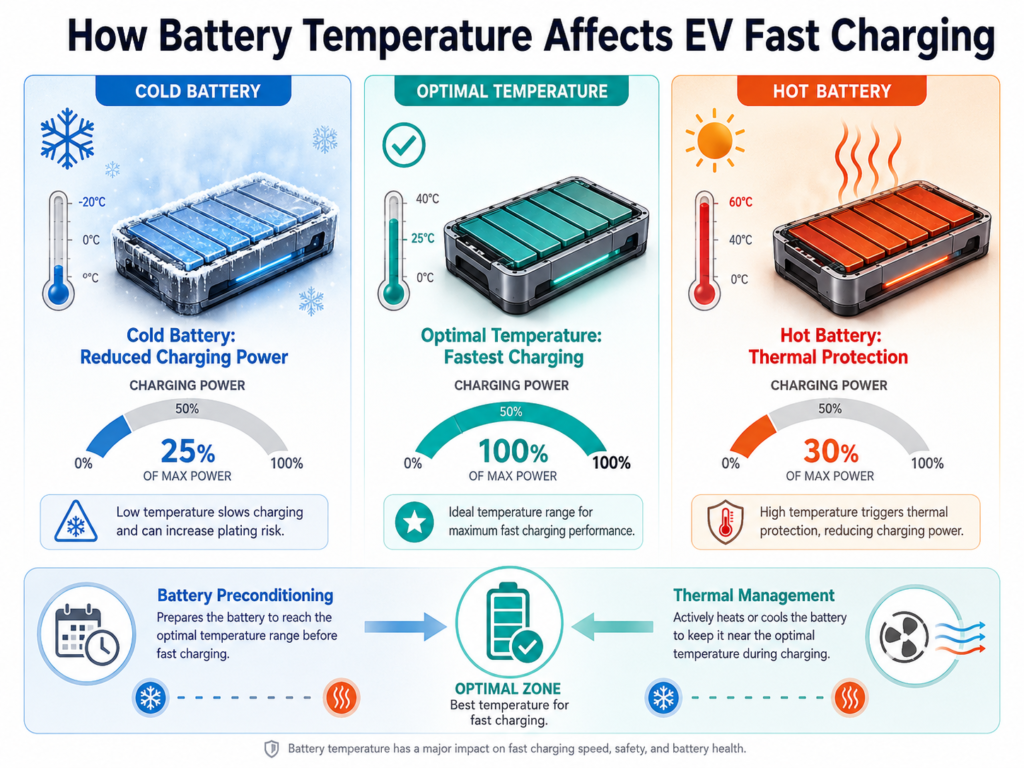
Heat is another major reason EVs slow charging above 80%. Fast charging sends a large amount of current into the battery pack in a short period of time. Current flowing through the cells creates heat. The more current you push, the more heat the system must remove.
Modern EVs use liquid cooling, refrigerant loops, heat pumps, battery heaters, chillers, coolant plates, temperature sensors, and software controls to keep the pack within a safe operating range. But even strong thermal management cannot ignore battery physics.
At high state of charge, the battery is under more voltage stress. If the battery is also hot, charging aggressively can accelerate unwanted chemical reactions inside the cell. If the battery is too cold, lithium plating risk becomes more important. This is why the same EV may charge differently depending on conditions. On a mild day after battery preconditioning, it may hold strong charging power. On a very cold day without preconditioning, it may charge slowly even at a low state of charge. After repeated fast charging sessions on a hot road trip, it may taper earlier to protect the pack. After towing or high-speed driving, the battery may need more cooling before accepting maximum charging power.
The U.S. Department of Energy’s Alternative Fuels Data Center notes that battery life is affected by climate, charging patterns, battery chemistry, design, and the vehicle-battery-environment thermal system in its Electric Vehicle Benefits and Considerations resource. That is why charging behavior is never just about the charger. It is about the whole vehicle system.
For more on temperature and aging, see: Why EV Batteries Degrade Faster in Hot Weather.
The BMS Is the Real Gatekeeper
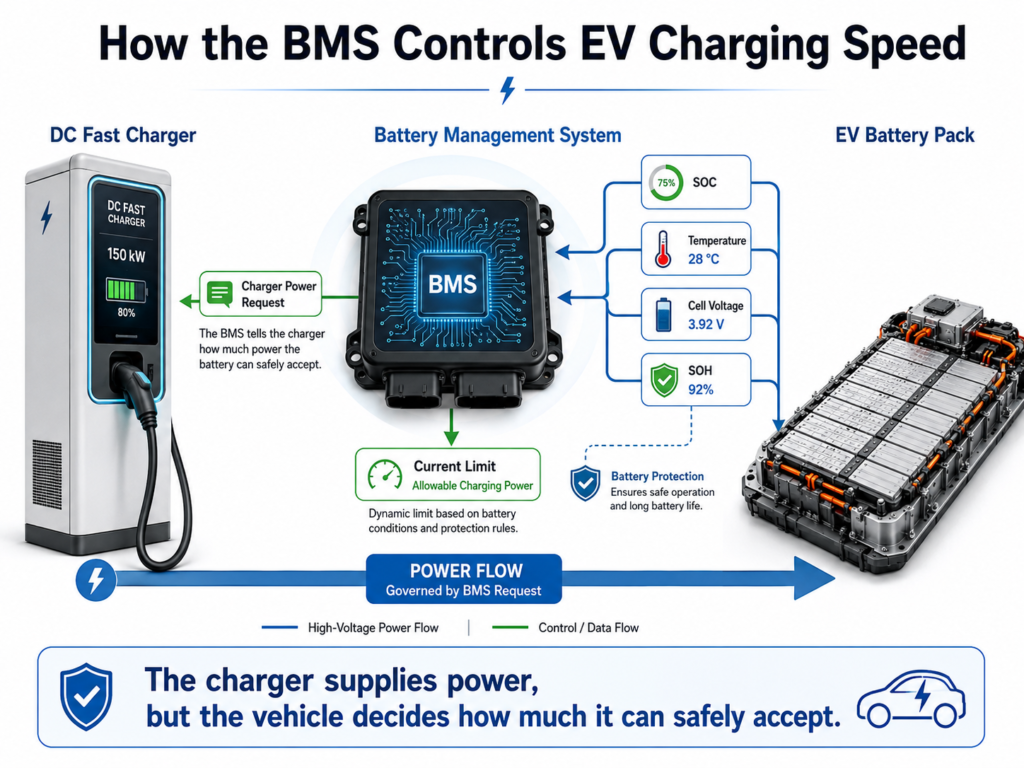
A DC fast charger does not simply decide how much power to force into the car. The EV and charger communicate continuously. The charger may be capable of 350 kW, but the vehicle decides how much power it can safely accept. That decision is handled by the battery management system, or BMS. The BMS monitors and manages:
- Pack voltage.
- Cell group voltage.
- Charging current.
- Battery temperature.
- Temperature differences across the pack.
- Estimated state of charge.
- Estimated state of health.
- Cooling limits.
- Safety limits.
- Cell balancing needs.
The BMS then sends charging limits to the charger. If the battery is in the right temperature range and at a low enough state of charge, it may request high power. As the battery fills, the BMS reduces the allowable current. This is why plugging a slower-charging EV into a 350 kW charger will not make it charge at 350 kW. The car must be able to accept that power.
It is also why two EVs plugged into the same charger can charge very differently. One may have a warmer battery, a lower state of charge, a larger pack, better cooling, or a more aggressive charging calibration.
For more background on how the BMS controls charging, see: EV Battery Management System Explained.
Why the Last 20% Can Take Almost as Long as the First 60%
Many EV owners are surprised by how slow the last 20% feels. A simplified example might look like this:
- 10% to 60%: about 15–20 minutes.
- 60% to 80%: another 10–15 minutes.
- 80% to 100%: another 25–45 minutes.
Those numbers vary widely by vehicle, but the pattern is familiar. The first part is fast. The last part is slow. This happens because charging power does not stay constant. For example, imagine an EV that charges at 180 kW near 30% state of charge. By 80%, it may be accepting 70 kW. By 90%, it may be accepting 40 kW. Near 95%, it may be closer to Level 2-like speeds in some cases.
The result is that each percentage point near the top takes longer than each percentage point near the bottom. This is why sitting at a busy public fast charger until 100% is often inefficient unless you truly need the range. You may be using the charger during the slowest part of the session while another driver is waiting to use the fast part.
That is also why Tesla has congestion-related policies at busy Supercharger sites, including cases where congestion fees can apply when a vehicle is at or above 80% battery charge, as described in Tesla’s Supercharging support page. The charging slowdown is not just a battery issue. It also affects charger availability.
Should You Stop Charging at 80% Every Time?
No. You do not need to treat 80% as a hard rule. Charging to 100% is completely reasonable when you need the range. Road trips, long rural drives, winter travel, towing, mountain routes, and limited charging access can all justify charging higher. The better question is not “Is 100% bad?” The better question is “Do I need 100% right now?”
For daily driving, many EV owners do not. If your daily commute uses 20% or 30% of the battery, charging to 100% every night may not provide much practical benefit. It may also keep the battery at a higher voltage for longer than necessary.
For long-term battery health, a moderate daily charge limit is usually a good habit. Chevrolet’s support guidance says charging to 80% or less for daily use can help promote battery health and optimal regenerative braking performance. Ford Canada recommends setting the maximum charge level to no more than 90% to prolong battery life.
Different automakers use slightly different recommendations. Some say 80%. Some say 90%. Some give different advice for LFP and non-LFP batteries. The exact number depends on chemistry, pack design, software buffers, and warranty strategy. A practical approach is:
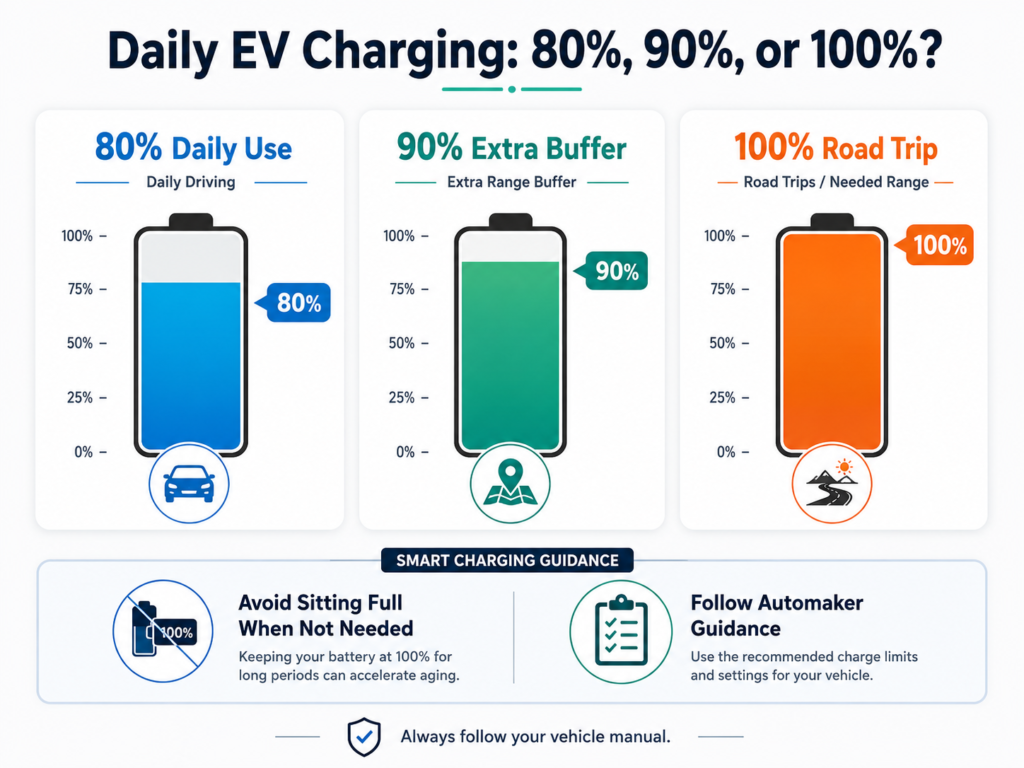
- Use 70–80% for routine daily driving if that gives you enough range.
- Use 90% when you need more buffer.
- Use 100% before longer trips.
Avoid letting the car sit at 100% for long periods when it is not needed. This is not about babying the battery. It is about using the battery in a way that matches real driving needs.
LFP Batteries Are Different, But They Still Taper
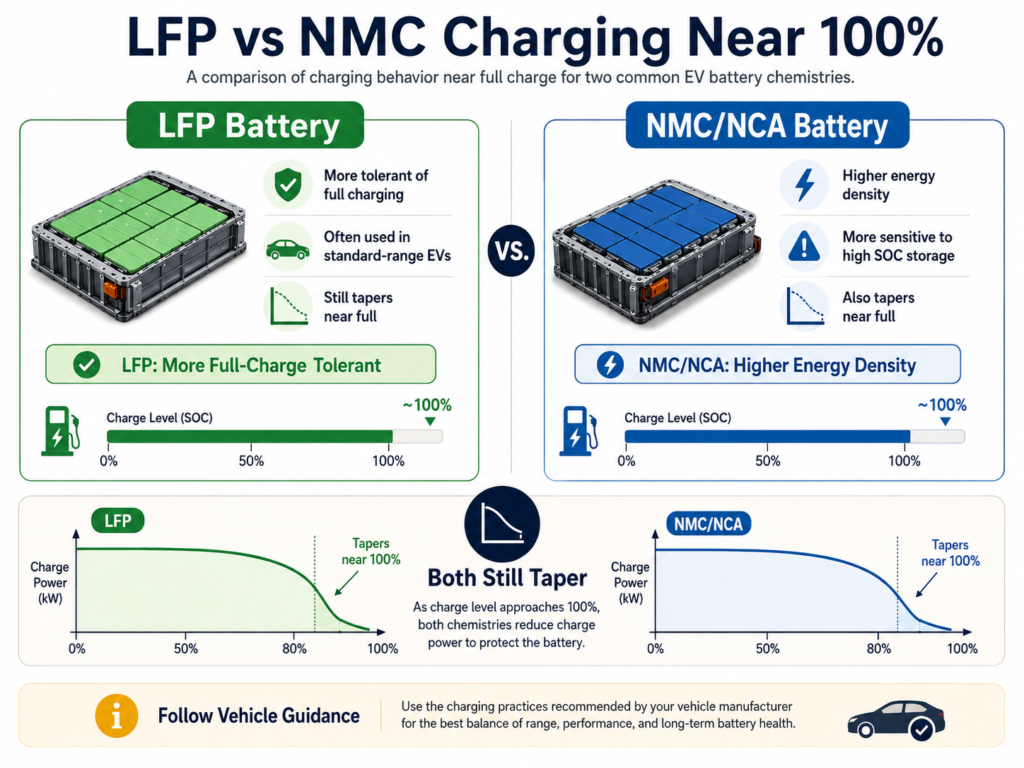
LFP batteries deserve a separate explanation because many EV owners have heard that LFP packs can be charged to 100% more often. That is partly true. Lithium iron phosphate batteries are generally more tolerant of high state of charge than many nickel-rich chemistries such as NMC or NCA. LFP batteries also tend to offer long cycle life, strong thermal stability, and lower material cost. This is one reason LFP has become popular in standard-range EVs and affordable models.
Some automakers recommend periodically charging LFP vehicles to 100% to help the car calibrate state-of-charge estimation. That is because LFP voltage curves are flatter over much of the usable range, making accurate SOC estimation more challenging.
But this does not mean LFP batteries charge at full power all the way to 100%. They still taper. The reason is simple: LFP is still a lithium-ion battery chemistry. It still has voltage limits, current limits, temperature limits, and cell balancing requirements. Charging to 100% may be less stressful for LFP than for some nickel-rich packs, but the final portion of charging still takes longer. So the distinction is important:
- LFP may tolerate regular full charging better.
- LFP still slows near full charge.
- LFP still benefits from good thermal management.
- LFP still should follow the automaker’s specific recommendation.
For a deeper comparison, see: LFP vs NMC Batteries: Which EV Battery Is Better in 2026?.
Why Cold Weather Makes Charging Slow Even Below 80%
Although this article focuses on the 80% slowdown, cold weather can make charging slow at almost any state of charge. When a battery is cold, lithium ions move less easily inside the cell. The electrolyte is less conductive, internal resistance rises, and lithium plating risk increases during high-current charging. The BMS responds by reducing allowable current until the battery warms up. This is why battery preconditioning matters.
When you navigate to a fast charger in many modern EVs, the car may automatically heat or cool the battery before arrival. The goal is to put the pack in a temperature window where it can accept higher charging power safely.
Without preconditioning, a cold battery may charge slowly even if it is at 20% or 30%. With preconditioning, the same car may charge much faster. This is one reason winter charging complaints are common among new EV owners. The charger may not be the problem. The battery may simply be too cold to accept peak power.
For more detail, see: Why EV Range Drops in Winter.
Why 800V EVs Still Slow Down Above 80%
A common misunderstanding is that 800V EVs eliminate charging taper. They do not. A higher-voltage architecture can reduce current for a given power level. Lower current can reduce resistive losses and make very high charging power easier to manage. This is why some 800V EVs can deliver excellent 10–80% charging performance.
But 800V architecture does not remove the electrochemical limits inside the cells. The battery still has maximum voltage limits. The anode still becomes more filled at high state of charge. Lithium plating risk still matters. Heat still matters. Cell balancing still matters. That means even a very fast-charging 800V EV slows down near full.
The difference is that a well-designed 800V system may charge very quickly through the useful road-trip window. It may hold high power longer, manage heat better, and reduce overall charging time from 10% to 80%. But from 80% to 100%, it still must protect the cells. This is why the industry often advertises 10–80% charging times rather than 10–100% times.
For more background, see: 400V vs 800V EV: Why Higher Voltage Matters.
Does Slower Charging Above 80% Mean the Battery Is Degrading?
Usually, no. Charging taper above 80% is normal even in a brand-new EV. It does not automatically mean the battery is weak or damaged. However, if your EV is charging much slower than usual under similar conditions, several factors could be involved:
- The battery may be too cold.
- The battery may be too hot.
- The charger may be sharing power with another vehicle.
- The charger may be limited or malfunctioning.
- The vehicle may be protecting the battery after repeated fast charging.
- The pack may be at a high state of charge.
- The vehicle software may have changed charging behavior.
- The battery may be older and less able to accept high power.
Tesla notes that charging rates can vary based on battery charge level, battery temperature, current use of the Supercharger station, and extreme climate conditions. That kind of explanation applies broadly across EVs, even though each automaker uses its own charging system and software.
The key is to compare similar situations. A single slow session does not prove anything. But if charging speed has permanently changed under the same charger, same temperature, and same starting state of charge, it may be worth checking the vehicle’s battery health or service messages.
For long-term battery aging, see: How Long Do EV Batteries Last? Real-World Data and Battery Degradation.
Fast Charging, Battery Degradation, and Real-World Data
Fast charging does create more battery stress than slow Level 2 charging, especially when combined with heat, high state of charge, or cold battery temperature. But that does not mean occasional DC fast charging destroys EV batteries.
Modern EVs are designed to manage fast charging carefully. The BMS limits power, cooling systems regulate temperature, and software protects the pack from unsafe conditions. Still, real-world data suggests charging behavior matters.
Geotab’s 2026 EV battery health study reported an average degradation rate of 2.3% per year across its dataset. It also found that vehicles relying on high-power DC fast charging above 100 kW experienced degradation rates of up to 3.0% per year, roughly double that of vehicles primarily using lower-power charging, according to Geotab’s EV Battery Health Study.
This does not mean drivers should avoid DC fast charging. It means frequent high-power charging is one factor among many. Climate, chemistry, thermal management, pack size, driving patterns, and average state of charge all matter. A driver who fast charges occasionally on road trips should not panic. A ride-share driver who fast charges daily in hot weather may see more battery stress over time.
For a deeper discussion, see: Why Fast Charging Degrades EV Batteries in 2026.
Why Automakers Do Not Simply Allow Full-Speed Charging to 100%
Some drivers wonder why automakers do not just build batteries that can charge at maximum power all the way to 100%. The answer is tradeoffs. To charge extremely fast near full, a battery would need to manage higher stress without lithium plating, excessive heat, voltage imbalance, or accelerated aging. That could require different electrode designs, thinner electrodes, more expensive materials, stronger cooling, more conservative usable capacity, or more complex software.
Those changes can affect cost, range, weight, durability, and manufacturing complexity. A battery optimized for maximum charging speed may not be the same as a battery optimized for low cost or long range. A commercial fleet battery may need durability more than peak charging speed. A premium performance EV may accept more expensive cooling and pack design. An affordable city EV may prioritize cost and reliability. That is why there will not be one perfect charging curve for every EV. The charging behavior reflects the entire vehicle design.
Practical Charging Strategy for EV Owners
For most EV owners, the best charging strategy is not complicated. At home, use a daily charge limit that gives you enough range without always sitting at 100%. For many drivers, that means 70–80%. For some vehicles or driving needs, 90% may be reasonable. Follow your automaker’s guidance when it differs.
On road trips, start fast charging at a lower state of charge when possible. Charging from 10% to 60% or 70% is usually much faster than charging from 80% to 100%. Use the car’s route planner when available because it often understands the vehicle’s charging curve better than a generic map app.
Before fast charging in cold weather, use battery preconditioning if your EV supports it. This can make a major difference. Do not worry about charging to 100% when you need it. Just avoid making 100% your default parking state when daily driving does not require it. Do not assume a 350 kW charger will make every EV charge at 350 kW. The car controls the charging power. And when charging slows above 80%, remember that the car is doing what it is supposed to do.
Common Myths About EV Charging Above 80%
Myth 1: “The charger is broken if charging slows above 80%.”
Usually, no. Charging taper is normal. The charger may be fine.
Myth 2: “A 350 kW charger should always give me 350 kW.”
No. The charger’s rating is the maximum it can deliver under the right conditions. Your EV decides how much it can accept.
Myth 3: “Charging to 100% once will ruin the battery.”
No. Occasional 100% charging is normal, especially before long trips. The bigger concern is repeatedly keeping some batteries at high state of charge for long periods.
Myth 4: “LFP batteries do not slow down near full.”
They do. LFP batteries may tolerate full charging better, but they still taper near the top.
Myth 5: “Fast charging is always bad.”
Not exactly. Occasional fast charging is part of normal EV ownership. The stressful pattern is frequent high-power fast charging under heat, cold, or high-SOC conditions.
Conclusion: Slower Charging Above 80% Is a Feature, Not a Flaw
EV batteries charge slower above 80% because the battery is nearing its upper voltage range, the anode is becoming more filled with lithium, heat is harder to manage, and lithium plating risk becomes more important under high-current charging.
The vehicle’s battery management system reduces charging power to protect the pack. That slowdown may feel inconvenient at a public charger, but it helps preserve battery health, safety, and long-term performance.
For daily driving, charging to around 70–80% is often enough. For road trips, charging to 100% is fine when you need the range. The key is to understand that the final 20% is usually the slowest and least time-efficient part of DC fast charging.
Once you understand the charging curve, EV charging becomes easier to plan. You stop thinking of 100% as the goal every time and start thinking in terms of useful range, charging speed, and battery health. That is the real lesson behind the 80% slowdown: your EV is not failing. It is managing a very complex battery system in a way that helps it last longer.
FAQs
Why do EV batteries charge slower after 80%?
EV batteries charge slower after 80% because the battery is close to its upper voltage limit. The BMS reduces charging current to manage heat, prevent lithium plating, control cell voltage, and protect long-term battery health.
Is it bad to charge an EV above 80%?
No. Charging above 80% is not automatically bad. It is useful before long trips or when you need extra range. For daily driving, however, many automakers recommend a lower charge limit because it reduces time spent at high state of charge.
Why does 80% to 100% take so long?
The final 20% occurs during the slowest part of the charging curve. Current tapers as the battery approaches full voltage, and the BMS may also manage cell balancing and thermal limits during this stage.
Should I charge my EV to 100% every night?
Usually not, unless your automaker recommends it for your specific battery chemistry or your driving needs require it. Many EV owners use a daily limit around 70–80%, or up to 90% depending on the vehicle and routine.
Do LFP batteries need to be charged to 100%?
Some automakers recommend periodically charging LFP batteries to 100% for state-of-charge calibration. But LFP batteries still slow down near full charge, and owners should follow the vehicle-specific guidance in the manual or app.
Does fast charging above 80% damage the battery?
The vehicle is designed to reduce charging power above 80% to avoid excessive stress. Occasional charging above 80% is normal. Frequent high-power fast charging to high SOC, especially in hot or cold conditions, can add more battery stress over time.
Why does my EV charge slower in winter?
Cold batteries cannot accept high charging current as easily. The BMS may reduce charging power to prevent lithium plating. Battery preconditioning can help warm the pack before arriving at a fast charger.
Is a 350 kW charger always faster?
Not always. A 350 kW charger only helps if your EV can accept high power at that moment. Battery state of charge, temperature, pack voltage, battery design, and software limits all affect the actual charging speed.
Editor’s Note: This guide has been updated and expanded from an earlier EV Insight Daily article on why EV batteries charge slower above 80%. The revised version adds more detail on charging curves, CC-CV charging, lithium plating risk, battery temperature, BMS control, and practical charging strategies for daily driving and road trips.