
Quick Answer
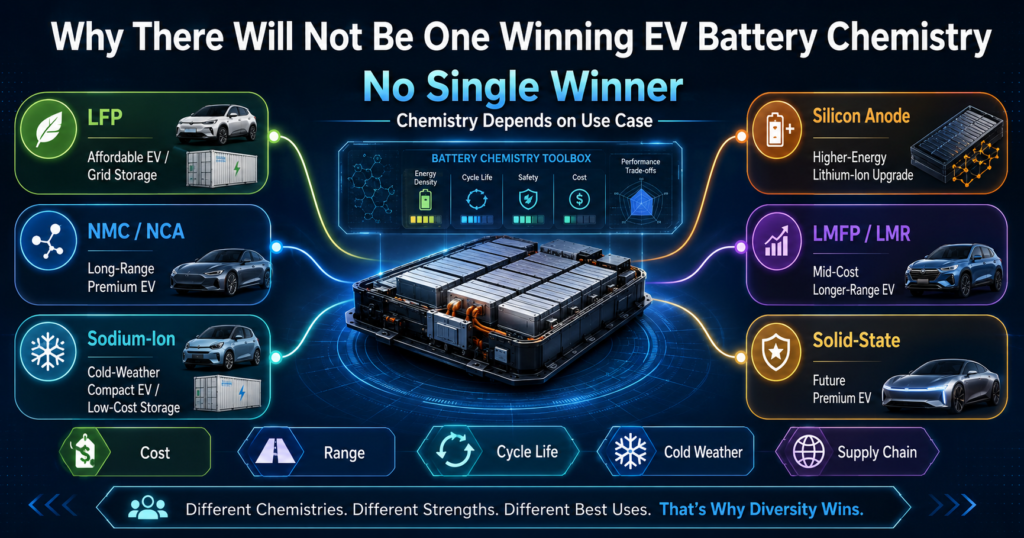
There probably will not be one winning EV battery chemistry because electric vehicles do not all need the same battery. A useful EV battery chemistry comparison starts with one idea: different vehicles need different batteries. A low-cost city EV, a long-range electric truck, a premium performance car, a cold-weather fleet vehicle, and a grid storage system all ask different things from a battery. Some need the lowest possible cost. Some need high energy density. Some need extreme cycle life. Some need better cold-weather behavior. Some need fast charging. Some need simpler supply chains.
That is why the future of EV batteries is likely to be a mix of chemistries, not a single winner. LFP, NMC/NCA, sodium-ion, LMFP, LMR, silicon-anode lithium-ion, and solid-state batteries may all grow at the same time, but in different parts of the market. The better question is not “Which battery chemistry will win?” It is “Which battery chemistry fits this vehicle, this price point, this climate, and this job?”
Introduction: The EV Battery Race Is Not a Winner-Take-All Game
EV battery discussions often sound like a sports tournament. Will LFP beat NMC? Will sodium-ion replace lithium-ion? Will solid-state batteries make every current battery obsolete? Will silicon anodes arrive before solid-state? These are reasonable questions, but they can also create the wrong mental picture. Battery technology is not moving toward one universal chemistry that will dominate every electric vehicle and every energy storage system. It is moving toward specialization.
That may sound less exciting than a single breakthrough story, but it is closer to how the EV industry actually works. Automakers do not choose a battery chemistry only because it looks good in a lab. They choose it because it fits a complete vehicle program: price, range, performance, safety, charging speed, warranty risk, supply chain, factory tooling, thermal management, and customer expectations.
The U.S. Department of Energy describes next-generation batteries as a broad group of technologies, including solid-state and other designs, that may offer different benefits such as better performance, safety, or cost depending on the application. That framing matters. The future is not simply “today’s lithium-ion versus tomorrow’s miracle battery.” It is a menu of battery tools, each with strengths and weaknesses.
At the same time, real-world market data already shows a split. The International Energy Agency notes that LFP battery packs were more than 40% cheaper on average than NMC alternatives per kWh in 2025, helping pull overall battery prices lower. But that does not mean NMC disappears. It means LFP becomes attractive where cost and durability matter most, while nickel-rich chemistries still make sense where higher energy density is worth paying for. That is the core idea behind this article: EV battery chemistry is becoming more diverse, not less.
Why EV Battery Chemistry Comparison Is Not About One Winner
A battery chemistry is not just a material recipe. It shapes the entire vehicle. It affects how large the pack must be, how much cooling is required, how fast the car can charge, how much range it can offer, how much power it can deliver, how it ages, how it behaves in cold weather, and how much the vehicle costs to build.
If every EV had the same mission, one chemistry might eventually dominate. But EVs are spreading into more segments, not fewer. A small commuter car does not need the same battery as a 7,000-pound electric pickup. A delivery van that returns to a depot every night does not need the same chemistry as a luxury sedan built around maximum highway range. A grid battery container sitting next to a solar farm does not care about weight in the same way a sports car does. This is why comparing battery chemistries only by one number, such as energy density, can be misleading.
Energy density matters. But it is not the whole story. Cost per kWh, cost per mile of range, cycle life, charge acceptance, safety margin, pack integration, recycling value, and supply availability can matter just as much. Sometimes they matter more.
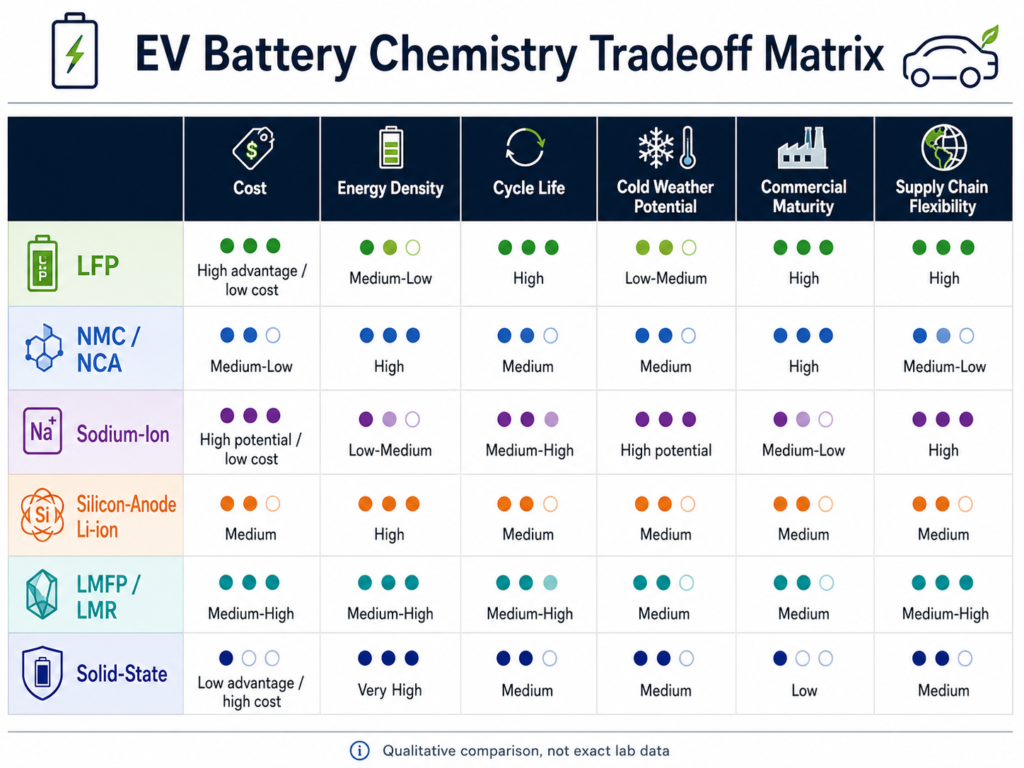
A battery that looks “worse” on paper may be better for a specific product. LFP is a good example. It usually has lower energy density than nickel-rich NMC or NCA cells, but it can offer strong safety characteristics, long cycle life, and lower cost. For an affordable EV with moderate range, that tradeoff can be excellent. For a large premium SUV chasing maximum range, the same tradeoff may be harder to accept. The winner changes depending on the job.
LFP: The Affordable Workhorse
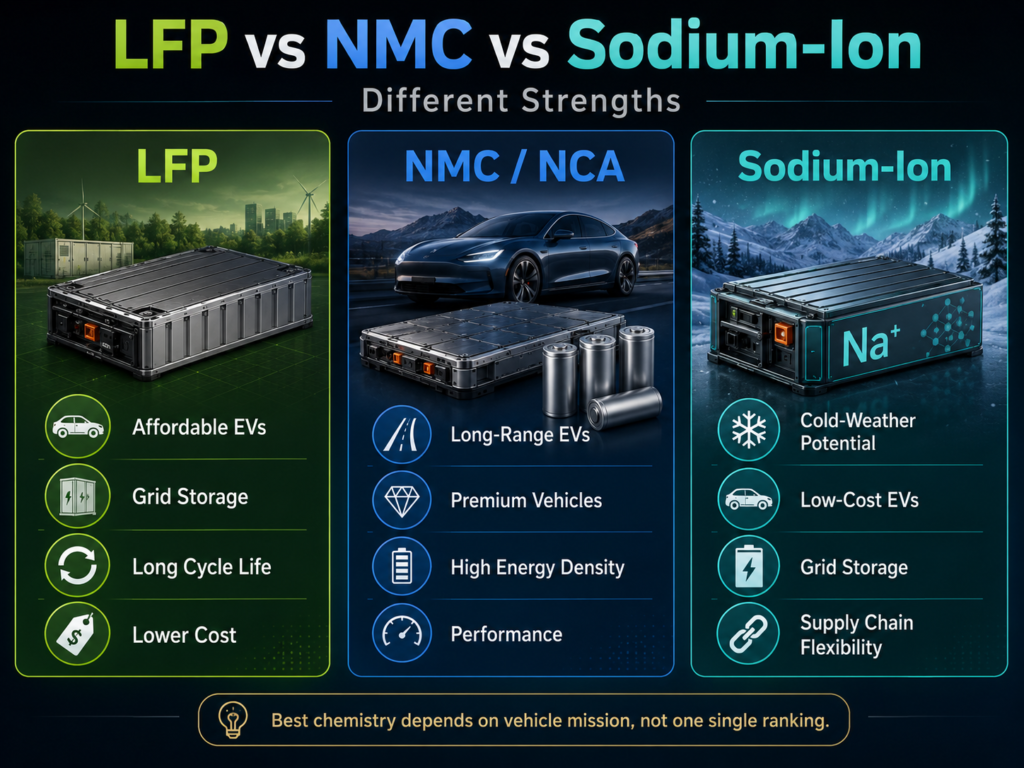
Lithium iron phosphate, better known as LFP, has become one of the most important EV battery chemistries in the world. It is especially strong in lower-cost vehicles and energy storage systems because it avoids nickel and cobalt, uses relatively abundant materials, and has a reputation for good thermal stability and long cycle life.
For many EV buyers, LFP is not exciting in the “breakthrough battery” sense. It does not usually promise the highest energy density or the longest highway range. But it does something arguably more important: it helps make EVs cheaper and more durable.
That is why LFP has grown so quickly in China and is expanding into more global markets. The IEA has noted that LFP has been especially prevalent in the Chinese electric car market, while NMC has historically been more common in Europe and the United States. LFP also fits stationary storage extremely well. In a grid storage container, weight and volume matter, but they are not as critical as they are in a passenger vehicle. A battery system that is slightly larger but cheaper, safer, and longer-lasting can be a very good deal.
That does not mean LFP wins everything. Its lower energy density can be a limitation for long-range vehicles, heavy trucks, and premium EVs where every kilogram matters. Cold-weather performance can also be a challenge if the pack is not managed well. LFP can be excellent, but it is not universal. This is why LFP is more likely to become a major pillar of the battery market than the single final answer.
NMC and NCA: Still Important for High-Range EVs
Nickel-rich chemistries such as NMC and NCA are often criticized because they can be more expensive and more dependent on critical materials like nickel and cobalt. Those concerns are real. Automakers are clearly trying to reduce cost and material risk. Still, it would be a mistake to assume NMC and NCA are simply going away.
Their biggest advantage is energy density. For a long-range EV, especially a larger vehicle, energy density can determine whether the vehicle feels practical or compromised. A battery pack with higher energy density can deliver more range without becoming too large or too heavy.
That matters for premium sedans, performance vehicles, large SUVs, and electric trucks. Customers in those segments often expect long range, fast acceleration, towing capability, and strong highway performance. Those features demand energy and power. If the battery becomes too heavy, the vehicle needs more structure, stronger suspension, bigger brakes, and more energy just to move itself. This is where nickel-rich lithium-ion chemistries can still make sense, even if they cost more.
The future may not be “NMC versus LFP.” It may be “NMC where energy density is worth the cost, LFP where affordability and cycle life matter more.” That is a more realistic view of how automakers build vehicle lineups. A base version of an EV may use LFP. A long-range or performance version may use a nickel-rich chemistry. Both can exist under the same model name.
Sodium-Ion: Not a Lithium Killer, But a Serious New Option
Sodium-ion batteries are one of the most interesting battery stories right now because they challenge a basic assumption: that EV batteries must always depend on lithium. Sodium is more abundant than lithium, and sodium-ion batteries can potentially reduce pressure on lithium supply chains. They may also offer advantages in low-temperature performance and safety, depending on the design. That makes sodium-ion especially interesting for affordable EVs, cold-climate vehicles, two-wheelers, commercial fleets, and stationary storage.
But sodium-ion is not simply “better lithium-ion.” Its main challenge is energy density. Sodium ions are larger and heavier than lithium ions, and sodium-ion cells generally do not match the best lithium-ion cells for energy stored per kilogram. That means sodium-ion may not be the first choice for a premium long-range EV where pack weight and size are critical.
The IEA’s 2025 EV battery analysis gives a balanced view. It notes that BYD has been investing in sodium-ion production for EVs and storage, and that HiNa launched a newer sodium-ion battery with improved energy density and faster charging. At the same time, the IEA also cautions that sodium-ion batteries may need higher energy density or more favorable market conditions to compete directly with LFP on a price-per-kWh basis.
CATL has also pushed sodium-ion into the spotlight with its Naxtra battery announcement. CATL says its Naxtra passenger EV sodium-ion battery reaches 175 Wh/kg, with the company positioning it as comparable to LFP for certain uses. For readers who want a deeper explanation of this technology, see our related article: Sodium-Ion Batteries in 2026: The Next Step After LFP.
The key point is this: sodium-ion does not need to beat every lithium-ion chemistry to matter. It only needs to be good enough for the right segments. If it works well in affordable cars, cold-weather fleets, grid storage, and short-range commercial vehicles, it could become a major battery category without replacing high-energy lithium-ion cells.
Silicon-Anode Batteries: A Near-Term Upgrade, Not a Separate War
Silicon-anode batteries are often discussed alongside solid-state batteries, but they are not the same kind of technology. A silicon-anode battery usually remains a lithium-ion battery. The main change is on the anode side, where silicon is added to or partially replaces graphite. Silicon can store much more lithium than graphite in theory, which makes it attractive for improving energy density and possibly fast-charging performance.
The problem is swelling. Silicon expands significantly during charging. If that expansion is not controlled, it can damage the electrode, reduce cycle life, and create mechanical stress inside the cell. This makes silicon a classic battery tradeoff. More silicon can mean more energy, but too much poorly managed silicon can hurt durability. The winning designs are not necessarily the ones with the most silicon. They are the ones that balance energy density, swelling control, first-cycle loss, cycle life, cost, and manufacturability.
Silicon-anode technology may arrive in broader EV use before full solid-state batteries because it can build on existing lithium-ion manufacturing infrastructure more easily. It is an improvement path, not a complete platform replacement. That is why silicon does not eliminate LFP, NMC, sodium-ion, or solid-state. It can be combined with several cathode chemistries. You could have silicon-enhanced NMC cells for premium range, silicon-enhanced LFP or LMFP designs in some cases, or silicon-carbon anodes in high-power applications.
For a deeper explanation, see: Silicon Anode Battery: Why It May Beat Solid-State. Silicon is not the one winner. It is one of the tools that may make multiple lithium-ion chemistries better.
LMFP and LMR: The Middle Ground Between Cost and Range
The battery market is also exploring chemistries that sit between today’s mainstream options. LMFP, or lithium manganese iron phosphate, is related to LFP but adds manganese to improve voltage and energy density. The basic idea is attractive: keep some of LFP’s cost and safety advantages while improving range. If successful at scale, LMFP could become a strong option for mid-range EVs where standard LFP feels slightly limited but nickel-rich NMC is too expensive.
LMR, or lithium manganese-rich chemistry, is another example of this middle-ground strategy. General Motors and LG Energy Solution announced plans to commercialize lithium manganese-rich prismatic cells for future electric trucks and full-size SUVs. GM says the chemistry is intended to deliver more affordable high-capacity cells by using a higher proportion of manganese and reducing dependence on more expensive materials. GM has also said Ultium Cells plans to start commercial production of LMR prismatic cells in the U.S. in 2028.
This is exactly the kind of development that argues against a single winning chemistry. Automakers are not just choosing between “cheap LFP” and “expensive NMC.” They are trying to create new combinations that fill gaps in the market. Large electric trucks and SUVs are a good example. They need a lot of energy, but customers are also sensitive to price. A chemistry that approaches nickel-rich range at a lower cost could be valuable, even if it does not beat LFP in cost or beat NMC in maximum performance. The future may include several middle chemistries that are not famous among consumers but become very important inside vehicle platforms.
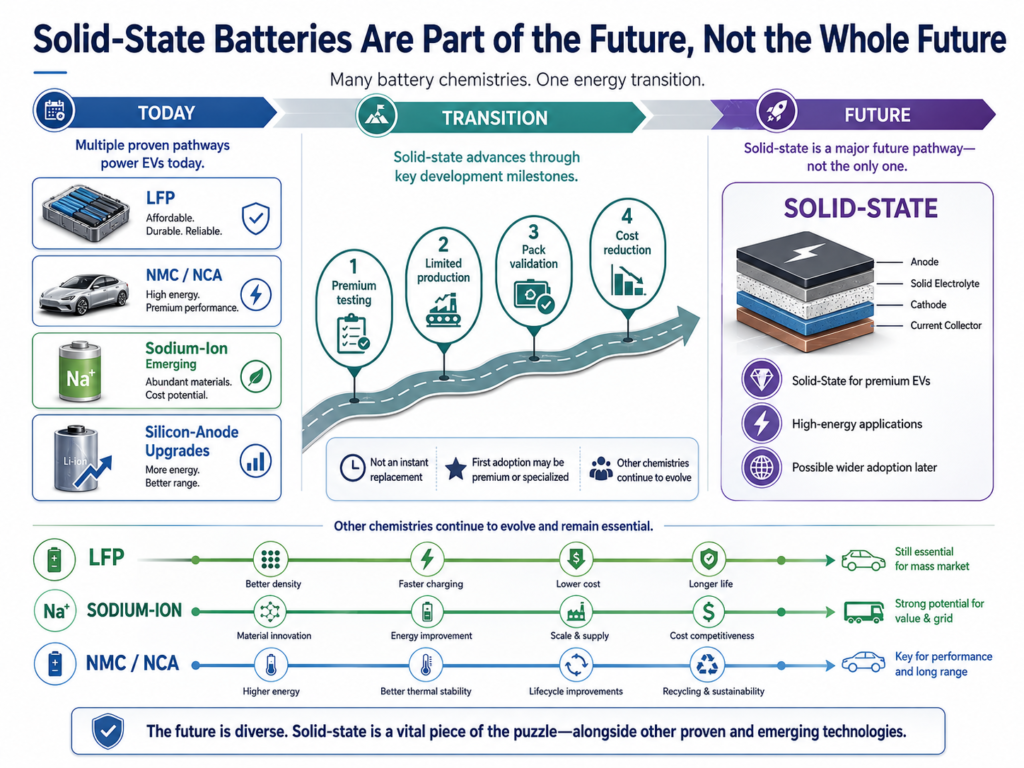
Solid-State Batteries: A Future Platform, Not an Instant Replacement
Solid-state batteries attract more attention than almost any other battery technology. The promise is easy to understand: replace the liquid electrolyte with a solid electrolyte, potentially improve safety, enable lithium-metal anodes, increase energy density, and reduce charging limitations. That sounds like the ultimate winner. But real vehicle development is more complicated.
Solid-state batteries still need to prove manufacturing scale, long-term durability, pack-level safety, cold-weather performance, interface stability, mechanical pressure control, and cost. A cell that performs well in a lab does not automatically become a production EV battery.
Recent progress is real. Stellantis and Factorial announced in June 2026 that Factorial’s FEST solid-state battery technology had been integrated into a Dodge Charger Daytona development vehicle and that road testing had begun. Mercedes-Benz also reported that a lightly modified EQS test vehicle equipped with a lithium-metal solid-state battery completed a 1,205-kilometer trip from Stuttgart, Germany, to Malmö, Sweden, without recharging. These are important milestones. But they do not mean every EV will soon switch to solid-state batteries.
Solid-state may first appear in premium vehicles, performance models, limited-production vehicles, or specialized applications where higher cost can be justified. It may take longer to reach low-cost mass-market EVs. Even if solid-state becomes successful, LFP and sodium-ion may still dominate affordable cars and stationary storage because cost matters more than maximum energy density in those markets.
For more context, see our article: Solid-State Battery Road Testing: What Happens Next?. Solid-state could become extremely important. But important is not the same as universal.
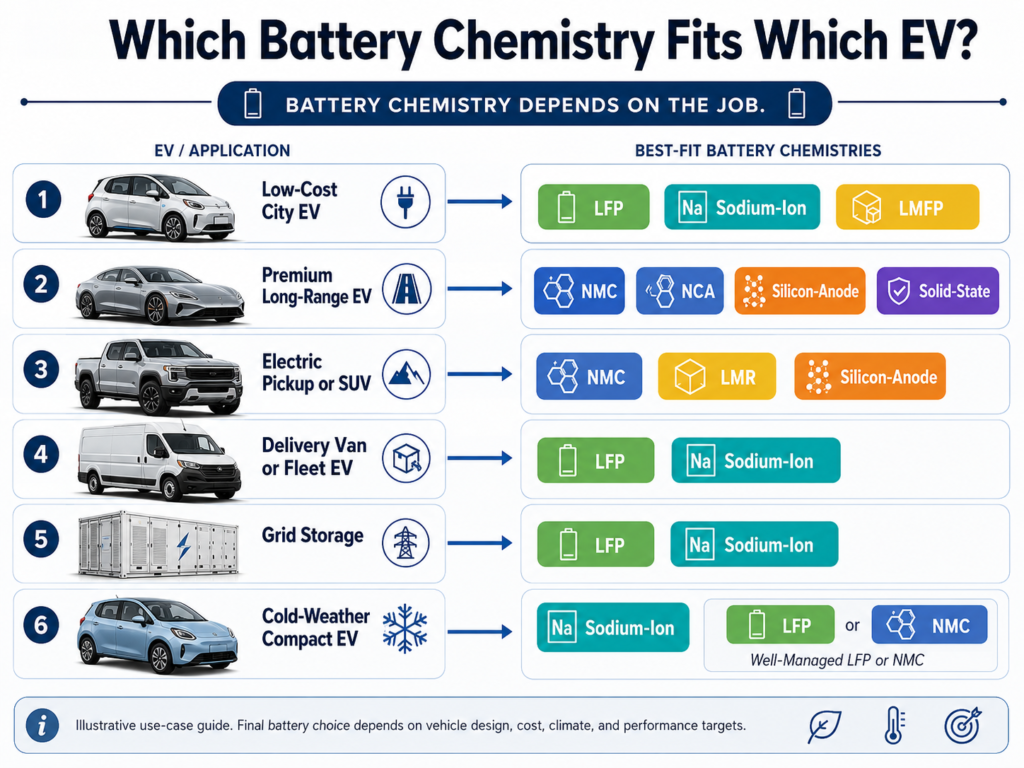
Different Vehicles Need Different Batteries
The easiest way to understand the future is to match chemistries to use cases.
- A low-cost commuter EV may prioritize affordability, safety, and daily durability. LFP, LMFP, or eventually sodium-ion could make sense.
- A premium long-range sedan may prioritize energy density and fast charging. Nickel-rich lithium-ion, silicon-enhanced anodes, or future solid-state designs may fit better.
- A large electric pickup or SUV needs a difficult balance of range, power, towing capability, cost, and pack size. NMC, LMR, silicon-enhanced lithium-ion, or eventually solid-state could all play a role depending on the model.
- A delivery van may care more about cycle life, predictable routes, depot charging, and total cost of ownership than maximum range. LFP or sodium-ion could be strong candidates.
- A cold-weather fleet vehicle may value low-temperature performance more than headline energy density. Sodium-ion could become especially interesting here if commercial claims translate into real-world durability.
- A grid storage system may care mostly about cost, safety, cycle life, supply chain, and ease of installation. LFP and sodium-ion could dominate many of these applications, while high-energy nickel-rich cells may be unnecessary.
This is why the battery market will look more like the tire market than the smartphone processor market. There is no single “best tire” for every car, road, climate, and budget. There are summer tires, winter tires, all-season tires, racing tires, truck tires, and low-rolling-resistance tires. Batteries are heading in the same direction.
Dual-Chemistry Packs Could Make the Picture Even More Diverse
One of the most interesting possibilities is that future EVs may not always use one chemistry per vehicle. Dual-chemistry battery packs could combine two different cell types in the same vehicle. One part of the pack might be optimized for daily driving and cost, while another part supports high power, long range, cold-weather operation, or fast charging.
CATL has already discussed this direction with its Freevoy Dual-Power Battery and cross-chemistry system design. The idea is powerful, but it is not simple. Different chemistries have different voltage curves, thermal behavior, aging patterns, charge limits, and safety requirements. A dual-chemistry pack requires a more sophisticated battery management system, more careful thermal design, and more complex control logic.
Still, the concept reinforces the main point of this article. If one chemistry cannot do everything perfectly, engineers may stop forcing it to. They may instead design battery systems where different chemistries work together.
For more detail, see: Dual-Chemistry EV Batteries: Why One Car May Need Two Battery Types.
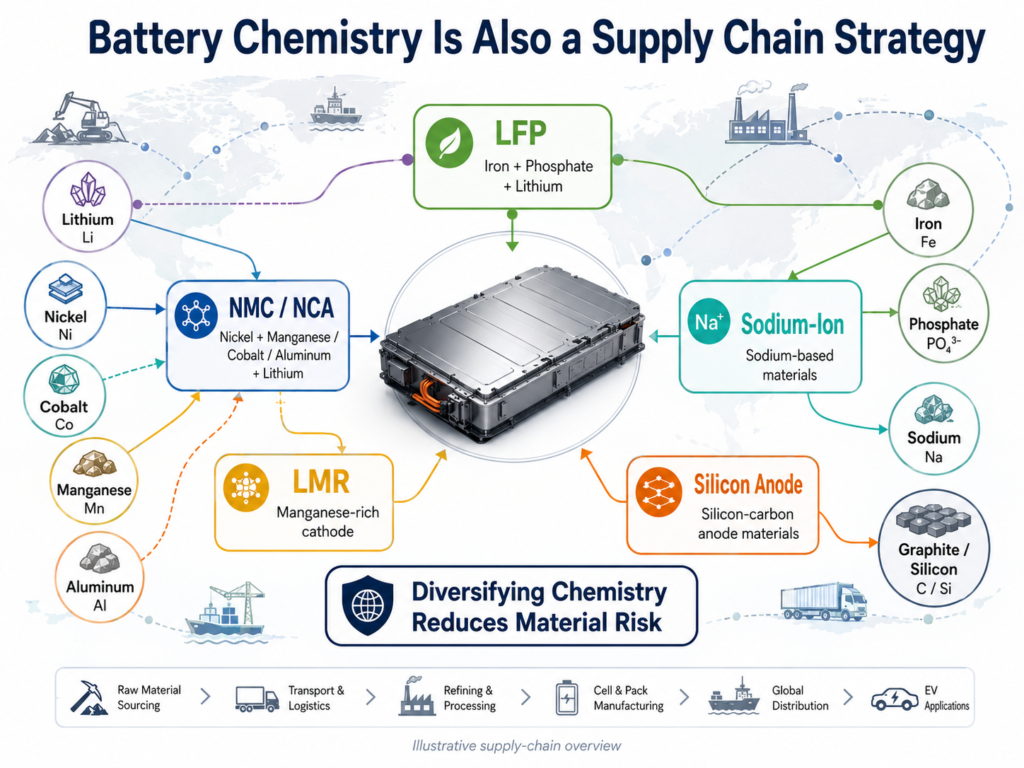
Battery Chemistry Is Also a Supply Chain Strategy
Battery chemistry is not only an engineering decision. It is also a supply chain decision. A chemistry that depends heavily on nickel, cobalt, graphite, lithium, or specific refining capacity can create cost and geopolitical risk. That does not automatically make the chemistry bad, but it changes how automakers think about sourcing.
LFP reduces dependence on nickel and cobalt. Sodium-ion can reduce dependence on lithium and, depending on the design, graphite. LMR increases the role of manganese. Silicon anodes create new demand for engineered silicon-carbon materials. Solid-state batteries may require new electrolyte materials and new manufacturing equipment. In other words, battery diversification is not just about performance. It is also about resilience.
Automakers do not want to be trapped by one material bottleneck or one regional supply chain. A multi-chemistry strategy gives them more flexibility. If lithium prices rise, sodium-ion becomes more attractive. If nickel prices fall, high-energy NMC may regain cost competitiveness. If LFP production expands locally, it becomes easier to use in affordable EVs. If solid-state manufacturing matures, premium vehicles may shift faster. The chemistry race is also a supply chain balancing act.
What This Means for EV Buyers
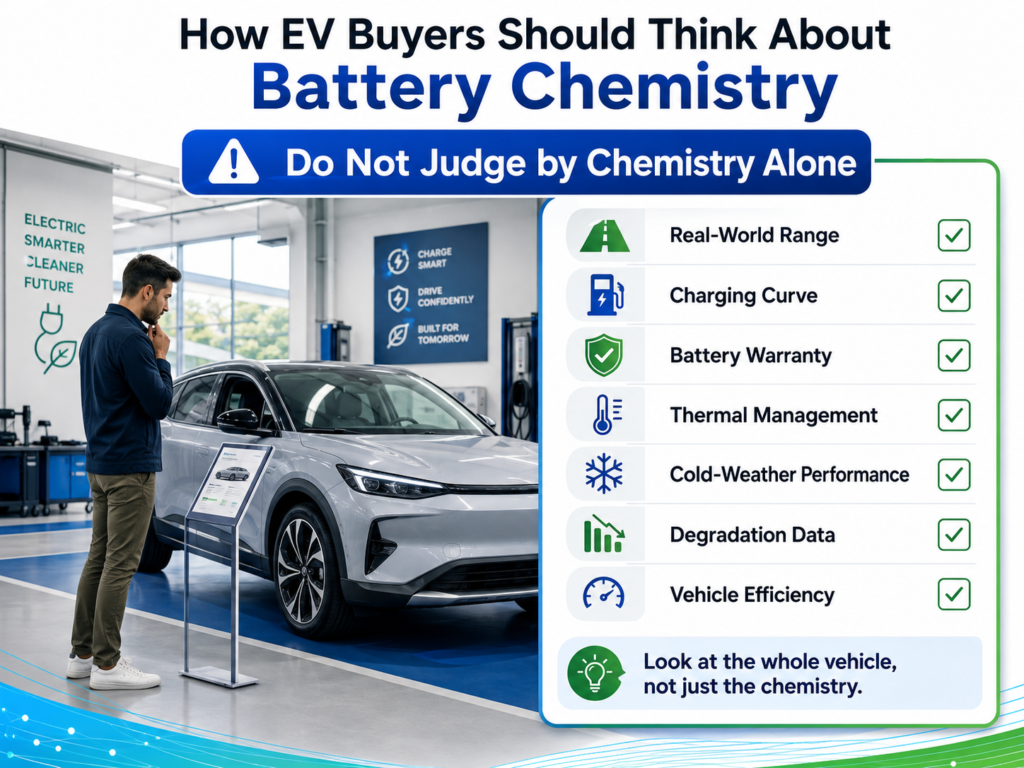
For EV buyers, the message is simple: do not judge an EV only by the chemistry name. LFP is not automatically better or worse than NMC. Sodium-ion is not automatically a downgrade. Solid-state is not automatically perfect. Silicon-anode cells are not automatically long-lasting just because silicon stores more lithium.
The right question is how the battery performs in the vehicle you are actually buying. A well-designed LFP EV with good thermal management may be better for daily commuting than a poorly managed high-energy pack. A sodium-ion vehicle could be excellent for cold-weather city driving if range expectations are realistic. A nickel-rich battery may be worth it in a long-range SUV. A future solid-state pack may be impressive, but only if the automaker can validate durability, charging, safety, and cost at the pack level. Buyers should look at practical factors:
- Real-world range
- Charging speed across a full session, not just peak power
- Battery warranty terms
- Thermal management system
- Cold-weather performance
- Long-term degradation data
- Vehicle efficiency
- Manufacturer track record
Chemistry matters, but it is only one part of the EV ownership experience.
Conclusion: The Future Is Multi-Chemistry
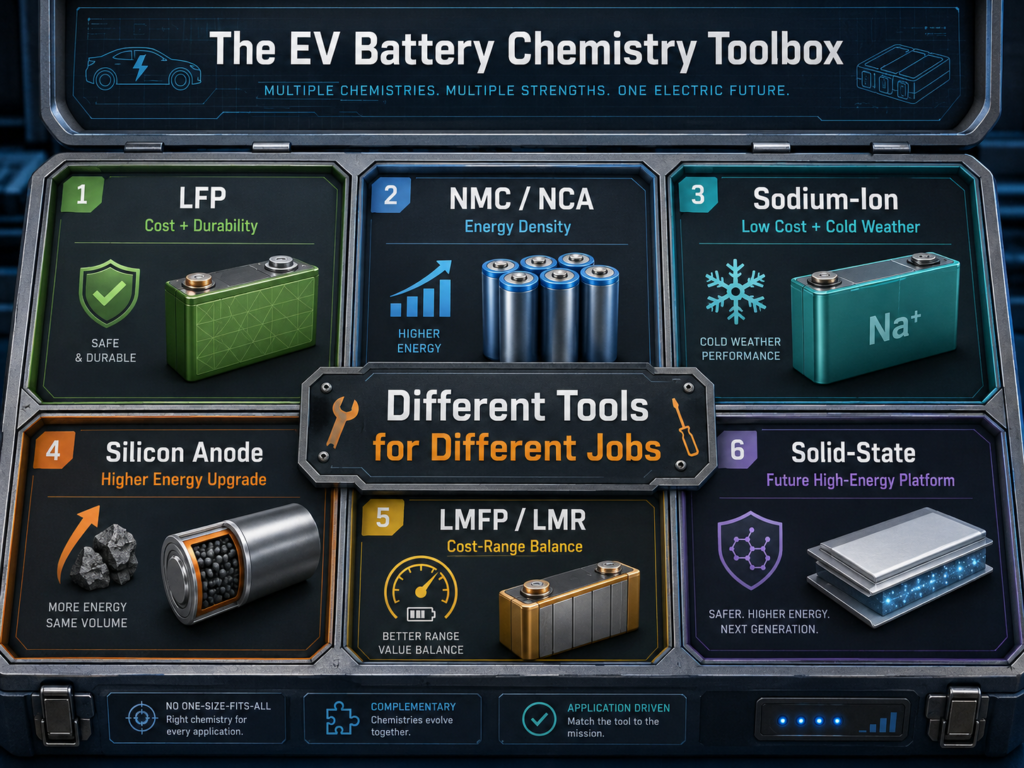
There will probably not be one winning EV battery chemistry. LFP is likely to keep growing because it is affordable, durable, and practical. NMC and NCA will remain important where energy density and performance justify the cost. Sodium-ion could become a major option for affordable vehicles, cold-weather applications, and grid storage. Silicon anodes may improve lithium-ion batteries before solid-state becomes mainstream. LMFP and LMR may fill the space between low-cost and high-range designs. Solid-state batteries could eventually reshape premium EVs and high-energy applications, but they still have to prove manufacturability and long-term durability.
That may sound messy, but it is actually a sign of maturity. Early EV discussions often treated batteries as one technology moving along one path. The industry is now moving into a more advanced stage where different vehicles get different solutions. That is what happens when a market grows up. The future of EV batteries is not a single finish line. It is a toolbox. And the automakers that succeed may not be the ones that bet everything on one chemistry. They may be the ones that know exactly which chemistry belongs in which vehicle, for which customer, at which price.
FAQ
Will LFP replace NMC batteries?
LFP will likely take more market share in affordable EVs and energy storage, but it probably will not fully replace NMC. Nickel-rich chemistries still make sense for vehicles that need higher energy density, longer range, or stronger performance.
Are sodium-ion batteries better than lithium-ion batteries?
Not in every way. Sodium-ion batteries may offer cost, material availability, safety, and cold-weather advantages, but they generally face energy-density challenges compared with high-performance lithium-ion cells. They may be best for specific applications rather than every EV.
Will solid-state batteries replace all EV batteries?
Solid-state batteries could become important, especially in premium or high-energy vehicles, but they are unlikely to replace every chemistry quickly. Cost, manufacturing scale, durability, and pack integration still matter.
Is silicon-anode battery technology separate from lithium-ion?
Usually, no. Most silicon-anode batteries are still lithium-ion batteries. The difference is that silicon is added to or used in the anode to improve energy storage, while the rest of the cell may still use familiar lithium-ion architecture.
What battery chemistry is best for cold weather?
There is no single answer. Pack heating, thermal management, and software matter a lot. Sodium-ion is gaining attention for potential cold-weather advantages, while LFP and NMC can also perform well when the vehicle has a strong battery thermal management system.
What is the best EV battery chemistry overall?
There is no universal best chemistry. LFP may be best for affordability and durability. NMC may be best for high range. Sodium-ion may be useful for low-cost and cold-weather applications. Solid-state may eventually be best for premium high-energy vehicles. The best chemistry depends on the job.