
Quick Answer
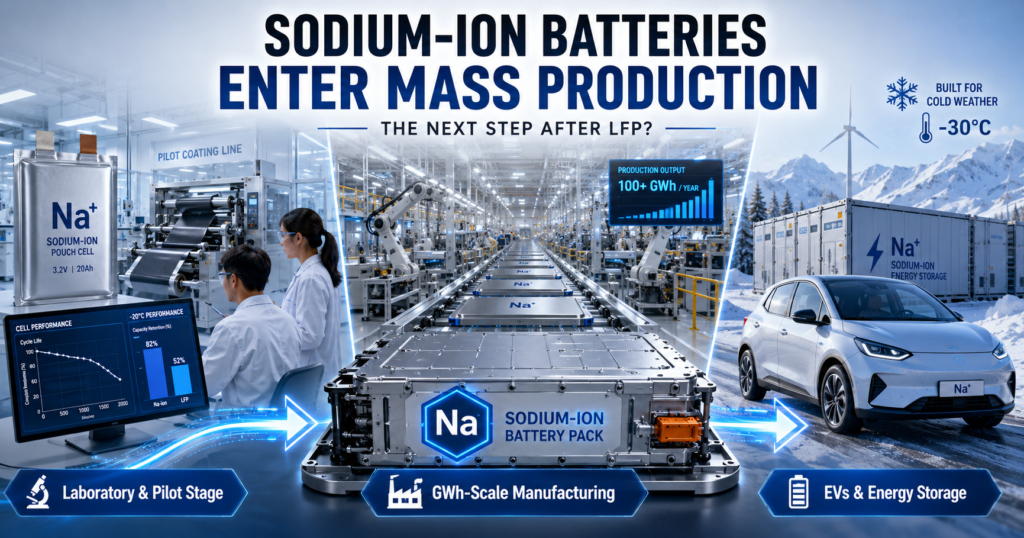
Sodium-ion batteries are entering a new phase in 2026. After years of laboratory research and limited pilot projects, the technology is moving toward commercial EVs and GWh-scale energy storage. In 2026, CATL and Changan unveiled a mass-production passenger vehicle using CATL’s Naxtra sodium-ion battery, while CATL also announced a large sodium-ion supply agreement for energy storage.
This does not mean sodium-ion batteries are about to replace LFP or high-nickel lithium-ion batteries across the entire EV market. Their lower energy density still makes them less attractive for long-range SUVs, large pickup trucks, and performance vehicles.
Their first meaningful role is more likely to be in affordable compact EVs, battery-swapping vehicles, hybrids, commercial vehicles operating in cold climates, and stationary energy storage systems. In those applications, lower dependence on lithium, strong cold-weather performance, good safety characteristics, and potentially lower long-term material costs may matter more than maximum driving range.
The real change is not that sodium-ion has suddenly become the “best” battery. It is that automakers may soon have another commercially scalable chemistry to choose from.
Sodium-Ion Batteries Are No Longer Just a Future Technology
For years, sodium-ion batteries were usually discussed as a promising alternative that might become useful someday. Researchers understood the basic chemistry, prototype cells were improving, and several companies had announced pilot projects. Yet there was still a large gap between producing a working laboratory cell and supplying thousands of consistent battery packs for vehicles.
That gap is now beginning to narrow. In February 2026, CATL and Changan announced a mass-production sodium-ion passenger vehicle scheduled to reach the market in 2026. CATL said its Naxtra sodium-ion batteries would be used across Changan brands, including Deepal, Qiyuan, AVATR, and UNI.
Two months later, CATL described Naxtra as having reached GWh-scale industrialization and said full-scale mass production was planned by the end of 2026. The company also announced a three-year, 60 GWh sodium-ion energy-storage agreement with HyperStrong.
These announcements do not prove that sodium-ion batteries will immediately become cheaper than LFP or capture a large share of the EV market. Manufacturer announcements should always be treated carefully until production volume, pricing, warranty performance, and real-world durability are independently verified.
Still, they represent something more important than another prototype. Sodium-ion technology is beginning to enter the stage where manufacturing consistency, vehicle integration, supply contracts, warranty risk, and factory economics matter as much as laboratory performance. That is what separates promising battery research from a commercially relevant battery industry.
Battery Research and Mass Production Are Very Different Problems
A laboratory battery can perform impressively under carefully controlled conditions. Researchers may demonstrate high energy density, fast charging, long cycle life, or strong low-temperature operation in a small test cell.
Mass production introduces an entirely different set of challenges. Every electrode must have nearly the same thickness and material loading. Moisture must be controlled throughout manufacturing. Electrolyte filling must remain consistent. Cells must behave similarly after formation cycling, aging, and inspection. A process that works for dozens of cells may become difficult to control when a factory produces millions.
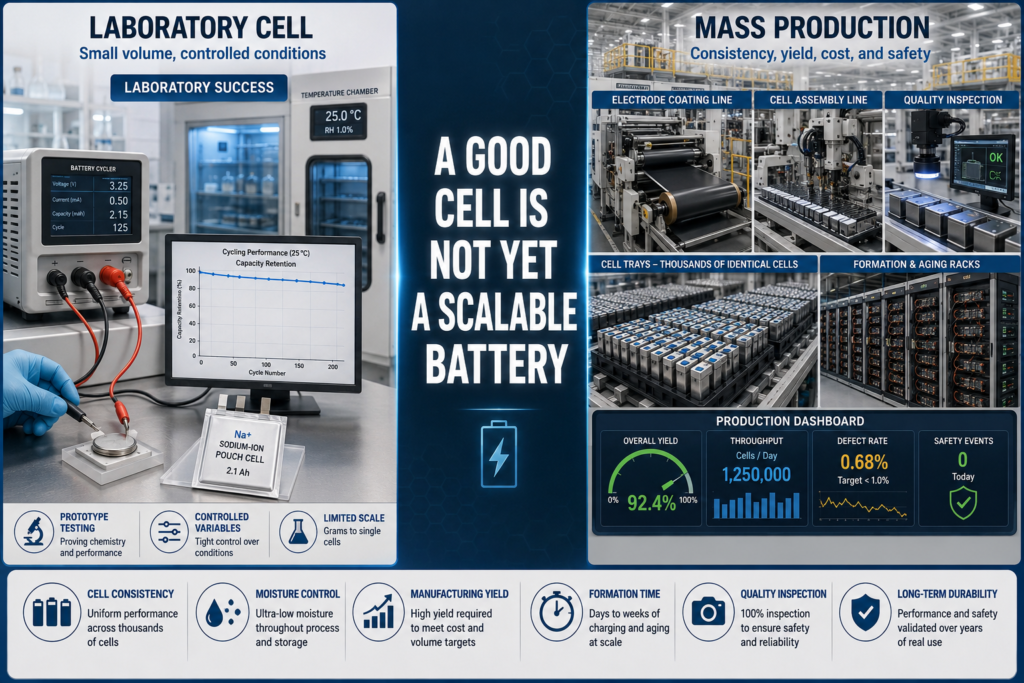
Sodium-ion manufacturing has several practical challenges that do not receive much attention in general news coverage. CATL has identified moisture control, gas generation in hard-carbon anodes, adhesion to aluminum current collectors, and anode formation behavior as important barriers to large-scale production. These are not dramatic breakthroughs that create exciting headlines, but solving them is essential for reliable manufacturing.
A battery company cannot simply produce a few excellent cells. It must produce a large number of cells with narrow performance variation, predictable aging, low defect rates, and an acceptable manufacturing yield. That is why the phrase “mass-producible” is different from “mass-produced.”
A technology may be designed for large-scale manufacturing while still operating at limited volume. It enters true mass production only when factories repeatedly deliver commercial quantities with stable quality and competitive economics.
CATL’s recent announcements suggest that sodium-ion batteries are crossing this industrial boundary. Whether they succeed will now depend less on a single laboratory record and more on production yield, cost, vehicle performance, and customer acceptance.
Readers interested in how difficult this scaling process can be may also find our guide to how an EV battery gigafactory manufactures battery cells useful. Battery chemistry matters, but manufacturing quality often determines whether that chemistry becomes commercially successful.
What Is CATL’s Naxtra Sodium-Ion Battery?
Naxtra is CATL’s commercial sodium-ion battery platform for passenger vehicles, commercial vehicles, battery swapping, and stationary energy storage. Like a conventional lithium-ion battery, a sodium-ion cell moves charged ions between a cathode and an anode during charging and discharging. The main difference is that it uses sodium ions rather than lithium ions as the charge carrier.
Commercial sodium-ion designs may use layered oxide, polyanionic, or Prussian blue analogue cathodes, depending on the balance of energy density, material cost, durability, and supply-chain requirements. Hard carbon is commonly used as the anode because sodium ions do not intercalate into conventional graphite as easily as lithium ions do.
CATL initially introduced the Naxtra passenger-vehicle battery with a claimed gravimetric energy density of up to 175 Wh/kg. In its 2026 Changan announcement, the company said an advanced Cell-to-Pack design and battery-management system could support more than 400 kilometers of pure-electric range. CATL also projected that future sodium-ion vehicles could reach approximately 500 to 600 kilometers as the supply chain, cell design, and pack integration improve.
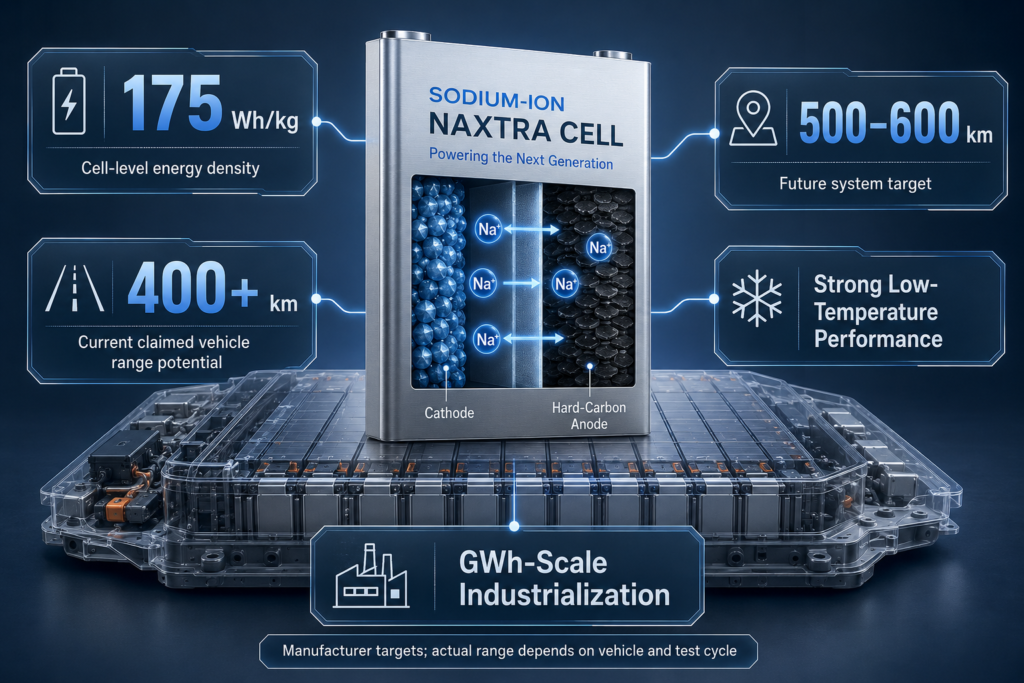
Those numbers require context. The company did not present them as U.S. EPA range ratings, and range estimates from Chinese vehicle announcements may be based on different driving cycles. A 500-kilometer laboratory or regulatory-cycle claim should not automatically be interpreted as roughly 310 miles of EPA range.
Vehicle efficiency, battery capacity, cabin heating, aerodynamics, tire selection, ambient temperature, and testing procedure all affect the final number. The more important point is that modern sodium-ion batteries are approaching a level where they can support practical compact and midsize EVs. They are no longer limited to very short-range neighborhood vehicles.
Why Sodium-Ion Batteries Still Trail LFP in Energy Density
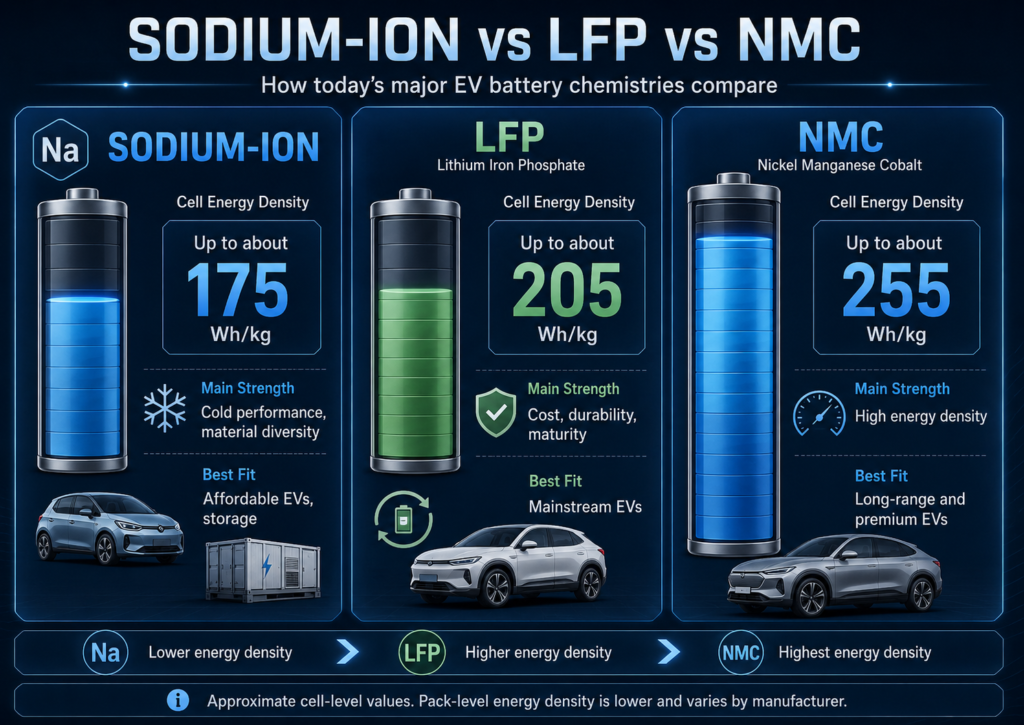
Energy density remains the clearest weakness of sodium-ion batteries. According to a recent International Energy Agency analysis of sodium-ion technology, the latest sodium-ion cells can reach approximately 175 Wh/kg. Advanced LFP cells can reach around 205 Wh/kg, while high-nickel NMC cells may reach roughly 255 Wh/kg.
These figures are cell-level comparisons rather than complete battery-pack values. Pack structures, cooling systems, electrical connections, crash protection, and battery-management hardware reduce the energy density of the finished system.
Even so, the difference matters. Suppose two vehicles need the same usable battery energy. A lower-energy-density battery normally requires more cell mass or more physical volume. That can increase curb weight, reduce interior space, or require a smaller battery and shorter range.
This is why sodium-ion is unlikely to displace high-nickel batteries in premium long-range vehicles anytime soon. Large SUVs and pickup trucks already require heavy battery packs. Adding more weight to compensate for lower cell energy density would make efficiency, towing range, handling, and packaging more difficult.
LFP is the more relevant competitor. Both LFP and sodium-ion emphasize lower-cost materials, safety, durability, and reduced dependence on nickel and cobalt. Their commercial roles may overlap, particularly in entry-level EVs and stationary storage.
However, modern LFP has an enormous advantage: maturity. LFP production lines are already operating at enormous scale. Automakers have years of validation data, suppliers understand the manufacturing process, and battery-pack designs are highly optimized. Cell-to-pack and cell-to-body architectures have also reduced some of LFP’s packaging disadvantage. For a broader explanation of these tradeoffs, see our comparison of LFP vs NMC batteries.
Sodium-ion does not need to beat every LFP battery immediately. It only needs to become competitive in applications where its specific advantages outweigh its lower energy density.
Why Sodium-Ion Batteries Perform Well in Cold Weather
Cold weather is one of the most interesting areas for sodium-ion batteries. Battery performance falls in winter because electrochemical reactions slow down, internal resistance increases, and ion transport becomes more difficult. The battery may temporarily provide less usable energy and less power. Charging also becomes more restrictive because the battery-management system must protect the cells.
LFP batteries can be particularly sensitive to low temperatures. They remain safe and durable, but power capability, regenerative braking, charging speed, and usable capacity can decline significantly when the battery is cold.
CATL says the Naxtra passenger-vehicle battery can retain more than 90% of its usable capacity at minus 40 degrees Celsius. The company also claims that it can provide nearly three times the discharge power of an equivalent LFP battery at minus 30 degrees Celsius and continue delivering power at temperatures as low as minus 50 degrees Celsius.
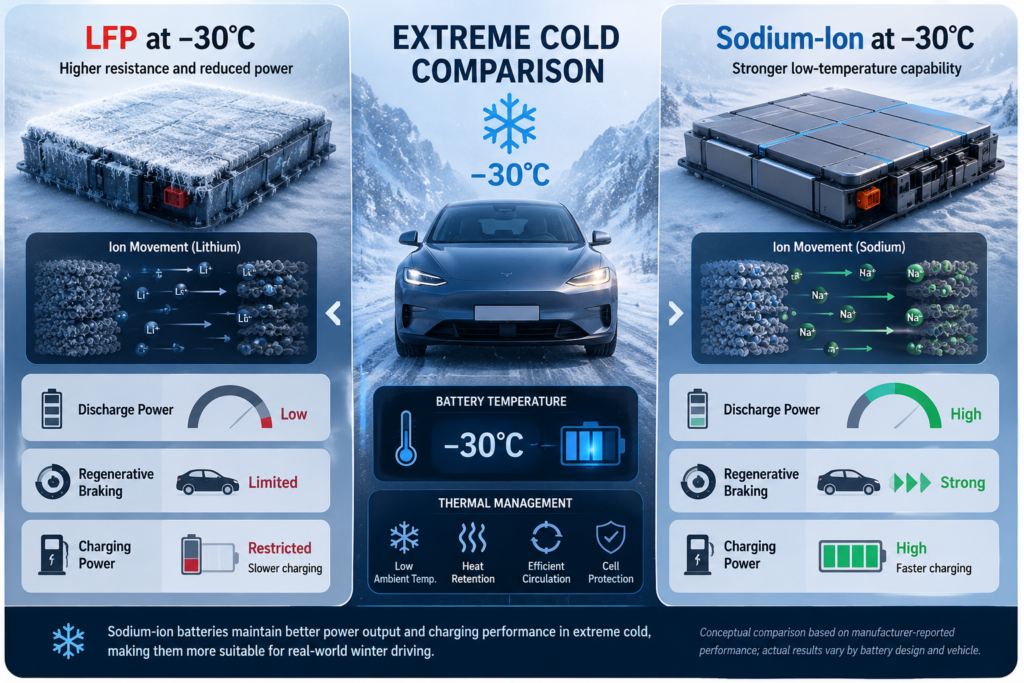
These are manufacturer-reported results rather than independent long-term fleet data. They should therefore be viewed as performance claims that still need broader real-world validation. Even with that caution, sodium-ion’s low-temperature behavior could create a meaningful advantage.
An EV with better cold-weather power capability may need less battery heating before driving. It may retain stronger acceleration and regenerative braking sooner after startup. A battery that accepts charging more easily in the cold may also reduce the time and energy required for preconditioning.
That does not mean thermal management becomes unnecessary. Sodium-ion packs still need temperature sensors, coolant systems, heating strategies, and battery controls. Cabin heating will also continue to reduce winter driving range regardless of chemistry.
The potential advantage is that the battery itself may remain more electrochemically capable before the thermal-management system brings it to an ideal operating temperature. This could make sodium-ion especially useful in northern China, Canada, Scandinavia, and cold U.S. regions such as Michigan, Minnesota, and the Northeast. It could also help commercial fleets. Delivery vehicles, buses, and shared vehicles often operate on fixed schedules and cannot always wait for a battery pack to warm fully before beginning service.
Why Sodium-Ion Could Work Well in Affordable EVs
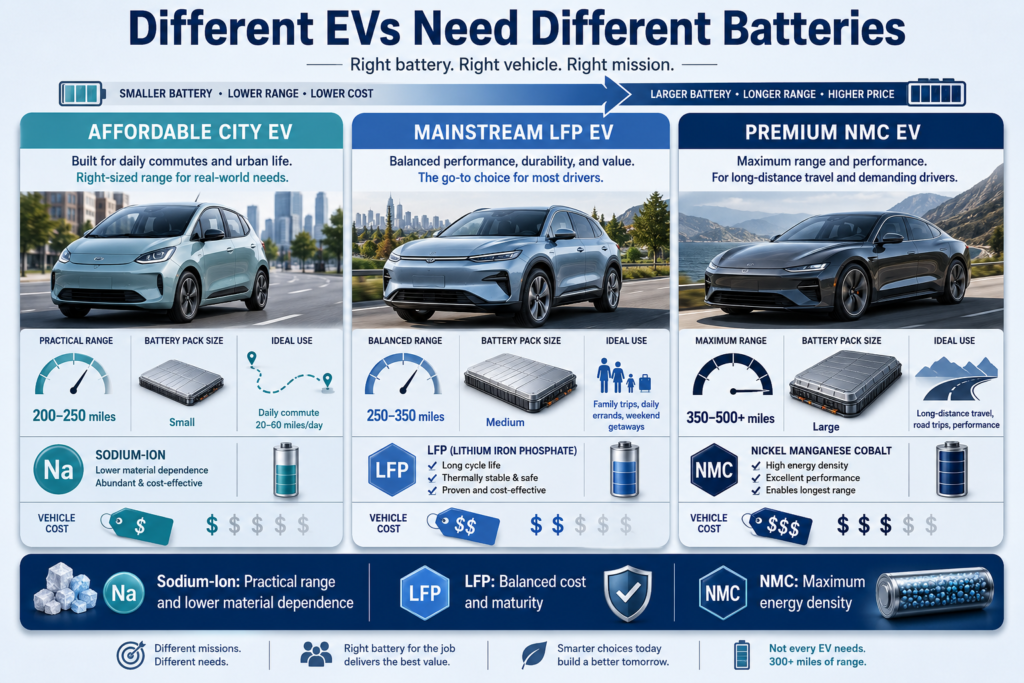
Affordable EVs do not necessarily need the battery with the highest energy density. They need a battery that meets the vehicle’s actual mission at the lowest practical system cost. A compact commuter EV may travel 30 to 60 miles on a typical day. Giving that vehicle a 300-mile battery can make it more expensive and heavier than necessary. A sodium-ion battery supporting 200 to 250 miles of practical range could be entirely sufficient for many drivers, especially when home or workplace charging is available.
The chemistry may also fit small city cars, entry-level crossovers, car-sharing fleets, delivery vehicles, and battery-swapping models. These vehicles are often designed around predictable travel patterns rather than maximum interstate range.
There are several reasons sodium-ion may eventually lower costs. Sodium resources are abundant and geographically widespread. Many sodium-ion chemistries can avoid lithium, cobalt, and nickel. Some designs can also use aluminum current collectors on both electrodes, rather than requiring copper on the anode side.
However, abundant raw materials do not automatically create a cheap battery. The final cell price depends on cathode processing, hard-carbon production, electrolyte cost, factory utilization, yield, production volume, financing, and supplier competition. A new sodium-ion factory operating below capacity could produce more expensive cells than a fully optimized LFP plant. That is why sodium-ion’s near-term value may be strategic before it becomes purely economic.
It gives automakers another option. An entry-level EV platform could use sodium-ion in cold regions, LFP in standard versions, and a higher-energy lithium-ion chemistry in longer-range trims. Manufacturers may also combine chemistries within a pack or vehicle platform rather than relying on one battery for every customer. The affordable-EV market may therefore move toward chemistry diversification rather than a simple replacement of LFP.
Why Sodium-Ion Still Matters When Lithium Prices Fall
One of the most common arguments against sodium-ion is that lithium prices have already fallen from their 2022 peak. If lithium becomes inexpensive, why develop another chemistry? The answer is that battery strategy is not based only on today’s spot price.
Lithium prices can change quickly as mine supply, processing capacity, inventories, government policy, and battery demand shift. The IEA reported that lithium prices at the beginning of 2026 were more than twice their level a year earlier, even though they remained far below the 2022 peak.
This volatility matters to automakers planning vehicles several years in advance. A new EV platform may remain in production for six to ten years. Battery contracts, factories, and mineral investments are made long before the final vehicles reach customers. Manufacturers therefore care about supply stability as much as the lowest temporary price.
Sodium-ion can act as a hedge. If an automaker or battery supplier can produce both lithium-ion and sodium-ion cells, it has more flexibility when raw-material markets change. It may shift certain entry-level vehicles or storage products toward sodium-ion without redesigning its entire business.
Supply-chain diversity also matters for energy security. Replacing lithium does not make a sodium-ion supply chain automatically independent or geographically balanced. Some sodium-ion cathodes still use nickel, manganese, vanadium, or other industrial materials. Hard-carbon production and electrolyte manufacturing must also scale.
The IEA notes that China currently dominates sodium-ion manufacturing capacity and is expected to retain a very large share of announced capacity through 2030. Therefore, sodium-ion may diversify battery chemistry before it significantly diversifies manufacturing geography. Even so, building an alternative to lithium-based cells can reduce exposure to one material market. That strategic value remains relevant even during periods of low lithium prices.
Will Sodium-Ion Batteries Grow Faster in EVs or Energy Storage?
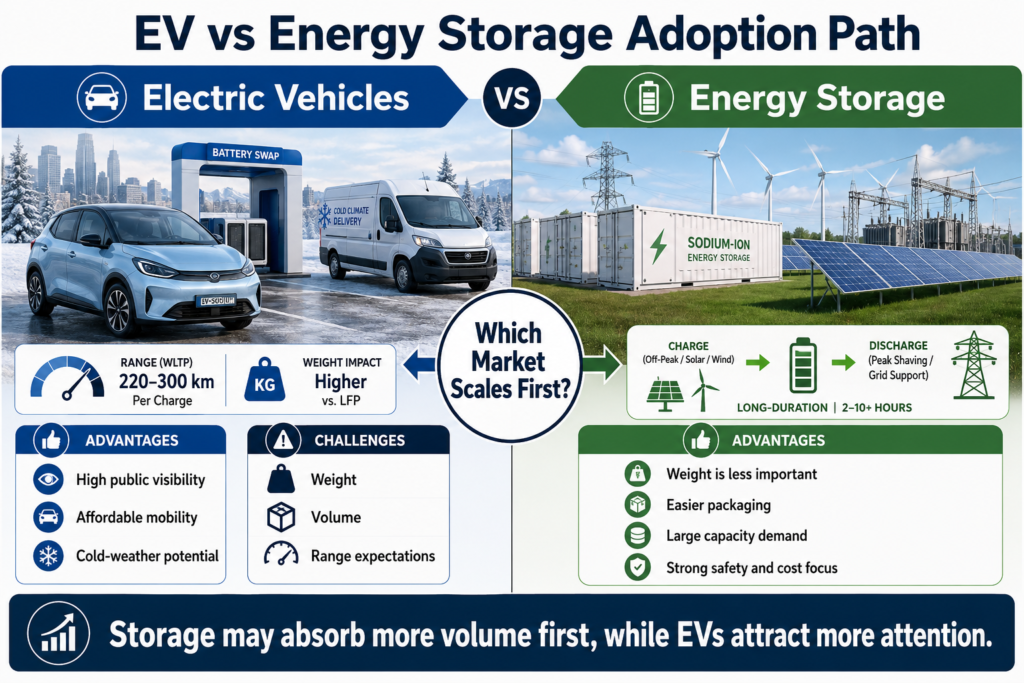
Stationary energy storage may offer the easier path to high-volume sodium-ion deployment. An energy-storage container does not need to carry its own weight down the highway. It does not lose driving efficiency when the battery is heavier, and it has more room for cells, cooling equipment, structural support, and electrical hardware.
That makes lower energy density less damaging. For grid storage, cost, safety, cycle life, temperature tolerance, maintenance, and supply availability may matter more than weight. A slightly larger container can be acceptable if it offers stable operation and lower lifetime cost.
CATL’s 60 GWh agreement with HyperStrong shows how quickly the storage market could absorb sodium-ion production if the cells meet commercial requirements. For comparison, 60 GWh is enough battery capacity to support a very large number of grid and commercial storage projects.
Energy storage also provides a useful environment for scaling the supply chain. Manufacturers can accumulate field data, improve production yields, and reduce costs before relying on the chemistry for a broad range of passenger vehicles.
That does not mean EV adoption will be insignificant. Changan’s 2026 vehicle launch, CATL’s battery-swapping plans, and other Chinese sodium-ion programs indicate that automotive deployment is happening at the same time. Compact vehicles in cold climates may become one of the chemistry’s first visible consumer applications.
The likely outcome is not a single winner. Energy storage may consume more sodium-ion capacity first because it is less sensitive to weight and volume. Affordable EVs may create more public attention because drivers can see and purchase the technology directly. Commercial vehicles, 12-volt auxiliary batteries, hybrids, and battery-swapping fleets may develop between those two markets.
Sodium-Ion May Be Used Alongside LFP, Not Instead of It
Battery discussions often assume that one chemistry must replace another. In practice, the market is becoming more specialized. High-nickel NMC and NCA cells remain attractive when maximum range, power, and low weight are priorities. LFP has become a strong choice for mainstream EVs because it combines low cost, durability, safety, and increasingly competitive pack-level energy density.
Sodium-ion adds a new option for cold-weather performance, lithium-free supply chains, affordable short- and medium-range vehicles, and stationary storage.
Hybrid battery packs may also become more important. A multi-chemistry pack could use sodium-ion cells for cold-weather power and lithium-ion cells for higher energy density. The battery-management system would coordinate current, state of charge, temperature, and aging between the different cell groups.
This approach is more complicated than using one chemistry. Different cell voltages, capacity curves, resistance characteristics, and degradation rates must be managed carefully. Yet it may allow automakers to combine the strengths of two batteries rather than forcing one chemistry to handle every operating condition.
CATL has already presented multi-chemistry battery architectures as part of its broader strategy. If these systems prove reliable, future vehicle specifications may describe more than simply “LFP” or “NMC.” The battery pack itself may become a coordinated energy system containing cells optimized for different jobs.
What Sodium-Ion Mass Production Does Not Mean
The move toward mass production should not be confused with immediate global availability. Most current sodium-ion production capacity and expertise remain concentrated in China. Supply chains for cathode materials, hard carbon, electrolyte salts, production equipment, and quality control are less mature than the enormous lithium-ion industry.
There is also limited public information about long-term automotive warranties, repair procedures, residual values, recycling economics, and performance after years of real driving. CATL has published strong safety and cycle-life claims, but buyers should distinguish company testing from independently verified fleet results.
The first generation of mass-produced sodium-ion EVs will provide valuable answers. How much range will they lose in real winters? How fast will they charge after several years? Will the cells remain balanced as they age? How will insurers and repair centers handle damaged packs? Will the lower-cost materials actually result in a lower vehicle price?
These practical questions are more important than a record set by a prototype cell. Mass production is not the end of battery development. It is the beginning of large-scale validation.
What This Could Mean for U.S. EV Buyers
U.S. buyers should not expect sodium-ion vehicles to appear nationwide overnight. The technology is currently advancing fastest in China, where battery manufacturers, automakers, suppliers, and charging networks can develop together. Bringing sodium-ion EVs to the United States would require local certification, service support, supply agreements, vehicle integration, and a competitive business case.
Trade policy and battery sourcing rules may also affect which sodium-ion products enter the U.S. market. The first effect American buyers notice may not be a sodium-ion vehicle. It could be a stationary storage product, a commercial fleet application, or a lithium-ion battery that becomes cheaper because manufacturers have another chemistry available.
Over time, sodium-ion could help create a more affordable category of EVs that prioritizes practical daily range rather than very large battery packs. For example, a small crossover with around 220 miles of usable range, reliable winter performance, and a lower purchase price could be more valuable to many drivers than a heavier model offering 350 miles at a substantial premium.
The success of that vehicle would depend on charging access and efficiency as much as battery chemistry. Sodium-ion will not solve poor public charging reliability, expensive vehicle manufacturing, high insurance rates, or inefficient vehicle design. It is one part of a much larger affordable-EV strategy.
How This Article Differs From Our Earlier Sodium-Ion Guide
Our previous article, Sodium-Ion Batteries Explained, focused on how the chemistry works, why sodium can replace lithium as the charge carrier, and where sodium-ion fits within the broader future battery landscape.
The central question was whether sodium-ion could become an important technology after lithium-ion and solid-state batteries. The question has now changed. Sodium-ion is no longer only a candidate technology. CATL and Changan are moving toward commercial passenger-vehicle deployment, while large energy-storage agreements are creating a path toward substantial production volume.
The more useful question is no longer, “Can sodium-ion batteries work?” It is, “Which applications make sense first, and can the industry manufacture them economically at scale?” That shift from scientific possibility to industrial execution is the main reason sodium-ion deserves another look in 2026.
Conclusion: Sodium-Ion Is Becoming a Practical Option, Not a Universal Replacement
Sodium-ion batteries are entering their most important stage yet. CATL’s Naxtra technology, the Changan passenger-vehicle program, and the 60 GWh HyperStrong storage agreement suggest that the industry is moving from pilot projects toward meaningful commercial volume.
The chemistry still faces clear limitations. Its energy density trails advanced LFP and NMC cells. Its supply chain is less mature. Cost advantages are not guaranteed while lithium prices remain relatively low and LFP factories continue to improve.
But sodium-ion does not need to replace lithium-ion to succeed. It can serve affordable EVs that do not need maximum range. It can improve cold-weather performance. It can support battery-swapping fleets and commercial vehicles. It can give stationary storage developers another chemistry choice. It can also reduce the battery industry’s dependence on a single raw-material pathway.
LFP will likely remain the benchmark for low-cost lithium-ion batteries for years. Sodium-ion’s next step is not to defeat LFP everywhere. It is to become competitive wherever LFP’s energy density advantage matters less than cold performance, supply flexibility, safety, or long-term material availability. That may sound less revolutionary than claims that sodium will become a “lithium killer.” It is also a much more realistic path to becoming a mainstream battery technology.
Frequently Asked Questions
Are sodium-ion batteries already in mass production?
Sodium-ion cells have previously been produced in limited commercial and pilot volumes. In 2026, CATL announced a mass-production passenger-vehicle program with Changan and said its Naxtra platform had reached GWh-scale industrialization. Full-scale production is expected to expand through the end of 2026.
Will sodium-ion batteries replace LFP batteries?
Not in the near future. LFP currently offers greater manufacturing maturity, a well-developed supply chain, competitive cost, and higher energy density in advanced cells. Sodium-ion is more likely to complement LFP in cold climates, affordable short- and medium-range EVs, hybrid packs, and stationary storage.
How much range can a sodium-ion EV provide?
CATL says its current Cell-to-Pack system can support more than 400 kilometers of pure-electric range under the applicable test conditions. It projects that future systems could reach roughly 500 to 600 kilometers. These numbers should not be treated as U.S. EPA ratings.
Are sodium-ion batteries cheaper than LFP?
Not necessarily today. Sodium raw materials can offer a structural cost advantage, but commercial cell cost also depends on production volume, manufacturing yield, factory utilization, hard-carbon processing, electrolyte cost, and supply-chain maturity. Highly optimized LFP may remain cheaper in many near-term applications.
Do sodium-ion batteries work better in cold weather?
Recent sodium-ion designs show strong low-temperature capability. CATL claims Naxtra retains more than 90% capacity at minus 40 degrees Celsius and provides much stronger cold discharge power than comparable LFP cells. Broader independent fleet data will be needed to verify long-term real-world performance.
Will sodium-ion batteries appear first in EVs or energy storage?
Both markets are developing, but stationary energy storage may absorb more production volume first because weight and size are less important. Affordable EVs and cold-climate vehicles may become the first highly visible consumer applications.
Do sodium-ion batteries contain no critical minerals?
They eliminate the need for lithium and can avoid cobalt and graphite, depending on the design. However, some commercial cathodes still use nickel, manganese, vanadium, or other materials with their own supply-chain considerations. Sodium-ion improves material diversity but does not eliminate every supply risk.