
Quick Answer
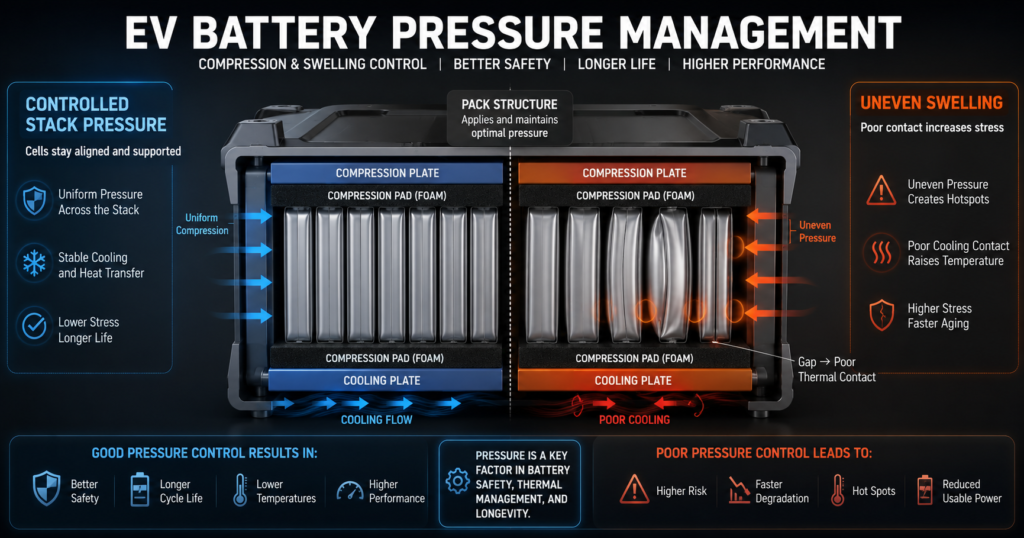
Modern EV batteries need pressure management because battery cells are not mechanically static. They expand and contract during charging and discharging, gradually swell as they age, and can generate internal pressure if gas forms inside the cell. This is especially important for pouch cells, prismatic cells, and blade-style battery designs, where the cells are tightly packed inside the battery pack.
Good pressure control helps keep cells mechanically stable, improves electrical contact, supports more predictable aging, and helps the battery management system estimate battery health more accurately. Poor pressure control can lead to uneven cell aging, reduced capacity, higher resistance, lithium plating risk, swelling-related stress, and in severe cases, safety concerns.
Most EV discussions focus on chemistry, charging speed, thermal management, or battery degradation. But inside the pack, mechanical pressure is becoming just as important as temperature and voltage.
Introduction
When people talk about EV battery health, they usually focus on heat, fast charging, battery chemistry, or charging to 100%. Those topics matter. But there is another part of battery design that rarely gets discussed outside engineering circles: pressure.
Modern EV battery cells are packed tightly inside modules or directly inside battery packs. They are not loose objects sitting in a box. They are compressed, supported, cushioned, cooled, and constrained by the surrounding structure. That mechanical environment matters because lithium-ion cells physically change shape during normal operation.
A battery cell may look solid from the outside, but internally it is a layered electrochemical system. Lithium ions move in and out of electrode materials during charging and discharging. The anode and cathode expand and contract slightly. Over many cycles, side reactions can create irreversible swelling. In some cases, gas generation can make a cell bulge more dramatically. This is why modern EV battery packs are no longer just electrical systems. They are electrochemical, thermal, and mechanical systems all working at the same time.
Battery swelling and pressure control are especially important for pouch cells and prismatic cells. Unlike cylindrical cells, which have rigid metal cans, pouch cells use a flexible laminated enclosure. That gives engineers excellent packaging efficiency, but it also means the cell needs external mechanical support. Recent battery testing discussions highlight that pouch and prismatic cells expand as they age, increasing pressure inside the pack and affecting performance, state-of-charge estimation, and state-of-health prediction. That may sound like a small detail. In reality, it is becoming one of the key design challenges in high-energy EV battery packs.
Battery Cells Breathe During Normal Operation
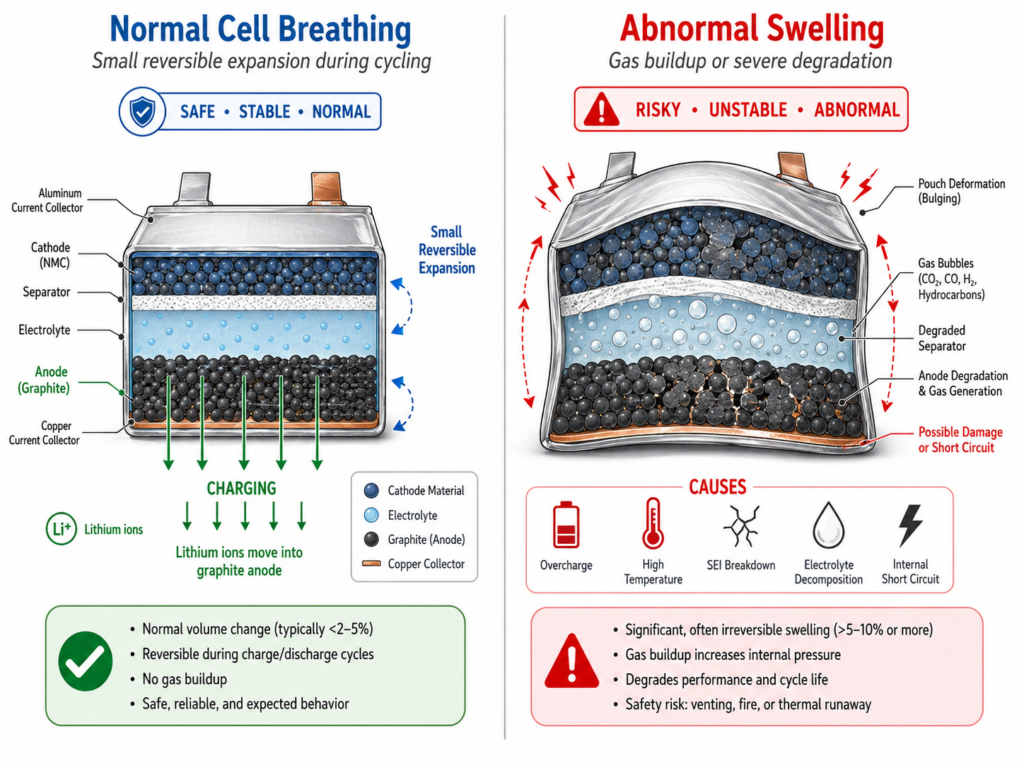
A lithium-ion battery cell does not stay exactly the same size throughout its life. Even during normal operation, it expands and contracts slightly as lithium ions move between the electrodes. Engineers sometimes describe this as cell “breathing.”
During charging, lithium ions move into the anode. In most EV lithium-ion batteries, that anode is still mostly graphite, sometimes blended with silicon. When lithium enters graphite, the graphite structure expands. During discharge, lithium leaves the anode and moves back toward the cathode, and the anode contracts again.
This repeated expansion and contraction may be small at the cell level, but in a large EV battery pack containing hundreds or thousands of cells, it becomes important. The pack structure must allow enough compliance for normal breathing while still keeping the cells firmly supported.
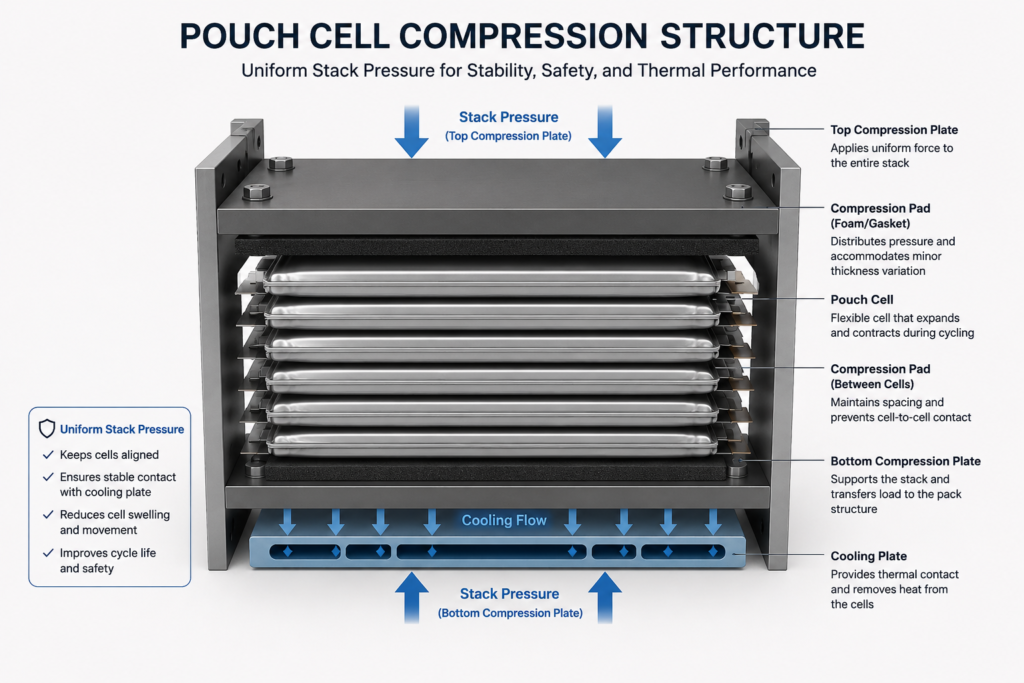
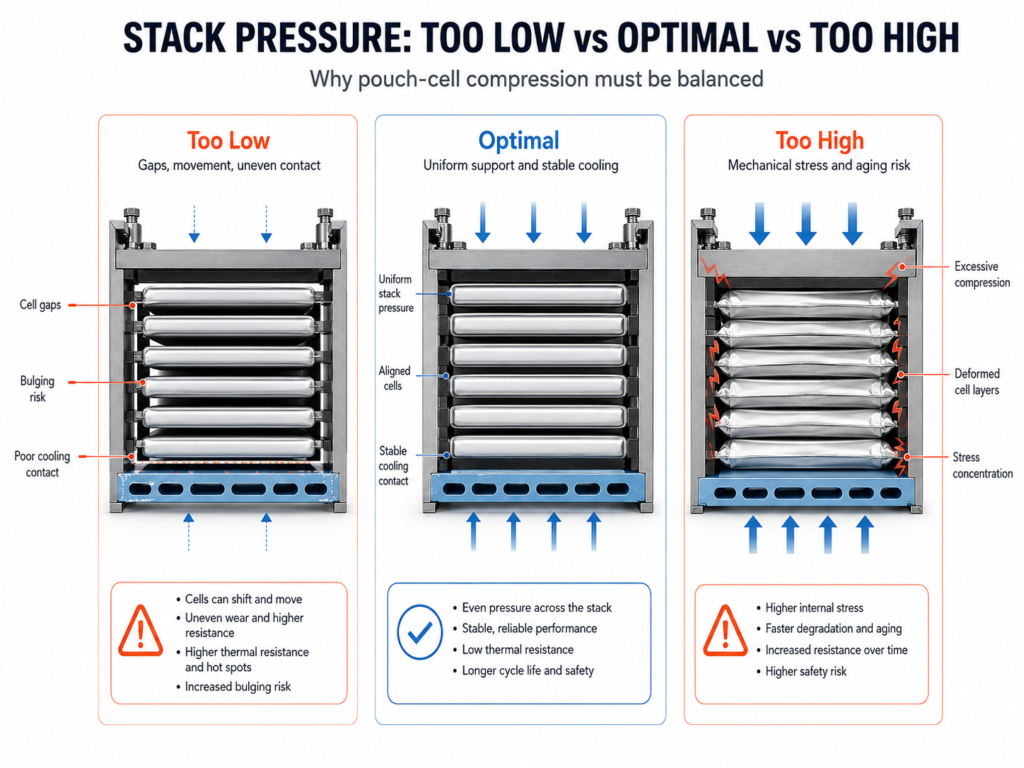
Too little compression can allow gaps, movement, or uneven contact. Too much compression can stress the cell layers and make aging worse. The goal is not simply to squeeze the battery as tightly as possible. The goal is controlled, uniform, predictable pressure. This is a reason why battery pack design is much more complicated than simply placing cells into a metal tray. Engineers need compression pads, end plates, foam layers, cooling plates, adhesives, structural members, and sometimes pressure-sensitive test data to understand how the pack will behave over years of use.
The challenge gets even harder because pressure changes over time. A brand-new battery pack and a battery pack after 100,000 miles may not have the same internal mechanical condition.
Cell Swelling Is Not Always the Same Thing as Battery Failure
The word “swelling” can sound alarming, and in some cases it should be. A visibly swollen consumer battery is a serious warning sign. In an EV, however, there are different levels of swelling. Some dimensional change is expected. Cells expand and contract during cycling, and a small amount of irreversible growth can occur as the battery ages. This does not automatically mean the pack has failed.
The concern is uncontrolled swelling. That can happen when internal side reactions generate gas, when lithium plating contributes to abnormal degradation, when the electrolyte breaks down, or when a cell experiences internal damage. As discussed in our related article, Why EV Batteries Swell — And Why You Should Never Ignore It, EV batteries can swell when gases build up inside lithium-ion cells due to overheating, electrolyte breakdown, lithium plating, aging, manufacturing defects, or physical damage.
The important distinction is that battery engineers design for normal expansion. They do not design for severe gas-generation events as if they were normal operation. That is why pressure management has two roles. The first role is everyday performance. The pack needs to maintain the right mechanical environment for thousands of charge and discharge cycles.
The second role is safety and diagnostics. Abnormal swelling or abnormal pressure increase can be an early clue that something inside the cell is going wrong.
Why Pouch Cells Need Compression
Pouch cells are common in EVs because they offer excellent packaging flexibility. Instead of using a rigid cylindrical metal can, a pouch cell uses a thin laminated aluminum-plastic enclosure. This allows the cell to be made in flat, rectangular shapes that can fit efficiently into a vehicle floor.
That packaging efficiency is the advantage. Mechanical vulnerability is the tradeoff. A pouch cell does not have the same built-in structural stiffness as a cylindrical cell. It depends more heavily on the surrounding module or pack structure. Without proper compression, the cell can swell unevenly, lose uniform contact with cooling surfaces, or experience localized stress. This is why pouch cells are usually assembled with compression pads or controlled clamping structures. These materials are not just there to fill empty space. They help maintain pressure as the cell breathes, ages, and expands.
Good compression also helps keep internal layers aligned. Inside a pouch cell, electrode sheets and separators are stacked or wound into a dense layered structure. If pressure distribution becomes uneven, some areas of the cell may age faster than others. That can contribute to local resistance growth, uneven current distribution, and reduced usable capacity.
Recent research on pouch-cell mechanical stress shows why this is complicated. As lithium ions intercalate into active particles, the electrodes want to expand, but stiff current collectors constrain that expansion. This creates internal stress, and that stress can influence electrochemistry and mechanical degradation. In simple terms, the battery is not only aging chemically. It is also aging mechanically.
Stack Pressure: The Hidden Mechanical Variable
“Stack pressure” refers to the pressure applied across a stack of battery cells or electrode layers. In an EV battery pack, this pressure may come from module end plates, pack frames, compression pads, adhesives, cooling plates, or the vehicle-integrated structure itself.
Stack pressure is one of those engineering variables that consumers rarely hear about, but it can influence battery performance in several ways. If stack pressure is too low, cells may not stay uniformly supported. Contact with cooling plates can become less consistent. Pouch cells may bulge more easily. Electrical and thermal behavior can become less predictable.
If stack pressure is too high, the cell may experience excessive mechanical stress. That can deform internal layers, increase local pressure gradients, or make lithium plating worse under aggressive fast charging conditions. One 2023 study on lithium-ion batteries under compressive loading reported that compressive loads during fast charging could increase lithium plating-related degradation under the tested conditions, showing that more pressure is not always better.
This is the key point: battery pressure control is not about maximum compression. It is about optimal compression. The ideal pressure depends on cell chemistry, format, electrode design, state of charge, temperature, aging condition, pack architecture, and charging profile. That is why automakers and battery suppliers spend so much time testing cells under controlled mechanical conditions.
Pressure and Battery Aging Are Connected
Battery aging is often explained through chemistry: SEI growth, lithium inventory loss, cathode degradation, electrolyte decomposition, and lithium plating. Those mechanisms are real. But mechanical pressure can affect how those mechanisms develop across the cell.
For example, if one region of a pouch cell is under higher pressure than another, lithium-ion transport may not be perfectly uniform. Over time, this can produce uneven aging. The cell may still show a normal average voltage, but internally, some regions may be working harder than others.
This matters because EV battery packs are only as strong as their weakest cells or weakest regions. A pack can contain many healthy cells, but if a small number of cells age faster, the BMS may need to limit pack power, charging speed, or usable capacity to protect the system.
Battery testing companies now pay close attention to swelling force and pressure because swelling can affect electrical performance and BMS accuracy. ZwickRoell notes that pouch and prismatic cells expand with age, increasing battery pack pressure, and that conventional BMS systems do not directly detect this pressure or its effects.
That last point is important. Most EV owners assume the BMS “knows everything” happening inside the battery. In reality, production BMS systems usually measure voltage, current, and temperature. Pressure is harder to measure directly inside a mass-produced EV pack. This is why future battery packs may rely more on embedded pressure sensors, swelling models, force-sensitive materials, or indirect diagnostics that combine voltage, impedance, temperature, and mechanical behavior.
Pressure Also Affects Thermal Management
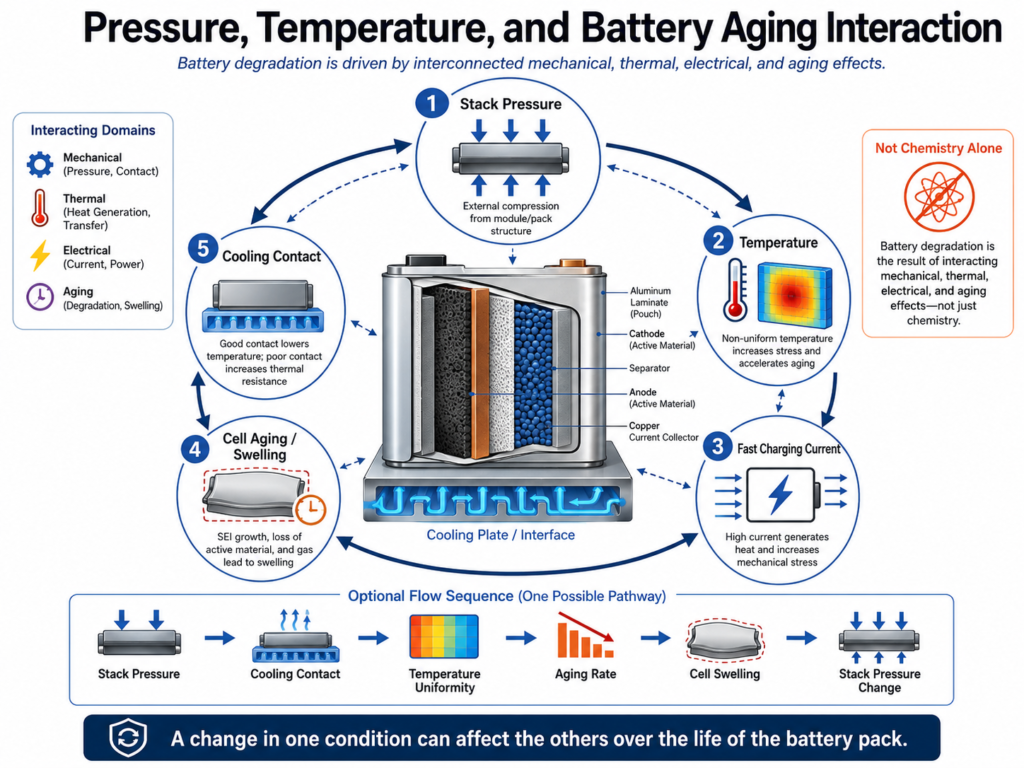
Thermal management and pressure management are closely connected. A battery cell needs good contact with cooling surfaces. If a pouch cell or prismatic cell expands unevenly, contact pressure against the cooling plate may change. Some areas may transfer heat efficiently, while others may become warmer. That uneven temperature distribution can accelerate local degradation.
This becomes especially important during DC fast charging. Fast charging generates heat, and the battery’s ability to remove that heat depends not only on coolant temperature but also on physical contact between cells, thermal interface materials, and cooling plates.
A well-designed pack keeps the mechanical stack stable enough that thermal paths remain predictable over the life of the vehicle. A poorly controlled pack may start with good cooling performance but gradually lose uniformity as cells swell, pads compress, or structures relax.
This is a reason modern EV battery design is moving toward multi-physics engineering. Engineers cannot optimize voltage, temperature, and mechanical pressure separately. A change in one area can affect the others. For more background on how battery software and thermal limits interact during real-world charging, see our article on Why EV Batteries Fail Early: The Hidden Role of BMS.
Blade Battery Designs Make Pressure Management Even More Interesting
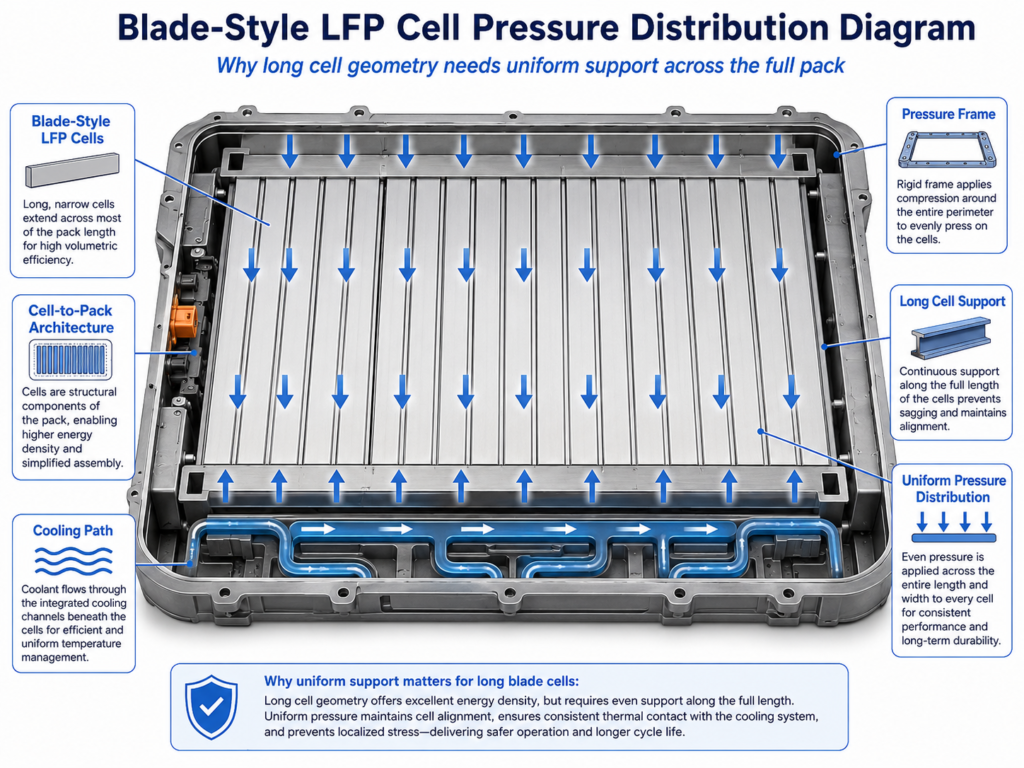
BYD’s Blade Battery is a good example of why mechanical design has become central to EV battery innovation. Many people describe the Blade Battery as an LFP battery, which is true but incomplete. It is also a packaging and structural design. BYD’s Blade Battery uses long, thin LFP cells that can be arranged efficiently in the battery pack. BYD says the Blade Battery is designed for safety, stable range, and long life, and its public technology page emphasizes the role of LFP chemistry, thermal stability, and the blade-shaped structure.
The blade format changes the mechanical problem. Instead of many smaller cells grouped into modules, the pack uses long cell elements that contribute to space efficiency and structural packaging. That makes cell support, pressure distribution, cooling contact, and crash protection especially important. In our article on Cell-to-Pack vs Structural Battery Pack, we discussed how BYD’s Blade Battery is both a chemistry choice and a packaging innovation. It helps reduce traditional module structure and moves closer to cell-to-pack or cell-to-body thinking.
That shift improves packaging efficiency, but it also reduces the number of intermediate structures that used to help separate, support, and isolate cells. As the industry moves from cell-to-module to cell-to-pack and cell-to-body designs, the pack structure itself must do more work. In other words, pressure management becomes more integrated with vehicle architecture.
Cell-to-Pack and Structural Packs Raise the Stakes
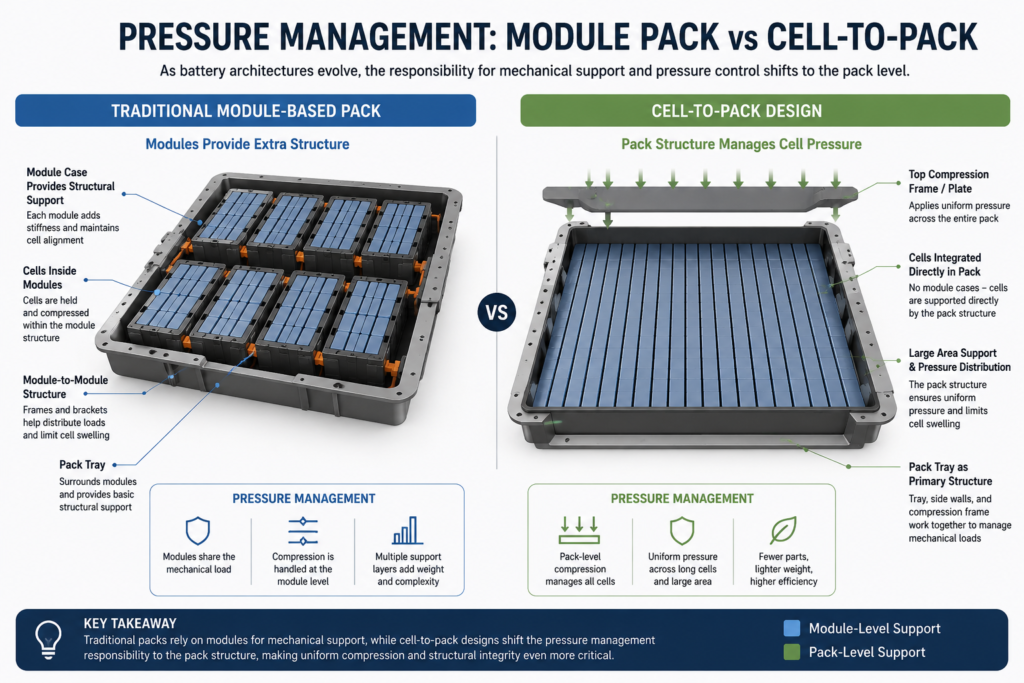
Traditional EV battery packs had a layered hierarchy: cells, modules, pack, vehicle. Modules added weight and complexity, but they also provided mechanical support and some separation between cell groups. Newer designs remove some of that structure. Cell-to-pack designs place cells directly into the pack. Cell-to-body designs integrate the battery more closely with the vehicle body. Structural battery packs go even further by making the battery pack part of the vehicle’s load-bearing structure.
This architectural evolution can improve efficiency, reduce weight, and increase usable battery volume. But it also means battery cells are more directly connected to the mechanical behavior of the vehicle. Vibration, crash loads, thermal expansion, road impacts, pack stiffness, adhesive behavior, and long-term swelling all become part of the same design problem. The battery is no longer just a removable box under the floor. It is becoming part of the vehicle’s structure.
CATL’s public technology page describes battery system innovations such as gas-electric separation, active isolation, self-cooling technology, and big-data early warning systems for battery faults. While that page is not specifically a consumer explanation of compression pads, it shows the broader industry direction: battery packs are becoming more integrated, more monitored, and more actively managed. Pressure management fits directly into that trend.
What Happens If Pressure Is Poorly Managed?
Poor pressure management does not always create an immediate failure. More often, it slowly reduces the battery’s margin. A pack with uneven compression may age unevenly. Some cells may experience higher stress. Others may lose ideal thermal contact. A pouch cell may swell more in the center than at the edges. A cooling plate may not remove heat as uniformly as it did when the vehicle was new.
Over time, the BMS may respond by reducing charging speed, limiting peak power, or narrowing the usable state-of-charge window. From the driver’s perspective, this might appear as slower charging, reduced range, or more conservative performance in hot or cold weather.
In more serious cases, abnormal swelling can indicate gas generation, internal short risk, or severe degradation. Research on gas-induced bulging in pouch cells has explored how gas formation can create large deformations and how bulging shape may help estimate internal pressure or state of health without opening the cell (arXiv). That is why swelling is not just a packaging inconvenience. It can become a diagnostic signal.
Why BMS Software May Eventually Include Pressure Data
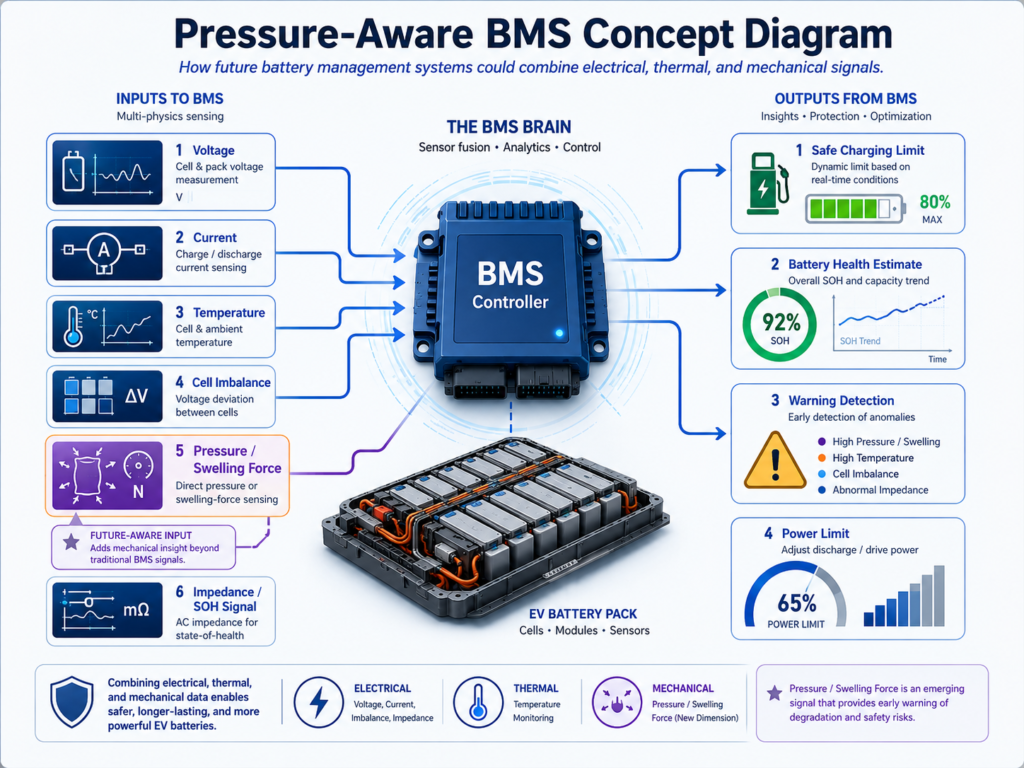
Today’s EV battery management systems mostly rely on voltage, current, and temperature sensors. Some advanced systems also use impedance estimation, model-based state estimation, and cloud analytics. Pressure sensing is still less common in mass-market EV packs, partly because it adds cost, complexity, and packaging challenges.
But pressure data could become more valuable as battery packs become more energy-dense and more structurally integrated. A pressure-aware BMS could potentially detect abnormal swelling earlier. It could compare expected cell breathing with actual expansion force. It could identify cells or regions that are aging differently. It could improve state-of-health estimation by adding a mechanical signal to electrical and thermal signals.
This does not mean every future EV will have a pressure sensor on every cell. That would likely be too expensive and complicated. But selective sensing, module-level force monitoring, or pressure-informed models could become more common in advanced battery systems.
Battery diagnostics are moving beyond simple voltage monitoring. The future BMS may need to understand not only how hot the battery is, or how much charge it has, but also how the battery is physically changing over time.
What This Means for EV Owners
EV owners do not need to worry about stack pressure every day. You cannot adjust battery compression from the driver’s seat, and you should never attempt to physically inspect or press on an EV battery pack yourself. Still, pressure management explains why some familiar EV ownership advice matters.
Avoiding unnecessary heat helps reduce side reactions and gas generation. Preconditioning before fast charging helps reduce lithium plating risk in cold weather. Avoiding repeated high-power charging at very high states of charge reduces stress. Paying attention to battery warnings matters because swelling-related problems may not be visible from outside the vehicle.
It also explains why battery pack design differs so much between automakers. Two EVs may both use LFP cells, but one may use blade-style cell-to-pack architecture while another uses prismatic cells in modules. Two EVs may both use pouch cells, but their compression pad design, cooling plate layout, and structural support strategy may be completely different. Battery chemistry gets most of the attention, but pack engineering often determines how that chemistry survives real-world use.
Conclusion
EV battery pressure management is one of the least-discussed but most important parts of modern battery design. Lithium-ion cells expand and contract during normal operation. They gradually swell as they age. Pouch and prismatic cells need controlled mechanical support. Blade batteries and cell-to-pack designs improve packaging efficiency but also make pressure distribution and structural integration more important.
The best EV battery packs are not simply the ones with the highest energy density or fastest charging speed. They are the ones that manage electrochemical, thermal, and mechanical stress together. That is why compression pads, stack pressure, swelling force, cooling contact, and pack stiffness matter. They may be hidden under the floor, but they help determine how safely and consistently an EV battery performs over many years.
As EVs continue moving toward larger packs, faster charging, LFP blade cells, structural battery packs, and eventually solid-state or lithium-metal designs, pressure control will only become more important. In the future, the smartest EV batteries may not only manage voltage and temperature. They may also understand pressure.
FAQ
Why do EV battery cells swell?
EV battery cells can swell because of normal electrode expansion, long-term aging, electrolyte decomposition, gas generation, lithium plating, overheating, internal defects, or physical damage. Small dimensional changes can be part of normal operation, but abnormal swelling is a warning sign.
Why are pouch cells more sensitive to pressure?
Pouch cells use a flexible laminated enclosure instead of a rigid metal can. That improves packaging efficiency, but it also means the surrounding battery module or pack must provide mechanical support and controlled compression.
Is more compression always better for EV batteries?
No. Too little compression can allow swelling, movement, or poor thermal contact. Too much compression can create mechanical stress and may worsen some degradation mechanisms under certain conditions. The goal is optimal and uniform pressure.
What is stack pressure in an EV battery?
Stack pressure is the mechanical pressure applied across a stack of battery cells or electrode layers. It helps keep cells supported, aligned, and in contact with cooling and structural components.
Does the BMS measure battery pressure?
Most production EV battery management systems primarily measure voltage, current, and temperature. Some advanced research and testing systems measure swelling force or pressure, and future battery packs may use more pressure-aware diagnostics.
How does the BYD Blade Battery relate to pressure management?
The BYD Blade Battery uses long LFP cells arranged efficiently in the pack. Because the design reduces traditional module structure and improves space utilization, mechanical support, pressure distribution, and structural integration become especially important.