
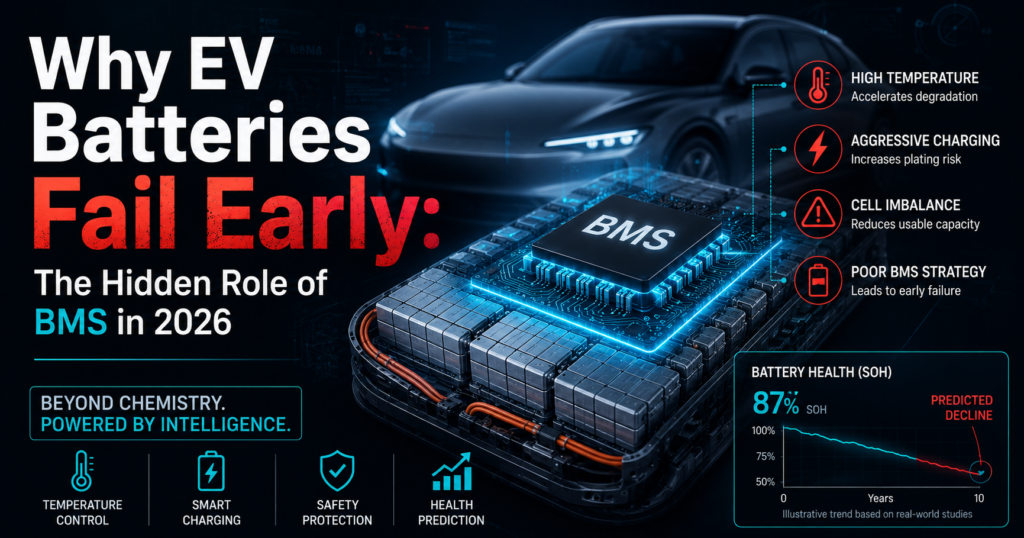
Why do EV batteries fail early even when modern lithium-ion batteries are designed to last hundreds of thousands of miles? Modern EVs routinely exceed 150,000 miles while retaining most of their original battery capacity, and long-term fleet studies continue to show that degradation rates are generally lower than what the industry feared a decade ago.
At the same time, however, not all EV battery packs age equally well. Some vehicles experience noticeably faster degradation despite using similar lithium-ion chemistry, similar charging hardware, and sometimes even similar driving patterns. That has pushed automakers and researchers to focus on something most drivers rarely think about: the Battery Management System, or BMS.
Modern EV battery performance is no longer determined solely by chemistry. Increasingly, it depends on how intelligently the vehicle controls temperature, charging behavior, current flow, and electrochemical stress in real time. If you have already read our previous articles on battery degradation, fast charging, or LFP vs NMC batteries, you have probably noticed a recurring theme. Heat and charging conditions matter just as much as battery chemistry itself. The BMS sits at the center of all of those variables, quietly managing the battery pack thousands of times per second.
Why EV Batteries Fail Early Despite Modern Battery Technology
A common misconception is that EV battery degradation mainly comes from defective cells or poor chemistry. In reality, most modern lithium-ion batteries are remarkably durable when operated within appropriate thermal and electrochemical limits.
The real challenge is that lithium-ion batteries are extremely sensitive systems operating near narrow electrochemical boundaries. Small differences in temperature, charging current, or operating voltage can gradually create long-term degradation pathways inside the cell. In many cases, the battery may appear perfectly healthy externally while microscopic damage slowly accumulates inside the electrodes over hundreds or thousands of cycles.
Recent electrochemical-thermal aging research published in 2026 demonstrated that degradation depends heavily on temperature, charging rate, depth-of-discharge, and resting state-of-charge rather than simply mileage alone (arXiv).
More importantly, the study showed that battery aging can accelerate nonlinearly once certain thermal or electrochemical thresholds are exceeded. That nonlinear behavior is one reason modern EVs increasingly depend on advanced BMS algorithms rather than simple voltage monitoring.
The battery management system exists largely to keep the pack away from those harmful operating regions for as much of its life as possible.
Why Lithium Plating Has Become a Major Engineering Challenge
Among all battery degradation mechanisms, lithium plating has become one of the most important concerns for modern EVs, especially as charging systems continue pushing toward shorter charging times.
Lithium plating occurs when lithium ions deposit as metallic lithium on the anode surface instead of properly intercalating into graphite. This problem becomes particularly severe during aggressive DC fast charging at low temperatures, where lithium diffusion inside the electrode slows dramatically while charging current remains high.
Once plating begins, several cascading problems can emerge. Permanent lithium loss reduces usable capacity, internal resistance rises, and the probability of dendrite formation increases. In severe cases, plating-related defects can also contribute to thermal instability.
A few years ago, 150kW charging was considered cutting-edge. Today, 350kW charging is increasingly common in premium EV platforms, while the industry is already discussing megawatt-level charging architectures for future commercial vehicles and ultra-high-performance platforms (Market Intelo).
As charging systems continue moving toward extremely short charging times, the electrochemical margin for error becomes smaller and smaller. That is where the BMS becomes critical.
What makes lithium plating particularly difficult is that it cannot be directly measured in production vehicles. Instead, the BMS must estimate plating risk indirectly using thermal models, impedance estimation, electrochemical constraints, and predictive charging algorithms. In practice, modern EV battery management increasingly resembles a real-time estimation and optimization problem rather than simple battery monitoring.
This also explains why two EVs using similar chemistry can still age very differently over time. The difference often comes down to how conservatively or aggressively the battery pack is managed under difficult thermal conditions.
Relative Lithium Plating Risk During Fast Charging
Illustrative conceptual trend showing how aggressive fast charging and low temperatures can increase lithium plating risk.
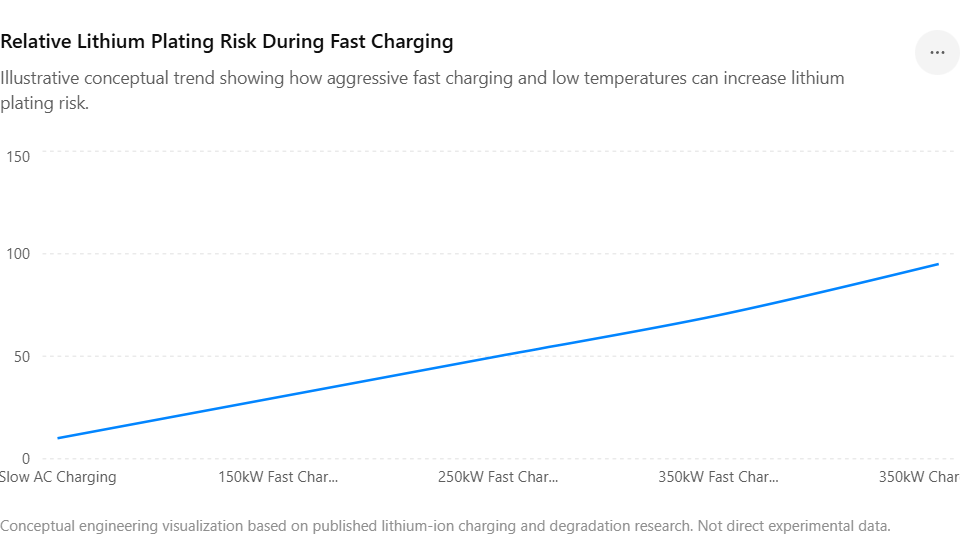
Conceptual engineering visualization based on published lithium-ion charging and degradation research. Not direct experimental data.
As discussed in our previous article on fast charging degradation, the problem is not necessarily fast charging itself. The larger issue is how effectively the BMS controls thermal stress and plating risk during repeated high-current charging events.
Thermal Management Is No Longer Just About Cooling
Many people still think EV thermal systems mainly exist to prevent batteries from overheating. That may have been true a decade ago, but modern thermal management systems now play a much broader role in controlling long-term battery health.
Today’s EVs continuously coordinate coolant flow, heat pump operation, charging limits, battery preconditioning, and cell temperature equalization in real time. These systems are deeply integrated with the BMS because thermal behavior directly affects electrochemical stability inside the battery.
This becomes especially important during fast charging in cold weather. Low temperatures dramatically slow lithium-ion diffusion kinetics, which significantly increases lithium plating risk during DC fast charging. That is why many EVs now warm the battery before arriving at a charging station, even if drivers may not realize it is happening.
On the opposite side of the temperature spectrum, elevated temperatures accelerate unwanted side reactions inside lithium-ion cells and increase long-term degradation rates. As discussed in our previous article on hot-weather battery degradation, sustained exposure to high battery temperature can significantly accelerate capacity fade over time.
- Related article:
Recent predictive thermal management research is now exploring nonlinear model predictive control (MPC) approaches capable of optimizing charging speed while minimizing long-term battery stress (Springer)
That represents a major shift in how thermal systems are viewed inside the industry. They are no longer simply cooling systems. Increasingly, they are active battery-life optimization systems.
Estimated Battery Aging Trend vs Operating Temperature
Illustrative conceptual trend showing how elevated operating temperatures can accelerate lithium-ion battery aging over time.
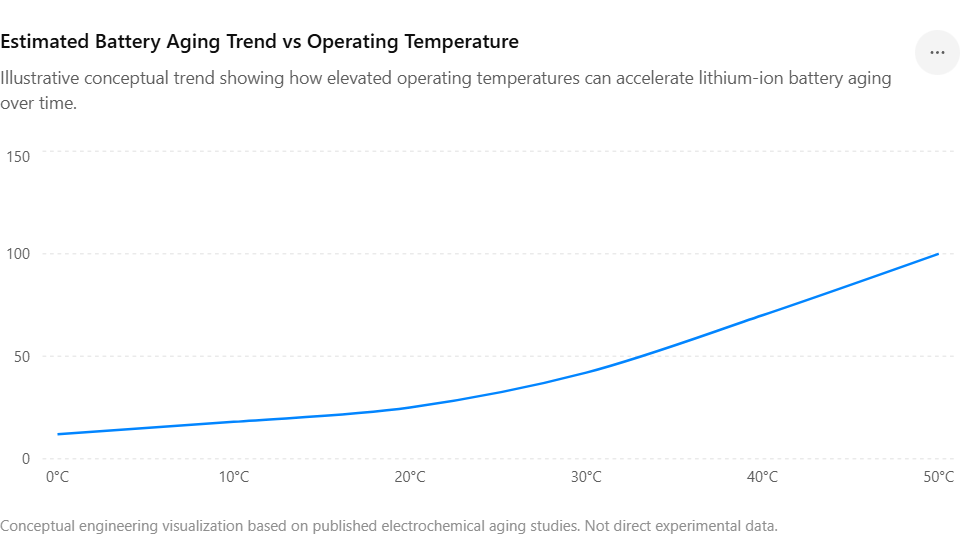
Conceptual engineering visualization based on published electrochemical aging studies. Not direct experimental data.
EV Batteries Are Quietly Becoming Software-Defined Systems
Perhaps the biggest transformation happening in the EV industry is that battery packs are increasingly behaving like software-defined energy systems.
Modern BMS platforms already incorporate sophisticated estimation and control algorithms capable of tracking state of charge (SOC), predicting state of health (SOH), managing adaptive charging limits, balancing cells, detecting anomalies, and monitoring thermal runaway risk in real time. Some automakers are even deploying over-the-air software updates that modify battery charging behavior years after the vehicle has already been sold.
Historically, battery durability depended mostly on chemistry and manufacturing quality. Today, however, the quality of the control algorithms protecting the battery pack may be just as important. Small differences in charging logic, thermal management aggressiveness, or SOC window management can create meaningful long-term differences in degradation behavior.
This trend is likely to accelerate further as EV batteries continue increasing in energy density. Higher energy density improves range, but it also reduces thermal margin and increases electrochemical stress during aggressive charging events. As a result, future battery systems will likely depend even more heavily on predictive software control.
Traditional BMS vs Predictive AI-Assisted BMS
Illustrative comparison showing how modern battery management systems are evolving beyond basic monitoring toward predictive battery control.
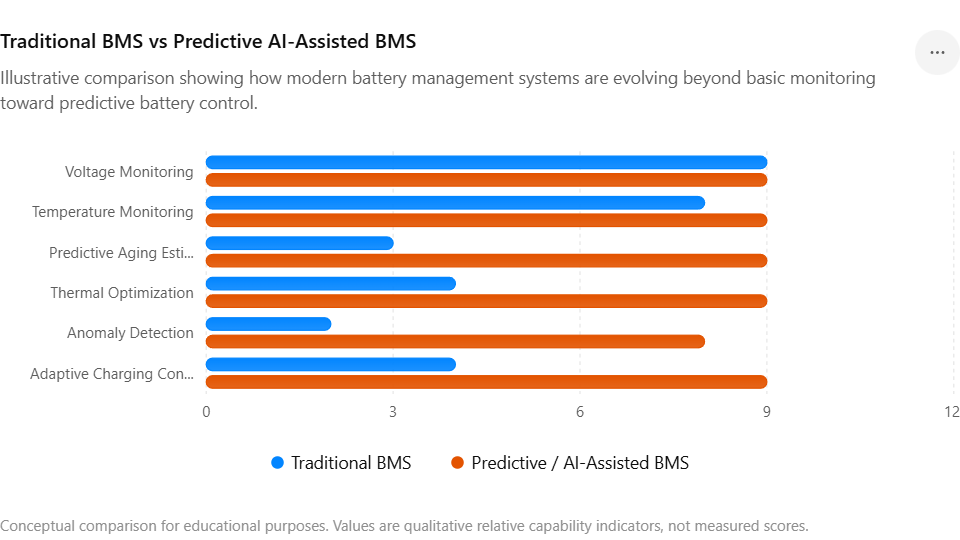
Conceptual comparison for educational purposes. Values are qualitative relative capability indicators, not measured scores.
Why Cell Balancing Matters More Than Most Drivers Realize
A modern EV battery pack may contain thousands of individual cells, and no two cells age identically. Over time, even small differences in internal resistance, thermal exposure, and charge throughput gradually create imbalance between cells.
Without proper balancing, weaker cells may reach voltage or thermal limits earlier than the rest of the pack, reducing usable energy and accelerating overall degradation. This becomes increasingly important as battery packs grow larger and higher voltage.
Modern BMS architectures therefore rely on increasingly advanced balancing strategies that combine passive balancing, active balancing, predictive thermal equalization, and pack-level estimation algorithms. Industry analysis published in 2026 shows growing adoption of AI-assisted thermal optimization and integrated BMS-linked thermal architectures specifically because thermal nonuniformity has become one of the key long-term durability challenges for large EV battery packs (Global Market Insights)
What is interesting is that many of these optimizations are largely invisible to drivers. When an EV battery ages gracefully over many years, it is often because the BMS continuously prevented the pack from operating inside damaging conditions thousands of times without the driver ever noticing.
The Next Big Shift: Predictive Battery Diagnostics
One of the most interesting recent developments in battery management is the rise of predictive battery diagnostics.
Traditional battery monitoring mainly relied on voltage, current, and temperature measurements. But researchers are increasingly developing methods capable of extracting far more detailed electrochemical information from normal operating data.
A 2026 study demonstrated that advanced algorithms could estimate EIS-grade diagnostic information using only short voltage relaxation signals already collected by existing BMS systems during normal operation (arXiv)
Electrochemical impedance spectroscopy (EIS) has long been considered one of the most powerful battery diagnostic tools available, but historically it required expensive hardware and lengthy testing procedures. If these newer approaches mature commercially, future EVs may be able to detect subtle internal degradation far earlier than current systems can.
That could significantly improve predictive maintenance, warranty analysis, second-life battery grading, and long-term health estimation. In many ways, the EV industry is moving toward batteries that continuously diagnose themselves while operating.
Why Some EVs Age Better Than Others
Many EV owners eventually notice something interesting: two vehicles with similar mileage can still show dramatically different battery degradation behavior over time.
The reason is often not chemistry alone.
Differences in BMS strategy can significantly affect long-term aging behavior, including charging buffers, cooling system capability, preconditioning logic, SOC management, and fast charging aggressiveness. Some automakers intentionally sacrifice a small amount of charging speed or usable range in exchange for improved long-term durability, while others prioritize maximum advertised specifications.
Battery chemistry still matters, of course. As discussed in our previous comparison of LFP vs NMC batteries, LFP chemistry generally tolerates higher cycle counts better than NMC chemistry, although important tradeoffs remain in energy density and cold-weather performance.
- Related article:
Increasingly, however, the companies with the smartest battery software may gain the biggest long-term advantage.
Final Thoughts
EV battery longevity is no longer determined solely by chemistry.
The Battery Management System has quietly become one of the most important technologies inside modern electric vehicles, continuously managing temperature, charging behavior, thermal safety, electrochemical stress, and long-term degradation.
As charging power rises and battery energy density continues increasing, advanced BMS algorithms will become even more critical. The hidden reality is that many EV batteries fail early not because the cells themselves are inherently bad, but because operating lithium-ion batteries near the edge of performance has become an extraordinarily complex thermal and electrochemical control problem.
And increasingly, the winners in the EV industry may be the companies with the smartest battery software.