
Quick Answer
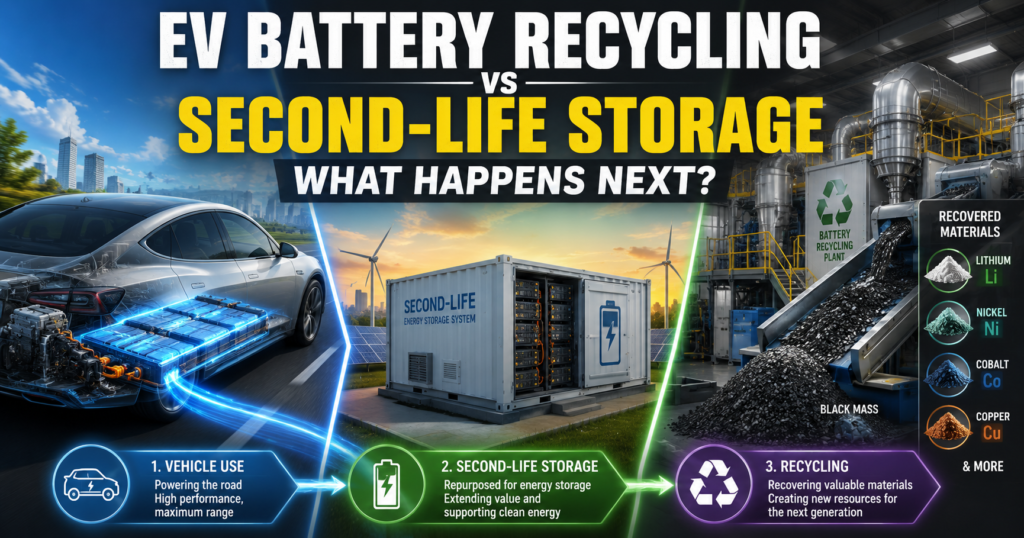
Most EV batteries do not go directly from a vehicle to a recycling facility. Instead, many batteries follow a three-stage lifecycle:
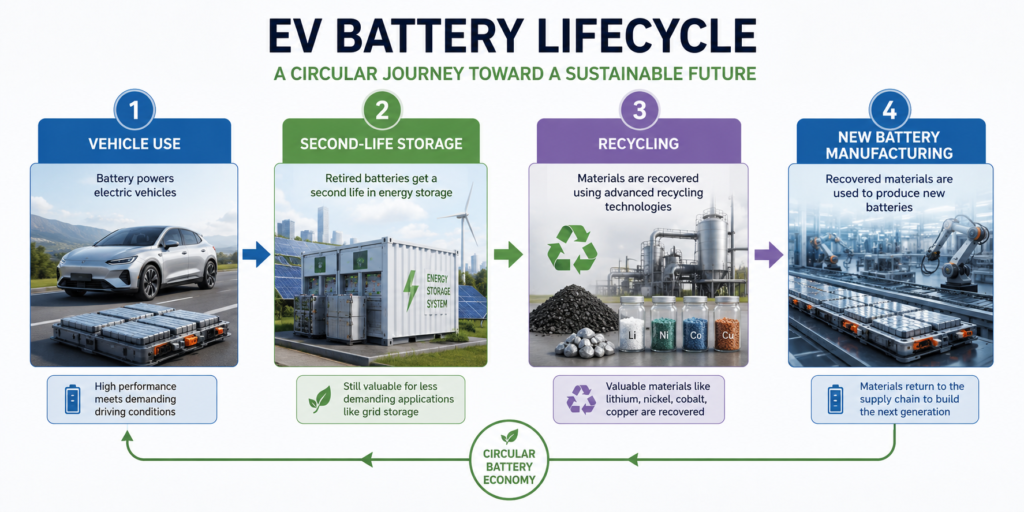
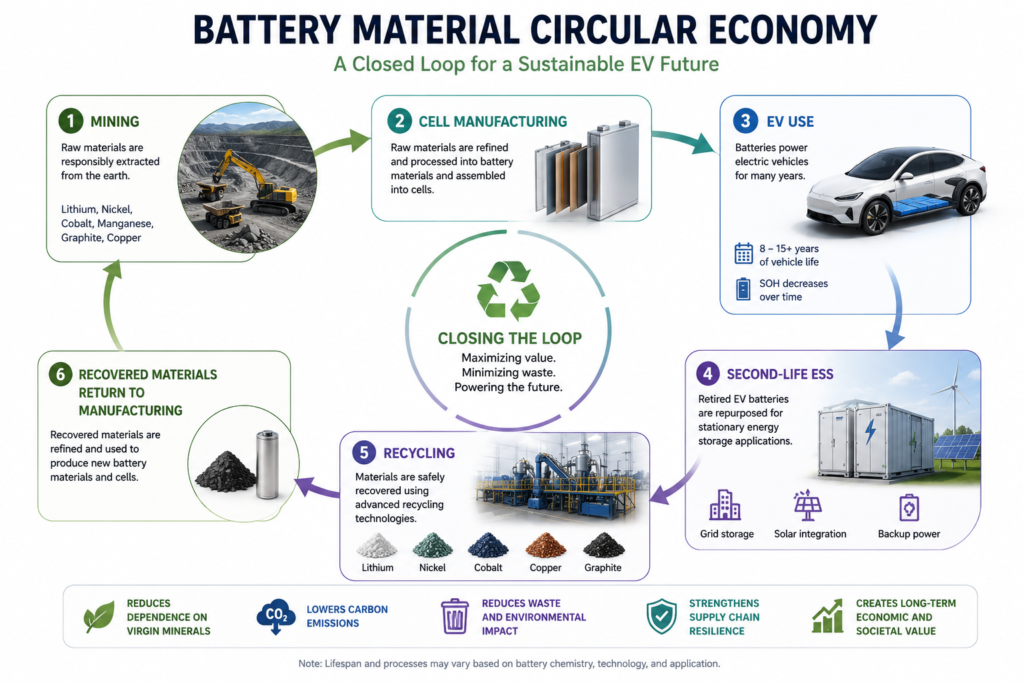
Vehicle Use → Second-Life Energy Storage → Material Recycling
After an EV battery reaches the point where it is no longer ideal for vehicle use, it may still retain enough capacity for stationary energy storage applications. Only after that second-life phase does the battery typically enter the recycling stream, where valuable materials such as lithium, nickel, cobalt, copper, and graphite can be recovered.
As EV adoption accelerates worldwide, both second-life battery systems and battery recycling technologies are becoming essential parts of the emerging battery circular economy.
Introduction
EV Battery Recycling vs Second-Life Storage is becoming one of the most important sustainability questions facing the electric vehicle industry in 2026. One of the most common misconceptions about electric vehicles is that EV batteries become useless once they are removed from a car. In reality, that is rarely the case. An EV battery that has lost some of its original capacity may no longer meet the performance expectations of a modern vehicle, but it often still contains a significant amount of usable energy. In many cases, these batteries can continue operating for years in less demanding applications before eventually being recycled.
This raises an important question: What should happen to an EV battery after it leaves a vehicle? Should it be recycled immediately to recover valuable raw materials? Or should it first be reused in stationary energy storage systems before recycling? The answer depends on battery condition, economics, technology, and future material demand. Understanding this process is becoming increasingly important as millions of EV batteries approach retirement over the next decade.
The Three Stages of an EV Battery’s Life
Most modern lithium-ion batteries are expected to follow a lifecycle that looks something like this:
Stage 1: Vehicle Use
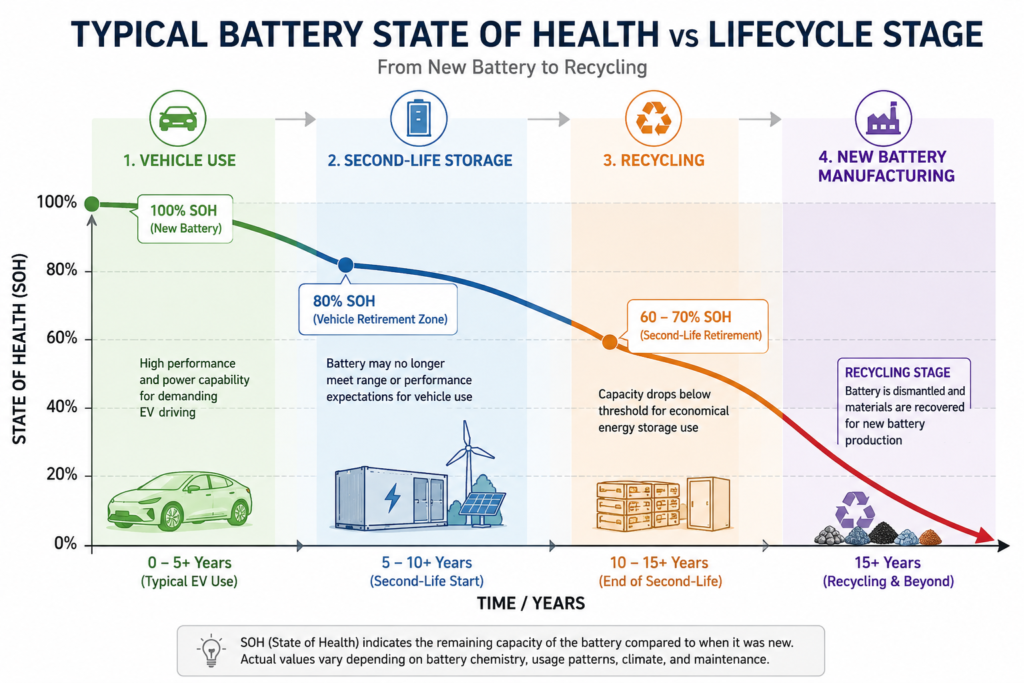
The first stage is obvious. The battery powers an electric vehicle throughout its primary service life. For most EVs, manufacturers typically design battery packs to retain around 70–80% of their original capacity after many years of operation. As discussed in our article on EV Battery Degradation in Hot Weather (2026 Guide), battery degradation occurs gradually due to calendar aging, charge-discharge cycling, temperature exposure, and operating conditions.
Even after significant degradation, many EV batteries continue to provide acceptable driving range for daily transportation. Eventually, however, the reduced capacity, increased internal resistance, or changing customer expectations may make the battery less desirable for automotive use. That does not necessarily mean the battery is at the end of its useful life.
Stage 2: Second-Life Energy Storage
This is where things become interesting. A battery that no longer meets automotive requirements may still be perfectly suitable for stationary applications. Unlike vehicles, stationary energy storage systems do not require rapid acceleration, high power output, fast charging capability, or strict weight constraints. As a result, batteries with reduced performance can still provide substantial value.
A battery that has degraded to 75% State of Health (SOH) may no longer deliver the range expected in a premium EV, but it can still store and deliver electricity for years in a stationary environment. This concept is commonly called second-life battery storage.
Stage 3: Recycling and Material Recovery
Eventually, every battery reaches a point where further use becomes impractical. Capacity loss, rising internal resistance, safety concerns, or economic factors can make continued operation uneconomical. At this stage, the battery enters the recycling stream.
Rather than treating retired batteries as waste, modern recycling facilities recover valuable materials including lithium, nickel, cobalt, copper, aluminum, and graphite. These materials can then be processed and reintroduced into battery manufacturing, helping reduce reliance on newly mined resources.
This final stage completes the battery circular economy: Vehicle → Energy Storage → Recycling → New Battery Manufacturing. As recycling technologies continue to improve, recovered materials are expected to play an increasingly important role in future EV battery supply chains.
Why Energy Storage Is a Natural Second Life
From an engineering perspective, vehicle operation is one of the most demanding environments for a battery. EV batteries experience high charge and discharge currents, wide temperature variations, fast charging sessions, frequent cycling, and vibration and mechanical stress. However, stationary storage systems are generally much less demanding.
A battery connected to a solar installation or grid-support system often experiences lower power demands, controlled temperatures, predictable cycling patterns, and minimal mechanical stress. Because of these reduced requirements, the battery can continue delivering useful service even after its automotive career ends. This creates an opportunity to extract additional value from the battery before recycling becomes necessary.
Real-World Second-Life Battery Projects
Second-life battery systems are no longer theoretical. Several major automakers and energy companies have already deployed commercial projects.
Nissan
One of the earliest pioneers was Nissan, which repurposed used batteries from the Nissan Leaf for stationary energy storage applications. The company has demonstrated projects involving backup power systems, street lighting, and renewable energy integration.
BMW
BMW has used retired EV batteries in grid-scale storage installations capable of supporting renewable energy management and peak demand reduction.
Mercedes-Benz
Mercedes-Benz has also explored large-scale stationary storage systems built from used EV battery modules. These projects demonstrate that battery retirement from a vehicle does not automatically mean the battery has reached the end of its technical life. For more information about battery aging, see How Long Do EV Batteries Last? Real-World Data and Battery Degradation (2026).
The Challenges of Second-Life Batteries
While the idea sounds attractive, second-life deployment is not always straightforward. As a battery engineer, this is where I believe the real challenges begin. Every used battery is different. Two identical vehicles sold on the same day may have experienced completely different operating conditions such as different climates, different charging habits, different mileage, different fast-charging frequency, or different thermal exposure. As a result, assessing battery health becomes critical.
Before a battery can enter a second-life application, engineers must determine remaining capacity, internal resistance, safety condition, cell imbalance, and remaining useful life. This evaluation process can become expensive and time-consuming. In fact, battery characterization is often one of the largest economic barriers to second-life deployment.
Recent advances in battery diagnostics, including electrochemical impedance spectroscopy (EIS), model-based estimation, and machine-learning techniques, are helping improve this process. These are technologies increasingly being explored across the industry to better understand battery health without requiring lengthy testing procedures.
When Recycling Makes More Sense
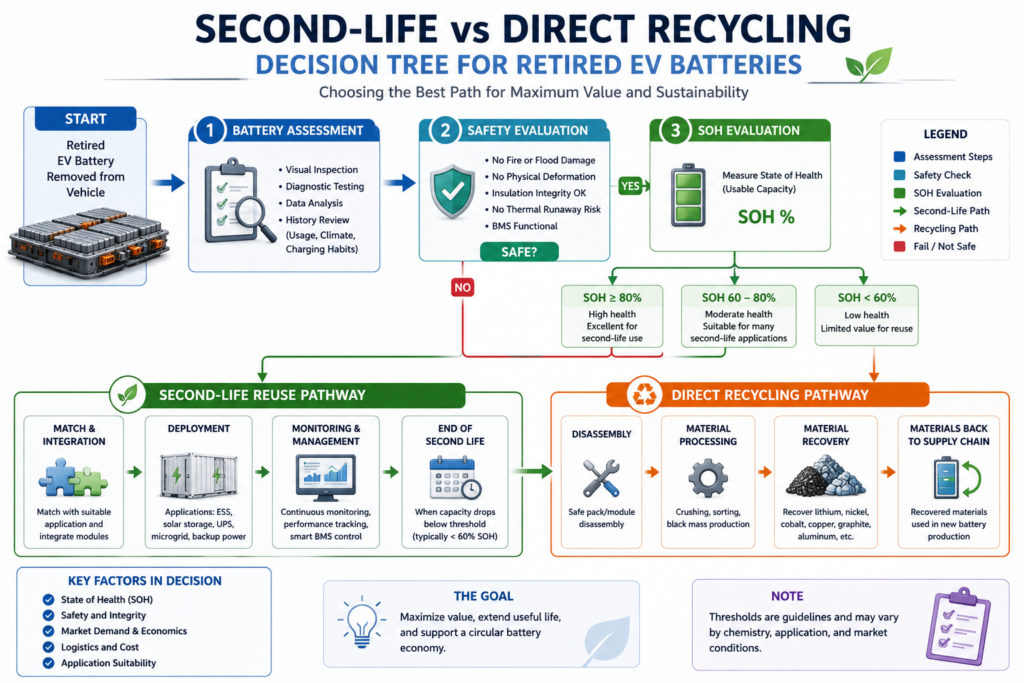
Although second-life applications receive a lot of attention, recycling is ultimately unavoidable. Every battery eventually reaches a point where further use becomes impractical. At that stage, the focus shifts from extracting energy value to recovering materials. Modern EV batteries contain valuable materials such as lithium, nickel, cobalt, copper, aluminum, and graphite. Recovering these materials reduces the need for new mining operations and helps strengthen domestic battery supply chains. As battery demand continues to grow, recycled materials are expected to become increasingly important sources of future battery production.
How Modern Battery Recycling Works
Battery recycling technology has advanced significantly over the past decade. Early recycling efforts focused primarily on recovering high-value metals such as cobalt. Today, recyclers are increasingly targeting broader material recovery. The process generally follows several steps:
Collection and Transportation
Retired batteries are collected from vehicles, service centers, and storage installations. Because lithium-ion batteries still contain significant energy, transportation requires specialized safety procedures.
Disassembly
Battery packs are dismantled into modules and cells. Depending on battery design, this process may be partially automated or manually performed.
Black Mass Production
Cells are mechanically processed into a material commonly called black mass. Black mass contains valuable battery materials including lithium, nickel, cobalt, manganese, and graphite.
Material Recovery
Various recycling techniques are then used to recover individual materials. The three most common approaches include mechanical processing, pyrometallurgical recovery, and hydrometallurgical recovery. Many modern facilities increasingly favor hydrometallurgical methods because they can achieve higher recovery rates for critical battery materials.
The Growing Importance of Battery Recycling in 2026
The industry conversation has changed significantly over the last few years. A decade ago, second-life storage received much of the attention because relatively few EV batteries had reached retirement. Today, the focus is becoming broader. Large-scale battery recycling capacity is rapidly expanding across North America, Europe, and Asia. Companies such as Redwood Materials, Li-Cycle, and Ascend Elements are investing heavily in domestic battery material recovery infrastructure.
This shift is driven by several factors: First, EV adoption continues to accelerate. Second, battery manufacturing demand is increasing dramatically. Third, governments are emphasizing supply chain security and critical mineral sourcing. As a result, recycled battery materials are increasingly viewed as strategic resources rather than waste products.
Will Most EV Batteries Be Reused or Recycled?
This is one of the most debated questions in the battery industry today. The answer is likely Both. Some batteries will clearly benefit from second-life deployment. Others may be recycled immediately. The decision will often depend on economics rather than technology.
For example, if lithium prices remain high and recycling becomes extremely efficient, immediate recycling may become more attractive. On the other hand, if stationary storage demand continues growing rapidly, second-life systems may provide greater overall value before recycling.
Many experts now expect a hybrid ecosystem to emerge. Some batteries will follow: Vehicle → Recycling. Others will follow: Vehicle → Second-Life Storage → Recycling. The industry is unlikely to settle on a single pathway.
The Engineering Perspective
As battery engineers, we often think about batteries in terms of performance metrics such as capacity, power capability, resistance, State of Health, safety. But from a sustainability perspective, another question becomes equally important: How much value can we extract from a battery throughout its entire lifecycle?
The goal is no longer simply to maximize vehicle range. The goal is to maximize total lifetime value. That means designing batteries that last longer in vehicles, can be efficiently evaluated after retirement, are easy to repurpose, and are easy to recycle. Future battery designs may increasingly prioritize all four objectives simultaneously. This is one of the reasons why battery recyclability and circular-economy considerations are becoming part of early battery design discussions rather than afterthoughts.
Conclusion
The debate around EV Battery Recycling vs Second-Life Storage is not about choosing one option over the other. The future of EV batteries is not a simple story of use and disposal. Instead, it is increasingly becoming a story of reuse, recovery, and circular value creation. Many batteries will spend years powering vehicles before moving into stationary energy storage systems. After that second-life phase, they can still provide valuable raw materials for future battery production. In other words, the lifecycle of an EV battery may look less like a straight line and more like a loop: Vehicle → Energy Storage → Material Recovery → New Battery.
As EV adoption continues to expand throughout the 2020s, both second-life storage and advanced recycling will play critical roles in making electric transportation more sustainable, more economical, and less dependent on newly mined resources.
Further Reading
Internal Articles
- EV Battery Degradation in Hot Weather (2026 Guide)
- How Long Do EV Batteries Last? Real-World Data and Battery Degradation (2026)
- EV Battery SOH Explained: How State of Health Is Actually Measured in 2026