
Quick Answer
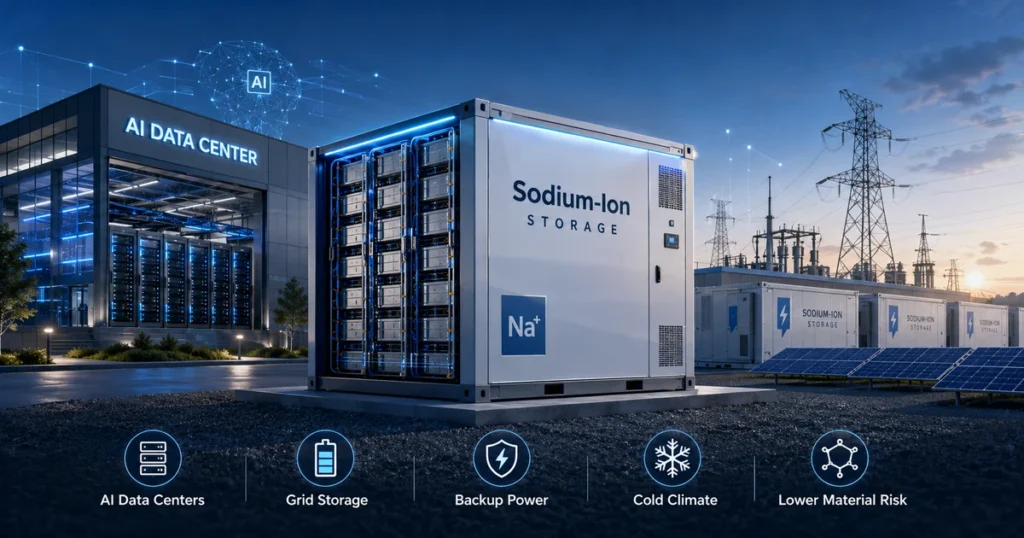
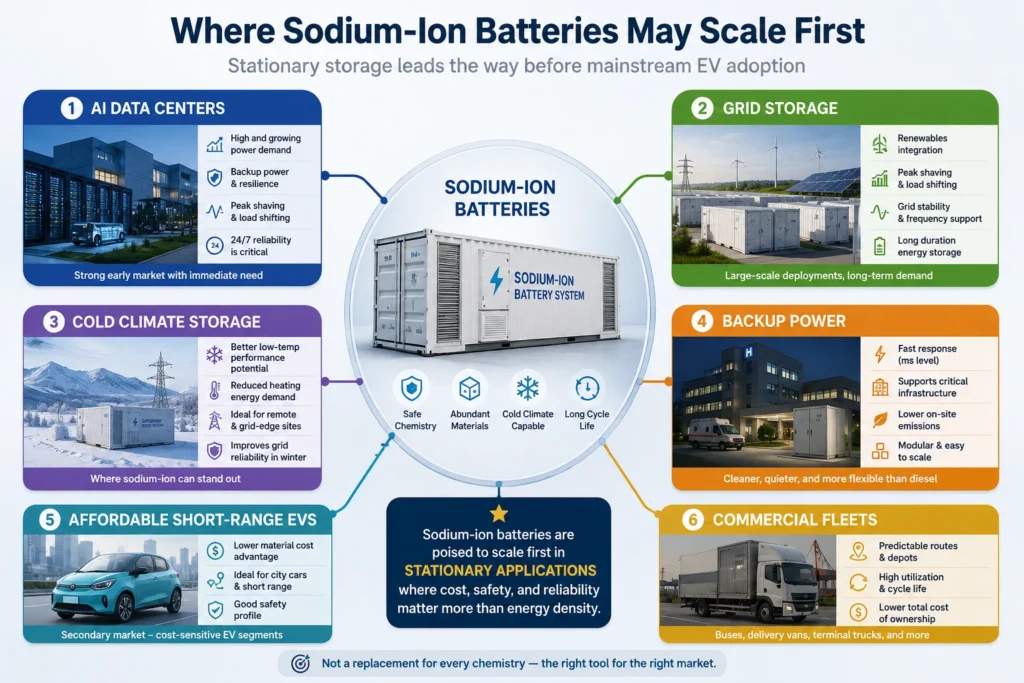
Sodium-ion batteries may become important sooner in data centers and grid storage than in mainstream electric vehicles. The reason is simple: stationary batteries do not need to be lightweight in the same way EV batteries do.
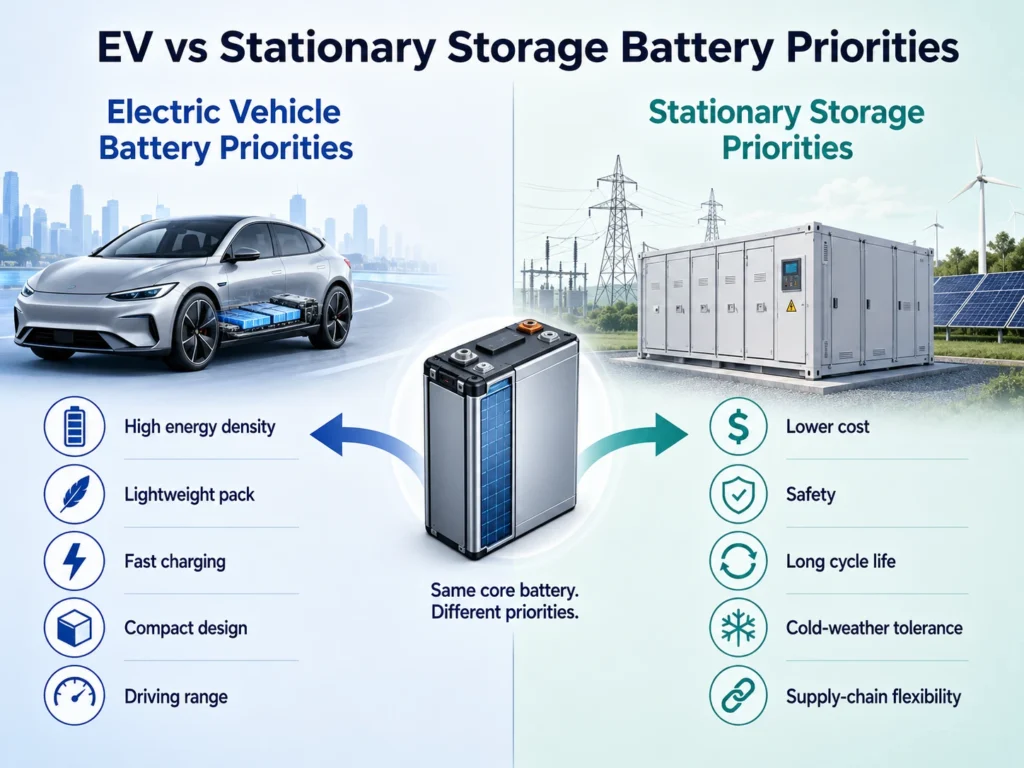
For an EV, every kilogram matters. Lower energy density means less driving range or a heavier battery pack. For a data center, utility battery project, backup power system, or cold-climate grid site, the priorities are different. Cost, safety, supply-chain flexibility, long cycle life, temperature tolerance, and reliable power delivery can matter more than maximum energy density.
That is why sodium-ion is getting fresh attention in 2026. Reuters recently reported that AI-driven electricity demand is accelerating sodium-ion battery production plans, while the International Energy Agency says sodium-ion could reach about 10% of annual battery storage additions by 2030. The chemistry still has challenges, but its first large commercial market may not be EVs. It may be the infrastructure behind AI, renewable energy, and a more stressed electric grid.
Introduction: Sodium-Ion Is Not Just an EV Story
When most people hear about a new battery chemistry, the first question is usually, “How much range will it give an electric car?” That makes sense. EVs made lithium-ion batteries famous. Tesla, BYD, Hyundai, Ford, GM, Rivian, and nearly every other automaker have trained the public to think about batteries through the lens of driving range, charging speed, and vehicle price.
But batteries are now moving far beyond cars. AI data centers need huge amounts of stable electricity. Solar and wind farms need storage to smooth out variable generation. Utilities need batteries to handle peak demand. Businesses want backup power that can respond faster and cleaner than diesel generators. Cold regions need storage systems that can keep working when temperatures drop.
That wider energy-storage market may be where sodium-ion batteries make their first serious impact. Sodium-ion batteries are not magic. They are not about to replace LFP, NMC, or solid-state batteries across every application. But they may solve a different problem: how to build large, durable, lower-cost storage systems without depending as heavily on lithium, nickel, cobalt, or graphite supply chains.
For a deeper chemistry background, see our earlier guide: Sodium-Ion Batteries Explained: Could They Be the Next Big Breakthrough After Solid-State Batteries?
Why Sodium-Ion Looks Less Exciting for Long-Range EVs
The main weakness of sodium-ion batteries is energy density. Sodium ions are larger and heavier than lithium ions. In practical battery design, that usually means sodium-ion cells store less energy per kilogram or per liter than today’s best lithium-ion cells. That does not automatically make sodium-ion “bad.” It just means the chemistry is not ideal for every job.
In a long-range EV, energy density is a big deal. A battery pack has to fit under the floor, stay within a reasonable weight limit, meet crash requirements, support fast charging, and still deliver enough range to satisfy buyers.
If sodium-ion cells require more mass or volume to deliver the same usable energy, automakers face a tradeoff. They can accept shorter range, use a larger battery pack, redesign the vehicle platform, or limit sodium-ion to lower-range models.
That is why sodium-ion is more likely to appear first in smaller EVs, entry-level vehicles, commercial fleets, battery-swapping applications, or cold-climate use cases rather than premium long-range SUVs and pickup trucks.
This is similar to the way LFP batteries first grew in practical, cost-sensitive EV segments before expanding into broader markets. But even LFP has a major advantage today: huge manufacturing scale and a mature supply chain. As discussed in our related article, Why LFP Batteries Are Taking Over the Global EV Market, LFP has become the benchmark low-cost lithium-ion chemistry because it is already proven at massive scale. Sodium-ion has to earn that same manufacturing trust.
Why Sodium-Ion Batteries Fit Stationary Storage
Stationary storage is different. A battery container next to a data center does not need to accelerate from 0 to 60 mph. It does not need to fit inside a sleek vehicle floor. It does not need to maximize range per pound. It needs to store energy, deliver power reliably, survive many cycles, operate safely, and make economic sense over years of service.
That changes the value of sodium-ion. A grid-scale battery can be heavier if the total installed cost is attractive. A data center backup system can be larger if it improves safety, reduces cooling complexity, or makes the supply chain more secure. A cold-climate storage project can accept lower energy density if the battery performs better at low temperatures.
This is why the phrase “lower energy density” can be misleading. Lower energy density is a serious disadvantage in a vehicle. It may be a manageable compromise in a stationary battery project. That is also why the sodium-ion market should not be judged only by whether it beats lithium-ion in EV range. The more useful question is: where does sodium-ion offer the best total system value?
AI Data Centers Are Creating a New Battery Market
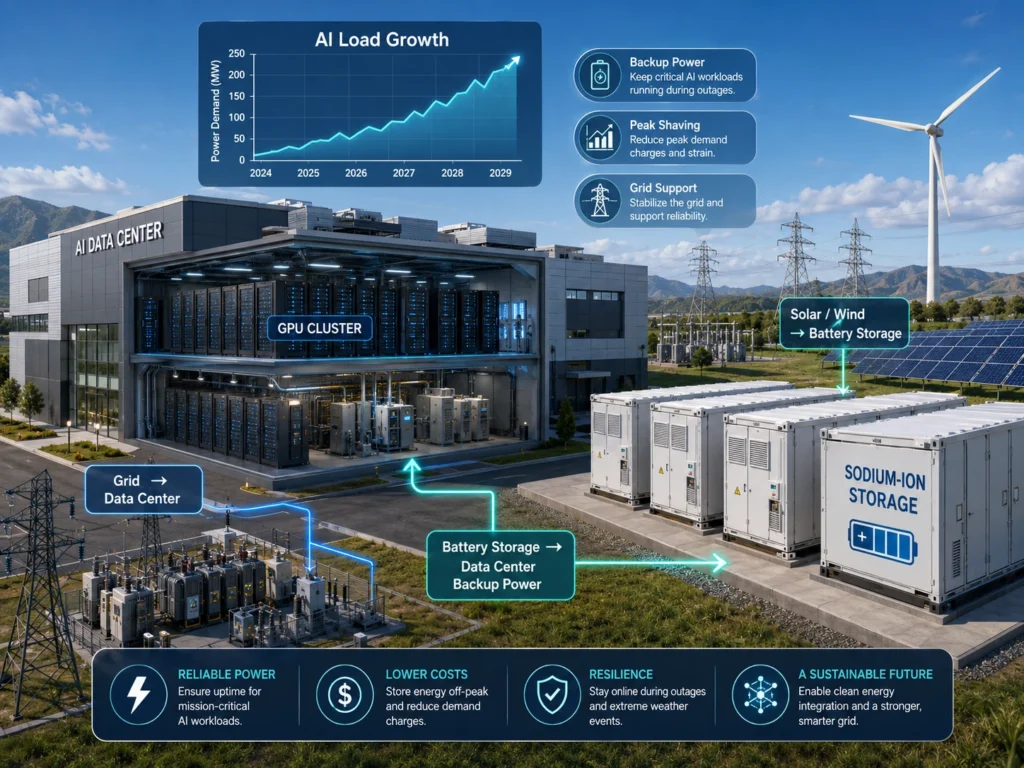
AI data centers are changing the electricity conversation. The International Energy Agency’s Energy and AI report says global data center electricity consumption could more than double by 2030, reaching around 945 TWh. That is a massive number, and it helps explain why utilities, hyperscalers, battery companies, and automakers are suddenly talking more seriously about stationary storage.
Data centers do not only consume a lot of electricity. They also need extremely reliable electricity. A traditional office building can tolerate short disruptions more easily than a high-density AI data center running expensive GPU clusters. AI workloads can create sharp demand swings. Backup systems must respond quickly. Grid connections can become bottlenecks. In some regions, the speed of data center construction is already running ahead of the speed of grid expansion.
This creates an opening for batteries. Battery energy storage can help data centers in several ways. It can provide backup power, smooth power spikes, reduce peak demand charges, support on-site solar or other generation, and help the facility interact more intelligently with the grid.
That is why sodium-ion is entering the conversation. Reuters reported that the AI energy race is accelerating sodium-ion production, with companies including GM, BYD, CATL, Peak Energy, and Energy Vault connected to new sodium-ion activity. You can read the Reuters report here: AI energy race accelerates sodium battery production.
For more background on why this market is growing, see our related article: AI Data Center Battery Storage: 5 Reasons Demand Is Booming.
Why Sodium-Ion Fits Data Center Priorities
A data center battery does not need to be the lightest battery. It needs to be dependable, safe, scalable, and cost-effective. That plays into several sodium-ion strengths. First, sodium is far more abundant than lithium. This does not guarantee cheap batteries by itself, because manufacturing yield, cathode chemistry, hard-carbon anodes, electrolytes, controls, and system integration all matter. But it gives sodium-ion a potential long-term material-cost advantage if production scales successfully.
Second, sodium-ion batteries can reduce exposure to some critical-material bottlenecks. Many sodium-ion designs avoid lithium and cobalt. Some may also avoid graphite, depending on the anode design. That does not mean they are free from supply-chain constraints, but they diversify the battery industry away from relying on only a few material pathways.
Third, sodium-ion can offer attractive temperature tolerance. This matters for outdoor storage containers, cold-climate installations, and backup-power systems that may not operate in perfect laboratory conditions.
Fourth, sodium-ion may offer good safety characteristics for stationary storage. Safety is not only about chemistry; it also depends on cell design, system architecture, thermal management, monitoring, installation quality, and emergency planning. Still, a chemistry that can support stable operation with lower fire risk is appealing for large installations near critical infrastructure. This is especially important for data centers, where downtime can be extremely expensive and public acceptance of large battery installations depends heavily on safety confidence.
Grid Storage May Be the Bigger Sodium-Ion Opportunity
The grid storage market may be even more important than data centers alone. The IEA’s Batteries and Secure Energy Transitions report says sodium-ion batteries are expected to make up a growing share of energy storage because they use less expensive materials and do not use lithium. In the full report, the IEA projects sodium-ion could reach about 10% of annual battery storage additions by 2030.
That is not a small niche. Battery storage is becoming essential as solar and wind generation grow. Solar production peaks during the day, while electricity demand often peaks later. Wind generation can vary by hour, day, and season. Batteries help shift energy from when it is produced to when it is needed.
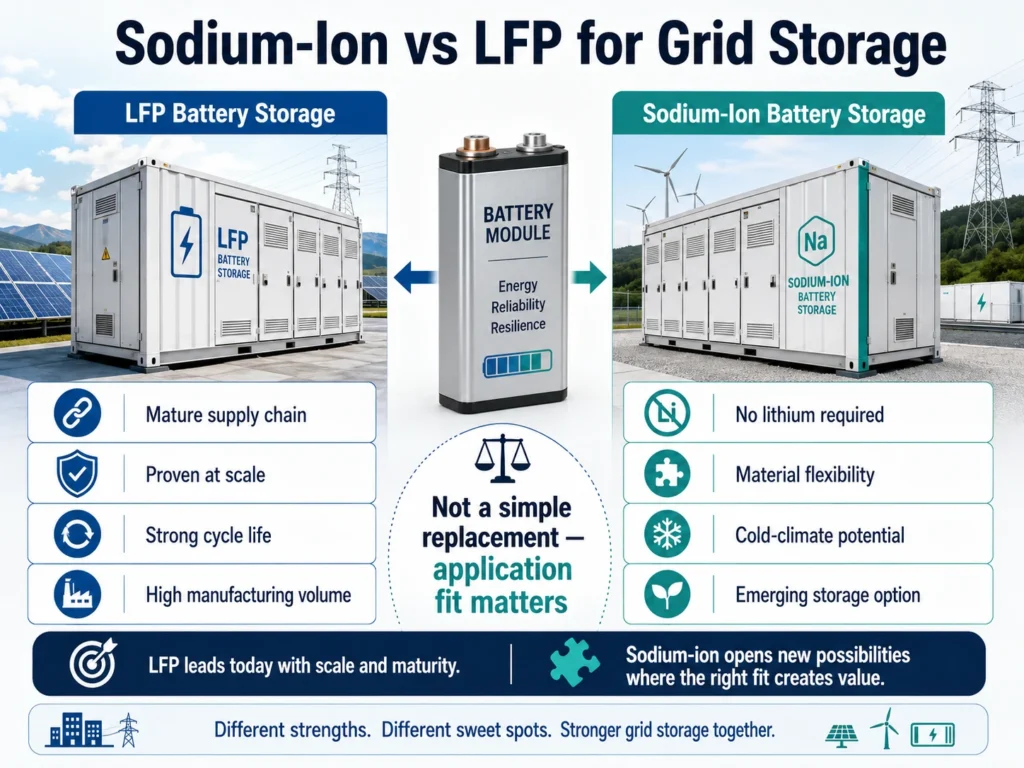
Today, LFP dominates much of the stationary storage market because it is durable, relatively safe, and cost-effective. Sodium-ion does not need to eliminate LFP to succeed. It only needs to become competitive in certain applications.
For example, sodium-ion may be attractive where lithium supply risk matters, where cold-weather performance is valuable, where local manufacturing incentives apply, or where project developers want a chemistry with potentially lower long-term material volatility.
That is why sodium-ion should be viewed as part of a broader chemistry toolbox. We discussed this broader trend in Why There Will Not Be One Winning EV Battery Chemistry. The same idea applies to grid storage. One chemistry will not serve every duration, climate, cost target, and safety requirement.
GM’s Sodium-Ion Move Shows the Market Shift
One of the most interesting developments is GM’s sodium-ion push for grid-scale storage. GM said it is developing next-generation sodium-ion battery cells purpose-built for grid-scale energy storage in partnership with Peak Energy, backed by a GM Ventures investment. In its announcement, GM framed sodium-ion around “the right battery for the right application,” which is exactly the point. You can read GM’s announcement here: Why sodium-ion batteries will reshape grid-scale energy storage
This is notable because GM is known primarily as an automaker. But automakers increasingly understand that battery value does not stop at vehicles. EV battery expertise can apply to stationary storage. Cell engineering, pack design, power electronics, battery management, thermal controls, diagnostics, safety validation, and manufacturing discipline are all relevant. A company that understands battery systems for vehicles can use some of that knowledge in energy storage, even though the product requirements are different.
In a vehicle, the battery must be compact, crashworthy, lightweight, and optimized for driving. In grid storage, the battery must be durable, serviceable, safe, and economically strong over many cycles. That difference is exactly why sodium-ion may fit grid storage before it becomes a major EV chemistry in the U.S. passenger-car market.
CATL’s 60 GWh Deal Is a Signal, Not a Guarantee
CATL’s sodium-ion activity is another major signal. Reuters reported that CATL signed a three-year agreement to supply 60 GWh of sodium-ion batteries to Beijing HyperStrong Technology for energy storage systems. The report said CATL had improved energy density and addressed production issues such as moisture control. You can read the Reuters article here: Chinese battery maker CATL signs first major sodium-ion deal for energy storage
A 60 GWh agreement is large enough to matter. It suggests sodium-ion is moving beyond lab demonstrations and small pilot projects. But it should still be interpreted carefully. Battery announcements do not automatically prove delivered volume, long-term reliability, or profitable economics. The real test is whether customers receive consistent cells, systems operate safely, warranties hold up, and total installed cost competes with LFP.
Still, the direction is clear. Sodium-ion is no longer just an academic topic. It is entering commercial supply discussions, especially for energy storage. For more on sodium-ion’s 2026 commercialization path, see our related article: Sodium-Ion Batteries in 2026: The Next Step After LFP
Peak Energy and Energy Vault Point Directly at AI Infrastructure
The Energy Vault and Peak Energy agreement is especially relevant because it connects sodium-ion directly to AI-first data center infrastructure. Energy Vault announced a strategic development agreement with Peak Energy that includes 1.5 GWh of U.S.-manufactured sodium-ion battery systems. The companies described the solution as aimed at AI-first data center operators, along with broader grid-scale applications. You can read the announcement here: Energy Vault and Peak Energy Announce Strategic Development Agreement
This is important because it shows sodium-ion being positioned not as a future EV battery, but as infrastructure. That may be the more realistic early market. AI data centers are growing fast, need reliable power, and may be willing to pay for storage solutions that reduce grid-connection risk and improve uptime. Unlike EV buyers, data center operators are not comparing battery chemistries based on miles of range. They are looking at power reliability, safety, service life, permitting, availability, supply chain, and total cost of ownership. That makes the market logic very different.
Cold Climate Could Be a Hidden Advantage
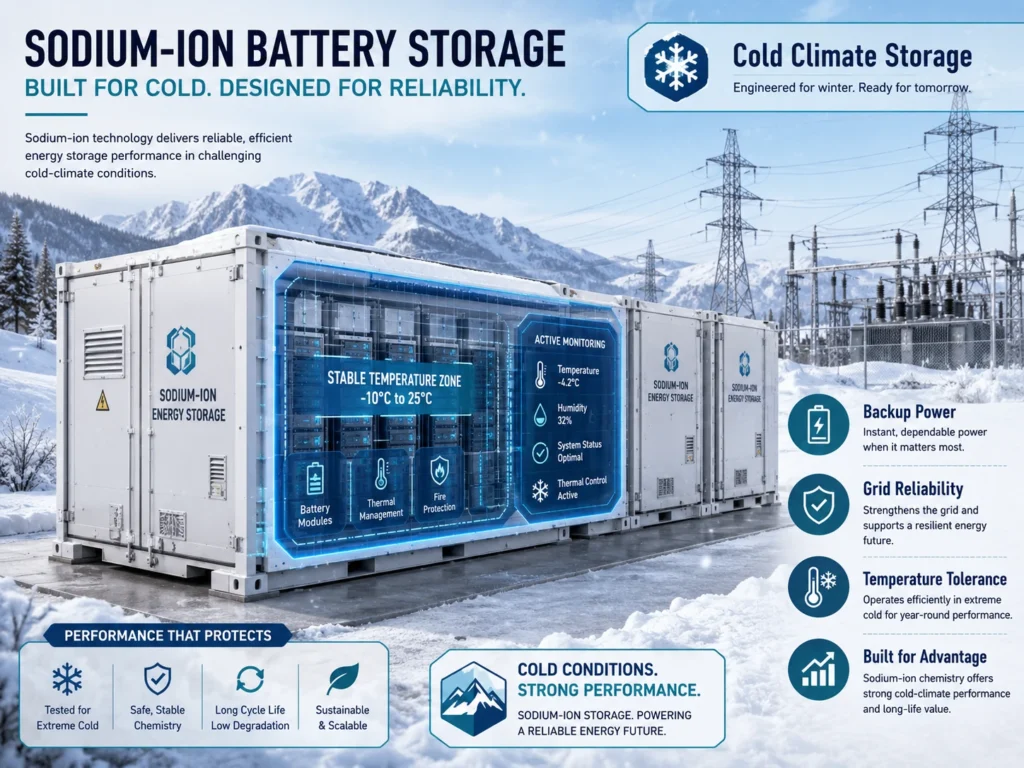
Cold-weather performance is another reason sodium-ion deserves attention. Lithium-ion batteries can struggle in low temperatures. The electrolyte becomes less conductive, internal resistance rises, charging must be limited to avoid lithium plating, and usable power can drop. EV owners often notice this as reduced winter range and slower charging.
In stationary storage, cold weather creates a different problem. A battery container may need heaters, insulation, or more active thermal management to keep the cells in their preferred operating range. That adds cost and consumes energy.
If sodium-ion systems can operate more effectively across a wider temperature range, that could help in northern U.S. states, Canada, parts of Europe, high-altitude regions, and other cold climates. This does not mean sodium-ion batteries are immune to winter losses. All batteries are affected by temperature. But if sodium-ion can reduce heating needs or maintain better power delivery in cold conditions, it could improve project economics.
Cold-climate backup power is also important for critical facilities. Hospitals, telecom sites, emergency services, water systems, and data centers need power when the grid is stressed. Winter storms are exactly when backup systems must work. That makes temperature tolerance more than a convenience. It can be a reliability feature.
Backup Power Is Not the Same as EV Range
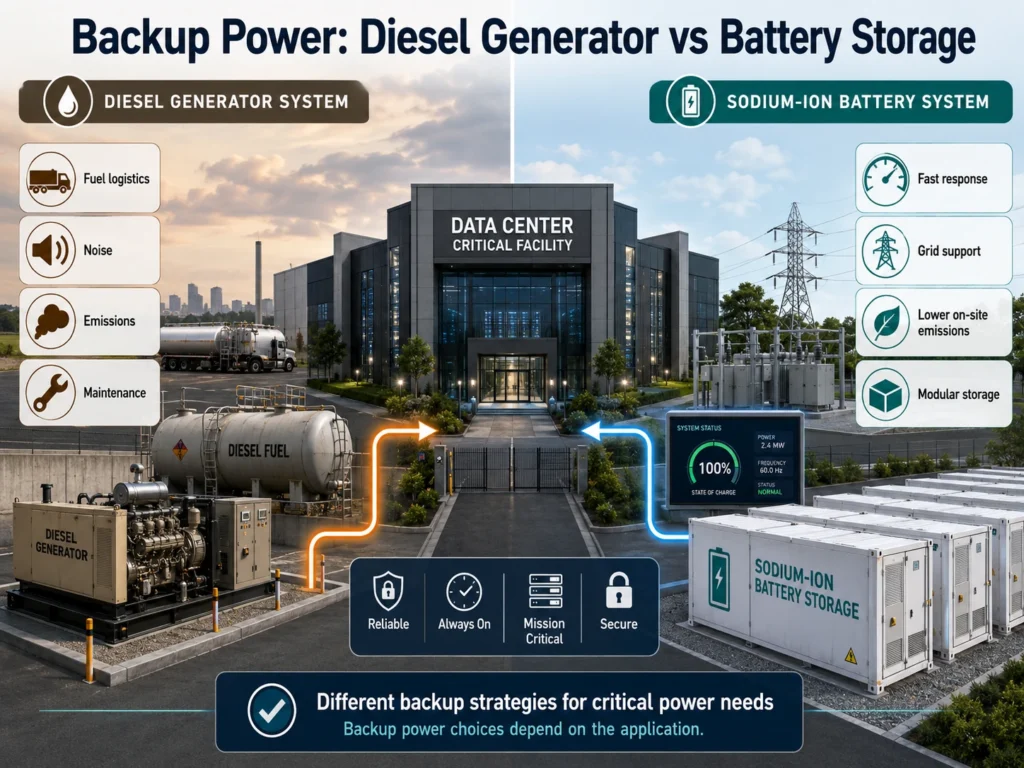
Backup power is another area where sodium-ion may make sense. Most people think of backup power as a diesel generator. Diesel generators are familiar, energy-dense, and widely deployed. But they have disadvantages: emissions, fuel logistics, maintenance, noise, permitting concerns, and slow response compared with battery systems.
Battery backup can respond almost instantly. It can bridge short outages, support uninterruptible power systems, reduce generator runtime, and help facilities manage demand charges during normal operation. For short-duration backup and grid-support functions, sodium-ion could be a practical fit if system cost and reliability are competitive.
Again, the key point is that backup power does not require the battery to be small enough to fit under a car. It needs to be safe, durable, affordable, and available. That is why sodium-ion’s lower energy density may be acceptable. A slightly larger container is not necessarily a deal-breaker if the system reduces material cost, improves safety, or works better in difficult temperatures.
The Cost Advantage Is Possible, Not Automatic
It is tempting to say sodium-ion will simply be cheaper because sodium is abundant. That is too simple. Battery cost is not just raw material cost. It includes electrode processing, cell design, electrolyte formulation, separator choice, formation cycling, quality control, yield, factory utilization, module and pack assembly, thermal management, controls, power conversion, installation, warranty risk, and financing.
LFP is a very tough competitor because it is already manufactured at enormous scale. Chinese LFP producers have spent years driving down cost and improving performance. In many projects, sodium-ion will not be competing against expensive nickel-based batteries. It will be competing against very optimized LFP. That is a much harder target.
The IEA’s sodium-ion commentary notes that sodium-ion momentum is growing, but also that optimized LFP still has advantages in energy density, supply-chain maturity, and cost. You can read the IEA analysis here: Sodium-ion battery momentum grows, but challenges remain
So sodium-ion should not be marketed as a guaranteed “LFP killer.” A better way to describe it is this: sodium-ion may become a strong alternative where lithium supply risk, cold-weather operation, safety, domestic manufacturing, or long-term material availability are more important than maximum energy density.
What Has to Happen for Sodium-Ion to Scale?
For sodium-ion to become a major stationary storage chemistry, several things must go right. Manufacturers need to prove consistent large-scale cell production. That includes moisture control, stable anode behavior, predictable aging, good yield, and reliable quality inspection.
System integrators need to prove that sodium-ion containers can meet utility and data center requirements. That means fire safety testing, controls integration, thermal validation, power conversion compatibility, and service procedures. Project developers need bankable warranties. A chemistry can look promising technically but still struggle if insurers, financiers, or utilities are not comfortable with long-term risk.
The supply chain also has to mature. Sodium is abundant, but a battery supply chain requires far more than sodium. Cathode materials, hard carbon, electrolytes, separators, manufacturing equipment, testing standards, and trained engineering teams all have to scale together. This is the unglamorous part of battery commercialization. It is less exciting than announcing a breakthrough, but it matters more.
Will EVs Still Use Sodium-Ion Batteries?
Yes, but probably selectively. Sodium-ion EVs may make sense for short-range city cars, low-cost models, cold-climate fleets, commercial vehicles, microcars, battery-swapping platforms, and possibly hybrid battery systems that combine chemistries.
They are less likely to dominate long-range premium EVs soon. For large SUVs, pickup trucks, and performance vehicles, higher-energy lithium-ion chemistries still have a clear advantage. This is why sodium-ion’s first big market may not be the one consumers notice most. People may see sodium-ion in EV headlines, but the larger deployment volume may come from storage containers sitting beside solar farms, substations, factories, and data centers.
In other words, sodium-ion could become successful without becoming the main battery in your next EV. That may sound less exciting, but it is probably more realistic.
Conclusion: Sodium-Ion’s First Big Win May Be Behind the Scenes
Sodium-ion batteries are entering a more serious phase. The technology is no longer only a research topic or a future promise. Large companies are signing agreements, automakers are investing, and energy-storage developers are looking for alternatives to lithium-ion systems.
But sodium-ion’s most important early market may not be mainstream EVs. For electric vehicles, lower energy density is a real limitation. Range, weight, packaging, and charging expectations make the EV market difficult. Sodium-ion can still find a place there, especially in affordable and cold-climate applications, but it may not be the first place where the chemistry scales fastest.
Data centers and grid storage are different. They need safe, durable, cost-effective, scalable batteries. They are less sensitive to weight. They care deeply about reliability, supply-chain resilience, temperature tolerance, and total system economics. That is why sodium-ion may become a battery technology people benefit from before they ever drive it.
It may help keep AI data centers online. It may support renewable energy. It may improve backup power. It may give utilities another option as electricity demand rises. And it may reduce pressure on lithium supply chains by giving the storage market a second low-cost chemistry path.
Sodium-ion does not need to beat lithium-ion everywhere. It just needs to be the right battery for the right job. For data centers and grid storage, that job may arrive sooner than many EV buyers expect.
FAQs
Are sodium-ion batteries better than lithium-ion batteries?
Not overall. Sodium-ion batteries usually have lower energy density than lithium-ion batteries, which makes them less attractive for long-range EVs. However, they may offer advantages in cost potential, material availability, safety, cold-weather performance, and stationary storage applications.
Why might sodium-ion batteries be used in data centers?
Data centers need reliable backup power, fast response, peak-demand management, and grid support. Sodium-ion batteries may be attractive because stationary systems do not need the same energy density as EVs. Safety, durability, cost, and supply-chain flexibility can matter more.
Will sodium-ion replace LFP in grid storage?
Not immediately. LFP is already highly optimized and widely deployed. Sodium-ion is more likely to compete with LFP in selected storage applications where material availability, cold-weather operation, domestic manufacturing, or safety characteristics improve the total project economics.
Why are AI data centers important for sodium-ion batteries?
AI data centers are increasing electricity demand and creating a need for reliable, fast-response energy storage. This is pushing companies to explore battery chemistries beyond traditional lithium-ion options, including sodium-ion.
Can sodium-ion batteries work in EVs?
Yes, but they are more likely to appear first in affordable EVs, short-range vehicles, commercial fleets, cold-climate vehicles, and possibly battery-swapping applications. Long-range premium EVs will likely continue using higher-energy lithium-ion chemistries for now.
Great content! Keep up the good work!
Thank you! I’m glad you enjoyed the article. Sodium-ion batteries are definitely becoming an interesting topic as data centers and grid storage demand continue to grow.