
Quick Answer
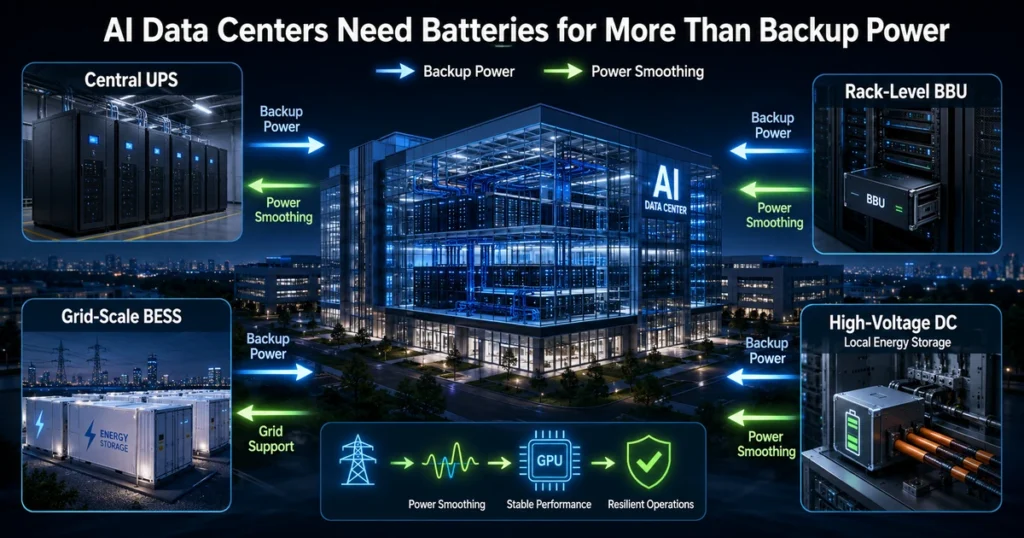
AI data centers need batteries for much more than keeping servers online during a blackout. Traditional uninterruptible power supply systems, or UPS systems, are still essential for bridging the gap between a grid outage and the startup of backup generators. However, modern AI facilities are beginning to use batteries at several different levels of the electrical system.
Large battery energy storage systems can reduce peak demand, support the local grid, and smooth facility-wide load changes. Grid-interactive UPS systems can use battery capacity during normal operation instead of leaving it idle. Rack-level battery backup units can respond within milliseconds when power to a GPU rack changes or disappears. In future high-voltage DC architectures, batteries and supercapacitors may be placed even closer to the computing load.
The result is not one giant battery doing every job. It is a coordinated energy-storage system in which different batteries handle different power and time scales.
Introduction
For decades, batteries inside data centers had a fairly narrow assignment: wait for the power to fail. A conventional UPS battery bank spent most of its life fully charged. When utility power disappeared, the batteries immediately supplied electricity to the servers while diesel generators started and stabilized. Once the generators were ready, the batteries returned to standby. That model is still important. Even a brief interruption can crash workloads, corrupt data, or shut down expensive computing equipment.
But AI data centers are changing the power problem. Large GPU clusters do not always draw electricity at a smooth, predictable rate. Their power consumption can change as training jobs begin, pause, synchronize, checkpoint, or move between computational phases. When thousands of accelerators behave in a coordinated way, those changes can appear at the facility connection as rapid increases or decreases in electrical demand.
The International Energy Agency notes that data center demand is especially challenging because it is concentrated in specific locations rather than evenly distributed across a region. A large campus may therefore create a serious local grid constraint even when data centers remain a relatively modest share of total national electricity consumption. The IEA discusses this geographic concentration in its report on energy demand from AI. This is why the conversation around data center batteries is expanding beyond emergency backup.
A modern AI campus may need energy storage to provide:
- uninterrupted power during an outage;
- short-duration ride-through during voltage disturbances;
- rack-level protection for individual GPU systems;
- facility-level power smoothing;
- peak-demand reduction;
- grid support;
- renewable-energy integration;
- and, in some cases, additional capacity while waiting for a larger grid connection.
These applications overlap, but they are not identical. A rack-level battery designed to respond in milliseconds is solving a different problem from a two-hour BESS installed beside the data center. Understanding that difference is the key to understanding where data center battery design is heading.
AI Data Centers Create a Different Kind of Electrical Load
A traditional office building may have thousands of individual loads that turn on and off independently. Because their behavior is not perfectly synchronized, the total demand tends to look smoother than the demand of any one device.
An AI cluster can behave differently. During large-scale training, many GPUs may process the same workload together. They communicate, exchange results, wait at synchronization points, and then begin the next computational phase at nearly the same time. The electrical demand of the cluster can therefore rise and fall in a coordinated pattern.
The average power demand may already be enormous, but average demand is only part of the challenge. The electrical system must also handle:
- rapid load ramps;
- repetitive power pulses;
- sudden training interruptions;
- workload migration;
- synchronized checkpointing;
- and large changes between active and idle operating states.
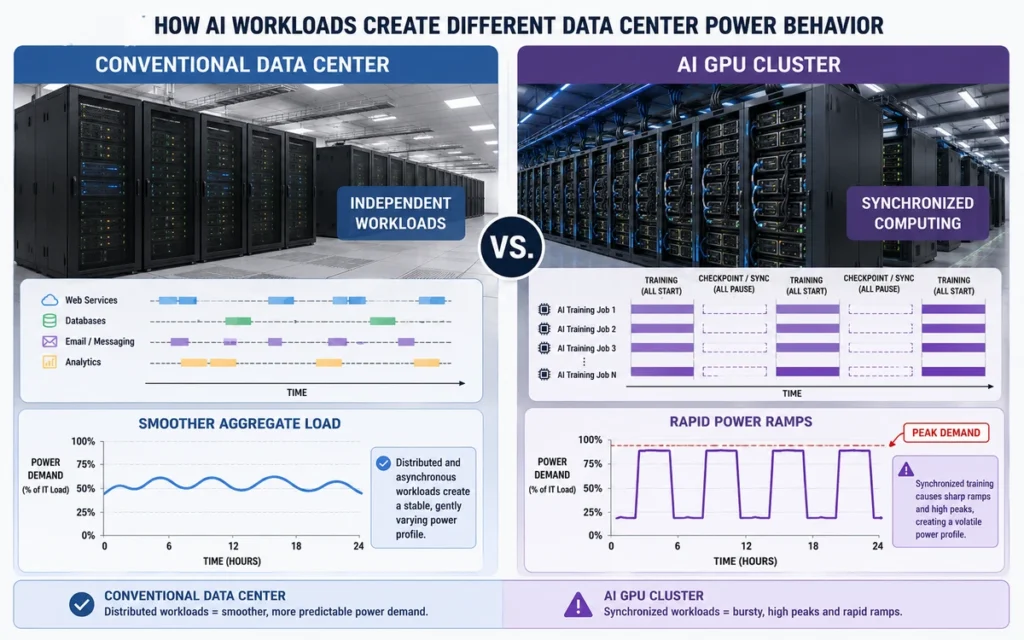
Recent research on AI data center power forecasting describes sudden load changes caused by inference activity, training interruptions, and changing computational demand. The authors argue that short-term forecasting can help data centers and utilities allocate power more effectively, although the internal behavior of AI workloads can be difficult to model.
A 2026 U.S. Department of Energy–hosted technical report on large data center electrical modeling goes further. It describes battery systems that may be used not only for backup, but also for load smoothing, grid support, and ride-through. The report also discusses the possibility of rack-level supercapacitors and batteries in future DC distribution architectures.
This does not mean every AI data center experiences the same dramatic power profile. Workload management software, power caps, accelerator design, cooling systems, and local electrical architecture all influence the final demand seen by the grid.
Still, the trend is clear: data center power systems can no longer be designed only around a steady average load plus an occasional outage. They increasingly need to manage power as a dynamic variable.
The First Layer: Conventional UPS Backup
The UPS remains the foundation of data center power protection. A conventional online or double-conversion UPS converts incoming AC power to DC and then converts it back to controlled AC power for the IT load. The DC link also allows a battery bank to support the system when incoming power is lost.
During a grid outage, the sequence usually looks like this:
- Utility power disappears or falls outside acceptable limits.
- The UPS battery immediately supplies the IT load.
- Backup generators start.
- The generators reach the required voltage and frequency.
- The facility transfers to generator power.
- The battery returns to charging or standby.
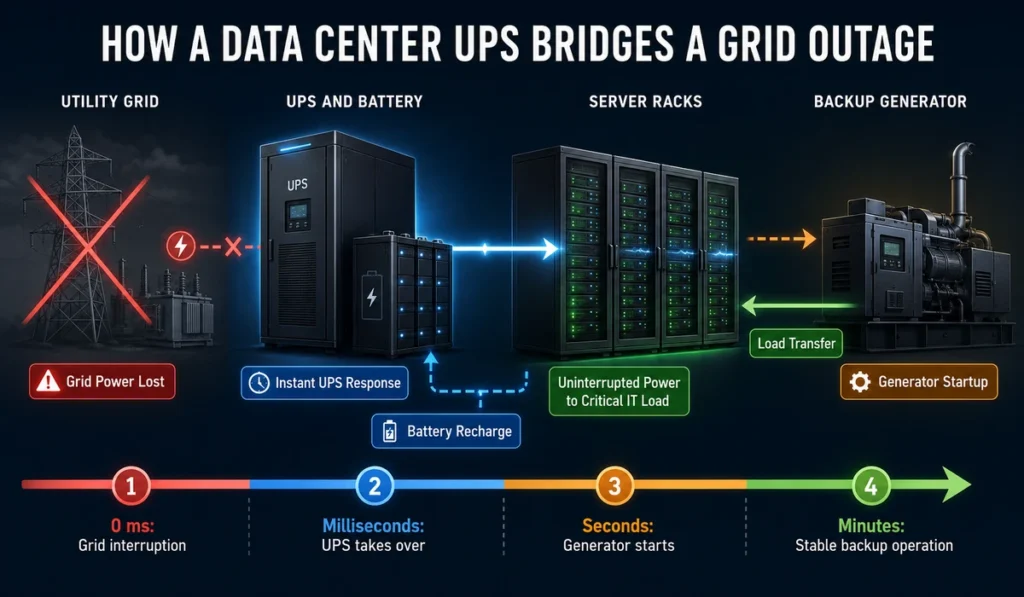
The battery may need to support the load for only a few minutes. Its most important qualities are immediate response, high reliability, predictable health, and enough energy to cover the generator-start interval. Historically, many data centers used valve-regulated lead-acid batteries. Lithium-ion systems have gained attention because they can offer a smaller footprint, lower weight, better monitoring, and longer service life under appropriate operating conditions.
However, chemistry alone does not determine whether a UPS system is reliable. The complete system also depends on:
- cell quality
- battery management
- thermal control
- fault isolation
- fire detection
- maintenance procedures, and
- accurate state-of-health estimation.
This is similar to the broader distinction between vehicle and stationary batteries discussed in our guide to EV batteries versus grid storage batteries. Both may use lithium-ion cells, but their design priorities depend on the job they must perform.
A data center UPS battery may sit in standby for years and then be expected to work perfectly during a rare event. That operating pattern is very different from an EV battery that charges and discharges almost every day.
The Second Layer: Grid-Interactive UPS
A conventional UPS battery is valuable but underused. Most of the time, it waits. A grid-interactive UPS changes that relationship by allowing some of the stored energy and power-conversion capability to participate in normal facility or grid operations. Depending on the design, a grid-interactive UPS may help with:
- peak shaving;
- demand-response events;
- frequency regulation;
- voltage support;
- renewable-energy balancing;
- or short-duration facility power smoothing.
The idea is attractive because the battery, inverter, protection equipment, and controls are already installed. Rather than building a completely separate storage system, the operator may use some of that existing capacity more productively.
There is an important limitation, however: backup reliability must remain the first priority. A data center operator cannot discharge the UPS battery for grid services and then discover that insufficient energy remains when the grid fails. Control software must therefore preserve a minimum state of charge, account for battery health, predict potential outage risk, and ensure that every grid-support action remains within the equipment’s warranty and safety limits.
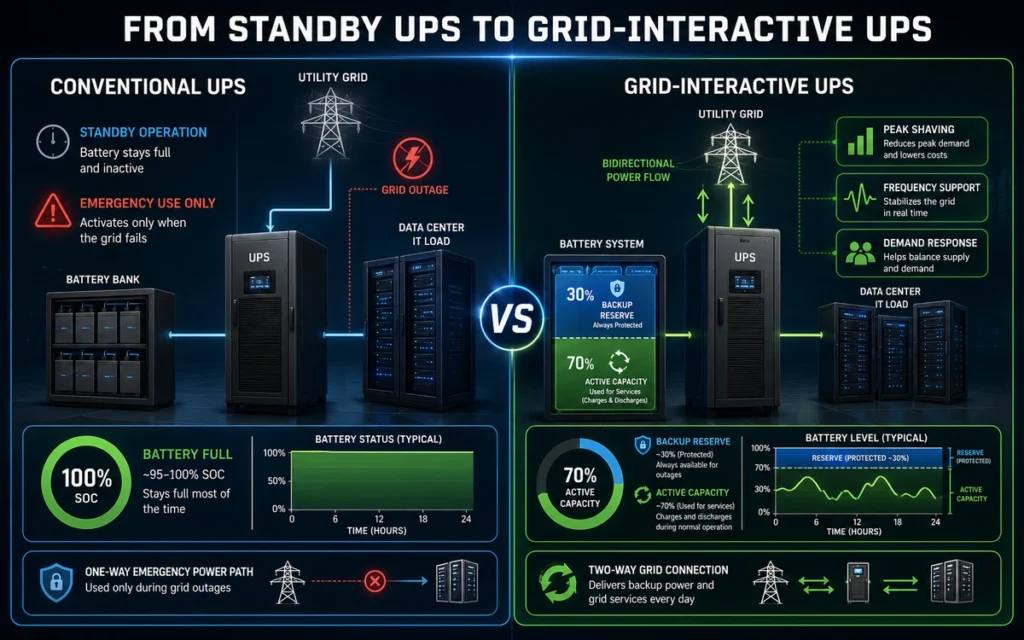
This creates an optimization problem. Suppose a UPS battery could provide 10 minutes of full-load backup when fully charged. The operator might allow a limited portion of that capacity to reduce a short demand peak, but only if the remaining energy still satisfies the site’s reliability requirement. The available capacity may also depend on:
- generator startup time;
- current IT load;
- battery temperature;
- battery age;
- expected grid conditions;
- and the redundancy level of the facility.
A battery that appears to have 30% spare capacity under one operating condition may have much less flexibility during hotter weather, higher server utilization, or a maintenance event that has taken one generator offline. For that reason, grid-interactive UPS operation requires closer coordination between the battery management system, the UPS controller, the building management system, and the data center workload scheduler. It is no longer just a battery backup system. It becomes part of the site’s energy-management strategy.
The Third Layer: Rack-Level Battery Backup
Facility-level UPS systems protect large groups of servers. Rack-level battery backup units move the storage much closer to the computing hardware. Instead of routing all protected power through a centralized UPS, a distributed architecture places a battery backup unit, or BBU, inside or beside the server rack. The battery connects to the rack’s DC bus and supplies power directly when the normal source disappears.
The Open Compute Project’s Open Rack V3 BBU specification provides a useful real-world example. It describes a 48-volt rack-level system in which multiple battery modules provide redundant DC backup. The specification includes a battery pack, BMS, charger, discharger, monitoring functions, and communication with the rack controller.
The document specifies that the BBU should detect a bus-voltage drop and begin supporting the rack within milliseconds. It also describes periodic health checks, controlled charging, state-of-charge monitoring, and peak-power operation.
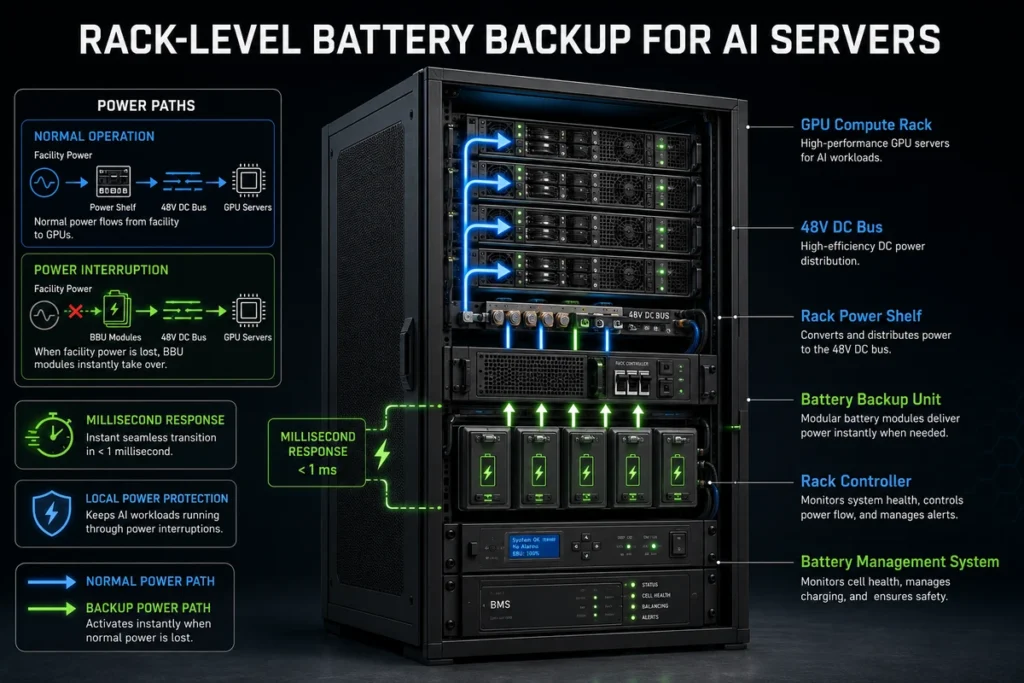
This architecture has several potential advantages. First, it reduces the distance between energy storage and the load. Power does not have to pass through as many facility-level conversion stages before reaching the servers.
Second, a rack-level battery can respond specifically to the needs of that rack. One rack may experience a sudden workload change while another remains relatively stable.
Third, distributed storage can make expansion more modular. New racks can be added with their own backup capability rather than requiring a complete redesign of a centralized UPS plant.
There are tradeoffs. Thousands of small battery systems create a large monitoring and maintenance challenge. Each unit needs accurate health estimation, temperature monitoring, fault reporting, and replacement planning. Operators must also manage the safety implications of placing lithium-ion batteries close to expensive computing hardware. The distributed design may save conversion equipment, but it also creates more individual battery assets to track.
Rack-Level Batteries Can Do More Than Handle Outages
One of the most interesting details in the Open Rack V3 specification is that its rack-level BBU is not limited to emergency backup. The document also describes a forced-discharge mode that can be used for data center peak-power shaving. In that mode, the rack controller commands the battery units to contribute power while reducing the output supplied by the normal power system.
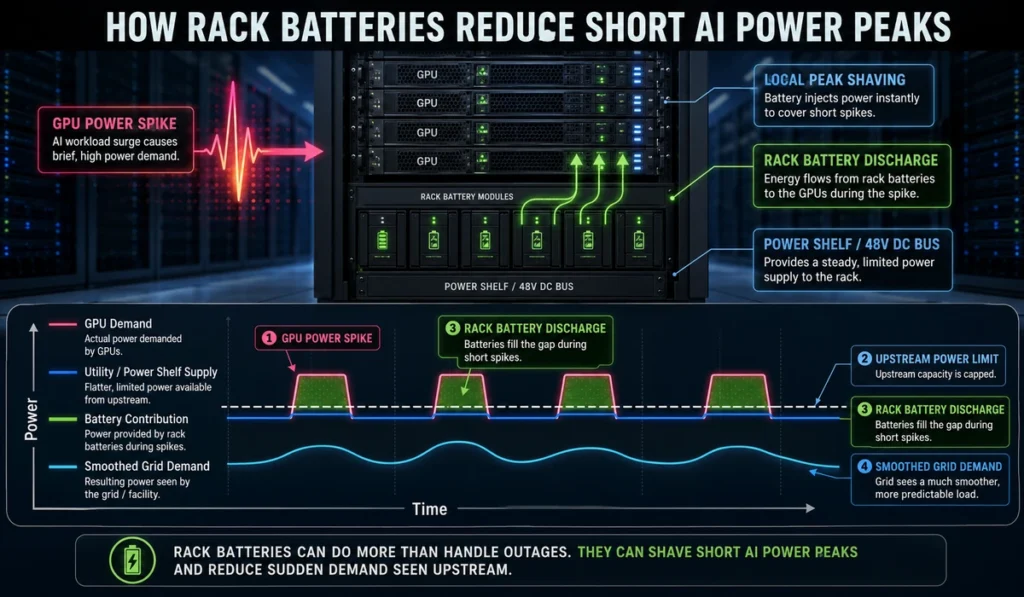
This is a small-scale version of the same idea behind a grid-interactive UPS. Instead of leaving every rack battery fully idle until an outage, the data center can potentially use some of that stored energy to reduce a brief peak.
That may be especially useful for AI workloads, where a short power surge does not necessarily require a large amount of energy. The peak might last milliseconds, seconds, or minutes. The battery does not need to run the entire data center for hours. It only needs to fill the gap between the instantaneous computing demand and the power the upstream electrical system is prepared to deliver.
This distinction between power and energy is important. A battery may have enough energy to run a rack for several minutes, but its inverter and cells must also deliver the required instantaneous power. Conversely, a supercapacitor may deliver extremely high power almost instantly but store much less total energy. That is why future AI data centers may use several storage technologies together rather than relying on one universal battery.
The Fourth Layer: Battery Energy Storage Systems
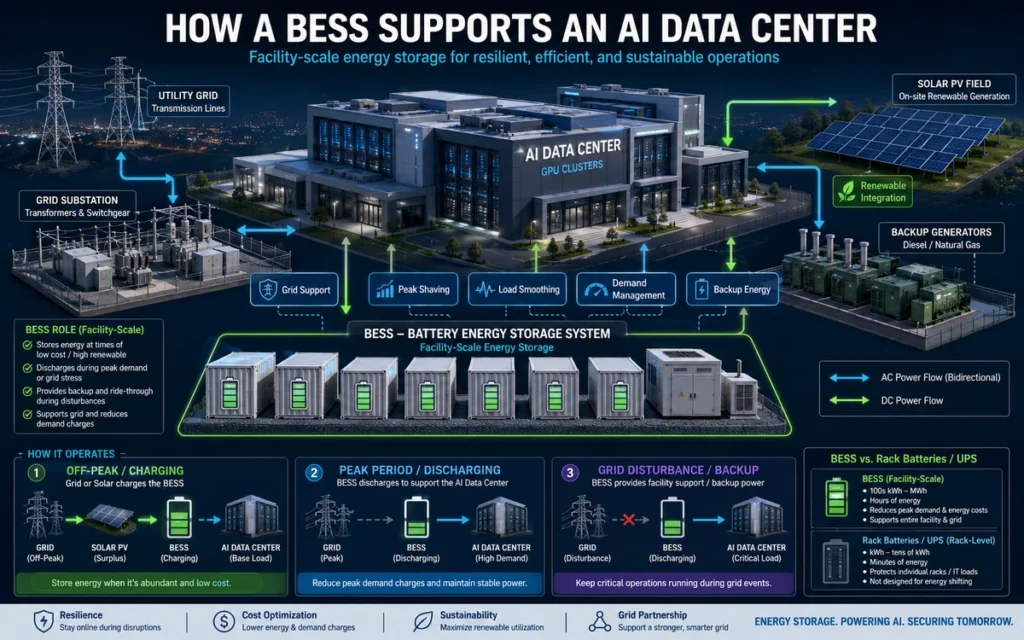
A facility-scale BESS operates on a much larger scale than a rack-level BBU. It may consist of multiple containerized battery blocks connected to power-conversion equipment, transformers, switchgear, thermal-management systems, fire-protection equipment, and a site energy-management platform. The BESS may be installed:
- behind the data center meter;
- beside the facility substation;
- as part of an on-site microgrid;
- or on the utility side of the connection.
Its duties can include backup power, but it is generally better suited to longer and broader energy-management tasks.
Peak-demand reduction
Many commercial customers pay not only for total energy consumption but also for the highest level of power drawn during a billing period. A BESS can discharge when the facility approaches a demand threshold, reducing the peak seen by the utility. This can lower demand charges and may reduce the electrical infrastructure required to support occasional short peaks.
Power smoothing
A BESS can absorb energy when AI demand falls and discharge when demand rises. The utility then sees a smoother load than the data center is actually producing internally. The battery effectively acts as a buffer between the computing workload and the grid.
Renewable-energy integration
If the campus has solar or wind generation, a BESS can store surplus energy and release it later. That does not mean a short-duration battery can make a data center run entirely on intermittent renewable power. A two-hour or four-hour system cannot compensate for several cloudy days or a long period of weak wind. It can, however, reduce short-term mismatch and improve the use of locally generated electricity.
Grid connection support
In some regions, the power requested by new data centers is arriving faster than utilities can build substations, transmission lines, and generation capacity. A BESS cannot create unlimited energy. But it may help a facility operate within a lower grid-import limit by handling temporary peaks, supporting ramp control, or coordinating with on-site generation.
This is one reason battery storage is becoming central to the broader data center expansion discussed in Why AI Data Centers Are Driving the Next Battery Storage Boom. That earlier article explains the market-level relationship between AI growth, grid constraints, and battery demand. The focus here is narrower: the BESS is only one layer of a larger power-protection and power-management architecture.
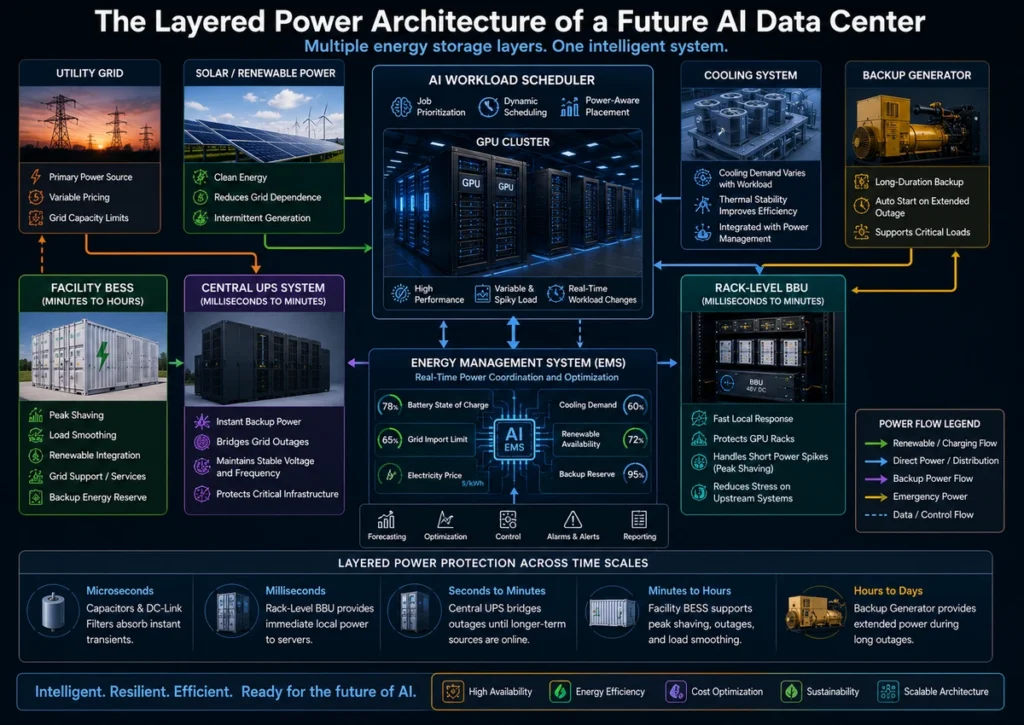
Power Smoothing Happens Across Several Time Scales
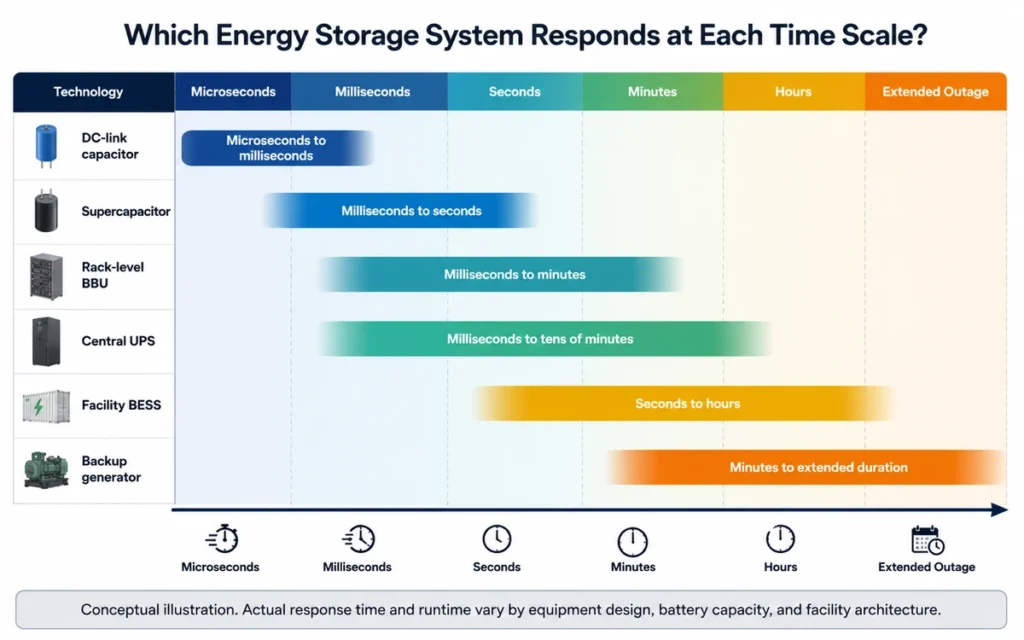
The phrase “power smoothing” sounds simple, but it can refer to very different events. A useful way to understand the problem is to separate it by time scale.
Milliseconds
Very fast power changes may be handled by:
- power-supply capacitors;
- DC-link capacitors;
- supercapacitors;
- rack-level BBUs;
- and fast inverter controls.
At this scale, response speed matters more than total stored energy.
Seconds
Repeated workload transitions or short cluster-level peaks may be handled by rack-level batteries, a centralized UPS, or a fast-response BESS. The battery must deliver meaningful power but may not need a large energy capacity.
Minutes
Longer load ramps, generator startup, utility disturbances, and facility demand peaks may require larger UPS batteries or a site BESS. Here, energy capacity becomes more important.
Hours
A facility-scale BESS may shift energy between low-demand and high-demand periods, support renewable generation, or reduce sustained grid imports. At this scale, rack-level storage is generally too small to be the primary solution.
Research on hybrid storage for AI data centers illustrates why this layered approach is attractive. Some proposed systems assign the slower, energy-heavy portion of the load change to batteries while using supercapacitors for faster fluctuations. This reduces the burden on the battery and may improve state-of-charge control and battery life.
The concept is similar to suspension in a vehicle. A tire absorbs very small road irregularities, the suspension handles larger movement, and the vehicle structure manages the overall load. Asking one component to handle every frequency and magnitude usually produces a poor design.
The Move Toward High-Voltage DC Power Distribution
Today’s data centers use multiple conversion stages to move power from the utility connection to the processors. Power may pass through transformers, rectifiers, UPS equipment, AC distribution, server power supplies, DC buses, and voltage regulators before it reaches a GPU. Every conversion stage adds cost, losses, heat, and equipment.
As AI rack power rises, the industry is exploring higher-voltage DC distribution. NVIDIA has described an emerging 800-volt DC architecture for AI factories, arguing that higher DC voltage can help deliver large amounts of power with lower current and make it easier to integrate energy storage at suitable locations.
The DOE-hosted modeling report describes a similar direction. It considers 400-volt or 800-volt DC distribution to racks, followed by DC-to-DC conversion closer to the IT equipment. It also notes that batteries could be integrated at the high-voltage DC level for backup, ride-through, load smoothing, or grid support.
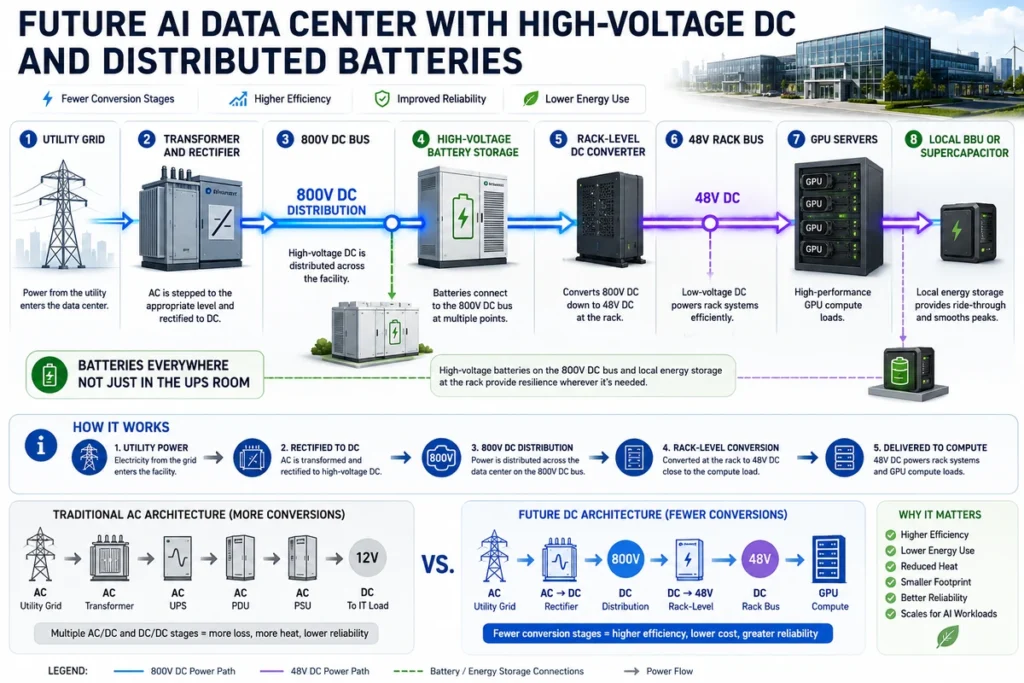
This could change the physical location and role of data center batteries. Instead of placing all storage in a separate UPS room, future architectures may distribute energy storage across several points:
- facility-level BESS near the grid connection;
- high-voltage batteries on the main DC bus;
- rack-level batteries on a 48-volt bus;
- and supercapacitors near high-power computing equipment.
The closer the storage moves to the load, the faster and more precisely it can respond. But proximity also increases requirements for compact packaging, thermal management, fault isolation, and fire protection.
Why Battery Chemistry Still Matters
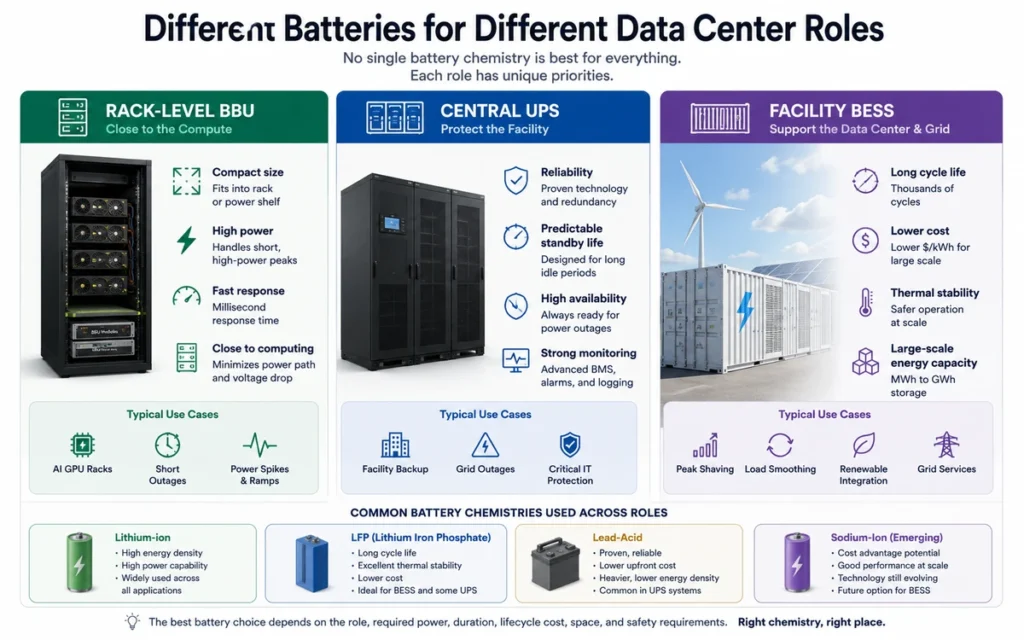
AI data center batteries do not all need the same chemistry. A rack-level BBU values high power, compact size, low weight, and fast response. A large outdoor BESS may prioritize cycle life, cost, safety, and ease of thermal management. Lithium iron phosphate, or LFP, is attractive for many stationary systems because it generally offers strong cycle life, relatively good thermal stability, and lower reliance on nickel and cobalt. That helps explain why LFP is expanding beyond vehicles into stationary storage, as discussed in Why LFP Batteries Are Taking Over the Global EV Market.
Nickel-based lithium-ion chemistries may still be attractive where volume and weight are tightly constrained. Lead-acid batteries remain in use in many established UPS installations. Sodium-ion batteries may eventually gain a role where cost, supply-chain diversity, cold-temperature behavior, or high cycle life matter more than maximum energy density. Our article on sodium-ion batteries in mass production explains why the chemistry may first become competitive in applications that are less sensitive to size and weight than long-range passenger EVs.
No chemistry removes the need for system-level safety. The Open Compute Project’s recent energy-storage guidance emphasizes that lithium-ion systems require careful thermal-runaway mitigation, code compliance, monitoring, maintenance, and emergency planning.
For a data center, the consequences of a battery incident extend beyond the storage equipment itself. Smoke, water discharge, shutdown procedures, and access restrictions can affect nearby computing systems even when the fire does not spread directly.
The Hidden Challenge: Battery Health and Availability
A data center battery may appear ready because its state-of-charge display reads 100%. That does not guarantee that it can deliver the expected power or runtime. State of charge describes the battery’s current energy level. State of health describes how its usable capacity and resistance have changed with age. State of power describes how much power it can safely deliver under current conditions.
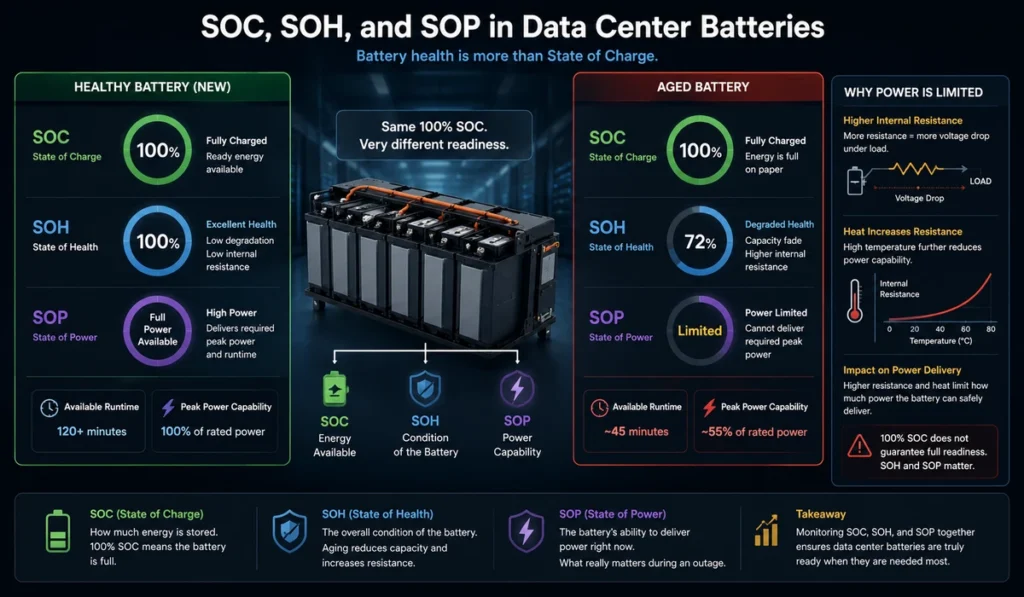
All three matter. A battery may be fully charged but degraded. It may have enough energy for the planned backup duration but be too cold, too hot, or too resistive to deliver the required peak power. A rack-level battery may also have enough capacity but fail to respond correctly because of a communication or power-electronics fault. This is why modern BBU specifications include periodic health tests rather than relying only on voltage or state-of-charge readings.
The Open Rack V3 specification, for example, calls for scheduled state-of-health checks and communication of battery condition to the rack monitoring system. Data center operators must also decide how aggressively to use their batteries.
Grid services and peak shaving can create economic value, but every additional cycle contributes some wear. A well-designed strategy may use shallow cycles in moderate temperature ranges, preserving enough reserve for emergencies. A poor strategy could accelerate degradation and reduce backup reliability. The objective is not to avoid cycling completely. It is to use the battery only when the operational or financial benefit justifies the wear.
Batteries Will Not Replace Every Other Power Source
It is easy to imagine a future data center powered entirely by batteries, but batteries remain energy-storage devices rather than primary energy sources. A BESS can shift electricity from one time to another. It cannot produce energy indefinitely.
For short outages, batteries may provide all the backup time a facility needs. For longer outages, many data centers will continue to rely on diesel engines, natural-gas generators, fuel cells, or other on-site generation. Long-duration storage technologies could eventually reduce this dependence, but economics, space, permitting, fuel availability, and reliability requirements will determine what is practical.
The most realistic near-term architecture is hybrid. Batteries provide instant response, smooth rapid fluctuations, and bridge short interruptions. Generators or other firm resources provide energy during extended outages. Grid connections supply normal operation. Workload-management software adjusts computing activity when flexibility is available. No single component carries the entire burden.
What the Future AI Data Center May Look Like
The future AI data center will probably treat power and computing as one coordinated system. Today, a workload scheduler decides where and when a job runs primarily according to processor availability, memory, networking, and deadlines. In a more energy-aware design, it may also consider:
- available grid capacity;
- battery state of charge;
- electricity prices;
- renewable generation;
- cooling conditions;
- UPS reserve requirements;
- and limits on the rate at which facility power can change.
A large training job could ramp gradually rather than starting every accelerator at once. Non-urgent tasks could shift to a lower-demand period. Batteries could absorb the remaining difference between computing demand and the grid-import target.
The battery would not simply react to the workload. The workload and battery would be scheduled together. That is a deeper change than replacing lead-acid batteries with lithium-ion cells. It turns energy storage into part of the computing architecture.
Conclusion
AI data centers still need traditional backup power, but backup is only the beginning. Centralized UPS systems protect the facility during outages. Grid-interactive UPS systems can use reserved battery capacity for demand management and grid support. Rack-level BBUs provide fast, localized protection close to GPU hardware. Large BESS installations smooth facility demand, reduce peaks, support renewable energy, and help manage grid-connection limits.
Each system operates on a different power and time scale. A supercapacitor may respond to a millisecond pulse. A rack battery may support a server for several minutes. A facility BESS may shift energy for hours. A generator may sustain the campus through a long outage. The most effective solution is therefore not the largest possible battery. It is a layered architecture that places the right kind of storage in the right location.
As AI racks become more powerful and data center electrical systems move toward high-voltage DC distribution, batteries will become more deeply integrated with power electronics, workload scheduling, and grid operations. In that environment, batteries are no longer equipment that waits quietly for an emergency. They become active components of how an AI data center operates every day.
FAQs
Why do AI data centers need batteries if they already have generators?
Generators take time to start and stabilize. Batteries provide immediate power during that interval. They can also handle rapid load changes, reduce facility peaks, and support the grid in ways that generators are not well suited to perform.
What is the difference between a UPS and a BESS?
A UPS is primarily designed to protect critical equipment from interruptions and power-quality problems. A BESS is usually designed for broader energy-management tasks such as peak shaving, energy shifting, renewable integration, and grid support. Some modern systems combine both roles.
What is a grid-interactive UPS?
A grid-interactive UPS uses part of its battery and inverter capacity during normal operation. It may provide peak shaving, demand response, frequency regulation, or power smoothing while maintaining enough reserve for emergency backup.
What is a rack-level battery backup unit?
A rack-level BBU is a small battery system installed inside or near a server rack. It supplies DC power directly to the rack during a power interruption and may also help manage brief peak-power events.
Can rack-level batteries replace a facility UPS?
They can replace some centralized UPS functions in a distributed architecture, but they do not necessarily eliminate the need for facility-level protection, grid controls, backup generation, or larger energy storage.
Why use both batteries and supercapacitors?
Batteries store more energy, while supercapacitors can respond rapidly to short, high-power events and tolerate frequent cycling. A hybrid system can assign fast fluctuations to the supercapacitor and longer changes to the battery.
Which battery chemistry is best for AI data centers?
There is no single best chemistry for every layer. LFP may be attractive for large stationary storage because of its cycle life and thermal characteristics. Other lithium-ion chemistries may suit compact rack-level systems. Lead-acid remains common in traditional UPS installations, while sodium-ion and other alternatives may gain ground in future stationary applications.