
Quick Answer
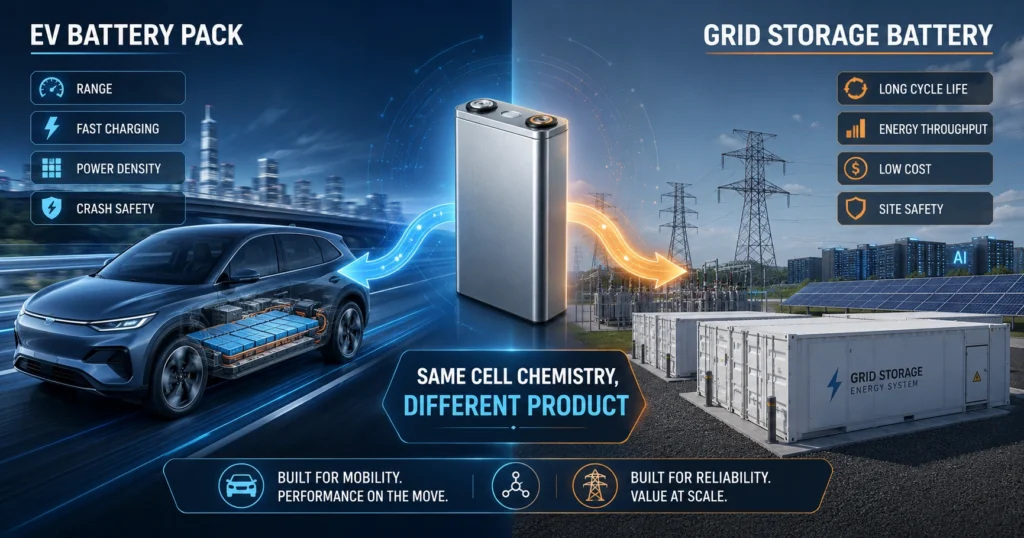
EV batteries and grid storage batteries can use similar lithium-ion cells, especially LFP cells, but they are not the same product. An EV battery must move a vehicle. That means it has to balance driving range, weight, acceleration, fast charging, crash safety, vibration, cold-weather performance, and warranty expectations.
A grid storage battery, often called a battery energy storage system or BESS, usually stays in one place. Its priorities are different: low cost, long cycle life, predictable energy throughput, thermal safety, serviceability, software control, and long-term project economics.
So even when an EV battery and a grid storage battery share the same basic chemistry, the final product can be very different. The cell design, pack architecture, cooling system, safety validation, warranty model, and control software are all shaped by the job the battery is expected to do.
Introduction: Same Battery Industry, Different Mission
EV batteries vs grid storage batteries is not just a comparison of chemistry. Even when both products use similar lithium-ion or LFP cells, they are designed for very different jobs. It is easy to look at an EV battery pack and a grid-scale battery container and assume they are basically the same thing. Both store electricity. Both may use lithium-ion cells. Both may use LFP chemistry. Both need a battery management system, thermal control, safety monitoring, and long-term durability.
But the similarity can be misleading. An EV battery is part of a moving vehicle. It has to help the car accelerate, climb hills, handle regenerative braking, fast charge on road trips, and operate in hot summers and cold winters. It also has to fit into a vehicle platform where space and weight are always limited.
A grid storage battery has a very different life. It may sit near a solar farm, substation, factory, data center, or utility project. It does not need to deliver 0–60 mph acceleration. It does not need to fit under a passenger cabin. It does not need to survive potholes, road salt, or vehicle crash loads. Instead, it needs to store and deliver electricity reliably for years, often under a predictable daily cycling schedule.
This distinction matters more now because battery storage is becoming one of the fastest-growing parts of the energy industry. In 2026, Reuters reported that lithium producers are increasingly betting on battery storage demand as growth shifts beyond EVs. The same report noted that storage demand is becoming a much larger driver of lithium demand, especially as grid storage and AI data centers expand.
The U.S. grid is also adding batteries at record speed. The U.S. Energy Information Administration said in its 2026 capacity outlook that developers planned to add 24 GW of utility-scale battery storage in 2026, compared with a record 15 GW added in 2025.
That creates an important question for the battery industry: if EV companies and energy storage companies are sometimes buying similar cells, why are the final products so different? The answer is that batteries are not defined by chemistry alone. A cell becomes a product only after it is engineered for a specific use case.
For background on why energy storage demand is rising, see our related article: AI Data Center Battery Storage: 5 Reasons Demand Is Booming.
EV Batteries vs Grid Storage Batteries: Different Design Priorities
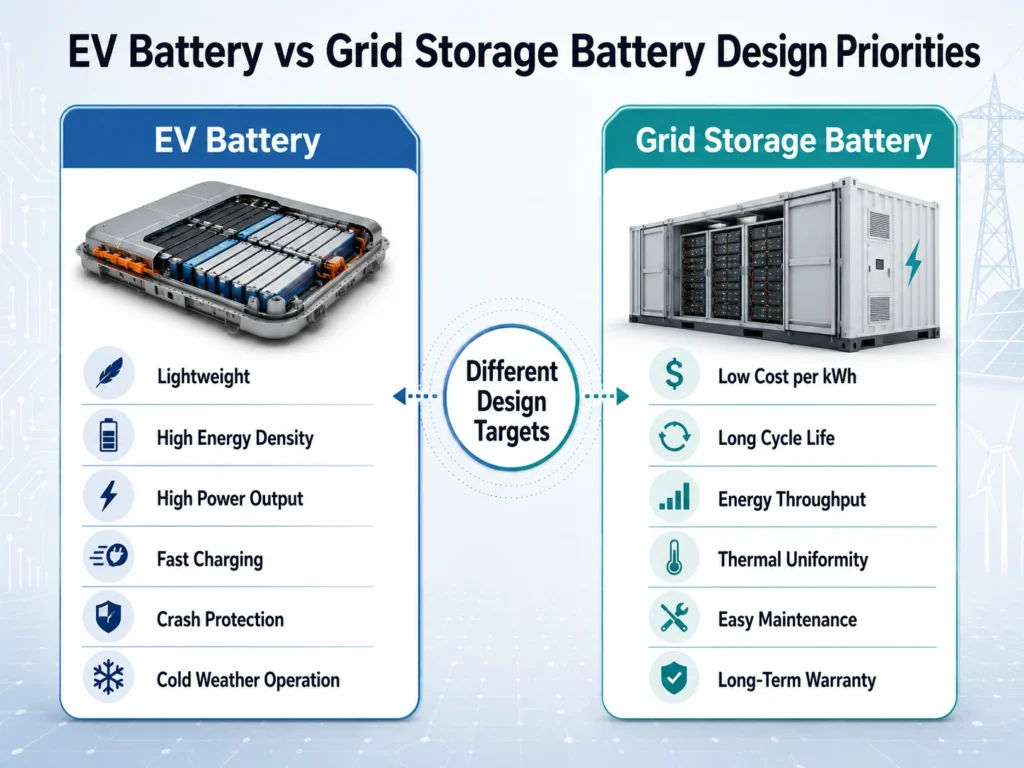
The biggest difference is simple: an EV battery has to move. Every pound matters. A heavier battery can reduce efficiency, shorten range, affect handling, increase tire wear, and raise cost. Automakers therefore care deeply about energy density, which is how much energy a battery can store for a given weight or volume.
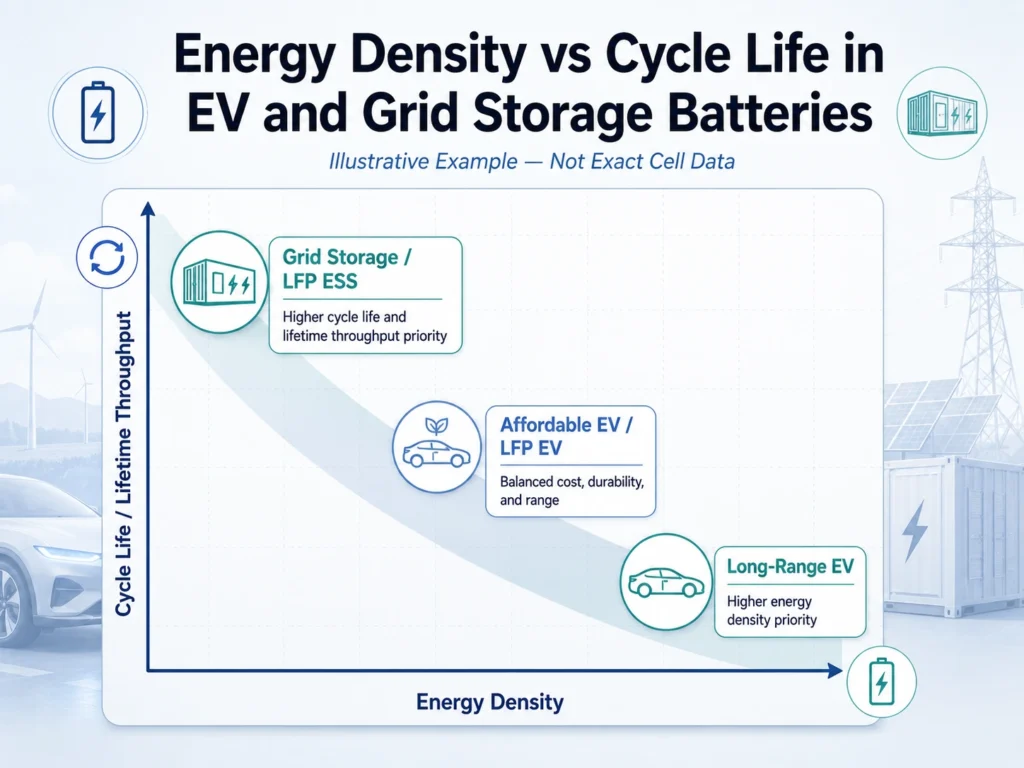
This is why high-nickel chemistries such as NMC and NCA have historically been important in long-range EVs. They can store more energy in a limited space than traditional LFP cells. That matters when an automaker wants to offer a 300-mile or 400-mile vehicle without making the pack too large or too heavy.
LFP is now becoming much more common in EVs because it is lower cost, durable, and thermally stable. Still, energy density remains a real constraint in vehicles. An affordable city EV, standard-range sedan, or commercial fleet vehicle may be a great fit for LFP. A long-range pickup, large SUV, or performance EV may still benefit from higher-energy chemistries.
Grid storage batteries do not face the same weight pressure. A battery container can be heavy. It can sit on a pad. It can be transported once and then stay in place for years. Land use, installation cost, and container footprint still matter, but they do not affect driving range because there is no driving range.
The International Energy Agency explains this difference clearly in its report on batteries and secure energy transitions. The IEA notes that energy density is extremely important for EV batteries, while it is less critical for battery storage. That is one reason LFP has shifted so strongly into stationary storage.
This is the first major lesson: the same chemistry can look more or less attractive depending on the product. LFP may be a compromise in some long-range EVs, but it can be close to ideal for many stationary storage applications.
For more on this chemistry tradeoff, see our earlier article: LFP vs NMC Batteries: Which EV Battery Is Better in 2026?
Grid Storage Batteries Are Designed Around Energy Throughput
EV owners usually think in miles. Grid storage operators think in megawatt-hours delivered over time. That difference changes the entire design philosophy. Most personal EVs do not use a full battery cycle every day. A driver may use 20%, 30%, or 40% of the pack on a normal commute, then recharge overnight. Even road trips are occasional for many owners. The battery still needs to last for many years, but its daily cycling pattern is often moderate.
Grid storage can be much more repetitive. A storage system may charge during the day when solar power is abundant and discharge in the evening when electricity demand rises. It may help reduce peak demand, support grid frequency, smooth renewable energy output, or provide backup power for critical facilities.
In those applications, the battery may cycle frequently. The owner cares about how much usable energy the system can deliver over its lifetime. This is called energy throughput, and it is one of the most important economic measures for stationary storage.
A grid battery that is cheap upfront but degrades too quickly may be a poor investment. A battery that costs more but delivers stable capacity for 15 or 20 years may be more valuable because the project owner can model revenue more confidently. This is why cycle life matters so much in energy storage. It is not just a lab number. It affects financing, warranties, maintenance planning, and project returns.
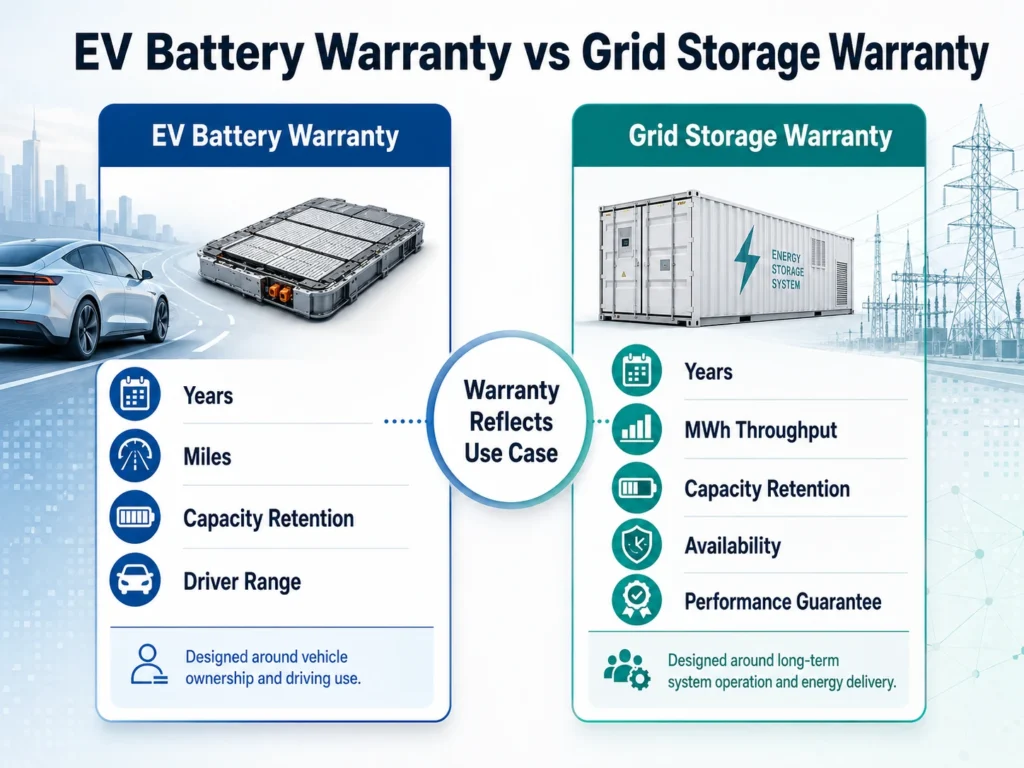
EV batteries also care about cycle life, but the warranty language is usually different. Tesla, for example, explains its vehicle battery coverage on its New Vehicle Limited Warranty page. EV warranties are commonly tied to years, mileage, and a minimum battery capacity threshold.
Grid storage products are sold differently. Tesla’s Megapack page describes the product with a 20-year warranty and performance guarantees. That type of language fits the stationary storage market because buyers want long-term operational capacity, not miles driven.
So while both markets care about degradation, the business meaning is different. In an EV, degradation shows up as reduced driving range. In grid storage, degradation shows up as reduced usable capacity, lower revenue potential, and possible warranty exposure.
Power Requirements Are Not the Same Either
An EV battery needs both energy and power. Energy gives range. Power gives acceleration, towing capability, hill climbing, regenerative braking, and fast charging. Even a normal family EV may need short bursts of high power when merging onto a highway or passing another vehicle.
This is why EV battery software constantly manages power limits. The battery management system estimates state of charge, state of health, temperature, voltage, current, and available power. If the pack is too cold, too hot, nearly full, nearly empty, or aging, the vehicle may reduce acceleration or fast-charging speed to protect the battery.
Grid storage also needs power, but the profile is different. A stationary system may be designed as a 1-hour, 2-hour, 4-hour, or longer-duration battery. For example, a 100 MW / 400 MWh system is designed to deliver 100 MW for four hours. That is very different from an EV pack that delivers short bursts of high power during driving.
Some grid batteries are built for energy shifting, such as storing solar power during the day and discharging it in the evening. Others are built for fast response, such as frequency regulation. Some newer use cases, including AI data centers, may require batteries to respond quickly to sharp changes in electrical load.
This is one reason the storage market is becoming more diverse. A battery system for a solar farm, a data center, a substation, and a factory may use similar cells, but the controls and power electronics may be tuned for different jobs. The battery is not just a box of stored energy. It is part of a power system.
Thermal Management: EV Packs Must Handle the Road
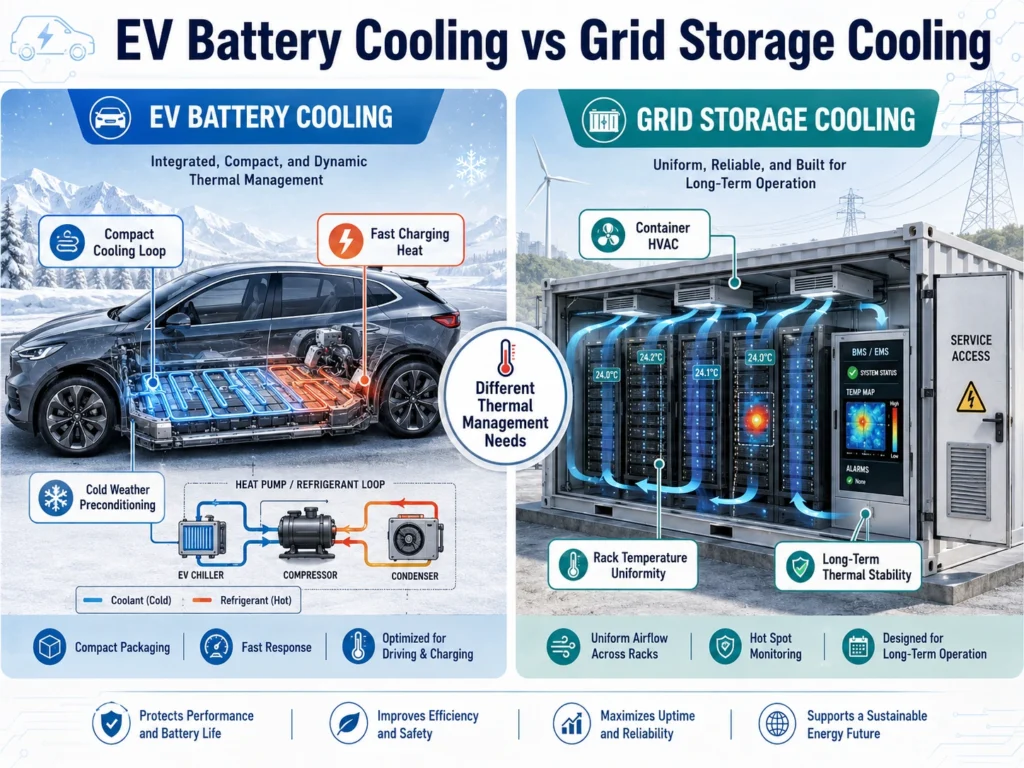
Thermal management is another major difference. An EV battery lives in a harsh environment. It sits inside a moving vehicle, often under the floor, where it must deal with road vibration, water exposure, debris, salt, hot pavement, freezing weather, fast charging, rapid acceleration, and regenerative braking.
The cooling system must be compact and lightweight. It often shares thermal hardware with the cabin heat pump, power electronics, electric motor, or refrigerant loop. It must also use energy efficiently because cooling and heating the battery can affect driving range.
This is why EV battery thermal management is so closely connected to real-world ownership. Cold batteries charge more slowly. Hot batteries age faster. Fast charging may be limited if the pack cannot stay within a safe temperature range. We discussed this in more detail in Why EV Range Drops in Winter and Why EV Batteries Charge Slower Above 80%.
Grid storage batteries have more physical space, but they face a different thermal challenge: uniformity across a very large system. A storage container may contain thousands of cells. A large site may include many containers. If one part of the system runs hotter than another, cells may age unevenly. That can reduce usable capacity, complicate balancing, and lower long-term performance.
Stationary storage also has a different operating rhythm. A battery may charge and discharge on a daily schedule, often during hot afternoon or evening grid conditions. Cooling systems must be designed for site climate, container spacing, airflow, service access, and fire safety requirements.
This is why utility-scale storage products are usually sold as integrated systems. Tesla Megapack, for example, includes not just battery modules, but also power electronics, thermal management, controls, and software in a packaged product. CATL’s TENER energy storage system is another example of how storage products are marketed around full-system performance, not just individual cells.
The cooling goal is different too. EV cooling protects range, power, fast charging, and vehicle durability. Grid storage cooling protects capacity retention, safety, uptime, and long-term project economics.
Safety Validation Depends on the Application
Both EV batteries and grid storage batteries must be safe, but they are validated around different risks. An EV battery is designed around passenger safety and vehicle crashworthiness. The pack must be protected during impacts. It must isolate high voltage when needed. It must survive vibration, shock, water intrusion, and years of road use. The vehicle structure is part of the battery safety strategy.
Grid storage safety is more site-based. A battery container may be installed near a substation, solar farm, commercial facility, data center, or industrial site. The main concerns include fire propagation, container spacing, ventilation, emergency access, monitoring, shutoff procedures, and compliance with local fire codes.
The total stored energy can also be much larger. A single EV battery may store 60 to 120 kWh. A grid storage site can store hundreds of MWh or more. Even if the chemistry is relatively stable, the scale of the system changes the safety discussion.
LFP is widely used in stationary storage partly because of its safety profile. The IEA notes that LFP is a lower-cost lithium-ion chemistry that does not contain nickel or cobalt and has lower flammability and longer lifetime compared with some other lithium-ion options. That makes it a natural fit for large storage systems where energy density is less critical.
But a safer cell chemistry does not automatically make a safe storage site. The full system still needs sensors, fuses, contactors, isolation monitoring, thermal controls, fire detection, software limits, emergency procedures, and proper installation. A battery product is only as safe as the system around it.
This is why grid storage increasingly competes on integration. The winning product is not always the one with the most impressive cell datasheet. It may be the one with the best combination of safety design, software, warranty support, serviceability, and real-world operating history.
Cost Targets Are Different
EV batteries and grid storage batteries both need to get cheaper, but “cheap” means different things in each market. For EVs, battery cost affects vehicle price, range, profit margin, and market positioning. A lower-cost battery can make an affordable EV possible. It can also allow an automaker to offer more range without raising the sticker price.
That is why falling battery prices matter so much for EV adoption. We covered this in more detail in EV Battery Prices 2026: Why Costs Keep Falling.
For grid storage, the cost target is tied to the value the system can create. A storage project may earn revenue by shifting energy from low-price hours to high-price hours. It may reduce demand charges, provide grid services, support renewable energy, or improve reliability for a data center or industrial site.
So grid storage buyers care about installed cost, cycle life, degradation rate, round-trip efficiency, availability, service cost, software optimization, and warranty terms. The cell price is important, but it is not the whole story.
This helps explain why battery companies are expanding into stationary storage. If EV demand slows in one region or segment, storage can absorb more cell production. At the same time, storage can create new demand for lithium, LFP cathodes, power electronics, thermal systems, and battery software.
Reuters’ 2026 report on lithium producers and battery storage demand shows this shift clearly: storage is no longer a small side market next to EVs. It is becoming one of the main growth engines for the battery supply chain.
Why LFP Is the Bridge Between EVs and Grid Storage
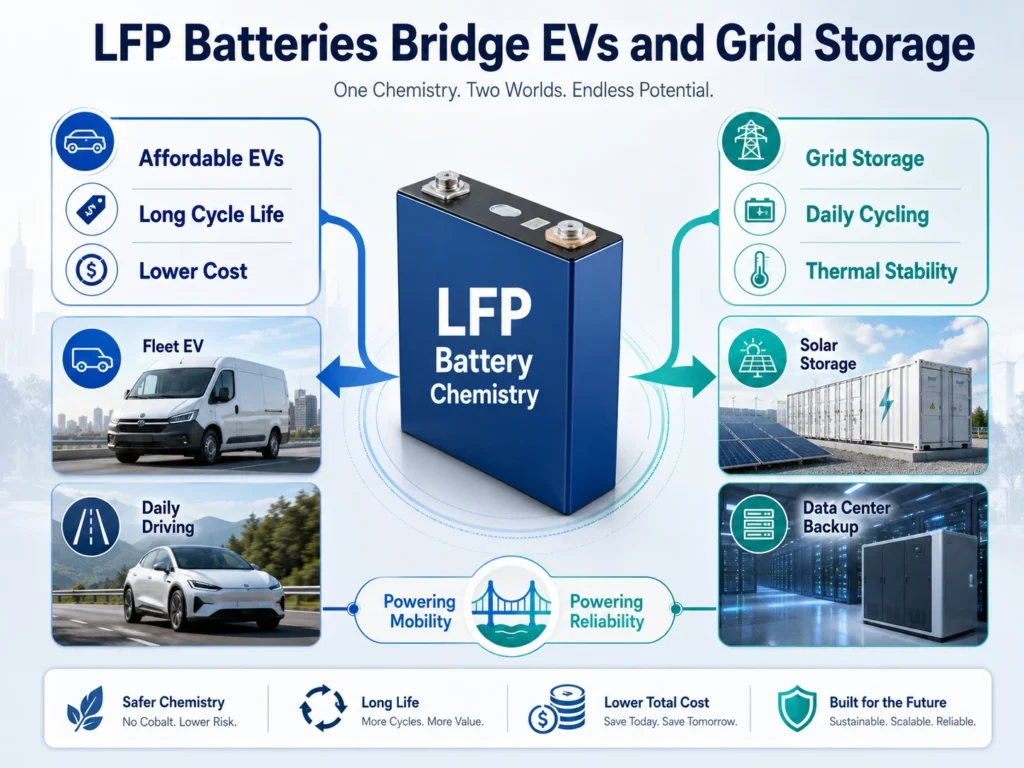
LFP sits at the center of this story. In EVs, LFP is attractive because it is durable, lower cost, and less dependent on nickel and cobalt. It is especially useful for standard-range vehicles, entry-level EVs, commercial fleets, and drivers who care more about affordability and longevity than maximum range.
In grid storage, those same strengths become even more important. Weight is less of a problem. Volume is less of a problem. Cycle life, cost, and safety become more important. That makes LFP a natural fit for many stationary storage systems.
But this does not mean every LFP cell is interchangeable. A cell designed for an EV may have different power capability, electrode design, form factor, quality controls, swelling behavior, current collector design, or cooling requirements than a cell designed for storage. Even if both are called LFP, they may not be optimized for the same duty cycle.
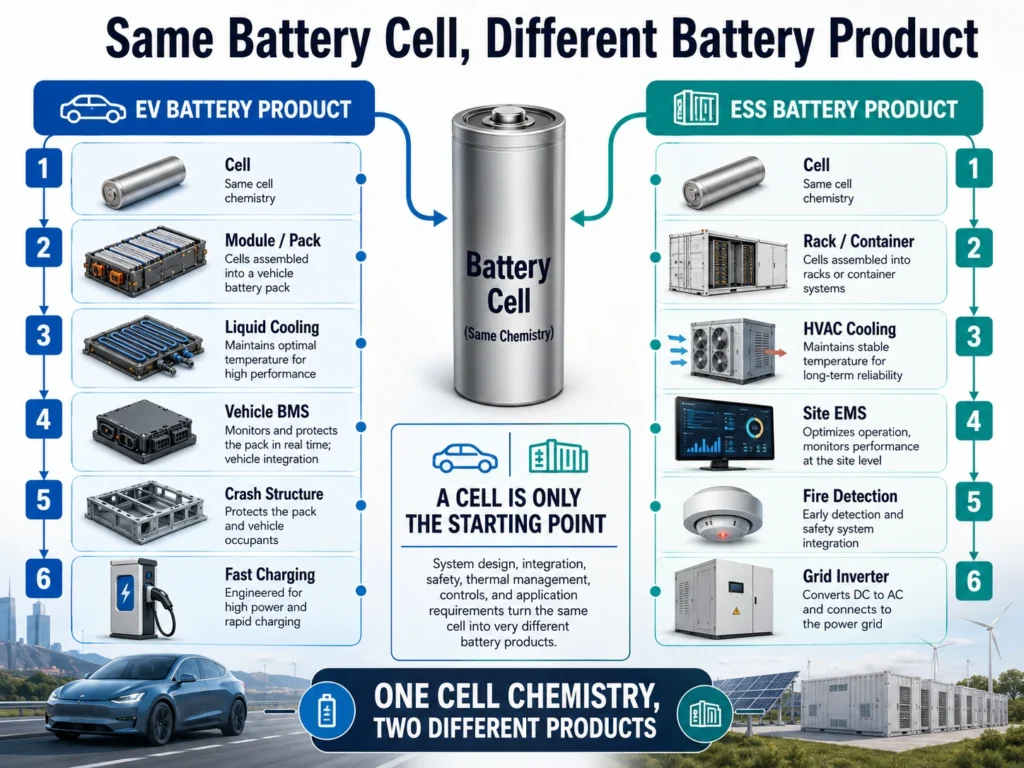
This is the key point: chemistry is not the product. A battery product includes the cell, module, pack, enclosure, cooling system, BMS, power electronics, safety system, software, warranty, and service model. The same chemistry can become a very different product when the target application changes.
That is why the future battery market will probably not have one single winner. Instead, it will look more like a toolbox. LFP will serve affordable EVs and grid storage. NMC and NCA will continue to matter in long-range and performance vehicles. Sodium-ion may grow in low-cost storage and some affordable EVs. LMFP may try to improve LFP-like batteries with higher energy density. Solid-state may eventually serve premium applications if cost and manufacturing challenges improve.
For a broader look at this idea, see Why There Will Not Be One Winning EV Battery Chemistry.
Why EV Battery Companies Are Moving Into ESS
Battery companies are moving into ESS because the opportunity is too large to ignore. EVs remain the largest and most visible battery market, but stationary storage is growing quickly because the grid is changing. Solar and wind need storage to shift energy across the day. Data centers need reliable and flexible power. Utilities need tools to handle peak demand and grid congestion. Industrial customers want backup power and lower electricity costs.
That creates demand for battery products that are not tied to vehicle sales. For a battery manufacturer, this has several advantages. ESS can use high-volume cell production. It can help smooth demand when EV sales fluctuate. It can use chemistries such as LFP that are already produced at scale. It can also open new revenue streams in software, service, and long-term energy management.
But ESS is not simply a dumping ground for EV cells. Storage customers are sophisticated. They care about warranties, bankability, safety records, capacity retention, and project economics. A battery supplier must prove that its system can operate reliably for many years.
This is why companies such as Tesla and CATL present their stationary storage products as complete energy systems. Tesla sells Megapack as a utility-scale energy storage product with integrated controls and long-term support. CATL markets TENER around energy capacity, lifecycle performance, and storage-specific design. The product is no longer just the cell. The product is the energy system.
Second-Life EV Batteries Are Useful, but Not Simple
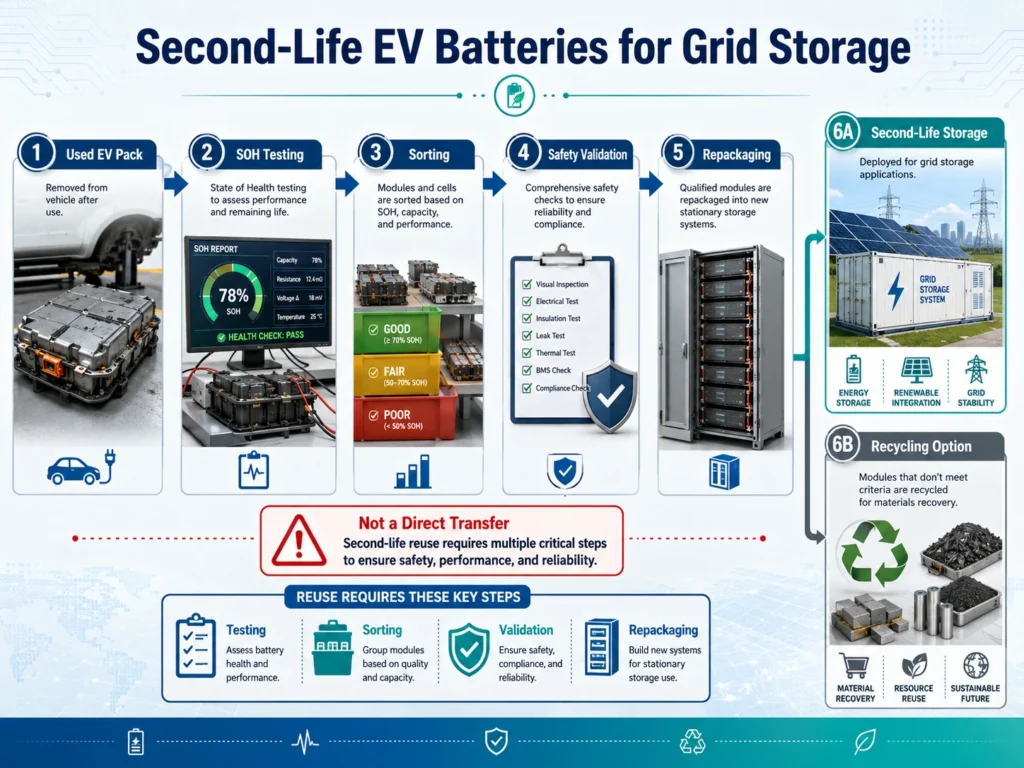
A common question is whether used EV batteries can simply become grid storage batteries. Sometimes they can. An EV battery that has lost too much capacity for vehicle use may still have value in a stationary system. If a pack has 75% or 80% of its original capacity, it may no longer be ideal for a long-range EV, but it can still store energy.
That sounds like an easy solution, but the real world is more complicated. Second-life batteries need testing, sorting, safety validation, and repackaging. Each pack may have a different age, chemistry, usage history, degradation pattern, and state of health. The system designer must know how much capacity remains, how the cells will behave, and whether the modules can be safely integrated into a new stationary product.
There is also an economic challenge. New LFP storage batteries are becoming cheaper and more standardized. A project developer may prefer a new, uniform, warrantied storage system over a second-life system that requires extra testing and engineering. That does not mean second-life batteries have no future. They may work well in some lower-cost, lower-risk, or smaller-scale applications. But they are not automatically better than new grid storage batteries.
In many cases, recycling may be the more practical route. A battery that is too inconsistent or too degraded for second-life use can still provide valuable materials for future cells. For more detail, see our article: Direct Battery Recycling Explained: Can Old EV Batteries Become New Cells?
What This Means for EV Owners
For EV owners, the rise of grid storage is mostly good news. First, it increases battery manufacturing scale. More demand from EVs and storage can support larger factories, better supply chains, and faster learning. Over time, that can help reduce battery costs.
Second, it strengthens the role of LFP. As more storage systems use LFP, suppliers can improve production quality, reduce cost, and expand supply. Those improvements can also help affordable EVs.
Third, it may make the battery market more resilient. If EV sales slow in one region, storage demand may help keep factories busy. If storage demand grows too quickly, it can also compete with EVs for materials and cells. The relationship cuts both ways.
For consumers, the important takeaway is that grid storage growth does not mean EV batteries are becoming less important. It means battery technology is expanding into more parts of the energy system.
The same manufacturing knowledge, thermal management lessons, degradation models, and BMS strategies can move across markets. A better storage battery can teach engineers about long cycle life. A better EV battery can teach engineers about compact packaging and thermal control. The products differ, but the learning overlaps.
Conclusion: Same Chemistry, Different Product
EV batteries and grid storage batteries are part of the same battery revolution, but they are not the same product. An EV battery is designed for mobility. It must balance range, weight, acceleration, fast charging, cold-weather performance, crash safety, and customer warranty expectations.
A grid storage battery is designed for stationary energy economics. It must deliver long cycle life, predictable capacity, safe site operation, low installed cost, high availability, and strong performance guarantees.
This is why the same chemistry can play different roles. LFP can be useful in affordable EVs because it lowers cost and improves durability. The same chemistry can be even more attractive in grid storage because energy density is less important and lifetime cost matters more.
The battery industry is therefore moving beyond the simple question of “Which chemistry is best?” The better question is “Best for what?” A battery cell is only the beginning. The final product depends on how that cell is packaged, cooled, controlled, warranted, installed, monitored, and used.
As AI data centers, renewable energy, and grid reliability needs continue to drive storage growth, more EV battery companies will move into stationary energy storage. But they are not just selling car batteries in a box. They are building a different kind of battery product for a different kind of energy problem. That difference is what makes the next stage of the battery industry so important.
FAQs
Are EV batteries and grid storage batteries the same?
No. They may use similar lithium-ion chemistries, especially LFP, but they are designed for different jobs. EV batteries are optimized for mobility, while grid storage batteries are optimized for stationary energy storage, long cycle life, safety, and project economics.
Why is LFP so popular in grid storage?
LFP is popular in grid storage because it is relatively low cost, durable, thermally stable, and does not rely on nickel or cobalt. Since grid storage batteries do not need to be lightweight like EV batteries, LFP’s lower energy density is less of a disadvantage.
Do grid storage batteries need fast charging?
Not in the same way EVs do. EVs need fast charging for driver convenience. Grid storage batteries usually charge and discharge based on electricity prices, solar output, grid needs, or site operation. The required power rate depends on the project design.
Can used EV batteries be reused for grid storage?
Yes, but it is not automatic. Used EV batteries need testing, sorting, safety validation, and system integration. In some cases, second-life use makes sense. In other cases, new LFP storage batteries or recycling may be more practical.
Why are EV battery companies entering the ESS market?
EV battery companies are entering energy storage because demand is growing quickly from renewable energy, grid reliability needs, AI data centers, and industrial power users. ESS also gives battery manufacturers another large market beyond passenger vehicles.