
Quick Answer
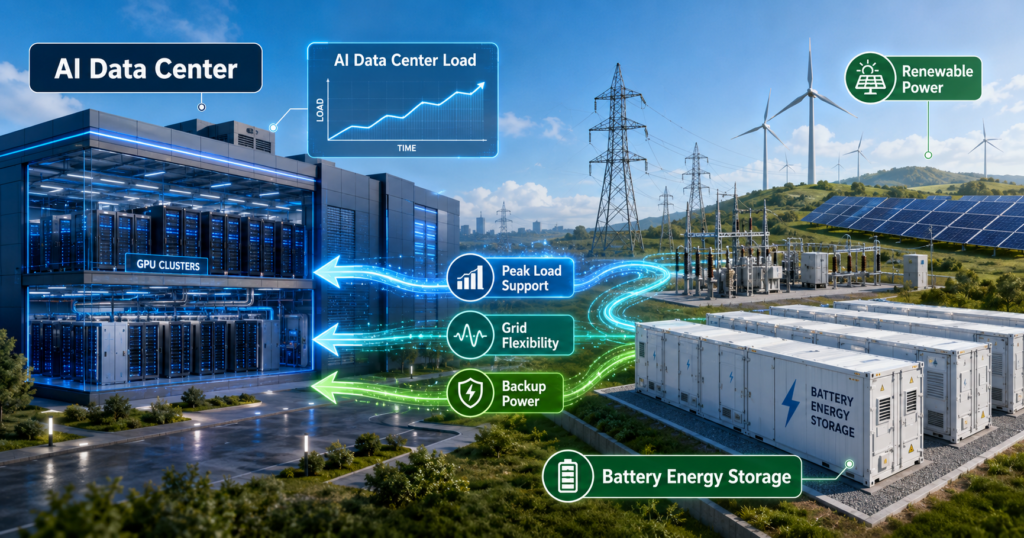
AI data centers are driving the next battery storage boom because they need huge amounts of reliable electricity in a grid that is already under pressure. Large AI facilities can run around the clock, pull power almost continuously, and appear in clusters where local transmission and substation capacity may not be ready.
Battery energy storage systems, or BESS, can help by reducing peak demand, supporting backup power, smoothing grid stress, storing renewable energy, and helping utilities connect large new loads more efficiently.
This article is different from our earlier discussion of why EV battery companies are betting big on grid energy storage. That article looked at the battery industry expanding beyond cars. This one looks at the demand side: AI data centers, cloud companies, utilities, and grid operators trying to solve a fast-growing electricity problem.
Introduction: AI Is No Longer Just a Software Story
Artificial intelligence used to sound like a software topic. People talked about models, chips, training data, cloud platforms, and productivity. But AI is quickly becoming something else too: a power infrastructure story.
Every AI model runs somewhere. Behind the simple chatbot window or image generator is a physical data center filled with servers, GPUs, networking equipment, cooling systems, backup power equipment, transformers, and electrical switchgear. As AI services grow, those facilities need more electricity. Not just a little more, but enough to reshape local and regional grid planning. That is why battery storage is entering the conversation.
Battery energy storage systems are no longer just tools for storing extra solar power. They are becoming grid flexibility assets. They can absorb electricity when supply is abundant, discharge during high-demand hours, provide fast response during grid disturbances, and help large customers manage peak loads.
According to the International Energy Agency’s 2026 report, Key Questions on Energy and AI, electricity consumption from data centers could roughly double from 485 TWh in 2025 to 950 TWh in 2030. The IEA also notes that AI-focused data centers are growing especially quickly as model training and inference workloads expand.
That does not mean batteries will power AI by themselves. They will not. Data centers still need generation, transmission, substations, cooling systems, grid planning, and energy efficiency. But battery storage is becoming one of the most practical tools for making this new electricity demand easier to handle.
How This Topic Is Different From the EV Battery Storage Boom
It is easy to confuse this topic with the broader battery storage boom. The two are related, but they are not the same story. Our earlier article, Why EV Battery Companies Are Betting Big on Grid Energy Storage, focused on the battery industry. It asked why EV battery makers are moving into stationary storage. The answer has a lot to do with LFP chemistry, lower battery costs, manufacturing scale, sodium-ion development, long cycle life, and the need for non-automotive battery markets.
This article starts from a different direction. The main question here is not, “Why do battery companies want to sell more storage?” It is, “Why are AI data centers creating a new need for battery storage?” That shift changes the entire article. Instead of focusing on battery factories, cell chemistry, and EV-to-grid supply chains, this article focuses on data center electricity demand, grid congestion, power reliability, backup power, renewable energy matching, and peak load management.
In simple terms, the earlier article was about supply. This article is about demand. Battery companies may benefit from both trends, but the reason batteries matter is different. In the AI data center story, storage becomes important because the grid needs more flexibility.
AI Data Centers Are Large, Concentrated, and Always On
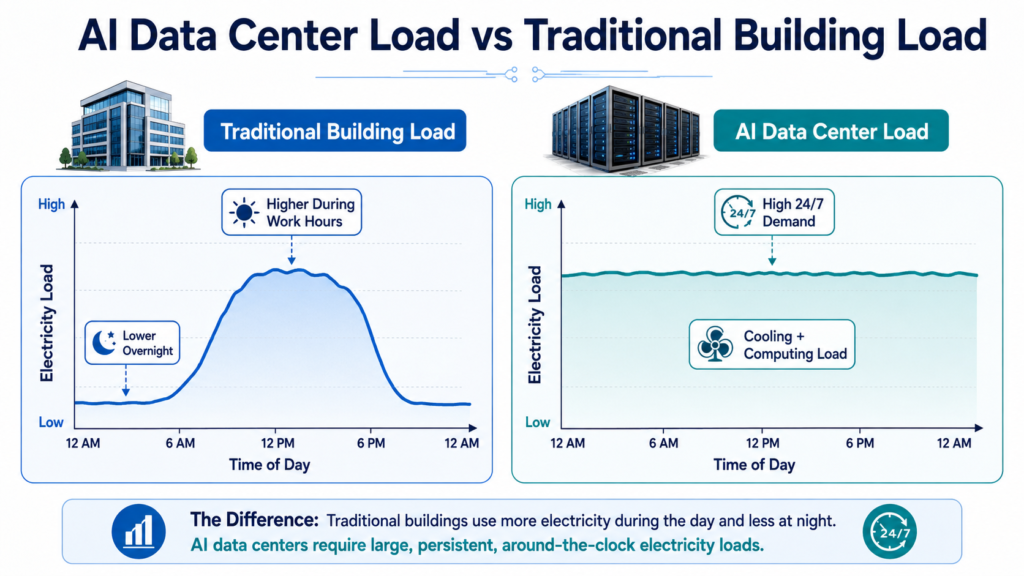
A normal office building has a daily rhythm. Electricity demand rises during working hours and drops at night. A shopping mall has busy hours and quiet hours. Even many factories have shifts, maintenance windows, or production cycles.
AI data centers are different. They are designed to run constantly. Servers may be training large models, handling AI search requests, generating images, processing enterprise workloads, or supporting cloud applications. Cooling systems also need to operate continuously because high-performance chips produce a lot of heat.
The U.S. Energy Information Administration explains that data center server load is relatively flat compared with many other building loads. In its 2026 analysis, Data center server energy use grows across the United States, the EIA estimated that servers alone accounted for about 7% of U.S. commercial sector electricity consumption in 2025. The same analysis projects that server electricity use could grow to 22%–33% of commercial building electricity use by 2050 across its modeled cases.
That load shape matters. A flat load is not automatically bad for the grid. In some ways, steady demand can be easier to plan for than unpredictable demand. The challenge is that AI data centers are both steady and very large.
A single hyperscale data center campus can request hundreds of megawatts of power. In some cases, proposed AI campuses are so large that they look less like commercial buildings and more like industrial power customers. When several facilities cluster in the same region, the impact can become much larger than the individual projects suggest. That is one reason utilities are paying close attention. A data center may be one customer on paper, but electrically it can resemble a new town, a new factory complex, or a large industrial load suddenly appearing on the grid.
The Grid Connection Problem: AI Wants Power Faster Than the Grid Can Build It
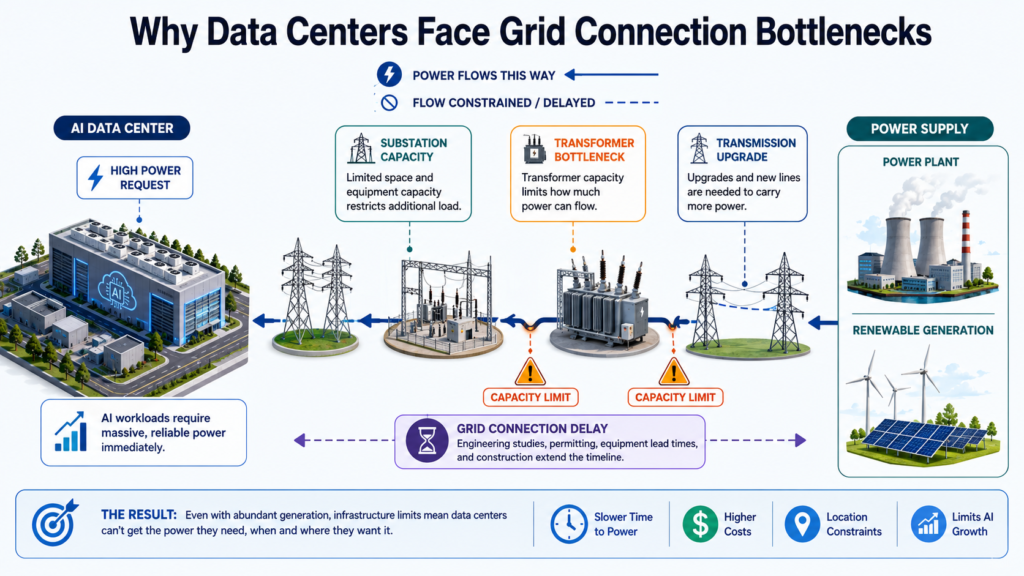
AI companies often want data centers in specific places. They may choose a location because of fiber connections, land availability, tax incentives, skilled labor, proximity to customers, water access, existing cloud infrastructure, or regional latency requirements.
Unfortunately, the best place for computing is not always the best place for electricity. A developer may find the land and secure permits, only to discover that the local grid cannot deliver the requested power quickly. New substations, transformers, transmission lines, and distribution upgrades can take years. Large electrical equipment can also face long lead times.
The U.S. Department of Energy has acknowledged this challenge in its resource page, Clean Energy Resources to Meet Data Center Electricity Demand. DOE frames data center electricity demand as both a challenge and an opportunity for clean energy, demand flexibility, efficiency, and grid modernization.
This is where battery storage becomes useful. A battery does not remove the need for grid infrastructure. It does not create electricity on its own. But it can change when electricity is drawn from the grid. For example, a data center could charge a battery during lower-demand hours and discharge it during local peak periods. That can reduce the highest power draw seen by the grid. In some cases, this may help a site stay within a lower interconnection limit, reduce demand charges, or avoid adding stress during the most difficult hours of the day.
This does not solve every problem. A data center that consumes a huge amount of energy still needs a huge amount of energy. But batteries can make the load easier to manage.
How AI Data Center Battery Storage Reduces Peak Demand
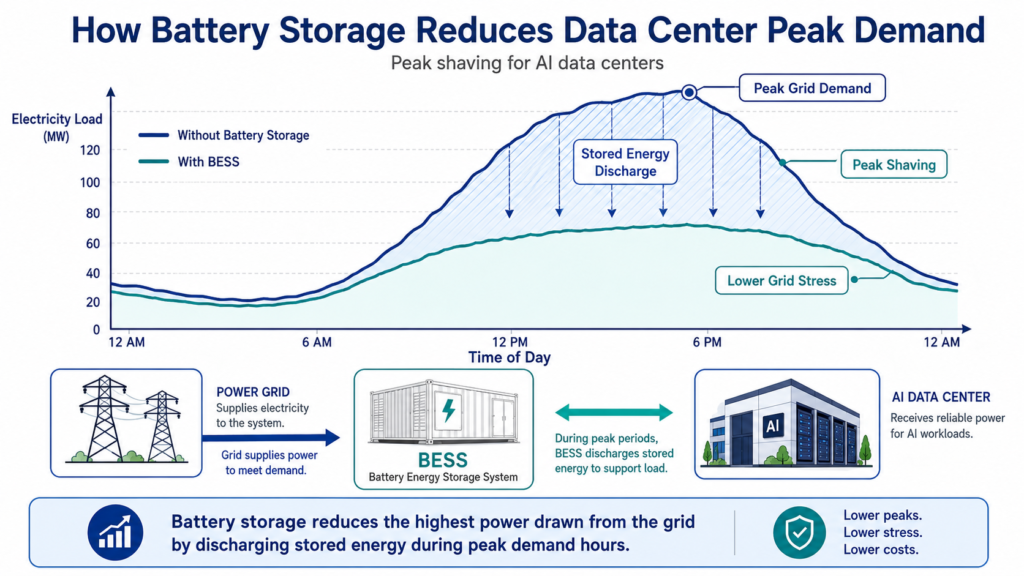
One of the clearest uses for battery storage is peak shaving. A data center may have an average load and a peak load. The utility must prepare for the peak. If a facility normally draws 150 MW but can rise to 220 MW under certain conditions, the local grid may need to be sized for the higher number.
A battery can discharge during those peak periods. From the grid’s point of view, the data center becomes less spiky and more predictable. That matters because grid infrastructure is expensive and slow to build. A new transmission line can take years to plan, permit, and construct. A battery project can often be built faster, especially if it is located behind the meter or near the data center site.
The IEA’s 2026 electricity report highlights battery storage as a major flexibility tool for modern power systems. In its section on power system flexibility, the IEA notes that batteries can help integrate wind and solar, provide balancing services, support security of supply, and reduce or defer some network upgrades.
That last point is especially relevant for AI data centers. Batteries are not only being added because renewable energy is variable. They are also being added because electricity demand is becoming more complex. EVs, heat pumps, factories, and AI data centers are all changing when and where power is needed. Storage gives grid operators another tool to handle those changes.
AI Workloads Can Create Fast Power Changes
At the building level, a data center may look like a steady load. But inside the facility, AI workloads can change quickly. Training jobs may ramp up. Inference traffic may surge. Cooling demand may respond to chip load. Networking equipment may shift power levels as workloads move between servers. These changes can happen over different time scales, from seconds to hours.
A recent research paper, AI Data Centers and Power System Sustainability, describes AI-driven data centers as a growing power system challenge because their loads can be large, concentrated, and difficult to integrate sustainably without better planning and flexibility.
Another 2025 study, Energy Management for Renewable-Colocated Artificial Intelligence Data Centers, explores how AI data centers with colocated renewable generation can use energy management systems to coordinate workloads, renewable output, and electricity market participation. The important idea is that the future data center may not be a passive electricity user. It may become a flexible energy system.
A data center could shift non-urgent workloads to a different time or region. It could adjust cooling operation. It could charge or discharge on-site batteries based on grid conditions. It could respond to electricity prices or carbon intensity. These actions are easier when battery storage is part of the system.
Renewable Energy Matching Is Harder Than It Sounds
Many large technology companies already buy renewable energy. They sign power purchase agreements, support wind and solar projects, and publish clean energy targets. That is important, but it does not fully solve the AI power problem.
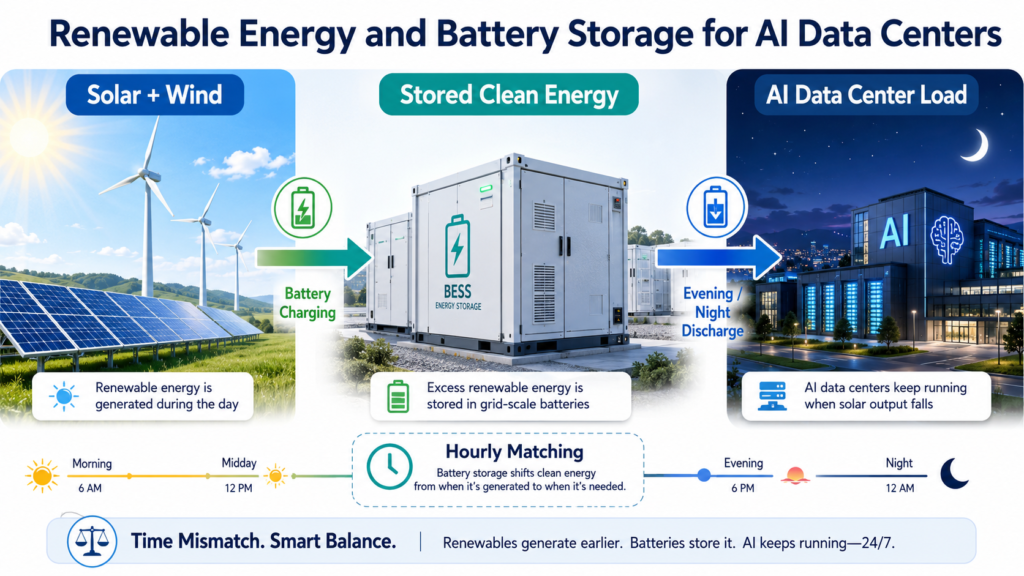
A data center uses electricity every hour. Solar power is strongest during the day. Wind output varies by region and weather. A company may buy enough renewable energy over a year to match annual consumption, but the local grid may still rely on fossil fuel generation during certain hours. That is why hourly matching is becoming more important than annual matching.
Battery storage helps by shifting clean electricity from one time to another. A solar-plus-storage system can charge during the day and discharge in the evening. A wind-plus-storage system can smooth output. A grid-connected battery can charge when clean electricity is abundant and discharge when the grid is under stress.
The International Energy Agency’s 2025 report, Energy and AI, explains that data centers are becoming important actors in the energy system and that electricity demand from AI will increasingly affect power sector planning. The report also discusses how clean energy, grid investment, efficiency, and flexibility will shape the AI-energy relationship.
A four-hour lithium-ion battery cannot solve every clean energy challenge. It cannot carry a data center through a week-long low-wind event. For that, the grid may need long-duration storage, nuclear power, geothermal energy, hydropower, hydrogen, fuel cells, natural gas with carbon management, or other firm power resources. But short-duration batteries are still extremely useful because many grid problems happen over minutes and hours, not weeks.
The U.S. Battery Storage Market Is Already Growing Fast
The timing matters. AI data center growth is accelerating at the same time that grid-scale battery storage is expanding rapidly. The EIA reported in New U.S. electric generating capacity expected to reach a record high in 2026 that developers planned to add 24 GW of utility-scale battery storage in 2026, compared with a record 15 GW added in 2025. The same EIA analysis says more than 40 GW of battery storage was added to the U.S. grid over the previous five years.
AI data centers are not the only reason this is happening. Solar growth, declining battery costs, grid reliability needs, energy market rules, and state policies all matter. But AI adds a new demand driver. Storage developers can now look at a market where utilities need flexibility, renewable projects need balancing, and large power customers need reliability. Data centers sit right at the intersection of those needs. This is one reason the phrase “battery storage boom” keeps showing up in energy discussions. The boom is not only about batteries becoming cheaper. It is also about the grid needing more flexibility than before.
Backup Power Is Also Changing
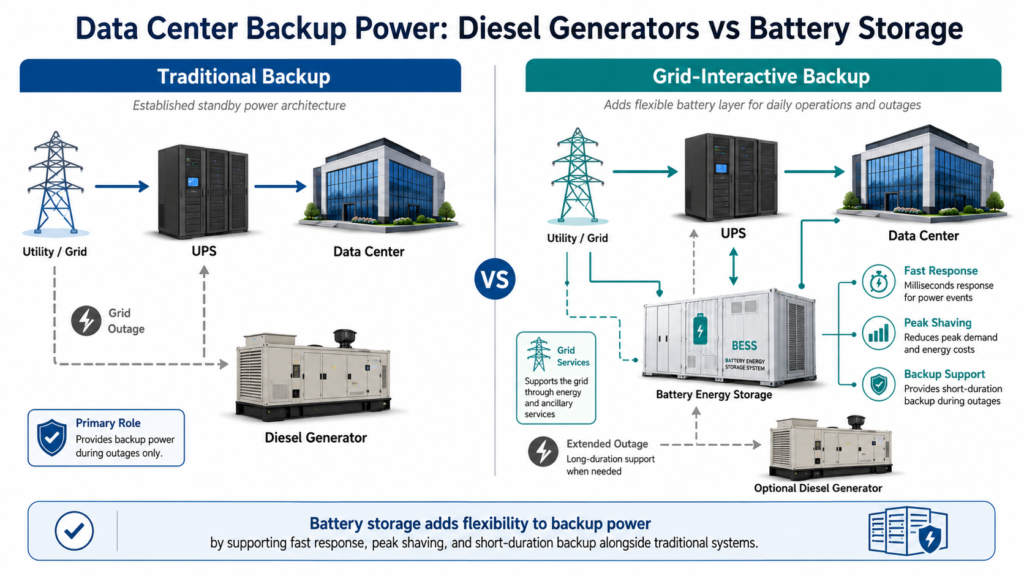
Data centers have always cared about backup power. Downtime is expensive. For cloud services, financial systems, enterprise computing, and AI platforms, even a short interruption can create serious problems. Traditionally, many data centers used diesel generators for long-duration backup and UPS systems for immediate short-term protection. The UPS keeps equipment running when the grid drops. Diesel generators then start and carry the load if the outage continues.
That architecture is not disappearing overnight. Diesel generators are still common because they are proven, energy-dense, and capable of long runtime with stored fuel. But batteries are changing the backup power conversation. Large battery systems can provide instant response. They can ride through short outages, voltage dips, and grid disturbances. They can also support daily operations by reducing peak demand or participating in grid services.
That is a major difference from diesel generators. A generator mostly waits for an outage. A battery can create value even on normal days. This does not mean batteries will replace every generator. For multi-day backup, lithium-ion batteries can become expensive and physically large. But for short-duration backup, power quality, peak shaving, and grid support, they are increasingly attractive.
Why LFP Batteries Fit This Market
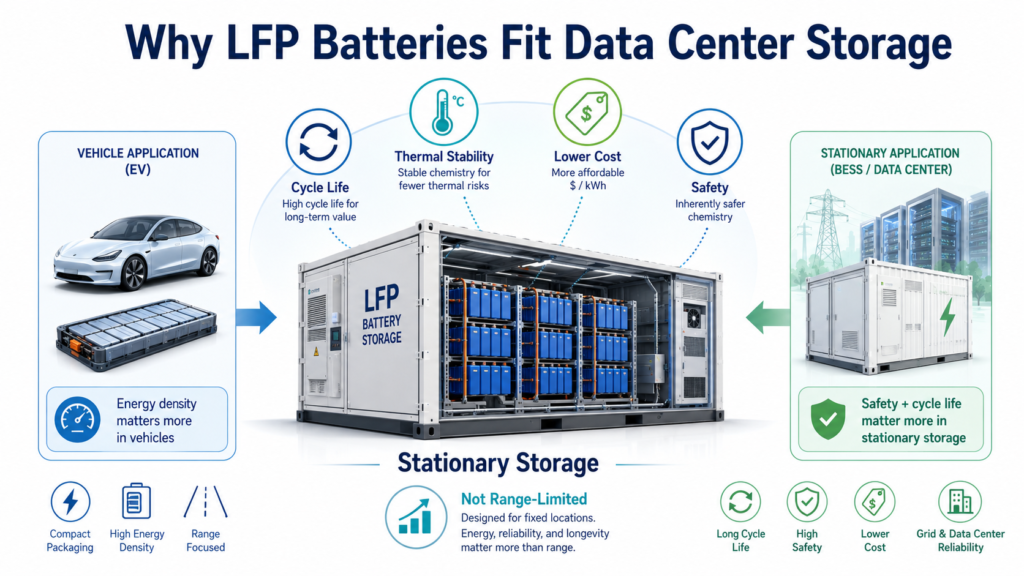
AI data center storage does not need the same battery priorities as a long-range EV. In a vehicle, energy density matters because the battery moves with the car. Weight and volume affect range, efficiency, handling, and cost. That is why high-nickel chemistries such as NMC and NCA became important for many long-range EVs.
Stationary storage is different. A battery container near a data center does not need to be lightweight. It needs to be safe, durable, cost-effective, and easy to manage. That makes LFP, or lithium iron phosphate, a strong fit. LFP batteries generally offer good cycle life, strong thermal stability, and lower dependence on nickel and cobalt. They are already widely used in stationary energy storage. For data center applications, where safety and reliability matter more than maximum energy density, LFP’s practical advantages are important.
This connects with the broader cost trend discussed in Why EV Battery Prices Keep Falling. As LFP manufacturing scale grows and battery costs decline, stationary storage becomes more economically realistic.
Sodium-ion batteries could also become relevant over time. As discussed in Sodium-Ion Batteries in 2026, sodium-ion is unlikely to replace lithium-ion in every application, but it could make sense where cost, safety, cold-weather behavior, and material availability are more important than maximum energy density.
For AI data centers, the best battery chemistry may not be the one with the longest driving range. It may be the one that offers the best mix of safety, cost, cycle life, availability, and reliability.
Data Centers May Become Grid-Interactive Assets
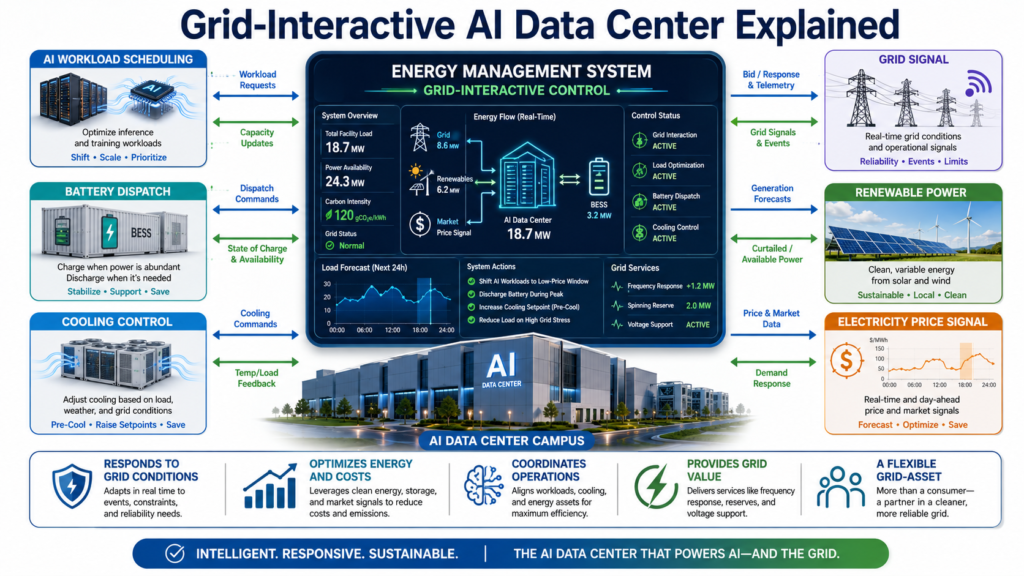
The most interesting future is not simply a data center with a big battery next to it. The more advanced idea is a grid-interactive data center. In this model, the facility responds to grid conditions. If electricity prices spike, some non-urgent workloads could shift. If renewable output is high, the data center could run more flexible computing tasks or charge its batteries. If the local grid is stressed, the site could reduce demand or discharge stored energy.
This is similar in spirit to vehicle-to-grid technology, although the scale and business model are very different. In our article on vehicle-to-grid battery degradation, the key question is whether an EV can support the grid without damaging its battery too quickly. With AI data centers, the question is whether computing, cooling, storage, and grid interaction can be coordinated without compromising uptime. The answer will depend heavily on software.
AI companies already manage workloads across data centers. In the future, that workload management could include electricity prices, carbon intensity, local grid conditions, battery state of charge, and cooling constraints. If this happens, battery storage will become more valuable because it will not operate alone. It will be part of a larger energy management system.
The Battery Storage Boom Will Not Look the Same Everywhere
Not every AI data center will use the same storage strategy. Some facilities may install behind-the-meter lithium-ion batteries for peak shaving and short backup support. Others may sign contracts with nearby utility-scale battery projects. Some may pair solar, wind, and storage. Others may look at fuel cells, geothermal power, nuclear power, or long-duration storage.
The local grid matters. A data center in a region with strong transmission capacity may use batteries mainly for economics and resilience. A facility in a constrained region may need storage to help manage interconnection limits. In areas with high solar penetration, batteries may be especially valuable for shifting midday solar into evening demand. In regions with high demand charges, peak shaving may drive the business case. This means the AI data center battery storage boom will be uneven. It will likely be strongest where three things overlap: fast data center growth, grid congestion, and favorable storage economics.
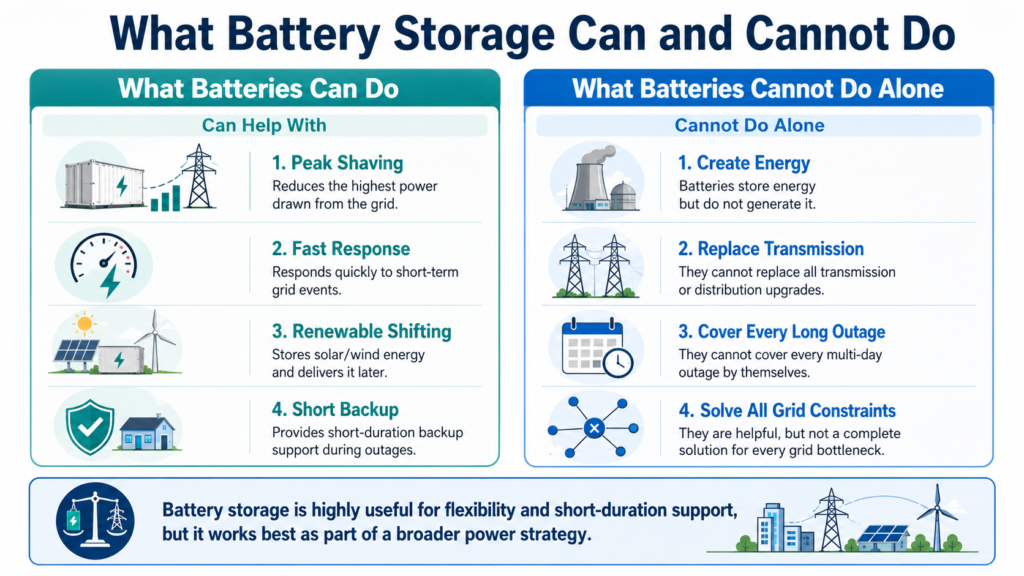
Batteries Are Not a Magic Solution
Battery storage is useful, but it has limits. A battery does not create electricity. If a region does not have enough generation, storage only shifts electricity from one time to another. It improves flexibility, but it does not eliminate the need for new power plants, clean energy resources, transmission lines, and substations.
Battery duration is another limit. Most lithium-ion grid batteries are designed for short-duration applications, often around two to four hours. That is helpful for peak shaving, solar shifting, frequency response, and short outages. It is not enough for every long-duration reliability challenge.
There are also safety and permitting issues. Large battery systems require thermal management, fire protection, spacing, monitoring, emergency response planning, and compliance with local codes. Data centers are already critical facilities, so storage integration must be carefully engineered.
Cost also matters. A data center operator will not install a battery simply because it sounds sustainable. The system needs a business case. That business case may come from lower demand charges, avoided grid upgrade costs, higher reliability, clean energy targets, or participation in energy markets. The best way to think about batteries is as one important tool in a larger power strategy.
What This Means for the EV Battery Industry
Even though this article focuses on AI data centers, the trend still matters for the EV battery world. First, AI-related storage demand could create another large market for lithium-ion cells, especially LFP cells. Second, it may support interest in sodium-ion batteries and other lower-cost stationary chemistries. Third, it will make battery safety, diagnostics, thermal management, and state-of-health monitoring even more important.
The data center market may value batteries differently from the EV market. EV buyers care about range, charging speed, vehicle price, warranty, and driving experience. Data center operators care about uptime, fire safety, response time, service contracts, degradation management, and total cost of energy. That could create a growing market for battery systems designed specifically for stationary reliability rather than vehicle performance.
Over time, the EV and data center storage markets may influence each other. EV manufacturing scale helps reduce battery costs. Stationary storage creates another outlet for cells. Better BMS software, thermal models, and degradation prediction tools can move between both industries. But the use cases are not identical. That distinction matters.
Conclusion: AI Is Turning Battery Storage Into Digital Infrastructure
AI data centers are changing the electricity conversation. They are large, concentrated, always-on loads that need reliable power in a grid already dealing with renewable energy growth, EV charging, heat pumps, industrial electrification, aging infrastructure, and transmission constraints.
Battery storage is becoming one of the most practical tools for managing that challenge. It can reduce peak demand, smooth grid stress, support renewable energy, improve resilience, and help data centers interact with the grid more flexibly.
Batteries will not power AI by themselves. The AI energy buildout will still require generation, transmission, substations, cooling improvements, efficiency gains, and smarter workload management. But batteries are likely to become a central part of the solution because they can respond quickly and serve multiple roles at once. That is why AI data centers may drive the next battery storage boom.
The earlier storage boom was about battery companies expanding beyond EVs. This next one is about power-hungry digital infrastructure forcing the grid to become more flexible. In the AI era, battery storage is no longer just part of the clean energy transition. It is becoming part of the physical infrastructure behind the digital economy.
Frequently Asked Questions
Why do AI data centers need battery storage?
AI data centers need battery storage because they use large amounts of electricity, require high reliability, and can strain local grids. Batteries can reduce peak demand, provide short-duration backup power, smooth power fluctuations, and help match electricity use with renewable energy.
Are batteries replacing diesel generators at data centers?
Not completely. Diesel generators are still widely used for long-duration backup. However, batteries can reduce generator runtime, provide instant response, and support daily grid services. In many cases, batteries will complement generators rather than fully replace them.
What battery chemistry is best for AI data center storage?
LFP is one of the strongest candidates because it offers good safety, long cycle life, and competitive cost. Sodium-ion may also become relevant for stationary storage if production scale improves. High-energy EV chemistries are not always necessary because stationary batteries do not need to be lightweight.
Can AI data centers run only on renewable energy and batteries?
Some data centers can use renewable energy and batteries to reduce emissions, but running 24/7 only on renewables and short-duration batteries is difficult. Long-duration storage, firm clean power, grid upgrades, and workload flexibility may also be needed.
How is this different from EV battery storage?
EV battery storage usually refers to batteries used in vehicles or stationary systems built from EV battery technology. AI data center storage focuses on solving electricity demand, grid connection, backup power, and peak load problems created by large computing facilities.