
Quick Answer
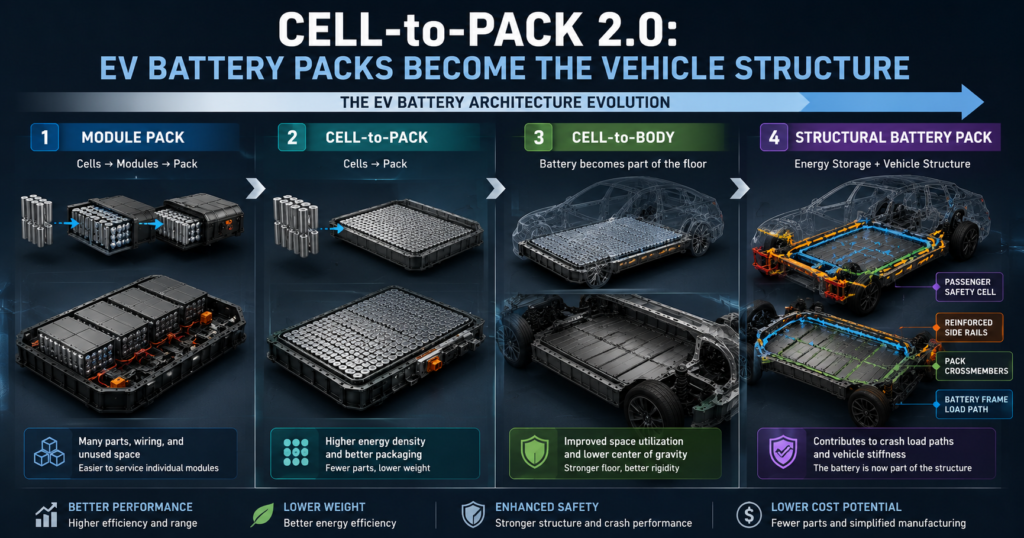
Cell-to-pack battery design is entering a new stage. Instead of simply removing modules, the next generation of EV battery packs is becoming part of the vehicle’s structure, crash load path, thermal system, and serviceability strategy. The first generation of cell-to-pack batteries focused on removing traditional modules so more of the pack volume could be filled with battery cells. The next stage goes further. The battery pack is no longer just an energy storage box mounted under the floor. It is becoming part of the vehicle’s structure, crash load path, thermal system, manufacturing strategy, and long-term serviceability plan.
This shift includes designs often described as Cell-to-Pack, Cell-to-Body, Cell-to-Chassis, skateboard chassis, or structural battery packs. These terms are not always used consistently, but they point in the same direction: EV makers want fewer duplicated parts, better packaging efficiency, lower weight, higher stiffness, and simpler vehicle assembly.
The tradeoff is that battery design becomes much more tightly connected to the rest of the vehicle. A modern EV battery pack is no longer only about range. It increasingly determines how the car is built, how it handles a crash, how it manages heat, and how difficult it may be to repair later.
Introduction
For years, EV battery packs were built like large electrical containers. Battery cells were grouped into modules. Those modules were placed inside a pack enclosure. The pack was then bolted into the vehicle. This approach made sense when automakers were still learning how to build safe, durable, high-voltage battery systems at scale. But it also had a problem. Every layer added weight, cost, parts, and unused space.
A traditional battery pack may include cell housings, module frames, module covers, pack crossmembers, cooling plates, fasteners, wiring, busbars, sealing systems, and the vehicle floor structure above it. Some of that structure is necessary. Some of it is duplicated. In an EV, duplicated structure is expensive because it competes directly with battery capacity, range, cabin space, crash protection, and manufacturing cost.
That is why the industry moved toward Cell-to-Pack, often shortened to CTP. Instead of building cells into modules first, CTP places cells more directly into the pack structure. We previously covered the basic differences in Cell-to-Pack vs Structural Battery Pack: 7 Key Differences You Should Know. This article goes one level deeper. The next phase is not just about deleting modules. It is about redesigning the entire EV around the battery pack. That is why cell-to-pack battery design has become one of the most important trends in modern EV engineering.
Why Cell-to-Pack Battery Design Matters
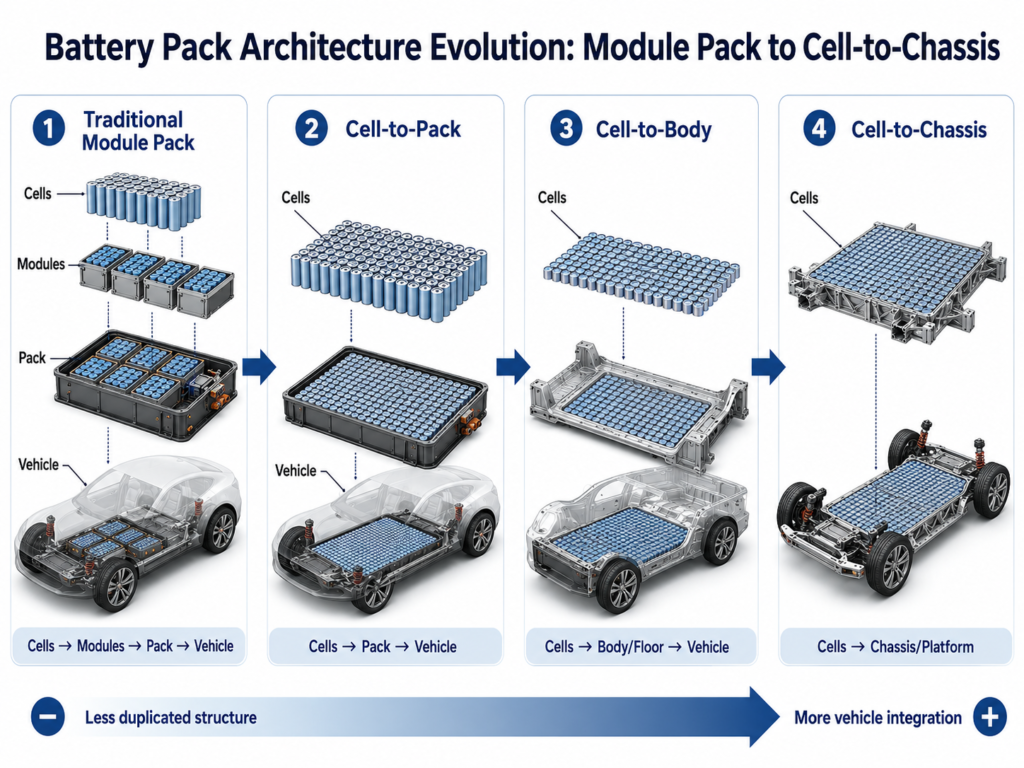
The simplest way to understand the old architecture is this: Cells → Modules → Pack → Vehicle.
Each module acted like a smaller battery box. It organized cells, provided mechanical support, simplified manufacturing, and made pack assembly more manageable. Modules also gave engineers a convenient way to isolate groups of cells and, in some designs, replace sections of the pack during service.
The downside is that modules take up space. A module has walls, covers, busbars, sensors, fastening points, and sometimes separate thermal interfaces. When many modules are placed inside one pack, those repeated parts reduce the percentage of the battery pack that actually stores energy.
Cell-to-Pack changes the hierarchy: Cells → Pack → Vehicle. That sounds like a small change, but it affects almost everything. Fewer module frames can mean better space utilization, lower mass, fewer assembly steps, and potentially lower cost. This is one reason large prismatic cells and long blade-style cells have become so important in modern EV design.
BYD’s Blade Battery is one of the clearest examples of this trend. BYD describes the Blade Battery as a technology designed around safety, space utilization, and structural integration, and its SEAL sedan uses what BYD calls CTB, or Cell-to-Body technology. In that layout, the battery is not treated as a completely separate box. It becomes more closely tied to the vehicle floor and body structure.
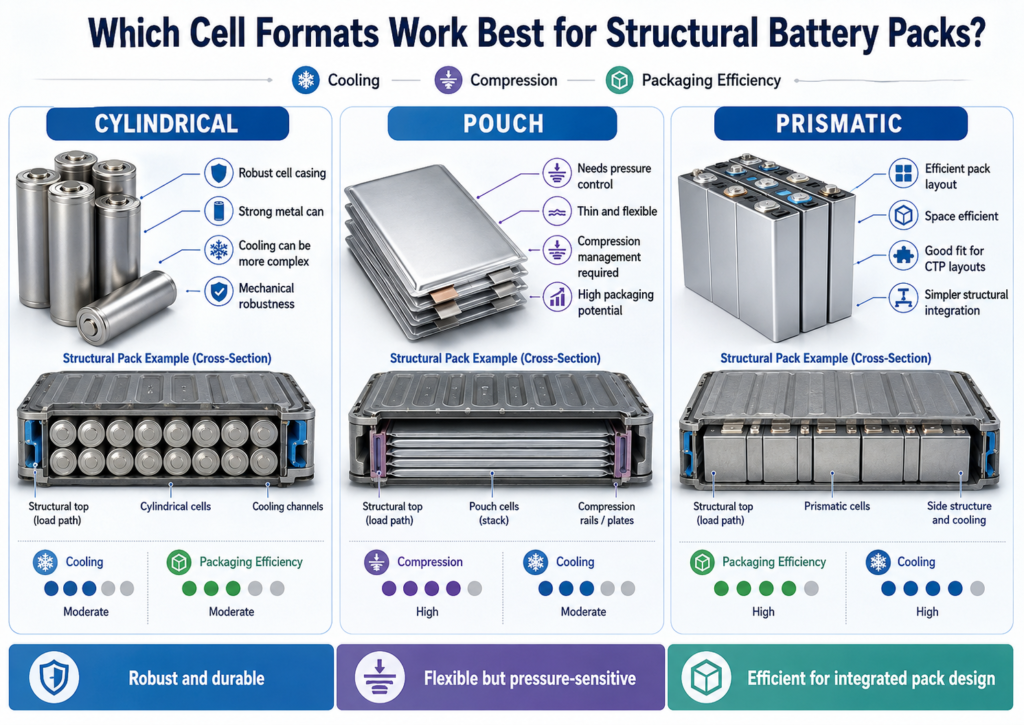
Cell format also matters here. Cylindrical, pouch, and prismatic cells do not package the same way, cool the same way, or handle mechanical loads the same way. That is why pack architecture and cell format are now closely connected. For a deeper look at this side of the topic, see our guide to Cylindrical vs Pouch vs Prismatic EV Batteries.
The important point is that CTP is not simply “modules removed.” Once the module disappears, the pack has to perform jobs that modules used to help with. It must hold cells securely, manage compression, route coolant, protect against vibration, maintain electrical isolation, survive crash loads, and remain manufacturable at high volume. That is where Cell-to-Pack 2.0 begins.
What Makes Cell-to-Pack 2.0 Different?
The first generation of Cell-to-Pack was mostly about packaging efficiency. The question was simple: how can we fit more active cell material into the same physical space? Cell-to-Pack 2.0 asks a bigger question: how can the battery pack become part of the vehicle platform itself?
This is why terms such as Cell-to-Body, Cell-to-Chassis, and structural battery pack keep appearing. The names vary by company, but the engineering direction is similar. Automakers and battery suppliers are trying to remove unnecessary layers between the cell and the vehicle.
CATL uses the term Cell-to-Chassis, or CTC. On its official technology page, CATL describes CTC technology as integrating the battery cell with the vehicle body, chassis, electric drive, thermal management, and high- and low-voltage control modules. That is much broader than a conventional battery pack. It sounds less like a component and more like an EV platform.
In late 2024, CATL also announced its Bedrock Chassis, an integrated skateboard-style chassis built around battery-centered structural integration. CATL said the design uses Cell-to-Chassis integration and is intended to improve crash protection, platform efficiency, and development speed.
Manufacturer claims should always be read carefully until more independent vehicle-level data becomes available. Still, the direction is clear. Battery companies are no longer only supplying cells. They are moving deeper into chassis, safety, thermal, and platform engineering. That is the real meaning of Cell-to-Pack 2.0. The battery is becoming the center of vehicle architecture.
The Battery Pack as a Structural Member
In a conventional EV, the battery pack is mounted into the body, but the body still carries much of the structural responsibility. In a structural battery design, the pack contributes more directly to vehicle stiffness and load transfer. This can improve packaging.
If the upper pack cover can also act as part of the cabin floor, the vehicle may not need as much separate structure above the battery. If the pack side rails contribute to body stiffness, engineers may reduce duplicated metal elsewhere. If cells, cooling plates, adhesives, and the enclosure are designed together, the pack can become a sandwich-like structural element.
The benefit is not only weight reduction. A stiffer floor can improve ride quality, handling, noise behavior, and crash load distribution. It can also help control how the battery and body deform together during an impact. But there is a major engineering challenge: battery cells are not just structural blocks.
They are electrochemical devices. They age. They generate heat. They expand slightly during operation and over life. They respond to pressure. They must be protected from deformation, moisture, corrosion, vibration, and electrical faults. A structural battery pack cannot simply be stiff. It must be stiff in the right places, compliant in the right places, and safe under real-world abuse conditions. This is why pack design is becoming one of the most important technical battlegrounds in EV engineering.
Crash Load Paths: The Battery Is Now in the Safety Conversation
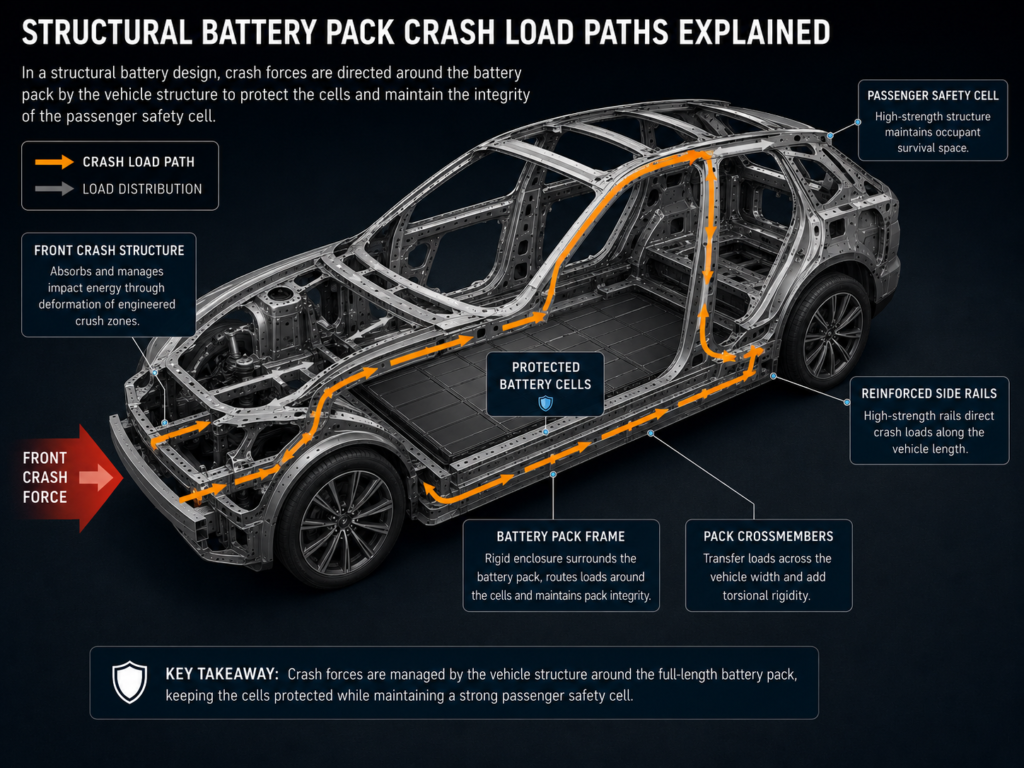
Crash safety used to be discussed mostly in terms of crumple zones, airbags, seatbelts, and passenger compartments. In an EV, the battery pack adds another layer. It is large, heavy, high-voltage, and usually located under the cabin floor. When the pack becomes more integrated with the vehicle body, crash load paths matter even more.
Engineers must decide how impact energy travels around the battery, through the pack frame, into crossmembers, and away from the passenger cell. A good structural pack should help the vehicle manage loads. A poor design could transmit damaging forces into cells or high-voltage components.
This does not mean structural packs are unsafe. In fact, integration can improve safety when designed correctly. A wide, stiff battery enclosure can help protect the cabin floor and resist intrusion. Strong side rails can shield cells from side impacts. Internal pack barriers can limit damage propagation.
But the design has to be intentional. The battery cannot be treated like a passive slab. In a serious crash, the EV has to disconnect high voltage, protect electrical isolation, prevent coolant leakage from becoming a secondary problem, and reduce the risk of thermal runaway. The U.S. Department of Energy’s Alternative Fuels Data Center gives a basic overview of how all-electric vehicles use traction battery packs, but in modern EVs, that pack is also tied deeply into the safety architecture.
We covered this in more detail in EV Battery Crash Safety: What Really Happens After a Crash. The key point is that battery engineers and body engineers can no longer work in separate worlds. The battery pack is not only an electrical system. It is part of the crash structure.
Thermal Architecture Becomes More Integrated
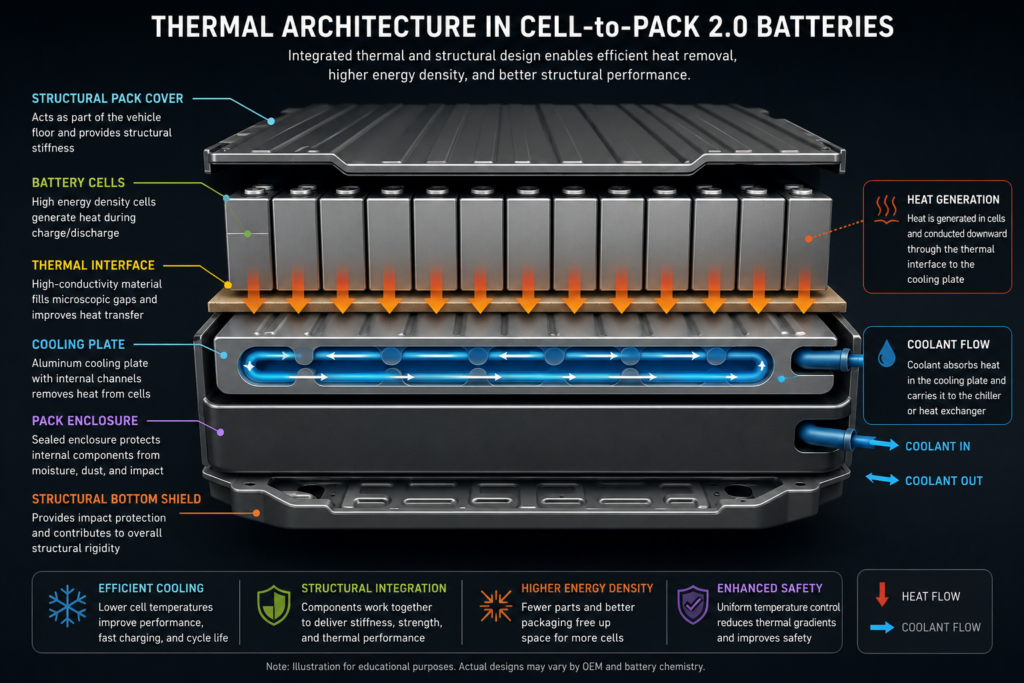
Thermal management also changes when the pack becomes structural. In a module-based pack, engineers can place cooling plates under modules, between modules, or along module sides. The design may be less space-efficient, but the thermal system is somewhat modular.
In Cell-to-Pack and structural designs, coolant routing must be integrated more carefully into the pack floor, cell support surfaces, adhesives, compression pads, and enclosure. The cooling system is no longer just attached to the battery. It may be built into the same structure that carries mechanical loads.
This creates opportunities. A well-designed structural pack can use large-area cooling contact, reduce thermal resistance, and create a more compact thermal path from cells to coolant. It may also help distribute heat more evenly across the pack, which is important for fast charging, battery life, and consistent performance.
But it creates new constraints too. Cooling plates may now have mechanical jobs. Adhesives may need to transfer heat and carry load. Foam or potting materials may improve support but complicate heat transfer and repair. The pack enclosure may need to seal against water, resist corrosion, carry crash loads, and maintain coolant integrity at the same time. This is why “thermal management” is no longer just about keeping cells cool. It is becoming part of the mechanical architecture of the vehicle.
A pack that performs well during fast charging but cannot handle swelling, vibration, crash deformation, or service access is not a good pack. These issues connect directly with pressure management, especially for pouch and prismatic cells. As discussed in EV Battery Pressure Management: Why Compression Matters, moving toward CTP and structural packs raises the stakes because the pack structure itself must manage cell support, swelling, pressure distribution, and long-term mechanical stability.
Why Cell Format Matters More Than Ever
The shift toward structural packs affects which cell formats are attractive. Prismatic cells often work well in Cell-to-Pack layouts because their rectangular shape packs efficiently. Long blade-style cells can span across the pack and support high volume utilization. Pouch cells offer packaging flexibility but require careful compression and swelling management. Cylindrical cells are mechanically robust and manufacturing-friendly, but they create different cooling and packing challenges.
There is no universal winner. A structural pack using cylindrical cells may rely on adhesive and top/bottom sheets to create a stiff sandwich structure. A blade-cell pack may use long prismatic LFP cells as both energy storage and packaging elements. A pouch-cell design may achieve excellent energy density but demand more careful pressure control. This is why pack architecture and chemistry are becoming inseparable. LFP, NMC, LMFP, sodium-ion, silicon-anode, and future solid-state cells will not succeed on chemistry alone. They must fit into a vehicle architecture that makes sense for cost, crash safety, cooling, service, and manufacturing.
For example, LFP cells are often attractive for affordable EVs because they offer good cycle life, lower material cost, and strong thermal stability compared with many nickel-rich chemistries. But LFP’s lower cell-level energy density means pack-level efficiency becomes even more important. A well-designed CTP layout can help compensate by reducing inactive structure. That is why BYD’s Blade Battery and other LFP-based CTP approaches matter. They are not only chemistry stories. They are pack architecture stories.
Serviceability: The Hidden Tradeoff
For EV owners, the biggest concern may not be whether the pack uses CTP, CTB, CTC, or a structural battery layout. The practical question is simpler: What happens if something goes wrong?
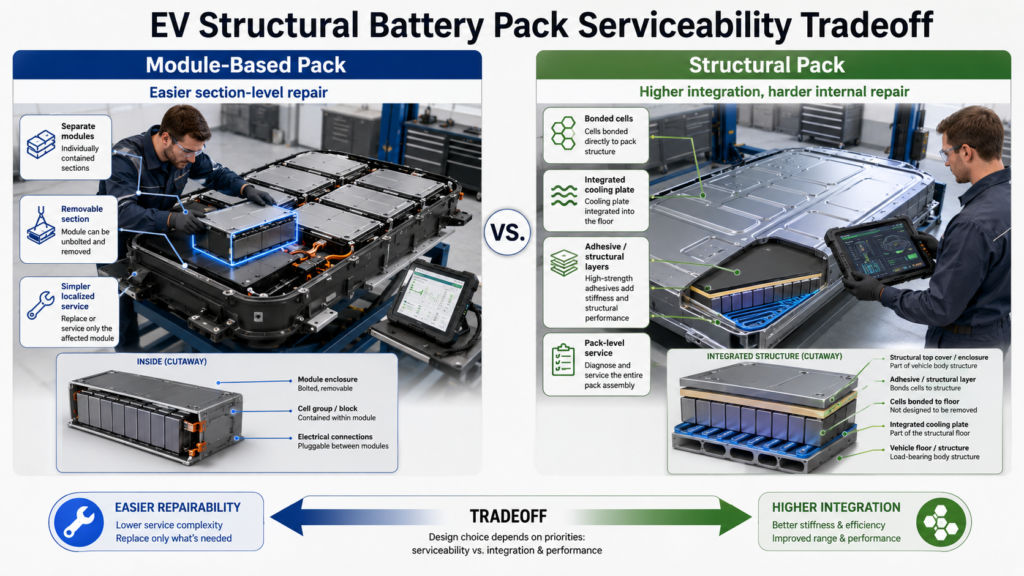
A traditional module-based battery pack can be easier to diagnose and repair at the section level, at least in theory. If one module has an issue, a service center may be able to replace that module instead of replacing the entire pack. This depends heavily on automaker policy, parts availability, safety procedures, and labor cost, but the architecture at least allows the possibility.
Highly integrated packs are different. If cells are bonded directly into the pack with structural adhesive, foam, or potting materials, internal repair becomes harder. If the pack is part of the vehicle’s load-bearing structure, removing it may be more complex. If the top of the battery is effectively part of the floor, sealing and reassembly become more critical.
Tesla’s public service documentation is useful here because it openly lists procedures for vehicles with structural packs. The Model Y Service Manual includes multiple references to high-voltage battery components for structural-pack configurations, including contactors, busbars, harnesses, coolant components, and high-voltage battery removal procedures. That does not mean structural packs are impossible to service. It means service becomes more specialized.
This is a key ownership question. A structural pack may reduce parts, improve stiffness, and lower manufacturing cost when built at scale. But when repair is needed, the work may shift from simple module replacement toward pack-level service, specialized component replacement, or full pack replacement.
That is why serviceability must be considered part of pack design, not an afterthought. Our article EV Battery Repair: Can a Dead Battery Be Restored? covers this tradeoff directly. Adhesives, welded connections, CTP layouts, and structural packs can improve energy density and manufacturing efficiency while making internal service more difficult.
Manufacturing: Why Automakers Like Integration
From an automaker’s perspective, integration is attractive because it can reduce parts and assembly steps. A conventional pack requires many subassemblies. Cells become modules. Modules become packs. Packs are tested, sealed, shipped, and installed into vehicles. Each step adds equipment, labor, quality checks, logistics, and potential defects.
A more integrated architecture can simplify this chain. If fewer modules are used, there are fewer housings, fasteners, connectors, and intermediate handling steps. If the pack becomes part of the vehicle floor, the body shop and battery assembly process can be designed around that integration.
This is one reason battery suppliers are talking more about platform-level solutions. CATL’s Bedrock Chassis is not just a battery announcement. It is a sign that battery manufacturers see value in helping automakers shorten development time and build EV platforms around integrated battery structures.
However, integration also raises the consequences of manufacturing variation. In a module-based design, a defective module may be removed before final pack assembly. In a deeply integrated design, a defect discovered late in the process may be more expensive. Cell grading, dimensional control, adhesive application, sealing, coolant leak testing, and end-of-line inspection become even more important.
This connects directly to battery manufacturing quality. Before cells ever reach pack assembly, they must go through electrode manufacturing, cell assembly, electrolyte filling, formation, aging, grading, and testing. A modern gigafactory is not just making cells quickly. It is trying to make millions of cells consistent enough to be integrated into increasingly unforgiving pack architectures.
For more background on that manufacturing chain, see EV Battery Gigafactory: 12 Key Cell Manufacturing Steps Explained. Cell-to-Pack 2.0 depends on more than clever packaging. It depends on manufacturing precision.
Cell-to-Body vs Cell-to-Chassis vs Structural Battery Pack
These terms can be confusing because different companies use them differently. Still, there is a useful way to think about the progression. A module-based pack keeps the old hierarchy: cells are assembled into modules, modules are assembled into a pack, and the pack is installed into the vehicle. Cell-to-Pack removes the module layer. Cells are integrated directly into the pack.
Cell-to-Body goes further. The pack is more closely tied to the vehicle body or floor structure. BYD’s SEAL is a production example where BYD describes the vehicle as using Cell-to-Body technology, integrating the Blade Battery more directly into the body architecture.
Cell-to-Chassis is usually used for deeper platform integration. CATL describes CTC as integrating the battery cell with the vehicle body, chassis, electric drive, thermal management, and control modules. In this view, the battery is not just installed into the chassis. It helps define the chassis.
A structural battery pack is a broader phrase. It usually means the battery pack contributes meaningfully to vehicle structure rather than simply being a removable energy box. The industry does not always use these terms perfectly. Marketing language can blur the boundaries. But the engineering trend is real: the battery is moving from component to structure.
Is Cell-to-Chassis the Final Destination?
Cell-to-Chassis sounds like the logical endpoint: put the cells directly into the chassis and remove as much duplicated structure as possible. But the real future will probably be more mixed. Some affordable EVs may use highly integrated LFP or sodium-ion CTP packs to reduce cost. Performance EVs may choose architectures that prioritize stiffness, cooling, and fast-charging performance. Trucks and SUVs may need stronger pack enclosures for towing, off-road loads, and underbody impacts. Luxury EVs may accept more complex structures if they improve cabin space, ride quality, or noise performance.
Repairability and insurance cost may also push some automakers to keep partial modularity. A pack that is extremely efficient to build but expensive to repair after minor underbody damage may create problems for customers, insurers, and used-EV buyers. This is especially important in the used EV market, where buyers may not always know whether a vehicle has experienced underbody damage, water intrusion, or improper lift-point use.
So Cell-to-Pack 2.0 does not mean every EV will converge on one design. It means the battery pack is becoming a platform-level decision.
What This Means for EV Owners
For everyday drivers, this technology will mostly show up indirectly. A better integrated pack may allow more range without making the vehicle physically larger. It may lower the floor, increase cabin space, improve handling, reduce weight, or lower manufacturing cost. It may also help automakers build EVs faster and with fewer parts.
But buyers should understand the tradeoff. A highly integrated pack can be excellent when new, but long-term service strategy matters. Used EV buyers should pay attention to battery warranty terms, repair options, diagnostic reports, underbody damage history, and insurance experience.
The pack is not just a battery anymore. It is part of the vehicle’s body. This is especially important as EVs age. Structural battery packs may last a long time, but when damage occurs, the repair decision may involve battery health, body structure, sealing integrity, electrical safety, and crashworthiness all at once. In other words, battery pack architecture is becoming an ownership issue, not just an engineering topic.
Conclusion
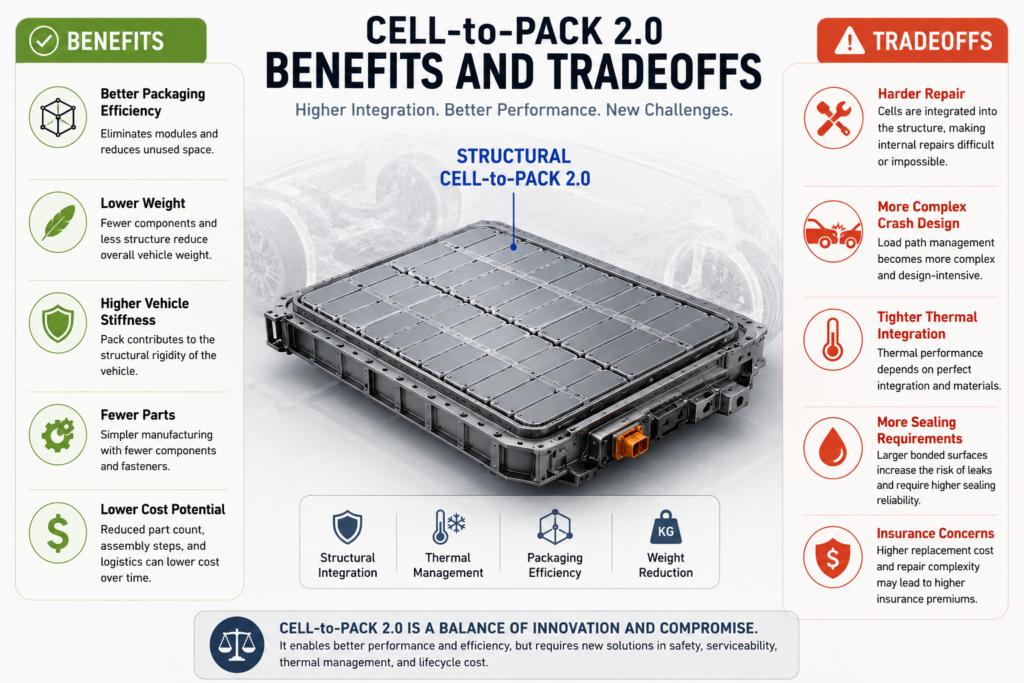
Cell-to-Pack 2.0 is one of the most important EV design trends because it changes what a battery pack is. The original goal of Cell-to-Pack was to remove unnecessary module structure and fit more energy into the same space. The next stage is broader. The pack is becoming part of the vehicle floor, stiffness strategy, crash load path, cooling system, manufacturing process, and service model.
That is why terms like Cell-to-Pack, Cell-to-Body, Cell-to-Chassis, skateboard chassis, and structural battery pack keep appearing. They are not just marketing labels. They describe a real engineering shift from battery-as-component to battery-as-architecture. The benefits are clear: better packaging, lower weight, fewer parts, improved stiffness, and lower cost potential.
The tradeoffs are just as real: more complex crash design, tighter thermal integration, harder service access, greater sealing demands, and higher dependence on manufacturing quality. For EV owners, the result may be better vehicles. For engineers, it makes the battery pack one of the most demanding systems in the entire car.
FAQs
What is Cell-to-Pack 2.0?
Cell-to-Pack 2.0 is an informal way to describe the next stage of EV battery pack integration. Instead of only removing modules, automakers are designing packs that influence vehicle stiffness, crash protection, thermal management, manufacturing, and serviceability.
Is Cell-to-Pack the same as a structural battery pack?
No. Cell-to-Pack usually means cells are integrated directly into the battery pack without traditional modules. A structural battery pack goes further by making the pack part of the vehicle’s load-bearing structure.
What is Cell-to-Body?
Cell-to-Body usually refers to a design where the battery pack is integrated more directly into the vehicle body. BYD uses this term for the SEAL, where the Blade Battery is integrated into the body structure to improve packaging and rigidity.
What is Cell-to-Chassis?
Cell-to-Chassis is a deeper integration concept where the battery cells and pack are integrated with the chassis and other vehicle systems. CATL describes CTC as combining the battery cell with the vehicle body, chassis, electric drive, thermal management, and control modules.
Are structural battery packs harder to repair?
Often, yes. Highly integrated packs may use adhesives, foam, welded parts, or sealed structural components that make internal repair more difficult. However, the actual repairability depends on the specific vehicle design and manufacturer service strategy.
Do structural battery packs make EVs safer?
They can, if designed correctly. A structural pack can improve stiffness and help manage crash loads, but it must also protect cells from deformation, maintain electrical isolation, and control thermal risks. Safety depends on the full vehicle design, not the label alone.
Will all EVs use Cell-to-Chassis designs?
Probably not. Different vehicles have different priorities. Affordable EVs, performance cars, trucks, and luxury vehicles may use different levels of battery integration depending on cost, range, crash targets, serviceability, and manufacturing strategy.