
Quick Answer
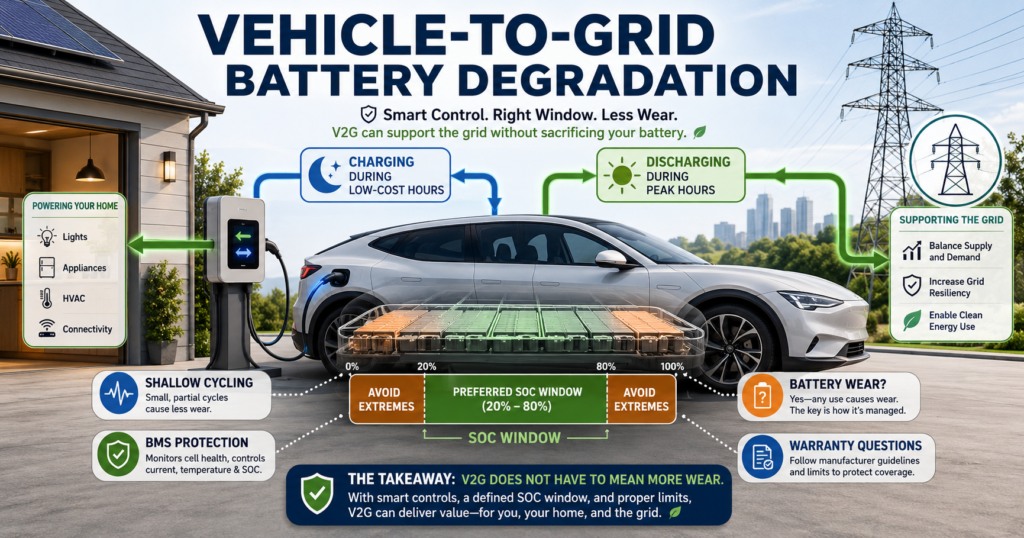
Vehicle-to-grid battery degradation is real, but it does not mean V2G automatically ruins an EV battery. V2G does not automatically ruin an EV battery. But it can add battery wear if the system repeatedly charges and discharges the pack too deeply, too often, at high power, or near stressful state-of-charge levels.
The real question is not simply, “Does V2G use the battery?” Of course it does. The better question is, “How is the battery being used?”
A carefully managed V2G system that uses shallow cycles, avoids very high and very low state of charge, respects temperature limits, and follows the vehicle’s battery management system can have a relatively small impact on long-term battery health. In some situations, smart bidirectional charging may even help manage battery aging better than leaving the battery sitting at a high state of charge for long periods.
The risk increases when V2G is treated like an unlimited home battery. Deep daily discharges, poor thermal conditions, aggressive cycling, and unclear warranty rules can change the economics quickly.
In simple terms: V2G can be battery-friendly, but only when the software, utility program, charger, vehicle, and warranty rules are designed around battery health.
Introduction: The Big Consumer Question Behind V2G
Vehicle-to-grid battery degradation is one of the biggest questions EV owners have as bidirectional charging becomes more common. Vehicle-to-grid technology sounds almost too good to be true. Your EV charges at night when electricity is cheap. During the evening, when demand rises and electricity costs more, the car sends some energy back to your home or the grid. You save money, the utility gets flexible energy storage, and the same vehicle that takes you to work also helps support the electric grid.
That is the promise. But most EV owners immediately ask a more practical question: Will this wear out my expensive battery? That concern is reasonable. The high-voltage battery is usually the most expensive part of an electric vehicle. Many owners already think carefully about fast charging, heat, winter range, and long-term degradation. Asking the same question about V2G is not fearmongering. It is basic financial common sense.
Automakers and energy companies are clearly moving in this direction. GM Energy now sells vehicle-to-home equipment for compatible GM EVs, and GM says it has more than 250,000 bidirectional-capable vehicles on U.S. roads as of June 2026. GM has also described V2G as a way for EVs to become distributed energy assets rather than just parked vehicles.
Ford has promoted home energy management for the F-150 Lightning, including the ability to charge at lower rates, store lower-cost energy in the vehicle battery, and power the home during peak hours. Kia also offers vehicle-to-home capability for eligible EV9 drivers through Wallbox equipment, with language focused on outage backup and peak-rate energy savings.
So V2H and V2G are not science-fiction concepts anymore. They are becoming real consumer features. The hard part is understanding what they mean for battery life.
V2L vs V2H vs V2G: What Is the Difference?
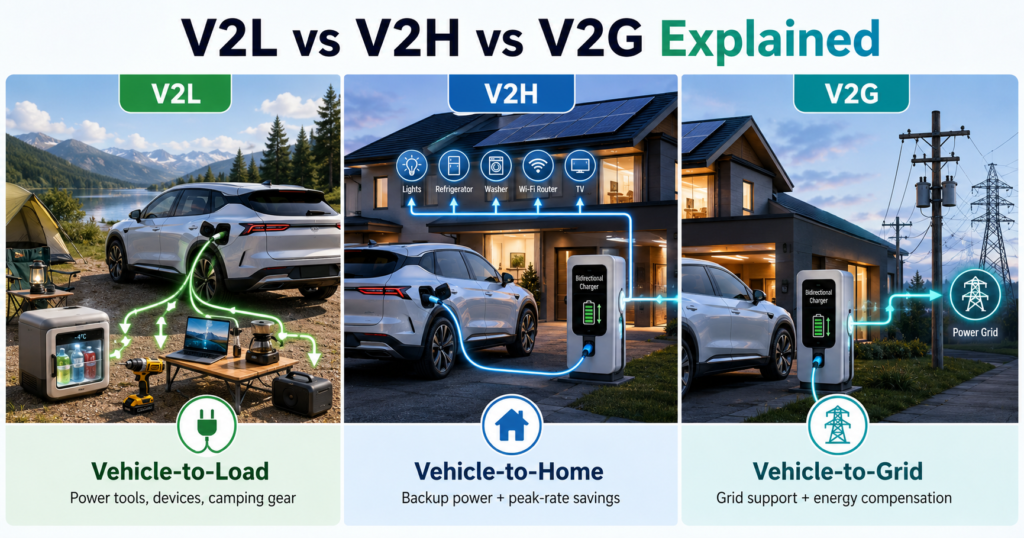
The terms around bidirectional charging can be confusing because they sound similar. They all involve using energy stored in an EV battery, but they are not the same thing.
Vehicle-to-Load: V2L
Vehicle-to-load, or V2L, is the simplest version. The EV powers external devices directly. Think of it as using your EV as a large mobile power bank. You might plug in a laptop, camping equipment, power tools, a small refrigerator, or emergency appliances. Hyundai helped popularize this idea with the IONIQ 5’s V2L function, which allowed the vehicle to power or charge external electric devices.
V2L usually does not power an entire home. It is more like a high-capacity outlet. From a battery-aging standpoint, V2L is usually not a major issue unless the owner drains the battery deeply and frequently. Running a few devices at modest power is small compared with driving the vehicle.
Vehicle-to-Home: V2H
Vehicle-to-home, or V2H, is more serious. In this case, the EV can send energy into a properly equipped home electrical system. This usually requires a compatible EV, a bidirectional charger or inverter, transfer equipment, professional installation, and utility or permitting approval depending on location. GM’s V2H system, for example, requires a V2H-capable GM EV, the GM Energy PowerShift Charger, and the GM Energy V2H Enablement Kit. GM describes the system as allowing power to move between the vehicle and a properly equipped home, especially during outages.
Kia’s EV9 V2H setup similarly requires a Wallbox Quasar 2 and additional equipment. Kia also notes that certain jurisdictions may require permits, utility approval, or electrical-panel upgrades. V2H can be used for backup power, but it can also be used for time-of-use savings: charge the EV when electricity is cheap, then use the EV to support home loads when electricity is expensive.
Vehicle-to-Grid: V2G
Vehicle-to-grid, or V2G, goes one step further. The EV does not just power your devices or your home. It can send energy back to the electric grid, usually under a utility program or energy-market arrangement. The U.S. Department of Energy describes bidirectional EVs as mobile storage that can receive energy from EVSE and provide energy to an external load. DOE also explains that V2B and V2G can support buildings, grids, distributed energy resources, and demand-response programs.
V2G is more complicated than V2L or V2H because it involves the utility. The grid must know when the vehicle is available, how much power it can safely provide, how the owner will be compensated, and how to prevent the car from being drained below the driver’s required range. That is where battery degradation becomes especially important. V2G is not just a backup feature used a few times per year. In some programs, it could become a repeated charging and discharging activity.
How an EV Battery Connects to a Home or the Grid
A normal home charger sends AC power from the electrical panel to the vehicle. Inside the EV, an onboard charger converts AC to DC and stores the energy in the high-voltage battery. Bidirectional systems can work differently depending on architecture. Some systems use DC bidirectional charging, where power conversion happens outside the vehicle in a bidirectional charger or inverter. Others may use onboard power electronics, depending on vehicle design.
In practical terms, a V2H or V2G setup usually needs four things to work correctly. First, the vehicle must support bidirectional power flow. Not every EV can do this. Second, the charger or energy system must be bidirectional. A regular Level 2 charger cannot automatically send power back from the EV to the house. Third, the home electrical system must be prepared. For backup use, the house must be able to isolate safely from the grid. This prevents the EV from accidentally energizing utility lines during an outage. Fourth, the software and utility rules must allow it. This is especially important for V2G, where the car interacts with the broader electric grid.
This is why V2G adoption has been slower than the headlines sometimes suggest. The vehicle may be capable, but that does not mean every home, charger, utility, and rate plan is ready.
Why Vehicle-to-Grid Battery Degradation Depends on Cycling
Every lithium-ion battery ages in two broad ways. The first is calendar aging. This happens with time, even if the battery is not used much. High state of charge and high temperature can make calendar aging worse. The second is cycle aging. This happens when the battery charges and discharges. More energy throughput generally means more opportunity for wear, especially if the cycles are deep, hot, or near voltage extremes.
V2G adds energy throughput. That is unavoidable. If your EV sends 10 kWh to your house in the evening and later recharges that 10 kWh overnight, the battery has done extra work. But the important point is that not all cycles are equally damaging. A shallow cycle around a moderate state of charge is usually much gentler than a deep cycle from nearly full to nearly empty. For example, using 10% of a large EV battery in the middle of its operating range is very different from draining 70% of the pack every night. This is one of the reasons V2G battery degradation cannot be answered with a simple yes-or-no statement. The details matter.
For a deeper explanation of normal battery aging, see our related guide: EV Battery Degradation: 7 Reasons Range Loss Usually Isn’t Battery Failure.
Shallow Cycling vs Deep Cycling
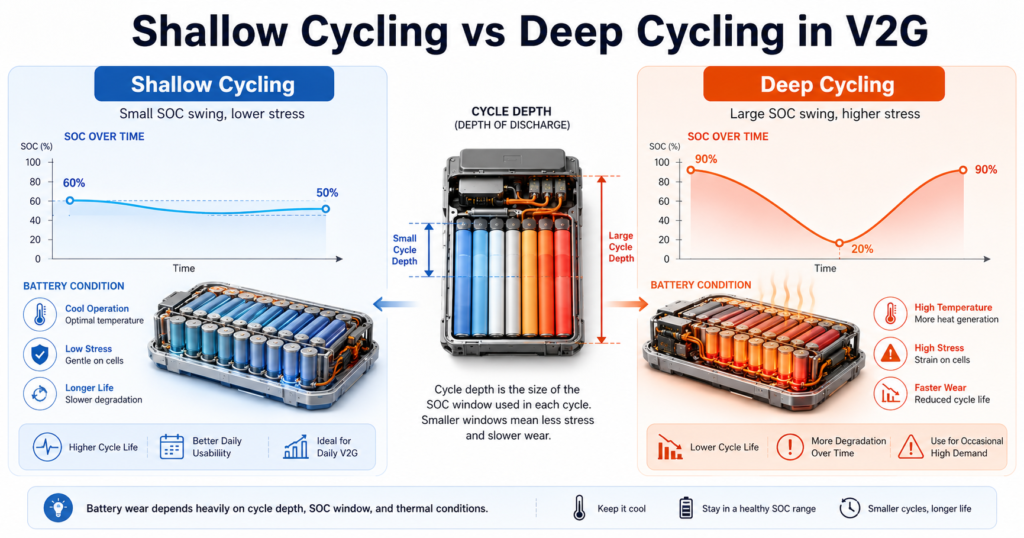
A useful way to think about V2G is to compare shallow cycling and deep cycling. A shallow cycle uses a small portion of the battery’s capacity. For example, the vehicle might move between 55% and 65% state of charge during a grid-support event. The battery is being used, but it is not being pushed near empty or near full.
A deep cycle uses a much larger portion of capacity. For example, the vehicle might discharge from 90% to 30% and then recharge again. That creates more mechanical, thermal, and electrochemical stress.
Lithium-ion cells do not age only based on the number of cycles. They age based on how those cycles are performed. Depth of discharge, temperature, current, state of charge, cell chemistry, and rest time all matter. This is why a well-designed V2G program may limit how much of the battery can be used. Instead of allowing the utility to use the whole battery, the system may reserve a protected window. The driver might set a minimum departure charge, while the BMS and energy-management software decide how much energy can safely be exported.
A V2G program that only uses a small slice of the pack during selected peak events is very different from using the EV as a daily whole-home battery replacement.
The SOC Operating Window Is the Heart of Battery-Friendly V2G
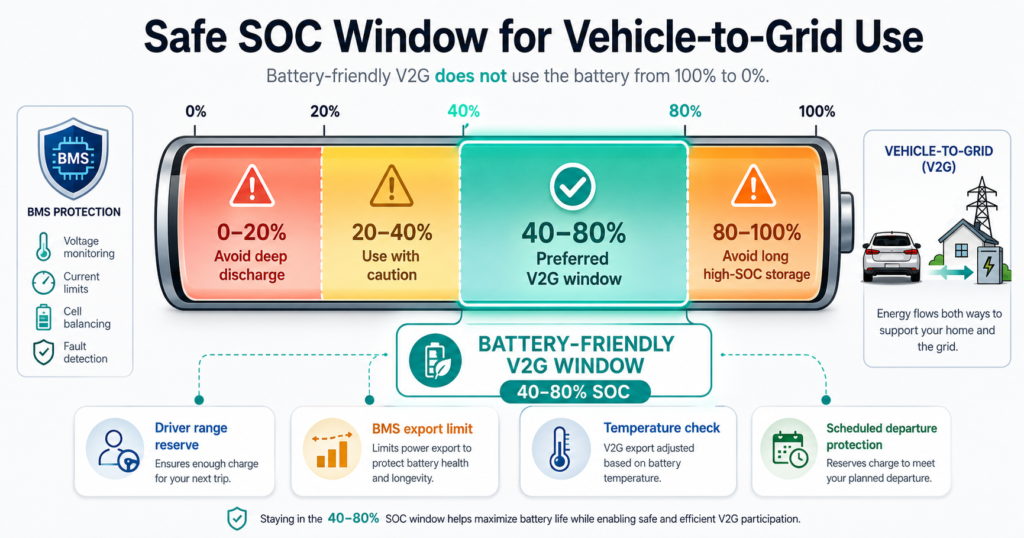
State of charge, or SOC, may be the most important concept in consumer-friendly V2G. Most EV batteries are happiest when they spend much of their time in the middle of the SOC range. Very high SOC can increase voltage-related stress and accelerate some side reactions. Very low SOC can create other risks and reduce driver flexibility. This is why many EV owners already follow a daily charging habit such as charging to 70%, 80%, or 90% instead of 100% unless they need the full range.
V2G should follow the same logic. A battery-friendly V2G strategy would avoid using the top and bottom extremes of the battery whenever possible. Instead, it might operate within a moderate window such as 40–70%, 50–80%, or another range selected by the automaker and BMS.
The exact ideal window depends on the vehicle, chemistry, temperature, and owner needs. LFP batteries, for example, may tolerate frequent cycling differently from high-nickel NMC batteries. But the principle remains the same: controlled shallow cycling in a reasonable SOC window is much less concerning than uncontrolled deep cycling.
This is also where the BMS becomes critical. A modern EV does not simply expose the battery directly to the charger, home, or utility. The BMS monitors voltage, current, temperature, cell imbalance, estimated battery health, and power limits. For a detailed background, see EV Battery Management System Explained: How Modern EV BMS Actually Work.
Can V2G Actually Help Battery Aging?
It sounds counterintuitive, but in some cases, smart V2G may help manage battery aging. The reason is calendar aging. If an EV is charged to a high SOC and then sits for many hours or days in hot conditions, the battery can age even though it is not being driven. In that scenario, a smart system that avoids long high-SOC parking could potentially reduce some calendar-aging stress.
Recent V2G research has focused on this tradeoff. A 2024 study using physics-based battery digital twins found that the decision to use V2G depends strongly on the battery’s dominant aging mechanism. The authors emphasized the relationship between calendar-aging-driven degradation and the benefit or harm of additional V2G throughput.
In plain English, if a battery would otherwise spend a lot of time aging while sitting at high SOC, carefully managed V2G may not be as harmful as people assume. The system could use some energy during peak hours, recharge later, and avoid unnecessary high-voltage storage time.
That does not mean V2G magically improves every battery. It means the comparison should not be “V2G vs no aging.” The real comparison is “smart V2G vs whatever the battery would have experienced otherwise.” A car left at 95% SOC in a hot garage all summer may not be living an ideal battery life either.
The Money Side: Can V2G Pay for the Battery Wear?
For many owners, the V2G decision will come down to economics. If the utility pays little or nothing, battery wear does not need to be large to make V2G unattractive. But if the owner can save meaningful money through time-of-use rates, demand-response credits, backup-power value, or grid-service compensation, the equation changes.
The DOE notes that bidirectional EV fleets can participate in demand response and time-of-use arbitrage. Charging during lower-cost off-peak periods can reduce electricity costs, while grid services may help reduce peak-load stress.
Ford describes a similar consumer idea: charge an F-150 Lightning at lower electricity rates, store lower-cost energy in the battery, and use the vehicle to power the home during peak hours. Kia also frames EV9 V2H partly around charging during off-peak periods and powering home loads during peak-rate hours.
But the owner should think like this: If V2G saves $300 per year but adds noticeable battery wear or creates warranty uncertainty, it may not be worth it. If it saves $1,000 per year, provides backup power, and operates within a conservative SOC window, it becomes much more attractive.
The missing piece is transparency. Owners need to know how much energy was exported, what SOC window was used, how often deep cycles occurred, how the battery warranty treats bidirectional usage, and how compensation is calculated. Without that information, the owner is taking the battery risk while the utility receives part of the benefit.
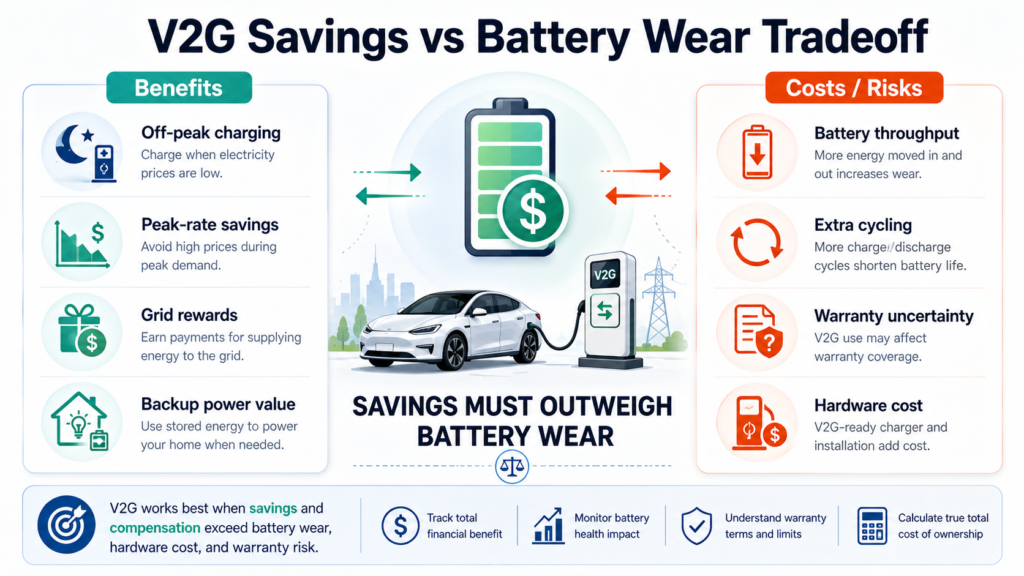
Warranty Issues: The Fine Print Matters
Battery warranty is one of the most important unresolved consumer questions around V2G. Most EV battery warranties are written around years, mileage, defects, and capacity retention thresholds. Many U.S. EV warranties use an 8-year/100,000-mile structure, often with a 70% capacity-retention threshold. We covered this in detail here: EV Battery Warranties Explained: What They Really Cover.
The challenge is that V2G can add battery cycles without adding miles. A driver might put only 8,000 miles per year on the vehicle but still cycle the battery heavily through daily grid export. Traditional warranty language does not always make clear how this kind of energy throughput is treated.
There are several questions owners should ask before enrolling in a V2G program: Does the automaker officially support this specific bidirectional charger? Is V2G, V2H, or V2L use mentioned in the warranty manual? Does the utility program require third-party hardware or software? Can the vehicle manufacturer see V2G energy throughput in diagnostic logs? Could improper installation or non-approved equipment affect warranty coverage? This does not mean owners should avoid V2G. It means they should avoid unsupported or unclear setups.
A factory-approved V2H system is very different from a third-party workaround that the automaker has not validated. If the vehicle, charger, inverter, installation, and utility interconnection are all approved, the warranty risk is likely lower. But the owner should still confirm the terms for that exact model year and market.
How the BMS Limits V2G to Protect the Battery
A good V2G system should not let the grid treat your EV like a dumb battery. The BMS should remain in control. During bidirectional operation, the vehicle can limit export power based on battery temperature, SOC, cell voltage, estimated state of health, and driver settings. If the battery is too cold, too hot, too empty, too full, or showing abnormal imbalance, the BMS can reduce or stop discharge.
This is similar to how DC fast charging works. Your EV may plug into a 350 kW charger, but the battery only accepts what the BMS allows. Charging power tapers because the pack has electrochemical limits, not because the charger is weak. For more background, see EV Battery Charging Power: 4 Reasons It Must Taper.
V2G should work the same way in reverse. The BMS may restrict maximum discharge power, minimum allowed SOC, maximum allowed SOC for recharging, battery temperature range, daily or annual energy throughput, operation during fault conditions, and operation when the driver has a scheduled departure. This is why automaker-integrated V2G is so important. The utility may want energy, but the vehicle must protect mobility and battery health first.
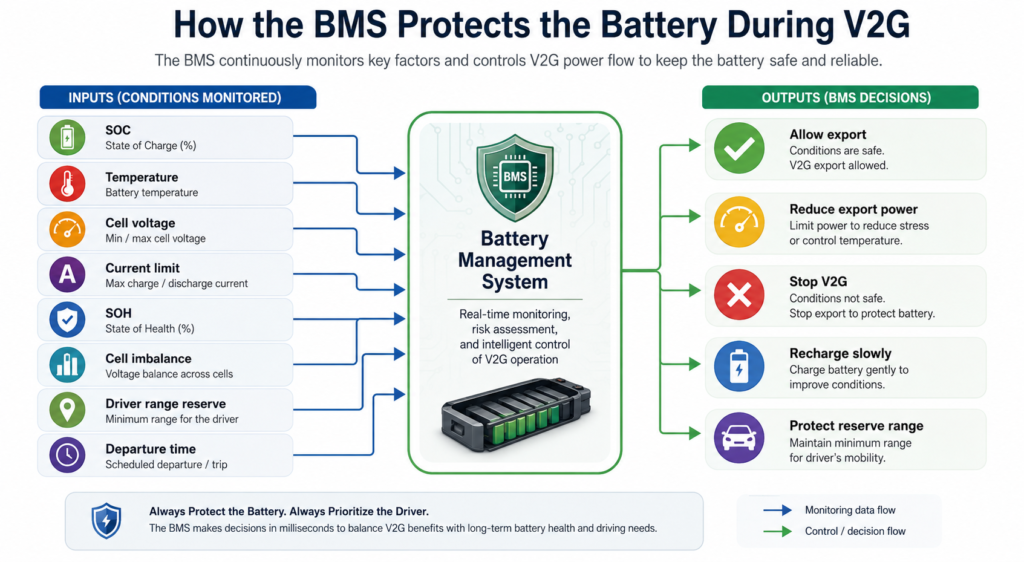
When V2G Is Most Likely to Be Battery-Friendly
V2G is most likely to be gentle on the battery when it operates within a narrow, moderate SOC window and avoids high thermal stress. A good consumer V2G profile might look like this: The owner charges overnight to 70%. The car sits at home during the afternoon. During a peak event, the system exports a small amount of energy, perhaps lowering SOC from 70% to 60%. Later that night, it recharges slowly when demand is low. The vehicle is never deeply discharged, never held at 100% for long periods, and never forced to export power during extreme battery temperatures.
That kind of usage is much less concerning than draining the battery from 90% to 20% every evening and recharging it back to 90% every night. The best V2G programs will likely feel boring from the owner’s perspective. The car remains ready to drive. The owner sets a minimum range. The system quietly handles small energy exchanges in the background. The BMS refuses anything harmful. That is the version of V2G that has the best chance of gaining consumer trust.
When V2G Could Accelerate Degradation
V2G becomes more concerning when the battery is used aggressively. Daily deep discharges are the obvious risk. If an owner uses the EV like a full-time home battery and repeatedly pulls large amounts of energy from the pack, cycle aging will increase.
High power is another concern. A low-power home discharge may be gentle, but high-power grid export events can create more heat and stress, especially if repeated often.
Temperature also matters. V2G during hot conditions can increase aging if the pack is already warm. Cold-temperature charging after discharge may also need careful control to avoid lithium plating risk during recharge.
Poor scheduling can also hurt. For example, if V2G discharges the vehicle late at night and then the car fast charges aggressively in the cold before a morning trip, the total operating pattern may be stressful. This is why V2G must be treated as an energy-management problem, not just a charger feature.
Practical Advice for EV Owners Considering V2G
The safest approach is to start with V2H before thinking seriously about V2G. V2H provides clear personal value: backup power and possible peak-rate savings. The battery is serving your own home, and the use case may be occasional or moderate.
V2G can offer broader grid value, but it depends more heavily on utility rules, compensation, and software control. Before enrolling, ask the utility or provider for three things. First, ask what SOC window the program uses. If the answer is vague, that is a red flag. Second, ask whether the program lets you set a minimum departure charge. You should not wake up to a car that cannot meet your driving needs. Third, ask how battery throughput is tracked and whether the automaker has approved the program.
For most owners, a reasonable V2G setup should preserve mobility first, protect battery health second, and chase energy revenue third. If the order is reversed, the owner may be carrying too much risk.
Conclusion: V2G Is Not the Enemy, Poor Control Is
Vehicle-to-grid does not automatically damage an EV battery. The battery impact depends on how the system is designed and how aggressively it is used. A poorly managed V2G setup can add unnecessary cycle aging, especially if it uses deep daily discharges, high power, stressful SOC ranges, or unclear third-party hardware. In that case, the owner may be giving away battery life for too little compensation.
But a smart V2G system is different. If it uses shallow cycling, moderate SOC windows, temperature-aware controls, driver-defined range reserves, and automaker-approved hardware, the extra degradation may be small. In some cases, smart bidirectional charging may even reduce harmful high-SOC parking time and help manage battery aging more intelligently.
The future of V2G will not be decided by whether EV batteries can technically send power back to the grid. They can. It will be decided by whether automakers, utilities, charger companies, and regulators can make the system fair for the EV owner. The battery belongs to the driver. Any V2G program that uses it should protect it, pay for its value, and make the rules clear.
FAQs
Does V2G use up battery cycles?
Yes. Any discharge and recharge uses some battery throughput. The important question is how much energy is cycled, how deeply the battery is discharged, and whether the system avoids stressful SOC and temperature conditions.
Is V2H safer for battery health than V2G?
Not automatically, but V2H is often easier to control because it serves the owner’s home rather than a broader grid program. Occasional backup use is unlikely to matter much. Daily deep home-energy cycling can still add wear.
Can I use my EV as a home battery every day?
Technically, some systems may allow it. Whether it is a good idea depends on your electricity rates, warranty terms, SOC limits, cycle depth, and how much energy your home uses. Using a small portion of the battery is very different from deeply cycling the pack every day.
What SOC range is best for V2G?
There is no universal number for every EV, but a moderate SOC window is generally better than operating near 0% or 100%. Many battery-friendly strategies avoid high SOC storage and deep discharge.
Will V2G void my EV battery warranty?
It depends on the vehicle, equipment, installation, and warranty language. Factory-supported systems are less risky than unsupported third-party setups. Always check the warranty manual and confirm that the specific charger and program are approved for your vehicle.
Could V2G make financial sense?
Yes, but only if compensation or energy savings exceed the practical cost of battery wear, hardware, installation, and inconvenience. Time-of-use savings and demand-response payments can help, but the program must be transparent.