
Quick Answer
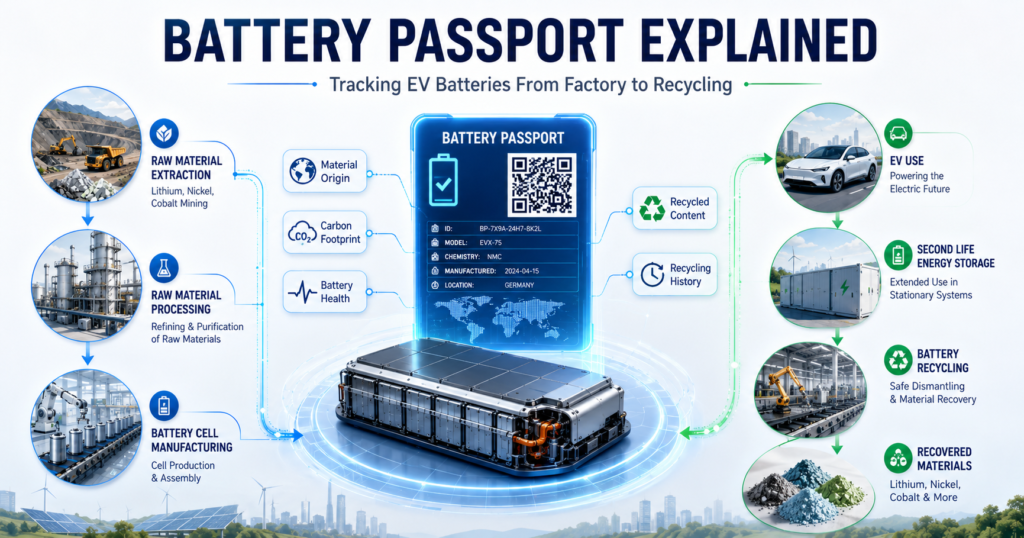
A battery passport is a digital record that follows an electric vehicle battery throughout its life. It can contain information about where the battery was manufactured, what materials it contains, its carbon footprint, its expected performance, its recycling requirements, and—under controlled access—its condition after years of use.
Under the European Union’s Batteries Regulation, every EV battery placed on the EU market from February 18, 2027 must have a battery passport connected to a unique identifier and accessible through a QR code. The passport is intended to improve supply-chain traceability, make carbon emissions easier to compare, support repair and second-life decisions, and help recyclers recover valuable materials more efficiently (EUR-Lex).
Although the requirement begins in Europe, its effects will not remain limited to European vehicles. Battery manufacturers and automakers that sell globally are unlikely to build completely separate information systems for every market. As a result, the EU battery passport could influence how EV batteries are designed, manufactured, tracked, serviced, reused, and recycled around the world between 2026 and 2030.
Introduction
Most EV buyers know surprisingly little about the battery underneath their vehicle. They may know its usable capacity, charging speed, chemistry, warranty period, and perhaps the name of the battery supplier. But they usually cannot see where the lithium, nickel, graphite, or cobalt came from. They cannot easily compare the carbon emissions generated during battery production. When the vehicle becomes older, it can also be difficult for a buyer, repair shop, second-life operator, or recycler to determine the battery’s history and remaining value.
The battery passport is an attempt to change that. Instead of treating an EV battery as a sealed product whose history disappears once it leaves the factory, the passport creates a digital identity that can remain connected to the battery throughout its useful life. In principle, that identity can begin with raw-material sourcing, continue through cell and pack manufacturing, and remain available during vehicle use, repair, resale, repurposing, and final recycling.
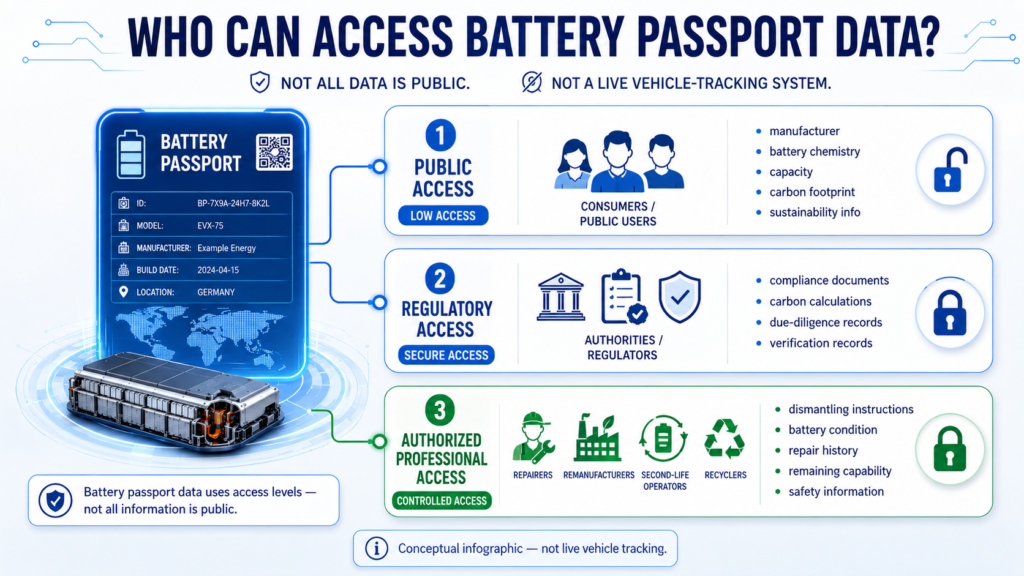
This does not mean that every person scanning a QR code will gain access to every piece of battery data. Public information, commercially sensitive information, regulatory records, and detailed service data will have different access levels. Nevertheless, the battery passport represents a major shift in how the industry thinks about batteries.
An EV battery will no longer be judged only by range, power, and charging speed. Increasingly, it will also be judged by where its materials came from, how much carbon was emitted to produce it, how responsibly its supply chain was managed, and what can happen to it at the end of its automotive life.
What Is a Battery Passport?
A battery passport is an electronic record linked to a specific battery. The idea is similar to a vehicle identification number, but the passport is much more detailed and focused on the battery’s materials, sustainability, technical characteristics, and life-cycle history. It does not replace the vehicle identification number or the automaker’s service records. Instead, it gives the battery itself a persistent digital identity.
The EU Batteries Regulation requires a passport for every EV battery, every light means of transport battery, and every industrial battery with a capacity greater than 2 kWh that is placed on the EU market or put into service from February 18, 2027. The passport will be linked to a unique identifier and accessed through a QR code attached to the battery or accompanying documentation (EUR-Lex).
The economic operator that places the battery on the market is responsible for ensuring that the passport information is accurate, complete, and current. Depending on the supply chain, that operator could be an automaker, battery manufacturer, importer, or another company legally responsible for introducing the product into the European market.
The passport is also expected to survive changes in the battery’s status. A battery may begin as an original EV battery, later become a used battery, and eventually be classified as reused, repurposed, remanufactured, or waste. The record can be updated to reflect those changes. After the battery has been fully recycled, the regulation allows the passport to cease to exist (EUR-Lex).
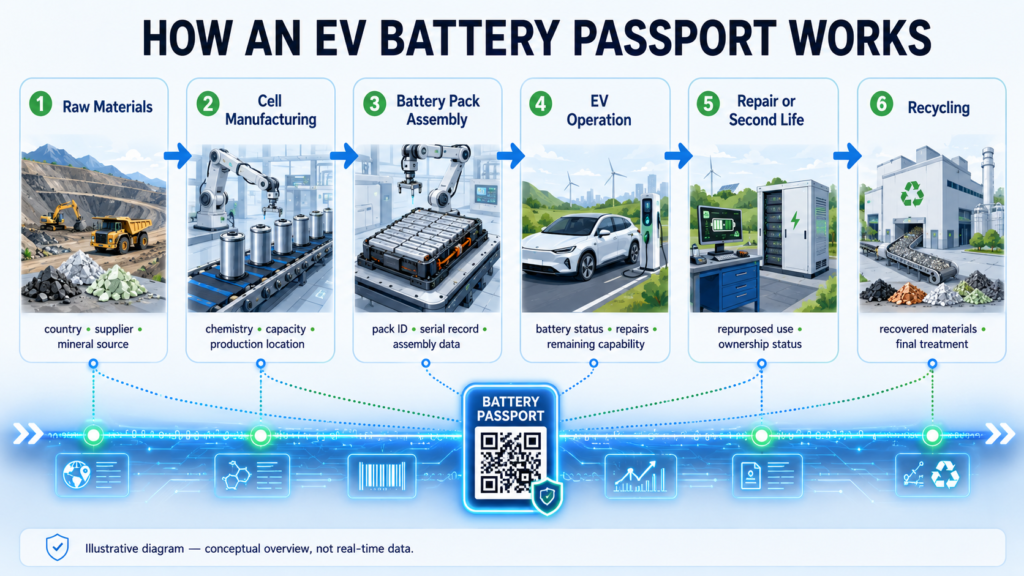
What Information Will an EV Battery Passport Contain?
The passport will combine information about the battery model with information that applies to the individual battery. Some information will be static. The battery chemistry, manufacturing location, rated capacity, and original carbon-footprint declaration do not normally change during vehicle use. Other information may change as the battery ages. Its status, repair history, remaining capability, and suitability for reuse or repurposing can evolve over time.
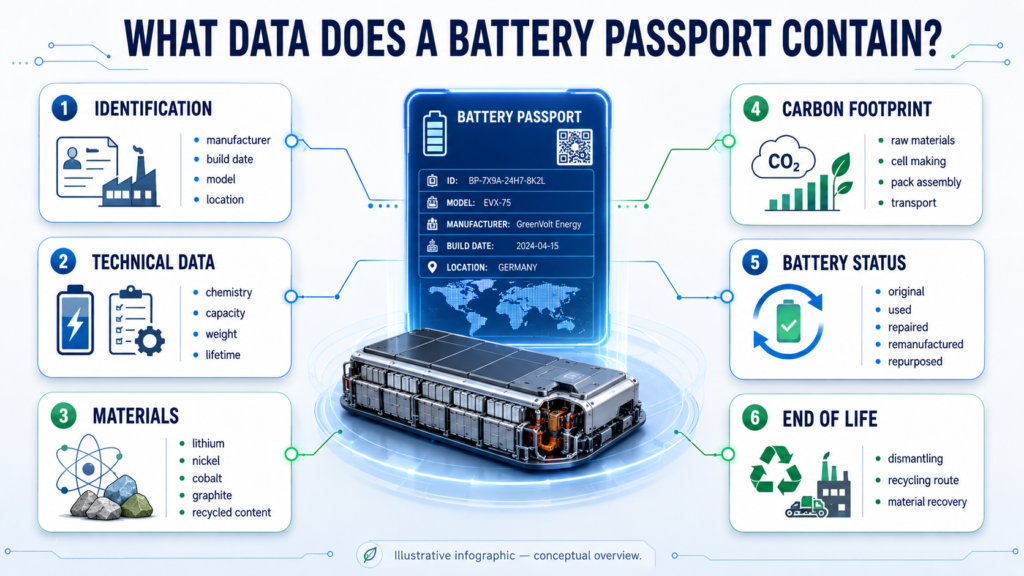
Basic Battery Identification
A passport can identify the battery manufacturer, manufacturing location, production date, model, weight, chemistry, and rated capacity. It may also include information about hazardous substances and critical raw materials contained in the battery. This information sounds basic, but it can be extremely useful later in the battery’s life.
EV packs are not all built the same way. A pack may use cylindrical, pouch, or prismatic cells. It may have conventional modules, a cell-to-pack structure, or deeper integration with the vehicle body. Cooling plates, adhesives, busbars, structural components, and pack enclosures can also differ significantly. For a closer look at how these differences affect disassembly and recycling, see our guide to Cell-to-Pack vs. Structural Battery Packs. Accurate identification helps repairers and recyclers understand what they are handling before opening a high-voltage battery pack.
Battery Chemistry and Material Composition
The passport can indicate whether a battery uses LFP, NMC, NCA, or another chemistry, along with information about critical materials present above specified concentrations. That distinction matters because battery chemistries have different supply chains and recycling economics. An LFP battery does not contain the same nickel and cobalt content as an NMC battery. A high-nickel battery may have greater material value at the end of life, while an LFP battery may require a different economic approach to recycling. The chemistry also influences thermal behavior, energy density, cycle life, and possible second-life applications.
Our LFP vs. NMC battery comparison explains these differences in more detail.
Carbon-Footprint Information
One of the most important elements is the battery’s life-cycle carbon footprint. The EU regulation is designed to move the industry beyond vague claims such as “green battery” or “low-carbon manufacturing.” Manufacturers will need to calculate carbon emissions using harmonized rules and supporting documentation.
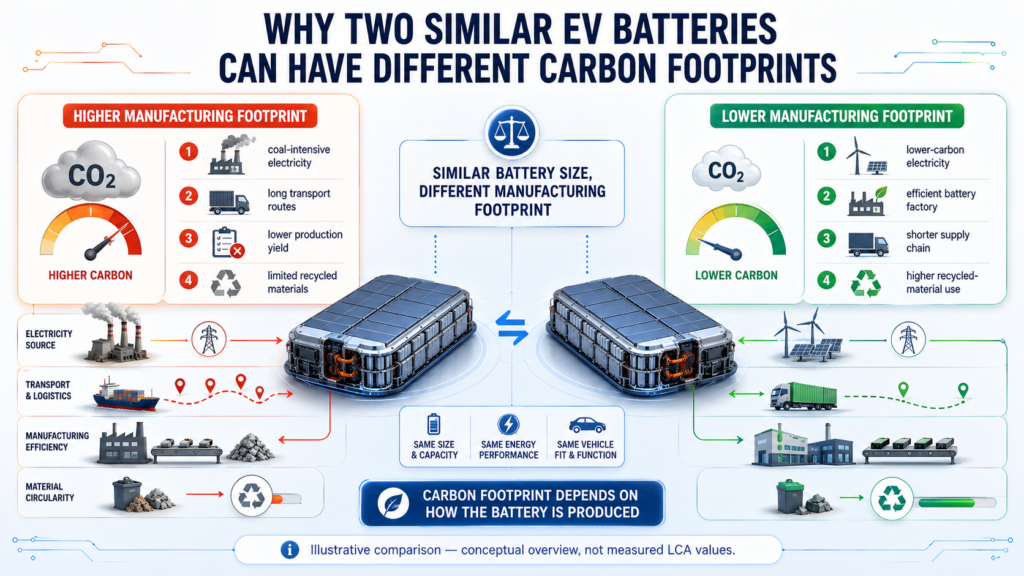
The calculation is expected to consider major stages of the battery life cycle, including raw-material extraction and processing, active-material production, cell manufacturing, pack assembly, transportation, and end-of-life treatment. This matters because two EV batteries with similar capacity and performance can have very different manufacturing emissions.
A battery produced using a coal-intensive electricity grid may have a larger carbon footprint than a similar battery manufactured using nuclear, hydroelectric, wind, solar, or other lower-carbon electricity. Material-processing routes, factory energy efficiency, production yield, transport distance, and the amount of recycled material can also change the result.
The EU regulation establishes a phased system involving carbon-footprint declarations, performance classes, and eventually maximum life-cycle carbon-footprint thresholds. Some details depend on delegated and implementing acts, so the practical dates may be influenced by when those acts enter into force. The regulation currently provides that maximum carbon-footprint thresholds for EV batteries will apply no earlier than February 18, 2028, or 18 months after the relevant delegated act enters into force, whichever is later (EUR-Lex). This is an important distinction. The battery-passport deadline of February 2027 is clearly established, but some carbon-footprint rules remain dependent on the EU’s detailed implementation process.
Recycled Content
The passport and supporting technical documentation will also help track how much recycled material is used in new batteries. Starting from the applicable reporting stage, manufacturers will need to disclose the percentage of cobalt, lithium, nickel, and lead recovered from battery-manufacturing waste or post-consumer waste. The regulation currently anticipates recycled-content documentation from August 18, 2028, or 24 months after the relevant delegated act enters into force, whichever comes later (EUR-Lex).
Mandatory minimum recycled-content requirements for EV batteries are scheduled for August 18, 2031:
- 16% recycled cobalt
- 6% recycled lithium
- 6% recycled nickel
- 85% recycled lead, where applicable
Higher targets are planned for 2036 (EUR-Lex). These percentages refer to specific materials in battery active materials rather than the total weight of the pack.
The recycled-content rules are closely connected to the growth of closed-loop battery manufacturing. Instead of discarding old batteries or exporting mixed waste, Europe wants materials recovered from end-of-life batteries and manufacturing scrap to return to the battery supply chain. Our article on how old EV batteries become new ones explains how batteries are disassembled, processed into black mass, and separated into reusable materials.
Supply-Chain Due Diligence
Battery traceability is not only about carbon. The EU regulation also introduces due-diligence obligations involving cobalt, natural graphite, lithium, nickel, and certain other materials used in battery manufacturing. Companies covered by the rules will need policies for identifying and managing social and environmental risks in their supply chains (EUR-Lex). This may include risks connected to labor conditions, human rights, environmental damage, corruption, unsafe mining practices, and sourcing from conflict-affected or high-risk areas.
The original regulation planned for these obligations to apply in August 2025. However, a 2025 amendment postponed the date to August 18, 2027, giving companies more time to map and adjust complex global supply chains. The delay does not remove the requirement. It shows how difficult the task is.
A battery cell may contain materials that passed through several countries and processing stages before reaching the cell factory. Lithium can be mined in one country, refined in another, converted into cathode material elsewhere, and finally assembled into a cell at a different plant. Natural graphite may also pass through purification and coating operations before it becomes battery-grade anode material.
Creating an auditable chain of custody across this network requires more than adding a QR code to the final pack. Suppliers need compatible data systems, consistent definitions, verification procedures, and methods for protecting confidential commercial information.
A Battery Passport Is Not the Same as Live Vehicle Tracking
Some EV owners may hear the word “passport” and assume the system will continuously report where the vehicle is located or how the driver uses it. That is not the primary purpose of the regulation. The passport is a product and sustainability record, not a public vehicle-surveillance system. Its purpose is to provide relevant information about the battery’s origin, composition, environmental performance, status, and possible future use.
The EU regulation also divides passport data into different access categories. Some information will be available to the general public. Other information will be limited to the European Commission, market-surveillance authorities, or notified conformity-assessment bodies. More detailed technical information may be available only to parties with a legitimate interest, such as repairers, remanufacturers, second-life operators, recyclers, or purchasers evaluating the battery’s remaining value (EUR-Lex).
This access structure attempts to balance several competing needs. Consumers need meaningful transparency. Regulators need enough information to verify compliance. Recyclers need technical details for safe processing. At the same time, manufacturers need protection for intellectual property, supplier pricing, production recipes, and other commercially sensitive information. The success of the system will depend heavily on whether that balance works in practice.
How the Battery Passport Could Improve Traceability
Today, battery supply-chain information is often fragmented. A mining company may maintain extraction records. A refinery may have processing data. A cathode supplier may calculate material composition. The cell manufacturer may record production energy and quality-control results. The automaker may track pack assembly, software, and warranty data. These records do not always use the same format, and they may not remain connected to the physical battery after it changes ownership.
The passport creates a framework for linking this information to a unique battery identity. That does not guarantee that every data point is correct. A digital system is only as trustworthy as the information entered into it. Verification, auditing, common standards, and data authentication will therefore be essential. The regulation requires passport systems to support data reliability, integrity, interoperability, and access control. It also states that consumers and other authorized actors should receive access without charge, according to their respective access rights (EUR-Lex).
Industry trials are already testing how this might work. The Global Battery Alliance conducted battery-passport pilots involving cell manufacturers, traceability providers, mining and processing companies, and other supply-chain participants. Its 2024 pilots focused on gathering and exchanging real-world sustainability data before broader implementation.
These pilots are important because regulatory language alone cannot solve the technical problem. Companies must still determine how data will be collected, verified, transferred, corrected, and preserved for a battery that could remain in service for 15 years or longer.
Why Battery Health Data Matters
A battery passport could also improve the used-EV and second-life battery markets, but this part requires careful explanation. The passport does not necessarily give every member of the public unrestricted access to every battery-management-system signal. However, the EU Batteries Regulation separately requires up-to-date parameters related to state of health and expected lifetime to be available through the battery management system for EV batteries.
Since August 18, 2024, read-only access to relevant battery-health parameters must be provided on a non-discriminatory basis to legal purchasers, independent operators, waste operators, or authorized third parties for purposes such as evaluating residual value and preparing batteries for reuse, repurposing, or remanufacturing (EUR-Lex).
This could address a major weakness in the used-EV market. A conventional used-car buyer can check mileage, service records, accident history, and engine condition. For a used EV, battery condition may be more important than any of those factors, yet the available health information is often limited to a dashboard range estimate or an automaker-specific diagnostic test. A more standardized record could help a buyer distinguish between two vehicles that appear similar but have experienced very different battery lives.
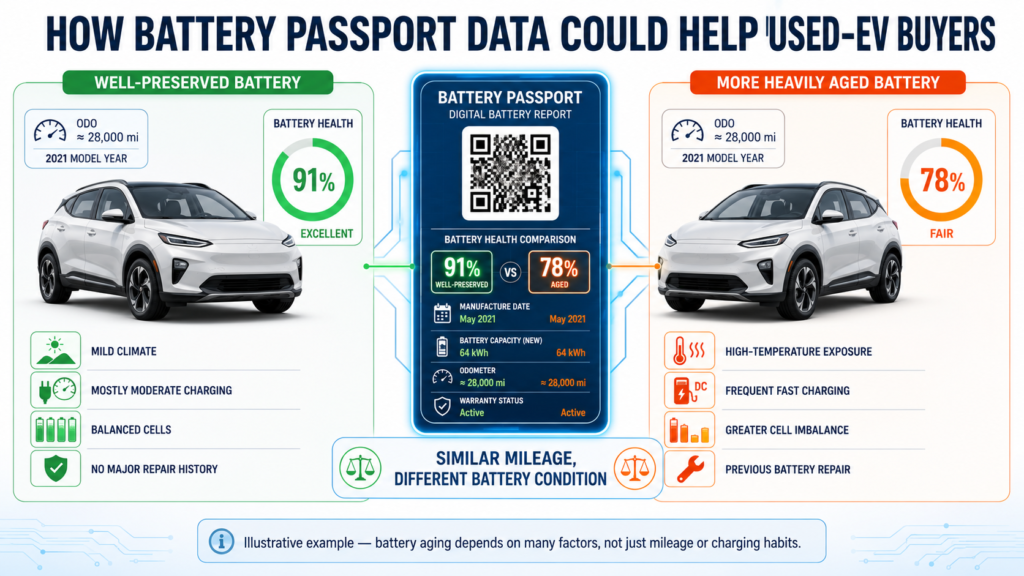
One battery may have operated in a mild climate, received mostly moderate Level 2 charging, and retained strong capacity. Another may have experienced years of high temperatures, frequent high-power charging, or long periods at very high states of charge.
Mileage alone cannot fully describe that difference. Battery-health information could also help determine whether a retired pack should be repaired, remanufactured, placed into a stationary second-life application, or sent directly to recycling. That could reduce unnecessary recycling of batteries that still have useful capacity.
How Battery Passports Could Change Recycling
Recycling an EV battery is more complicated than placing it into a shredder. The pack must first be identified, transported, electrically isolated, discharged, and dismantled safely. Recyclers need to understand its chemistry, voltage, pack construction, fastening methods, hazardous materials, and fire-suppression requirements.
Without reliable data, workers may need to spend additional time inspecting the battery and determining how it was assembled. This becomes even more challenging as automakers adopt structural packs, large castings, adhesives, foam materials, and cell-to-body architectures.
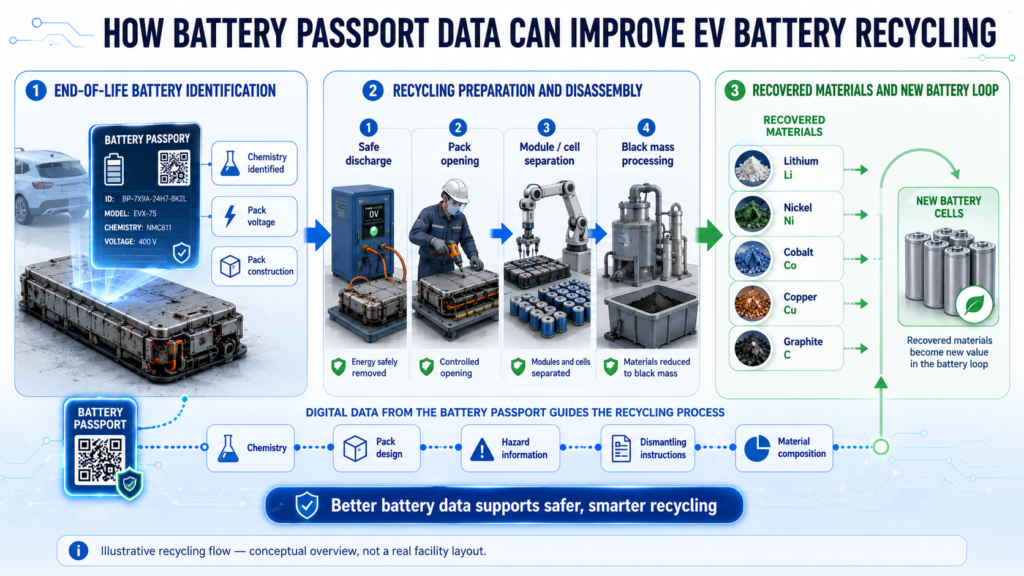
A battery passport can provide recyclers with controlled access to detailed composition and dismantling information. The regulation specifically recognizes that repairers, remanufacturers, second-life operators, and recyclers may need technical information that is not appropriate for unrestricted public access (EUR-Lex). Better information could reduce processing costs, improve worker safety, and increase material-recovery efficiency.
It may also improve sorting. An NMC battery containing valuable nickel and cobalt should not necessarily follow the same economic and processing pathway as an LFP battery. Accurate chemistry and composition data can help recycling facilities decide how to handle different packs before they enter mechanical or hydrometallurgical processes.
The EU has also established material-recovery targets. By the end of 2027, recycling processes are expected to recover 50% of lithium and 90% of cobalt, copper, lead, and nickel. By the end of 2031, those targets increase to 80% for lithium and 95% for cobalt, copper, lead, and nickel (European Parliament).
In July 2025, the European Commission adopted updated calculation and verification rules for battery-recycling efficiency and material recovery, another sign that implementation is moving from general policy toward measurable industrial requirements (Environment).
What Does This Mean for Automakers?
For automakers, the battery passport is not simply a new label. It requires coordination across purchasing, manufacturing, software, cybersecurity, regulatory compliance, sustainability, service, warranty, and recycling operations.
An automaker may need data from mining companies, refiners, active-material producers, cell manufacturers, pack plants, logistics providers, dealerships, repair facilities, and recycling partners. Some of those companies may be located outside Europe but still need to provide verified data because the final vehicle is sold in the EU.
This will likely influence supplier selection. A supplier that offers a competitive price but cannot provide reliable carbon, sourcing, or recycled-content data may become less attractive. In contrast, a supplier with strong traceability systems and lower-carbon production may gain an advantage even when its initial component cost is slightly higher.
Battery manufacturing location may become more important as well. Cell factories powered by lower-carbon electricity could receive more favorable carbon-footprint classifications than factories using carbon-intensive energy.
Manufacturing yield will also matter. Producing more defective electrodes and rejected cells wastes energy and materials, increasing the environmental burden per usable battery. For a detailed explanation of where these losses can occur, see our overview of the 12 major EV battery gigafactory manufacturing steps.
Will the Battery Passport Increase EV Prices?
In the near term, compliance will add cost. Companies must develop data infrastructure, integrate supplier records, conduct audits, calculate carbon footprints, maintain secure digital records, and update passport information when a battery’s status changes. Smaller suppliers may find these requirements particularly difficult. A large automaker can build a dedicated compliance and data-management organization. A small mining, processing, or component company may have limited resources for digital traceability and third-party verification.
However, the system could also reduce costs later in the battery’s life. More accurate identification may reduce diagnostic work. Better battery-health information can support used-EV valuation. Recyclers may dismantle packs more efficiently. Automakers may recover more usable materials. Warranty investigations could become easier when manufacturing and service histories are better documented.
The long-term effect will therefore depend on whether companies treat the passport as a paperwork exercise or use it to improve the battery’s entire life cycle. A poorly designed system could create expensive data entry without providing meaningful value. A well-designed system could reduce waste, improve residual values, and make the circular battery economy more efficient.
What Will EV Owners Actually See?
The most visible feature will probably be the QR code. Scanning it may open a digital page showing public information about the battery, such as its manufacturer, chemistry, capacity, manufacturing location, carbon-footprint category, and sustainability-related documentation.
Owners should not expect the first generation of battery passports to function like a perfect battery medical record. Implementation will likely vary, and some valuable technical information will remain restricted.
Over time, however, the passport could become useful during used-EV sales. A seller might be able to demonstrate that the battery is original, identify its chemistry, confirm whether it has been repaired or remanufactured, and provide authorized access to information used to evaluate its remaining condition.
For buyers, that could reduce uncertainty. For well-maintained EVs, it may also protect resale value by making battery condition easier to verify rather than relying on assumptions based only on age and odometer mileage.
The 2026–2030 Battery Passport Timeline
The period from 2026 through 2030 will be a transition rather than a single overnight change.
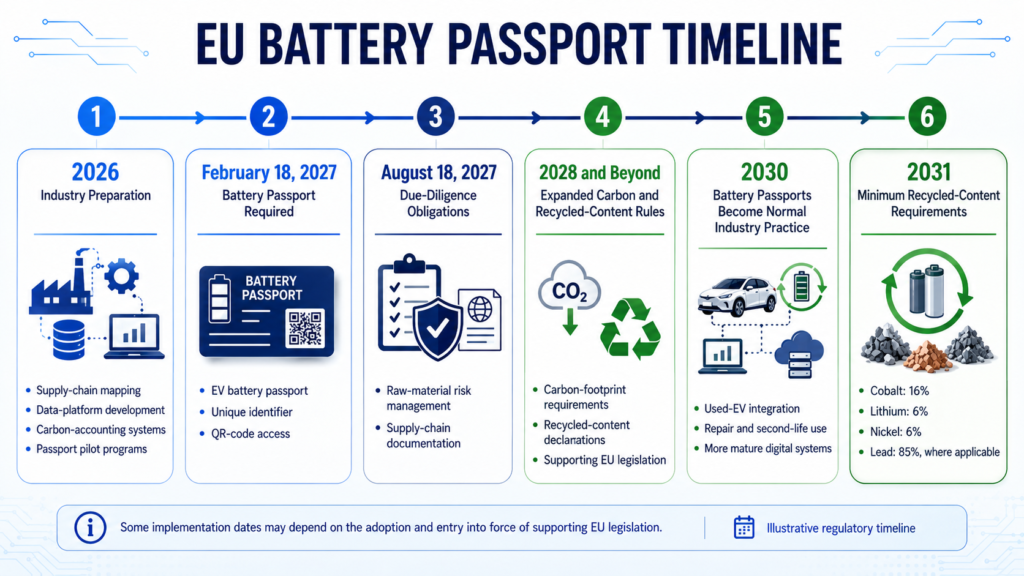
2026: Building the Infrastructure
During 2026, automakers and battery suppliers are preparing data systems, tracing supplier information, testing QR-code access, developing carbon calculations, and working toward interoperability. The European Commission is also continuing to develop delegated and implementing acts that define detailed calculation methods, data access, and technical requirements. This means companies must prepare for the regulation while some implementation details are still being finalized.
February 18, 2027: Battery Passports Become Mandatory
From this date, every newly marketed EV battery in the EU must have an electronic battery passport. The QR-code requirement also begins for relevant battery categories (EUR-Lex). This is the central date most EV manufacturers are working toward.
August 18, 2027: Due-Diligence Obligations
Following the 2025 amendment, battery supply-chain due-diligence requirements are scheduled to apply from August 18, 2027. These obligations focus on identifying and managing environmental and social risks associated with key raw materials (EUR-Lex).
2028 and Beyond: Carbon and Recycled-Content Requirements Expand
Carbon-footprint thresholds and recycled-content declarations will become increasingly important, although some application dates depend on the adoption and entry into force of supporting EU legislation. The regulation’s maximum carbon-footprint threshold for EV batteries is scheduled to apply no earlier than February 2028, while recycled-content documentation is expected no earlier than August 2028 (EUR-Lex).
2030: The Passport Becomes Part of Normal Battery Business
By 2030, battery passports are likely to be less of a new compliance project and more of a normal part of EV manufacturing. Manufacturers should have several years of operational experience. Supply-chain data systems will be more mature. Used EVs carrying passports will begin entering the secondary market in larger numbers. Recyclers and second-life operators will also have more experience using passport information. The system may still be imperfect, but it could become difficult to imagine launching a new EV battery in Europe without a detailed digital identity.
Could Battery Passports Become a Global Standard?
The EU rule applies to batteries placed on the European market, but the battery industry is global. The same cell manufacturer may supply factories in Europe, North America, and Asia. The same vehicle platform may be sold in dozens of countries. Raw materials from one processing facility may enter batteries destined for several markets.
Maintaining one traceable system for Europe and a completely separate system everywhere else would add complexity. For that reason, many manufacturers may gradually extend similar data structures across their global operations. Other governments could also use the EU framework as a reference when developing their own rules for battery carbon emissions, critical-mineral sourcing, recycling, or digital product records.
The Global Battery Alliance is pursuing a broader battery-passport framework aimed at comparable and verifiable sustainability information across international supply chains, not only EU regulatory compliance. Its target is a system that can support transparency and accountability across the global battery industry.
That does not guarantee that every country will adopt an identical passport. Different markets may create different rules, data fields, security requirements, and definitions. The bigger question is whether those systems will be interoperable. If they are not, companies could end up maintaining several digital passports for the same battery.
Challenges the Battery Passport Still Needs to Solve
The concept is promising, but implementation will not be easy. The first challenge is data accuracy. Companies may report incomplete or inconsistent information, especially far upstream in the supply chain. The second is verification. A carbon-footprint number is meaningful only when the calculation boundaries, electricity assumptions, material data, and auditing methods are consistent. The third is confidentiality. Battery manufacturers will not want to reveal proprietary cell designs, supplier contracts, production recipes, or detailed cost information to competitors.
Cybersecurity is another concern. Passport records must remain available and trustworthy for many years. The system needs to prevent unauthorized changes while allowing legitimate operators to update information when a battery is repaired, repurposed, or remanufactured.
There is also a risk of information overload. A passport containing hundreds of technical fields may satisfy regulators but remain confusing to consumers. Public-facing information needs to be presented clearly enough that an EV buyer can understand what matters.
Finally, battery state of health is not always a simple number. Capacity, internal resistance, power capability, temperature history, cell imbalance, and diagnostic uncertainty can all affect how a battery should be evaluated. A standardized health indicator will be useful, but it should not create a false impression that every battery’s condition can be summarized perfectly by one percentage.
Conclusion
The battery passport is much more than a QR code attached to an EV battery. It represents an effort to connect the entire battery life cycle—from raw-material extraction and cell manufacturing to vehicle use, second-life storage, and final recycling.
Beginning February 18, 2027, EV batteries placed on the EU market will require a digital passport. The information will help regulators verify compliance, give consumers greater transparency, allow repairers and second-life operators to evaluate batteries more effectively, and help recyclers recover materials safely and efficiently.
The most important changes may not be immediately visible to drivers. They will occur behind the scenes as automakers begin choosing suppliers based not only on price and performance, but also on traceability, carbon emissions, recycled content, and data quality. By 2030, a battery’s digital history may become almost as important as its physical chemistry.
Range, charging speed, and durability will still matter. But future EV batteries will increasingly need to prove where they came from, how they were produced, how responsibly their materials were sourced, and what will happen to them after they leave the vehicle.
FAQs
When will battery passports become mandatory?
EV batteries placed on the European Union market or put into service from February 18, 2027 must have a battery passport. The requirement also applies to light means of transport batteries and industrial batteries with capacities above 2 kWh (EUR-Lex).
Will every EV owner be able to scan the battery passport?
The passport will be accessible through a QR code, but not every user will see every data field. Some information will be public, while commercially sensitive or detailed technical information will be limited to regulators and authorized parties with a legitimate need.
Will a battery passport show battery health?
Battery-health and expected-lifetime parameters are part of the broader EU battery data framework. Access can be provided to vehicle purchasers, independent operators, recyclers, and authorized third parties for purposes such as evaluating residual value, reuse, and repurposing. The exact public presentation may vary (EUR-Lex).
Does the battery passport apply to existing EVs?
The passport requirement is primarily tied to batteries placed on the market or put into service from the applicable date. Older EV batteries are not automatically required to receive retroactive passports simply because they remain on the road after 2027.
Is a battery passport required in the United States?
The EU battery-passport mandate does not directly apply to vehicles sold only in the United States. However, global automakers may use similar traceability systems across multiple markets, and future U.S. policies or industry standards could adopt comparable elements.
Will the passport prevent unethical battery-material sourcing?
It cannot eliminate unethical sourcing by itself. It can make supply chains more visible and auditable, but the result will depend on accurate reporting, independent verification, enforcement, and the willingness of manufacturers to respond when risks are identified.
Can battery passports make used EVs more valuable?
Potentially. Better information about battery identity, condition, repairs, and remaining capability could reduce uncertainty in the used-EV market. Vehicles with well-documented and healthy batteries may be easier to evaluate and could retain stronger resale values.