
Quick Answer
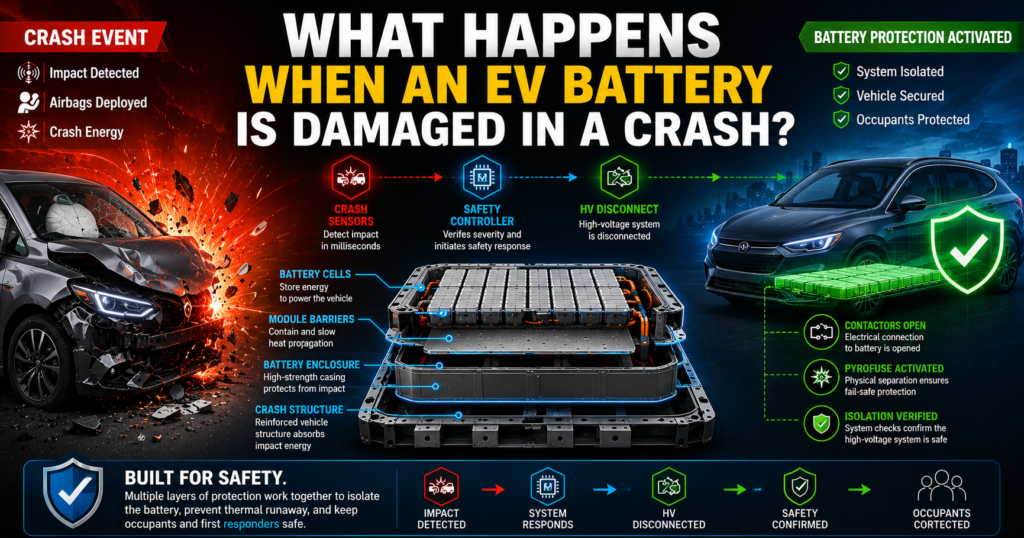
EV battery crash safety is one of the most misunderstood aspects of electric vehicle ownership. When an electric vehicle is involved in a serious crash, the battery does not simply remain energized and continue supplying power to the vehicle. Modern EVs are designed to detect collisions almost instantly and isolate the high-voltage battery within milliseconds. A combination of crash sensors, battery management systems, contactors, and pyrofuses work together to disconnect electrical power and reduce the risk of electric shock or battery-related hazards.
While severe battery damage can still create safety concerns, today’s EVs incorporate multiple layers of protection that make post-crash battery incidents far less common than many people assume.
Introduction
One of the most common concerns people have about electric vehicles is what happens when the battery is involved in a crash. The question is understandable. Unlike a gasoline vehicle, an EV carries a large lithium-ion battery pack that may operate at 400 volts, 800 volts, or even higher. News reports showing damaged EVs being towed away after accidents often leave people wondering whether the battery could catch fire, electrocute occupants, or become dangerous hours after the collision. The reality is far less dramatic than many headlines suggest.
Modern electric vehicles are engineered with crash scenarios in mind from the earliest stages of development. Automakers spend years testing battery packs against front, side, rear, and underbody impacts. In many cases, the battery is one of the most heavily protected components in the entire vehicle. Understanding what actually happens after a crash helps explain why EV safety has improved so dramatically over the past decade—and why battery damage does not automatically mean catastrophe.
How EV Battery Crash Safety Systems Respond
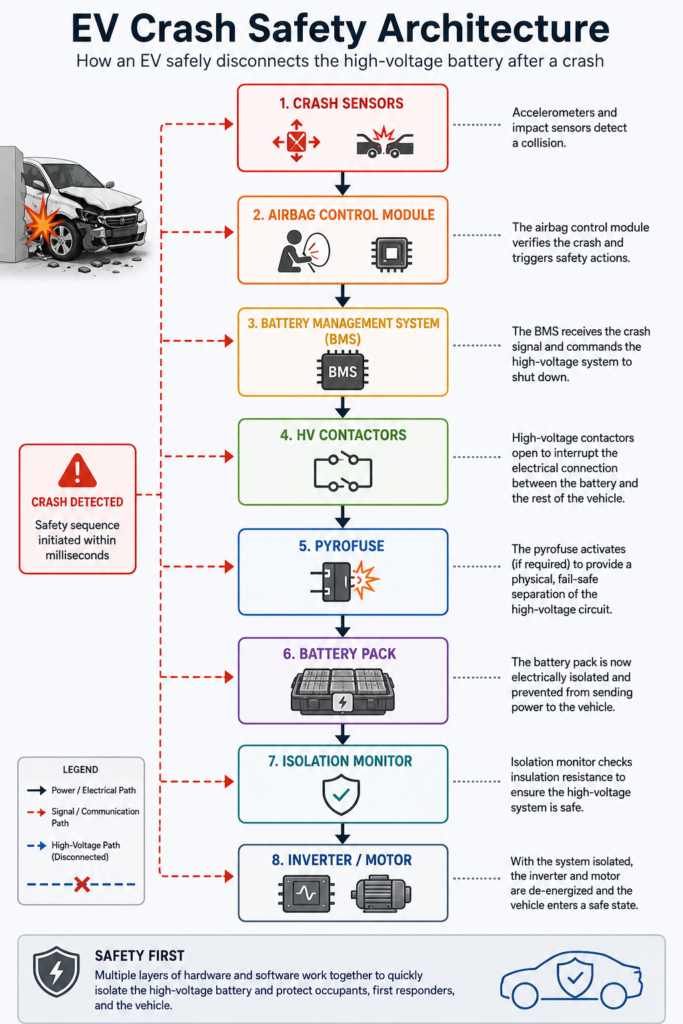
The most important safety actions in an EV occur long before the driver has time to react. The moment a significant collision takes place, a network of sensors begins measuring impact forces throughout the vehicle. These sensors are similar to those used to deploy airbags, but in an electric vehicle they serve an additional purpose: protecting the high-voltage system.
If the crash exceeds predetermined thresholds, the vehicle’s safety controller immediately begins a battery isolation sequence. This process happens incredibly fast, often within a few milliseconds of the initial impact. From the driver’s perspective, the only noticeable event may be airbag deployment. Behind the scenes, however, multiple electronic control units are exchanging information and making safety decisions almost instantaneously. The objective is straightforward: eliminate electrical hazards before damaged components can create additional risks.
EV Crash Safety Architecture
Why Disconnecting the Battery Is So Important
Many people assume that once a vehicle turns off, the battery is no longer a concern. Unfortunately, high-voltage battery systems do not work that way. A modern EV battery stores a tremendous amount of energy. Even when the vehicle is parked, the battery remains capable of delivering power. If damaged wiring, crushed components, or exposed conductors remain connected after a collision, that stored energy could become a hazard. This is why EV engineers focus so heavily on electrical isolation.
As soon as a serious crash is detected, the vehicle attempts to separate the battery pack from the rest of the high-voltage system. By interrupting the flow of electricity, the vehicle reduces the possibility of electrical shock, short circuits, and secondary damage. Think of it as the electrical equivalent of shutting off a fuel supply line after a gasoline vehicle accident.
The Unsung Hero: High-Voltage Contactors
One of the most important safety devices inside an electric vehicle is something most owners never see. High-voltage contactors are essentially large electrically controlled switches that connect the battery pack to the rest of the vehicle. Under normal driving conditions, they allow power to flow between the battery, inverter, electric motor, and charging system. During a crash, those same switches become part of the vehicle’s emergency response system.
Once the safety controller determines that a significant impact has occurred, the contactors open and interrupt the high-voltage circuit. This action disconnects much of the vehicle from the battery pack and helps create a safer environment for occupants and emergency responders. Modern EVs typically use multiple contactors to provide redundancy and ensure that electrical isolation occurs even if one component fails.
What Is a Pyrofuse?
If you’ve never heard the term “pyrofuse,” you’re not alone. Despite being one of the most important components in EV crash protection, it rarely receives attention outside the automotive industry. A pyrofuse is a high-speed battery disconnect device that uses a small pyrotechnic charge to physically sever an electrical connection during severe crash events. Unlike a conventional fuse that melts because of excessive current, a pyrofuse creates an actual physical break in the circuit. That distinction matters. A physical separation provides an additional level of protection in situations where wiring may already be damaged or where electrical arcing could occur.
The technology is remarkably fast and highly reliable. Many modern EVs from manufacturers such as Tesla, General Motors, BMW, Mercedes-Benz, Hyundai, and others use pyrotechnic disconnect systems as part of their overall battery safety strategy. Most drivers will never know whether their vehicle contains a pyrofuse, but during a major collision it may become one of the most important safety devices in the entire car.
Battery Isolation: Verifying That the System Is Safe
Disconnecting the battery is only part of the challenge. Engineers must also verify that the high-voltage system remains electrically isolated from the vehicle chassis. This is where insulation monitoring and battery isolation systems become critical.
Modern Battery Management Systems continuously monitor insulation resistance between high-voltage components and the vehicle body. Under normal conditions, this resistance remains extremely high. If damaged wiring, moisture intrusion, or crash damage causes the isolation level to drop, the vehicle can detect the problem and respond accordingly. In many cases, the vehicle will disable charging, limit power output, or completely shut down the high-voltage system until repairs are performed. These monitoring systems operate continuously, not just after accidents. However, they become especially important when evaluating battery safety following a collision.
The Battery Pack Is One of the Strongest Parts of the Vehicle
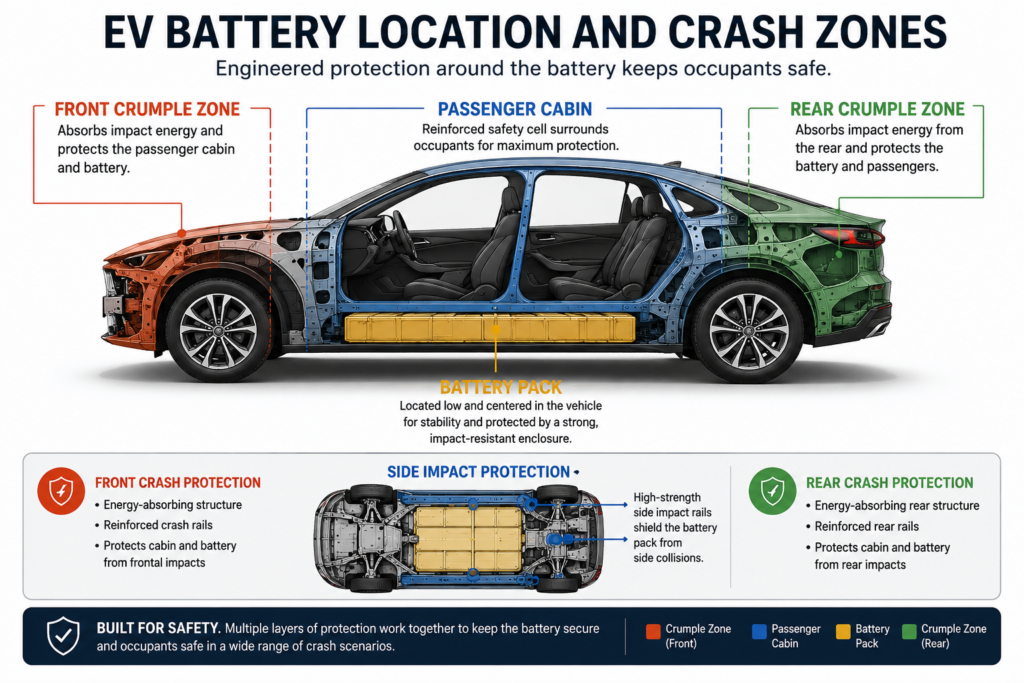
A common misconception is that EV battery packs sit exposed underneath the vehicle with little protection. In reality, the opposite is often true. Battery packs are typically surrounded by reinforced structures specifically designed to withstand severe impacts. Automakers devote enormous engineering effort to ensuring crash energy is absorbed by the vehicle structure before it can reach the battery cells.
Modern EV platforms use reinforced side rails, structural cross-members, impact-resistant battery enclosures, and carefully designed crumple zones to achieve this goal. Many newer EVs even use the battery pack as a structural component of the vehicle itself. This approach can improve both chassis rigidity and crash performance while providing additional protection for the cells inside the pack. As a result, many accidents that cause significant exterior damage never actually reach the battery cells.
Battery Protection Layers
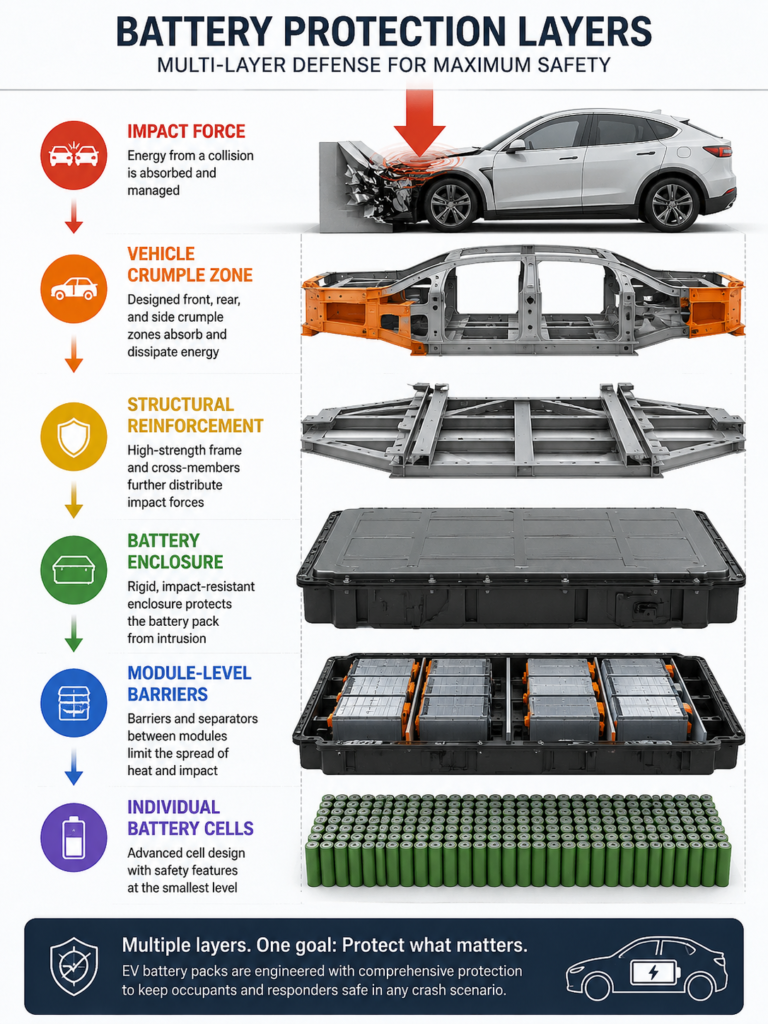
The diagram below illustrates how modern EVs use multiple layers of protection to keep battery cells safe during a collision. Unlike the common perception that the battery sits directly beneath the vehicle floor, crash forces must pass through several protective structures before they can reach the cells themselves. These layers are designed to absorb energy, redirect impact loads, and prevent intrusion into the battery pack.
The first layer is the vehicle’s crumple zone, which absorbs a significant portion of crash energy before it reaches the passenger compartment. Behind it are reinforced structural members that help distribute impact forces throughout the vehicle body.
The battery pack itself is enclosed within a rigid housing made from high-strength steel, aluminum, or a combination of both. Inside the pack, additional module-level barriers provide another layer of defense by separating groups of cells and limiting both mechanical damage and heat transfer.
This layered approach follows a fundamental principle of automotive safety engineering: no single component is expected to provide complete protection on its own. Instead, multiple independent systems work together to reduce the likelihood of severe battery damage.
What Happens If Battery Cells Are Actually Damaged?
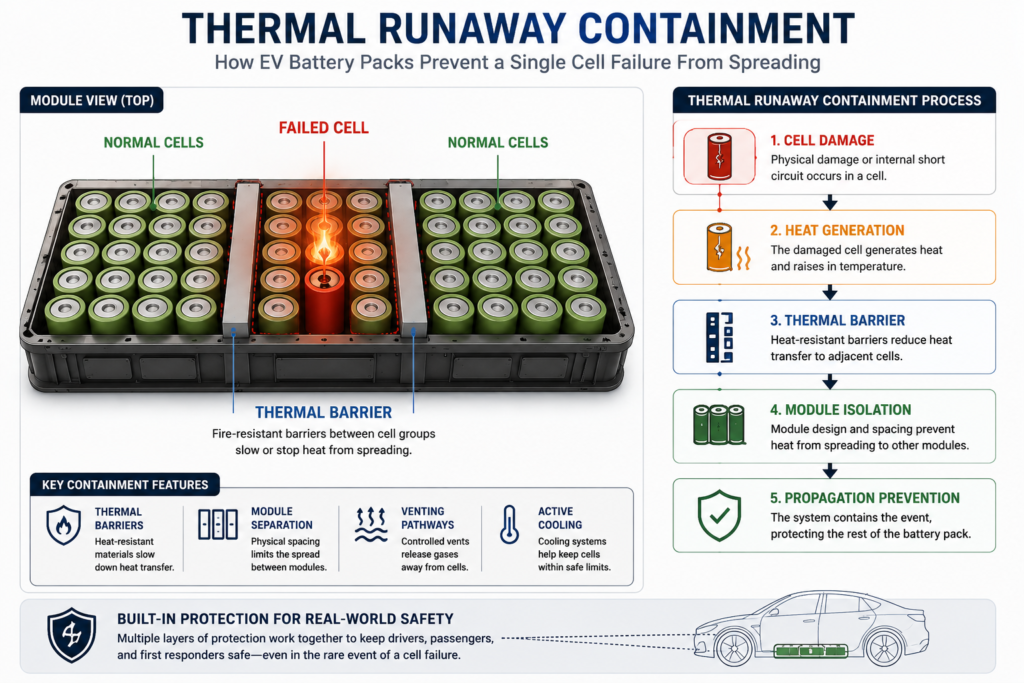
The situation becomes more serious when a collision is severe enough to damage individual battery cells. Lithium-ion cells contain both stored electrical energy and flammable electrolyte. If a cell experiences internal mechanical damage, an internal short circuit may develop. That short circuit can generate heat, and under certain circumstances the heat can begin to accelerate chemical reactions inside the cell. This process is known as thermal runaway.
The phrase often appears in headlines, but the reality is more nuanced than many people realize. Modern battery packs are designed with the assumption that individual cells can fail. Engineers use thermal barriers, module separation structures, venting pathways, cooling systems, and advanced monitoring software to prevent a single damaged cell from affecting the entire battery pack. This layered approach is one of the reasons battery fires remain relatively uncommon despite millions of EVs operating worldwide.
If you’re interested in the broader discussion around EV fires, our article on EV Battery Fire: Do EV Batteries Catch Fire More Often Than Gas Cars? (2026 Data) explores the data in greater detail.
Why Thermal Runaway Does Not Always Happen Immediately
One of the most misunderstood aspects of battery damage is timing. Many people assume that if a battery is damaged, a fire will occur immediately. In reality, battery failures can sometimes develop slowly.
A crash may create internal damage that is not immediately apparent. Over time, that damage can cause localized heating inside a cell. Depending on the severity of the defect, the resulting thermal event may occur minutes, hours, or in rare cases even days after the collision. This delayed failure mechanism is one of the reasons damaged EVs often require special handling and monitoring after major accidents.
Organizations such as the National Fire Protection Association (NFPA) has published guidance for safely managing damaged electric vehicles.
The High-Voltage Disconnect Sequence
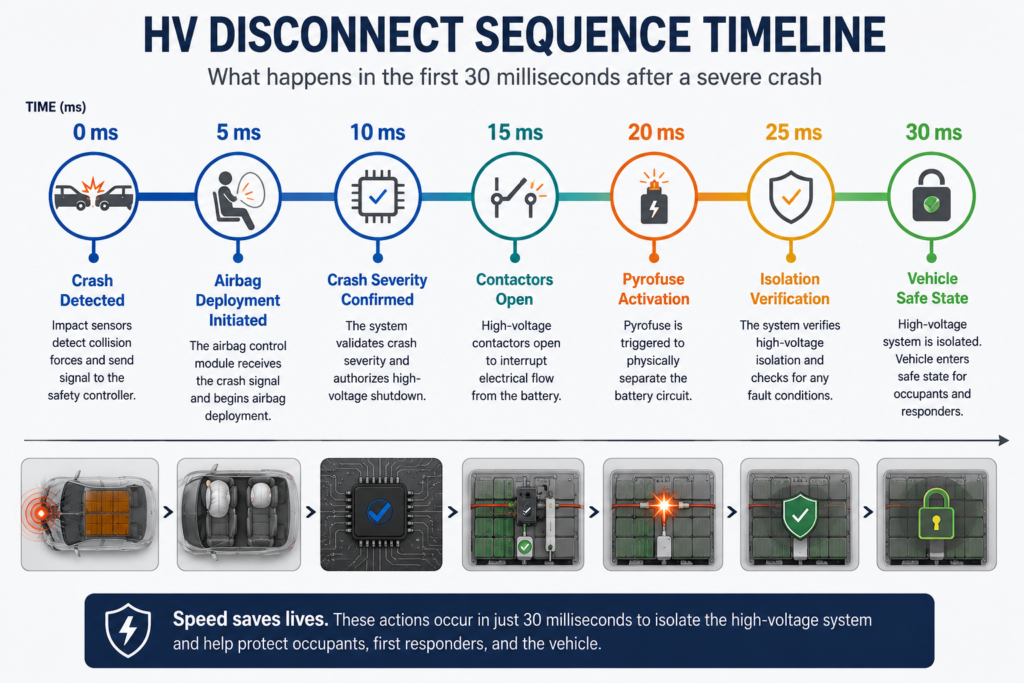
The process of making an EV electrically safe happens remarkably quickly. A simplified sequence typically looks like this:
Crash detected → Airbags deploy → Safety controller confirms impact severity → High-voltage contactors open → Pyrofuse activates (if required) → Battery isolation verified → Vehicle enters safe state.
All of these actions can occur in just a fraction of a second.
What About Emergency Responders?
Another common concern involves firefighters, police officers, and tow operators. Are they at risk of electric shock when approaching a damaged EV? Modern EV safety systems are designed specifically to reduce that risk. Once the high-voltage system has been isolated, large portions of the vehicle become electrically de-energized. In addition, automakers provide emergency response guides that identify battery locations, cut zones, and recommended procedures for handling damaged vehicles.
As EV adoption has increased, emergency responder training has expanded significantly. Fire departments throughout North America now routinely train for EV incidents, and organizations such as the NFPA provide extensive educational resources focused on high-voltage vehicle safety. While any crash scene contains risks, serious electrical injuries involving trained responders remain relatively uncommon.
Why Post-Crash Battery Inspections Matter
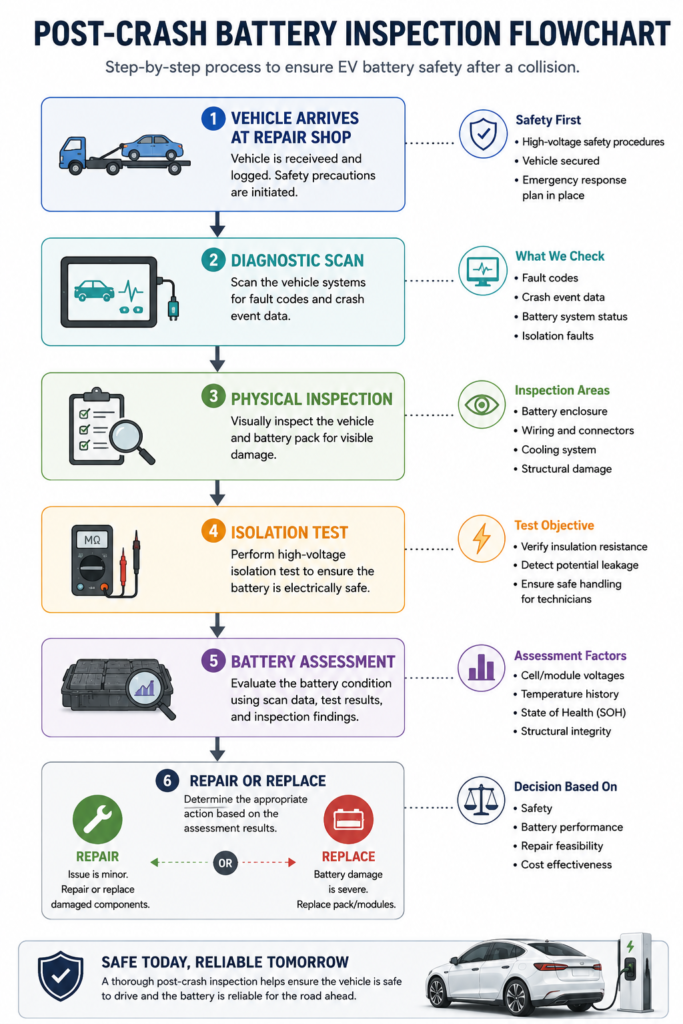
Even when a vehicle appears to be functioning normally after a collision, hidden battery damage may still exist. This is particularly true for impacts involving the vehicle floor, side structures, or underbody.
A proper post-crash inspection typically involves more than a visual assessment. Technicians often review crash data logs, diagnostic trouble codes, battery isolation measurements, temperature history, and physical pack condition. In some cases, only minor repairs are necessary. In others, battery modules—or the entire pack—may need replacement. This is one of the reasons battery replacement costs can vary significantly following major accidents. We discussed that topic in detail in EV Battery Replacement Cost in 2026: Why Full Replacements Are Still Rare.
Are EVs Becoming Safer?
The answer is almost certainly yes. Every generation of EVs introduces improvements in battery protection, structural design, thermal management, and crash response strategies. Technologies that were once limited to premium vehicles—such as structural battery packs, advanced isolation monitoring, and sophisticated thermal propagation barriers—are gradually becoming more common across the industry.
As battery technology continues to evolve, engineers are not only improving range and charging speed. They are also making batteries more resilient when things go wrong. That progress is one of the reasons modern EVs consistently perform well in crash testing and continue to earn high safety ratings around the world.
Conclusion
When an EV battery is damaged in a crash, a complex chain of safety systems immediately springs into action. Crash sensors detect the impact, high-voltage contactors disconnect the battery, pyrofuses create physical separation when necessary, and isolation monitoring systems verify that the vehicle remains electrically safe.
At the same time, reinforced battery enclosures, structural protection systems, and thermal containment features help shield the battery from damage and limit the consequences if a failure does occur.
While severe battery damage should always be evaluated by qualified technicians, modern electric vehicles are specifically engineered to handle crash scenarios. In most cases, the sophisticated safety systems built into today’s EVs make them far safer than many people realize.
FAQ
Can an EV battery catch fire immediately after a crash?
Yes, but it is relatively uncommon. In many cases, battery damage does not result in a fire. Modern battery packs include multiple protective layers designed to prevent thermal runaway.
What is a pyrofuse?
A pyrofuse is a pyrotechnic battery disconnect device that physically separates high-voltage circuits during severe crash events.
Can I drive my EV after a minor accident?
Possibly, but any impact involving the battery area or underbody should be professionally inspected.
How quickly does an EV disconnect its battery after a crash?
Modern systems typically isolate high-voltage circuits within milliseconds.
Can a damaged EV battery fail hours after an accident?
Yes. Some battery failures are delayed, which is why post-crash inspections and monitoring are important.