
Quick Answer
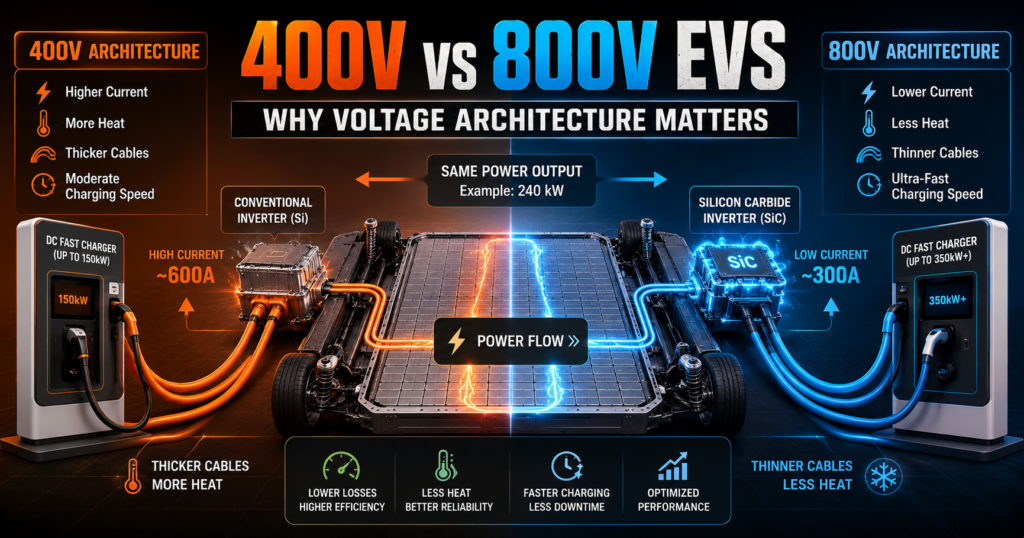
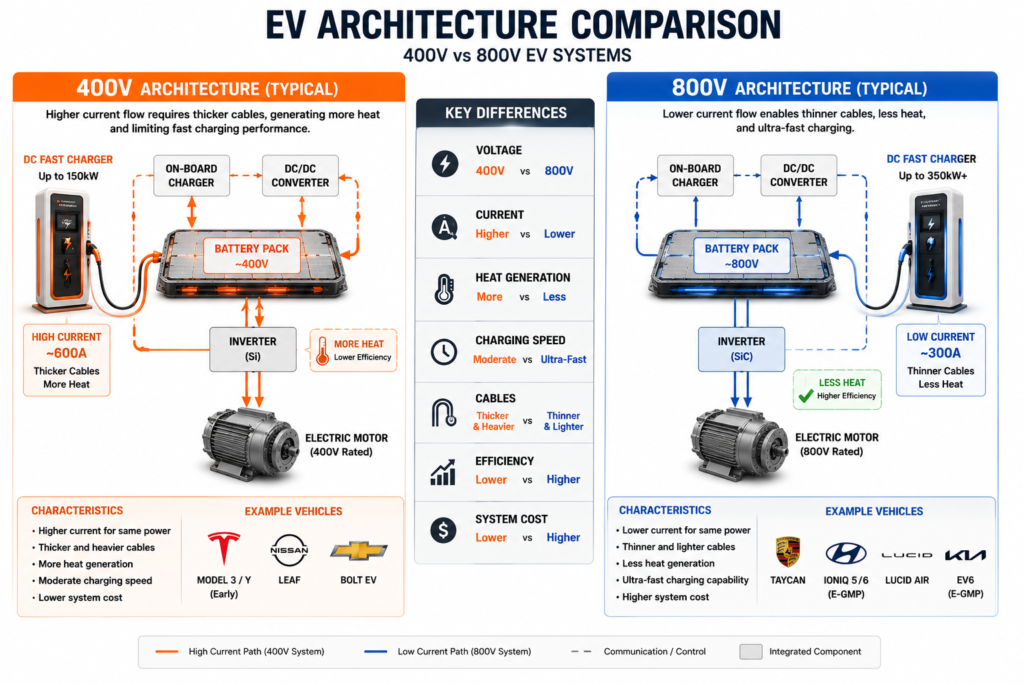
The debate around 400V vs 800V EV architectures has become one of the biggest topics in the electric vehicle industry. A higher-voltage EV architecture allows the vehicle to deliver the same power with lower current. That reduces heat generation, improves charging speed, enables thinner cables, and increases drivetrain efficiency.
Most mainstream EVs today still use around 400V systems, but newer platforms from companies like Hyundai Motor Company, Porsche, Lucid Motors, General Motors, and Tesla are increasingly adopting 800V-class architectures because they support ultra-fast charging and higher efficiency.
The shift to 800V is one of the biggest technical transitions currently happening in the EV industry.
Why Voltage Matters in an EV
Many EV discussions focus on battery size or range, but voltage architecture is equally important. At the simplest level:
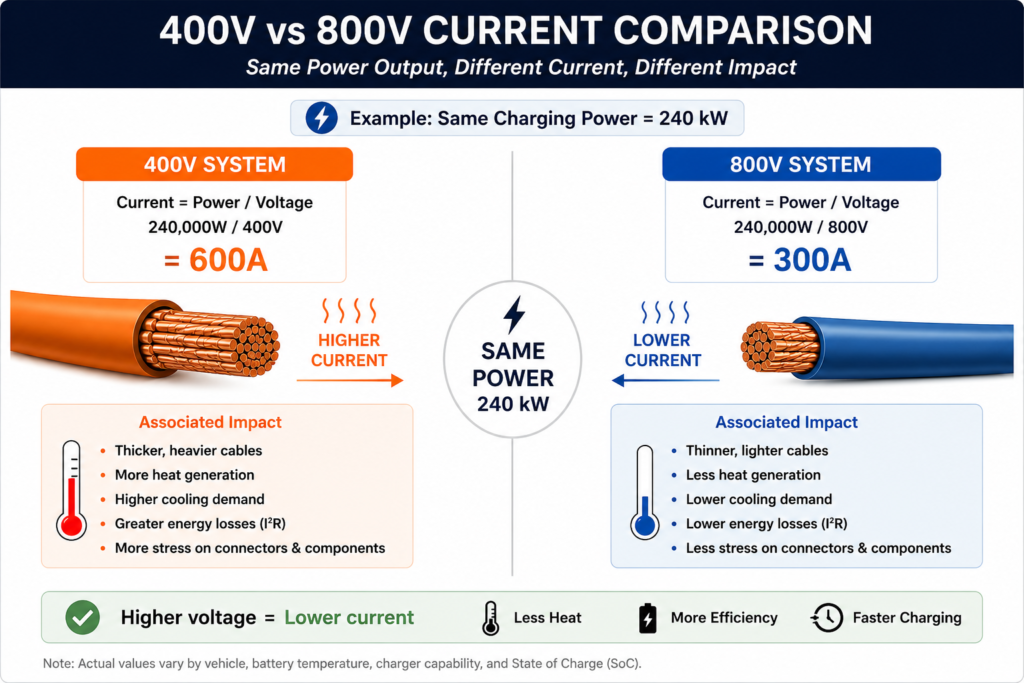
(Power = Voltage × Current)
If an EV needs 240 kW of charging power, a 400V system requires roughly 600A while an 800V system only needs about 300A. That difference is enormous in real-world engineering. Higher current creates more heat, larger cables, higher cooling requirements, and more electrical losses. This is why modern high-performance EVs increasingly move toward higher voltages.
Why 800V Charging Is Faster
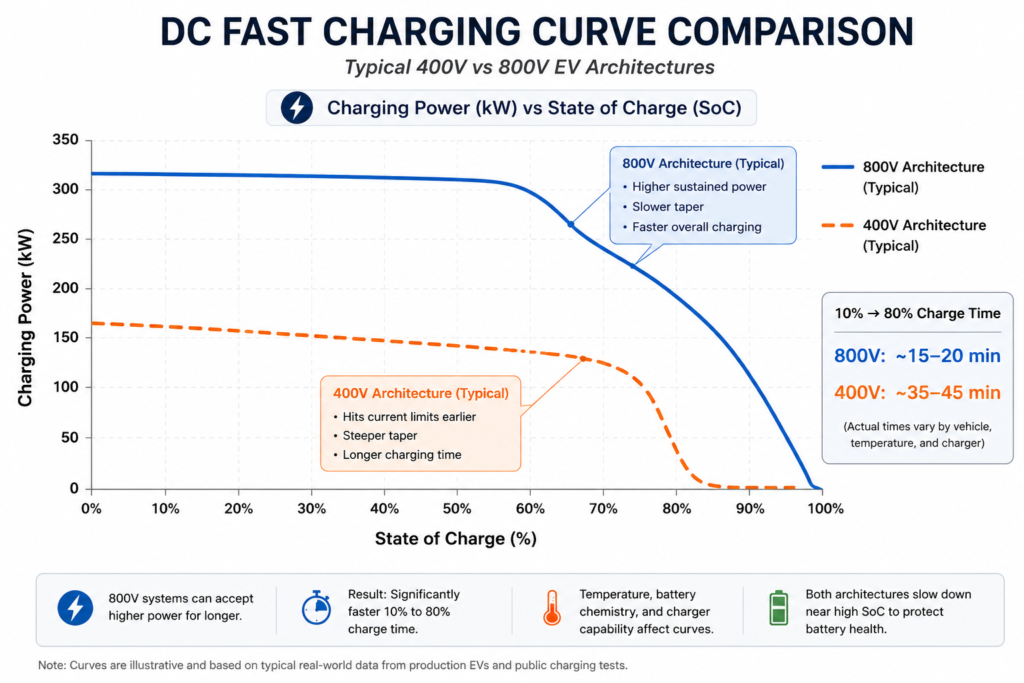
One of the biggest advantages of 800V systems is DC fast charging performance. Most 400V EVs eventually become limited by current handling capability. Even if the charger can deliver huge power, cable temperatures and battery thermal limits become bottlenecks.
An 800V architecture reduces current demand substantially while maintaining high charging power. That is why vehicles like the Porsche Taycan and Hyundai IONIQ 5 can maintain extremely high charging rates. According to Hyundai’s official E-GMP overview, E-GMP vehicles support 800V charging capable of charging from 10% to 80% in around 18 minutes. Similarly, Porsche’s Taycan technical overview explains that the 800V system reduces charging time while also reducing cable size and weight.
The Real Engineering Benefit: Lower Heat
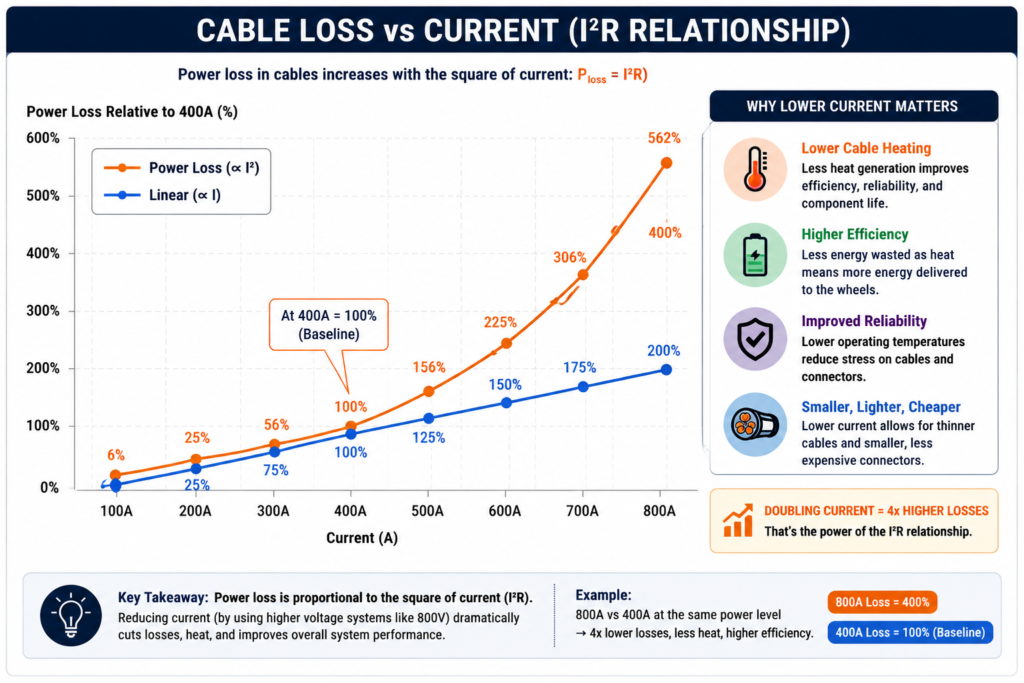
From an engineering standpoint, this is where things become especially interesting. Electrical losses are approximately proportional to current squared:
This means doubling current increases resistive losses by roughly 4× or reducing current dramatically improves efficiency. In EVs, heat is one of the primary enemies of battery longevity, charging consistency, inverter efficiency, or cable durability. This is why higher voltage systems are attractive not only for charging speed, but also for sustained performance. It is also one of the reasons why high-performance EVs increasingly rely on advanced thermal management systems and silicon carbide power electronics.
Silicon Carbide Inverters Changed Everything
The rise of 800V EV platforms became much more practical because of silicon carbide (SiC) power semiconductors. Traditional silicon-based inverters struggle with switching losses at higher voltages and frequencies. Silicon carbide devices offer lower switching losses, higher efficiency, better high-temperature operation, and smaller cooling requirements. This technology is now becoming common in premium EV platforms. For example:
- Porsche Taycan uses SiC-based inverters
- Lucid Air heavily emphasizes drivetrain efficiency
- Hyundai IONIQ 5 and Kia EV6 leverage 800V charging capability
- Tesla Cybertruck moved toward a higher-voltage architecture compared to earlier Tesla platforms
This is one of the reasons why modern EV efficiency numbers have improved noticeably over the past several years.
Why Most EVs Still Use 400V
If 800V is better, why doesn’t every EV use it? The answer is cost and complexity. 800V systems require more expensive power electronics, higher insulation requirements, different inverter designs, more advanced charging systems, and additional safety validation. For many mainstream vehicles, a well-designed 400V system is still perfectly adequate. That is why many affordable EVs continue using 400V architectures today. Examples include earlier versions of:
- Tesla Model 3
- Tesla Model Y
- Chevrolet Bolt EV
- Nissan LEAF
For drivers primarily charging at home overnight, the difference between 400V and 800V may not feel dramatic day-to-day. The biggest advantage appears during repeated DC fast charging on long trips.
The Charging Infrastructure Problem
Another challenge is charging infrastructure compatibility. Not every DC fast charger fully supports 800V operation. Automakers solved this differently. For example, Hyundai Motor Group designed E-GMP vehicles to support both 400V and 800V charging without requiring additional external hardware. Meanwhile, Porsche Taycan includes onboard solutions for compatibility with 400V chargers.
This backward compatibility is critical because public charging infrastructure is still evolving. Even today, actual charging performance often depends more on charger capability and battery temperature than the theoretical voltage architecture alone.
Why Lucid Is Getting So Much Attention
Among current EV companies, Lucid Motors receives enormous engineering attention because of its extremely efficient high-voltage platform. The Lucid Air operates on a 900V+ architecture and focuses heavily on efficiency optimization. Lucid’s strategy is interesting because they are not simply chasing bigger batteries. Instead, they improve motor efficiency, inverter efficiency, aerodynamics, thermal management, and electrical losses. This allows them to achieve extremely high range numbers without requiring excessively massive battery packs. That engineering philosophy is becoming increasingly important as EV manufacturers attempt to reduce cost and improve scalability.
Where GM and Tesla Fit Into This
General Motors and Tesla have taken somewhat different approaches. GM’s Ultium platform was designed with flexibility in mind, allowing different battery pack configurations and scalable architectures across multiple vehicle segments. Tesla historically remained heavily optimized around 400V systems because of manufacturing simplicity and infrastructure maturity. However, the Tesla Cybertruck introduced a more advanced electrical architecture and next-generation power electronics strategy, signaling where Tesla may be heading long-term.
The industry trend is increasingly clear:
- Mainstream EVs may remain near 400V for cost reasons
- Premium and performance EVs are steadily moving toward 800V+
- Future platforms may go even higher
Is 800V the Future of EVs?
Probably yes — especially for premium vehicles. But 400V systems are not disappearing anytime soon. The industry is likely heading toward a split:
400V Systems
Best for lower-cost EVs, urban commuters, simpler architectures, and lower charging expectations.
800V Systems
Best for fast road-trip charging, high-performance EVs, large battery packs, heavy vehicles and trucks, and premium EV platforms. As charging infrastructure improves and silicon carbide costs continue falling, 800V architectures will likely become increasingly common.
Conclusion
The move from 400V to 800V EV architectures is much more than a marketing trend. It fundamentally changes charging speed, thermal behavior, cable sizing, power electronics design, and vehicle efficiency.
And as EV technology matures, these electrical architecture decisions are becoming one of the clearest indicators of how advanced a platform truly is. A few years ago, 800V systems were rare. Today, they are becoming one of the defining technologies of next-generation EVs.
Related article:
How Long Do EV Batteries Last? Real-World Data and Battery Degradation (2026)
LFP vs NMC Batteries: Which EV Battery Is Better in 2026?
Why EV Batteries Charge Slower Above 80%