
Quick Answer
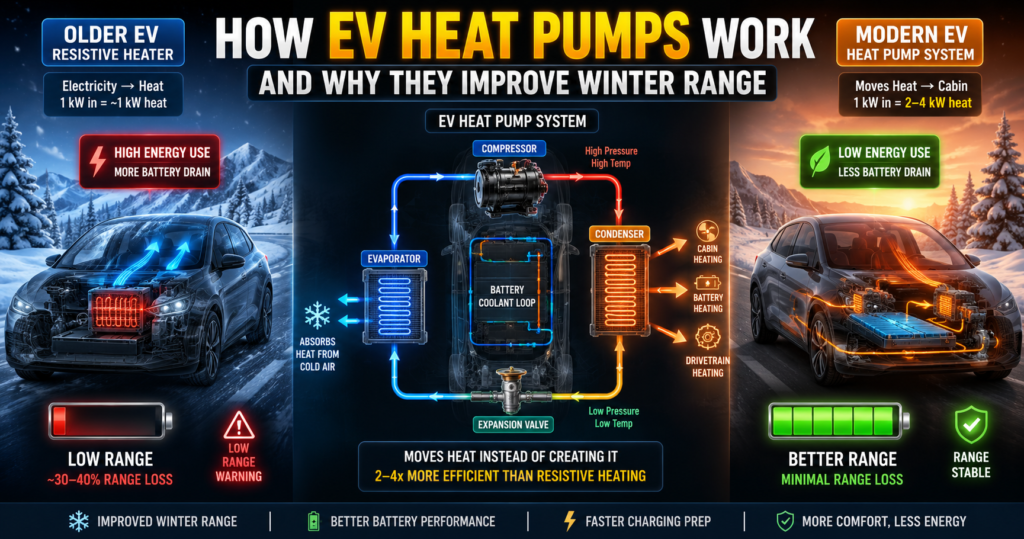
EV heat pumps improve winter driving efficiency by moving heat instead of generating it directly like a traditional resistive heater. Because heat pumps transfer thermal energy using a refrigerant cycle, they can deliver significantly more heating energy per unit of electrical power consumed. This helps reduce battery drain during cold weather and improves winter driving range.
Modern EVs from companies like Tesla, Hyundai, Kia, GM, and Rivian now use increasingly sophisticated heat pump systems as part of their battery and cabin thermal management strategy.
Why EV Heat Pumps Matter in Winter
One of the biggest surprises for new EV owners is how much range can drop during winter. Unlike gasoline vehicles, EVs do not have abundant waste engine heat available for cabin warming. In an internal combustion engine vehicle, the engine naturally produces a large amount of excess heat. In an EV, nearly all energy is carefully conserved for propulsion and battery operation. That means cabin heating directly consumes battery energy. This is why cold-weather efficiency has become one of the most important topics in modern EV development.
The U.S. Environmental Protection Agency and FuelEconomy.gov both explain that cold temperatures reduce EV efficiency because batteries operate less efficiently in low temperatures while cabin heating increases energy consumption.
For additional winter EV insights, you can also read these related EV Insight Daily articles:
- Why EV Range Drops in Winter
- Why EV Batteries Charge Slower Above 80%
- EV Battery Degradation in Hot Weather (2026 Guide)
The Basic Idea Behind an EV Heat Pump
A heat pump does not create heat from scratch. Instead, it moves heat from one location to another. Even cold outdoor air still contains thermal energy. A heat pump extracts that energy and transfers it into the cabin or battery system. This is fundamentally different from a traditional resistive heater.
EV Heat Pump vs Resistive Heater
Traditional Resistive Heater
A resistive heater works similarly to a household space heater or toaster. Electric current passes through a resistive element, converting electricity directly into heat. The problem is efficiency. In simplified terms, 1 kW of electrical power produces roughly 1 kW of heat. This is straightforward but energy intensive.
EV Heat Pump
A heat pump uses refrigerant, compressor, evaporator, condenser, and expansion valve to transfer heat instead of generating it directly. Because it moves existing thermal energy, it can produce much more heating output than the electrical energy it consumes.
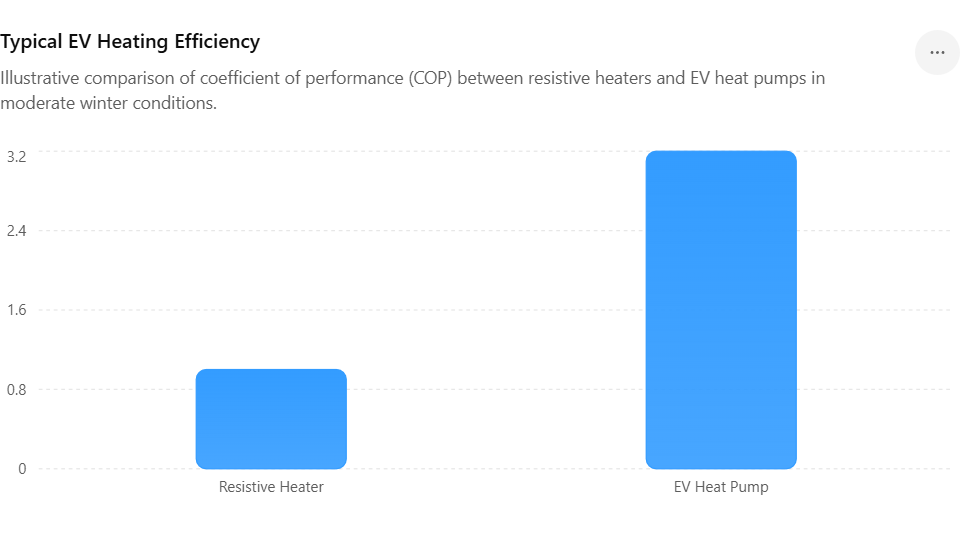
This efficiency advantage is commonly described using Coefficient of Performance (COP).
In many moderate winter conditions:
- Resistive heater COP ≈ 1
- Heat pump COP ≈ 2–4
That means the system may deliver 2–4 times more heating energy than the electrical energy consumed.
Heat Pump Efficiency vs Resistive Heating
Typical EV Heating Efficiency
Illustrative comparison of coefficient of performance (COP) between resistive heaters and EV heat pumps in moderate winter conditions.
How the Refrigerant Cycle Actually Works
Modern EV heat pumps operate using the same thermodynamic principles found in residential HVAC systems, but automotive implementations are significantly more compact and dynamic. Here is the simplified cycle.
1. Evaporator — Absorbing Heat
The refrigerant enters the evaporator at very low pressure and temperature. Even when outside air feels cold to humans, the refrigerant can still absorb thermal energy from it. The refrigerant evaporates into a gas as it absorbs heat.
2. Compressor — Raising Temperature
The compressor pressurizes the refrigerant gas. Compressing the gas increases its temperature significantly. This is one of the key reasons heat pumps work even during winter.
3. Condenser — Delivering Cabin Heat
The hot refrigerant flows through the condenser. Heat transfers into cabin air, battery coolant loop, and drivetrain thermal loop depending on vehicle operating conditions. The refrigerant then condenses back into liquid form.
4. Expansion Valve — Restarting the Cycle
The refrigerant pressure drops rapidly through the expansion valve. Its temperature decreases again, preparing it to absorb more heat from the outside environment. The cycle repeats continuously.
Why Heat Pumps Improve EV Winter Range
Cabin heating can become one of the largest energy consumers in winter driving. In some cold-weather situations, heating demand alone can noticeably reduce total range. Because heat pumps reduce heating power consumption, they directly help preserve battery energy for driving. This is one reason manufacturers aggressively shifted toward heat pump adoption after early EV generations relied heavily on resistive heating.
Examples include:
- Tesla Support — Cold Weather Best Practices
- Tesla Owner’s Manual — Using Climate Controls
- Rivian Official Support Home
- Drive Electric Vermont — Your Guide to EVs in Winter
Many modern EV platforms now integrate battery thermal management (BMS), cabin HVAC, inverter cooling, motor cooling, and fast charging temperature conditioning into a shared thermal architecture. This is far more advanced than earlier EV generations.
Tesla’s Octovalve Changed the Industry
One reason heat pumps became a major EV discussion topic is Tesla’s introduction of the “Octovalve” thermal system. Tesla redesigned thermal flow management to dynamically route coolant and thermal energy between multiple systems. Instead of treating cabin heating, battery heating, and drivetrain cooling as mostly separate functions, the system can redistribute thermal energy where it is needed most. This improves winter efficiency, fast charging preparation, battery temperature stability, and overall system efficiency.
Several engineering teardown analyses helped popularize how advanced Tesla’s thermal integration had become:
Tesla also publicly discussed its integrated thermal architecture during Model Y development:
Modern EVs Are Using More Advanced Refrigerants and Thermal Strategies
The thermal management industry is evolving rapidly. Newer EVs increasingly use refrigerants with lower global warming potential (GWP) and more integrated cooling architectures. For example,
- R1234yf has become common in automotive HVAC systems
- Some next-generation systems are exploring CO₂-based heat pumps
- Battery preconditioning strategies are becoming more software-driven
Several companies are also improving low-temperature compressor operation and refrigerant flow optimization for extreme winter environments. This matters because one major limitation of heat pumps is extremely cold weather performance.
The Main Weakness of EV Heat Pumps
Heat pumps are highly efficient in cool-to-cold weather. But they become less effective as outdoor temperatures fall dramatically. At extremely low temperatures, there is less ambient thermal energy available, compressor efficiency declines, and frost buildup can become problematic. In very cold regions, many EVs still rely on supplemental resistive heaters. This is why some drivers in places like Alaska, northern Canada, or Scandinavian regions may still observe substantial winter range loss despite having a heat pump-equipped EV.
Real-world testing and industry studies continue to show noticeable EV efficiency reductions during freezing weather:
Why Battery Chemistry Also Matters
Battery chemistry and thermal management are now deeply connected.
LFP Batteries
Lithium Iron Phosphate Battery batteries generally struggle more in cold temperatures compared to many NMC chemistries. This increases the importance of battery preconditioning, intelligent thermal control, and efficient cabin heating during winter operation.
High-Nickel Chemistries
High-energy-density nickel-rich batteries can provide strong performance but often require tighter thermal control windows. This makes advanced heat pump integration increasingly valuable.
Future Solid-State Batteries
Future solid-state battery systems may eventually reduce some thermal management challenges, but most experts still expect sophisticated heating and cooling systems to remain essential.
Related reading:
- LFP vs NMC Batteries: Which EV Battery Is Better in 2026?
- Solid-State Batteries Explained: Hype vs Reality in 2026
Heat Pumps Also Help Fast Charging
One overlooked advantage of EV heat pumps is fast-charging preparation. Fast charging works best when battery temperature is within an optimal range. Modern EVs can use thermal systems to warm batteries before DC fast charging, cool batteries during charging, and improve charging speed consistency. This becomes especially important during winter road trips. The battery may not accept high charging power efficiently if temperatures are too low.
Researchers have also explored predictive battery preheating algorithms for cold-weather charging optimization:
Real-World Winter Driving Still Matters
Even with advanced heat pumps, winter range depends heavily on driving speed, wind, snow tires, cabin temperature setting, battery chemistry, trip length, or preconditioning habits. Drivers can often improve winter efficiency by preheating while plugged in, using seat heaters instead of excessive cabin heating, scheduling battery preconditioning before charging, or reducing short cold starts.
Conclusion
Heat pumps have become one of the most important technologies in modern EV thermal management. They improve winter efficiency by transferring heat rather than generating it directly, helping preserve driving range during cold weather.
But modern EV heat pumps are no longer simple HVAC systems. Today’s vehicles integrate battery thermal control, cabin comfort, charging optimization, and drivetrain cooling into increasingly sophisticated thermal architectures.
As EV battery chemistry continues evolving — including LFP, high-nickel cells, and future solid-state batteries — thermal management systems will likely become even more important.
And in many ways, the heat pump is now one of the quiet technologies making modern EV ownership significantly better than it was just a few years ago.
FAQ
Do all EVs have heat pumps now?
No. Many newer EVs include them, but some entry-level trims still use resistive heaters or offer heat pumps as optional equipment.
How much range can a heat pump save in winter?
The exact improvement varies widely depending on temperature and driving conditions, but heat pumps can significantly reduce heating energy consumption compared to resistive heating systems.
Why do heat pumps struggle in extreme cold?
As temperatures drop, less thermal energy is available in outside air, reducing heat pump efficiency.
Can heat pumps heat the battery too?
Yes. Many modern EV thermal systems use shared coolant loops to warm both the cabin and battery pack.