
Quick Answer
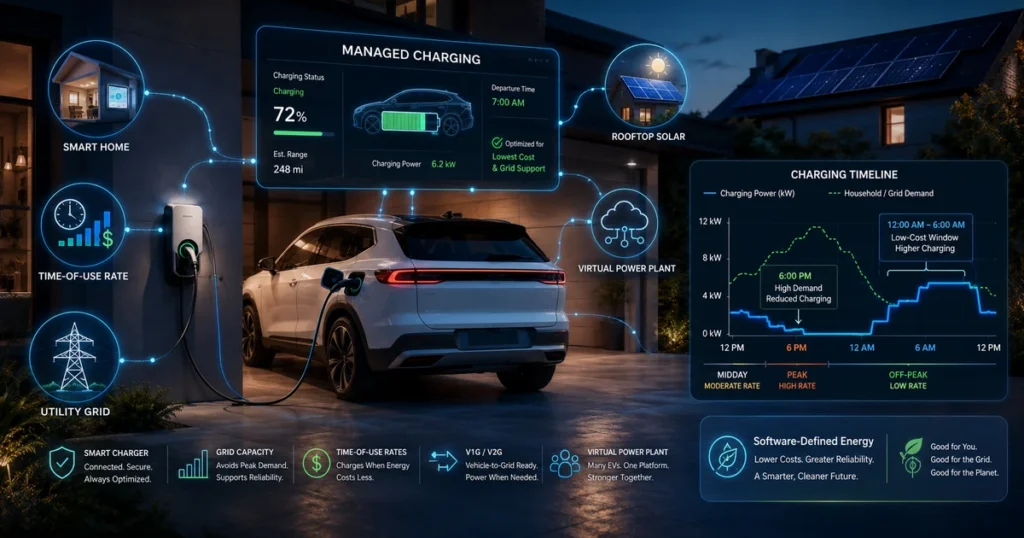
Managed EV charging uses software to decide when an EV charges, how much power it draws, and when charging should slow down or pause. Instead of starting at full power as soon as the vehicle is plugged in, a managed system considers the driver’s departure time, required battery level, electricity prices, building demand, local grid capacity, renewable-energy availability, and utility signals.
For drivers, this may mean plugging in at 6:00 p.m. but having the car wait until electricity becomes cheaper later that night. For an apartment building or commercial fleet, it can mean distributing limited electrical capacity across dozens of vehicles without charging all of them at maximum power at once.
Managed charging is important because most everyday EV energy will not come from highway fast chargers. The National Renewable Energy Laboratory’s report, The 2030 National Charging Network, projects that Level 1 and Level 2 charging will handle roughly 80% of light-duty EV charging needs in its 2030 scenario, with single-family homes representing the largest charging location. That means the future of charging will depend not only on how quickly chargers can deliver energy, but also on software that decides when and how that energy should be delivered.
EV Charging Is Becoming More Than Plugging In
The traditional view of EV charging is simple: park the car, connect the cable, and let electricity flow until the battery reaches its target. That description is technically correct, but it leaves out the part that is becoming increasingly important. A modern charging session can involve communication among the vehicle, charger, home energy-management system, charging-network operator, utility, electricity market, and sometimes a third-party energy aggregator. The driver may only see a cable and a mobile app. Behind the scenes, software may be answering several questions:
- How much energy does the vehicle actually need?
- When will the driver need the car?
- Is electricity expensive right now?
- Is the house already using a large amount of power?
- Are many EVs charging on the same neighborhood circuit?
- Is solar generation expected later in the day?
- Can charging be delayed without inconveniencing the driver?
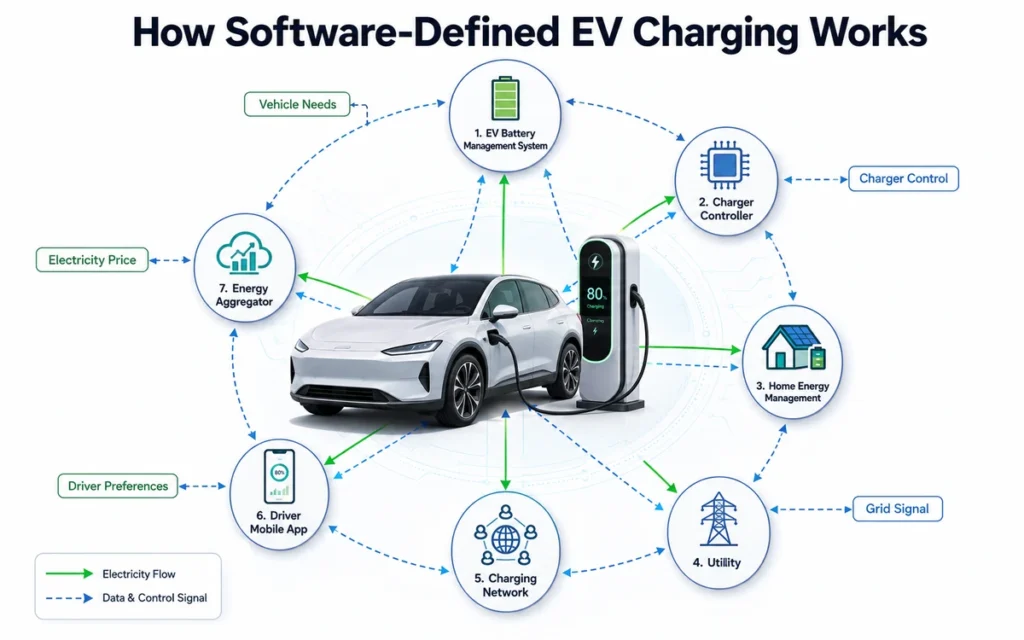
This is the basic idea behind managed charging. The U.S. Department of Energy defines managed EV charging as an adaptive approach that considers vehicle energy needs along with control objectives such as reducing grid impacts, avoiding expensive infrastructure upgrades, or lowering electricity costs. The important word is adaptive. The charger is no longer treated as a simple electrical outlet. It becomes a controllable energy device.
That does not necessarily make charging more complicated for the owner. Ideally, the experience becomes simpler. The driver tells the system, “I need 80% by 7:00 tomorrow morning,” and the software handles everything else.
What Managed Charging Actually Controls
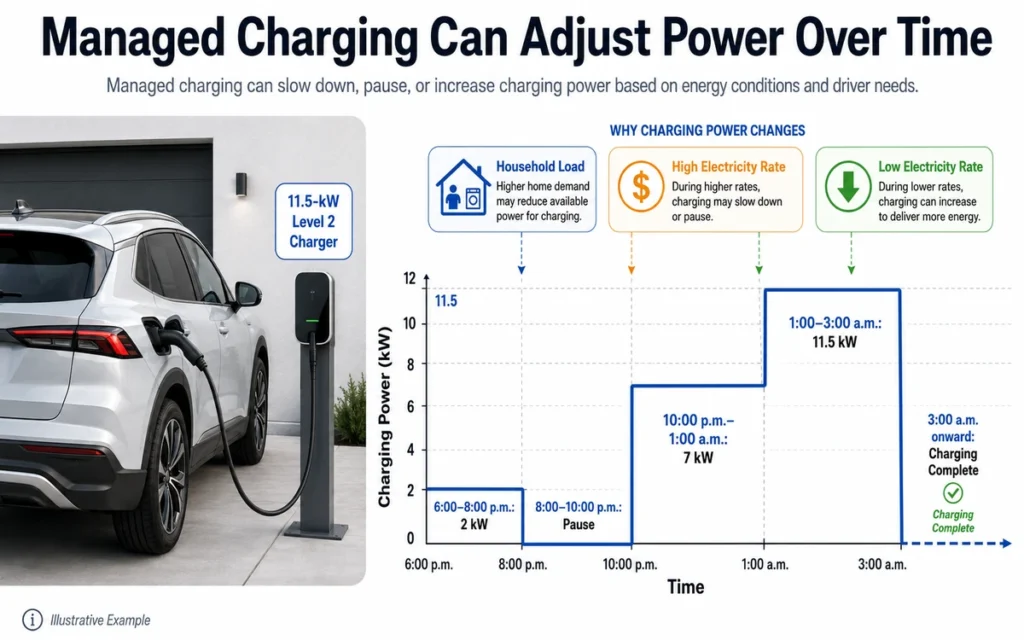
Managed charging is sometimes described as delayed charging, but delaying the start time is only the simplest form. A more advanced system can adjust charging power continuously. Imagine an EV connected to an 11.5-kW Level 2 charger. The charger does not have to operate at either zero or 11.5 kW. Depending on the equipment and communication setup, software may reduce it to 7 kW, then 4 kW, pause it temporarily, and increase it again later. In practice, managed charging can control three basic variables:
Charging Start and Stop Time
The easiest strategy is to wait until an off-peak period. A vehicle plugged in during the early evening might not begin charging until midnight, when household and grid demand are lower.
Many current EVs and home chargers already offer this function through scheduled charging. However, a fixed schedule is only a basic form of management because it does not automatically react to changing grid conditions.
Charging Power
A more flexible system changes how much power the vehicle receives. This can prevent a building from exceeding its electrical limit or reduce charging during an expensive demand period.
For example, four 9.6-kW chargers could theoretically draw 38.4 kW if they all operated at maximum power. A managed system might limit their combined demand to 20 kW and distribute that capacity based on departure times and battery needs.
Charging Priority
Not every vehicle needs to be treated equally at every moment. A fleet van leaving in one hour may receive priority over another van parked overnight. An employee who arrived with 15% battery may need energy sooner than someone who arrived with 70%. This is where managed charging becomes an optimization problem rather than a simple timer.
Why Home Charging Matters More Than the Fast-Charging Headlines
DC fast charging receives much of the attention because its power numbers are easy to market. A 350-kW charger sounds far more advanced than a 7.2-kW home charger. Yet most EV drivers do not need to replenish an entire battery in 20 minutes every day. Their cars may remain parked at home for ten or twelve hours while needing only enough electricity to replace the miles driven that day.
The Department of Energy’s Alternative Fuels Data Center notes that Level 2 equipment is widely used at homes because it can generally recharge a typical EV overnight. It is also common at workplaces and public destinations where vehicles remain parked for extended periods.
That long parking period creates flexibility. Suppose an EV arrives home at 6:00 p.m. with 40% charge and needs to reach 80% by 7:00 a.m. The vehicle may need three or four hours of charging, but it is connected for thirteen hours. The remaining time is a scheduling opportunity.
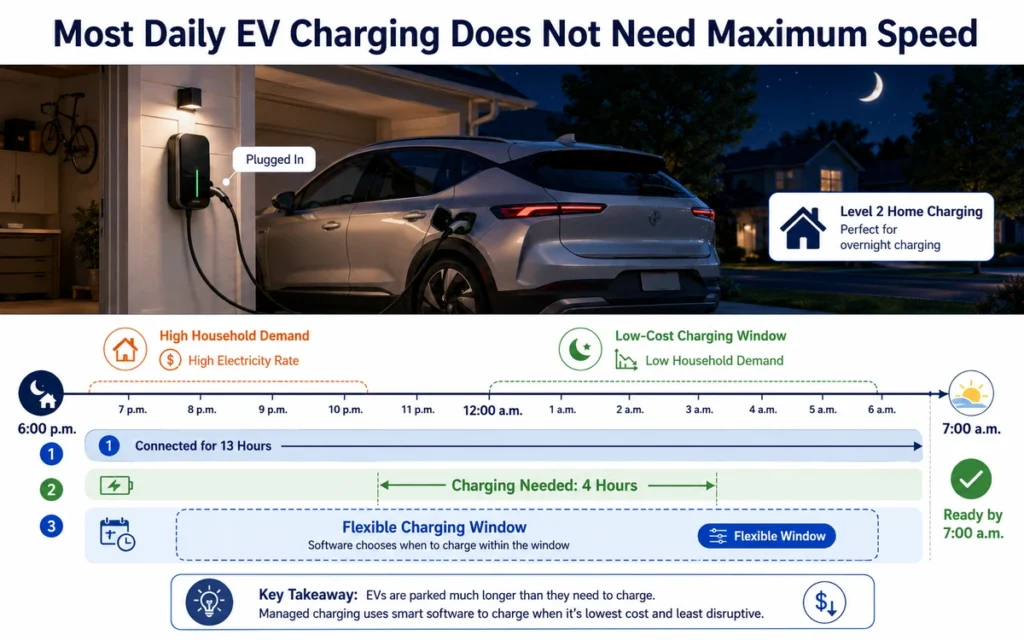
Software can choose the least expensive or least grid-constrained hours within that window. The driver still receives the requested charge by morning, but the car does not have to add a large electrical load at the same time that ovens, air conditioners, dryers, and other appliances are already operating. This is one reason managed charging could become more important to everyday EV ownership than another increase in peak fast-charging power.
Public fast charging will remain essential for road trips, drivers without dependable home charging, commercial transportation, and high-mileage use. But it solves a different problem. Fast charging is about delivering energy quickly when time is limited. Managed Level 1 and Level 2 charging is about using time intelligently when the vehicle is already parked.
For more detail on why advertised charging power does not always translate into a faster session, see Why Some EVs Charge Faster Than Others.
The Evening Charging Problem
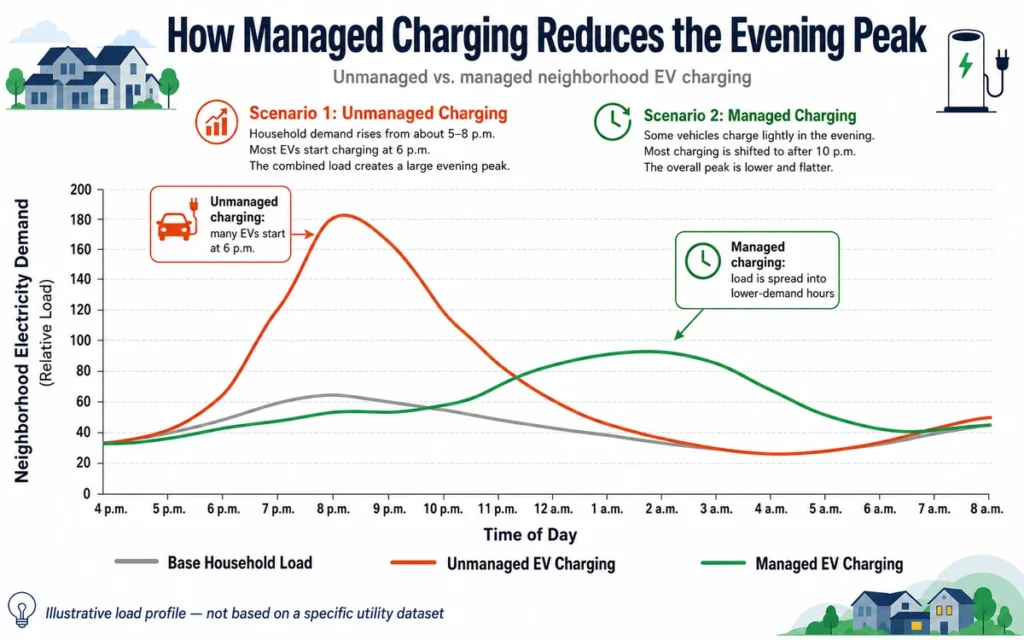
A single home EV charger is usually manageable. The challenge appears when many vehicles in the same neighborhood behave in the same way. Without management, drivers may arrive home from work between 5:00 and 7:00 p.m. and immediately plug in. The resulting charging load can overlap with the existing residential evening peak.
At the national level, the grid may have enough total generation to supply EVs. At the local level, however, a transformer, feeder, apartment electrical room, or commercial service connection may face a much tighter constraint.
The DOE’s 2024 report, Impact of Electric Vehicles on the Grid, emphasizes that EV charging effects are highly local. The same number of vehicles can produce very different infrastructure needs depending on where they charge, when they charge, and how much power they request. The report notes that managed charging can reduce peaks and defer some distribution-system upgrades.
This distinction matters. Saying “the grid can handle EVs” or “the grid cannot handle EVs” is too broad. A regional grid may have adequate energy over a full day while one neighborhood transformer becomes overloaded during a narrow evening window.
Managed charging cannot eliminate every infrastructure upgrade. Some areas will still need new transformers, conductors, substations, or service equipment as electricity use grows. But software can help avoid designing every part of the system around the unlikely assumption that every connected EV will draw maximum power at exactly the same time.
Time-of-Use Rates Are the First Layer of Managed Charging
The most familiar incentive for shifting charging is a time-of-use electricity rate. Under a time-of-use plan, electricity prices change according to the hour. Power may be relatively expensive during the late-afternoon and early-evening peak, then cheaper overnight. The Alternative Fuels Data Center describes these rates as schedules in which prices rise during high-demand periods and fall during lower-demand periods.
For an EV owner, the basic response is straightforward: schedule the car to charge during the least expensive window. Imagine a vehicle needs 40 kWh overnight. Charging that energy at $0.12 per kWh costs $4.80. At $0.28 per kWh, the same energy costs $11.20. The car travels the same distance either way. Only the timing changed. This example is illustrative. Actual rates, taxes, charging losses, and program rules vary by utility.
Time-of-use pricing is useful, but it is still a relatively blunt signal. Every participating customer may respond to the same cheap period by starting at the same moment. This can create a new spike when the lower rate begins, sometimes called a timer peak.
More advanced managed charging spreads those starts across a wider period. Rather than activating thousands of chargers at exactly midnight, software can stagger them while still meeting every driver’s requested departure time.
Home Energy Management Changes the Equation
Managed charging can also happen entirely behind the customer’s electric meter. Consider a house with a 200-amp electrical service, two EVs, an electric dryer, air conditioning, an induction range, a heat-pump water heater, and perhaps a home battery. Upgrading the service may be possible, but it can be expensive and may require utility work.
A home energy-management system can monitor total household demand and reduce EV charging when other large loads are operating. When the dryer finishes or the air conditioner cycles off, the charger can increase power again.
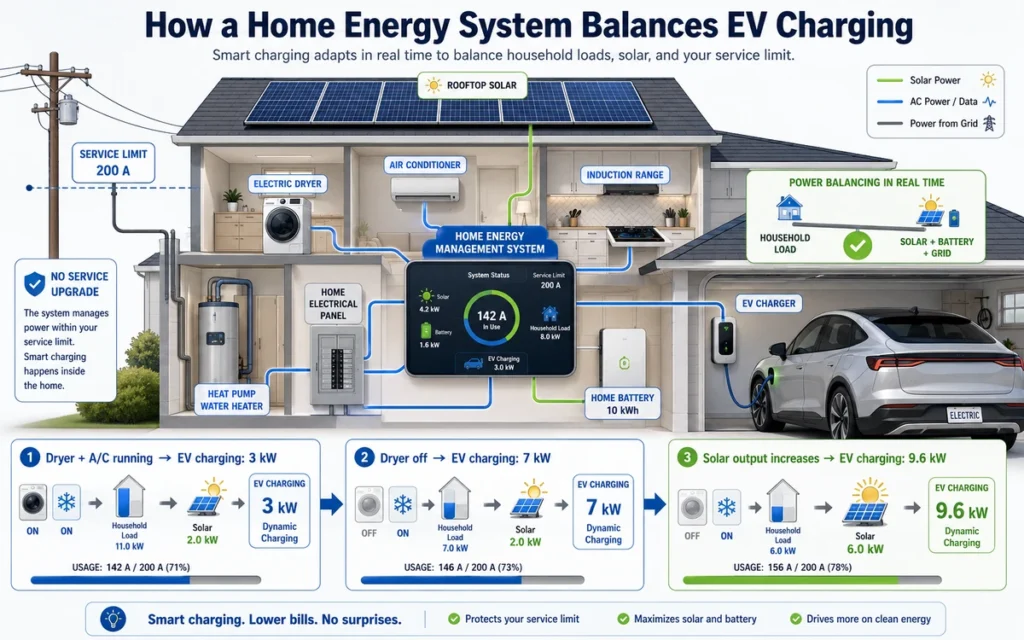
From the driver’s perspective, the car still charges overnight. From the electrical system’s perspective, the peak load remains below a defined limit. This approach is particularly useful because EV charging is usually flexible while many household loads are not. Dinner cannot always be postponed for four hours. The car, however, may have all night to recover the energy used during the day.
Solar adds another layer. A home with rooftop solar may prefer to charge during midday rather than export excess energy. A workplace might do the same with employee vehicles parked during daylight hours. Managed charging can follow solar production, reduce imports from the grid, or coordinate charging with a stationary battery.
Apartment Buildings Need Managed Charging Even More
Single-family homeowners often have a dedicated parking space and direct control over their electrical equipment. Multifamily buildings face a more difficult problem. An apartment property may need to support dozens or hundreds of parking spaces through an electrical system that was never designed for every vehicle to draw 7–12 kW simultaneously. Installing a dedicated full-power circuit for every space can become prohibitively expensive.
Managed charging allows the building to install more connectors than it could operate at full power at one time. Suppose a garage has 100 connected vehicles but only 300 kW available for charging. Giving every vehicle a dedicated 9.6-kW allocation would theoretically require 960 kW. A managed system can instead share the 300-kW limit.
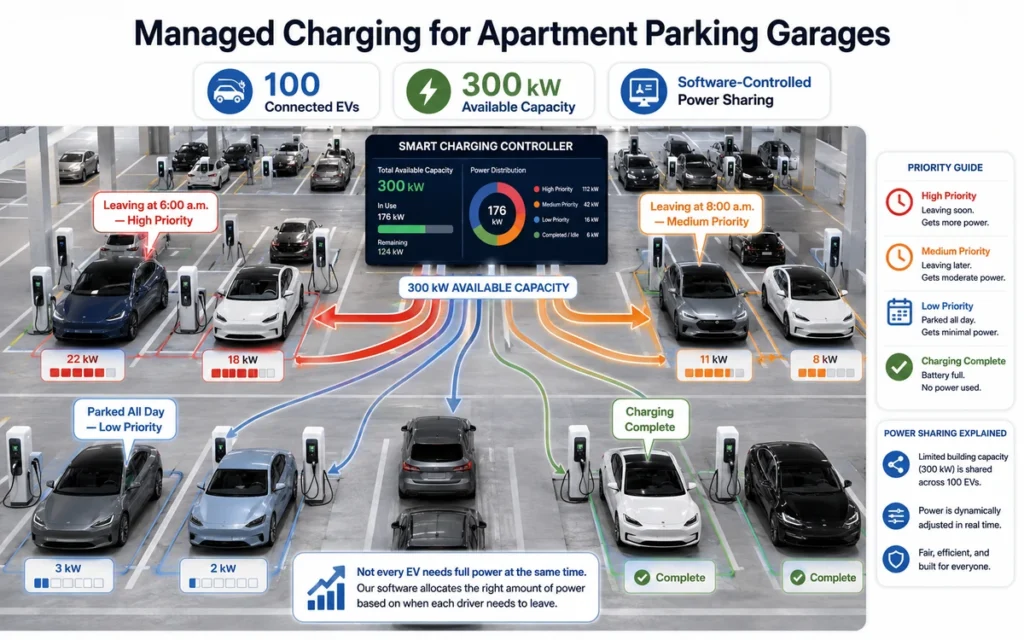
Vehicles that need to leave early receive energy first. Vehicles parked for the entire night can charge later. Cars that need only 10 kWh do not reserve the same electrical capacity as cars needing 60 kWh. This does not mean every building can avoid upgrades. It means the charging design can be based on realistic energy needs, parking duration, and diversity of use rather than the sum of every charger’s nameplate rating.
For apartment residents, the challenge is not only technical. Billing, parking rights, charger reliability, access control, and tenant turnover all matter. Managed charging software will increasingly have to handle those practical issues alongside electrical optimization.
Fleet Charging Turns Software Into an Operations Tool
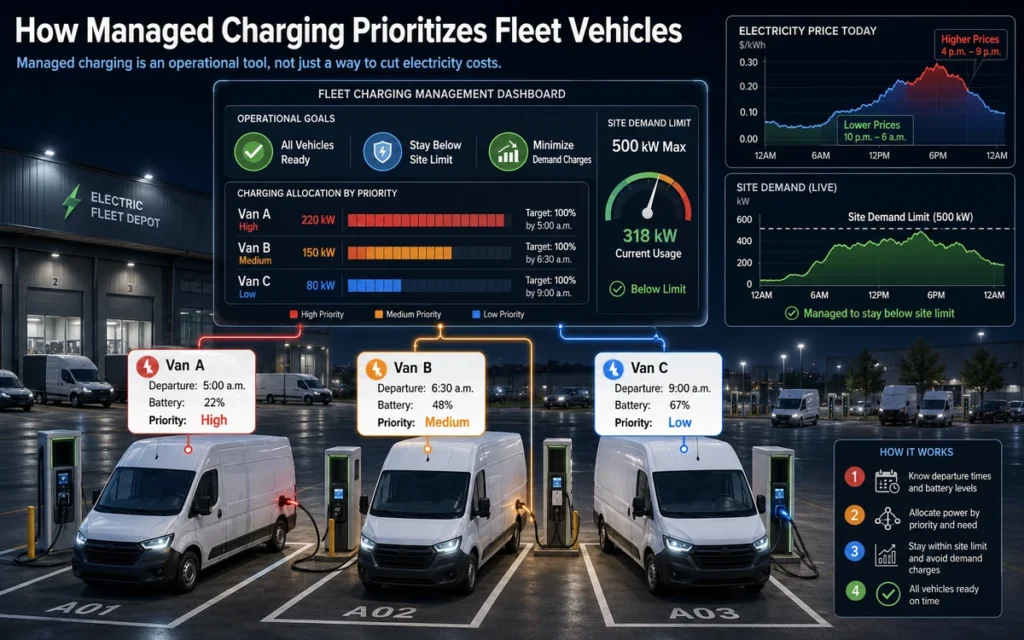
Fleet depots provide one of the clearest examples of why charging must become software-defined. A commercial fleet may operate delivery vans, service trucks, buses, or municipal vehicles. Each vehicle has a route, departure time, expected mileage, battery state, and minimum energy requirement. Electricity prices may include both energy charges and demand charges based on the site’s highest power draw.
Simply plugging everything in at maximum power can create an expensive peak. It can also force the facility to purchase more charging hardware and utility capacity than it regularly needs. A managed fleet system can build a schedule around operational priorities:
A vehicle leaving at 5:00 a.m. receives energy before one leaving at 9:00 a.m. A bus returning with a nearly empty battery is treated differently from one that completed a short route. Charging may slow during a building peak and accelerate later. Some vehicles may charge in multiple windows rather than one continuous session.
DOE’s Federal Energy Management Program says smart charge management can reduce charger installation costs, avoid some electrical upgrades, lower demand-related electricity costs, and still ensure that vehicles receive the energy needed for their missions. For fleets, the question is not “How fast is this charger?” It is “Can every required vehicle complete tomorrow’s work at the lowest practical energy and infrastructure cost?”
V1G Comes Before V2G
Managed charging is often associated with vehicle-to-grid technology, but they are not the same thing. Most managed charging today is unidirectional. Electricity flows from the grid to the vehicle, while software controls the timing and rate. This is often called V1G. Vehicle-to-grid, or V2G, adds reverse power flow. A compatible EV can return energy to a building or the wider grid. This could provide backup power, reduce a facility’s peak demand, or support grid services.
V2G receives more attention because an EV powering a house is visually compelling. Yet V1G may scale sooner because it does not require the vehicle battery to discharge through the charging connection.
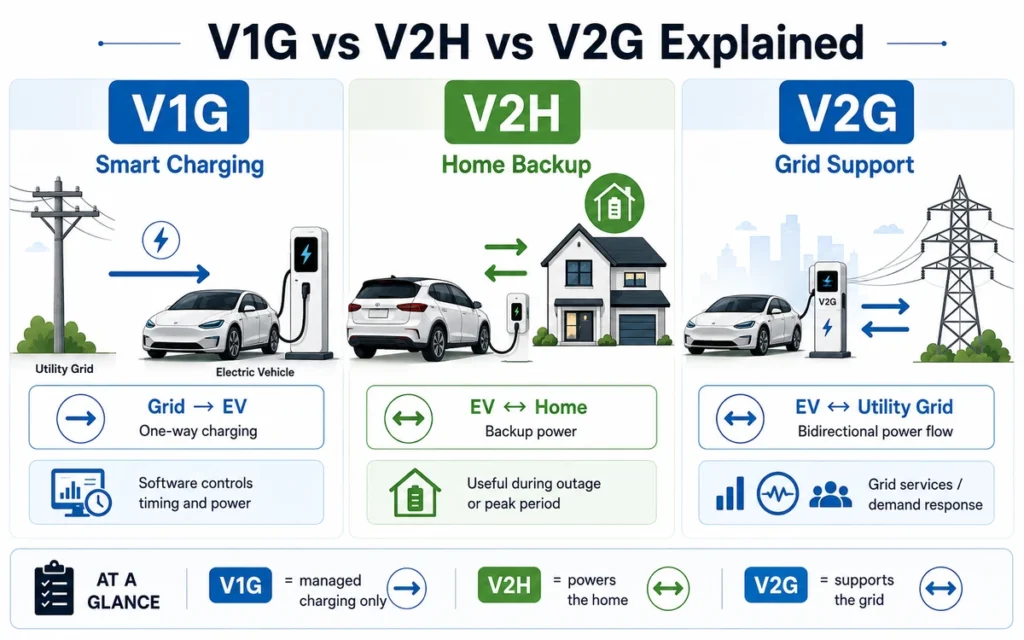
Simply moving charging away from a constrained time can create substantial value. The vehicle does not have to sell electricity back to the grid to become useful as a flexible resource. Bidirectional charging also requires compatible vehicles, chargers, interconnection rules, safety certifications, utility approval, and compensation structures. DOE notes that V2G incentive programs and reverse-power arrangements are not yet widely available in many areas.
For readers interested in the battery-health side of bidirectional operation, Does Vehicle-to-Grid Damage Your EV Battery? explains why additional cycling matters, but does not automatically mean V2G will ruin the battery.
How EVs Could Become Part of a Virtual Power Plant
A virtual power plant, or VPP, coordinates many distributed energy resources as though they were one larger resource. Those resources might include smart thermostats, home batteries, water heaters, rooftop solar systems, and EV chargers. A single vehicle shifting 5 kW may make little difference to the wider grid. Thousands of coordinated vehicles can create a meaningful change in demand.
Imagine 50,000 connected EVs, each capable of reducing charging power by an average of 3 kW for one hour. Together, they could reduce demand by 150 MW without disconnecting customers from essential electricity use. This is an illustrative calculation, not a forecast of a particular program.
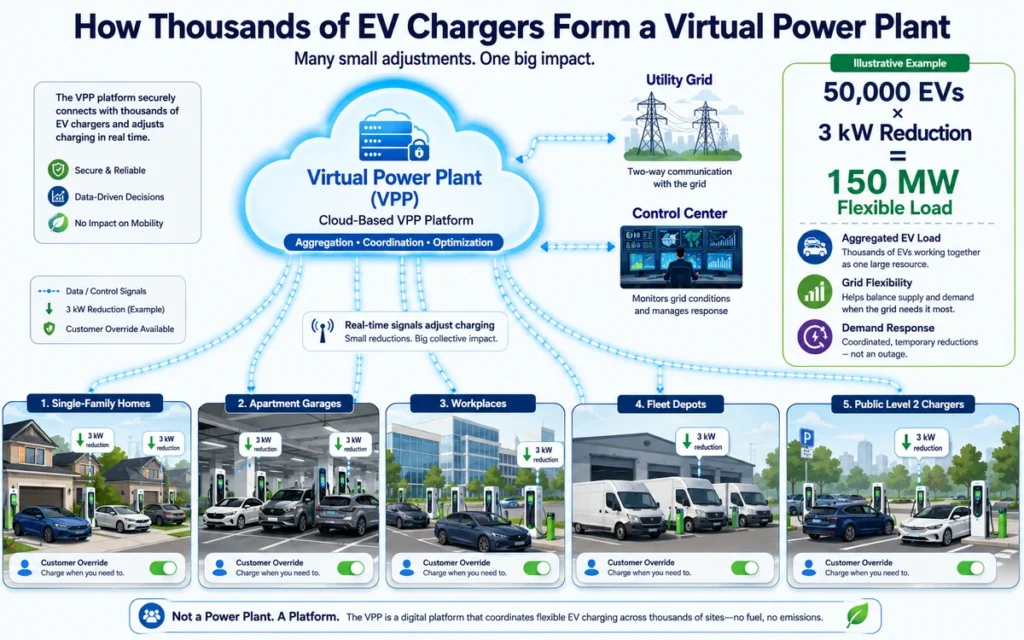
The vehicles would not all need the same control action. Some could pause. Others could reduce power. Cars already at their requested charge level would do nothing. The aggregator would coordinate the group while respecting customer settings.
DOE’s grid-impact report identifies distributed-resource aggregation and virtual power plants as potential tools for integrating growing electrical loads and reducing infrastructure costs. It also stresses that customer transportation needs must remain the priority. That last point is critical. A driver will not participate for long if the program leaves the car undercharged before an important trip.
The Vehicle, Charger, and Utility Must Speak the Same Language
Software-defined charging depends on communication, and communication becomes difficult when every manufacturer uses a different closed system. The vehicle may know the battery’s state of charge and charging limit. The charger knows its electrical capacity and network status. The utility knows local grid conditions and electricity prices. An aggregator may be responsible for coordinating thousands of devices.
For managed charging to work reliably, those systems need secure and interoperable ways to exchange information. Relevant standards and protocols include ISO 15118 for vehicle-to-charger communication, Open Charge Point Protocol for communication between chargers and charging-management platforms, and utility-facing standards such as IEEE 2030.5 in certain applications.
The details are mostly invisible to drivers, but interoperability affects whether a vehicle can participate in different programs without being locked into one charger brand, automaker, or utility platform. Cybersecurity matters as well. A networked charger is not merely a power cable. It is a connected device capable of controlling a significant electrical load. DOE has emphasized that communications, standards, data access, privacy, and cybersecurity must be developed together as vehicle-grid integration expands.
Does Managed Charging Harm the Battery?
In most normal applications, managed charging should not harm the battery simply because charging is delayed, slowed, or divided into multiple periods. In fact, lower charging power and less time spent at a very high state of charge may sometimes be gentler than immediately charging at the maximum available rate and leaving the vehicle full for many hours.
Battery aging depends on many factors, including temperature, chemistry, state of charge, charge rate, storage duration, and cell design. Managed charging software therefore needs to coordinate with the vehicle’s battery management system rather than bypass it.
The charger does not decide how much current the battery cells can safely accept. The vehicle’s BMS remains the gatekeeper. It considers cell voltage, temperature, battery state, cooling capability, and protection limits before requesting power.
This is also why charging slows near full even when plenty of grid capacity is available. The battery’s electrochemical limit is separate from the building or utility limit. Why EV Batteries Charge Slower Above 80% explains how battery voltage, charging taper, and BMS protection shape the upper part of the charging session. Managed charging can optimize around the battery’s limits, but it cannot erase them.
What Drivers Will Notice
For many EV owners, managed charging will initially look like a better version of the scheduled-charging feature they already use. The driver may enter a departure time, target charge level, and minimum emergency reserve. The system may then display an estimated cost and confirm that charging will be completed before departure.
Over time, utility programs could offer bill credits or lower rates in exchange for limited control during high-demand periods. Some programs may operate through the vehicle’s telematics connection, while others may communicate through a networked charger.
A good system should always provide a clear override. A driver leaving unexpectedly should be able to select “charge now” without navigating a complicated menu. The most successful programs will probably be the ones that require the least attention. Drivers should not have to study wholesale electricity markets or local transformer loading. They should only need to say when the car must be ready.
The Limitations Are Real
Managed charging is powerful, but it is not a substitute for building adequate charging infrastructure. Drivers without reliable residential charging have less flexibility. Someone who depends on a public charger cannot always wait several hours for a low-cost period. Rural corridors, apartment residents, street parkers, commercial trucks, and high-mileage drivers may need different solutions.
Poorly designed programs can also create frustration. A system that regularly fails to reach the requested charge level will quickly lose customer trust. Complex enrollment, small incentives, unreliable connectivity, and unclear privacy terms can limit participation.
There is also a fairness issue. Homeowners with garages may have greater access to low-cost managed charging than renters or drivers who depend on public stations. Grid-friendly charging programs should not assume that every EV owner has the same parking situation or schedule.
Finally, some grid constraints are physical and persistent. Software can shift load within the available capacity, but it cannot create unlimited capacity. Transformers, feeders, substations, generation, and transmission will still require investment as transportation electrification grows. The more realistic goal is to build the right amount of infrastructure and use it more efficiently.
Why EV Charging Will Become Software-Defined
Early EV charging was largely hardware-focused. The central questions were connector type, voltage, power rating, and station location. Those questions still matter, but the next stage is about coordination. A charger’s maximum output tells us how quickly it could deliver energy. It does not tell us whether that power is available at the site, whether using it now is economical, whether the battery needs it, or whether another connected vehicle has a more urgent departure.
Software connects those pieces. It can combine driver preferences, battery information, charger capacity, household demand, fleet schedules, time-of-use rates, local grid limits, renewable production, and energy-market signals. The result is a charging session designed around an outcome rather than a fixed power level.
The car is ready when the driver needs it. The charging site stays within its electrical limit. The owner avoids unnecessarily expensive energy. The utility gains more flexibility. Existing grid equipment is used more efficiently. That is what software-defined charging really means.
Conclusion
The future of EV charging will not be measured only by how many 350-kW stations are installed or how quickly a vehicle can reach 80%. Those developments are important, especially for long-distance travel. But much of the electricity used by passenger EVs will continue to be delivered slowly at homes, workplaces, apartments, and fleet depots while vehicles remain parked.
That creates a large amount of flexibility. A vehicle may be connected for ten hours while needing only three hours of energy delivery. Managed charging uses software to make productive use of the remaining time. At its simplest, the car waits for a lower electricity rate. At a more advanced level, dozens of vehicles share limited building capacity. At a grid level, thousands of chargers may respond collectively as part of a virtual power plant.
The driver still plugs in. The important change is that charging no longer has to begin immediately, operate at full power, or ignore everything happening around it. The next generation of charging will be less about sending electricity through a cable and more about making the right charging decision at the right time.
FAQs
What is managed EV charging?
Managed EV charging is a system that controls when a vehicle charges and, in more advanced setups, how much power it receives. It can account for departure time, desired battery level, electricity price, building demand, and grid conditions.
Is managed charging the same as scheduled charging?
Scheduled charging is a basic form of managed charging. A fixed schedule starts charging at a preset time. Advanced managed charging can continuously adjust power in response to prices, vehicle needs, building loads, or utility signals.
Can a utility prevent my EV from charging?
Program rules vary. Well-designed voluntary programs generally allow drivers to override a charging delay when they need the vehicle immediately. Owners should review enrollment terms, incentives, privacy policies, and override provisions before participating.
Does managed charging require a smart charger?
Not always. Some programs communicate directly with the vehicle through the automaker’s telematics platform. Others require a compatible networked charger. More advanced building-level power sharing normally requires controllable charging equipment.
Will managed charging save money?
It can reduce charging costs when it shifts energy to lower-priced periods. It may also help apartment buildings, fleets, and commercial sites avoid demand charges or reduce the size of electrical upgrades. Savings depend on local rates, program incentives, charging behavior, and equipment costs.
Is managed charging the same as V2G?
No. Managed charging is usually unidirectional, with electricity flowing only into the vehicle. V2G allows a compatible EV to send energy back to a building or the grid. Unidirectional managed charging is also called V1G.