
Quick Answer
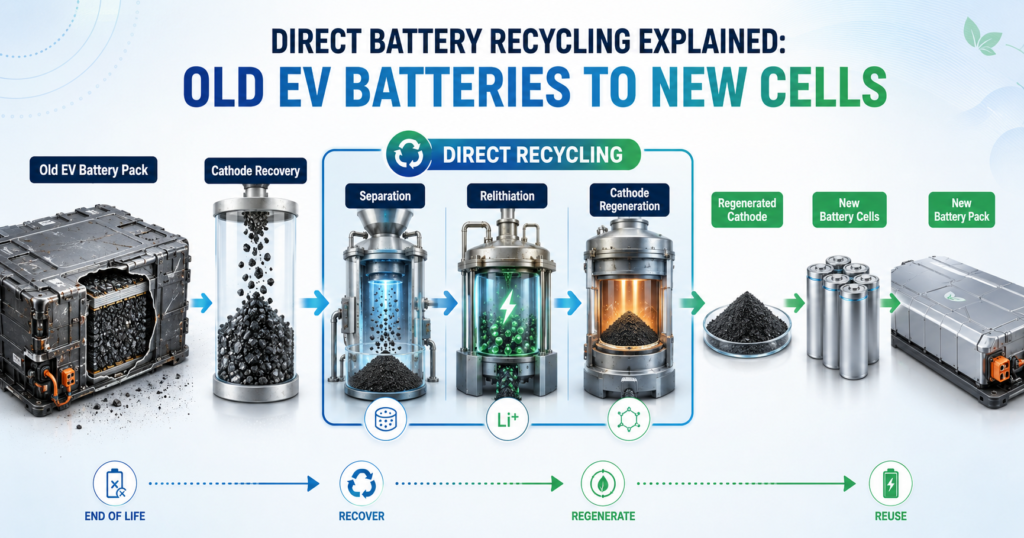
Direct battery recycling is a newer type of EV battery recycling technology that tries to recover and restore battery materials, especially cathode materials, without completely breaking them down into raw metals or chemical salts.
Traditional battery recycling usually uses pyrometallurgy, which relies on high-temperature smelting, or hydrometallurgy, which uses chemical leaching and refining. These methods can recover valuable materials such as nickel, cobalt, copper, lithium, and manganese, but they often destroy the original cathode structure in the process.
Direct recycling takes a different approach. Instead of treating an old lithium-ion battery as a pile of metals, it treats parts of the battery as engineered materials that may still have value if they can be cleaned, repaired, re-lithiated, and reused. That is why the U.S. Department of Energy-backed ReCell Center describes direct recycling as the recovery, regeneration, and reuse of battery components without breaking down their chemical structure.
The idea is powerful: if an old EV battery’s cathode material can be restored instead of rebuilt from scratch, recycling could become more energy-efficient, less wasteful, and closer to a true battery-to-battery loop. The challenge is that direct recycling is much harder when batteries are mixed by chemistry, design, age, and condition. It works best when the recycler knows exactly what material is coming in.
Introduction: Battery Recycling Is Not Just Melting Down Old Batteries
When most people hear the phrase “EV battery recycling,” they imagine a simple process. An old battery pack is removed from a car. It goes to a recycling plant. Valuable metals are recovered. Those metals eventually become part of a new battery. That general picture is not wrong, but it leaves out the most interesting part of where battery recycling is heading.
A lithium-ion battery is not just a container full of lithium, nickel, cobalt, manganese, copper, aluminum, graphite, and plastic. It is a carefully engineered electrochemical system. The cathode has a designed crystal structure. The anode has a specific particle shape and surface chemistry. The separator, electrolyte, binder, current collectors, and coatings all work together to move lithium ions safely and efficiently.
So when a battery reaches the end of its first life, the question is not only “Which metals can we recover?” A better question is: “How much of the original battery material value can we preserve?” That question is where direct battery recycling becomes important.
Traditional recycling often breaks a battery down into basic materials. Direct recycling tries to preserve more of the original active material structure, especially in the cathode. If that material can be repaired and reused, an old EV battery may become something closer to a source of new battery material rather than just a source of raw metal.
This is not science fiction. It is an active research area. The ReCell Center, led by Argonne National Laboratory and supported by the U.S. Department of Energy, was created to advance lithium-ion battery recycling technologies, including direct recycling. The center’s work reflects a larger shift in the battery industry: recycling is becoming part of the battery manufacturing ecosystem, not just a waste-management problem.
For EV owners, this may seem far removed from daily range, charging speed, and battery warranty concerns. But over time, better recycling could affect battery prices, material supply, environmental impact, and even how future EV battery packs are designed.
Why Direct Battery Recycling Could Be More Efficient
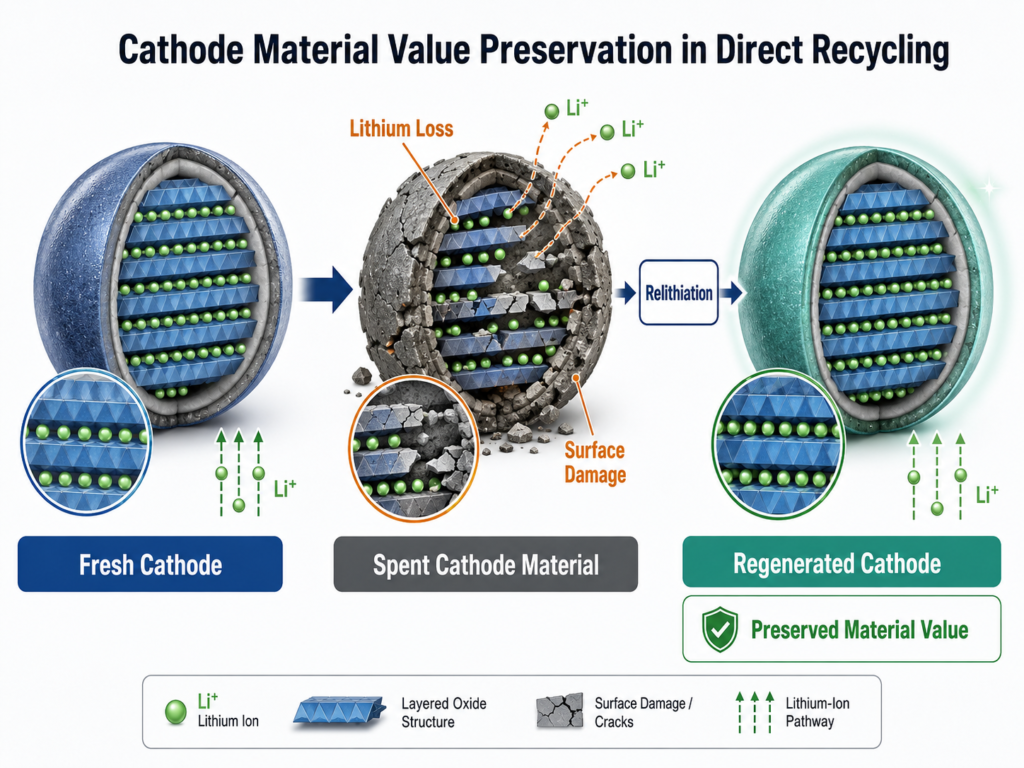
Direct battery recycling is a recycling method that aims to recover battery components in a form that can be reused more directly in new battery production. The main target is usually the cathode active material. In many EV batteries, the cathode is one of the most valuable parts of the cell. In NMC batteries, for example, the cathode contains nickel, manganese, cobalt, and lithium in a carefully controlled structure. In LFP batteries, the cathode uses lithium iron phosphate. In both cases, the value is not only in the elements themselves. The value is also in the fact that those elements have already been processed into battery-grade active material.
That distinction is important. If you dissolve a cathode completely, you may recover useful metals. But you lose the engineered structure that made it a cathode in the first place. To use those materials again, manufacturers must refine them, produce new precursors, synthesize new cathode powder, and qualify the material again.
Direct recycling tries to avoid some of that. Instead of fully destroying the cathode material, direct recycling tries to separate it, clean it, restore lost lithium, repair damage where possible, and reuse it in new cells. A simple way to think about it is this: Pyrometallurgy treats the battery like ore. Hydrometallurgy treats the battery like a chemical feedstock. Direct recycling treats the battery like a damaged but valuable engineered material. That is why direct recycling is so interesting. It asks whether a used battery material can be regenerated rather than completely remade.
A recent open-access review in npj Materials Sustainability describes direct recycling as one of the emerging routes that could help improve the sustainability and efficiency of lithium-ion battery recycling. The basic logic is clear: if the original active material can be preserved, fewer processing steps may be needed before it returns to battery production.
How Conventional EV Battery Recycling Works Today
To understand why direct recycling matters, it helps to compare it with the recycling methods used more commonly today. Most lithium-ion battery recycling relies on pyrometallurgical processing, hydrometallurgical processing, mechanical preprocessing, or a combination of these methods.
The ReCell Center’s direct recycling overview notes that direct recycling has historically been less studied than hydrometallurgical and pyrometallurgical processes. That is one reason the technology still feels newer, even though the concept is very attractive.
Pyrometallurgical Recycling
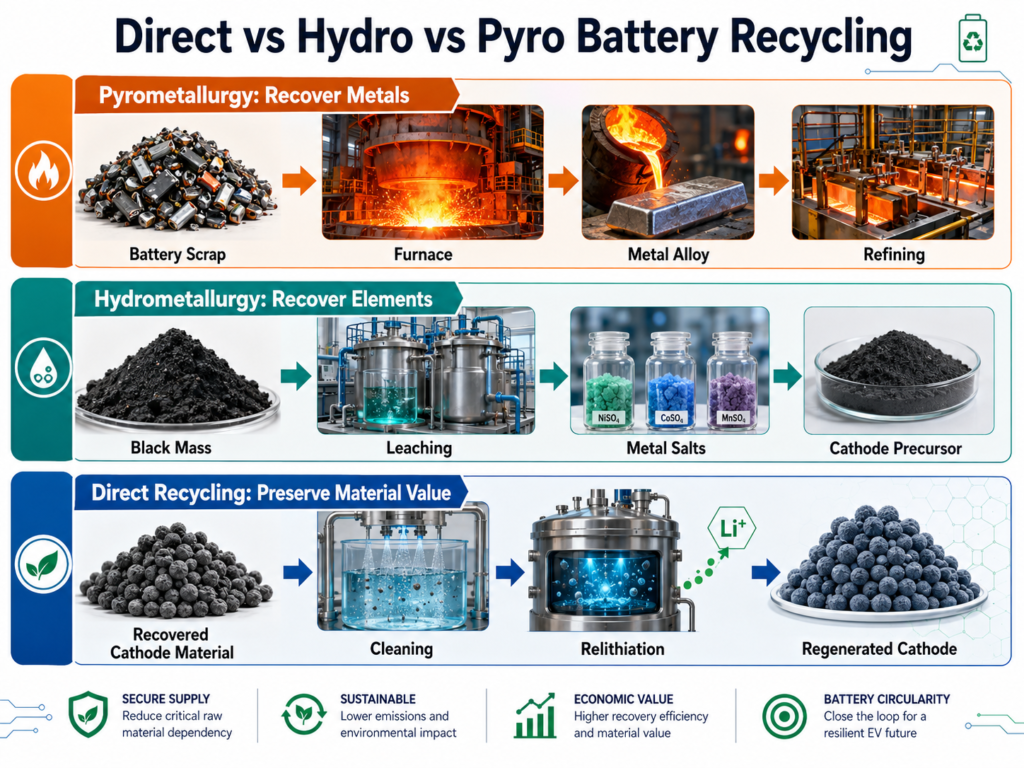
Pyrometallurgical recycling uses high temperatures to process battery materials. In simple terms, battery cells or battery scrap are fed into a furnace. Organic materials burn off. Some valuable metals are recovered in alloy form. Other materials may end up in slag or require additional recovery steps.
The strength of pyrometallurgy is that it is robust. It can handle mixed feedstock better than many more delicate processes. If a recycler receives batteries from many sources, with different chemistries and formats, a high-temperature process may be easier to manage.
But there are drawbacks. Smelting is energy-intensive. It can lose lithium and other materials depending on the process design. It also does not preserve the cathode’s original structure. After smelting, the recovered material still needs more refining before it can return to the battery supply chain. So pyrometallurgy can recover value, but it is not the most elegant route if the goal is a true battery-to-battery material loop.
Hydrometallurgical Recycling
Hydrometallurgical recycling uses chemical leaching and refining. In many cases, batteries are first mechanically processed into a material often called black mass. Black mass is a dark powder mixture that can contain cathode material, anode material, electrolyte residues, current collector fragments, and other cell components. The black mass is then treated with chemicals to dissolve and separate valuable elements such as lithium, nickel, cobalt, manganese, and copper.
Hydrometallurgy can recover a broader set of materials than pyrometallurgy and can produce refined products that are closer to battery precursor materials. This is why many modern battery recycling companies focus heavily on hydrometallurgical routes.
The drawback is that hydrometallurgy still breaks down the cathode material. It recovers elements, not the original cathode structure. Those recovered materials must then be rebuilt into new battery-grade active material. That is a major difference from direct recycling. Hydrometallurgy says, “Recover the ingredients.” Direct recycling says, “Try to preserve the recipe.”
Why Direct Recycling Could Be More Efficient
Direct recycling is attractive because it could reduce the number of steps needed to turn old battery material into new battery material. Making cathode material is not simple. Battery-grade cathode production involves mining, refining, precursor production, lithium addition, high-temperature synthesis, coating, quality control, and qualification. Every step requires energy, equipment, chemicals, and time.
If a spent cathode can be restored instead of rebuilt from scratch, some of that embedded value may be preserved. The ReCell Center frames this as a value-retention problem. Instead of only recovering individual elements, direct recycling tries to recover more value from the components inside the battery. That matters because battery recycling economics can be difficult. A recycler does not just need to recover material. It needs to recover material at a cost and quality level that battery manufacturers can actually use.
Direct recycling could help in several ways. It may reduce energy use because it avoids some high-temperature or chemical refining steps. It may reduce chemical use because it does not always require complete dissolution and separation of metals. It may preserve cathode material value because the original particle structure may be partly retained. It may also reduce the environmental footprint of recycling if fewer processing steps are needed.
A 2025 open-access review on lithium-ion battery recycling and regeneration in PMC notes that direct recycling has gained attention because it may reduce energy consumption, reagent use, and carbon emissions compared with conventional routes.
The word “may” is important. Direct recycling is not automatically better in every situation. It depends on the feedstock, chemistry, contamination level, process yield, and final material quality. Still, the potential is significant. If recycling can produce regenerated cathode material that meets battery-grade requirements, the battery industry could move closer to a circular supply chain.
What Happens Inside a Direct Recycling Process?
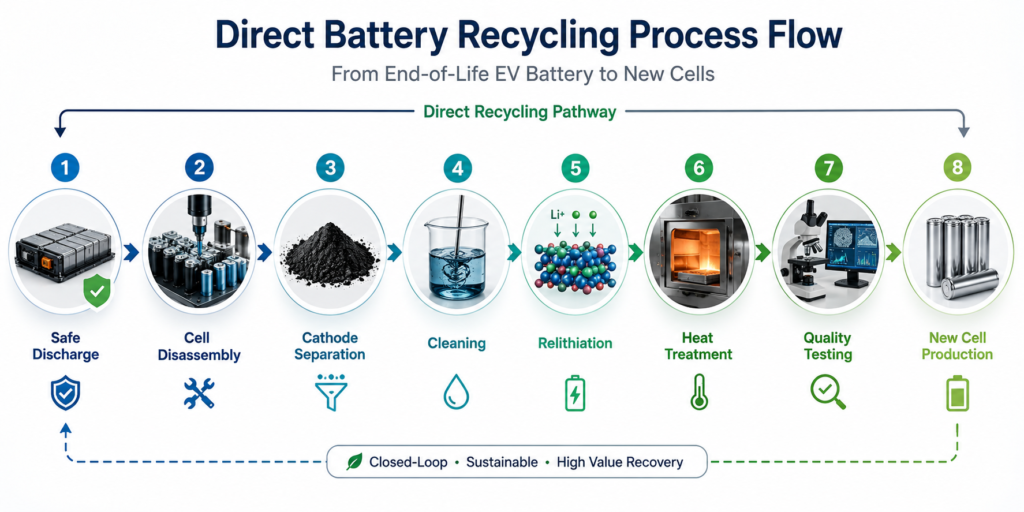
Direct recycling is not one single process. Different laboratories and companies use different methods. But the general idea usually follows a few major steps. First, the battery pack must be safely identified and discharged. EV battery packs are high-voltage systems, so they cannot be handled like ordinary scrap. They may contain damaged modules, residual charge, coolant, adhesives, sensors, structural components, and high-voltage connections.
Next, the pack or cells must be disassembled or processed in a way that separates useful materials. This is one of the hardest parts. A battery cell contains cathode material, anode material, separator, electrolyte, aluminum foil, copper foil, binders, additives, and casing materials. If the goal is to regenerate cathode material, contamination must be controlled carefully.
Then the cathode material must be separated from the current collector and cleaned. In many lithium-ion cells, cathode material is coated onto aluminum foil. The active material has to be recovered without introducing too much impurity or damaging the material beyond repair. After that, the material is regenerated.
For many cathode chemistries, regeneration involves restoring lost lithium. During battery aging, some lithium becomes unavailable due to side reactions, surface film growth, or structural degradation. Re-lithiation attempts to replace missing lithium and restore electrochemical performance.
Depending on the material, the process may also involve heat treatment, hydrothermal processing, chemical repair, particle surface treatment, or other steps. Finally, the regenerated material must be tested. This step is critical. It is not enough for recycled cathode material to look good in a lab. It must meet battery manufacturing standards.
Battery companies care about capacity, cycle life, impedance, moisture content, particle size, surface chemistry, contamination, safety, and consistency. A regenerated material that works in a small test cell still needs to prove it can work at industrial scale. That is the gap between a promising recycling technology and a commercial battery supply chain.
Direct Recycling vs Hydrometallurgy vs Pyrometallurgy
The easiest way to compare these methods is to ask what each one tries to preserve. Pyrometallurgy mainly preserves metal value. It is useful for mixed or difficult feedstock, but it uses high heat and usually requires more refining afterward. Hydrometallurgy mainly preserves elemental value. It can recover lithium, nickel, cobalt, manganese, and other materials in refined chemical forms, but it destroys the original cathode structure.
Direct recycling tries to preserve material value. It aims to keep the active material closer to its original engineered form, then repair and reuse it. This does not mean direct recycling will replace all other methods. A mixed pile of unknown batteries may not be a good candidate for direct recycling. If the recycler does not know the chemistry, age, condition, or contamination level, it may be safer and more practical to use hydrometallurgical or pyrometallurgical processing.
On the other hand, a clean stream of manufacturing scrap from one battery factory could be ideal for direct recycling. The chemistry is known. The material is relatively fresh. The contamination level may be lower. The recycler can design a process around a predictable input. That is why direct recycling may scale first through manufacturing scrap before becoming common for old EV battery packs from the road.
This point is easy to overlook. Many people assume EV battery recycling mainly means old cars. But a large amount of near-term recyclable battery material can come from battery manufacturing scrap. Cell production is complex, and scrap can be generated during electrode coating, cell assembly, formation, testing, and quality control. If that scrap can be directly recycled, it may feed back into the battery factory faster than end-of-life EV packs.
Why Sorting Is the Biggest Challenge
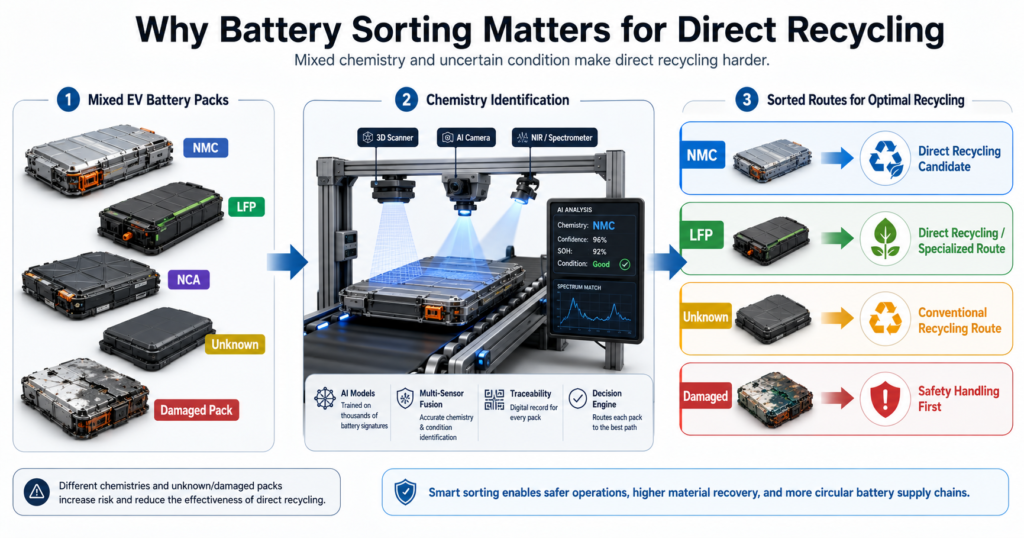
Direct recycling depends on knowing exactly what material is being processed. That sounds simple, but it is one of the biggest challenges in EV battery recycling. Modern EV batteries vary widely. Some use NMC. Some use LFP. Some use NCA. Some use lithium manganese-rich chemistries. Future batteries may include sodium-ion, semi-solid, or solid-state designs. Even within NMC, the exact ratio can vary. NMC111, NMC532, NMC622, and NMC811 are not the same material.
If these chemistries are mixed together, direct recycling becomes much harder. A regenerated cathode material must have a predictable composition. A battery manufacturer cannot use a mystery blend of cathode powders and hope it performs well. The material must meet tight specifications. This is where battery traceability becomes important.
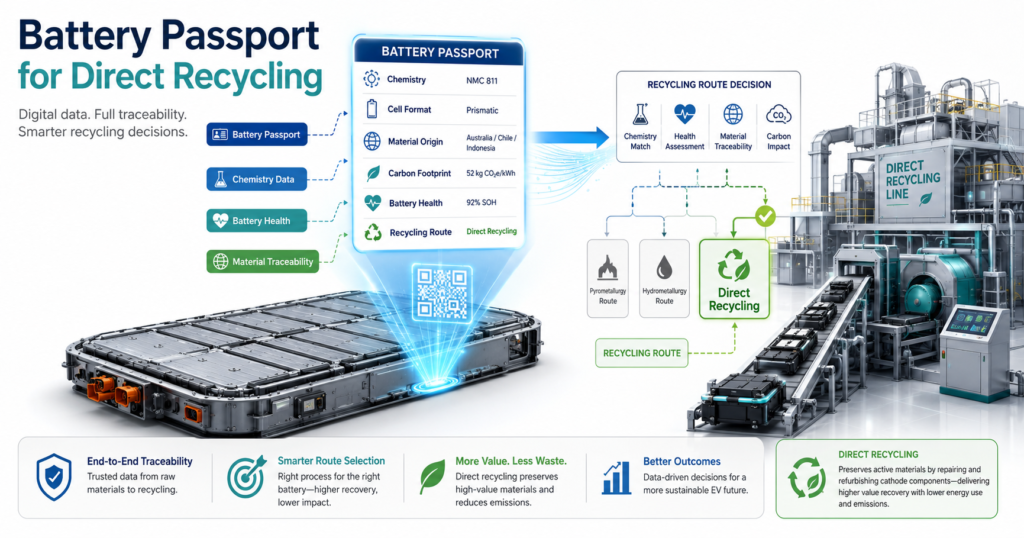
The European Union’s Battery Regulation summary includes rules related to sustainability, labeling, recycling efficiency, material recovery, recycled content, and battery passports. The International Energy Agency also summarizes the regulation in its policy database, including recovery targets and future recycled-content requirements.
For consumers, a battery passport may sound like paperwork. For recyclers, it could become a practical tool. If a battery’s chemistry, manufacturing origin, carbon footprint, and material composition are easier to identify, recyclers can route it more intelligently.
A known NMC pack may go to one process. A known LFP pack may go to another. A damaged or unknown pack may go through a more conventional route. A battery with enough remaining health may go to second-life storage before final recycling. This is also why battery design matters. If packs are difficult to disassemble, poorly labeled, or glued together in ways that make clean separation difficult, direct recycling becomes harder. If packs are designed with traceability and end-of-life recovery in mind, direct recycling becomes more realistic.
For more background on how pack structure affects end-of-life handling, see our article on Cell-to-Pack vs Structural Battery Packs.
Can Old EV Batteries Really Become New Cells?
Yes, but not in a simple one-step way. An old EV battery does not come out of a car and immediately become a new battery cell. It must be diagnosed, discharged, disassembled, separated, cleaned, regenerated, tested, and qualified. Direct recycling is not the same as reusing an old cell. It is about recovering active materials in a way that keeps them closer to battery-ready form.
A realistic process might look like this. An EV battery pack reaches the end of its vehicle life. The pack is inspected to determine whether it is suitable for repair, second-life use, or recycling. If it goes to recycling, the chemistry is identified. The cells are processed, and the cathode material is separated. That material is cleaned, re-lithiated, thermally treated, and tested. If it meets performance standards, it can be used as part of new cathode production. So yes, old EV battery material can potentially become part of new cells. But the process requires serious industrial control.
There is also an important difference between recycled content and direct recycling. A new battery may contain recycled lithium, nickel, cobalt, or copper recovered through hydrometallurgy. That does not necessarily mean the cathode was directly recycled. Direct recycling is specifically about preserving and regenerating active materials more directly. This is why direct recycling is more technically demanding but potentially more valuable. It is closer to remanufacturing a battery material than simply recovering the elements.
Why Direct Recycling Matters for LFP Batteries
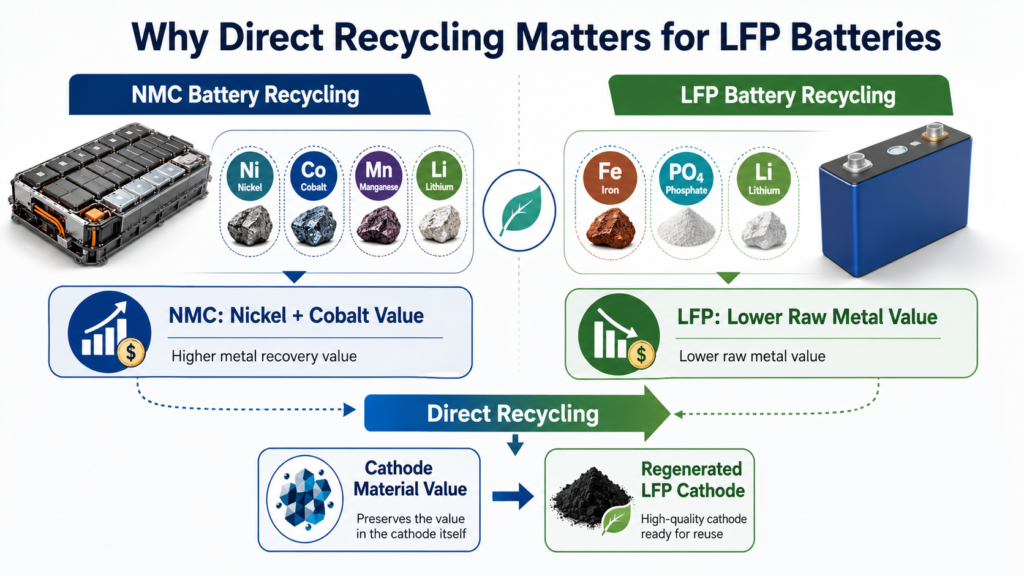
Direct recycling may become especially important as LFP batteries grow. For years, battery recycling economics were heavily influenced by cobalt and nickel. High-cobalt and high-nickel batteries contain valuable metals, which helps make recycling financially attractive.
LFP batteries are different. They use lithium iron phosphate. Iron and phosphate are much cheaper than nickel and cobalt. That is good for EV affordability and supply-chain stability, but it can make conventional recycling economics more difficult.
If a recycler breaks LFP down into low-cost ingredients, the recovered material may not be very valuable. But if the LFP cathode material itself can be regenerated, direct recycling could preserve more value. This is one reason direct recycling is not only relevant for expensive nickel-rich batteries. It may also be important for lower-cost chemistries where conventional metal recovery is less profitable.
The rise of LFP is also part of a broader EV battery trend. Automakers are using LFP because it is durable, relatively low cost, and less dependent on nickel and cobalt. But as more LFP packs reach end of life, the industry will need recycling pathways that make sense for that chemistry.
For more context, see our comparison of LFP vs NMC batteries, which explains why chemistry affects cost, range, durability, and long-term battery strategy.
Direct Recycling and Sustainable Battery Design
Direct recycling becomes easier when batteries are designed for recycling from the beginning. This is a major shift for the industry. Historically, battery packs were optimized mainly for cost, performance, safety, packaging, thermal management, and manufacturability. End-of-life recycling was often treated as a later problem.
That approach is changing. A future battery pack may need to be designed not only for vehicle performance, but also for repairability, second-life evaluation, material recovery, and regulatory compliance. Design for recycling could include clearer chemistry labeling, easier pack disassembly, better data access, safer discharge procedures, fewer hard-to-remove adhesives, and more standardized material documentation.
This does not mean every battery should be easy to take apart at the expense of safety or performance. EV batteries must survive vibration, crashes, water exposure, thermal stress, and years of charging. But recyclability should be part of the engineering tradeoff.
The EU Battery Regulation is pushing the industry in this direction. Its requirements around carbon footprint, recycled content, collection, recycling efficiency, and battery passports are likely to influence how batteries are designed and documented globally, not just in Europe.
The International Energy Agency’s Global EV Outlook 2025 also highlights how battery demand, supply chains, and policy are becoming increasingly connected as EV adoption grows. Recycling is part of that larger supply-chain story. In other words, direct recycling is not just a recycling-plant technology. It is connected to cell design, pack design, manufacturing data, policy, and supply-chain planning.
Why Direct Recycling Is Not Mainstream Yet
Direct recycling sounds like the obvious best solution, but it is not easy to commercialize. The first problem is feedstock variability. Batteries arriving at recycling facilities may come from different automakers, model years, chemistries, cell formats, and climates. Some may be crash-damaged. Some may have spent years in hot environments. Some may have been fast-charged heavily. Others may still have relatively good health.
The second problem is contamination. Battery cells contain many materials packed tightly together. Cathode powder must be separated from aluminum foil, copper foil, graphite, electrolyte residue, binder, separator material, casing fragments, and other impurities. Small contamination levels can matter when making new battery cells.
The third problem is quality control. Battery manufacturers are strict because EV batteries must last for many years and operate safely. Regenerated cathode material must prove consistent performance, not just in one lab sample but across large production batches.
The fourth problem is economics. Direct recycling may save energy and preserve material value, but sorting, disassembly, diagnostics, and regeneration all cost money. If virgin material prices are low, direct recycling may be less attractive in the short term.
The fifth problem is chemistry evolution. Battery chemistries are changing quickly. A recycling process optimized for one chemistry may not work well for another. As LFP, high-manganese cathodes, sodium-ion batteries, and future solid-state designs grow, recyclers will need flexible strategies.
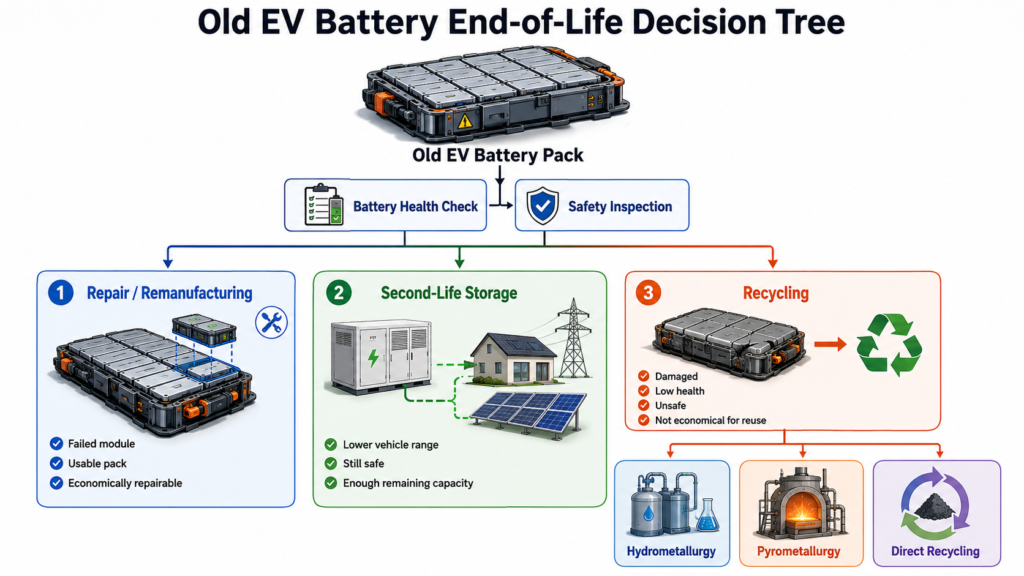
This is why the future of EV battery recycling will probably not depend on one method. Instead, different batteries will likely take different routes. Some packs may be repaired. Some may be remanufactured. Some may be used in second-life energy storage. Some may go to hydrometallurgical recycling. Some may go to pyrometallurgical processing. Some clean, well-sorted material streams may go through direct recycling.
For a practical overview of those different end-of-life paths, see our article on EV battery repair, remanufacturing, and recycling.
What Direct Recycling Means for EV Owners
For most EV owners, direct recycling will not change daily driving anytime soon. You do not need to charge differently because of direct recycling. You do not need to choose one EV over another only because its battery may someday be easier to recycle. The immediate ownership factors are still battery health, warranty coverage, charging habits, range needs, and long-term reliability.
But direct recycling could still matter indirectly. First, it could reduce the environmental concern around EV battery waste. A battery pack is not simply trash when it leaves a vehicle. It may still contain valuable materials that can return to the battery supply chain.
Second, it could help reduce dependence on newly mined materials over time. Recycling will not eliminate mining, especially while the EV fleet is still growing, but it can become a larger source of battery materials as more EVs reach end of life.
Third, it could support domestic battery supply chains. If recycled materials can be recovered and reused locally, battery manufacturers may become less dependent on long and geopolitically sensitive supply chains.
Fourth, it could affect battery design. Automakers may increasingly consider end-of-life value when designing future packs. A battery that is easier to identify, disassemble, and recycle may have advantages beyond its first vehicle life.
Finally, direct recycling supports a more realistic view of EV sustainability. EV batteries are not perfect, and recycling is not automatic. But the technology is improving. The industry is moving from simple waste handling toward more advanced material recovery and regeneration. That is an important step.
Direct Recycling vs Second-Life: They Are Not the Same Thing
It is easy to confuse direct recycling with second-life battery use, but they are different. Second-life means the battery is reused before recycling. For example, an EV battery that no longer provides enough range for a car may still be useful in stationary energy storage. It might help store solar energy, support grid balancing, or provide backup power.
Direct recycling means the battery materials are recovered and regenerated for use in new battery manufacturing. The two pathways can work together. A battery may serve in an EV first, then move into a second-life storage application, and later be recycled. Or it may skip second-life use and go directly to recycling if it is damaged, too degraded, or not economically suitable for reuse.
The best path depends on battery health, chemistry, safety, warranty status, logistics, and market demand. This is why battery diagnostics are important. Before deciding whether a pack should be reused or recycled, companies need to know its actual condition. A battery with enough remaining capacity may be more valuable in second-life use. A battery with poor condition or unknown safety history may be better suited for recycling.
For more on this topic, see our article on EV battery recycling vs second-life storage.
The Bigger Picture: Recycling as Part of Battery Manufacturing
The most important thing to understand about direct battery recycling is that it moves recycling closer to manufacturing. Old battery recycling was often seen as an end-of-life cleanup step. A product reached the end of its life, and the recycler tried to recover whatever value remained.
Direct recycling changes that mindset. It treats end-of-life batteries and manufacturing scrap as future battery material streams. That makes recycling part of the supply chain, not just the waste stream.
This could become increasingly important as battery demand grows. The IEA Global EV Outlook 2025 shows that electric vehicle deployment, battery demand, charging infrastructure, and policy are now deeply connected. As more batteries are produced, more material will eventually return from factories, vehicles, and second-life applications.
The question is how much value the industry can recover. If batteries are poorly labeled, hard to disassemble, and processed only as mixed waste, much of the value may be lost. If batteries are designed with traceability and recycling in mind, and if direct recycling can scale, old batteries could become an important source of new battery materials.
That does not mean direct recycling will solve every supply-chain problem. It will not remove the need for responsible mining. It will not make battery production impact-free. It will not instantly make every old EV battery into a new cell. But it could make the system more efficient. And in a battery industry measured in millions of vehicles and gigawatt-hours of storage, even incremental improvements matter.
Conclusion: Can Old EV Batteries Become New Cells?
Old EV batteries can become part of new battery cells, but the process is more complex than simply melting them down and starting over. Traditional recycling methods such as pyrometallurgy and hydrometallurgy recover valuable materials, but they often break down the original cathode structure. Direct battery recycling tries to preserve and restore that structure so the material can return to battery production with fewer steps. That is the key idea.
Direct recycling is not just about recovering lithium, nickel, cobalt, manganese, iron, phosphate, copper, or aluminum. It is about preserving the value already created when those materials were turned into battery-grade components.
The technology still faces major challenges. Sorting must improve. Battery data must become more accessible. Packs must be easier to disassemble. Regenerated materials must meet strict battery-grade standards. The economics must work at scale.
But the direction is clear. EV battery recycling is becoming more advanced, more specialized, and more connected to battery manufacturing. In the future, the best recycling systems may not simply ask, “How do we recover metals from old batteries?” They may ask, “How do we keep battery materials in battery form for as long as possible?” That is the promise of direct battery recycling.
FAQs
What is direct battery recycling?
Direct battery recycling is a method that recovers and regenerates battery materials without fully breaking them down into raw elements or chemical salts. It is especially focused on preserving cathode active material so it can be reused in new battery production.
How is direct recycling different from hydrometallurgical recycling?
Hydrometallurgical recycling dissolves battery materials and separates metals through chemical processing. Direct recycling tries to keep the cathode material closer to its original structure, then repair and reuse it.
How is direct recycling different from pyrometallurgical recycling?
Pyrometallurgical recycling uses high-temperature smelting to recover metals. Direct recycling uses lower-temperature and more targeted processes to recover active materials without destroying their structure.
Can direct recycling be used for LFP batteries?
Yes, but the economics are different from nickel- and cobalt-rich batteries. Because LFP contains cheaper materials, direct recycling may be important for preserving cathode material value instead of only recovering low-cost elements.
Is direct battery recycling already used commercially?
Direct recycling is still emerging compared with hydrometallurgical and pyrometallurgical recycling. It is being actively researched by groups such as the ReCell Center, and it may scale first with clean manufacturing scrap before becoming common for mixed end-of-life EV packs.
Does direct recycling mean old EV cells are reused as-is?
No. Direct recycling does not mean an old cell is placed directly into a new battery. The materials must be separated, cleaned, regenerated, tested, and qualified before they can be used again.
Why does battery sorting matter so much?
Direct recycling depends on knowing the exact battery chemistry and material condition. Mixing NMC, LFP, NCA, and unknown chemistries makes it much harder to regenerate a consistent battery-grade material.
Will direct recycling make EVs cheaper?
It could help reduce battery material costs over time, especially if it preserves high-value cathode materials and reduces processing steps. However, the final cost impact depends on feedstock availability, processing cost, material prices, and commercial scale.