
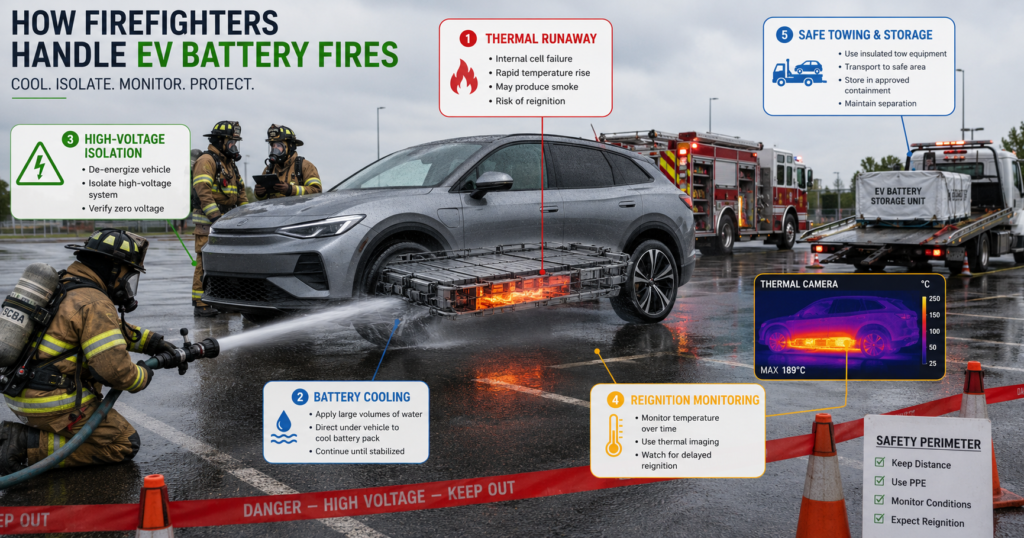
Quick Answer
Firefighters handle EV battery fires differently from gasoline vehicle fires because the main hazard is not just visible flame. The bigger concern is a damaged high-voltage lithium-ion battery that may enter thermal runaway, release toxic or flammable gases, reignite after the visible fire is out, or retain stranded electrical energy.
The usual response is built around several priorities: protect people first, identify the vehicle, isolate the high-voltage hazard, cool the battery with large amounts of water when the pack is involved, monitor temperatures with a thermal imaging camera, avoid cutting or opening the battery pack, and coordinate safe towing and outdoor storage after the incident.
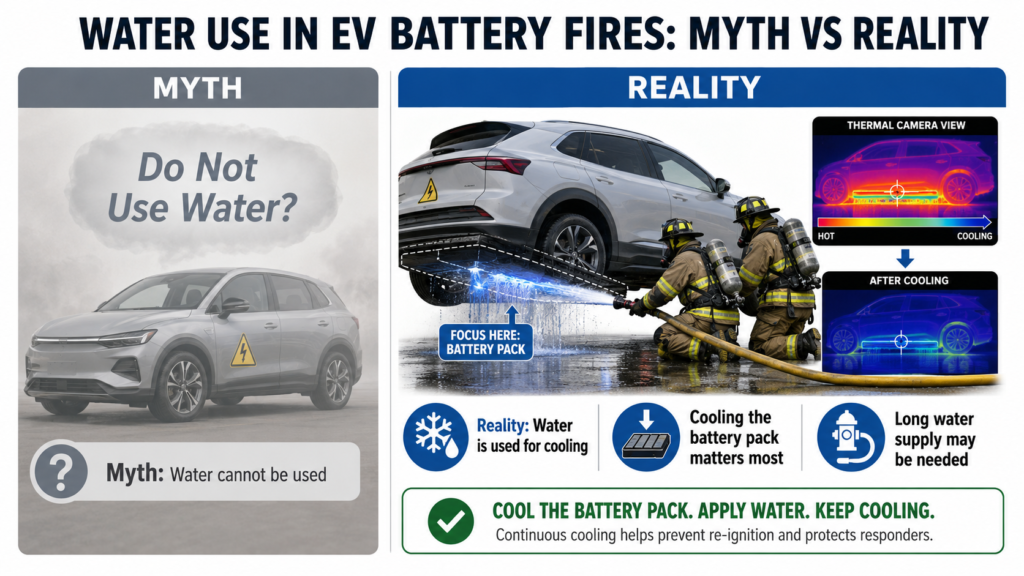
A common myth is that firefighters should not use water on EV battery fires. In reality, manufacturer emergency response guides and fire-service guidance commonly point to water as the primary cooling tool when a high-voltage battery is burning, heating, or off-gassing. The challenge is not that water “doesn’t work.” The challenge is getting enough water to the right part of the battery for long enough.
Introduction: EV Fires Are Rare, But the Response Is Different
EV battery fire response is very different from fighting a conventional gasoline vehicle fire. Firefighters are not only dealing with visible flames. They also need to manage high-voltage hazards, battery cooling, thermal runaway, possible reignition, and safe towing after the incident.
EV fires get a lot of attention because they look dramatic, they can burn for a long time, and they raise questions that most drivers never had to think about with gasoline cars. What happens if the battery under the floor catches fire? Can firefighters put it out? Is it safe to tow the car afterward? Could it reignite in a storage yard?
Those questions are reasonable. But the answer is not as simple as “EVs are more dangerous” or “EVs are perfectly safe.” The better answer is this: EV battery fires are a different kind of emergency. A gasoline vehicle fire is mostly about burning fuel, plastics, rubber, upholstery, and other vehicle materials. An EV fire can include all of that, but it may also involve a high-voltage lithium-ion battery pack made of many cells. If enough cells are damaged, overheated, or internally shorted, the battery can enter thermal runaway. That changes the firefighting problem.
For background on how EV fire risk compares with gasoline cars, see our earlier article: EV Battery Fire: Do EV Batteries Catch Fire More Often Than Gas Cars? This article looks at EV battery fires from the emergency response side. In other words, what do firefighters actually do when an EV battery is involved?
Why EV Battery Fire Response Requires a Different Strategy
The main difference is the battery pack. Most modern EVs place the high-voltage battery under the floor. That location is great for vehicle stability, crash protection, cabin space, and packaging. But from a firefighter’s perspective, it creates a practical challenge: the hottest and most important part of the incident may be inside a sealed structure underneath the vehicle.
NHTSA now provides a central Emergency Response Guides database where responders can access vehicle-specific emergency response guides and rescue sheets for battery-electric, hybrid, plug-in hybrid, and fuel-cell vehicles. NHTSA explains that these guides cover fire, submersion, leakage, towing, storage, and vehicle construction details for responders.
That vehicle-specific detail matters because EVs are not all built the same way. A Tesla Model 3, Ford F-150 Lightning, Chevrolet Blazer EV, Hyundai Ioniq 5, Rivian R1T, and Nissan Leaf may all be EVs, but their pack locations, high-voltage disconnects, structural layouts, lifting points, and rescue cut zones can differ. That is why a modern EV fire response is not just “spray water until the flames disappear.” It is a structured process.
What Thermal Runaway Means During an Emergency
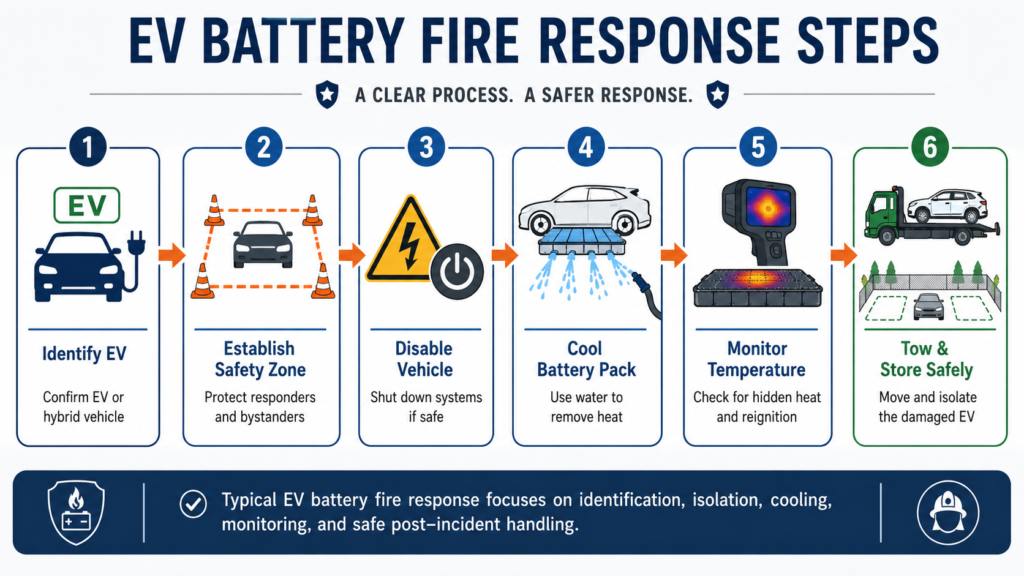
Thermal runaway is the core reason EV battery fires behave differently. Inside a lithium-ion cell, overheating, mechanical damage, overcharging, internal defects, or short circuits can trigger self-heating reactions. Once a cell reaches a certain failure point, it can release heat faster than the surrounding structure can remove it. That heat can damage nearby cells, which may then fail as well. This is why thermal runaway is sometimes described as a chain reaction.
The NTSB’s safety report on lithium-ion battery fires in EVs identified several risks to emergency responders: electric shock, thermal runaway, battery ignition and reignition, and stranded energy. The report also noted that damaged high-voltage batteries can retain energy even after a crash or fire, creating both electrical and reignition hazards.
For a firefighter, this means the visible fire is only one part of the problem. A battery pack can continue generating heat internally even after flames have been knocked down. Smoke, hissing, popping, venting gases, rising pack temperatures, or renewed flames can indicate that the battery is still unstable. This also explains why EV fires may require long monitoring periods after the initial suppression.
Step 1: Identify the Vehicle and the Battery Hazard
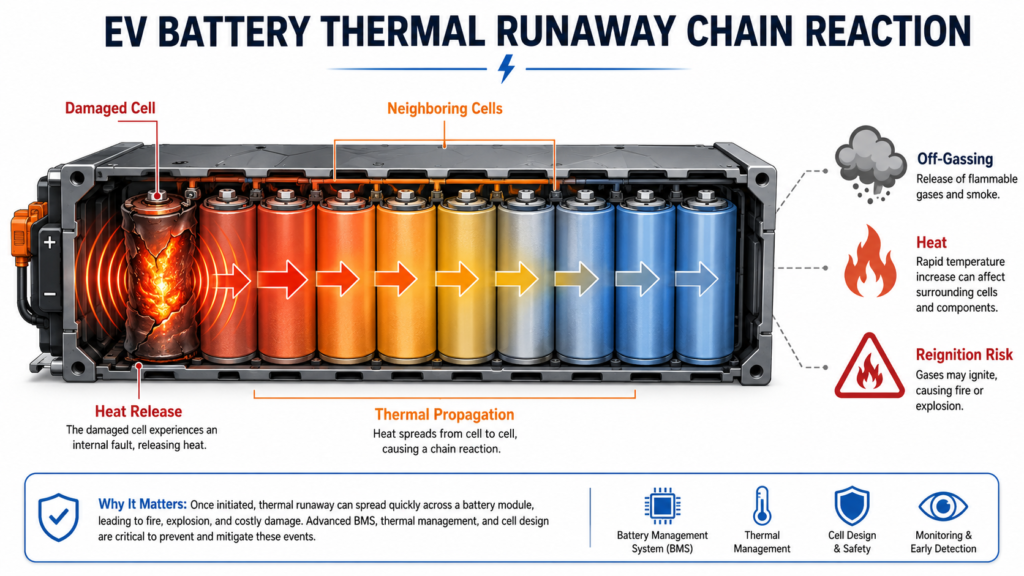
The first operational question is simple: is this an EV, hybrid, plug-in hybrid, or conventional vehicle? That sounds obvious, but it is not always easy at a crash scene. Badging may be damaged. Smoke may reduce visibility. A vehicle may be partially submerged, upside down, or severely deformed. Some hybrids and plug-in hybrids look almost identical to gasoline versions.
Responders look for EV badging, charging ports, missing exhaust components, orange high-voltage cables, battery warning labels, dashboard indicators, and information from dispatch, witnesses, or vehicle registration.
NHTSA’s towing and recovery guidance tells responders to determine whether the vehicle is electric or hybrid, advise dispatch and other responders, avoid orange high-voltage cabling, and assume damaged high-voltage batteries and components may remain energized.
That “assume energized” mindset is important. Firefighters do not treat a damaged EV battery as safe just because the vehicle is quiet, the dashboard is off, or the fire appears to be out. EVs do not idle like gasoline cars. A vehicle can be “on” without engine noise. Even when high-voltage contactors open, the cells inside the battery pack still store energy.
Step 2: Protect Occupants and Establish Scene Safety
As with any vehicle fire or crash, life safety comes first. Firefighters prioritize rescue, evacuation, traffic control, and protection of nearby people. If the EV is in a driveway, garage, parking structure, tunnel, ferry, or charging station, the surroundings become part of the response plan. A battery fire in an open parking lot is very different from a battery fire inside a residential garage with living space above it.
Responders also consider toxic and flammable gases. NHTSA and manufacturer guidance commonly warn that venting or off-gassing high-voltage battery vapors may be toxic and flammable. That is why firefighters use full protective gear and self-contained breathing apparatus near the incident. Even when the visible flames look small, battery vent gases and smoke from burning vehicle materials are not something people should breathe. For consumers, the practical advice is simple: get out, move away, call 911, and do not try to fight a suspected battery fire yourself.
Step 3: Disable the Vehicle When It Is Safe to Do So
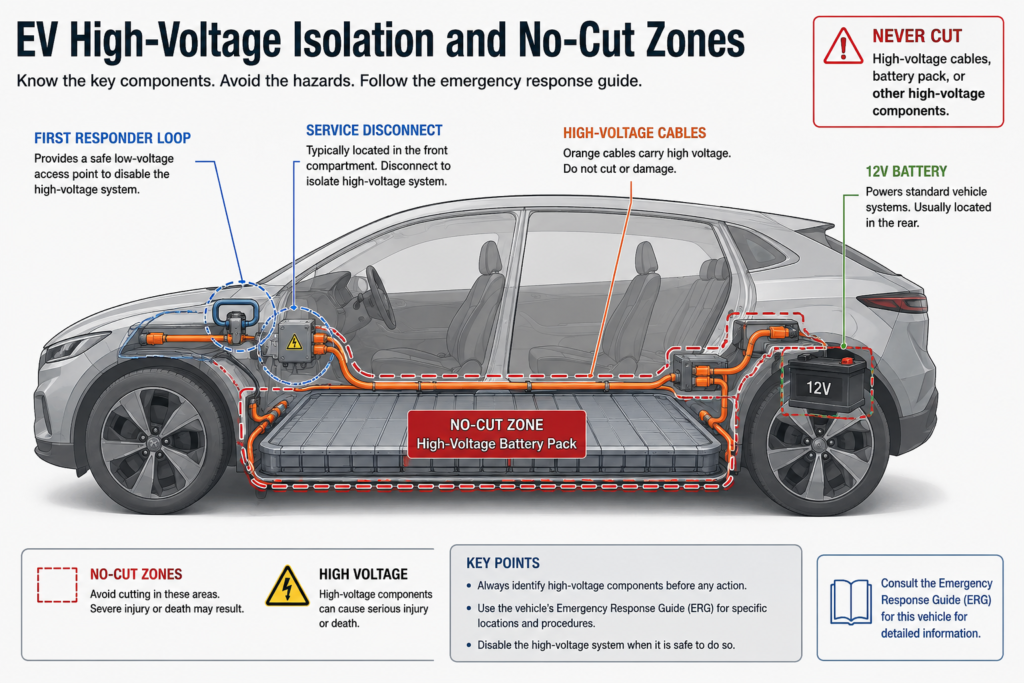
Emergency response guides usually explain how to shut down or isolate the vehicle’s high-voltage system. This may involve turning the vehicle off, removing the key or phone key, disconnecting the 12-volt battery, or cutting a manufacturer-designated first responder loop.
But disabling an EV is not the same as making the battery pack harmless. Tesla’s Model 3 Emergency Response Guide explains that cutting the first responder loop removes low-voltage power to the high-voltage contactors, but it also warns that the battery pack still contains stored energy and that responders should treat the pack and high-voltage components as if voltage may still be present.
That distinction is important. Opening contactors can isolate the battery from other vehicle systems. It does not instantly drain the energy stored inside hundreds or thousands of cells. This is why firefighters are trained not to cut orange high-voltage cables, not to cut into the battery pack, and not to assume the hazard is gone after a shutdown step.
Step 4: Decide Whether the Battery Pack Is Actually Involved
Not every EV fire is a battery fire. A fire may start in a tire, interior, cargo area, 12-volt accessory, charging equipment, or another vehicle nearby. If the high-voltage battery is not involved, firefighters may use conventional vehicle firefighting tactics while still treating the EV as a high-voltage hazard. This distinction matters because a battery-involved fire usually requires a different water strategy and longer monitoring.
The U.S. Fire Administration’s EV fire/rescue response operations document includes tactical language that separates fires not involving the battery pack from fires involving the battery pack. It notes that if the fire involves the battery pack and requires extinguishment, responders should make sure long-term water supply is available and use thermal imaging to ensure the pack is sufficiently cooled before transport.
In plain English, firefighters are trying to answer this question: are we fighting a normal vehicle fire near a battery, or are we cooling a battery that is actively failing? Those are not the same incident.
Step 5: Use Water for Cooling, Not Just Flame Knockdown
One of the biggest EV fire myths is that water should not be used because EVs are electrical. That misunderstanding comes from mixing household electrical fire advice with high-voltage vehicle firefighting. In real EV battery response, water is widely used because the main goal is cooling. Thermal runaway is a heat problem. If the battery is generating heat internally, responders need to remove heat from the pack and stop the spread to adjacent cells when possible.
Tesla’s first responder materials state that if a high-voltage battery catches fire, is exposed to high heat, or is generating heat or gases, responders should use large amounts of water to cool the battery. Tesla guidance also notes that direct access to the battery improves cooling, but responders should not open the battery pack to cool it.
That last part is critical. Water is useful, but access is hard. EV battery packs are designed to protect cells from crash damage, road debris, water, and intrusion. Those same protective structures can make it difficult for firefighting water to reach the hottest internal cells. So when people hear that an EV fire took thousands of gallons of water, that does not mean water is useless. It often means the battery was hard to cool because the heat source was inside a sealed pack.
Why Firefighters May Let an EV Battery Burn in Some Cases
This sounds strange, but in some scenarios, firefighters may choose a defensive strategy. If the vehicle is already isolated, there are no trapped occupants, no nearby structures, no other vehicles at risk, and the battery is fully involved, responders may decide that the safest approach is to protect exposures and let the battery burn while monitoring conditions.
That does not mean they are doing nothing. It means the risk of aggressive intervention may outweigh the benefit if there is no life safety issue and no exposure problem. USFA’s EV fire/rescue response operations document includes a scenario-based approach: if a vehicle is a safe distance from exposures and the fire involves the battery pack, responders may consider letting it burn. If extinguishment is needed, long-term water supply should be available. This is similar to how firefighters think about some hazardous materials incidents. The goal is not always to make the flames disappear as fast as possible. The goal is to reduce total risk.
Step 6: Monitor for Reignition
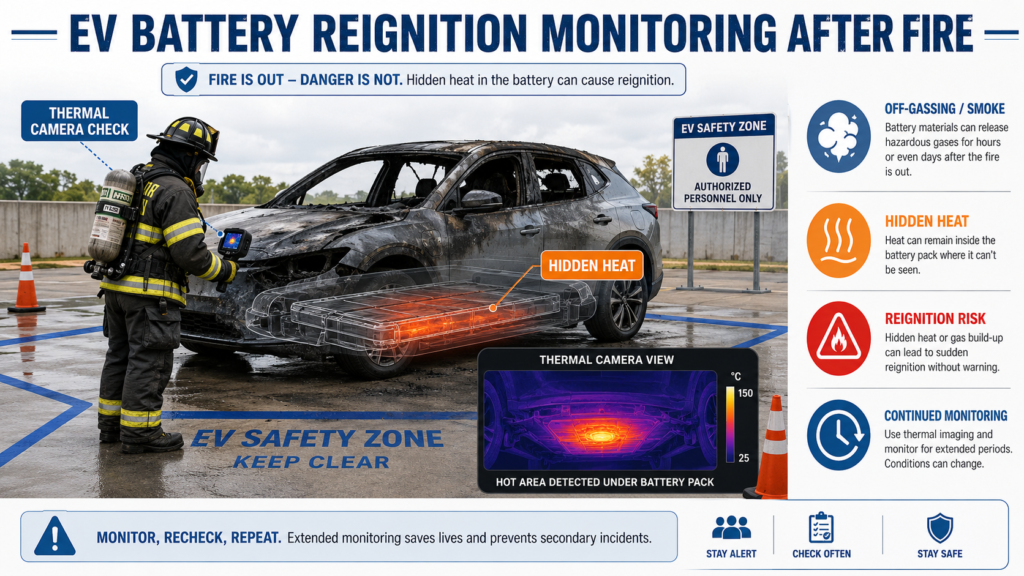
EV battery reignition is one of the most important post-fire concerns. A damaged lithium-ion battery can look stable and then heat up again later. This may happen because damaged cells still contain stranded energy, internal shorts continue developing, or heat migrates within the pack after the visible fire is out.
The NTSB specifically identified thermal runaway and multiple battery reignitions after initial fire suppression as safety risks in high-voltage lithium-ion battery fires. This is why responders may use a thermal imaging camera to monitor the pack temperature. It is also why the vehicle may need to sit outside, away from structures and other vehicles, after the incident.
From a consumer perspective, this is one of the least understood parts of EV fire response. The tow truck arriving does not mean the incident is over. The storage yard may still need to monitor the vehicle for smoke, heat, sparks, hissing, bubbling sounds, or renewed flames.
Step 7: Handle Towing and Storage as Part of the Emergency
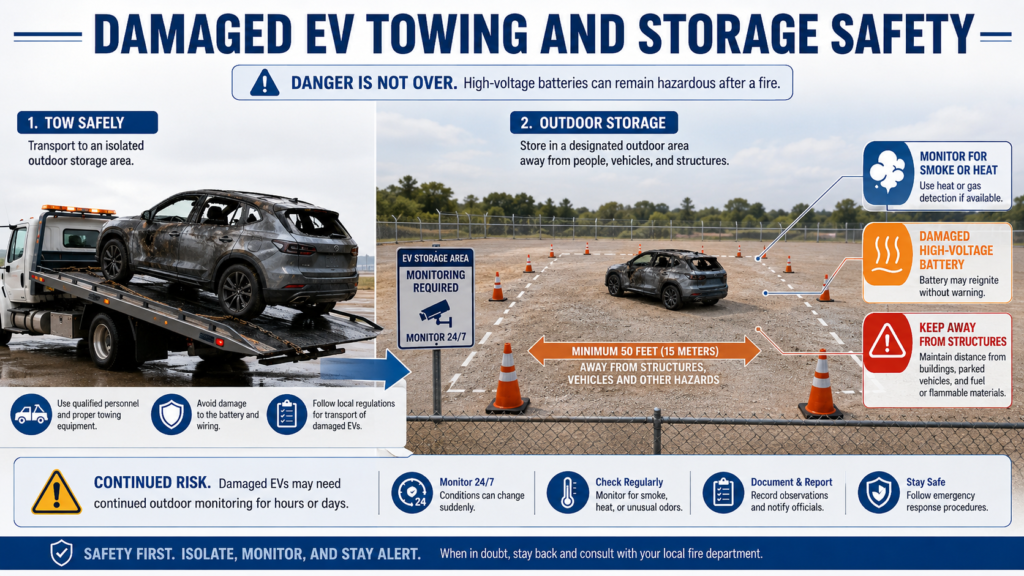
The response does not end when the fire is out. A severely damaged EV can remain a hazard during loading, transport, unloading, and storage. Tow operators and storage yards become “second responders,” and they need to know they are dealing with a damaged high-voltage battery vehicle.
NHTSA’s towing and recovery guidance says severely damaged vehicles with lithium-ion batteries should not be stored inside a structure or within 50 feet of any structure or vehicle. It also tells storage personnel to keep compartments ventilated, continue inspecting for signs such as leaking fluids, sparks, smoke, flames, or gurgling/bubbling sounds from the battery, and maintain access for monitoring and emergency response.
Ford’s damaged vehicle guidance uses the same general concept: assume the high-voltage battery may be energized and fully charged, treat venting vapors as potentially toxic and flammable, and recognize that physical damage can result in immediate or delayed release of gases and fire (USFA). This is one reason some tow yards have developed special EV storage areas. The vehicle may need to be parked outside, separated from other vehicles, and monitored for a period of time.
Why Battery Pack Access Is So Difficult
EV battery packs are not designed like open trays of cells. They are sealed, reinforced, crash-protected, thermally managed structures. That is good for everyday safety. It helps protect the pack from water, debris, vibration, and impacts. But in a fire, it creates a firefighting access problem.
If water only reaches the outer casing, the internal cells may stay hot. If the pack has already been breached by a crash, water may enter through that natural opening and cool the affected area more directly. But responders generally should not cut, pry, drill, or open a high-voltage battery pack to create access.
Manufacturer guides consistently warn against opening or cutting into the battery pack. Tesla’s Model 3 guide, for example, warns responders not to open the high-voltage battery and to treat the pack and orange cables as high-voltage hazards. This is where EV design may continue to evolve. Better emergency access points, improved venting paths, clearer rescue sheets, stronger pack-level isolation, and more standardized response information could all help responders.
For a related engineering discussion, see our article on EV Battery Pressure Management, because cell swelling, pack structure, cooling contact, and safety are increasingly connected in modern battery design.
Emergency Response Guides Are Now a Core Safety Tool
Firefighters do not rely only on general EV knowledge. They need vehicle-specific information. NHTSA’s ERG database is important because it centralizes emergency response guides and rescue sheets from manufacturers. NFPA also points emergency responders to NHTSA for the latest EV emergency response guides and rescue sheets.
GM maintains first responder resources by brand and model, including Chevrolet EV rescue sheets and emergency response guides for vehicles such as the Equinox EV, Blazer EV, Silverado EV, Bolt EV, and Bolt EUV. GM describes these documents as providing information about key safety systems, disabling methods, component locations, and rescue information. Tesla also provides a first responders page with product-specific emergency response guides, quick response sheets, owner’s manuals, and video guides. Ford’s first responder resources similarly include rescue cards and emergency response guides for EVs and hybrids, including the F-150 Lightning, Mustang Mach-E, E-Transit, and other electrified models. This is a major improvement over the early EV years, when response information was less standardized and harder to find quickly.
What Firefighters Watch for After the Flames Are Out
Once visible flames are gone, responders still watch for signs of battery instability. They may look for smoke, vapor, hissing, popping, crackling, unusual odors, rising temperature, leaking fluids, or signs of renewed heating from the battery area. Thermal imaging can help, but it does not see perfectly through thick structures or deep inside a battery pack. It is a tool, not a magic scanner.
The U.S. Fire Administration guidance specifically includes the use of a thermal imager to confirm that the battery pack is sufficiently cooled before transport. This is one reason EV fire scenes can last longer than people expect. The visible fire may be out, but the battery may still need monitoring.
What About Submerged EVs?
Submerged EVs create a related but different response problem. Floodwater, saltwater, damaged wiring, corrosion, and delayed battery failure can create hazards after the vehicle is removed from water. Not every submerged EV catches fire, but responders and tow operators treat damaged or submerged EVs cautiously because water intrusion and corrosion can affect high-voltage components.
DOE’s Alternative Fuels Data Center lists emergency responder resources that include NHTSA interim guidance, NTSB safety reports, NFPA resources, IAFC bulletins, and training materials for alternative fuel vehicle response. The practical takeaway is that a flooded EV should not be treated like a normal wet car. It needs professional inspection, and if the battery may be damaged, it should be handled according to manufacturer and responder guidance.
What EV Owners Should Do During a Suspected Battery Fire
This article is mainly about firefighters, but EV owners still have a role. If you see smoke, flames, popping sounds, strong chemical odors, or warning messages related to the high-voltage battery, the safest response is to stop if driving, exit the vehicle, move away, and call 911. Do not try to open the battery pack. Do not crawl under the vehicle. Do not assume the problem is minor because flames are not visible.
If the vehicle was in a serious crash, do not push to have it stored in a garage or near your home until it has been properly evaluated. A damaged EV battery may need outdoor separation and monitoring. For more background on delayed post-crash risks, see our article: EV Battery Crash Safety: What Really Happens After a Crash?
The Water Use Myth: Why “EV Fires Can’t Be Put Out” Is Misleading
You may see headlines claiming EV fires “cannot be extinguished.” That wording is misleading. A better statement is this: an EV battery fire can be difficult to fully cool and stabilize if the high-voltage battery pack is involved in thermal runaway. That difference matters.
Firefighters can knock down visible flames. They can cool the battery. They can protect exposures. They can monitor the pack. They can coordinate towing and storage. But if internal cells are still failing, the battery may continue to generate heat or reignite. This is why water use can be high. The goal is not simply to wet the outside of the car. The goal is to remove enough heat from the battery pack to prevent continued propagation.
Tesla’s emergency response guidance directly supports water use for high-voltage battery fires and notes that large amounts of water may be needed when the battery is burning, exposed to high heat, or generating heat or gases. So the myth is not just wrong. It can be dangerous if it makes people think firefighters have no effective response options.
How EV Design Can Make Fire Response Easier
The next generation of EV safety will not only come from better batteries. It will also come from better emergency response design. Several areas matter: Better emergency response guides help firefighters quickly identify the vehicle, locate high-voltage components, avoid cut zones, disable low-voltage control circuits, and understand model-specific towing and storage procedures.
Better pack-level sensing may help detect early thermal events before they become severe. Modern EVs already monitor temperature, voltage, current, isolation faults, and other safety signals. Future packs may add more advanced gas sensing, pressure sensing, or predictive diagnostics.
Better thermal barriers and pack segmentation may slow propagation from one group of cells to another. This is especially important as battery packs become more structurally integrated. Better access and venting design may help direct gases and heat away from occupants while giving responders clearer tactical options.
This connects with broader EV battery engineering trends. For example, LFP batteries are often discussed as safer because of their greater thermal stability compared with many nickel-rich chemistries, but pack design, cooling, monitoring, crash structure, and emergency response information still matter. See our related article: LFP vs NMC Batteries: Which EV Battery Is Better in 2026?
Conclusion: EV Fire Response Is About Cooling, Isolation, and Patience
Firefighters do not handle EV battery fires the same way they handle gasoline vehicle fires. The vehicle may look familiar from the outside, but the emergency response problem is different underneath.
The core challenge is thermal runaway. A damaged high-voltage battery can generate heat internally, release flammable or toxic gases, retain stranded energy, and reignite after visible flames are gone. That is why firefighters focus on identifying the vehicle, isolating hazards, cooling the battery, protecting exposures, monitoring pack temperature, and coordinating safe towing and storage.
Water is not the enemy. In many EV battery fire scenarios, water is the main cooling tool. The hard part is getting enough water to the battery for long enough, especially when the heat source is inside a protected pack.
As EV adoption grows, emergency response will keep improving. More standardized rescue sheets, better first responder training, improved battery pack design, and clearer manufacturer guidance will make these incidents easier to manage. EV fires are still uncommon, but when they happen, the response needs to be informed, patient, and specific to lithium-ion battery behavior.
FAQs
Do firefighters use water on EV battery fires?
Yes. Water is commonly used to cool a high-voltage battery that is burning, heating, or off-gassing. The challenge is that a battery pack may need a large amount of water because the heat source can be inside a sealed structure.
Can an EV battery reignite after the fire is out?
Yes. A damaged lithium-ion battery may reignite because of stranded energy, internal shorts, or continued thermal runaway inside the pack. That is why responders monitor the vehicle and why damaged EVs may need outdoor storage away from other vehicles and structures.
Should firefighters open the battery pack to put water inside?
No. Emergency response guides generally warn responders not to open, cut, drill, or pry into the high-voltage battery pack. If a crash has already created a natural opening, water may reach the battery more directly, but responders should not create an opening just to cool the pack.
Are EV fires impossible to extinguish?
No. That phrase is misleading. EV battery fires can be extinguished and controlled, but a battery involved in thermal runaway may require extended cooling, monitoring, and special storage precautions.
Why are damaged EVs stored away from other vehicles?
A damaged high-voltage battery may reignite or release gases after the incident. NHTSA guidance recommends that severely damaged lithium-ion battery vehicles not be stored inside a structure or within 50 feet of any structure or vehicle.
What should an EV owner do if the car starts smoking?
Stop safely, leave the vehicle, move away, and call 911. Do not try to inspect the battery pack, open the pack, or fight a suspected high-voltage battery fire yourself.