
Quick Answer
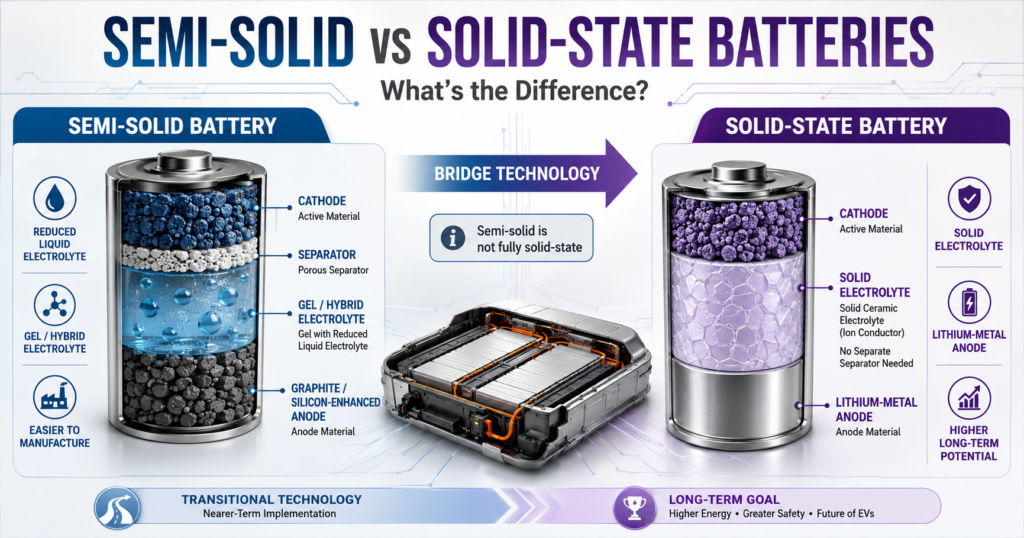
This semi-solid battery vs solid-state comparison matters because many EV battery announcements use similar language for technologies that are structurally different. Semi solid battery vs solid state is a confusing topic because the two technologies sound similar, but they are not the same thing. A semi-solid battery still contains some liquid or gel-like electrolyte. It is best understood as a bridge between today’s liquid-electrolyte lithium-ion batteries and future all-solid-state batteries. A solid-state battery, at least in the stricter technical sense, replaces the liquid electrolyte with a solid electrolyte that helps move lithium ions between the cathode and anode.
That difference sounds small, but it affects almost everything: safety, energy density, manufacturing difficulty, cost, charging performance, separator design, lithium-metal compatibility, and how quickly the technology can reach real EV buyers. In simple terms, semi-solid batteries are closer to production today. Full solid-state batteries may offer bigger long-term advantages, but they are harder to manufacture at automotive scale.
Introduction: Why These Battery Terms Are So Confusing
Battery headlines have become confusing. One article says a new EV has a “solid-state battery.” Another calls the same type of technology “semi-solid.” A press release may use terms like “solid-state-like,” “quasi-solid-state,” “hybrid solid-liquid electrolyte,” or “gel electrolyte.” For everyday EV buyers, it can sound as if all of these batteries belong in the same category. They do not.
The key point is this: semi-solid is not the same as fully solid-state. Semi-solid batteries may reduce the amount of flammable liquid electrolyte inside the cell. They may improve safety, energy density, cold-weather performance, or durability compared with some conventional lithium-ion designs. But they usually still rely on some liquid or gel-like material to help ions move through the cell.
Solid-state batteries go further. Their goal is to replace the liquid electrolyte with a solid electrolyte, often ceramic, sulfide-based, oxide-based, polymer-based, or a hybrid solid material. That change could make it easier to use lithium-metal anodes, increase energy density, and reduce certain safety risks. But it also introduces difficult interface, pressure, scaling, and manufacturing challenges.
This topic matters in 2026 because semi-solid batteries are moving into real vehicles faster than full solid-state batteries. MG, for example, describes its SolidCore battery as a semi-solid technology designed to bring solid-state-style benefits closer to everyday drivers. Meanwhile, Stellantis and Factorial have started real-world testing of Factorial’s solid-state battery technology in a Dodge Charger Daytona development vehicle, according to recent coverage from Car and Driver. Mercedes-Benz has also completed a long-distance road test with an EQS equipped with a solid-state battery system, which the company detailed in its official technology report. The industry is moving. The terminology needs to catch up.
What Is a Conventional Lithium-Ion Battery?
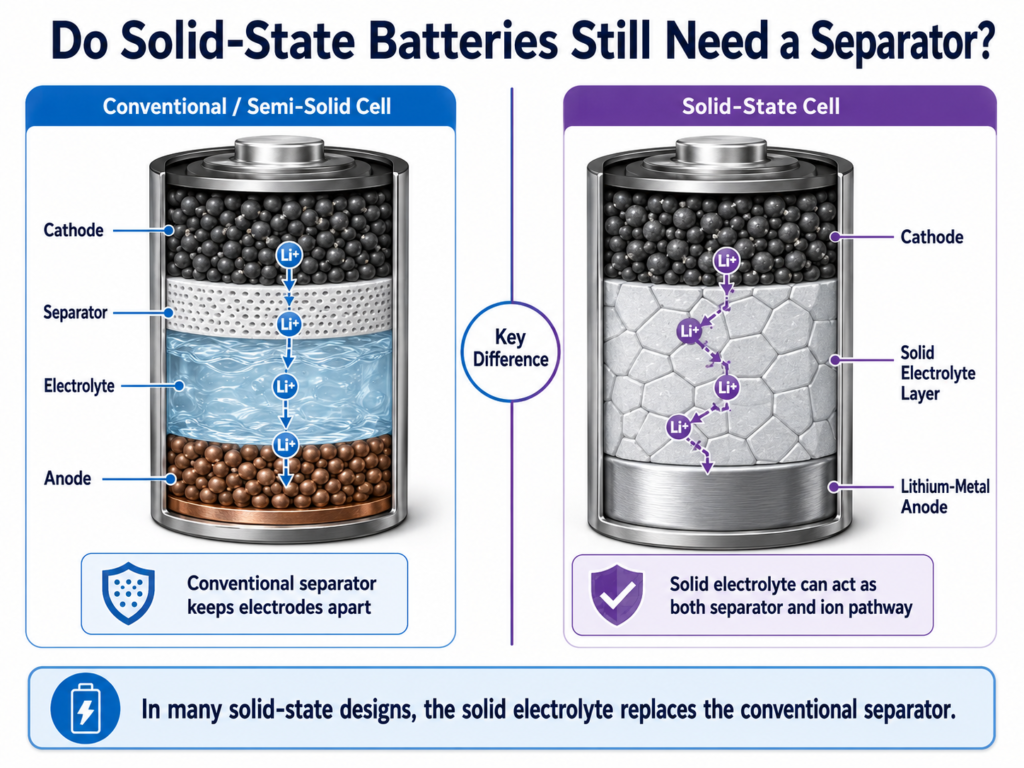
To understand semi-solid and solid-state batteries, it helps to start with today’s lithium-ion battery. A conventional EV lithium-ion cell usually has four main parts: The cathode stores lithium when the battery is discharged. The anode stores lithium when the battery is charged. The electrolyte allows lithium ions to move between the electrodes. The separator keeps the cathode and anode physically apart while still allowing ions to pass through.
Most current EV batteries use a liquid electrolyte. This liquid is good at moving lithium ions, which is one reason lithium-ion batteries became so successful. But liquid electrolytes also bring drawbacks. They can be flammable, they can react with electrode surfaces, and they require careful cell design to prevent leakage, gas generation, internal shorts, and thermal runaway.
The U.S. Department of Energy explains the basic role of electrolytes and separators in rechargeable batteries through its Vehicle Technologies Office battery resources, which is a useful starting point for readers who want the fundamentals before diving into semi-solid or solid-state designs.
That does not mean today’s lithium-ion batteries are unsafe by default. Modern EV packs include battery management systems, thermal management, crash protection, venting paths, current limits, and many layers of monitoring. But from a chemistry standpoint, the liquid electrolyte is still one of the reasons engineers keep searching for safer and higher-energy alternatives. That search leads to two related but different ideas: semi-solid batteries and solid-state batteries.
What Is a Semi-Solid Battery?
A semi-solid battery uses an electrolyte system that is not fully liquid, but not fully solid either. It may use a gel electrolyte, polymer-rich electrolyte, slurry-like material, or a hybrid solid-liquid electrolyte. The exact design depends on the company and cell chemistry.
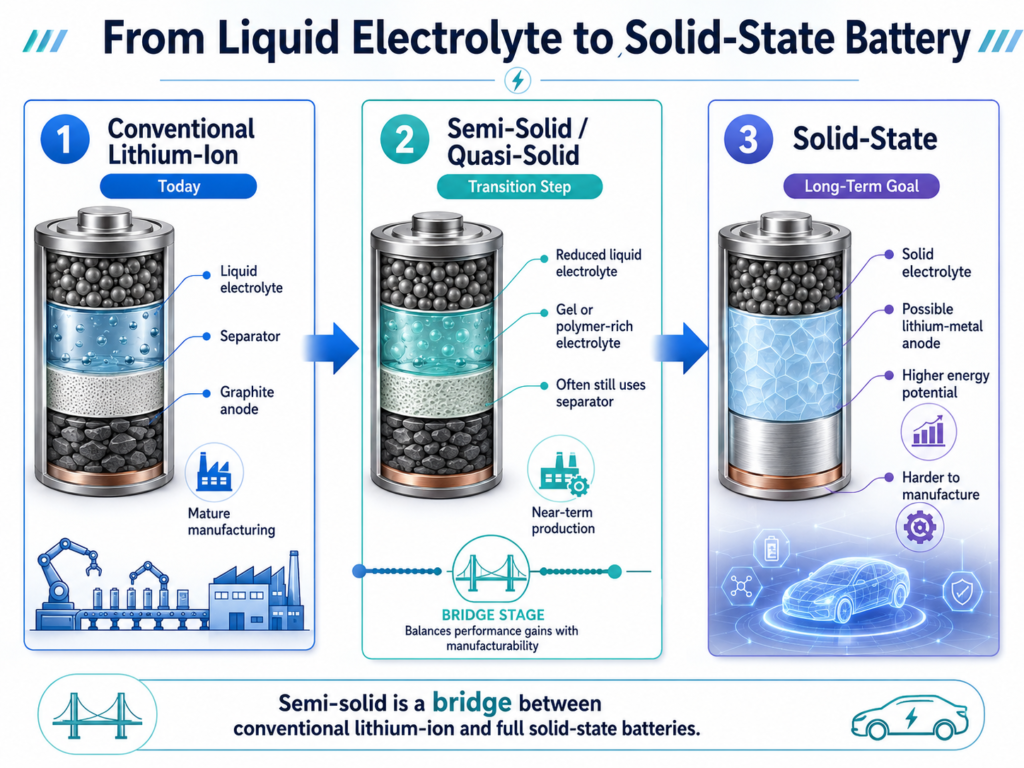
The important idea is that the battery still contains some liquid or liquid-like component. That is why semi-solid batteries are often described as a practical middle step. They may reduce liquid electrolyte content compared with today’s lithium-ion cells, but they do not eliminate it completely.
This matters because liquid electrolyte amount affects several things at once. Less liquid can mean lower leakage risk, improved thermal stability, reduced flammability, and better mechanical stability. But keeping some liquid or gel-like material can help preserve ion transport and make the cell easier to manufacture than a true all-solid-state design. In other words, semi-solid batteries are trying to capture some solid-state benefits without taking on the full manufacturing difficulty of all-solid-state batteries.
This is also why some semi-solid batteries may arrive in consumer EVs earlier. They can sometimes use modified versions of existing lithium-ion production equipment. They may still use familiar cathode chemistries. They may not require the same extreme interface control, stack pressure control, or dry-room changes as full solid-state cells.
MG’s SolidCore announcement is a good example of why this category is getting attention. MG describes SolidCore as semi-solid technology that aims to improve range, fast charging, safety, and cold-weather performance while staying closer to real-world deployment than many all-solid-state concepts. That is the nuance readers need to understand.
What Is a Solid-State Battery?
A solid-state battery replaces the conventional liquid electrolyte with a solid electrolyte. The U.S. Department of Energy has described solid-state batteries as a major next-generation direction because they use solid electrolyte materials instead of conventional liquid electrolytes. Argonne National Laboratory has also discussed the importance of solid electrolyte materials in its work on all-solid-state batteries.
In theory, this creates several advantages. A solid electrolyte can reduce leakage risk. It may improve safety by removing or reducing flammable liquid components. It can potentially support lithium-metal anodes, which can store more energy than graphite anodes. It may also enable thinner cell designs, higher energy density, and faster charging if the interface and ion transport problems are solved.
But “in theory” is doing a lot of work here. A solid-state battery is not automatically better in every real-world condition. Solid materials must stay in good contact with electrodes during charging, discharging, temperature changes, swelling, vibration, and aging. If the interface between the solid electrolyte and electrode becomes unstable, resistance can rise. If mechanical pressure is uneven, performance may degrade. If lithium metal grows unevenly, internal short risks can still exist.
That is why solid-state battery road testing is so important. A cell that performs well in a lab fixture still has to survive an automotive environment. It has to handle road vibration, fast charging, winter starts, summer heat, crash loads, manufacturing variation, and years of repeated cycling.
Stellantis and Factorial reached an important milestone by integrating Factorial’s FEST solid-state battery technology into a Dodge Charger Daytona development vehicle for real-world testing, as reported by Car and Driver. Mercedes-Benz also tested a lithium-metal solid-state battery system in an EQS, reporting a long-distance run of 1,205 km in its official Mercedes-Benz solid-state battery update.
Solid-state batteries are coming closer. They are not yet replacing mainstream LFP and NMC batteries across the EV market.
Semi Solid Battery vs Solid State: The Core Difference
The simplest way to separate the two is to look at the electrolyte. A semi-solid battery still contains some liquid, gel, or liquid-like electrolyte component. A solid-state battery uses a solid electrolyte as the main ion-conducting material.
That difference affects the rest of the cell design. A semi-solid battery may still need a separator, depending on the design. It may use a conventional graphite or silicon-enhanced anode. It may be easier to produce using modified lithium-ion manufacturing lines. It may improve safety compared with liquid-heavy cells, but it does not remove all liquid-electrolyte-related risks.
A solid-state battery may use the solid electrolyte itself as both ion conductor and separator. It is more likely to be paired with a lithium-metal anode in high-energy designs. It may offer greater long-term energy-density potential, but it is also harder to scale.
This is why the phrase “solid-state battery” can be misleading when used casually. Some companies use it broadly to describe any battery that contains a solid electrolyte component. Others use it more strictly to mean an all-solid-state battery with no liquid electrolyte. Between those two definitions sits a wide range of semi-solid and quasi-solid designs.
For EV buyers, the better question is not, “Is it solid-state?” The better question is, “How much liquid electrolyte does it still use, what anode does it use, and has the pack been validated in real vehicles?”
Liquid Electrolyte Amount: Why It Matters
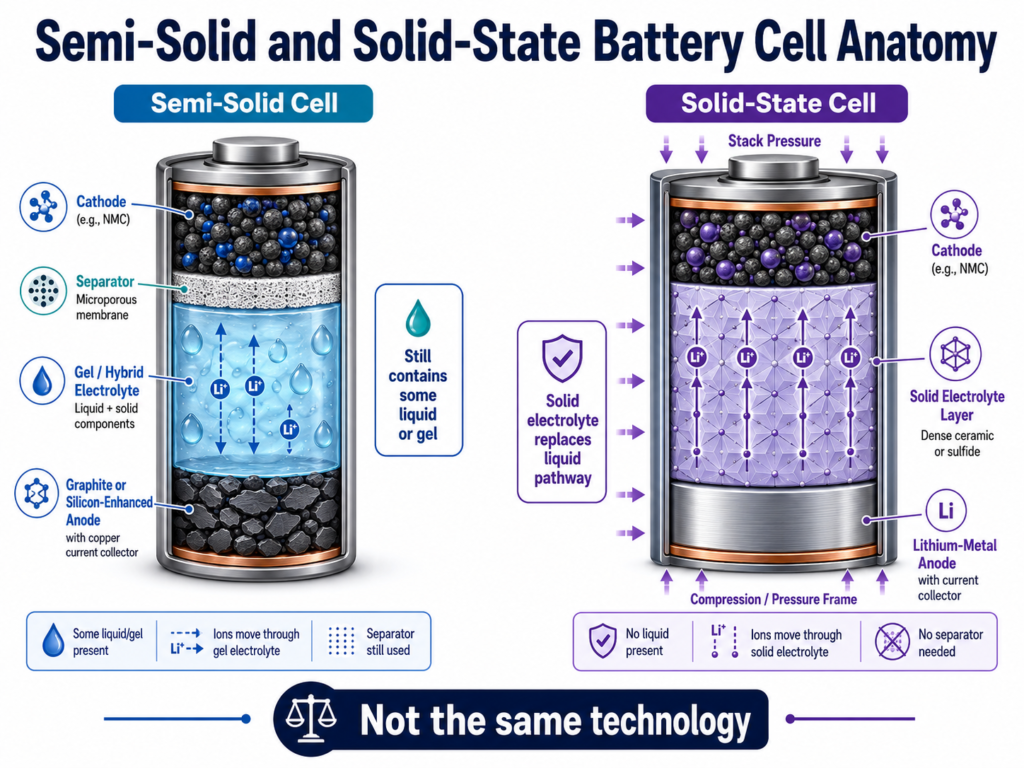
Liquid electrolyte amount is one of the most practical differences between semi-solid and solid-state batteries. In a conventional lithium-ion cell, liquid electrolyte fills the porous electrode structure and separator. It helps lithium ions move efficiently. That is good for power and charging performance, but the liquid can also be chemically reactive and flammable.
A semi-solid cell reduces the amount of free liquid. The electrolyte may become more gel-like or partially immobilized. This can reduce leakage, improve abuse tolerance, and help stabilize the cell. It may also improve cold-weather behavior if the electrolyte formulation is designed for lower-temperature ion transport.
But because semi-solid batteries still contain some liquid or gel-like material, they are not immune to all the same concerns. They still need careful thermal management. They still need BMS limits. They still need strong cell quality control. They still age through chemical and mechanical processes.
A full solid-state battery tries to remove the free liquid almost entirely. That can reduce flammability and leakage concerns, but it creates a different challenge: solid-solid contact. Ions must move through rigid or semi-rigid materials and across interfaces. Those interfaces are harder to keep perfect than a liquid-soaked porous separator.
Battery researchers have repeatedly pointed out that solid-state interfaces can become resistive or unstable if the materials are not well matched. Argonne’s article on solid electrolyte materials for all-solid-state batteries is a helpful example of why electrolyte design is still such an active research area. That is why the liquid electrolyte question is not just a safety detail. It is also a manufacturing and durability question.
Gel, Polymer, Ceramic, and Sulfide Electrolytes
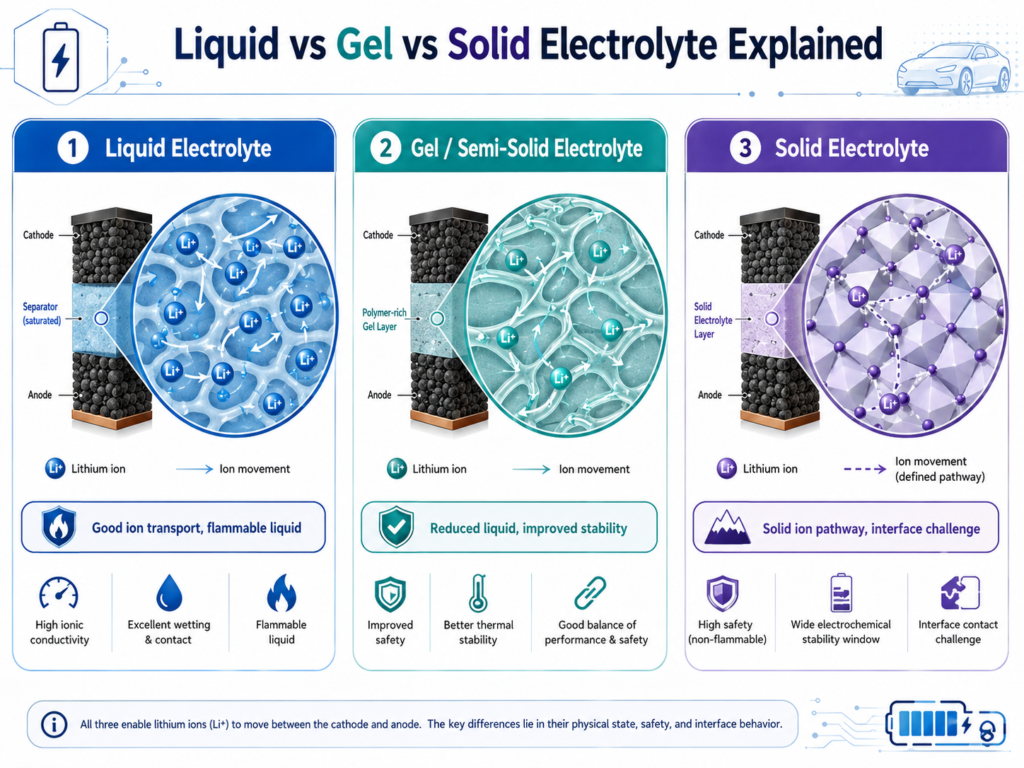
Not all semi-solid or solid-state batteries use the same electrolyte materials. Some semi-solid designs use gel polymer electrolytes. These can hold liquid electrolyte inside a polymer network, making the system less fluid while still allowing ion movement. This approach can be attractive because it may be easier to process than ceramic solid electrolytes.
Some solid-state designs use oxide ceramic electrolytes. These can offer strong chemical stability and mechanical strength, but they may require high-temperature processing and can be brittle. Maintaining good contact between oxide electrolytes and electrodes can be difficult.
Other solid-state designs use sulfide electrolytes. Sulfides can offer high ionic conductivity and may be easier to press into dense layers, but they can be sensitive to moisture and may require strict manufacturing controls.
Polymer solid electrolytes are another option. They can be more flexible and easier to process, but many polymer systems struggle with lower ionic conductivity at room temperature unless carefully engineered.
This is one reason solid-state commercialization is not a single race. It is many races at once. Companies are not only competing on energy density. They are competing on electrolyte chemistry, anode compatibility, manufacturing yield, pressure requirements, safety behavior, cost, and pack integration.
The Separator Question
In a conventional lithium-ion battery, the separator is essential. It physically separates the anode and cathode while allowing lithium ions to move through the electrolyte. Semi-solid batteries often still use a separator or separator-like layer. Even if the electrolyte is gel-like or partially solid, the cell may still need a physical barrier to prevent short circuits.
Solid-state batteries can be different. In some designs, the solid electrolyte also acts as the separator. Since it conducts lithium ions but blocks electrons, it can perform both roles. This is one of the reasons solid-state batteries could eventually reduce internal cell complexity.
However, this only works if the solid electrolyte layer is defect-free, mechanically stable, and chemically compatible with both electrodes. Tiny cracks, poor contact, contamination, or uneven lithium deposition can create serious problems. So while solid-state batteries may simplify the separator concept on paper, they complicate manufacturing quality control in practice.
Lithium-Metal Anodes: The Big Prize
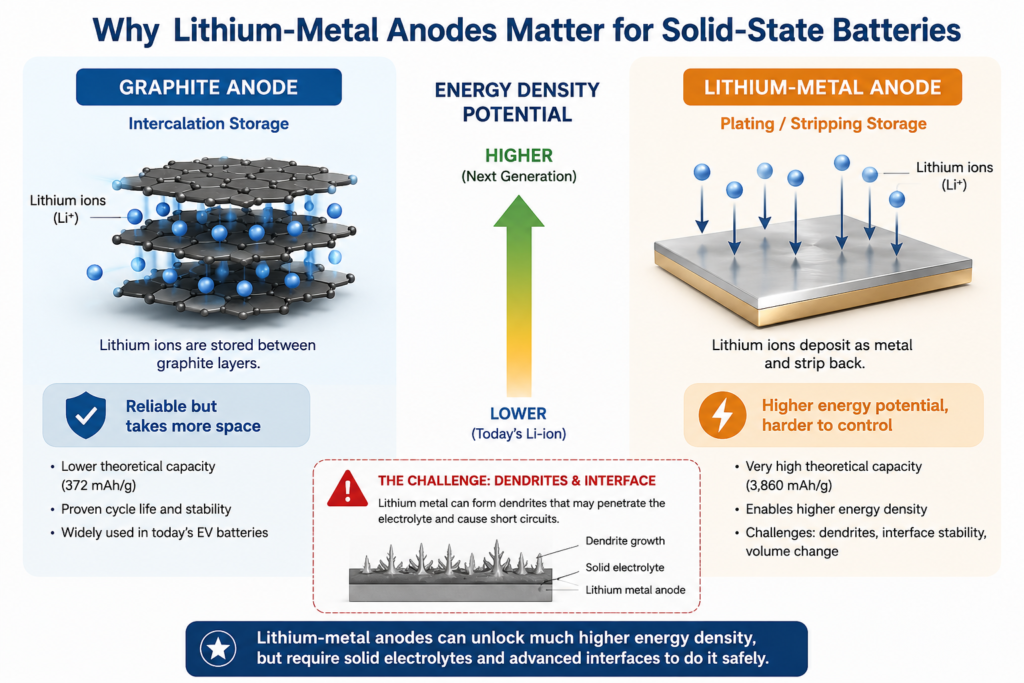
One of the biggest reasons solid-state batteries attract attention is lithium metal. Today’s EV batteries usually use graphite-based anodes, sometimes with silicon added. Graphite is reliable, well understood, and relatively stable. But it takes up space and weight. Lithium metal can store much more lithium per unit mass, which could increase energy density.
A full solid-state battery may make lithium metal more practical because the solid electrolyte could help control lithium deposition and reduce dendrite growth. That is one of the main reasons companies such as Factorial Energy, QuantumScape, Toyota, Nissan, and others have invested heavily in solid-state development. But lithium metal is not easy. It is highly reactive. It can form unstable interfaces. It can grow unevenly during charging. It can create mechanical stress. Even with a solid electrolyte, lithium-metal batteries still need careful pressure control, current control, temperature control, and interface engineering.
Semi-solid batteries do not always use lithium-metal anodes. Some may use graphite, silicon-enhanced graphite, lithium metal, or other anode designs depending on the company. This is why calling a battery “semi-solid” does not tell you everything. The anode matters just as much. For more background on anode upgrades, readers may want to see our related article on silicon-anode batteries, because silicon may reach broad EV adoption before full lithium-metal solid-state batteries.
Safety: Better Does Not Mean Risk-Free
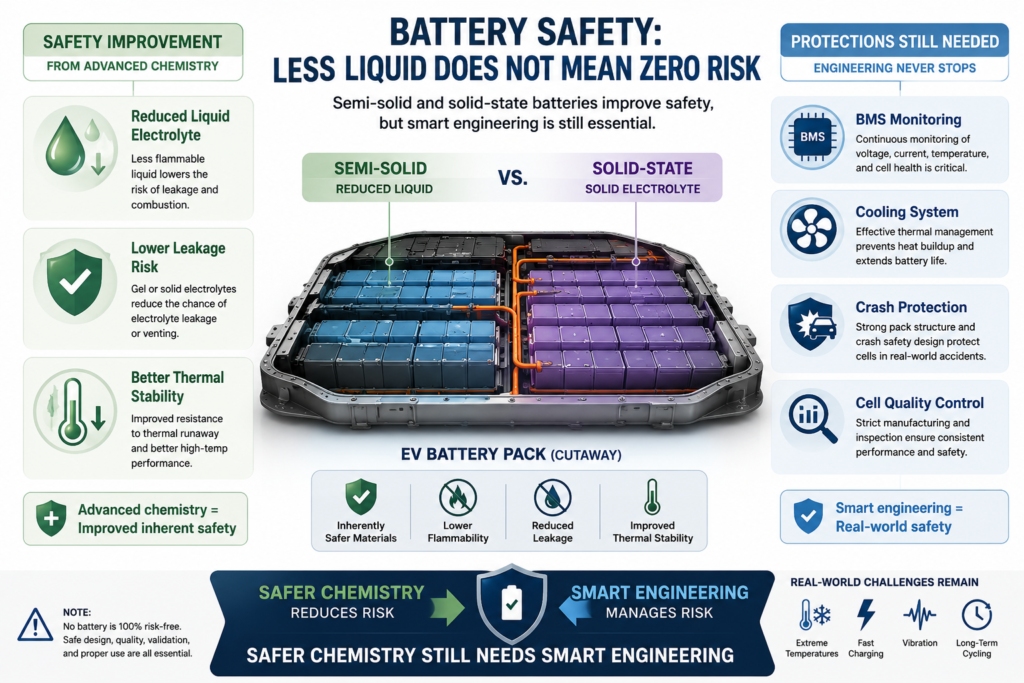
Semi-solid and solid-state batteries are often described as safer than conventional lithium-ion batteries. That can be true, but it needs context. Semi-solid batteries may improve safety by reducing the amount of free liquid electrolyte. Less liquid can reduce leakage risk and may lower flammability. A gel-like electrolyte may also help slow down some failure modes.
Solid-state batteries may go further by replacing volatile liquid electrolyte with solid materials. Argonne’s work on solid electrolyte materials highlights why electrolyte stability is central to safer all-solid-state battery designs.
But no EV battery is risk-free. A battery still stores a large amount of energy. Cathode materials can release oxygen under extreme abuse. Lithium metal can create internal short risks if poorly controlled. Poor manufacturing quality can create defects. Pack-level thermal management still matters. Crash protection still matters. BMS calibration still matters. In other words, solid-state technology may reduce certain risks, but it does not eliminate the need for engineering discipline.
This is similar to the way LFP batteries are often safer and more thermally stable than high-nickel NMC batteries, but an LFP pack still requires proper design. Chemistry helps, but pack engineering decides how that chemistry behaves in the real world. For a broader chemistry comparison, see our guide to LFP vs NMC batteries.
Energy Density: Where Solid-State Could Pull Ahead
Energy density is one of the main reasons people care about solid-state batteries. A semi-solid battery can improve energy density compared with some conventional designs, especially if it reduces inactive materials, improves packaging, or enables a higher-energy cathode or anode. But the biggest theoretical jump usually comes from pairing a solid electrolyte with a lithium-metal anode. That combination can reduce anode weight and increase usable energy in the same cell volume.
Still, energy density claims need careful reading. A company may report cell-level energy density, but EV buyers care about pack-level energy density. A battery pack includes cooling hardware, structure, electrical connections, crash protection, sensors, wiring, fire protection, and enclosure materials. A cell that looks impressive in the lab may deliver a smaller advantage once installed in a vehicle.
This is especially important with early solid-state packs. If the cells require high stack pressure, extra support structure, special thermal control, or conservative operating limits, the pack-level advantage can shrink. Semi-solid batteries may be less dramatic on paper, but they may offer a better near-term balance of performance, cost, and manufacturability. Full solid-state batteries may win later if manufacturers solve interface stability, yield, pressure, and cost at scale.
Charging Speed and Cold Weather Performance
Semi-solid and solid-state batteries are both often promoted as faster-charging technologies. The reality is more complicated. Charging speed depends on much more than electrolyte type. It depends on ion conductivity, electrode thickness, anode design, cell temperature, lithium plating risk, voltage limits, cooling capacity, pack voltage, charger power, and BMS strategy.
A semi-solid battery may improve fast charging if the electrolyte supports better ion transport and the anode can handle higher current without lithium plating. It may also perform better in cold weather if the electrolyte remains conductive at low temperatures.
Solid-state batteries may eventually support very fast charging, especially with lithium-metal designs and stable interfaces. In recent public reporting, Factorial and Stellantis have discussed validated FEST cells with 375 Wh/kg energy density and charging from 15% to over 90% in 18 minutes at room temperature, as summarized by Car and Driver. That is impressive, but it still needs to be proven across real vehicles, different temperatures, repeated cycles, and production-scale variation.
For EV owners, this is the practical takeaway: battery chemistry can raise the ceiling, but the vehicle still decides the charging curve. Even a great cell can be limited by thermal management, battery age, state of charge, and BMS protection logic. Our article on why EV batteries charge slower above 80% explains why charging speed always tapers near high SOC, regardless of marketing claims.
Manufacturability: Why Semi-Solid May Arrive First
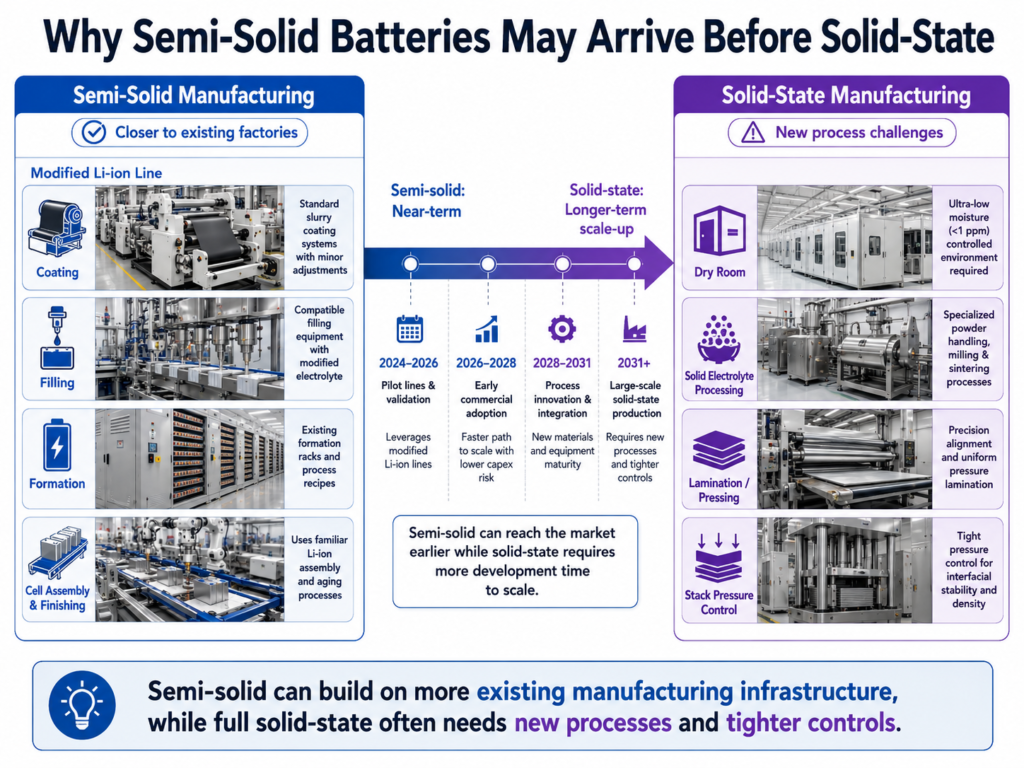
The best battery technology is not just the one that works in a lab. It is the one that can be manufactured consistently, affordably, and safely at scale. This is where semi-solid batteries have a near-term advantage. Semi-solid designs may be compatible with more existing lithium-ion manufacturing steps. They may allow companies to modify current production lines instead of building entirely new factories. They may also avoid some of the hardest solid-solid interface problems that all-solid-state batteries face.
Solid-state batteries are more demanding. They may require new electrolyte processing, new electrode coating methods, new lamination or pressing steps, tighter moisture control, more precise interface engineering, and different formation processes. They may also require new pack designs if the cells need mechanical pressure to maintain contact.
This does not mean solid-state batteries cannot scale. It means scaling them is hard. Nissan has shown its all-solid-state battery pilot line in Japan, while Toyota and its partners continue to work on solid-state materials and manufacturing readiness. These efforts matter because solid-state success will depend as much on production engineering as chemistry. That is why semi-solid batteries are likely to appear in more vehicles first. They may not be the final destination, but they may be the first commercially visible step.
Why 2026 Is an Important Year for Semi-Solid Batteries
The timing is important. For years, solid-state battery coverage was dominated by future promises. Companies talked about 2025, 2027, 2030, or “later this decade.” But consumers could not buy many real vehicles using these technologies. In 2026, semi-solid batteries are becoming more concrete. MG is now positioning SolidCore as a semi-solid battery technology that brings some solid-state-style benefits closer to production EVs. That matters because the first wave of semi-solid batteries may not arrive only in ultra-expensive concept cars.
That is a major shift. If semi-solid batteries appear in relatively mainstream EVs, they could become the first “solid-state-like” technology many drivers experience. The benefits may not be revolutionary at first. Range may not double. Charging may not become magically instant. But the technology could improve safety margins, cold-weather performance, durability, and packaging efficiency. That is how many battery transitions happen. They do not arrive as a single miracle. They arrive as a series of engineering steps that slowly change what becomes normal.
Why Full Solid-State Batteries Are Still Hard
Full solid-state batteries are difficult because they replace a flexible liquid interface with solid-solid interfaces. In a liquid-electrolyte battery, the electrolyte can wet the porous electrode surface. It fills tiny spaces and helps maintain ion pathways. In a solid-state battery, the electrolyte and electrode must remain in close contact even as the battery expands, contracts, heats, cools, charges, discharges, and ages.
That creates several challenges. The interface between the solid electrolyte and cathode can become resistive. The interface with lithium metal can become unstable. The cell may require pressure to maintain contact. Solid electrolytes can crack. Sulfide electrolytes may react with moisture. Oxide electrolytes can be difficult to process. Polymer electrolytes may struggle at low temperatures.
Then there is the automotive problem. A phone battery and an EV battery pack live very different lives. EV batteries must survive thousands of miles of vibration, high-current charging, thermal gradients, crash requirements, warranty expectations, and cost pressure. This is why road testing matters so much. Mercedes-Benz’s solid-state EQS test program and Stellantis-Factorial’s Dodge Charger Daytona development vehicle are not just publicity milestones. They are part of the process of proving whether solid-state cells can behave as vehicle systems.
What EV Buyers Should Watch For
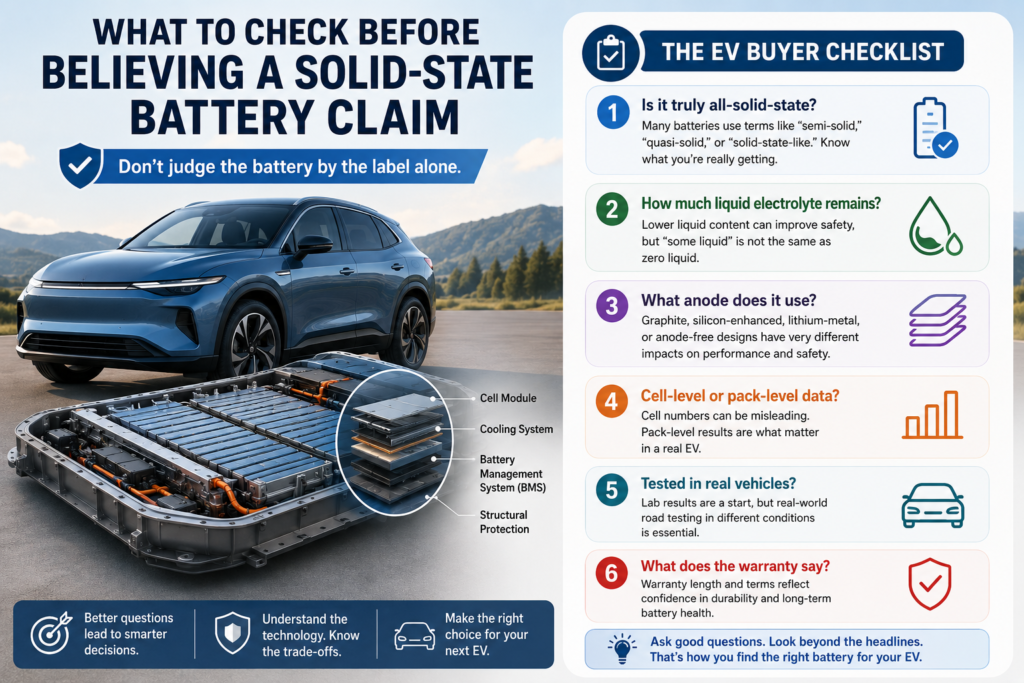
When an automaker announces a semi-solid or solid-state battery, do not stop at the headline. Look for the details. First, check whether the battery is truly all-solid-state or semi-solid. If it still contains a meaningful amount of liquid or gel electrolyte, it is better understood as semi-solid or quasi-solid.
Second, look at the anode. A graphite anode, silicon-enhanced anode, lithium-metal anode, and anode-free design are very different. The anode affects energy density, fast charging, swelling, cycle life, and safety.
Third, compare cell-level claims with pack-level results. A high Wh/kg number at the cell level does not automatically translate into a huge range advantage in a production EV.
Fourth, pay attention to temperature. A battery that charges quickly at room temperature may not charge the same way in freezing weather or desert heat.
Fifth, look for warranty terms and production volume. A limited pilot model is not the same as high-volume mass production.
Finally, remember that today’s LFP and NMC batteries are not standing still. They continue to improve through better cell design, silicon additives, pack integration, dry electrode manufacturing, thermal management, and software. Solid-state batteries are competing with a moving target.
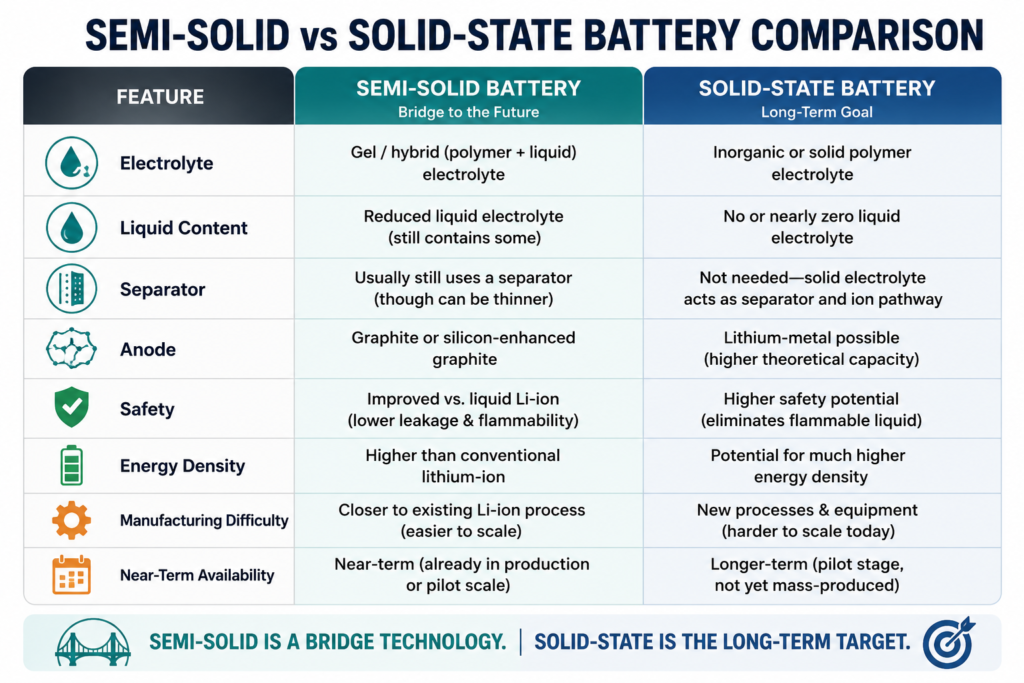
Semi-Solid vs Solid-State Comparison
| Feature | Semi-Solid Battery | Solid-State Battery |
|---|---|---|
| Electrolyte | Gel, polymer-rich, slurry-like, or hybrid solid-liquid | Mainly solid electrolyte |
| Liquid content | Reduced but not eliminated | Ideally little to none |
| Separator | Often still used | Solid electrolyte may act as separator |
| Anode | Graphite, silicon-enhanced, lithium metal, or other designs | Often aimed at lithium metal |
| Safety potential | Better than liquid-heavy designs | Potentially better, but not risk-free |
| Energy density potential | Moderate to high improvement | Higher long-term potential |
| Manufacturing difficulty | Closer to current lithium-ion production | More difficult to scale |
| Near-term EV availability | More likely in 2026–2027 | More limited, mostly testing or premium/pilot programs |
| Main challenge | Proving real-world advantage over LFP/NMC | Interfaces, pressure, yield, cost, durability |
Will Semi-Solid Batteries Replace LFP or NMC?
Not immediately. Semi-solid batteries may appear first in selected models where safety, cold-weather performance, charging, or packaging benefits justify the cost. But LFP and NMC are mature, scalable, and deeply integrated into global battery supply chains.
LFP is especially hard to beat on cost, durability, and safety. NMC remains strong where high energy density matters. Semi-solid batteries must prove that their advantages are large enough to justify new materials, new validation work, and possible cost premiums.
That said, semi-solid batteries do not need to replace LFP or NMC everywhere to matter. They could become useful in premium EVs, cold-climate vehicles, performance models, long-range packs, or compact EVs that need better packaging efficiency.
They may also act as a stepping stone. Automakers and suppliers can learn how to process lower-liquid electrolyte systems, validate new safety behavior, and prepare supply chains for more advanced solid-state designs later.
The Bottom Line
The easiest way to think about the semi-solid battery vs solid-state debate is this: semi-solid batteries are a near-term transition step, while full solid-state batteries are the longer-term target. Semi-solid and solid-state batteries are part of the same broad transition, but they are not the same technology. A semi-solid battery is a practical middle step. It reduces liquid electrolyte content and may improve safety, durability, cold-weather behavior, or energy density while staying closer to today’s lithium-ion manufacturing methods.
A solid-state battery is a deeper redesign. It replaces liquid electrolyte with a solid electrolyte and may unlock lithium-metal anodes, higher energy density, and stronger safety potential. But it is also harder to manufacture, harder to validate, and not yet ready for broad mass-market deployment.
For EV buyers, the most important message is simple: do not judge a battery by the label alone. Ask what electrolyte it uses. Ask whether it still contains liquid. Ask what anode chemistry it has. Ask whether the data comes from a lab cell, a prototype pack, or a real production vehicle. Ask whether the company has validated the battery through road testing, fast charging, cold weather, crash safety, and warranty cycles.
Semi-solid batteries may be the technology people actually see first. Full solid-state batteries may be the bigger long-term prize. Both matter, but confusing the two makes it harder to understand where EV battery technology is really going.
FAQs
Is a semi-solid battery the same as a solid-state battery?
No. A semi-solid battery still contains some liquid, gel, or hybrid electrolyte material. A solid-state battery uses a solid electrolyte as the main ion-conducting material. Semi-solid batteries are often described as a bridge between conventional lithium-ion and full solid-state batteries.
Are semi-solid batteries safer than regular lithium-ion batteries?
They can be safer, especially if they reduce free liquid electrolyte and improve thermal stability. But they are not risk-free. Pack design, BMS protection, cooling, manufacturing quality, and crash safety still matter.
Do solid-state batteries still need cooling?
Yes. Solid-state batteries may reduce some safety risks, but they still generate heat during charging and discharging. EV battery packs still need thermal management to control performance, aging, and safety.
Why are solid-state batteries so difficult to manufacture?
The main challenge is maintaining stable contact between solid materials. Solid electrolytes must stay compatible with electrodes during cycling, temperature changes, pressure changes, and aging. Scaling those interfaces into large automotive cells is difficult.
Will semi-solid batteries come before solid-state batteries?
Most likely, yes. Semi-solid batteries are closer to current lithium-ion manufacturing and are already moving into vehicle announcements. Full solid-state batteries are progressing, but broad mass-market use will likely take longer.
Do semi-solid batteries use lithium metal?
Some may, but not all. Semi-solid refers mainly to the electrolyte structure, not the anode. A semi-solid battery could use graphite, silicon-enhanced graphite, lithium metal, or another anode design.
Should EV buyers wait for solid-state batteries?
For most buyers, probably not. Today’s LFP and NMC EV batteries are already good enough for most daily use, and solid-state batteries are still in early vehicle testing or limited deployment. Waiting only makes sense if you are not in a hurry and specifically want next-generation battery technology.