
Quick Answer
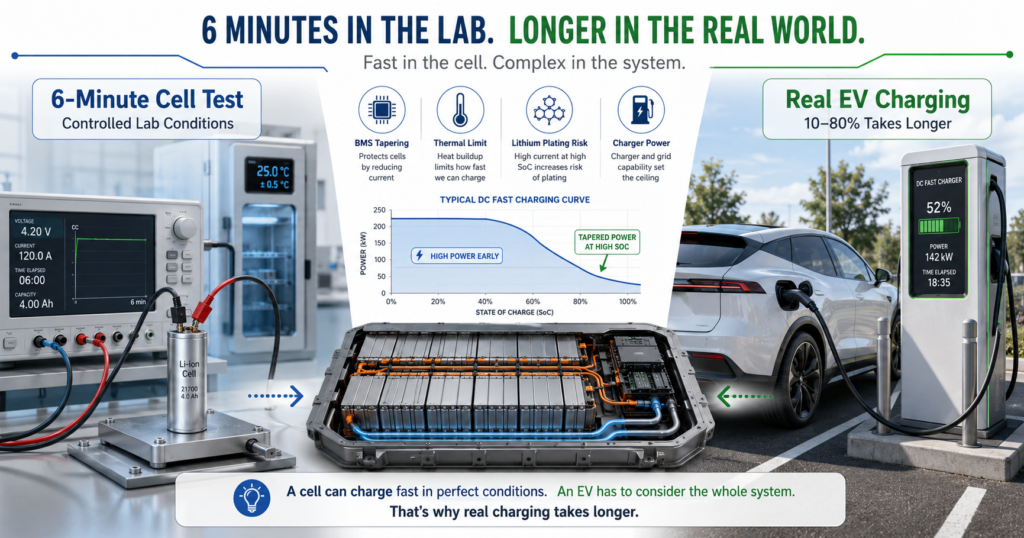
Can EV batteries charge in 6 minutes? In some cell-level lab tests, yes — but real EV charging is more complicated. Yes, some EV battery cells can reach very high charge levels in around six minutes under controlled test conditions. But that does not mean most electric cars on the road today can charge their full battery pack from 10% to 80% in six minutes at a public charging station.
The key difference is this: a battery cell fast-charging result is not the same as a real EV charging session. A lab cell may be small, carefully temperature-controlled, tested under ideal conditions, and charged using equipment designed for that specific experiment. A production EV has a large battery pack, hundreds or thousands of cells, cooling limits, safety margins, charging-curve tapering, BMS protection logic, cable limits, charger limits, and real-world station availability issues.
That is why today’s fastest production EVs usually advertise something closer to 10–80% charging in about 18 to 25 minutes, while next-generation battery companies talk about six-minute, ten-minute, or sub-15-minute charging at the cell or system target level. Six-minute EV charging is not impossible. But for everyday drivers, it is better understood as an emerging battery technology target, not a normal real-world charging experience yet.
Introduction: Why “6-Minute Charging” Sounds So Exciting
Every few months, a new EV battery headline appears: “5-minute charging,” “6-minute charging,” “10-minute charging,” or “gas-station-like EV charging.” It is easy to understand why these claims get attention. For many drivers, charging time is still one of the biggest psychological differences between an electric vehicle and a gasoline car. Even if most EV owners charge at home overnight, long road trips still make people ask a simple question:
How long will I have to stop? That question is why ultra-fast charging has become one of the hottest areas in battery technology. Battery Technology Online recently highlighted several of the fastest-charging EV battery technologies expected or discussed around 2026, including systems from companies such as CATL, BYD, StoreDot, ProLogium, QuantumScape, and Factorial Energy, with several targeting sub-15-minute charging performance.
At the same time, researchers are reporting impressive cell-level progress. One recent example from the University of Adelaide, reported by Tech Xplore, described pouch cells that reached more than 85% charge after six minutes while still delivering about 240.4 Wh/kg after less than six minutes of charging.
That sounds almost like the end of charging anxiety. But there is a catch. When a headline says a battery can charge in six minutes, the most important question is not simply “Is that true?” The better question is: What exactly was charged, under what conditions, and how does that compare with a real EV battery pack?
That distinction matters because EV charging is not just about pushing electricity into a battery as fast as possible. It is about moving lithium ions safely through a complex electrochemical system without damaging the battery, overheating the pack, creating lithium plating, exceeding voltage limits, or shortening battery life.
We already covered the physics behind charging tapering in detail in our article on why EV batteries can’t always accept maximum charging power. This article focuses on a different but closely related question: how to interpret fast-charging claims when they sound almost too good to be true.
What Does “6-Minute EV Battery Charging” Actually Mean?
The phrase “6-minute charging” can mean several different things. It might mean a small laboratory cell reached 80% or 85% state of charge in six minutes. It might mean a prototype battery module reached a certain charge level under controlled cooling. It might mean a battery company is targeting six-minute charging in future commercial products. It might mean a vehicle can add a certain number of miles in six minutes, not charge the entire pack from 10% to 80%.
Those are very different claims. For consumers, the most useful number is usually 10–80% charging time. Automakers use this window because it reflects real road-trip behavior. Most drivers do not arrive at a charger at 0%, and charging above 80% usually slows down significantly. That is why an EV that can charge from 10% to 80% in 18 minutes may still take much longer to go from 80% to 100%.
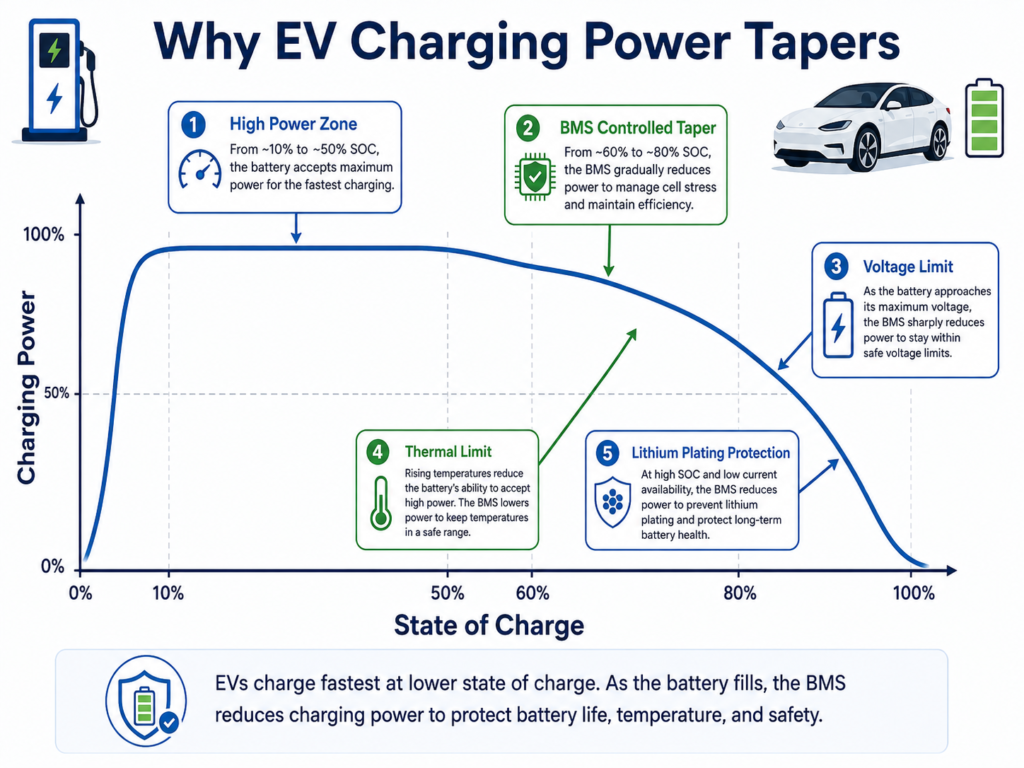
This is not a marketing trick. It is battery physics. At low state of charge, the battery has more room to accept lithium ions. As the pack fills up, the anode becomes more crowded, cell voltage rises, heat becomes harder to manage, and the BMS gradually reduces charging power. That slowdown is called tapering, and it is a normal part of fast charging.
For comparison, Hyundai lists the 2026 IONIQ 5 as charging from 10% to 80% in about 20 minutes on a 350-kW, 800V DC ultra-fast charger using the included CCS adapter, under appropriate conditions. Kia’s EV6 manual similarly lists about 18 minutes from 10% to 80% at room temperature on a 350-kW DC charger. Those are excellent real-world production EV charging numbers. But they are still not six minutes. That gap is the heart of the issue.
Cell-Level Charging Is Not the Same as Vehicle-Level Charging
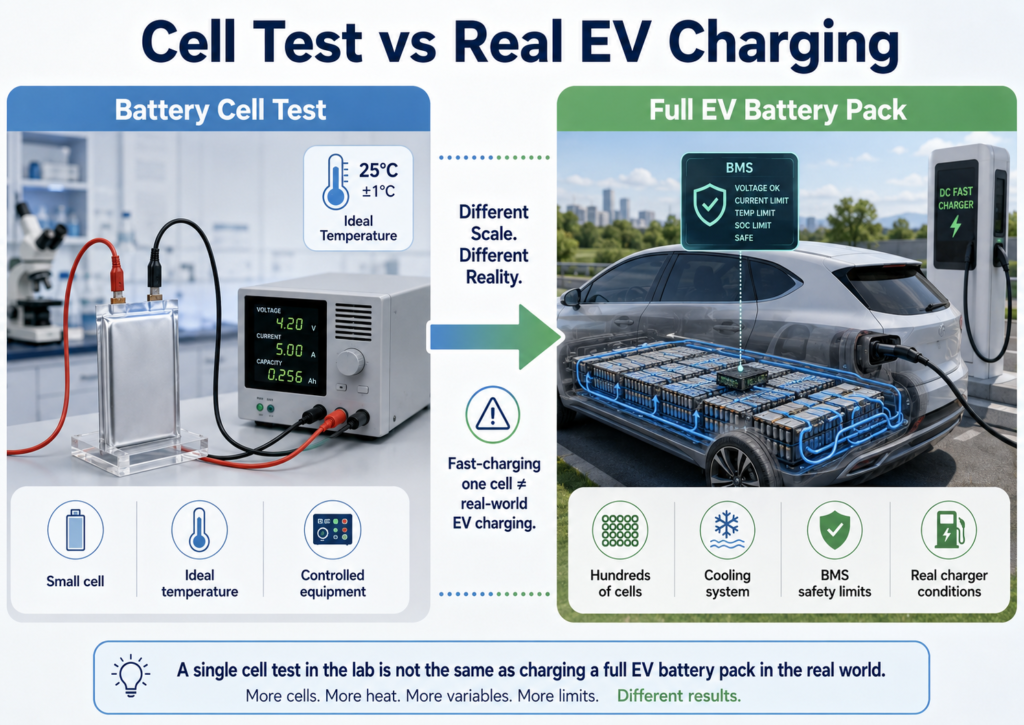
Battery companies often test new technologies at the cell level first. That makes sense. A battery cell is the basic building block of a pack, and researchers need to understand how the chemistry behaves before scaling it into a vehicle.
But a single pouch cell, cylindrical cell, or lab-format cell is much easier to manage than a full EV battery pack. A cell-level test can control temperature more precisely. It can use carefully selected cells. It can avoid some of the packaging, wiring, connector, and cooling challenges found in a production EV. It may also focus on a specific charge window, cycle count, or test condition that does not fully represent daily driver behavior.
A vehicle battery pack is much more complicated. A modern EV pack may contain hundreds or thousands of cells. Those cells are grouped into modules or integrated directly into the pack. The BMS has to monitor cell voltages, temperatures, current, state of charge, state of health, insulation safety, contactors, cooling loops, and fault conditions. If one cell group is hotter, colder, weaker, or closer to a voltage limit than the others, the whole pack may have to slow down.
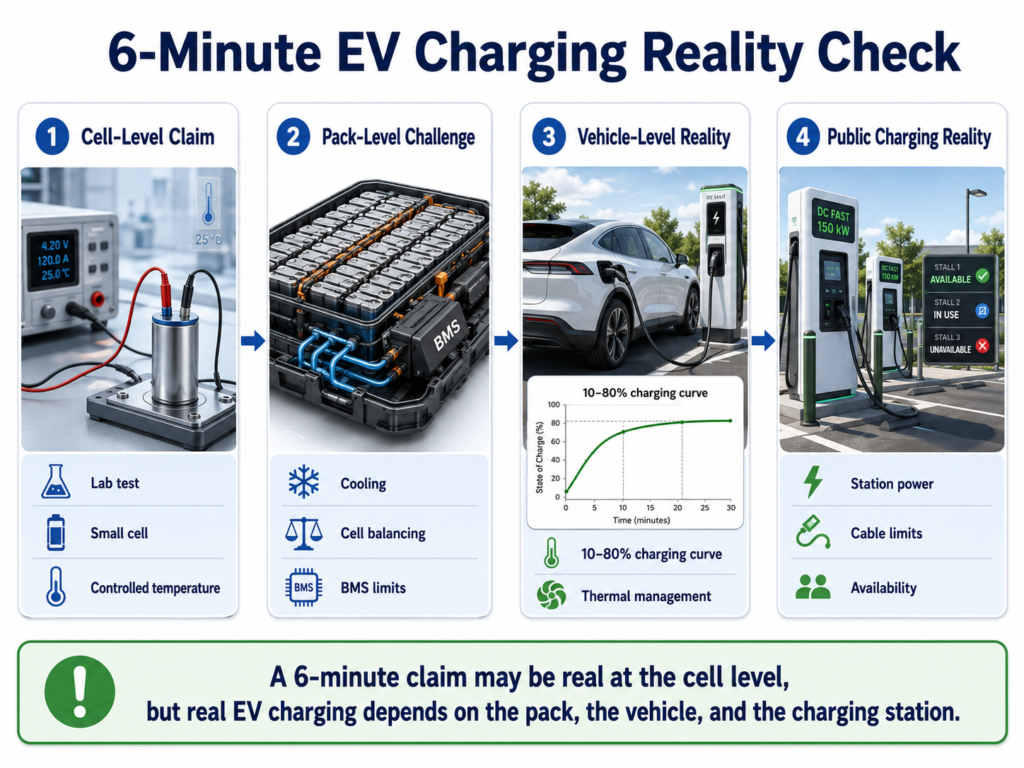
This is why a battery can look amazing in a cell-level test but still take years to become a mass-market EV product. The pack needs to work in Michigan winter, Arizona summer, heavy traffic, mountain driving, repeated road trips, imperfect chargers, and aging vehicles. It also needs to meet warranty expectations for many years. Automakers cannot design the charging curve only for a perfect lab day. That is why fast-charging claims should always be read with one question in mind: Is this a cell result, a module result, a pack result, or a production vehicle result?
The Math Behind a 6-Minute 10–80% Charge
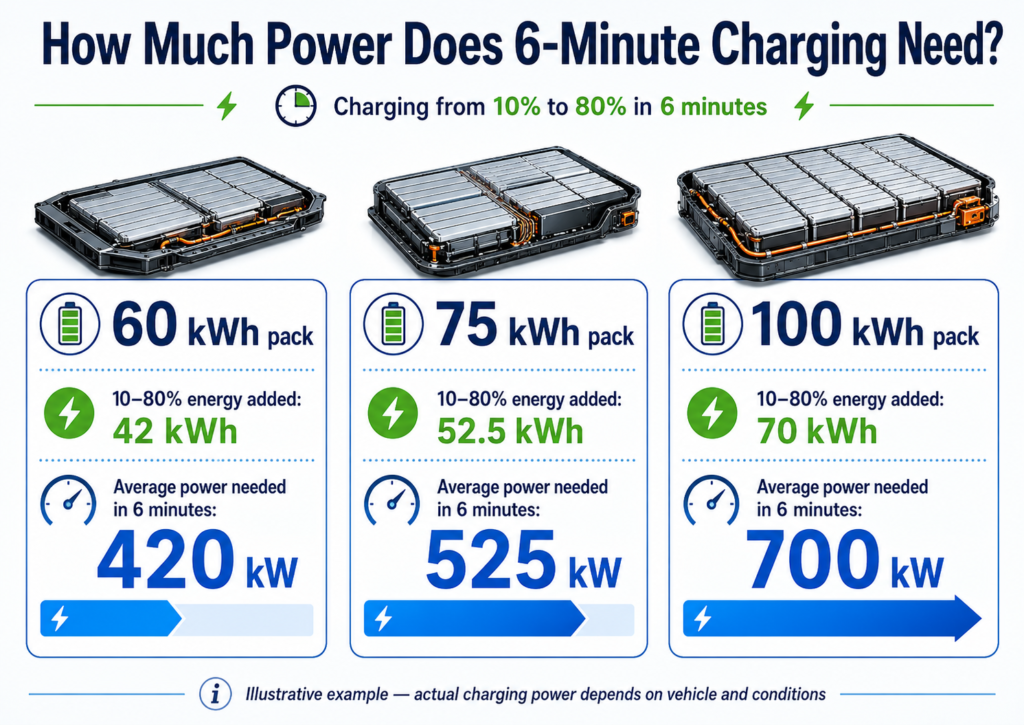
A six-minute 10–80% charge sounds simple until you calculate the power required. Imagine an EV with a 75 kWh usable battery pack. Charging from 10% to 80% means adding 70% of the pack’s usable capacity. That is about: 75 kWh × 70% = 52.5 kWh. To add 52.5 kWh in six minutes, the average charging power would need to be roughly: 52.5 kWh ÷ 0.1 hour = 525 kW. That is average power, not peak power.
In real charging, the vehicle usually does not hold peak power for the whole session. It may start high, hold for a while, then taper. So the peak power might need to be even higher than the average power, depending on the charging curve.
Now imagine a larger EV battery, such as a 100 kWh pack. A 10–80% charge adds about 70 kWh. To add that in six minutes, the average power would need to be about 700 kW. That is an enormous amount of power for a passenger EV.
It is not impossible from an electrical engineering standpoint, but it creates serious challenges. The charger, cable, connector, vehicle inlet, contactors, busbars, power electronics, cell tabs, cooling plates, and battery cells all have to handle very high current or very high voltage. Heat generation becomes a major problem. The battery also has to accept lithium ions at extreme speed without plating metallic lithium on the anode.
This is why 800V and even higher-voltage architectures matter. Higher voltage allows the same power with lower current, which helps reduce resistive losses and cable heating. But higher voltage does not eliminate the cell-level limits inside the battery. It only makes the power delivery side easier.
We covered this architecture tradeoff separately in 400V vs 800V EV: Why Higher Voltage Matters. The short version is that 800V systems help fast charging, but they do not magically remove lithium plating risk, thermal limits, or charging tapering.
Why Lithium Plating Is the Big Fast-Charging Risk
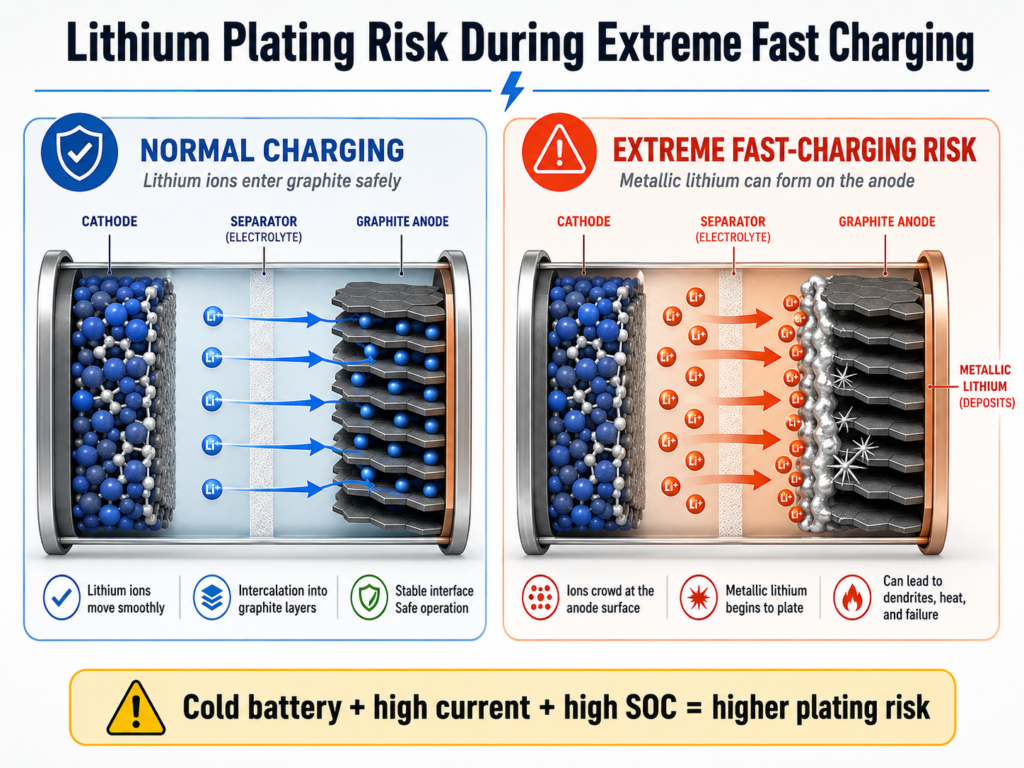
The biggest electrochemical concern during extreme fast charging is lithium plating. In a healthy lithium-ion battery, lithium ions move into the graphite or silicon-graphite anode during charging. That process is called intercalation. The ions do not simply pile up on the surface; they enter the anode structure.
But if charging is too aggressive, especially at low temperature or high state of charge, the anode may not accept lithium fast enough. When that happens, some lithium can deposit as metallic lithium on the anode surface instead of entering the graphite structure. That is lithium plating.
Lithium plating can reduce usable capacity because some of the lithium becomes inactive. It can also increase resistance, accelerate aging, and in severe cases contribute to dendrite-like growth that raises safety concerns. Modern EVs are designed to avoid this, which is why the BMS limits charging current when conditions are risky.
This is also why cold batteries charge slowly. A cold battery is not just uncomfortable. Its electrolyte is less conductive, lithium diffusion is slower, and the anode becomes less willing to accept high current. If the car allowed maximum charging power anyway, plating risk would rise.
Researchers studying extreme fast charging have repeatedly identified lithium plating as one of the main barriers to very short charging times. One technical paper on thermal switching and self-heating describes sub-15-minute charging as an important industry target, while noting that avoiding lithium plating remains one of the central challenges for extreme fast charging. That is why six-minute charging is not only a charger problem. It is a battery-chemistry problem.
Why Charging Power Must Taper
Most drivers notice fast charging as a number on the screen: 60 kW, 150 kW, 230 kW, 300 kW, and so on. But that number is constantly changing because the vehicle is continuously adjusting how much power the battery can accept. The BMS looks at battery temperature, cell voltage, current, state of charge, state of health, cell imbalance, and safety limits. Then it tells the charger how much current to deliver.
At low state of charge and ideal temperature, the battery may accept very high power. As the pack fills, the BMS gradually reduces current. This protects the battery from excessive voltage, heat, and lithium plating.
That is why charging from 10% to 60% can feel incredibly fast, while charging from 80% to 100% can feel slow. In our earlier article on why EV batteries charge slower above 80%, we explained that the slowdown is not a defect. It is an intentional battery protection strategy.
This is also why “peak charging power” can be misleading. A car that briefly reaches 300 kW may not charge faster overall than a car that peaks at 240 kW but holds high power longer. The full charging curve matters more than the highest number displayed for a few seconds.
For six-minute charging to become realistic in production EVs, batteries will need more than a high peak charging number. They will need to hold very high power through a large portion of the 10–80% window without overheating or aging too quickly. That is a much harder problem.
Why 10–80% Matters More Than 0–100%
When automakers advertise fast charging, they almost always use 10–80%, not 0–100%. There are good reasons for that. The bottom end of the battery is usually protected by buffers, and drivers rarely arrive at a charger with exactly 0% remaining. The top end is where charging becomes slowest because the battery is approaching its upper voltage limit. Charging from 80% to 100% may be useful before a long trip, but it is usually not the best use of time at a DC fast charger.
For road trips, the fastest strategy is often to arrive at a low state of charge, charge only to the level needed for the next leg, and leave before the charging curve slows too much. That is why many EV owners stop at 70% or 80% instead of waiting for 100%.
This is also why a “six-minute charge” claim may be less useful if it does not clearly state the charge window. A battery that goes from 10% to 50% in six minutes is impressive. A battery that goes from 10% to 80% in six minutes is far more difficult. A battery that goes from 0% to 100% in six minutes would be a completely different level of challenge.
Whenever you see a fast-charging claim, look for the starting SOC, ending SOC, battery size, temperature, charger power, cell chemistry, and cycle-life data. Without those details, the headline is incomplete.
Why Charger Power Alone Does Not Guarantee Fast Charging
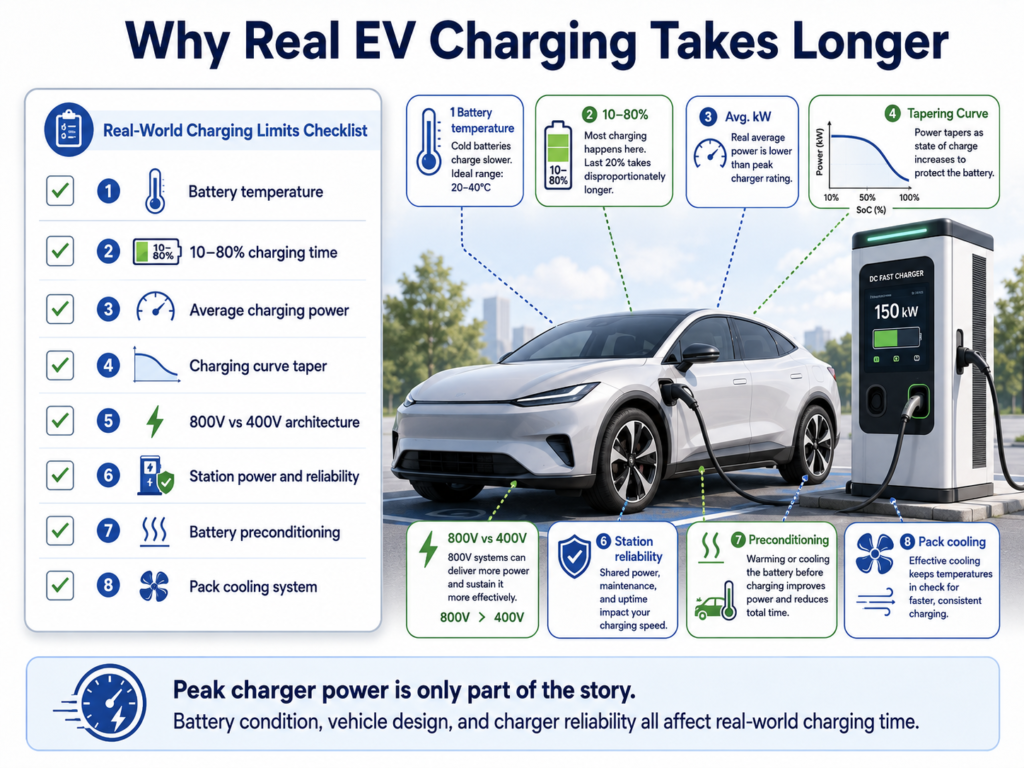
A 350-kW charger does not automatically mean your EV will charge at 350 kW. The charger can only offer power. The vehicle decides how much it can accept. This is one of the most common misunderstandings in EV ownership. A driver may plug into a 350-kW station and see only 120 kW. That does not always mean the charger is broken. The battery may be too cold, too hot, too full, or limited by the vehicle’s charging architecture. The vehicle may also have a lower maximum charge rate than the charger.
The U.S. Department of Energy has described extreme fast charging as a way to make EV road trips more practical, with high-power charging up to 350 kW playing a key role in corridor charging. But even high-power infrastructure only solves part of the problem. The EV itself must have:
- A battery chemistry that can accept high current
- A thermal system that can remove heat quickly
- A pack design with low electrical resistance
- A BMS that can safely manage charging limits
- A voltage architecture that supports high-power charging
- A connector and cable system rated for the power level
This is why two EVs can use the same public charger and have very different charging times. The station matters, but the battery pack and vehicle design matter just as much. For a deeper owner-focused explanation, your existing article Why Some EVs Charge Faster Than Others is a strong internal link here. It explains how battery chemistry, pack size, temperature, voltage architecture, and charging curves all interact.
The Role of Battery Chemistry: Why Silicon, LFP, Sodium-Ion, and Solid-State Matter
Fast charging is partly a materials problem. Traditional graphite anodes work well, but they have limits. Lithium ions need time to move through the electrolyte, cross the SEI layer, and enter graphite particles. If that process is rushed too hard, plating risk increases. That is why companies are exploring improved graphite structures, silicon-enhanced anodes, lithium-metal designs, solid-state electrolytes, advanced coatings, and even sodium-ion chemistry.
CATL’s Shenxing PLUS is one example of how commercial battery makers are pushing fast-charging claims. CATL says the Shenxing PLUS LFP battery can deliver 600 km of range in 10 minutes and uses technologies such as fast lithium-ion conductive coatings, transition metal elements, nanometer encapsulation, expanded overcurrent areas, and improved heat dissipation. That claim does not mean every EV with an LFP battery can do the same thing. It means the cell chemistry, electrode design, pack design, and thermal management have been engineered around fast charging.
Silicon anodes are another major path. Silicon can store more lithium than graphite, but it expands significantly during cycling. That creates durability and swelling challenges. If engineers can manage those issues, silicon-rich anodes may help batteries charge faster and store more energy.
Solid-state batteries are often discussed as the long-term breakthrough. They may eventually improve safety, energy density, and fast-charging capability, but mass-market EV deployment still requires solving manufacturing scale, interface stability, cost, and durability challenges.
Sodium-ion batteries are also gaining attention, especially for cost, cold-weather behavior, and material availability. However, sodium-ion cells usually have lower energy density than high-nickel lithium-ion cells, so their role may be strongest in affordable EVs, short-range vehicles, or energy storage before they dominate long-range premium EVs.
The important point is that fast charging is not controlled by one magic material. It depends on the full system: anode, cathode, electrolyte, separator, electrode thickness, cell format, cooling, pack design, and software.
Why Thermal Management May Decide the Real Winner
Fast charging creates heat. Some heat comes from electrical resistance. Some comes from electrochemical reactions. Some appears in the cells, while some appears in cables, connectors, busbars, and power electronics. At six-minute charging speeds, the heat problem becomes intense. This is why thermal management is not a secondary feature. It is central to fast charging.
A high-performance EV battery pack needs cooling plates, coolant channels, chillers, pumps, sensors, thermal interface materials, and software that can predict how the pack will behave during the session. If cooling cannot keep up, the BMS will reduce charging power.
That is also why battery preconditioning matters. If the EV knows you are navigating to a DC fast charger, it can warm or cool the battery before arrival. A battery that arrives in the ideal temperature window can usually accept more power than a battery that arrives too cold or too hot.
The tricky part is that extreme fast charging may require a narrow temperature balance. Warmer cells can reduce plating risk by improving lithium-ion transport, but too much heat accelerates side reactions and aging. The system has to stay in the sweet spot. That is why future six-minute or ten-minute charging will likely require tighter integration between battery chemistry, thermal hardware, and predictive BMS software. It will not be solved by a bigger charger alone.
What About Station Availability?
Even if an EV can technically charge very quickly, drivers still need access to the right charger. A six-minute-capable EV would need a high-power station that can actually deliver the required power. That station needs enough grid capacity, working hardware, properly cooled cables, compatible connectors, good payment systems, and enough stalls to avoid long waits.
This is where real-world charging often differs from the lab. A vehicle may advertise an ideal 10–80% time, but your actual road-trip stop may depend on whether the station is busy, whether the charger is power-sharing with another vehicle, whether the cable cooling system is working, whether the battery was preconditioned, and whether the charger communicates properly with the vehicle.
This is why the fastest theoretical charge time is not always the most important number for drivers. A reliable 18-minute session at a widely available station may be more useful than a six-minute capability that only works at rare high-power chargers under ideal conditions. For mainstream adoption, the charging ecosystem has to improve along with the battery.
Are 6-Minute EV Batteries Real or Just Marketing?
The fair answer is: both, depending on the claim. Six-minute battery charging is real in the sense that researchers and companies have demonstrated very fast cell-level charging under controlled conditions. The University of Adelaide example is a good illustration: a pouch cell reached more than 85% charge after six minutes in reported testing.
But six-minute EV charging can become misleading when readers assume that means a production electric SUV can pull into any public charger and go from 10% to 80% in six minutes. That is not where the mainstream market is today.
Today’s best production EVs are already impressive. E-GMP vehicles such as the Hyundai IONIQ 5 and Kia EV6 can charge in roughly 18 to 20 minutes from 10% to 80% under the right conditions. Porsche’s updated Taycan is also commonly cited around 18 minutes from 10% to 80% under optimal high-power DC charging conditions (EV Charging Station).
Those numbers are not slow. They are a major improvement over early EV fast charging. But moving from 18 minutes to six minutes is not a small step. It requires roughly tripling the average charging power, while still protecting battery life, safety, thermal balance, and charging infrastructure reliability. That is why six-minute charging should be viewed as an important direction, not a universal reality.
What Drivers Should Look for Instead of the Headline Number
For EV shoppers, the best charging comparison is not “Can it charge in six minutes?” A better set of questions is:
- What is the 10–80% charging time?
- What is the average charging power during that window?
- How long does it take to add 100 or 200 miles of real highway range?
- Does the car precondition the battery automatically?
- Does it use a 400V or 800V architecture?
- How well does it charge in cold weather?
- How quickly does charging taper after 60% or 80%?
- Are compatible high-power chargers common on your routes?
Those answers matter more than the most dramatic claim. A vehicle with a strong charging curve, good efficiency, reliable route planning, and dependable charger access may feel better on road trips than a vehicle with a huge peak power number but poor taper behavior.
This is also why range and charging speed must be considered together. A highly efficient EV does not need to add as many kWh to gain 100 miles of range. A less efficient large SUV may need much more energy for the same distance, even if its peak charging power is higher. In real life, drivers care about time added per useful mile, not just battery percentage.
Conclusion: Six-Minute Charging Is Coming, But Read the Fine Print
EV batteries really are getting faster at charging. New cell chemistries, silicon-enhanced anodes, improved LFP designs, better coatings, higher-voltage platforms, advanced thermal systems, and smarter BMS software are all pushing the industry toward shorter charging stops.
Six-minute charging is not science fiction. Researchers have already shown impressive cell-level results, and major battery companies are openly targeting sub-15-minute charging. But a six-minute battery cell result is not the same as a six-minute real-world EV charging stop.
For everyday drivers, the most useful way to read fast-charging claims is to separate four things:
- Cell-level test results
- Battery pack capability
- Production vehicle charging curves
- Public charging station reality
When all four improve together, EV charging will feel much closer to gasoline refueling. Until then, the best production EVs are already moving toward the 15–20 minute road-trip stop, while six-minute charging remains an exciting but still emerging frontier.
The headline may say “six minutes.” The real story is more interesting: fast charging is not just about speed. It is about safely managing lithium movement, heat, voltage, software, and infrastructure at the same time.
FAQs
Can an EV really charge in 6 minutes?
Some battery cells have shown six-minute-class charging in controlled tests, but most production EVs cannot charge their full battery pack from 10% to 80% in six minutes today. Real vehicle charging depends on pack size, charger power, battery temperature, BMS limits, cooling, and charging taper.
Why do companies talk about 5-minute or 6-minute charging?
Fast-charging claims are often based on cell-level testing, prototype systems, or range-added estimates. These are useful signs of progress, but they do not always represent what a driver will experience at a public charging station.
What is the fastest realistic EV charging time today?
Many of the fastest production EVs are in the roughly 18–25 minute range for 10–80% charging under ideal conditions. Some vehicles can add a large amount of range in less than 10 minutes, but that is different from charging the whole usable battery window.
Why does EV charging slow down after 80%?
Above 80%, the battery is closer to its upper voltage limit, lithium-ion movement becomes more constrained, and heat and plating risks increase. The BMS reduces charging power to protect battery life and safety.
Is 350 kW charging enough for 6-minute charging?
For some smaller battery packs, 350 kW could add a lot of energy quickly. But a true 10–80% charge in six minutes for a 75–100 kWh pack would often require average power far above 350 kW. Larger packs may need 500–700 kW average power depending on battery size and charging curve.
Will solid-state batteries make 6-minute charging normal?
Solid-state batteries may help future EVs charge faster, but they are not a guaranteed instant solution. Manufacturing scale, interface stability, cycle life, cost, and pack integration still matter. Six-minute charging will require the entire battery system to work together, not just a new electrolyte.