
Quick Answer
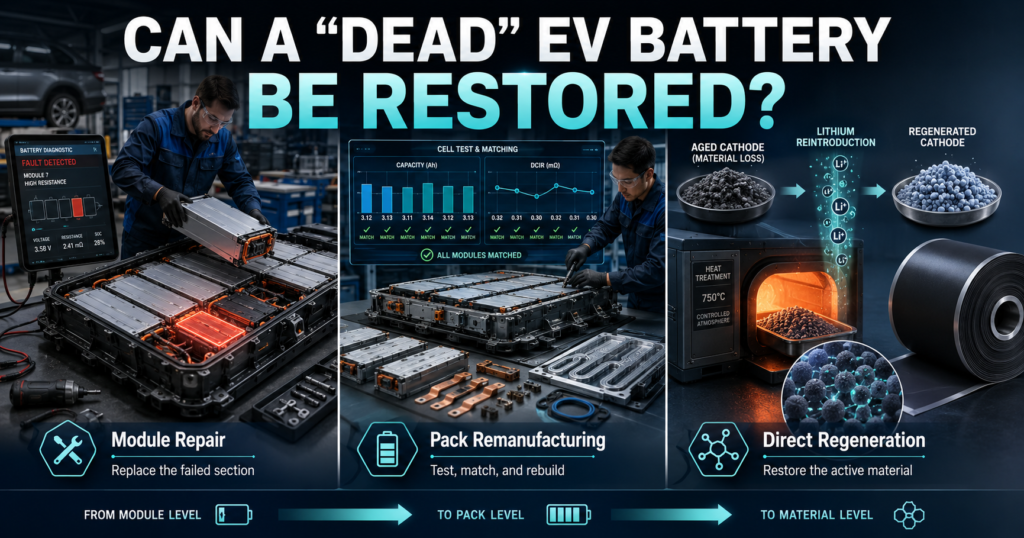
EV battery repair is becoming a more important option as older electric vehicles age and more high-voltage packs reach the end of their first life. Sometimes, but the word “restored” can mean several very different things. An EV battery with one defective module, a failed sensor, a damaged contactor, or a cooling-system problem may be repairable without replacing the entire pack. A used pack may also be remanufactured by replacing weak components and testing the rebuilt assembly.
More experimental approaches go deeper. Researchers are developing ways to restore degraded cathode materials through relithiation, direct electrode regeneration, and other direct recycling methods that preserve more of the original material structure.
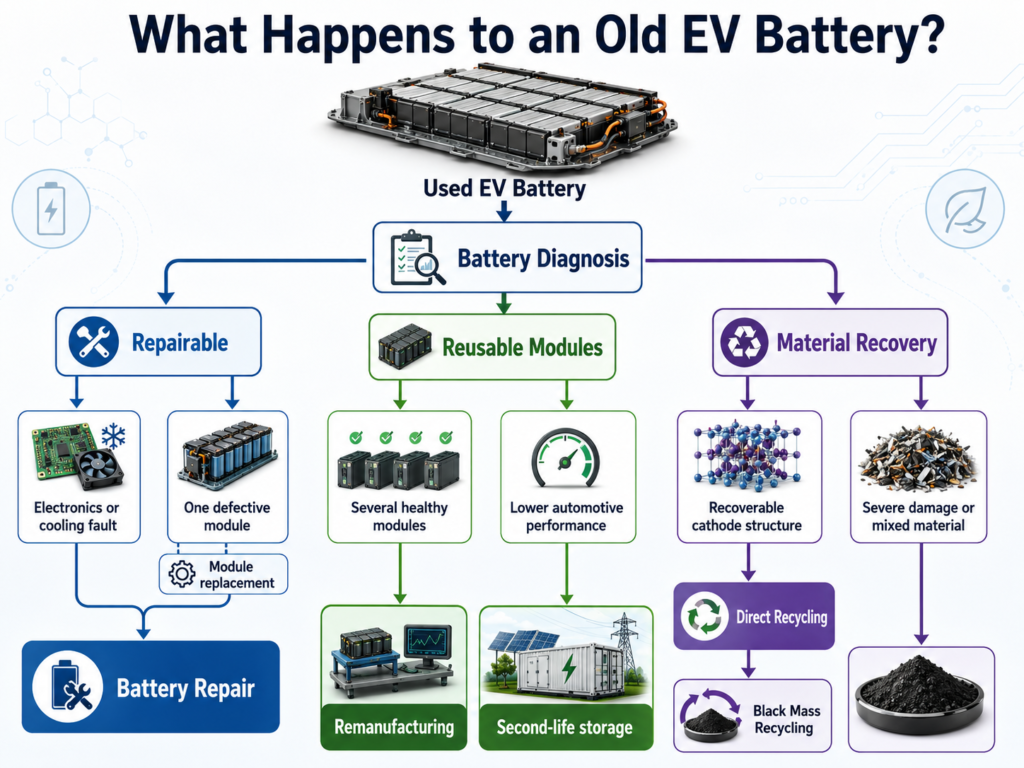
However, these technologies should not be confused with pouring new electrolyte into an old EV battery and making it new again. Commercial EV cells are sealed, chemically complex devices. Once they have experienced internal short circuits, severe lithium plating, fire damage, separator failure, major swelling, or widespread electrode deterioration, safe repair may no longer be practical. The future is therefore unlikely to be a choice between repair and recycling. The most realistic system will use several pathways:
Repair when the fault is localized.
Remanufacture when reusable sections can be safely recovered.
Regenerate valuable electrode materials when their structure can be preserved.
Recycle the rest into raw materials.
Introduction
When an EV battery develops a problem, many owners imagine only two possible outcomes. Either the battery continues working, or the entire pack is removed, shredded, and recycled. The real picture is becoming much more complicated.
An electric vehicle battery is not one giant cell. It is a system containing hundreds or thousands of individual cells, electrical connections, sensors, cooling components, contactors, structural parts, and a battery management system. A pack can stop operating correctly even when most of its cells are still usable.
That creates an obvious question: Why destroy an entire battery pack because one section has failed? Automakers, specialist repair companies, recyclers, and researchers are exploring several answers. Some focus on conventional vehicle repair, such as replacing a damaged battery module. Others rebuild used packs from tested components. At the material level, researchers are investigating whether degraded cathodes can be chemically restored without first breaking them down into individual metals.
These approaches could extend battery life, reduce replacement costs, and preserve more of the energy and value already invested in manufacturing the battery. They could also reduce the amount of material that must pass through energy-intensive recycling processes.
But battery restoration is not simple. A cell that looks healthy from the outside may contain lithium plating, microscopic separator damage, localized contamination, or internal resistance growth. Reusing it without understanding its condition can create both performance and safety problems. To understand where restoration makes sense, we first need to separate four terms that are often used interchangeably: repair, remanufacturing, direct recycling, and conventional material recycling.
EV Battery Repair, Remanufacturing, and Recycling Are Not the Same
Battery repair usually happens at the vehicle or pack level. The goal is to return the existing battery system to service by correcting a specific fault. That could mean replacing a failed contactor, fixing a coolant leak, installing a new battery control board, repairing a damaged wiring harness, or replacing one defective module. The battery pack remains fundamentally the same product and may return to the same vehicle.
Remanufacturing goes further. A used pack is opened, inspected, disassembled, and rebuilt using components that pass defined tests. Weak or damaged modules may be replaced, electrical connections renewed, seals changed, and control electronics updated. The completed pack must then be tested as an integrated system.
A remanufactured battery may contain a mixture of original and replacement components. The purpose is not necessarily to make the battery identical to a factory-new pack. It is to restore it to a defined level of capacity, power, insulation resistance, safety, and reliability.
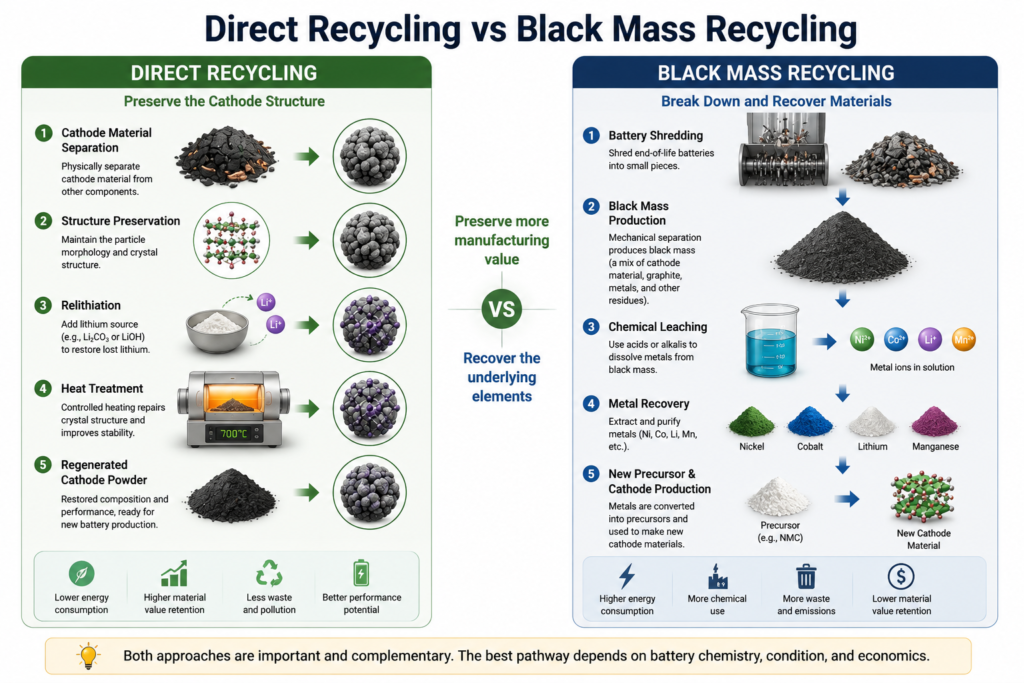
Direct recycling operates at the material level rather than the vehicle level. Its goal is to recover active battery materials while preserving as much of their engineered structure as possible. A degraded cathode powder, for example, might be separated, cleaned, replenished with lithium, heat-treated, and returned to battery production.
Conventional recycling usually breaks materials down further. Batteries may be discharged, dismantled, crushed, or shredded to produce a mixed material commonly called black mass. Hydrometallurgical or pyrometallurgical processes then recover elements or chemical compounds that can be processed into new battery materials.
These processes all have value, but they solve different problems. Repair tries to save the battery system. Remanufacturing tries to save usable components. Direct recycling tries to save the functional structure of the electrode material. Conventional recycling tries to recover its underlying elements.
Can a Failed EV Battery Module Be Replaced?
In some EVs, yes. A modular battery pack is divided into serviceable sections containing groups of cells. When diagnostics identify a localized failure, a trained technician may be able to replace the affected module instead of installing an entirely new pack.
This is not merely a theoretical possibility. General Motors has used module-level replacement as part of its Chevrolet Bolt EV and Bolt EUV battery recall strategy. GM’s recall information states that certain affected vehicles may receive replacement lithium-ion battery modules rather than an automatically replaced vehicle or unrelated repair. Ford service programs have also included high-voltage battery module replacement procedures for certain vehicles.
Module replacement can make economic and environmental sense when most of the pack remains healthy. Replacing a small section preserves the functional cells, cooling plates, enclosure, electronics, wiring, and other components that required substantial energy and resources to manufacture.
Still, module replacement is more complicated than changing a conventional 12-volt car battery. The replacement module must be compatible with the rest of the pack. Its voltage, capacity, internal resistance, temperature behavior, and state of charge must fall within acceptable limits. A new module placed beside heavily aged modules may behave differently during charging and acceleration. The battery management system then has to control a pack whose sections may not age uniformly.
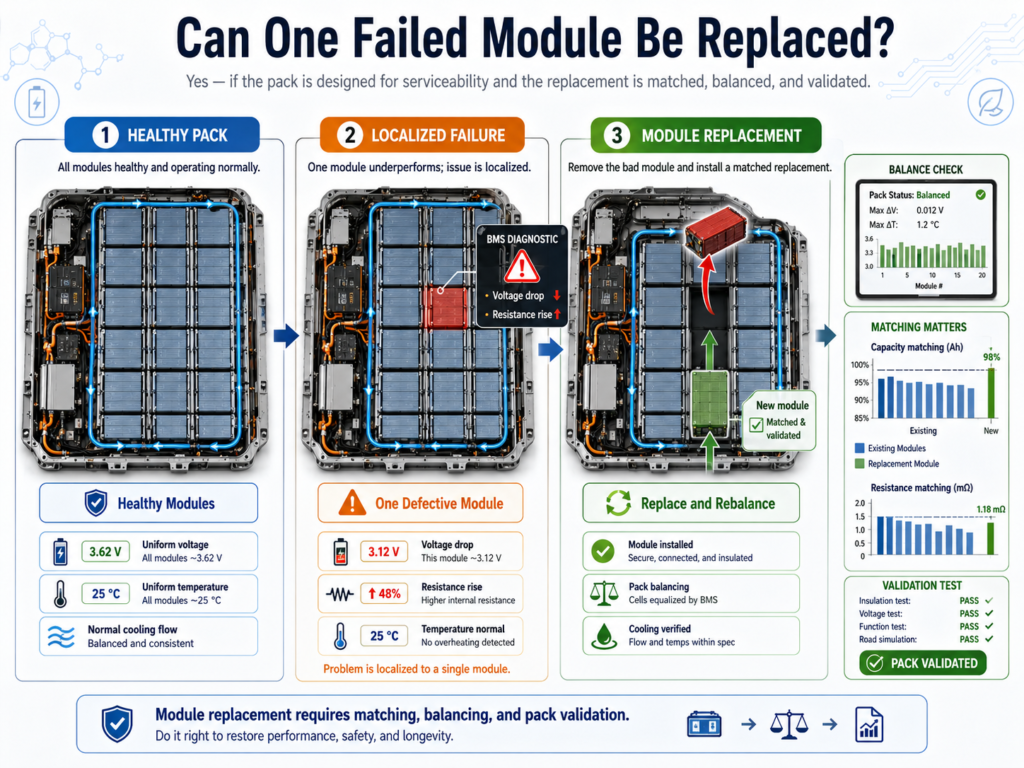
Cell balancing can correct small state-of-charge differences, but it cannot erase major differences in capacity or internal resistance. If one module reaches its voltage limit much earlier than the others, it can continue limiting the usable energy and charging power of the entire pack.
Pack construction also matters. Some battery packs were designed with replaceable modules and accessible fasteners. Others use extensive structural adhesive, foam, welded connections, cell-to-pack integration, or structural battery architecture. These designs can improve energy density, stiffness, and manufacturing efficiency, but they may make internal service more difficult.
That is one of the reasons a repair that is practical on one EV may not be practical on another. For owners, a battery warning therefore does not automatically mean the whole pack is chemically worn out. The fault could involve a cell group, sensor, control board, insulation issue, coolant circuit, or high-voltage connection. Our guide to EV battery replacement costs explains why the difference between a component repair, module replacement, remanufactured pack, and full new-pack replacement can change the final bill dramatically.
What Does Battery Remanufacturing Involve?
Battery remanufacturing begins with diagnosis and classification. A returned pack may be inspected for crash damage, fluid intrusion, corrosion, insulation faults, swelling, thermal exposure, and signs of internal instability. Technicians may then evaluate individual modules or cell groups using voltage measurements, capacity tests, resistance estimates, self-discharge monitoring, and diagnostic data stored by the battery management system.
The usable parts are separated from components that must be recycled. A remanufacturer might group modules with similar capacity and resistance, replace seals and busbars, repair cooling components, install updated control electronics, and rebuild the pack around a more closely matched set of modules.
This matching process is critical. A battery pack is limited by its weakest section. Combining modules that have very different histories can create imbalance, reduced usable capacity, inconsistent temperature behavior, and premature failure.
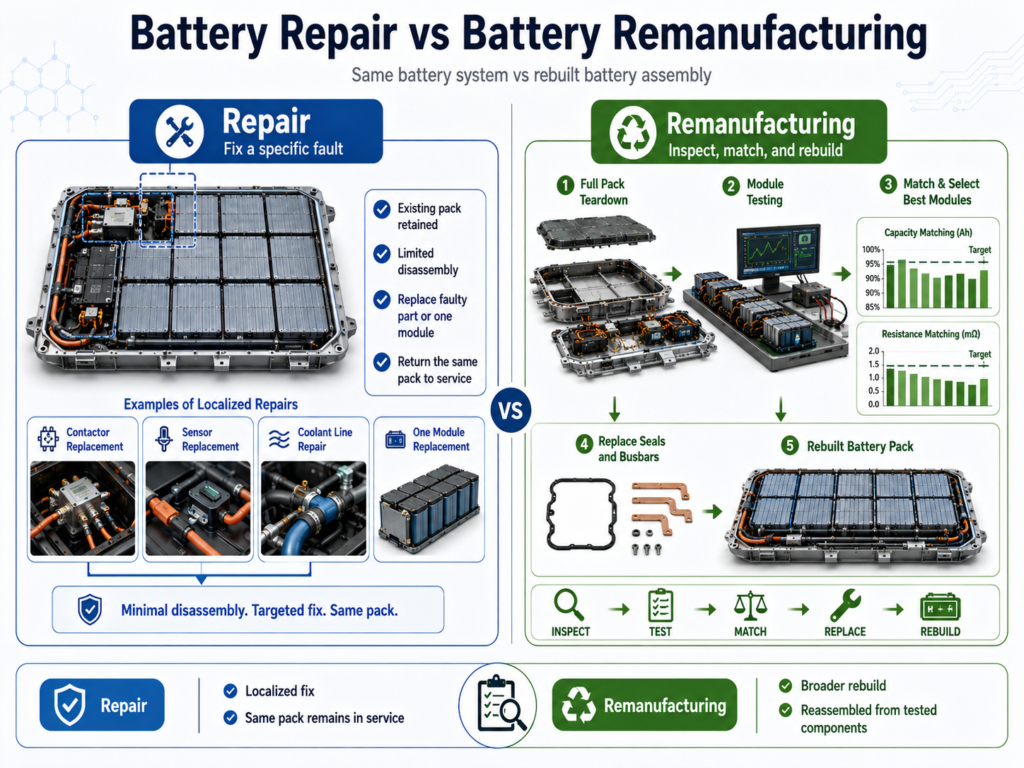
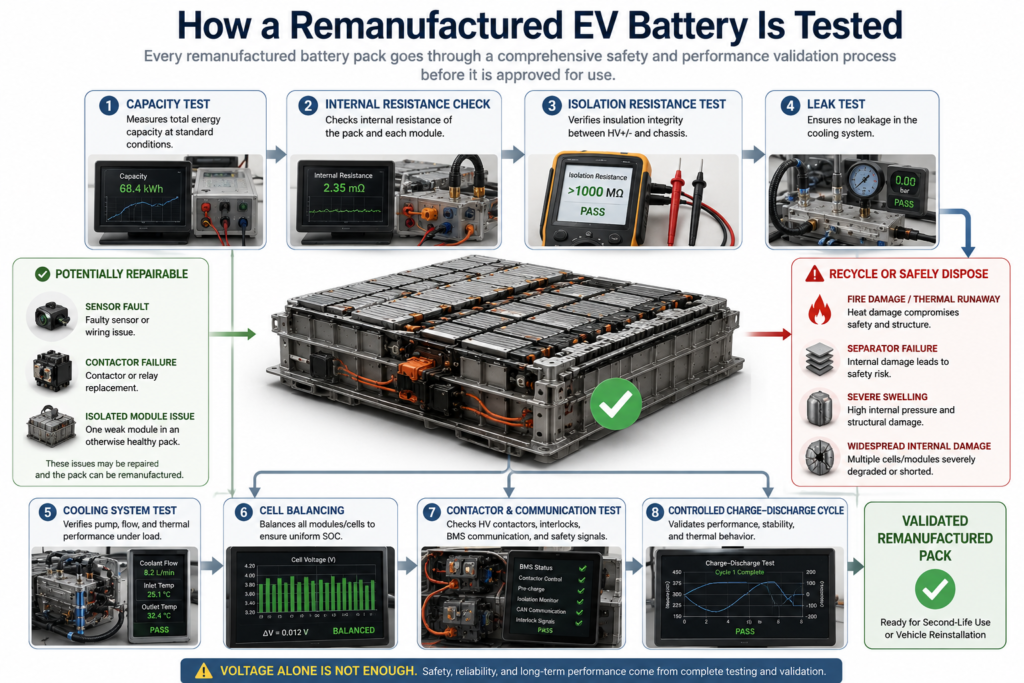
The completed battery must also pass more than a simple charge test. Proper validation may include leak testing, isolation resistance measurement, communication checks, cooling-system verification, contactor operation, cell-voltage monitoring, and controlled charge-discharge testing.
A remanufactured pack could provide a lower-cost alternative to a new battery, particularly for older EVs whose market value does not justify a factory-new replacement. It may also preserve far more manufacturing value than immediate shredding.
However, the quality of remanufactured batteries can vary. A pack rebuilt under an automaker-controlled process with traceable components, calibrated software, formal testing, and a warranty is different from an unknown used pack assembled from poorly documented modules. The word “remanufactured” alone does not guarantee a particular level of quality.
Can Old EV Batteries Simply Receive New Electrolyte?
Electrolyte replenishment sounds appealing. Lithium-ion cells lose performance partly because electrolyte components are consumed through side reactions. Over time, the electrolyte can decompose, additives can be depleted, and portions of the porous electrodes can become less effectively wetted.
Why not open the cell, add fresh electrolyte, seal it again, and restore the lost performance? In a laboratory, researchers can investigate electrolyte loss and experiment with rewetting or replenishment. In a commercial EV pack, the problem is much harder.
Most automotive lithium-ion cells are sealed products. Their electrolyte composition, fill quantity, formation history, moisture control, gas management, and internal pressure are carefully controlled during manufacturing. Opening a cell introduces contamination and changes the conditions inside it. More importantly, electrolyte loss is rarely the only aging mechanism.
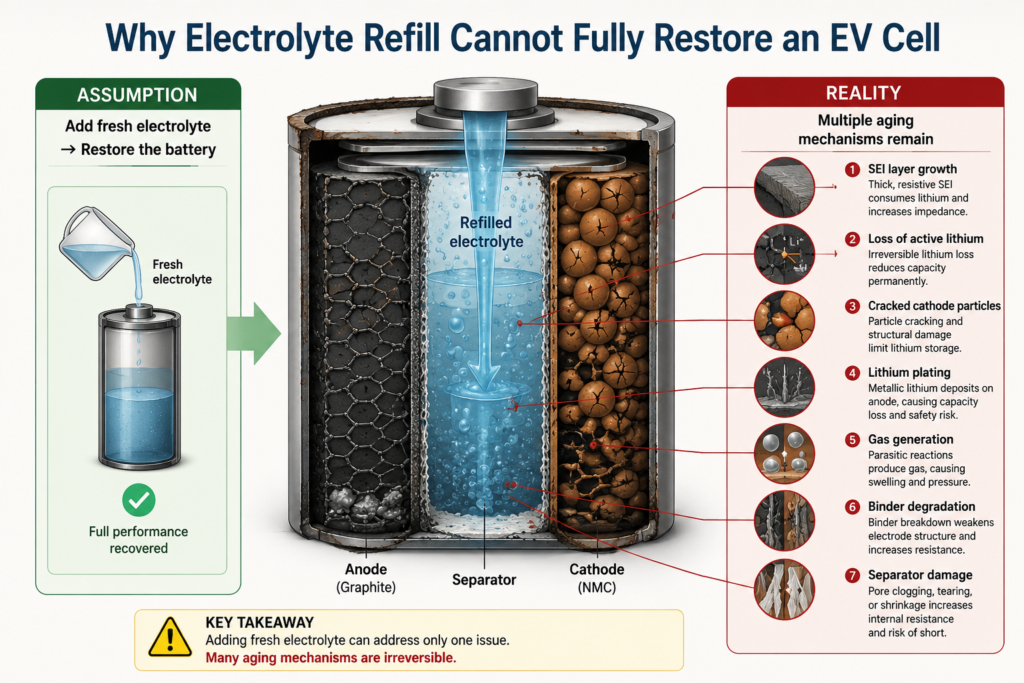
An old cell may also have lost active lithium to the solid-electrolyte interphase, developed cracks in electrode particles, suffered binder deterioration, accumulated gas, experienced current-collector corrosion, or formed metallic lithium on the anode. Adding liquid cannot reverse all of those changes.
Fresh electrolyte may even react with aged electrode surfaces in unpredictable ways. A resealed cell would then need to demonstrate long-term chemical stability, mechanical integrity, consistent formation of protective interface layers, and resistance to internal short circuits.
For these reasons, electrolyte replenishment is better viewed as a research concept or specialized cell-remanufacturing possibility than as a near-term service procedure for ordinary EV owners. A dealership is not going to refill individual EV cells in the way a mechanic once topped up the electrolyte in a flooded lead-acid battery.
Cathode Relithiation: Restoring What Aging Removed
Cathode relithiation is a more promising restoration approach, but it takes place after battery materials have been removed from the cell. During lithium-ion battery operation, lithium ions move between the cathode and anode. Over years of aging, some lithium becomes trapped in side-reaction products or is otherwise removed from the battery’s useful inventory. The cathode may become lithium-deficient, while its crystal structure can develop disorder or other changes.
Relithiation attempts to restore the cathode’s lithium content. In a simplified process, spent cathode material is recovered and analyzed. A lithium-containing compound is added, and the material is treated under controlled temperature and atmospheric conditions. The goal is to return the cathode closer to its intended composition and repair parts of its crystal structure.
The U.S. Department of Energy’s ReCell Center has made this type of direct cathode recycling an important research area. ReCell defines direct recycling as recovering, regenerating, and reusing battery components without completely breaking down their chemical structure.
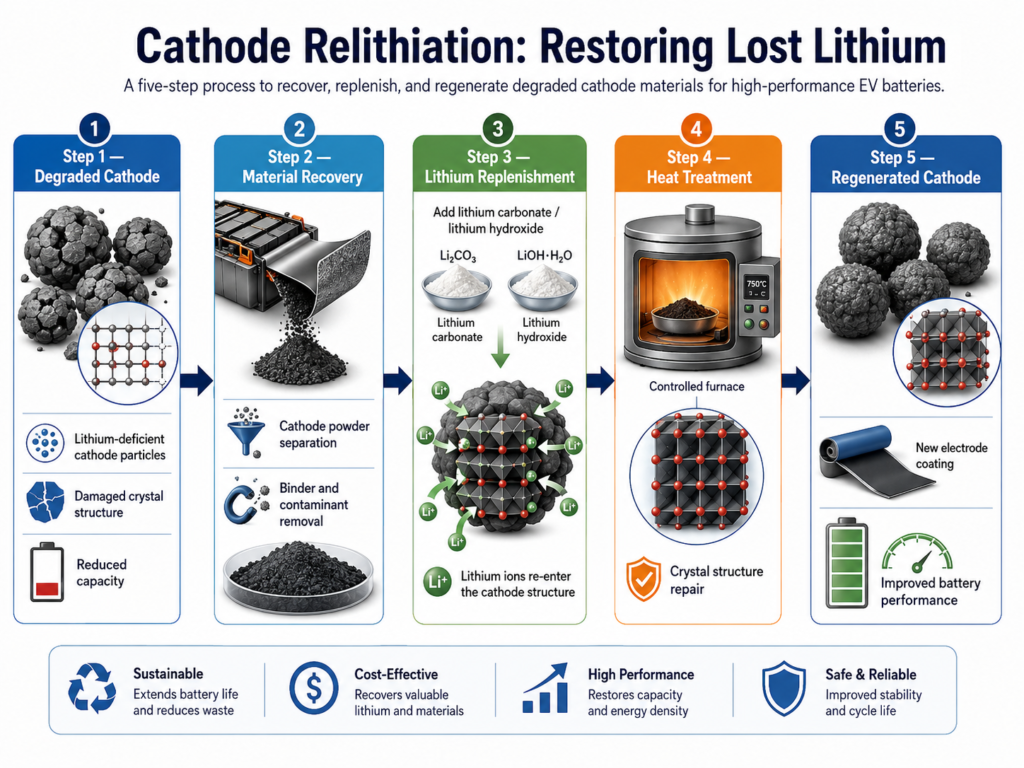
That distinction matters because cathode powder is not simply a bag of nickel, manganese, cobalt, iron, phosphate, and lithium. It is an engineered material with a specific particle size, morphology, composition, coating, and crystal structure. Considerable energy and manufacturing effort went into creating it.
Conventional recycling may dissolve or smelt the material and recover its constituent elements. Direct recycling tries to preserve more of the work that has already been done. Relithiation is not a universal cure. The correct treatment depends on cathode chemistry and condition. An NMC cathode has different requirements from an LFP cathode. Material from different battery generations may also contain different coatings, dopants, particle structures, and degradation histories.
Researchers must determine how much lithium to add, how to remove impurities, how to correct structural damage, and whether the regenerated material can meet the consistency standards required for new automotive cells. Still, the concept is powerful. Instead of reducing a highly engineered cathode to basic ingredients and rebuilding it from the beginning, direct recycling attempts to repair the material itself.
What Is Direct Electrode Regeneration?
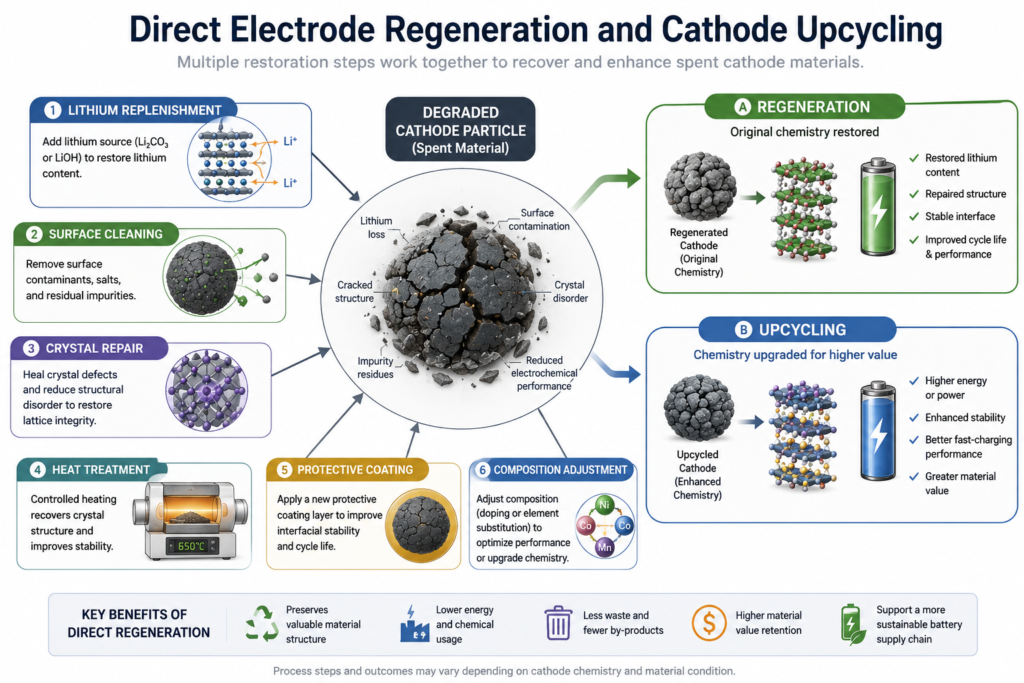
Direct electrode regeneration is a broader category that can include relithiation, impurity removal, particle repair, surface treatment, heat treatment, and chemical adjustment. The objective is to return recovered active material to useful electrochemical performance while preserving its fundamental structure.
For cathode materials, regeneration may address several forms of degradation at once. Lithium content may be restored. Crystal disorder may be reduced through annealing. Surface contamination may be removed. Particle surfaces may receive new coatings. In some cases, researchers may even modify an older cathode composition to create a higher-value material.
This last possibility is sometimes described as upcycling rather than simple recycling. Imagine recovering an older cathode whose original formulation is no longer commercially attractive. Returning it to exactly the same chemistry may not make economic sense if the battery industry has moved to a different composition. A direct recycling process might instead adjust the material so that it can meet a newer performance target.
That sounds ideal, but scaling it will require highly effective sorting and characterization. Black mass can contain material from multiple battery chemistries, manufacturers, cell formats, and states of health. Direct regeneration works best when the incoming material is sufficiently consistent and its history is understood. A mixed stream containing LFP, NMC, graphite, copper, aluminum, electrolyte residues, and multiple contaminants is much harder to regenerate directly than a clean, well-sorted production scrap stream.
This is why direct recycling may initially be especially attractive for manufacturing scrap and well-defined battery streams. The chemistry is known, contamination is lower, and the material has not experienced years of uncertain field aging.
How Is This Different From Black Mass Recycling?
Black mass is the dark powder produced after lithium-ion batteries or production scrap are mechanically processed and materials such as steel, aluminum, copper, and plastics are partly separated. It usually contains cathode material, graphite, lithium compounds, conductive carbon, binder residues, and other contaminants. Its exact composition can vary considerably depending on the feedstock and processing method.
The U.S. Environmental Protection Agency notes that there is no single industry-standard composition for black mass. Material from one recycling operation may be very different from material produced elsewhere. In hydrometallurgical recycling, black mass is generally treated with chemical solutions that dissolve valuable metals. Those materials are separated, purified, and converted into compounds that can re-enter the battery supply chain.
Pyrometallurgical recycling uses high-temperature processing. It can handle mixed and contaminated feedstocks relatively well, although additional steps may be required to recover certain materials. Direct recycling tries to intervene before the cathode’s engineered structure is completely destroyed. Ideally, the cathode material is separated from the other battery components, cleaned, regenerated, and reused.
The difference can be summarized this way: Traditional recycling asks, “Which elements can we recover?” Direct recycling asks, “How much of the functional battery material can we preserve?” That does not mean direct recycling will replace black mass processing. Highly mixed, contaminated, burned, or badly degraded material may still be better suited to conventional recovery. Direct processes may also generate residual materials that need hydrometallurgical or other treatment. The technologies are likely to complement each other rather than compete for every battery.
For a broader explanation of shredding, black mass, hydrometallurgy, and closed-loop material recovery, see our previous guide, EV Battery Recycling Explained: How Old EV Batteries Become New Ones.
Which EV Batteries Cannot Be Safely Restored?
Not every battery should be repaired or remanufactured. A pack with a localized electronics fault may be a good repair candidate. A pack exposed to thermal runaway is an entirely different case. Fire and extreme heat can damage separators, electrode binders, current collectors, seals, insulation, cooling components, and structural adhesives. Even cells that did not ignite may have experienced temperatures that changed their internal materials.
Flood or coolant contamination can also create hidden problems. Moisture and ionic contamination may reduce insulation resistance or initiate corrosion that continues after the battery is returned to service. Severe crash deformation is another major concern. A dented cell or compressed module can contain separator damage that is not visible externally. Returning such a battery to a high-power automotive environment may create an unacceptable risk.
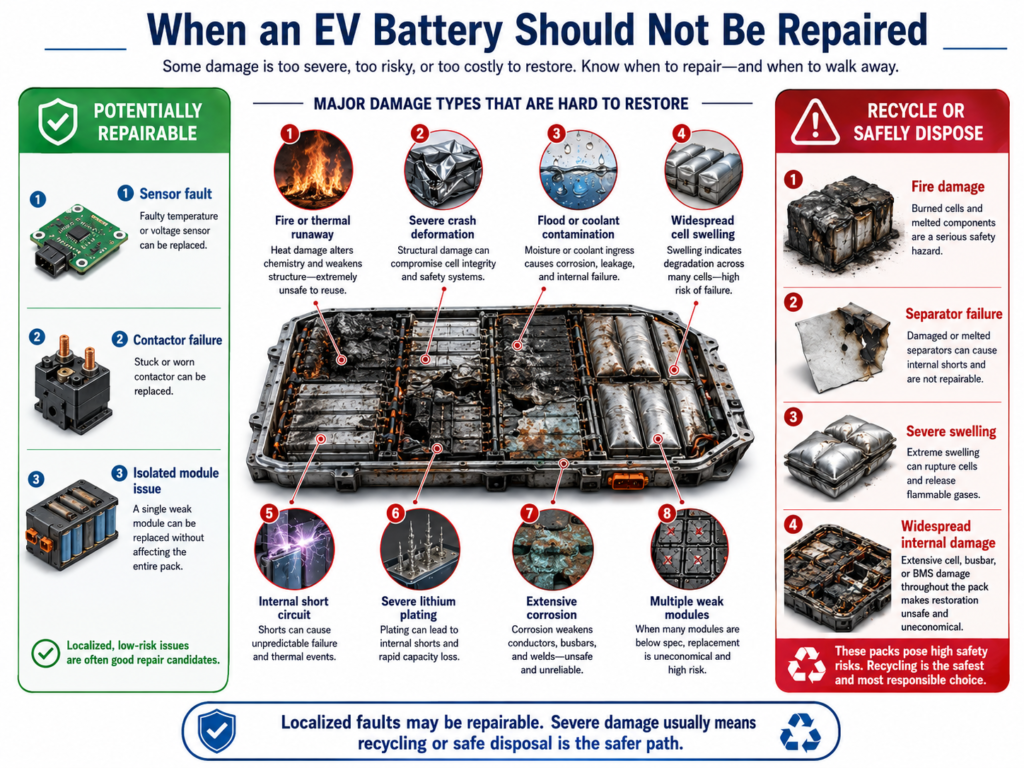
Other poor restoration candidates include batteries with widespread swelling, recurring internal isolation faults, rapid self-discharge, extensive corrosion, multiple weak modules, or evidence of internal short circuits. Severe lithium plating is especially difficult. Metallic lithium deposited on the anode can reduce capacity and, in some conditions, form structures that increase short-circuit risk. It cannot be reliably corrected by replacing a sensor, balancing the pack, or adding electrolyte.
There is also an economic limit. Technically, it might be possible to replace many modules and rebuild an old pack. But once the labor, testing, parts, transportation, liability, and warranty costs approach the price of a replacement battery, recycling may become the more rational option. The best pathway depends on both physical condition and value.
Are Remanufactured EV Batteries Safe?
A properly remanufactured battery can be safe, but safety depends on process control, traceability, testing, and pack design. A credible remanufacturing operation needs to know where components came from, what conditions they experienced, how they were tested, and why they were approved for reuse. It also needs clear rejection criteria.
Voltage alone is not enough to determine battery health. Two modules can show the same resting voltage while having very different capacities, resistance levels, self-discharge behavior, and thermal performance. A rebuilt pack must also work correctly with the vehicle. The battery management system needs accurate configuration data and must be able to monitor the installed modules. Cooling, insulation, sealing, crash protection, communications, and high-voltage disconnect systems all need to function as intended.
Automaker-authorized remanufacturing has an advantage because the manufacturer has access to original engineering specifications, diagnostic tools, software, safety limits, and component histories. Independent specialists can also provide valuable repair services, particularly for older vehicles, but customers should pay close attention to testing standards and warranty coverage.
A low-cost used battery with no documented capacity test, no isolation test, and no meaningful warranty carries more risk than a professionally rebuilt pack with traceable components and validated performance.
The Warranty Question
Battery warranty terms vary by manufacturer, vehicle, model year, and market. A warranty repair does not always mean the owner receives a completely new battery. Depending on the warranty language and repair procedure, the manufacturer may repair the existing pack, replace a module, install a remanufactured assembly, or provide a replacement pack that meets a defined performance standard.
That approach is not unusual in the automotive industry. The purpose of a warranty repair is generally to restore the vehicle to covered operating condition, not necessarily to replace every component with a newly manufactured one. Owners should ask several practical questions before accepting a battery repair or replacement: What capacity or state-of-health standard will the battery meet? Which components are being replaced? Is the repaired or remanufactured pack covered for the remainder of the original warranty, or does it receive a separate warranty? Is labor included if the replacement battery develops another problem?
The answers matter because battery capacity and battery defects are often treated differently. Gradual degradation may be covered only after capacity falls below a stated threshold, while manufacturing defects, isolation failures, or internal faults may follow different warranty rules. Our EV battery warranty guide explains why “battery replacement” can refer to a module, subassembly, remanufactured unit, or complete pack.
Why Direct Recycling Is Promising but Not Yet Routine
Direct recycling offers an attractive idea: preserve the most valuable and energy-intensive part of the battery material rather than destroying and rebuilding it. The potential advantages include fewer chemical processing steps, lower energy use, reduced waste, and greater retention of manufacturing value. It could be particularly useful for lower-value cathode chemistries whose raw materials provide less economic incentive for conventional metal recovery.
But automotive battery production requires extremely consistent materials. Small differences in impurity levels, particle structure, lithium content, moisture, or surface chemistry can affect cycle life, fast-charging performance, safety, and manufacturing yield. Recycled cathode material therefore cannot be considered successful simply because it stores energy in a laboratory coin cell. It must perform consistently at commercial cell scale and survive demanding qualification tests.
Supply-chain logistics are another challenge. Direct recycling becomes easier when batteries can be identified and sorted by chemistry, manufacturer, design, and production history. Better labeling, digital battery records, and battery passports may eventually help recyclers choose the correct pathway. Pack designs also need to become more repairable and recyclable. Permanent adhesives, welded structures, mixed materials, and inaccessible fasteners may reduce manufacturing cost but make later disassembly expensive and dangerous.
The Toyota Research Institute and Argonne National Laboratory have already worked through the ReCell Center to evaluate direct recycling using commercial battery products. This type of industry-laboratory cooperation is important because a process that works with carefully prepared laboratory samples must eventually handle real batteries with real manufacturing variation.
Repair or Recycling Will Not Be an Either-Or Decision
The battery circular economy is often illustrated as one simple loop: manufacture, use, recycle, and manufacture again. In practice, the future will contain many smaller loops. A vehicle with a failed contactor may receive a straightforward pack repair. A battery with one defective module may return to the road after module replacement. A pack removed from a damaged vehicle may supply tested modules for remanufacturing. A battery that no longer meets automotive power requirements may move into stationary energy storage.
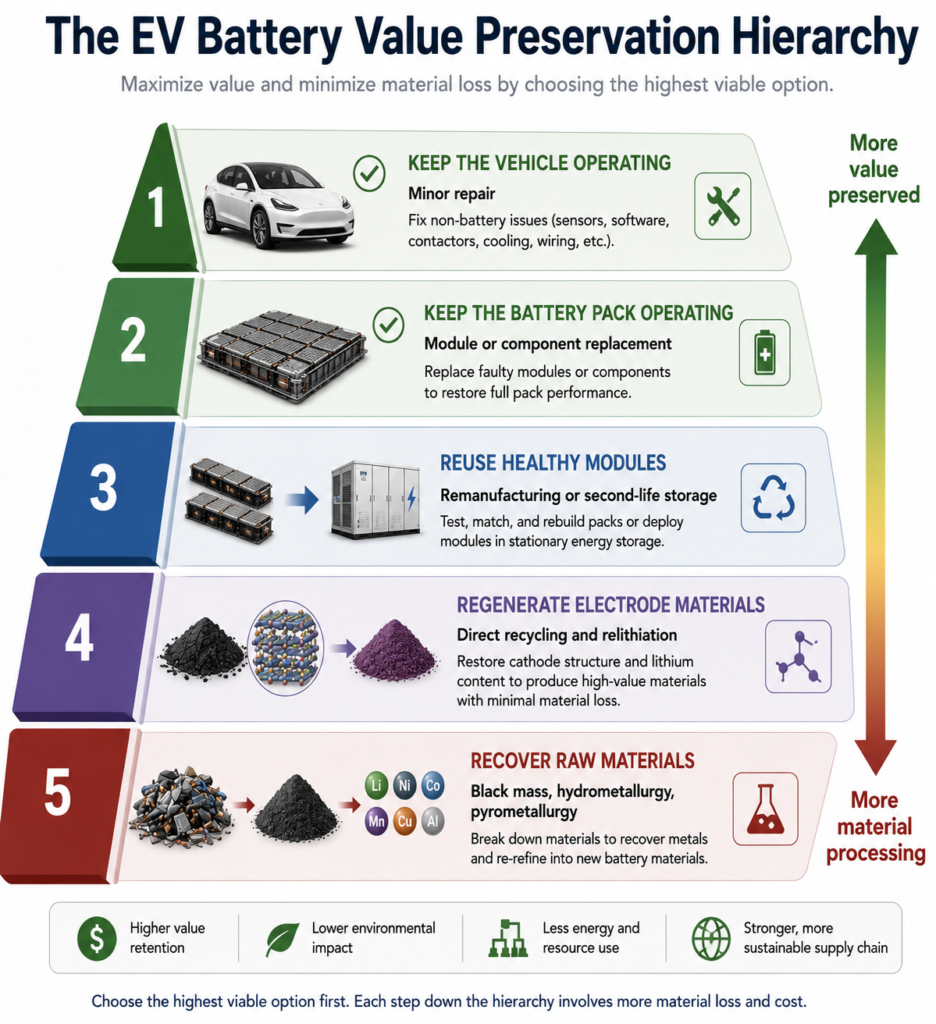
Eventually, usable materials may enter direct regeneration, hydrometallurgical recovery, pyrometallurgical treatment, or a combination of processes. This creates a hierarchy of value:
Keep the vehicle operating when practical.
Keep the pack operating when safe.
Keep usable modules and components in service.
Preserve active electrode materials when possible.
Recover the underlying elements when restoration is no longer practical.
Recycling remains essential because every battery will eventually reach a condition where continued use is no longer safe or economical. But recycling should not automatically be the first step for every pack that leaves a vehicle. As explained in our comparison of EV battery recycling and second-life storage, battery retirement is becoming a decision process rather than a single destination.
Conclusion
A “dead” EV battery is not always chemically dead. Sometimes the actual problem is a sensor, contactor, cooling component, wiring fault, or one weak module. In those cases, repair may preserve most of the original battery.
Remanufacturing can go further by rebuilding packs from tested, matched components. It may offer a practical way to keep older EVs on the road without the cost and resource use of a completely new battery.
At the material level, cathode relithiation and direct electrode regeneration could eventually preserve more of the battery’s original engineering value. Rather than dissolving every cathode into basic chemical ingredients, these processes attempt to repair and reuse the active material.
Yet there are clear limits. Electrolyte replenishment cannot reverse every aging mechanism. Fire-damaged, crushed, contaminated, severely swollen, shorted, or heavily plated batteries may be unsafe to restore. Poorly matched modules and inadequately tested remanufactured packs can also create reliability and warranty problems. The most sustainable outcome is not to force every battery into the same pathway. It is to diagnose each battery accurately and preserve the highest-value portion that can still be used safely.
Some batteries will be repaired. Some will be rebuilt. Some will power stationary storage systems. Some cathodes may be regenerated. The remaining materials will be recycled into the next generation of batteries. A battery’s first failure, in other words, may not be the end of its useful life. It may simply determine which part of the circular battery economy comes next.
FAQs
Can an EV battery be repaired without replacing the entire pack?
Yes, depending on the vehicle and the type of failure. Some packs allow replacement of modules, control electronics, contactors, sensors, seals, wiring, or cooling components. Other highly integrated or structural packs may be more difficult to service internally.
Can a bad battery cell be replaced individually?
Individual cell replacement is technically possible in some designs, but it is uncommon in normal dealership service. Cells may be welded, bonded, or tightly integrated into modules. Matching the replacement cell’s capacity, resistance, state of charge, and aging characteristics is also difficult.
Can adding new electrolyte restore an old EV battery?
Not in the way electrolyte can be added to some lead-acid batteries. Automotive lithium-ion cells are sealed, and aging usually involves several mechanisms beyond electrolyte loss. Electrolyte replenishment remains primarily a research or specialized remanufacturing concept.
What is cathode relithiation?
Cathode relithiation adds lithium back to lithium-deficient cathode material recovered from used batteries. Combined with heat treatment and other processing, it may restore composition and crystal structure without completely breaking the material down into individual elements.
Is a remanufactured EV battery as good as a new one?
It depends on the components, rebuilding process, testing standards, and warranty. A professionally remanufactured battery can provide reliable service, but it may not have the same capacity or expected life as a factory-new pack.
What happens when an EV battery cannot be repaired?
It may be evaluated for second-life stationary storage, dismantled for reusable parts, processed through direct recycling, or converted into black mass for hydrometallurgical or pyrometallurgical material recovery.